PROJECT
CULTURE
CANVAS10 steps on how to play nice
and hack project culture.
A LOOK
INTO THE
FUTURE
OF WORK.
THIS BOOK
CONSISTS
OF 2 PARTS.
1
2 THE CULTURE
CANVAS: TO
BRING THE
FUTURE OF
WORK TO
TODAY.
1
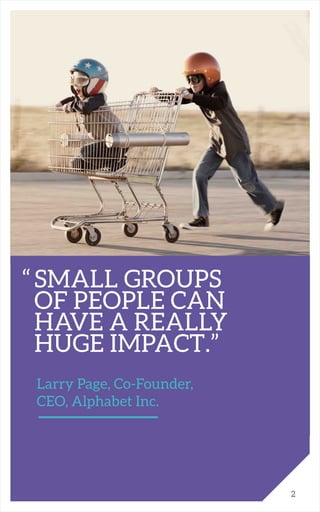
“	SMALL GROUPS 			
	 OF PEOPLE CAN 		
	 HAVE A REALLY 		
	 HUGE IMPACT.”
		 Larry Page, Co-Founder,
		 CEO, Alphabet Inc.
2
The future of work is here.
Project teams are distributed, people work from home, email is
being dumped for Slack or Basecamp. Everything is agile or lean.
Or both. Self-managing teams are growing in popularity.
But deadlines are still being missed while everyone talks about
new cloud productivity apps, nothing has really changed.
There’s more noise than ever before.
Maybe it’s the tons of email you receive. The endless meetings
you attend, or the conference calls with multiple countries that
never start or end on time.
Maybe you see the possibilities for working remotely, running
projects in a more effective way, or you crave a better work-life
balance.
Whatever the reason to download this book, we get it.
We’ve been there. As have many of our clients.
WHYYOU
NEED
THIS BOOK
3
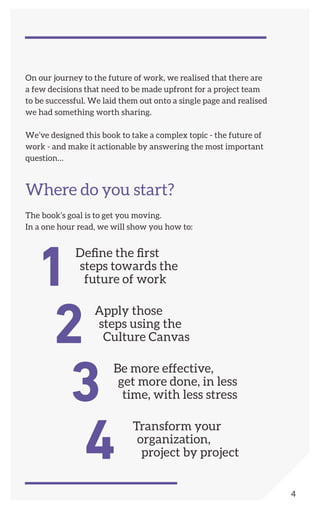
On our journey to the future of work, we realised that there are
a few decisions that need to be made upfront for a project team
to be successful. We laid them out onto a single page and realised
we had something worth sharing.
We’ve designed this book to take a complex topic - the future of
work - and make it actionable by answering the most important
question…
Where do you start?
The book’s goal is to get you moving.
In a one hour read, we will show you how to:
4
1
2
3
4
Define the first
steps towards the
future of work
Apply those
steps using the
Culture Canvas
Be more effective,
get more done, in less
time, with less stress
Transform your
organization,
project by project
GLOBAL
TRENDS
5
Our mindsets are changing.
Highly skilled workers are seeking compensation beyond
money. Many are choosing temporary projects over permanent
employment, preferring flexibility and autonomy over the
security of a regular paycheck.
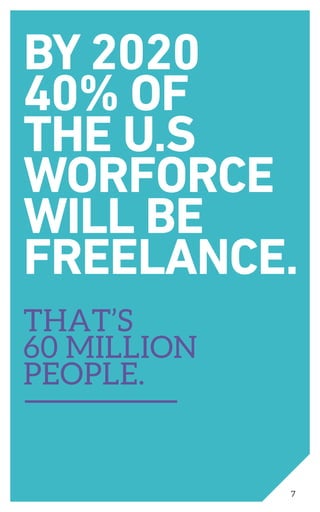
By 2020, 40% of the total U.S workforce will be freelance.
That’s 60 million people. Globally, the trend is not far off.
This shift is forcing corporations to re-think their traditional
9 to 5 mentality in order to compete for the best talent.
TALENT
IS FREE
(LANCE)
6
BY 2020
40% OF
THE U.S
WORFORCE
WILL BE
FREELANCE.
THAT’S
60 MILLION
PEOPLE.
7
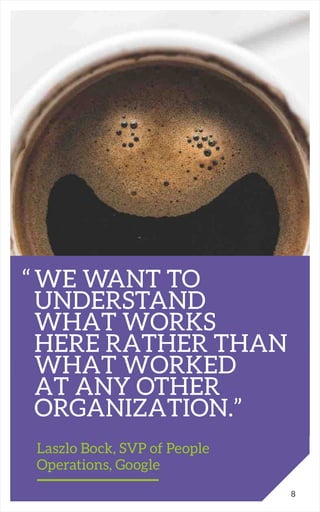
“	WE WANT TO 		
	UNDERSTAND
	 WHAT WORKS
	 HERE RATHER THAN
	 WHAT WORKED
	 AT ANY OTHER
	ORGANIZATION.”
		 Laszlo Bock, SVP of People
		Operations, Google
8
Austere head offices are making room for working remotely,
either from a home office, co-working space, or anywhere in
between. With 4G and Wi-Fi connections available everywhere,
we can now work wherever and whenever suits us best.
This raises key questions:
If employees aren’t at the
office, how do you keep
people connected?
How does this influence
company culture?
Are they more or less
productive?
WI-FI
AND
COFFEE
9
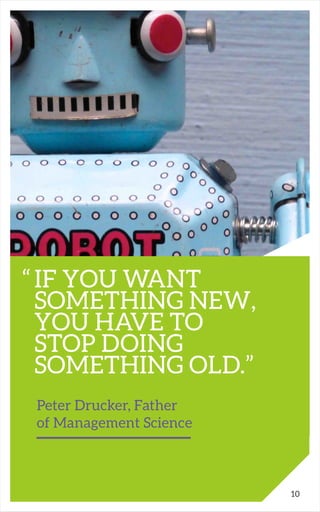
“	IF YOU WANT
	 SOMETHING NEW,
	 YOU HAVE TO
	 STOP DOING
	 SOMETHING OLD.”
		 Peter Drucker, Father
		 of Management Science
10
Conference calls have replaced
meetings, but they still retain
the same old cultural hang-ups,
like printing out emails.
We’ve been taken over by technology that helps us to be
more efficient, yet reduces our effectiveness in getting things
(not tasks) done.
It’s time to leverage the possibilities the future of work
has to offer, which global businesses like Automattic, Buffer,
and Github have been doing for years.
EFFECTIVE,
NOT
EFFICIENT,
TECHNOLOGY
11
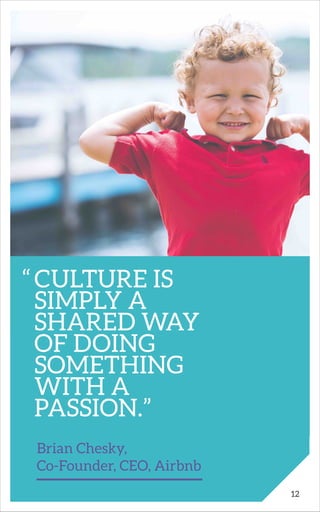
“	CULTURE IS
	 SIMPLY A
	 SHARED WAY
	 OF DOING
	SOMETHING
	 WITH A
	PASSION.”
		Brian Chesky,
		 Co-Founder, CEO, Airbnb
12
We know that more technology is not the solution, it’s people
that make for a great company. It’s people that influence and
make for a great culture.
We view this book as a call for a culture change, not by
employing armies of consultants with new vision and values
statements, but through small changes, one project at a time.
It leads us to the ultimate question:
How do you create a culture?
ARE YOU
A HUMAN
RESOURCE?
13
Research shows that group
norms, or behaviour when they
meet, is the most important
indicator of a team’s success,
more so than how smart all of
the individuals are.
This is backed up by research at Google, who identified 4 things
a team needs to be successful.
1. 	 Safety: Can I share ideas without being ridiculed?
2. 	Dependability: Can we count on each other to do high
	 quality work on time?
3. 	Structure & Clarity: Are the goals, roles, and what we are
	 trying to achieve (and how) clear.
4. Purpose: Why is what we are doing going to matter?
We used this research as part of the thinking for the canvas,
to create a foundation for a successful project culture.
HACKING
TEAM
CULTURE
14
CULTURE
IS WHAT
YOU DO
CONSISTENTLY
15
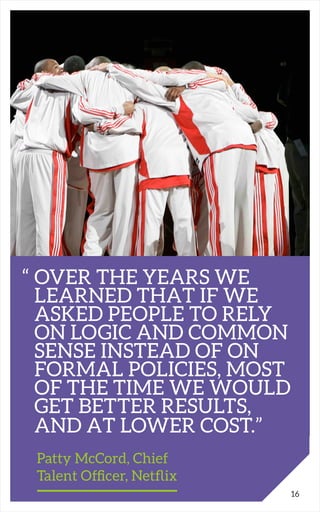
“	OVER THE YEARS WE
	 LEARNED THAT IF WE 						
	 ASKED PEOPLE TO RELY 		
	 ON LOGIC AND COMMON 	
	 SENSE INSTEAD OF ON
	 FORMAL POLICIES, MOST
	 OF THE TIME WE WOULD
	 GET BETTER RESULTS,
	 AND AT LOWER COST.”
		 Patty McCord, Chief
		 Talent Officer, Netflix
16
17
MEET
THE
CULTURE
CANVAS
To hack a culture for a team, we need to make what we do
regularly the most important thing.
We’ve identified the 10 key decisions all teams working on a
project make anyway. Sometimes consciously, but most often
unconsciously. If we resolve the obvious, but often overlooked,
challenges from the start, it saves time, energy and frustration
further down the line. This makes the team function better,
allowing us to get the job done with better results.
The changes are either small or simple, and often both and
are designed to be actionable in your very next project.
There is no need to change everything you do, or to learn
a new ‘collaboration language’ before getting started.
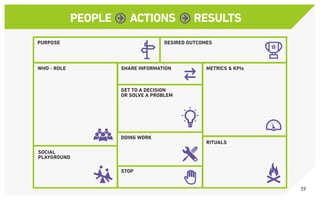
The Culture Canvas is a roadmap with room for your own specific
needs. We go from left to right, and every block builds on the other.
HOW
DOES THE
CULTURE
CANVAS
WORK?
18
PURPOSE
WHO - ROLE SHARE INFORMATION
DOING WORK
STOP
GET TO A DECISION
OR SOLVE A PROBLEM
METRICS & KPIs
RITUALS
DESIRED OUTCOMES
SOCIAL
PLAYGROUND
PEOPLE ACTIONS RESULTS
19
20
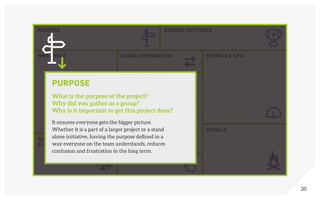
PURPOSE
WHO - ROLE SHARE INFORMATION
DOING WORK
STOP
GET TO A DECISION
OR SOLVE A PROBLEM
METRICS & KPIs
RITUALS
DESIRED OUTCOMES
SOCIAL
PLAYGROUND
PURPOSE
What is the purpose of the project?
Why did you gather as a group?
Why is it important to get this project done?
It ensures everyone gets the bigger picture.
Whether it is a part of a larger project or a stand
alone initiative, having the purpose defined in a
way everyone on the team understands, reduces
confusion and frustration in the long term.
21
PURPOSE
WHO - ROLE SHARE INFORMATION
DOING WORK
STOP
GET TO A DECISION
OR SOLVE A PROBLEM
METRICS & KPIs
RITUALS
DESIRED OUTCOMES
SOCIAL
PLAYGROUND
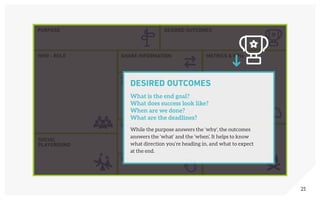
DESIRED OUTCOMES
What is the end goal?
What does success look like?
When are we done?
What are the deadlines?
While the purpose answers the ‘why’, the outcomes
answers the ‘what’ and the ‘when’. It helps to know
what direction you’re heading in, and what to expect
at the end.
22
PURPOSE
WHO - ROLE SHARE INFORMATION
DOING WORK
STOP
GET TO A DECISION
OR SOLVE A PROBLEM
METRICS & KPIs
RITUALS
DESIRED OUTCOMES
SOCIAL
PLAYGROUND
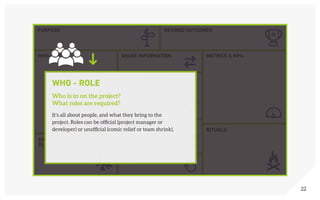
WHO - ROLE
Who is in on the project?
What roles are required?
It’s all about people, and what they bring to the
project. Roles can be official (project manager or
developer) or unofficial (comic relief or team shrink).
23
PURPOSE
WHO - ROLE SHARE INFORMATION
DOING WORK
STOP
GET TO A DECISION
OR SOLVE A PROBLEM
METRICS & KPIs
RITUALS
DESIRED OUTCOMES
SOCIAL
PLAYGROUND
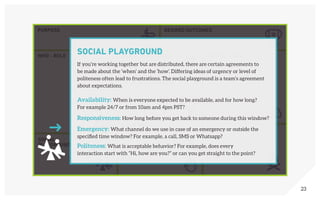
SOCIAL PLAYGROUND
If you’re working together but are distributed, there are certain agreements to
be made about the ‘when’ and the ‘how’. Differing ideas of urgency or level of
politeness often lead to frustrations. The social playground is a team’s agreement
about expectations.
Availability: When is everyone expected to be available, and for how long?
For example 24/7 or from 10am and 4pm PST?
Responsiveness: How long before you get back to someone during this window?
Emergency: What channel do we use in case of an emergency or outside the
specified time window? For example, a call, SMS or Whatsapp?
Politeness: What is acceptable behavior? For example, does every
interaction start with “Hi, how are you?” or can you get straight to the point?
24
PURPOSE
WHO - ROLE SHARE INFORMATION
DOING WORK
STOP
GET TO A DECISION
OR SOLVE A PROBLEM
METRICS & KPIs
RITUALS
DESIRED OUTCOMES
SOCIAL
PLAYGROUND
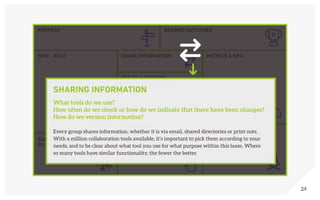
SHARING INFORMATION
What tools do we use?
How often do we check or how do we indicate that there have been changes?
How do we version information?
Every group shares information, whether it is via email, shared directories or print outs.
With a million collaboration tools available, it’s important to pick them according to your
needs, and to be clear about what tool you use for what purpose within this team. Where
so many tools have similar functionality, the fewer the better.
25
PURPOSE
WHO - ROLE SHARE INFORMATION
DOING WORK
STOP
GET TO A DECISION
OR SOLVE A PROBLEM
METRICS & KPIs
RITUALS
DESIRED OUTCOMES
SOCIAL
PLAYGROUND
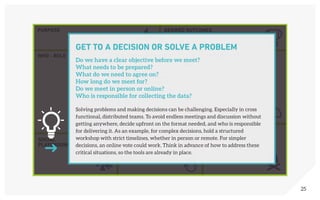
GET TO A DECISION OR SOLVE A PROBLEM
Do we have a clear objective before we meet?
What needs to be prepared?
What do we need to agree on?
How long do we meet for?
Do we meet in person or online?
Who is responsible for collecting the data?
Solving problems and making decisions can be challenging. Especially in cross
functional, distributed teams. To avoid endless meetings and discussion without
getting anywhere, decide upfront on the format needed, and who is responsible
for delivering it. As an example, for complex decisions, hold a structured
workshop with strict timelines, whether in person or remote. For simpler
decisions, an online vote could work. Think in advance of how to address these
critical situations, so the tools are already in place.
26
PURPOSE
WHO - ROLE SHARE INFORMATION
DOING WORK
STOP
GET TO A DECISION
OR SOLVE A PROBLEM
METRICS & KPIs
RITUALS
DESIRED OUTCOMES
SOCIAL
PLAYGROUND
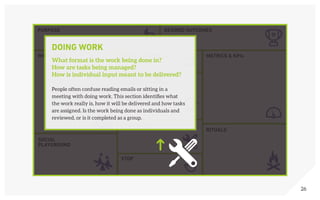
DOING WORK
What format is the work being done in?
How are tasks being managed?
How is individual input meant to be delivered?
People often confuse reading emails or sitting in a
meeting with doing work. This section identifies what
the work really is, how it will be delivered and how tasks
are assigned. Is the work being done as individuals and
reviewed, or is it completed as a group.
27
PURPOSE
WHO - ROLE SHARE INFORMATION
DOING WORK
STOP
GET TO A DECISION
OR SOLVE A PROBLEM
METRICS & KPIs
RITUALS
DESIRED OUTCOMES
SOCIAL
PLAYGROUND
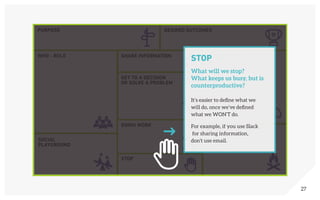
STOP
What will we stop?
What keeps us busy, but is
counterproductive?
It’s easier to define what we
will do, once we’ve defined
what we WON’T do.
For example, if you use Slack
for sharing information,
don’t use email.
28
PURPOSE
WHO - ROLE SHARE INFORMATION
DOING WORK
STOP
GET TO A DECISION
OR SOLVE A PROBLEM
METRICS & KPIs
RITUALS
DESIRED OUTCOMES
SOCIAL
PLAYGROUND
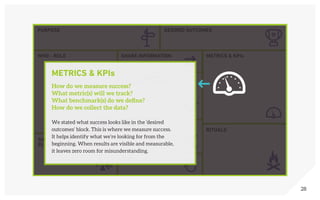
METRICS & KPIs
How do we measure success?
What metric(s) will we track?
What benchmark(s) do we define?
How do we collect the data?
We stated what success looks like in the ‘desired
outcomes’ block. This is where we measure success.
It helps identify what we’re looking for from the
beginning. When results are visible and measurable,
it leaves zero room for misunderstanding.
29
PURPOSE
WHO - ROLE SHARE INFORMATION
DOING WORK
STOP
GET TO A DECISION
OR SOLVE A PROBLEM
METRICS & KPIs
RITUALS
DESIRED OUTCOMES
SOCIAL
PLAYGROUND
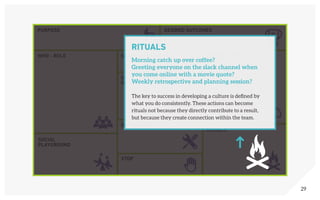
RITUALS
Morning catch up over coffee?
Greeting everyone on the slack channel when
you come online with a movie quote?
Weekly retrospective and planning session?
The key to success in developing a culture is defined by
what you do consistently. These actions can become
rituals not because they directly contribute to a result,
but because they create connection within the team.
An easy, effective and actionable
method for improving the culture
within your next project. A step
in the right direction to moving
towards the future of work.
If you want to download the digital version:
www.culturecanvas.biz
If you’re curious for succes stories:
www.culturecanvas.biz/stories
If you want to comment, have feedback or get in touch:
www.culturecanvas.biz/contact
If you want more examples, download at:
www.culturecanvas.biz/examples
SO, THERE
YOU HAVE IT…
THE
CULTURE
CANVAS.
30
Culture Canvas
We transform the way businesses work by changing how teams collaborate. No big
fanfare, just small steps that change day-to-day behaviour. We create team norms
that are made for new technologies and enable the future of work. The Culture
Canvas was developed as a collaboration between &Innovation and Kevin Weijers,
as part of the #CoCreateSA project for the Consulate General of the Kingdom of the
Netherlands in South Africa, showcasing collaboration between Dutch and South
African innovators. www.culturecanvas.biz
Kevin Weijers
While being flooded by 150 emails a day working a government job, Kevin said
farewell to his inbox in 2013, and his full time employment shortly after. He now
helps companies, organisations, and brands all around the world explore the
possibilities of the future of work, by running actionable experiments.
Although the future of work is strongly associated with digital collaboration tools,
Kevin believes the single most important asset is always the team culture.
#CoCreateSA	
#CoCreateSA is an initiative of the Consulate General of the Kingdom of the
Netherlands in South Africa to connect counterparts to exchange ideas and
innovations for a sustainable future. From 10 until 19 August #CoCreateSA
connected &Innovation and Kevin Weijers to work on a challenge: Can we hack
culture and help corporates move towards the future of work?
After 10 days of intense collaboration the Culture Canvas and this book were
realised. As a result of #CoCreateSA, a partnership is formed. If you want to know
more about #CoCreateSA, visit www.cocreatesa.co.za
&Innovation
We are a digital transformation consultancy. We partner with leading, future-
focused companies to drive strategic digital innovation and deliver revenue
growth. Our team consists of divergent skills and backgrounds, employing proven
methodologies to develop new products and services from concept to go-to-market.
We see digital transformation not just as a new interface, but also as the cultural
transformation required to make it stick. This book is an example of our work, as are
consumer apps, backend APIs, data driven insights and comprehensive business
models.
WHO WE ARE

Project culture canvas

  • 1.
    PROJECT CULTURE CANVAS10 steps onhow to play nice and hack project culture.
  • 2.
    A LOOK INTO THE FUTURE OFWORK. THIS BOOK CONSISTS OF 2 PARTS. 1 2 THE CULTURE CANVAS: TO BRING THE FUTURE OF WORK TO TODAY. 1
  • 3.
    “ SMALL GROUPS OF PEOPLE CAN HAVE A REALLY HUGE IMPACT.” Larry Page, Co-Founder, CEO, Alphabet Inc. 2
  • 4.
    The future ofwork is here. Project teams are distributed, people work from home, email is being dumped for Slack or Basecamp. Everything is agile or lean. Or both. Self-managing teams are growing in popularity. But deadlines are still being missed while everyone talks about new cloud productivity apps, nothing has really changed. There’s more noise than ever before. Maybe it’s the tons of email you receive. The endless meetings you attend, or the conference calls with multiple countries that never start or end on time. Maybe you see the possibilities for working remotely, running projects in a more effective way, or you crave a better work-life balance. Whatever the reason to download this book, we get it. We’ve been there. As have many of our clients. WHYYOU NEED THIS BOOK 3
  • 5.
    On our journeyto the future of work, we realised that there are a few decisions that need to be made upfront for a project team to be successful. We laid them out onto a single page and realised we had something worth sharing. We’ve designed this book to take a complex topic - the future of work - and make it actionable by answering the most important question… Where do you start? The book’s goal is to get you moving. In a one hour read, we will show you how to: 4 1 2 3 4 Define the first steps towards the future of work Apply those steps using the Culture Canvas Be more effective, get more done, in less time, with less stress Transform your organization, project by project
  • 6.
  • 7.
    Our mindsets arechanging. Highly skilled workers are seeking compensation beyond money. Many are choosing temporary projects over permanent employment, preferring flexibility and autonomy over the security of a regular paycheck. By 2020, 40% of the total U.S workforce will be freelance. That’s 60 million people. Globally, the trend is not far off. This shift is forcing corporations to re-think their traditional 9 to 5 mentality in order to compete for the best talent. TALENT IS FREE (LANCE) 6
  • 8.
    BY 2020 40% OF THEU.S WORFORCE WILL BE FREELANCE. THAT’S 60 MILLION PEOPLE. 7
  • 9.
    “ WE WANT TO UNDERSTAND WHAT WORKS HERE RATHER THAN WHAT WORKED AT ANY OTHER ORGANIZATION.” Laszlo Bock, SVP of People Operations, Google 8
  • 10.
    Austere head officesare making room for working remotely, either from a home office, co-working space, or anywhere in between. With 4G and Wi-Fi connections available everywhere, we can now work wherever and whenever suits us best. This raises key questions: If employees aren’t at the office, how do you keep people connected? How does this influence company culture? Are they more or less productive? WI-FI AND COFFEE 9
  • 11.
    “ IF YOU WANT SOMETHING NEW, YOU HAVE TO STOP DOING SOMETHING OLD.” Peter Drucker, Father of Management Science 10
  • 12.
    Conference calls havereplaced meetings, but they still retain the same old cultural hang-ups, like printing out emails. We’ve been taken over by technology that helps us to be more efficient, yet reduces our effectiveness in getting things (not tasks) done. It’s time to leverage the possibilities the future of work has to offer, which global businesses like Automattic, Buffer, and Github have been doing for years. EFFECTIVE, NOT EFFICIENT, TECHNOLOGY 11
  • 13.
    “ CULTURE IS SIMPLYA SHARED WAY OF DOING SOMETHING WITH A PASSION.” Brian Chesky, Co-Founder, CEO, Airbnb 12
  • 14.
    We know thatmore technology is not the solution, it’s people that make for a great company. It’s people that influence and make for a great culture. We view this book as a call for a culture change, not by employing armies of consultants with new vision and values statements, but through small changes, one project at a time. It leads us to the ultimate question: How do you create a culture? ARE YOU A HUMAN RESOURCE? 13
  • 15.
    Research shows thatgroup norms, or behaviour when they meet, is the most important indicator of a team’s success, more so than how smart all of the individuals are. This is backed up by research at Google, who identified 4 things a team needs to be successful. 1. Safety: Can I share ideas without being ridiculed? 2. Dependability: Can we count on each other to do high quality work on time? 3. Structure & Clarity: Are the goals, roles, and what we are trying to achieve (and how) clear. 4. Purpose: Why is what we are doing going to matter? We used this research as part of the thinking for the canvas, to create a foundation for a successful project culture. HACKING TEAM CULTURE 14
  • 16.
  • 17.
    “ OVER THE YEARSWE LEARNED THAT IF WE ASKED PEOPLE TO RELY ON LOGIC AND COMMON SENSE INSTEAD OF ON FORMAL POLICIES, MOST OF THE TIME WE WOULD GET BETTER RESULTS, AND AT LOWER COST.” Patty McCord, Chief Talent Officer, Netflix 16
  • 18.
  • 19.
    To hack aculture for a team, we need to make what we do regularly the most important thing. We’ve identified the 10 key decisions all teams working on a project make anyway. Sometimes consciously, but most often unconsciously. If we resolve the obvious, but often overlooked, challenges from the start, it saves time, energy and frustration further down the line. This makes the team function better, allowing us to get the job done with better results. The changes are either small or simple, and often both and are designed to be actionable in your very next project. There is no need to change everything you do, or to learn a new ‘collaboration language’ before getting started. The Culture Canvas is a roadmap with room for your own specific needs. We go from left to right, and every block builds on the other. HOW DOES THE CULTURE CANVAS WORK? 18
  • 20.
    PURPOSE WHO - ROLESHARE INFORMATION DOING WORK STOP GET TO A DECISION OR SOLVE A PROBLEM METRICS & KPIs RITUALS DESIRED OUTCOMES SOCIAL PLAYGROUND PEOPLE ACTIONS RESULTS 19
  • 21.
    20 PURPOSE WHO - ROLESHARE INFORMATION DOING WORK STOP GET TO A DECISION OR SOLVE A PROBLEM METRICS & KPIs RITUALS DESIRED OUTCOMES SOCIAL PLAYGROUND PURPOSE What is the purpose of the project? Why did you gather as a group? Why is it important to get this project done? It ensures everyone gets the bigger picture. Whether it is a part of a larger project or a stand alone initiative, having the purpose defined in a way everyone on the team understands, reduces confusion and frustration in the long term.
  • 22.
    21 PURPOSE WHO - ROLESHARE INFORMATION DOING WORK STOP GET TO A DECISION OR SOLVE A PROBLEM METRICS & KPIs RITUALS DESIRED OUTCOMES SOCIAL PLAYGROUND DESIRED OUTCOMES What is the end goal? What does success look like? When are we done? What are the deadlines? While the purpose answers the ‘why’, the outcomes answers the ‘what’ and the ‘when’. It helps to know what direction you’re heading in, and what to expect at the end.
  • 23.
    22 PURPOSE WHO - ROLESHARE INFORMATION DOING WORK STOP GET TO A DECISION OR SOLVE A PROBLEM METRICS & KPIs RITUALS DESIRED OUTCOMES SOCIAL PLAYGROUND WHO - ROLE Who is in on the project? What roles are required? It’s all about people, and what they bring to the project. Roles can be official (project manager or developer) or unofficial (comic relief or team shrink).
  • 24.
    23 PURPOSE WHO - ROLESHARE INFORMATION DOING WORK STOP GET TO A DECISION OR SOLVE A PROBLEM METRICS & KPIs RITUALS DESIRED OUTCOMES SOCIAL PLAYGROUND SOCIAL PLAYGROUND If you’re working together but are distributed, there are certain agreements to be made about the ‘when’ and the ‘how’. Differing ideas of urgency or level of politeness often lead to frustrations. The social playground is a team’s agreement about expectations. Availability: When is everyone expected to be available, and for how long? For example 24/7 or from 10am and 4pm PST? Responsiveness: How long before you get back to someone during this window? Emergency: What channel do we use in case of an emergency or outside the specified time window? For example, a call, SMS or Whatsapp? Politeness: What is acceptable behavior? For example, does every interaction start with “Hi, how are you?” or can you get straight to the point?
  • 25.
    24 PURPOSE WHO - ROLESHARE INFORMATION DOING WORK STOP GET TO A DECISION OR SOLVE A PROBLEM METRICS & KPIs RITUALS DESIRED OUTCOMES SOCIAL PLAYGROUND SHARING INFORMATION What tools do we use? How often do we check or how do we indicate that there have been changes? How do we version information? Every group shares information, whether it is via email, shared directories or print outs. With a million collaboration tools available, it’s important to pick them according to your needs, and to be clear about what tool you use for what purpose within this team. Where so many tools have similar functionality, the fewer the better.
  • 26.
    25 PURPOSE WHO - ROLESHARE INFORMATION DOING WORK STOP GET TO A DECISION OR SOLVE A PROBLEM METRICS & KPIs RITUALS DESIRED OUTCOMES SOCIAL PLAYGROUND GET TO A DECISION OR SOLVE A PROBLEM Do we have a clear objective before we meet? What needs to be prepared? What do we need to agree on? How long do we meet for? Do we meet in person or online? Who is responsible for collecting the data? Solving problems and making decisions can be challenging. Especially in cross functional, distributed teams. To avoid endless meetings and discussion without getting anywhere, decide upfront on the format needed, and who is responsible for delivering it. As an example, for complex decisions, hold a structured workshop with strict timelines, whether in person or remote. For simpler decisions, an online vote could work. Think in advance of how to address these critical situations, so the tools are already in place.
  • 27.
    26 PURPOSE WHO - ROLESHARE INFORMATION DOING WORK STOP GET TO A DECISION OR SOLVE A PROBLEM METRICS & KPIs RITUALS DESIRED OUTCOMES SOCIAL PLAYGROUND DOING WORK What format is the work being done in? How are tasks being managed? How is individual input meant to be delivered? People often confuse reading emails or sitting in a meeting with doing work. This section identifies what the work really is, how it will be delivered and how tasks are assigned. Is the work being done as individuals and reviewed, or is it completed as a group.
  • 28.
    27 PURPOSE WHO - ROLESHARE INFORMATION DOING WORK STOP GET TO A DECISION OR SOLVE A PROBLEM METRICS & KPIs RITUALS DESIRED OUTCOMES SOCIAL PLAYGROUND STOP What will we stop? What keeps us busy, but is counterproductive? It’s easier to define what we will do, once we’ve defined what we WON’T do. For example, if you use Slack for sharing information, don’t use email.
  • 29.
    28 PURPOSE WHO - ROLESHARE INFORMATION DOING WORK STOP GET TO A DECISION OR SOLVE A PROBLEM METRICS & KPIs RITUALS DESIRED OUTCOMES SOCIAL PLAYGROUND METRICS & KPIs How do we measure success? What metric(s) will we track? What benchmark(s) do we define? How do we collect the data? We stated what success looks like in the ‘desired outcomes’ block. This is where we measure success. It helps identify what we’re looking for from the beginning. When results are visible and measurable, it leaves zero room for misunderstanding.
  • 30.
    29 PURPOSE WHO - ROLESHARE INFORMATION DOING WORK STOP GET TO A DECISION OR SOLVE A PROBLEM METRICS & KPIs RITUALS DESIRED OUTCOMES SOCIAL PLAYGROUND RITUALS Morning catch up over coffee? Greeting everyone on the slack channel when you come online with a movie quote? Weekly retrospective and planning session? The key to success in developing a culture is defined by what you do consistently. These actions can become rituals not because they directly contribute to a result, but because they create connection within the team.
  • 31.
    An easy, effectiveand actionable method for improving the culture within your next project. A step in the right direction to moving towards the future of work. If you want to download the digital version: www.culturecanvas.biz If you’re curious for succes stories: www.culturecanvas.biz/stories If you want to comment, have feedback or get in touch: www.culturecanvas.biz/contact If you want more examples, download at: www.culturecanvas.biz/examples SO, THERE YOU HAVE IT… THE CULTURE CANVAS. 30
  • 32.
    Culture Canvas We transformthe way businesses work by changing how teams collaborate. No big fanfare, just small steps that change day-to-day behaviour. We create team norms that are made for new technologies and enable the future of work. The Culture Canvas was developed as a collaboration between &Innovation and Kevin Weijers, as part of the #CoCreateSA project for the Consulate General of the Kingdom of the Netherlands in South Africa, showcasing collaboration between Dutch and South African innovators. www.culturecanvas.biz Kevin Weijers While being flooded by 150 emails a day working a government job, Kevin said farewell to his inbox in 2013, and his full time employment shortly after. He now helps companies, organisations, and brands all around the world explore the possibilities of the future of work, by running actionable experiments. Although the future of work is strongly associated with digital collaboration tools, Kevin believes the single most important asset is always the team culture. #CoCreateSA #CoCreateSA is an initiative of the Consulate General of the Kingdom of the Netherlands in South Africa to connect counterparts to exchange ideas and innovations for a sustainable future. From 10 until 19 August #CoCreateSA connected &Innovation and Kevin Weijers to work on a challenge: Can we hack culture and help corporates move towards the future of work? After 10 days of intense collaboration the Culture Canvas and this book were realised. As a result of #CoCreateSA, a partnership is formed. If you want to know more about #CoCreateSA, visit www.cocreatesa.co.za &Innovation We are a digital transformation consultancy. We partner with leading, future- focused companies to drive strategic digital innovation and deliver revenue growth. Our team consists of divergent skills and backgrounds, employing proven methodologies to develop new products and services from concept to go-to-market. We see digital transformation not just as a new interface, but also as the cultural transformation required to make it stick. This book is an example of our work, as are consumer apps, backend APIs, data driven insights and comprehensive business models. WHO WE ARE