1
An Introduction to the study.
This report is based on the project study on the performance of receivables management
and its effect on performance of a firm, conducted at “UNIBIC FOODS INDIA
PRIVATE LTD”, which is one of the youngest company which manufacturer’s and
sells the different flavored cookies in India and all around the world. It is located at the
heart of Bangalore city which is the electronic capital of India. The company Unibic
Biscuits India Private Ltd was started in the year 2004 as a subsidiary of Unibic
Australia and later became the subsidiary of Peepul capital fund III LLC, Mauritius
Company and thus was renamed “Unibic foods India pvt ltd.
In this report the Accounts receivables performance of Unibic Foods India Pvt limited
has been studied and analyzed. Accounts receivable are customers who have not yet
made payment for goods or services which the firm has provided. The objective of the
debtor management is to minimize the time-lapse between completion of sales and
receipts of payment. The management of accounts receivable is largely influenced by
the credit policy and collection policy of a firm. Excessive level of debt in a company
could affect the profitability position of a firm. This is because if a firm has so many
Debtors to pay, then they may become short of cash which may lead to difficulty in
settling their short-term financial obligations. Profit may be called real profit after
receivables are turned into cash. Thus the proper management of receivables in a
company would help the organization to have a good position in profitability and in
working capital.The study was done for a period of two months from 1st
March to 30th
April 2016, focusing on the performance of receivables management and how does this
receivables performance affect the financial performance of Unibic Foods India Pvt
Limited., its financial performance, Company profile, and its products in their fields of
business activities. The industry and the environment of the firm is analyzed in brief.
The study revealed that the company has a good credit policy with its customers which
neither to liberal nor strict. Thus the firm is able to run with not much cash being stuck
in the form of receivables and thus able to enjoy a good position both in the area of
Liquidity and Profitability. Hence with such a strong financial position the company
would be able to achieve more success in the future.
2
Statement of the Problem.
The problem at hand is to analyze the receivables performance of the company with
the aid of ratio analysis, that are used for better understanding of the financial
performance of the company in the outlook of receivables performance. The issues
relating to receivables management are looked into with suitable tools for the analysis.
Correlation between receivables and sales and working capital, are used for analyzing
the receivables performance of the company.
Significance of the Study
Receivables performance is one of the major factor that are used to analyse how
financially well the company is being performing in the industry. It is used as the basis
for providing short term loans and credits to the company by external financial
companies. Thus a company should give importance to receivables and should ensure
that it being managed well so that both liquidity and profitability factors are positively
affected by it.This study is important as it helps to know the efficiency with which
receivables are being managed at Unibic Foods India Pvt limited, Bangalore. The study
helps to gain awareness about the various policies that are being followed regarding to
receivables and how it effects the profitability and liquidity performance of the
company.
Objectives.
 To study the performance of receivables management
 To find out the Proficiency with which Receivables are Managed
 To Assess the Role of receivables on sales
 To Find out the Role of receivables on working capital position
 To Evaluate the Role of receivables on operating profit of the company
3
Literature Review.
Barot Haresh (2012), this paper observed a negative relationship between accounts
receivables and corporate profitability and a positive relationship between accounts
payable and profitability. Consequently, it appears that profitability dictates how
managers act in terms of managing accounts receivables. Thus, the findings of this
paper suggest that managers can create value for their shareholders by reducing the
number of days for accounts receivables. In addition, the negative relationship between
accounts receivables and firm’s profitability suggest that less profitable firms should
pursue a decrease of their accounts receivables in an attempt to reduce their cash gap
in the cash conversion cycle. On the basis of findings of this paper, we conclude that
profitability can be enhanced if firms manage their working capital in a more efficient
way.
Cash conversion cycle and the time of receivable turnover as its part is considered as
closely linked to the performance of the small firms. Studies investigating this linkage,
regardless of national conditions or branch, have proved that firms with more efficient
cash conversion cycles reach higher firm performance and higher returns [Charitou et
al., 2010, Ebben & Johnson 2011]. The studies also confirmed a positive relation
between firm value and trade credit at low levels of receivable and a negative one at high
levels [Ebben & Johnson, 2011].
Ranchandran, A and Janakiraman, M, (2009), Analyzed the relationship between
working efficiency and earnings before interest and tax of the paper Industry in Indian.
The study revealed that cash conversion cycle and inventory days had negative
correlative with earnings before interest and tax, while accounts payable days and
accounts receivable days related positively with earnings before interest and tax.
Padachi.K (2006), examined the trends in working capital management and its impact
on firms performance. The results proved that a high investment in receivables
management would lead to lower profitability in a firm.
4
Lazaridis and Tryfonidis (2006) also investigated relationship between accounts
receivables management and corporate profitability for the firms listed in Athens Stock
Exchange for a sample of 131 listed companies. The researcher used the company
financials from 2001-2004 for the study. The results of the study of regression analysis
showed that there was a statistically significant relationship between gross operating
profit, a measure of profitability and the cash conversion cycle. He suggested that by
optimizing the cash conversion cycle the managers could create value for the
shareholders. Results of empirical analysis show that there is statistical evidence for a
strong relationship between the firm’s profitability and its receivables management
efficiency
Deloof M. (2003) discussed that most firms had a large amount of cash invested in
working capital. It can therefore be expected that the way in which working capital is
managed will have a significant impact on profitability of those firms. Using
correlation and regression tests he found a significant negative relationship between
gross operating income and the number of days accounts receivable, inventories and
accounts payable of Belgian firms. On the basis of these results he suggested that
managers could create value for their shareholders by reducing the number of days’
accounts receivable and inventories to a reasonable level.
Debasish Suret al. (2001). Attempted to study the association between the liquidity
and profitability of Indian Private Sector enterprises as a case of Aluminum producing
industry. He identified that there is a very high degree of positive correlation
between liquidity and profitability of selected companies. They also observed that
liquidity variables jointly influences of profitability of the selected companies.
Hyderabad (1999) found that long-term funds were used for working capital and
observed that flexibility and adjustment in the requirement of working capital
depends on the availability and cost of working capital. Debasish Sur, (1997)
conducted a study about in Working capital management in Colgate (Palmolive)
India Ltd.
5
He observed that working capital management is not satisfactory while
compared with the conventional standard. This study has identified that the
research gap for further research from the above reviews that this study can be
viewed in component wise which could be researched in this study.
Strischek , Dev (2001),A contractor's receivables represent two significant elements of
contractor cash flow and working capital. Receivables constitute the major source of cash
inflow, and payables absorb a big share of cash outflow. A construction company's ability
to extend credit to its customers depends on its own trade creditors' willingness to wait
for their payments from the contractor's collection of its progress billing receivables. The
delicate balance of receivables and payables is key to the financial success of the
contractor. Contract receivables take longer to collect, and the trade creditors expect
prompt payment. The receivables ratio is a quick-and-easy test of contractor viability.
Sims, C Paul, Jr; True, Patrick, (1997), Accounts receivable can represent a very sound
repayment source because they will typically convert to cash faster than any other asset
on the balance sheet. For the same reason, accounts receivable also can represent
additional risks.
There are 5 keys to relying on accounts receivable as a repayment source:
1. Making a prudent initial credit decision
2. Maintaining accurate and timely information
3. Ensuring control of the cash
4. Establishing effective monitoring procedures
5. Protecting against changing credit circumstances
The 5 C's of credit - character, capacity, conditions, capital, and collateral - play a vital
role in any prudent initial credit decision. The need for businesses to free cash from their
receivables is not going to disappear. The banks most successful at capitalizing on this
market opportunity will be those that recognize and control their receivables risk.
6
Methodology of the Study.
The research work focus on the empirical analysis of the relationship between
receivable management and performance of Unibic food India Pvt ltd. The ex-post
factor research design was used because it involves events that have already taken place
in the past. The records observed were observed a period of Six years. The variables
tested were accounts receivable, PBT, operating profit, Working capital and sales.
Research Design
The function of research design is to provide for the collection of relevant evidence
with minimal expenditure of effort time and money. This study is analytical and
descriptive in nature.
Data used for the research has been collected from primary and secondary sources.
Primary sources
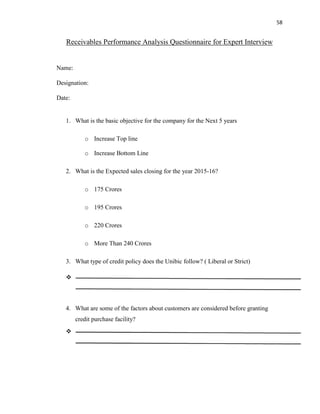
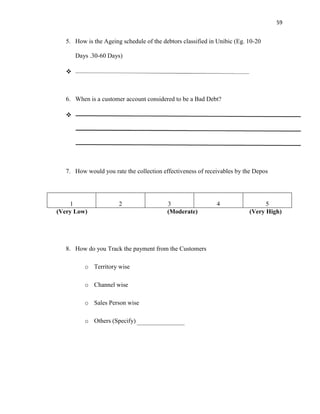
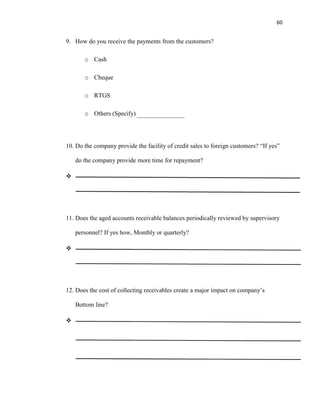
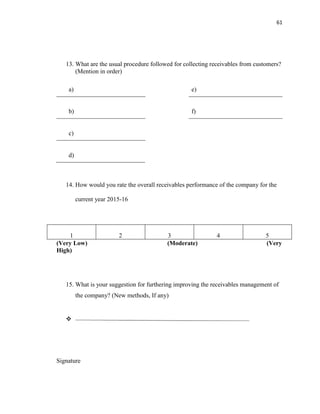
Primary data are collected through formal interview with company officials. This
was collected from the company officials in the finance department of Unibic
Foods India Private limited using both quantitative and qualitative techniques.
Quantitative data was collected through structured and formal questionnaires that
were filled by the researcher himself while conducting the formal interviews.
Qualitative data was collected by generating field notes and also conversations.
Secondary Sources
Secondary data on the other hand includes those data, which are collected from
company records, books and journals on financial management, Balance sheet,
Statement of Profit And Loss, Auditors Report and website.
Data Analysis and Interpretation
Various methods that can be used for analysing the data are Ratio analysis, Correlation
study and Percentage analysis. Tables and Clustered Column Charts are some the
various tools that can be used for presenting the data.
7
Limitations of the Study
All the research projects are hindered in their smooth flow by some unforeseen factors.
The problems arise in the form of constraints by time and scope of the study. The
current project was also faced by certain problem. Some of the problems faced in the
course of the research are as follows:
Some of the limitations of the study that may affect are that the financial statements
contain historical data which are not true indicators of the future. Also the data for
project mainly from Profit and loss account and balance sheet of company.
8
INDUSTRY PROFILE
Introduction.
Unibic Foods India Pvt Limited belongs to the Biscuits and cookies industry. Indian
Biscuits Industry came into major existence and started gaining a sound status in the bakery
Industry in the later part of 20th
century when the urbanized society called for readymade
food products at a tenable cost. Biscuits were assumed as sick men’s diet in earlier days.
But today it has become one of the most loved fast food products for every age growth.
Biscuits are always easy to carry, tasty to eat, cholesterol free and reasonable at cost. States
that have the larger intake of biscuits are Maharashtra, West Bengal, Andhra Pradesh ,
Karnataka & Uttar Pradesh .Maharashtra and West Bengal are the most Industrial
developed states; hold the maximum amount of consumption of biscuits. Even, the rural
sector consumes around 55% of the biscuits in the bakery products.
Indian biscuits Industry seems to be the largest among all the food Industries and has a
turnover of around Rs.14500 Cr in the fiscal year 2014-15. Indian subcontinent is known
to be the third largest manufacturer of biscuits , the first being USA and second being China
. The Industry is classified under two sectors: Organized and Unorganized. Bread and
Biscuits are the major part of the bakery Industry and covers around 80% of the total bakery
products in India. Biscuits today stand at a higher value and production level than bread.
This belongs to the unorganized sector of the bakery Industry and covers over 70% of the
total production.
The penetration of biscuits in India among the urban and rural market is 85% and 55%
respectively. Biscuits are always hygienically packaged nutritious snack food available at
very competitive prices, volumes and different tastes. According to the NCAER analysis,
biscuits are predominantly consumed by people from the lower strata of society,
particularly children in both rural and urban areas with an average monthly income of
Rs.750and above. While the country is the largest biscuit consuming nation, per capita
consumption is low at 2.1kg – compared to Ireland, which is the highest at 21.76kg. The
market for biscuits and cookies in India has come a long way accounting for 72 per cent of
the sales in the bakery industry.
9
Increasing consumption of packaged and convenience food, the availability of a variety of
biscuits and an increase in disposable incomes have provided a major boost to the industry.
Biscuits can he broadly categorized into the following segments in the Indian biscuit
industry- Glucose Marie Cream Cookie Milk Others in this industry. Some companies
focus only on some segments whereas giants like Britannia and Parle focus on all these
major segments of biscuits.
Current Scenario. India’s biscuit and cookie industry was valued at INR 145 billion (US
$2.41bn) in financial year 2014, of which Britannia and Parle, account for 61 per cent of
the market share, according to a Value Notes report entitled Biscuits and Cookies Industry
in India: 2015-2019. The industry is expected to grow at a CAGR of 14 per cent, to reach
INR 279 billion (USD $4.65bn) by 2019. Manufacturers are now aggressively entering the
premium segment of the market. Biscuits and cookies were considered to be a product of
mass consumption. However, with changing tastes and preferences, and increasing
affluence, this no longer seems to be the case. Increasing indulgence, health concerns and
familiarity with luxurious taste, which has developed among Indian consumers has led
Indian manufacturers to experiment with a variety of biscuits and cookies. This has also
led to higher growth in the premium segment compared to the economical and mid
segments of the industry.
Today Biscuits contributes to over 33 % of the total production of bakery and above 79 %
of the biscuits are manufactured by the small-scale sector of bakery industry comprising
both factory and non-factory units in the country. Today the large scale bakery
manufacturers like Cadbury, Nestle, and Brooke bond had traded in the biscuit industry but
couldn't hit the market because of the local companies that produced only biscuits.
Government has established The Federation of Biscuit Manufacturers of India (FBMI)
which has confirmed a bright future of India Biscuits Industry. According to FBMI, a
steady growth of 15 % per annum in the next 10 years will be achieved by the biscuit
industry of India. Besides, the export of biscuits will also surpass the target and hit the
global market successfully.
10
Total Contribution to the Economy/ Sales in India. The total revenue of the biscuit
industry for the fiscal year 2014-15 was 14500 crores. Biscuit industry contribute Rs.8,000
crore to the FMCG industry today, provides vast opportunity for growth, as the per capita
consumption of biscuits is less than 2.1 kg in our country. It is one of the major contributor
to the GDP of India and creates a major impact on the development of the Indian economy.
Apart from Big 3(Britannia, Parle, ITC) there are around 150 medium to small biscuit
factory in India.
Key Verdicts for the Industry in India. The biscuits and cookies industry in India, valued
at INR 145bn in FY 2014, has been growing at a CAGR of 10% over the last three years.
It is estimated that the industry will be worth nearly INR 279bn by FY 2019, growing at a
CAGR of ~14%.Growth of this segment is expected to slow down as manufacturers are
offering discounts to push volume sales, which in turn has slowed down the value growth
of the industry. The share of glucose biscuits is expected to decline as they have reached a
point of saturation. With rising incomes, consumers are being lured towards cream biscuits
and cookies instead of glucose biscuits. Share of premium biscuits is likely to increase by
FY 2019 as manufacturers are now aggressively entering the premium biscuit and cookie
segment on account of higher margins prevalent in the segment. Increase in disposable
income, changing lifestyles, growth in organized retail and increasing consumption of
processed and packaged food are the main drivers of the industry. Latest trends witnessed
in the industry reveal that companies are engaged in improving product packaging
Also, concerns like growing media coverage on health, rising incidence of health
conditions, increasing concerns over physical appearance, changing lifestyle and soaring
costs of healthcare have led the biscuits and cookies market to move towards a healthier
path.
Impact on the Biscuit and cookie industry. These trends offer huge risks and equally
outsized opportunities for the for the Indian Biscuit and Cookies industry. To address them
in a way that results in real competitive advantage, it’s critical to understand the specific
ways that these trends are already affecting companies in the industry.
11
E-retailing of bakery products. This is new trend in this industry which can create
a major impact on the top line of all major companies in this industry.
E-Retailing has been adopted by many companies as strategy for reaching all levels
of customers all around the country. It is an unexplored distribution channel in this
industry which can be explored and exploited by the companies in this industry.
Shift in consumer demand. Consumers appear to be rethinking their relation with
Biscuits brands and are viewing biscuits as food not only as a snack but also the
health content and taste. Although this is not likely to have a major impact on sales
volume, it is affecting how much people are willing to pay for Biscuits. Consumers
are also demanding more cookies in the premium segment, and are expecting more
tasty and quality features in the biscuits.
Improved Packaging. Packaging is one of the major factor that affect the demand
for baked products. There are many new technologies that can provide both safety
and aesthetic quality for the products. Hence the companies in this industry should
try to make upgradation in there packing as and when required. The Aesthetics
qualities and features of the package of such biscuits also create a major impact on
the demand for the products in this industry.
Hike in Central Excise Duty and other taxes by the government. All the
companies in this industry expected that the government would reduce the central
Excise duty on the food products. But there hasn’t been any change in the duty and
also there has been a small hike in the duty. Hence the companies are forced to
increase the price of their product. The taxes on the raw materials and finished
goods are still continuing to be a major problem in this segment. Especially the
non-implementation of GST tax system is affecting the industry badly.
Rise in the prices of basic Raw materials. There has been a hike in the price of the
basic raw materials that are used for the production of cookies and biscuits like
Milk, Sugar, Flour and Butter etc. For the past 5 years there has been a constant rise
in the price of raw materials that are being used for the production of biscuits and
cookies.
12
COMPANY PROFILE
Introduction.
Unibic Foods India Pvt Limited (Formerly known as Unibic Biscuits India Pvt Limited) is
a leading domestic Cookie brand with an exclusive focus on the "premium" segment of the
cookies market in India. The Company mainly focuses on the "Indulgence" and "Health &
Wellness" category and offers differentiated products. Unibic Foods India Private limited
was incorporated in July 2004, with an initial investment of Rs 15 Crore. The company
was established as an Indian subsidiary of the fourth largest Australian cookie maker,
Unibic Australia. Unibic has been manufacturing and marketing premium cookies in India
since 2004, with the objective of carving a niche at the premium end of the market and the
company has been satisfying the consumers with great taste.
However, today UNIBIC Foods India Pvt Ltd. is a privately held company backed by
reputed international private equity firms. The company is headed by its Managing Director
Mr. Nikhil Sen. Headquartered in Bangalore, UNIBIC has a state-of-the-art manufacturing
unit located a little outside the city. The company has been manufacturing and marketing
premium cookies for 10 years in India.
UNIBIC India started as an organization marketing two variants of cookies and now the
company grown leaps and bounds since. The company now market close to 30 different
types of cookies in the Indian market. It also export to multiple countries across the world.
It is one of the fastest growing FMCG brands in the country and we remain committed to
delighting consumers with unique, premium products.
Unibic operates in the high-margin cookies segment in India, with a share of around 8%.
The company retails biscuits in India, has strategic alliances to make cookies for PepsiCo's
Quaker, Future Group's Tasty Treat and Cafe Coffee Day besides exports. Sen says it will
continue to focus on the health and wellness platform. Its recent launch was a sugar-free
cookie. The 12,000-crore biscuits market consists of big players such as Parle Products,
Britannia, ITC, United Biscuits and Cremica, besides several regional players. In India the
largest markets for the company are in the South of the country.
13
The company is also present in various cities and towns in Maharashtra, West Bengal, and
North East and in Delhi NCR. The company is growing rapidly and are entering new
markets every month. The company also export to countries like UK, Korea, Australia,
New Zealand, Middle East and many more.
Forward looking statement. We have grown, and intended to grow, focusing on
harnessing our willingness to experiment and innovate our ability to transform our drive
towards excellence in quality, our people first attitude and our strategic direction.
Vision. To achieve this by delighting customers with Fresh and healthy food products,
those are a benchmark for quality in the Industry.
To be a preferred employer by nurturing entrepreneurship, managing career aspirations and
providing innovation avenues for enhanced employee prosperity.
Mission. Providing customers with hygienic, affordable and convenient supply of fresh
and healthy food products.
Tag Line. “Delight in Every Bite”
Slogan.
When you are happy, we are happy
We live for your Health and Happiness
Customer.
Timely supply of Quality & Healthy Products. High customer satisfaction.
Employees.
Enhancing the Technical and Managerial skills of Employees through continuous training
and development. Best appraisal systems to motivate employees. Incentives, bonus and
rewards systems to encourage employees
Qualities of Management Principles. Customer focuses to understand and meet the
changing needs of the expectations of customers. People involvement to promote team work
and tap the potential of people. Leadership to set constancy of purpose and promote quality
culture throughout the organization. Process approach to assess the efficiency and
effectiveness of each process. System approach to understand the sequence and interaction
of process. Factual approach to decision making is used to ensure its accuracy.
14
Unibic follows a social marketing principle for all its brands. Globally, the company
supports such social initiatives through association with various charitable organizations.
On the promotional side, the brand is not an aggressive promoter compared to its
competitors. Infact some of their advertisements landed them into trouble in the past. When
Unibic was launched, it directly pitted itself against the market leader Britannia.
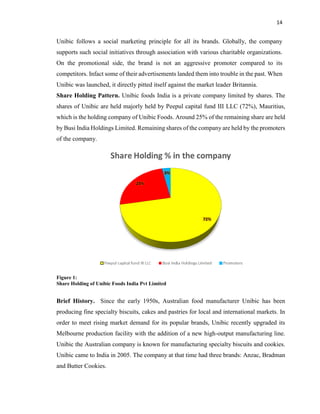
Share Holding Pattern. Unibic foods India is a private company limited by shares. The
shares of Unibic are held majorly held by Peepul capital fund III LLC (72%), Mauritius,
which is the holding company of Unibic Foods. Around 25% of the remaining share are held
by Busi India Holdings Limited. Remaining shares of the company are held by the promoters
of the company.
Figure 1:
Share Holding of Unibic Foods India Pvt Limited
Brief History. Since the early 1950s, Australian food manufacturer Unibic has been
producing fine specialty biscuits, cakes and pastries for local and international markets. In
order to meet rising market demand for its popular brands, Unibic recently upgraded its
Melbourne production facility with the addition of a new high-output manufacturing line.
Unibic the Australian company is known for manufacturing specialty biscuits and cookies.
Unibic came to India in 2005. The company at that time had three brands: Anzac, Bradman
and Butter Cookies.
15
Unibic was incorporated in India in August 2004 as a joint venture between premium
cookies maker Unibic Australia and Dhruv Deepak Saxena, a Melbourne-based serial
entrepreneur, who has since exited the business. The company started operations in March
2005 importing two cookie brands, Anzac (oatmeal) and Bradman (chocolate chip), from
Unibic Australia. By late 2005, its manufacturing unit in India was up and running,
producing cookies at costs that were as much as 40% lower than procuring them from
Australia. A five-year deal with Amalgamated Bean Coffee Trading Co for supplies to its
Café Coffee Day outlets came as a shot in the arm for Unibic India. It went on a marketing
overdrive, spending Rs.7.5 crore on advertising and promotions in 2006. Around 60% of
this was for television commercials aired on southern regional and national channels. The
rest was on association with sports events and cricket, where it brought the Unibic Bradman
20/20 tournament to India
Unibic Foods India Pvt Ltd had its genesis in Australia where the brand Unibic originated.
Unibic India was set up as a subsidiary of Unibic Australia. By early 2007, Nikhil Sen was
on board with sweat equity, as COO. Soon after, it established a retail and distribution
presence in a few southern states, and bagged an export deal from Australian supermarket
Coles. This was also the time that US-based private equity firm Lighthouse Capital picked
up a reported 20% stake in the company. The next few years saw the company further
consolidate its presence in South India, sign on Australian supermarket chain Woolsworth
as a customer, and receive an eligibility certificate by the British Retail Consortium for
exporting cookies to the UK market. Its private label business had begun to grow by now,
as well. By 2010, its revenues had reportedly touched Rs.60 crore.
Unibic’s fresh-off-the-oven success caught the fancy of FMCG major Marico, which
evinced interest for a 51% stake in the company in late 2010. The protracted talks
eventually fell through, and in 2011, Lazard India Private Equity picked up Unibic
Australia’s majority share in the Indian holdings. Yet again, in late 2012, private equity
firm Peepul Capital bought out Lazard private equity’s majority stake in Unibic India for
a reported Rs.100 crore. Its current owners now include Peepul Capital and Lighthouse
Capital, with Sen’s holdings said to be in the 10-15% range.
16
The Indian business continues to pay a nominal royalty to Unibic Australia for use of the
brand. However, today Unibic Foods India Pvt Ltd. is a privately held company backed by
reputed international private equity firms.
The company is headed by its Managing Director Mr. Nikhil Sen. Headquartered in
Bangalore, Unibic has a state-of-the-art manufacturing unit located a little outside the city.
Armed with sufficient funds, this time around Unibic is betting on a favorable environment
to grow faster than it has so far. Its timing could be just right. The composition of India’s
biscuits market has changed significantly over the past couple of years with the share of
glucose biscuits, traditionally the largest selling category, coming down. Hence the
company also should make the adjustments according to the industry so as to capture more
share of cream of the biscuit industry
Nature of Business Carried. The company Unibic Foods India Pvt limited mainly focus
at the premium segment of the Indian Biscuit industry. Its nature of business is basically
manufacturing of different flavours of cookies. The company also started operating in the
health segment of the biscuit industry by providing sugar free cookies to its customers. The
company is in operation only for more than a decade in India from being established from
2004 with a strong base of existence in Australian cookie market for the past 60 years. The
company is tailored to meet the needs of the customers from both higher and lower income
strata of the market. The company believes on the philosophy of carrying on business not
only with aim of making profit but also to serve the society by providing high quality
products with great taste to the customers.
Current Market. Unibic India started as an organisation marketing two variants of cookies
and now the company have grown leaps and bounds since. It has market close to 30
different types of cookies in the Indian market and also exports to multiple countries across
the world. Unibic cookies are being retailed through more than 100,000 outlets across the
country. 60% of sales of Unibic comes from south India, and the rest from metros such as
Delhi and Mumbai. While Unibic’s retail brands bring in 70% of revenues, its contract
manufacturing and private label business contributes another 20-25%.
17
It makes cookies for Café Coffee Day and Indigo for its onboard service, and for the private
labels of Future Group for its Tasty Treat store brand and Aditya Birla Retail’s “More
chain”, which sells its own food products under the Feasters label. The rest comes from
exports to the US, UK, New Zealand and countries in West and South East Asia. Unibic
have around 7-8% of the premium cookie market and hope to achieve 10% market share
over the next 12-18 months. The Company is also looking to expand its market share in
the health and wellness segment.
Business Performance. During the year 2014-2015 the company had a turnover of 140
crores. Compared to last year the company had an increase of 77% increase in revenue. In
the year 2015-16 the company also made a net profit of Rs.9 crores. The company made a
net profit for the first time after being established in the year 2004.The company has a shelf
spaces in all major branded retail stores like Big Bazar, Spar stores, Reliance stores and
Lulu. As a result of this the products of the company has even become renowned all over
India with a short span of time. Hence the company is growing in its revenue and customer
loyalty year by year.
Exports. Unibic has a good market base in the foreign markets also. It makes exports to
all major countries in the world. Some of the countries to which the company makes its
exports are Australia, China, UAE, Qatar, Bahrain, Oman, Jordan, Kuwait and many more.
The revenue which the company earns from exports are increasing year by year. It makes
exports under two brands Unibic cookies and Unibis cookies. UNIBIS is the flagship
international brand from UNIBIC Foods India Pvt. Ltd. UNIBIS is sold in the USA, the
UK and 12 other countries around the world.
UNIBIS cookies are made using the finest ingredients and meet high quality standards.
Around 4% of the total revenue of the company comes from exports of cookies. But the
percentage increase in the revenue from exports is comparatively less compared to
domestic sales, thus efforts should be taken by the companies to increase its revenue from
foreign markets.
18
Manufacturing Facilities. The factory of the company is located at Huskur Road in
Bengaluru. It has state-of-the-art machines imported from Italy with two oven lines
working at 75% capacity. The processes are employed to make its cookies lend an authentic
texture. The company claims that is the first biscuit maker in India to use wire cut
technology in baking cookies and it is the only method available to make cookies softer
and chewy, unlike biscuits. Biscuits are typically made through sheeting and cutting or
rotary molding.
In sheeting and cutting, the dough is passed through rollers to get the desired thickness and
then cut using plastic or metal dies. The dough has to be kept hard so that it retains its shape
when the extra scrap is being removed after. In rotary molds, the dough needs to be
compressed into dies or slots mounted on a roller with extra dough being scraped off. The
dough needs to be stiff here as well for the biscuits to retain their shape. In wire cut
technology, the short dough or much softer dough is extruded through a die and cut by
wires at regular intervals without being pressed by rollers.
Future Plans. With growth in the cookie market estimated at 20-25%, the company
expects its business to grow faster at 35% in the near future. It is lining up new products
such as chyavanprash based and a sugar-free cookies, even as it works on growing reach
among the top 20% population towns. “Expanding distribution is key for the company and
it is working on it diligently. The target is to eventually have a pan-India presence,
especially by increasing retail reach in north Indian cities such as Jaipur and Chandigarh,
and in cities such as Pune and Nasik in the West, by the end of the current financial year.
Also in the case of promotion the focus is strictly on below-the-line (BTL) activities such
as in-store promotions and on social media outreach. Thus the company has already started
making and implementing strategies to achieve these plans and targets.
19
Corporate Information.
Incorporated name Unibic Foods India Pvt Ltd.
Head Quarters Address Unibic Foods India Pvt Ltd.
Shreeram Nivas, No.1134.
100ft Road, HAL 2nd
Stage, Indiranagar,
Bangalore - 560038
Phone no 91 80 2520 1359 Connected to all
Departments
Website www.unibicindia.com
Class of Company Private Company
Year of Establishment 8th
July2004
Holding Company Peepul Capital Fund III LLC
Managing Director Nikhil Sen
Business Outline Manufacturing, sales and related business of
wide varieties of quality cookies.
Figure 2:
Corporate Information about Unibic Foods India Pvt Limited
20
PRODUCT PROFILE
Unibic is leading cookie brand in Australia for 40 years, The Company has the pride for
crafting cookies that are a cut above the rest. Having already taken Australia, New Zealand
& UK by storm, the company has begun its romance with India in 2004. And since then,
we have not looked back. With a strong pan-India presence in over 100000 outlets and an
extensive coverage across all channels, Unibic is the largest “real cookie” company in
India.
For the last ten years, the bakers at UNIBIC have been baking perfect, crunchy and
delightful cookies. The cookies of Unibic are made with the best ingredients and mixed
with selected fruits, nuts and spices to create a range over 20 flavors that will delight our
taste buds! Unibic provides cookies that would indulge our senses with chocolate, love
butter and cashews, which is a savoury snack to go with tea or even want to go sugar free,
the company has the perfect cookie for every want of the customers.
The company started selling cookies in India with two iconic flavors, – Anzac Oatmeal
Cookies and Bradman Choco chip Cookies – that has a legacy with connection with
Australian cookies. Then it created many more flavors and today it offer a Bicalcious range
of over 20 different cookies. The company also plans to increase its no of varieties in the
cookie segment as the demand for the cookies are increasing day by day. Even the exports
of the cookies are being increasing both geographically and revenue wise. The Export name
of the cookies are “Unibis” Instead of Unibic. They are being exported to all major
countries around the world. Health segment is another segment where the company has a
firm foot print. It provides wide varieties of sugar free cookies which helped the company
to enter that segment. Chocolate Flavored cookies of Unibic are the most demanded variety
of cookie demanded by the customers.
Unibic today provides flavors from chocolate, milk, fruit & nut, honey oatmeal, multigrain,
cashew, pista-badam, butter, oatmeal, chilly, sugar free, sugar free cream cookies, special
cookies for gifting and many more. Some of the cookies that are provided by Unibic are
provided below:
21
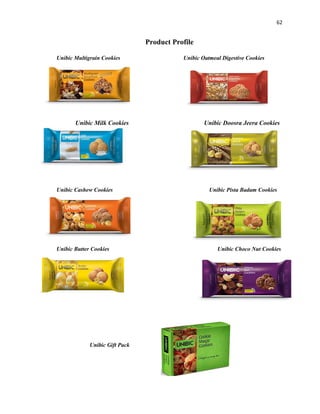
1. Unibic Cashew Cookies are an all-time favorite of customers. It is combined with the
rich taste of butter and the crunchy goodness of cashew nuts. These cookies are highly
preferred eatables for the breakfast.
2. Unibic Pista Badam. Cookies packed with real goodness of Pista & Badam along with
the crunchiness it is available in various delicious tastes, these Cookies can also be
eaten as raw and liked by the people of all the age groups.
3. The Ginger nut cookies. Are acknowledged as a heartwarming combination of real
ginger and real cinnamon, in golden syrup. These are prepared under hygienic
environment using advanced technology and quality assured ingredients.
4. Unibic Butter Cookies are baked with dollops of butter, these crisp cookies let you
savour the real taste of butter. These cookies contain 15% butter, three times more than
all other butter cookies that are available in the market.
5. Choco Ripple Cookies are the latest addition to the UNIBIC Family. This chocolaty
cookie crumbles with every bite. Priced at Rs. 10 for 75 Gram this cookie is a crispy
crunchy delight for your taste buds as well as your pocket.
6. Choco Nut Cookies. Are mainly for who love nuts as much as chocolates will love this
nutty and chocolaty combination. Choco Nuts are best served with piping hot coffee.
These are made with purest and good quality nuts and chocolates.
7. The Choco chip cookies. From Unibic are sprinkled with chocolate chips, which is
also its most prominent distinguishing ingredient. The ingredients of this traditional
recipe are butter, white and brown sugar and semi-sweet chocolate chips.
22
8. The Fruit and Nut Cookies. These are deliciously chewy and soft and are stuffed by
experts with cranberry, blackberry, cashew, glazed fruits, and almond bits that make
your taste buds go nuts. These are prepared with whole wheat flour and other needed
ingredients.
9. Unibic Multigrain Cookies are made with the exotic blend of 5 grains, which are
coupled with natural richness of black currant, cranberry, almond, dates and honey. It
has a longer shelf life, Healthy for body growth and Good in taste.
10. Unibic Oatmeal Digestive cookies are the most demanded cookie in the health
segment, these Oatmeal Digestive Cookies can also be eaten as raw and liked by the
people of all the age groups.
11. Unibic Milk cookies. It offers only one cookie now in this segment. Unibic Milk
Cookies have always been one of the preferred choices of children and adults owing to
their pleasing mouth-watering taste and shapes.
12. Doosra Jeera Cookies. Are known for their freshness, purity, rich taste, crispiness,
remarkable packaging options, longer shelf life, flavor, affordable prices and color.
13. Unibic Gift Range are available with wide variety of cookies in a single pack. These
package are provided on different festivals and celebrations. Different Packages contain
different flavoured cookies and these are of great demand among the customers. The
company provide these Cookies in hygienic and customer friendly packing,
23
DATA ANALYSIS AND INTERPRETATION
In the following chapter the data collected from the organization has been analyzed and
interpreted. All the analysis has been made strictly according to the objectives of the project
study. The main focus of the study was analyzing the performance of receivables
management in the organization and also how it affects the performance of the
organization. That is how it affects the profitability and Liquidity performance of the
organization. Accounts receivable are customers who have not yet made payment for goods
or services which the firm has provided. The objective of the debtor management is to
minimize the time-lapse between completion of sales and receipts of payment. The
management of accounts receivable is largely influenced by the credit policy and collection
policy of a firm. Excessive level of debt in a company could affect the profitability position
of a firm. This is because if a firm has so many Debtors to pay, then they may become short
of cash which may lead to difficulty in settling their short-term financial obligations. Profit
may be called real profit after receivables are turned into cash. Thus the proper
management of receivables in a company would help the organization to have a good
position in profitability and in working capital
Various methods that can be used for analysing the data are Ratio analysis, Correlation
study and Percentage analysis. Tables and Clustered Column Charts are some the various
tools that can be used for presenting the data. These methods are used to analyze and
interpret the objectives for this study. All the evaluations are being done with the help of
the data provided by the company.
Data collection was done from the company’s financial statements. Depth interviews were
conducted by interviewing the officials in the receivables department, to get solicit and
direct information of the performance of receivables management. Correlation as well as
percentage were also used for analysis of some of the data. The following shows details of
analysis and the interpretation that was done from the same
24
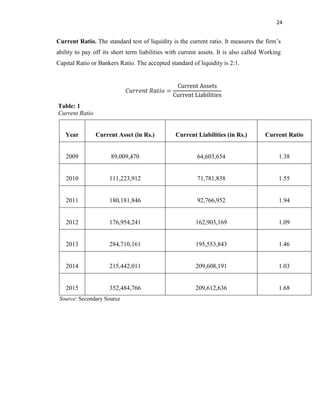
Current Ratio. The standard test of liquidity is the current ratio. It measures the firm’s
ability to pay off its short term liabilities with current assets. It is also called Working
Capital Ratio or Bankers Ratio. The accepted standard of liquidity is 2:1.
Table: 1
Current Ratio
Year Current Asset (in Rs.) Current Liabilities (in Rs.) Current Ratio
2009 89,009,470 64,603,654 1.38
2010 111,223,912 71,781,838 1.55
2011 180,181,846 92,766,952 1.94
2012 176,954,241 162,903,169 1.09
2013 284,710,161 195,553,843 1.46
2014 215,442,011 209,608,191 1.03
2015 352,484,766 209,612,636 1.68
Source: Secondary Source
25
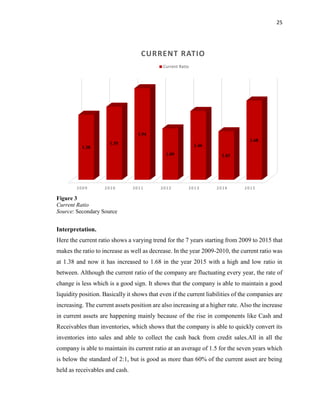
Figure 3
Current Ratio
Source: Secondary Source
Interpretation.
Here the current ratio shows a varying trend for the 7 years starting from 2009 to 2015 that
makes the ratio to increase as well as decrease. In the year 2009-2010, the current ratio was
at 1.38 and now it has increased to 1.68 in the year 2015 with a high and low ratio in
between. Although the current ratio of the company are fluctuating every year, the rate of
change is less which is a good sign. It shows that the company is able to maintain a good
liquidity position. Basically it shows that even if the current liabilities of the companies are
increasing. The current assets position are also increasing at a higher rate. Also the increase
in current assets are happening mainly because of the rise in components like Cash and
Receivables than inventories, which shows that the company is able to quickly convert its
inventories into sales and able to collect the cash back from credit sales.All in all the
company is able to maintain its current ratio at an average of 1.5 for the seven years which
is below the standard of 2:1, but is good as more than 60% of the current asset are being
held as receivables and cash.
2009 2010 2011 2012 2013 2014 2015
1.38
1.55
1.94
1.09
1.46
1.03
1.68
CURRENT RATIO
Current Ratio
26
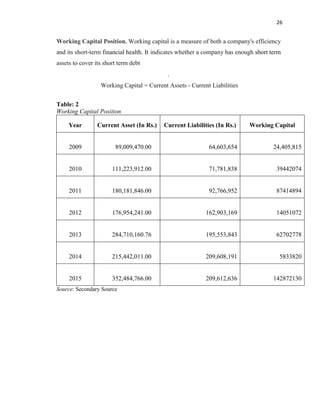
Working Capital Position. Working capital is a measure of both a company's efficiency
and its short-term financial health. It indicates whether a company has enough short term
assets to cover its short term debt
.
Working Capital = Current Assets - Current Liabilities
Table: 2
Working Capital Position
Year Current Asset (In Rs.) Current Liabilities (In Rs.) Working Capital
2009 89,009,470.00 64,603,654 24,405,815
2010 111,223,912.00 71,781,838 39442074
2011 180,181,846.00 92,766,952 87414894
2012 176,954,241.00 162,903,169 14051072
2013 284,710,160.76 195,553,843 62702778
2014 215,442,011.00 209,608,191 5833820
2015 352,484,766.00 209,612,636 142872130
Source: Secondary Source
27
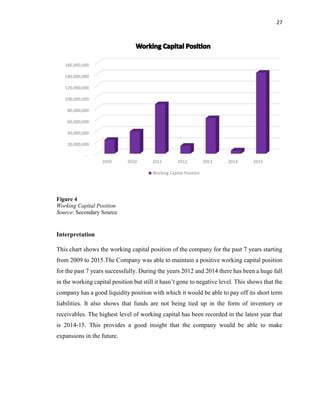
Figure 4
Working Capital Position
Source: Secondary Source
Interpretation
This chart shows the working capital position of the company for the past 7 years starting
from 2009 to 2015.The Company was able to maintain a positive working capital position
for the past 7 years successfully. During the years 2012 and 2014 there has been a huge fall
in the working capital position but still it hasn’t gone to negative level. This shows that the
company has a good liquidity position with which it would be able to pay off its short term
liabilities. It also shows that funds are not being tied up in the form of inventory or
receivables. The highest level of working capital has been recorded in the latest year that
is 2014-15. This provides a good insight that the company would be able to make
expansions in the future.
-
20,000,000
40,000,000
60,000,000
80,000,000
100,000,000
120,000,000
140,000,000
160,000,000
2009 2010 2011 2012 2013 2014 2015
Working Capital Position
28
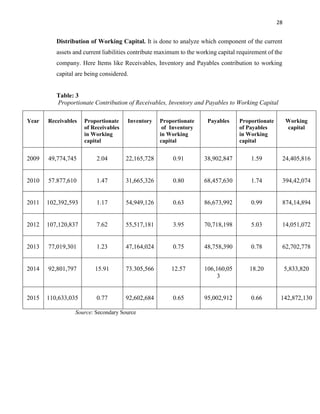
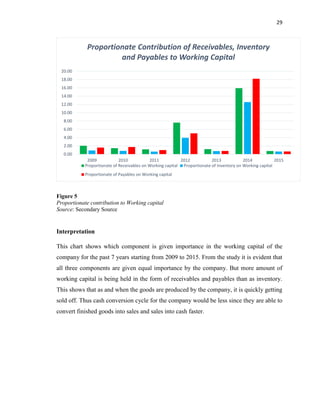
Distribution of Working Capital. It is done to analyze which component of the current
assets and current liabilities contribute maximum to the working capital requirement of the
company. Here Items like Receivables, Inventory and Payables contribution to working
capital are being considered.
Table: 3
Proportionate Contribution of Receivables, Inventory and Payables to Working Capital
Source: Secondary Source
Year Receivables Proportionate
of Receivables
in Working
capital
Inventory Proportionate
of Inventory
in Working
capital
Payables Proportionate
of Payables
in Working
capital
Working
capital
2009 49,774,745 2.04 22,165,728 0.91 38,902,847 1.59 24,405,816
2010 57.877,610 1.47 31,665,326 0.80 68,457,630 1.74 394,42,074
2011 102,392,593 1.17 54,949,126 0.63 86,673,992 0.99 874,14,894
2012 107,120,837 7.62 55,517,181 3.95 70,718,198 5.03 14,051,072
2013 77,019,301 1.23 47,164,024 0.75 48,758,390 0.78 62,702,778
2014 92,801,797 15.91 73.305,566 12.57 106,160,05
3
18.20 5,833,820
2015 110,633,035 0.77 92,602,684 0.65 95,002,912 0.66 142,872,130
29
Figure 5
Proportionate contribution to Working capital
Source: Secondary Source
Interpretation
This chart shows which component is given importance in the working capital of the
company for the past 7 years starting from 2009 to 2015. From the study it is evident that
all three components are given equal importance by the company. But more amount of
working capital is being held in the form of receivables and payables than as inventory.
This shows that as and when the goods are produced by the company, it is quickly getting
sold off. Thus cash conversion cycle for the company would be less since they are able to
convert finished goods into sales and sales into cash faster.
0.00
2.00
4.00
6.00
8.00
10.00
12.00
14.00
16.00
18.00
20.00
2009 2010 2011 2012 2013 2014 2015
Proportionate Contribution of Receivables, Inventory
and Payables to Working Capital
Proportionate of Receivables on Working capital Proportionate of Inventory on Working capital
Proportionate of Payables on Working capital
30
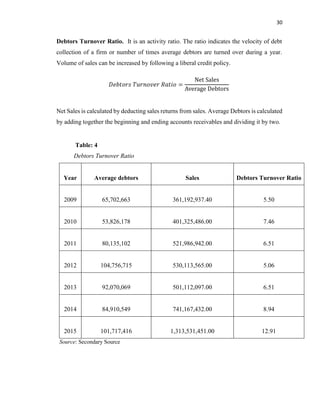
Debtors Turnover Ratio. It is an activity ratio. The ratio indicates the velocity of debt
collection of a firm or number of times average debtors are turned over during a year.
Volume of sales can be increased by following a liberal credit policy.
Net Sales is calculated by deducting sales returns from sales. Average Debtors is calculated
by adding together the beginning and ending accounts receivables and dividing it by two.
Table: 4
Debtors Turnover Ratio
Year Average debtors Sales Debtors Turnover Ratio
2009 65,702,663 361,192,937.40 5.50
2010 53,826,178 401,325,486.00 7.46
2011 80,135,102 521,986,942.00 6.51
2012 104,756,715 530,113,565.00 5.06
2013 92,070,069 501,112,097.00 6.51
2014 84,910,549 741,167,432.00 8.94
2015 101,717,416 1,313,531,451.00 12.91
Source: Secondary Source
31
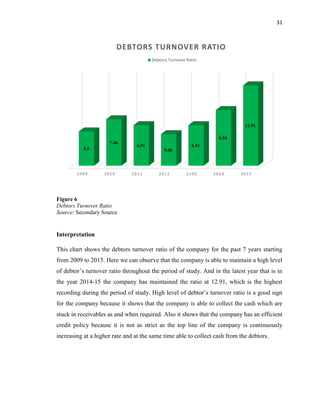
Figure 6
Debtors Turnover Ratio
Source: Secondary Source
Interpretation
This chart shows the debtors turnover ratio of the company for the past 7 years starting
from 2009 to 2015. Here we can observe that the company is able to maintain a high level
of debtor’s turnover ratio throughout the period of study. And in the latest year that is in
the year 2014-15 the company has maintained the ratio at 12.91, which is the highest
recording during the period of study. High level of debtor’s turnover ratio is a good sign
for the company because it shows that the company is able to collect the cash which are
stuck in receivables as and when required. Also it shows that the company has an efficient
credit policy because it is not as strict as the top line of the company is continuously
increasing at a higher rate and at the same time able to collect cash from the debtors.
2009 2010 2011 2012 2103 2014 2015
5.5
7.46
6.51
5.06
6.51
8.94
12.91
DEBTORS TURNOVER RATIO
Debtors Turnover Ratio
32
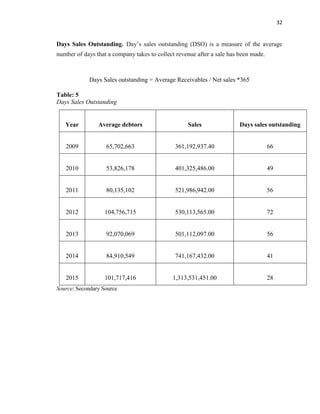
Days Sales Outstanding. Day’s sales outstanding (DSO) is a measure of the average
number of days that a company takes to collect revenue after a sale has been made.
Days Sales outstanding = Average Receivables / Net sales *365
Table: 5
Days Sales Outstanding
Year Average debtors Sales Days sales outstanding
2009 65,702,663 361,192,937.40 66
2010 53,826,178 401,325,486.00 49
2011 80,135,102 521,986,942.00 56
2012 104,756,715 530,113,565.00 72
2013 92,070,069 501,112,097.00 56
2014 84,910,549 741,167,432.00 41
2015 101,717,416 1,313,531,451.00 28
Source: Secondary Source
33
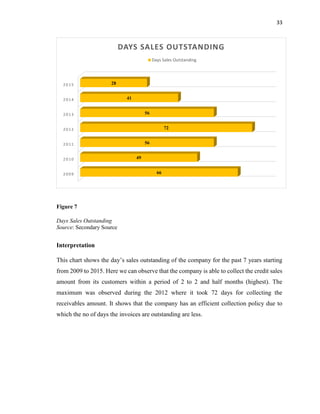
Figure 7
Days Sales Outstanding
Source: Secondary Source
Interpretation
This chart shows the day’s sales outstanding of the company for the past 7 years starting
from 2009 to 2015. Here we can observe that the company is able to collect the credit sales
amount from its customers within a period of 2 to 2 and half months (highest). The
maximum was observed during the 2012 where it took 72 days for collecting the
receivables amount. It shows that the company has an efficient collection policy due to
which the no of days the invoices are outstanding are less.
2009
2010
2011
2012
2013
2014
2015
66
49
56
72
56
41
28
DAYS SALES OUTSTANDING
Days Sales Outstanding
34
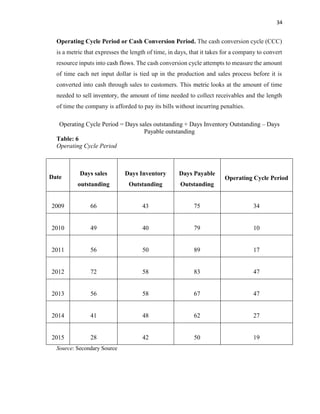
Operating Cycle Period or Cash Conversion Period. The cash conversion cycle (CCC)
is a metric that expresses the length of time, in days, that it takes for a company to convert
resource inputs into cash flows. The cash conversion cycle attempts to measure the amount
of time each net input dollar is tied up in the production and sales process before it is
converted into cash through sales to customers. This metric looks at the amount of time
needed to sell inventory, the amount of time needed to collect receivables and the length
of time the company is afforded to pay its bills without incurring penalties.
Operating Cycle Period = Days sales outstanding + Days Inventory Outstanding – Days
Payable outstanding
Table: 6
Operating Cycle Period
Source: Secondary Source
Date
Days sales
outstanding
Days Inventory
Outstanding
Days Payable
Outstanding
Operating Cycle Period
2009 66 43 75 34
2010 49 40 79 10
2011 56 50 89 17
2012 72 58 83 47
2013 56 58 67 47
2014 41 48 62 27
2015 28 42 50 19
35
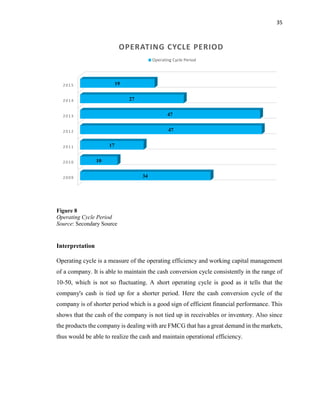
Figure 8
Operating Cycle Period
Source: Secondary Source
Interpretation
Operating cycle is a measure of the operating efficiency and working capital management
of a company. It is able to maintain the cash conversion cycle consistently in the range of
10-50, which is not so fluctuating. A short operating cycle is good as it tells that the
company's cash is tied up for a shorter period. Here the cash conversion cycle of the
company is of shorter period which is a good sign of efficient financial performance. This
shows that the cash of the company is not tied up in receivables or inventory. Also since
the products the company is dealing with are FMCG that has a great demand in the markets,
thus would be able to realize the cash and maintain operational efficiency.
2009
2010
2011
2012
2013
2014
2015
34
10
17
47
47
27
19
OPERATING CYCLE PERIOD
Operating Cycle Period
36
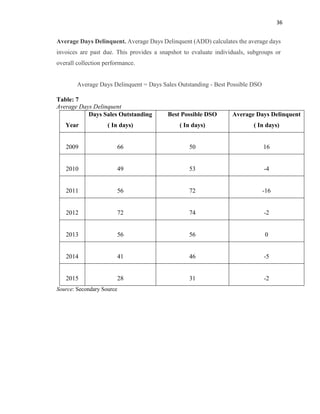
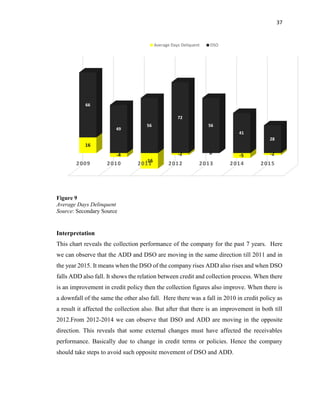
Average Days Delinquent. Average Days Delinquent (ADD) calculates the average days
invoices are past due. This provides a snapshot to evaluate individuals, subgroups or
overall collection performance.
Average Days Delinquent = Days Sales Outstanding - Best Possible DSO
Table: 7
Average Days Delinquent
Year
Days Sales Outstanding
( In days)
Best Possible DSO
( In days)
Average Days Delinquent
( In days)
2009 66 50 16
2010 49 53 -4
2011 56 72 -16
2012 72 74 -2
2013 56 56 0
2014 41 46 -5
2015 28 31 -2
Source: Secondary Source
37
Figure 9
Average Days Delinquent
Source: Secondary Source
Interpretation
This chart reveals the collection performance of the company for the past 7 years. Here
we can observe that the ADD and DSO are moving in the same direction till 2011 and in
the year 2015. It means when the DSO of the company rises ADD also rises and when DSO
falls ADD also fall. It shows the relation between credit and collection process. When there
is an improvement in credit policy then the collection figures also improve. When there is
a downfall of the same the other also fall. Here there was a fall in 2010 in credit policy as
a result it affected the collection also. But after that there is an improvement in both till
2012.From 2012-2014 we can observe that DSO and ADD are moving in the opposite
direction. This reveals that some external changes must have affected the receivables
performance. Basically due to change in credit terms or policies. Hence the company
should take steps to avoid such opposite movement of DSO and ADD.
2009 2010 2011 2012 2013 2014 2015
16
-4
-16
-2 0 -5 -2
66
49
56
72
56
41
28
Average Days Deliquent DSO
38
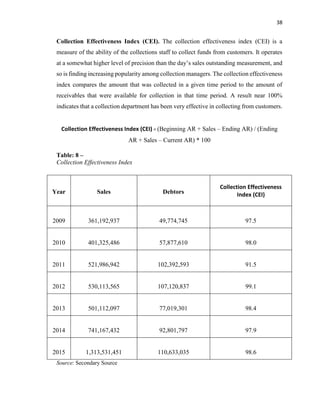
Collection Effectiveness Index (CEI). The collection effectiveness index (CEI) is a
measure of the ability of the collections staff to collect funds from customers. It operates
at a somewhat higher level of precision than the day’s sales outstanding measurement, and
so is finding increasing popularity among collection managers. The collection effectiveness
index compares the amount that was collected in a given time period to the amount of
receivables that were available for collection in that time period. A result near 100%
indicates that a collection department has been very effective in collecting from customers.
Collection Effectiveness Index (CEI) = (Beginning AR + Sales – Ending AR) / (Ending
AR + Sales – Current AR) * 100
Table: 8 –
Collection Effectiveness Index
Source: Secondary Source
Year Sales Debtors
Collection Effectiveness
Index (CEI)
2009 361,192,937 49,774,745 97.5
2010 401,325,486 57,877,610 98.0
2011 521,986,942 102,392,593 91.5
2012 530,113,565 107,120,837 99.1
2013 501,112,097 77,019,301 98.4
2014 741,167,432 92,801,797 97.9
2015 1,313,531,451 110,633,035 98.6
39
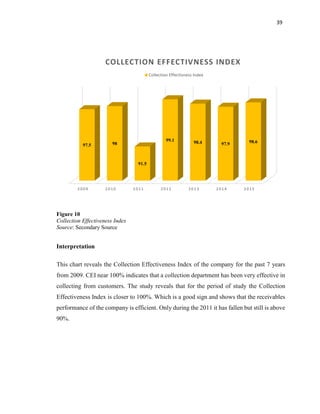
Figure 10
Collection Effectiveness Index
Source: Secondary Source
Interpretation
This chart reveals the Collection Effectiveness Index of the company for the past 7 years
from 2009. CEI near 100% indicates that a collection department has been very effective in
collecting from customers. The study reveals that for the period of study the Collection
Effectiveness Index is closer to 100%. Which is a good sign and shows that the receivables
performance of the company is efficient. Only during the 2011 it has fallen but still is above
90%.
2009 2010 2011 2012 2013 2014 2015
97.5 98
91.5
99.1 98.4 97.9 98.6
COLLECTION EFFECTIVNESS INDEX
Collection Effectivness Index
40
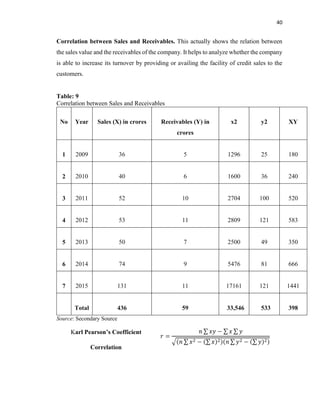
Correlation between Sales and Receivables. This actually shows the relation between
the sales value and the receivables of the company. It helps to analyze whether the company
is able to increase its turnover by providing or availing the facility of credit sales to the
customers.
Table: 9
Correlation between Sales and Receivables
No Year Sales (X) in crores Receivables (Y) in
crores
x2 y2 XY
1 2009 36 5 1296 25 180
2 2010 40 6 1600 36 240
3 2011 52 10 2704 100 520
4 2012 53 11 2809 121 583
5 2013 50 7 2500 49 350
6 2014 74 9 5476 81 666
7 2015 131 11 17161 121 1441
Total 436 59 33,546 533 398
Source: Secondary Source
Karl Pearson’s Coefficient
Correlation
41
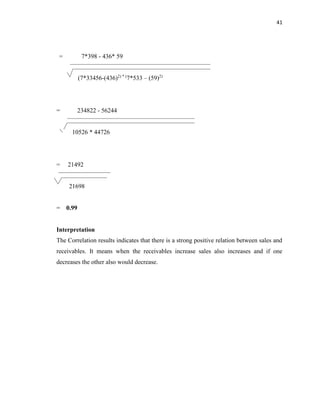
= 7*398 - 436* 59
(7*33456-(436)2) * (
7*533 – (59)2)
= 234822 - 56244
10526 * 44726
= 21492
21698
= 0.99
Interpretation
The Correlation results indicates that there is a strong positive relation between sales and
receivables. It means when the receivables increase sales also increases and if one
decreases the other also would decrease.
42
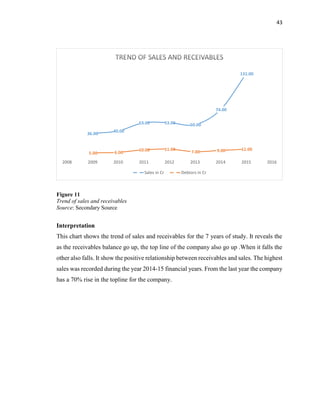
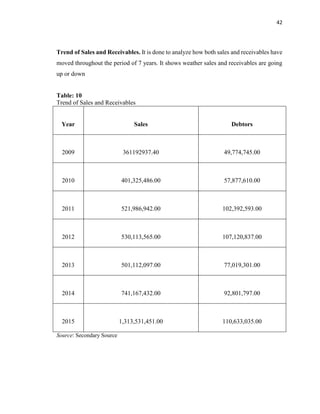
Trend of Sales and Receivables. It is done to analyze how both sales and receivables have
moved throughout the period of 7 years. It shows weather sales and receivables are going
up or down
Table: 10
Trend of Sales and Receivables
Year Sales Debtors
2009 361192937.40 49,774,745.00
2010 401,325,486.00 57,877,610.00
2011 521,986,942.00 102,392,593.00
2012 530,113,565.00 107,120,837.00
2013 501,112,097.00 77,019,301.00
2014 741,167,432.00 92,801,797.00
2015 1,313,531,451.00 110,633,035.00
Source: Secondary Source
43
Figure 11
Trend of sales and receivables
Source: Secondary Source
Interpretation
This chart shows the trend of sales and receivables for the 7 years of study. It reveals the
as the receivables balance go up, the top line of the company also go up .When it falls the
other also falls. It show the positive relationship between receivables and sales. The highest
sales was recorded during the year 2014-15 financial years. From the last year the company
has a 70% rise in the topline for the company.
36.00
40.00
53.00 53.00 50.00
74.00
131.00
5.00 6.00
10.00 11.00
7.00 9.00 11.00
2008 2009 2010 2011 2012 2013 2014 2015 2016
Sales in Cr Debtors in Cr
44
Correlation between Days sales outstanding and operating profit. This actually shows
the relation between the Days sales outstanding value and the operating profit of the
company. It helps to analyze whether the company is able to increase its operating profit
by improving the no of days required for collecting the receivables.
Table: 11
Correlation between Days Sales Outstanding and operating profit
No Year Days Sales
Outstanding (X)
Operating Profit (y) in
crores
x2 y2 XY
1 2009 66 8 4408 64 4408
2 2010 49 9 2397 81 2397
3 2011 56 11 3140 121 3140
4 2012 72 13 5202 169 5202
5 2013 56 14 3147 196 3147
6 2014 41 21 1668 441 1668
7 2015 28 52 799 2704 799
Total 369 128 20761 3776 20761
Source: Secondary Source
Karl Pearson’s Coefficient
Correlation
45
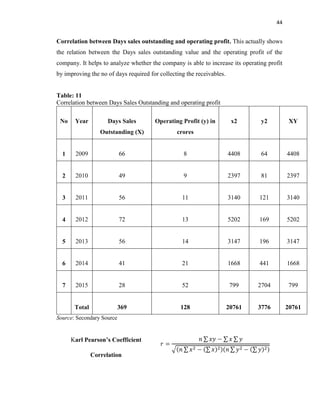
= 39473 - 47196
97 * 100
= -7723
9700
= -0.79
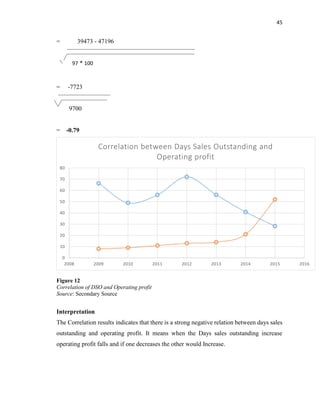
Figure 12
Correlation of DSO and Operating profit
Source: Secondary Source
Interpretation
The Correlation results indicates that there is a strong negative relation between days sales
outstanding and operating profit. It means when the Days sales outstanding increase
operating profit falls and if one decreases the other would Increase.
0
10
20
30
40
50
60
70
80
2008 2009 2010 2011 2012 2013 2014 2015 2016
Correlation between Days Sales Outstanding and
Operating profit
46
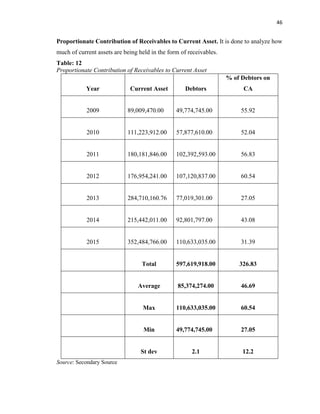
Proportionate Contribution of Receivables to Current Asset. It is done to analyze how
much of current assets are being held in the form of receivables.
Table: 12
Proportionate Contribution of Receivables to Current Asset
Year Current Asset Debtors
% of Debtors on
CA
2009 89,009,470.00 49,774,745.00 55.92
2010 111,223,912.00 57,877,610.00 52.04
2011 180,181,846.00 102,392,593.00 56.83
2012 176,954,241.00 107,120,837.00 60.54
2013 284,710,160.76 77,019,301.00 27.05
2014 215,442,011.00 92,801,797.00 43.08
2015 352,484,766.00 110,633,035.00 31.39
Total 597,619,918.00 326.83
Average 85,374,274.00 46.69
Max 110,633,035.00 60.54
Min 49,774,745.00 27.05
St dev 2.1 12.2
Source: Secondary Source
47
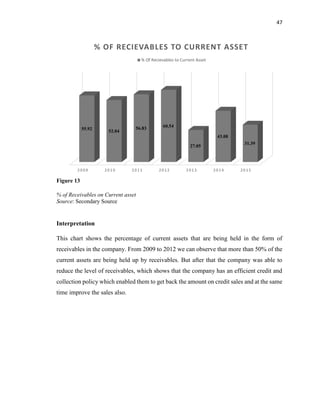
Figure 13
% of Receivables on Current asset
Source: Secondary Source
Interpretation
This chart shows the percentage of current assets that are being held in the form of
receivables in the company. From 2009 to 2012 we can observe that more than 50% of the
current assets are being held up by receivables. But after that the company was able to
reduce the level of receivables, which shows that the company has an efficient credit and
collection policy which enabled them to get back the amount on credit sales and at the same
time improve the sales also.
2009 2010 2011 2012 2013 2014 2015
55.92 52.04
56.83 60.54
27.05
43.08
31.39
% OF RECIEVABLES TO CURRENT ASSET
% Of Recievables to Current Asset
48
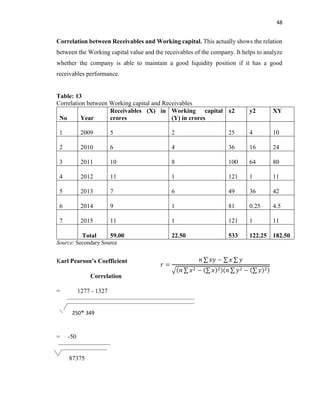
Correlation between Receivables and Working capital. This actually shows the relation
between the Working capital value and the receivables of the company. It helps to analyze
whether the company is able to maintain a good liquidity position if it has a good
receivables performance.
Table: 13
Correlation between Working capital and Receivables
No Year
Receivables (X) in
crores
Working capital
(Y) in crores
x2 y2 XY
1 2009 5 2 25 4 10
2 2010 6 4 36 16 24
3 2011 10 8 100 64 80
4 2012 11 1 121 1 11
5 2013 7 6 49 36 42
6 2014 9 1 81 0.25 4.5
7 2015 11 1 121 1 11
Total 59.00 22.50 533 122.25 182.50
Source: Secondary Source
Karl Pearson’s Coefficient
Correlation
= 1277 - 1327
250* 349
= -50
87375
49
= -0.17
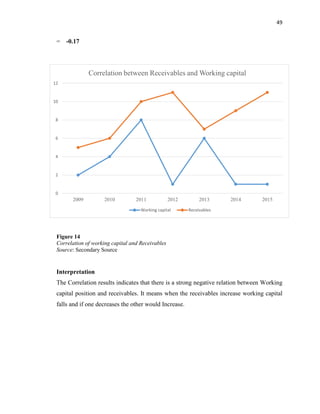
Figure 14
Correlation of working capital and Receivables
Source: Secondary Source
Interpretation
The Correlation results indicates that there is a strong negative relation between Working
capital position and receivables. It means when the receivables increase working capital
falls and if one decreases the other would Increase.
0
2
4
6
8
10
12
2009 2010 2011 2012 2013 2014 2015
Correlation between Receivables and Working capital
Working capital Receivables
50
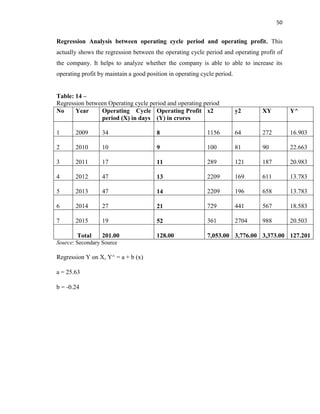
Regression Analysis between operating cycle period and operating profit. This
actually shows the regression between the operating cycle period and operating profit of
the company. It helps to analyze whether the company is able to able to increase its
operating profit by maintain a good position in operating cycle period.
Table: 14 –
Regression between Operating cycle period and operating period
No Year Operating Cycle
period (X) in days
Operating Profit
(Y) in crores
x2 y2 XY Y^
1 2009 34 8 1156 64 272 16.903
2 2010 10 9 100 81 90 22.663
3 2011 17 11 289 121 187 20.983
4 2012 47 13 2209 169 611 13.783
5 2013 47 14 2209 196 658 13.783
6 2014 27 21 729 441 567 18.583
7 2015 19 52 361 2704 988 20.503
Total 201.00 128.00 7,053.00 3,776.00 3,373.00 127.201
Source: Secondary Source
Regression Y on X, Y^ = a + b (x)
a = 25.63
b = -0.24
51
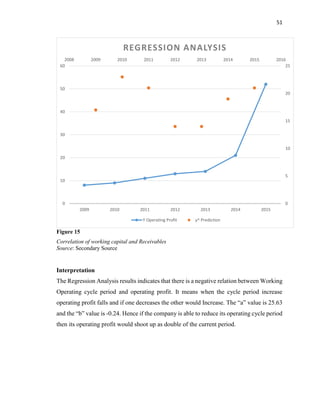
Figure 15
Correlation of working capital and Receivables
Source: Secondary Source
Interpretation
The Regression Analysis results indicates that there is a negative relation between Working
Operating cycle period and operating profit. It means when the cycle period increase
operating profit falls and if one decreases the other would Increase. The “a” value is 25.63
and the “b” value is -0.24. Hence if the company is able to reduce its operating cycle period
then its operating profit would shoot up as double of the current period.
2008 2009 2010 2011 2012 2013 2014 2015 2016
0
5
10
15
20
25
0
10
20
30
40
50
60
2009 2010 2011 2012 2013 2014 2015
REGRESSION ANALYSIS
Y Operating Profit y^ Prediction
52
SUMMARY OF FINDINGS, SUGGESTIONS AND CONCLUSION
Summary of Findings.
The study evaluates the performance of receivables management of Unibic foods India Pvt
limited and also analysis how it affects the performance of the company as a whole. It
analyses both liquidity and profitability of the company and their relationship with
receivables.
From the study it was evident that the company has a good and efficient performance in
the case of receivables. From all the tools that were used for the analysis of receivables
management performance it was evident that company has an efficient Credit management,
Credit policy and collection policy. When we consider the liquidity position of the
company, it is satisfactory and it shows that it is strong enough to meet its short term
obligations. The average current ratio of the company was 1.5 for the 7 years of study. In
the case of working capital also the organization is maintaining a good position and it was
evident that the company is giving more importance to receivables as much of the working
capital was being held in the form of receivables.
Then coming to the measurement of receivables management, the study showed that the
organization has a good management policy for receivables. It was able to maintain a high
debtor turnover ratio throughout these 7 years which shows that even though the amount
of receivables are going up it is able to collect it also as and when required. Also the average
no of days the invoices remain outstanding in a year is 2 to 3 months which shows the
efficient collection policies of the company. This is one of the main reason why the
company has a short cash conversion cycle because of which the company is able to
maintain good amount of current assets in the form of cash and are capable to meet its short
term obligation. The collection effectiveness index of the company also reveals the same,
the company is able to maintain the CEI % closer to 100 in these 7 years of period under
the study. Even when we consider the current assets of the company it shows that 50% of
the current assets are being held in the form of receivables. Thus the tools used for the
analysis discloses that company has an efficient management of receivables for the period
under study
53
The next part of the study focuses on how the receivables part affect the performance of
the company as a whole. Here the study focuses on how is the relation of receivables with
sales, how it affects the working capital of the company and the operating profit of the
company. The correlation coefficient of debtors and sales was positive, tested through the
hypothesis and concluded that the correlation between debtors and sales is significant. Also
there is a positive relationship between days sales outstanding and operating profit. Thus
the study as a whole shows that the organization has an efficient management of
receivables and thus has a strong liquidity and profitability position and would be able to
maintain the same in the future and achieve more success.
Suggestions
From the study it was evident the company focus mainly on increasing its top line and
efforts are made to increase them to. They are not focusing on Bottom line for the present
moment .But still the company was able to achieve a net profit for the first time in the year
2014-15.Thus the company should put more efforts to maintain this profit position and to
make improvement in the future. The average collection period should be maintained
the same level because the debtor’s collection period is found to be satisfactory. Also
they should try to this with the average day delinquent that is when one increase the other
should also increase. The company can also adopt measures to further increase the
receivables so that at the same time sales can also increase since there is appositive
relationship between both. When the sales increases automatically the profitability position
of the company can be improved. Also since the company has an efficient policy for
receivables management it can further increase the level of receivables. Hence if the
company is able to make these few changes it can further achieve more success in this
industry and can reach further heights as it is having a strong financial position.
54
CONCLUSION
The project study on the topic “study on performance of receivables management and how
it affects the performance of the company” was done at Unibic Foods India private Ltd.it
helped me to get clear picture of how an organization efficiently manages its receivables
and how the performance of receivables affects performance of the organization as a whole.
UNIBIC FOODS INDIA PRIVATE LTD”, which is one of the youngest company which
manufacturer’s and sells the different flavored cookies in India and all around the world. It
is located at the heart of Bangalore city which is the electronic capital of India. The main
products of Unibic are various varieties of cookies. It has a strong market base all around
India and even around the world.
Accounts receivable are customers who have not yet made payment for goods or services
which the firm has provided. The objective of the debtor management is to minimize the
time-lapse between completion of sales and receipts of payment. The management of
accounts receivable is largely influenced by the credit policy and collection policy of a
firm. Excessive level of debt in a company could affect the profitability position of a firm.
This is because if a firm has so many Debtors to pay, then they may become short of cash
which may lead to difficulty in settling their short-term financial obligations. Profit may
be called real profit after receivables are turned into cash. Thus the proper management of
receivables in a company would help the organization to have a good position in
profitability and in working capital
The study has accomplished several goals. The study has given a general idea about how
efficiently the organization is managing its receivables. It helped to analyze and understand
how the performance of receivables affects the performance of the organization especially
the liquidity and profitability positions. Since an organization cannot perform well
financially if it doesn’t have a good management of receivables, because it is asset where
a lot of cash of the organization gets held up. Thus an organization needs to manage it
efficiently and UNIBIC is able to do so due to which only the company able to achieve a
good financial platform within a short period of existence in India
55
BIBLIOGRAPHY
A. BOOKS AND JOURNALS
 Agrawal, N.K. (2003) Management of Working Capital, Sterling
Publishers Pvt, Ltd, New Delhi.
 Pandey, I.M. (1983): Financial Management, Vikas Publishing House Pvt.
Ltd., New Delhi.
 Annual reports of Unibic Foods India private Limited
 Maheshwari S.N, (1997) Financial Management Principles and Practice
Sultan Chand & Sons New Delhi.
 Jain, P.k. Khan, M.Y. (2005). Financial management. Place of publishing:
Tata McGraw-Hill Publishing Company Ltd, Fourth edition.
 Kothari, C.R. (2004). Research Methodology: Methods and technique
(2nd Ed). New Delhi: New Age International Publishers.
 Unibic Foods India Private Limited – Company Brochure
B. WEB SITES
 www.accountingtools.com
 www.unibicindia.com
 www.investopedia.com
56
ANNEXURE
57
Balance Sheet Unibic Foods India Private Limited
As on 31st
March 2015
Particulars Notes As on 31st March 2015 As on 31st March 2014
EQUITIES AND LIABILITIES
Share holders Fund
Share Cpaital 4 821266740 700459920
Reserves and Surplus 5 -366265350 -505137062
455001390 195322858
Non Current Liabilities
Long term Borrowings 6 3188048 0
Long term provisions 10 6388233 3308279
9576281 3308279
Current Liabilities
Short Term Borrowings 7 4594851 56050845
Trade Payables 8 95002912 106160053
Other current liabilities 9 109478032 46790428
Short Term Provisions 10 536841 606865
209612636 209608191
TOTAL 674190307 408239328
ASSETS
Non Current Assets
Fixed Assets
Tangible Assets 11 158474063 46154184
Intangible Assets 12 2864700 3470256
Capital Work in progress 0 4110828
Non Current Investments 13 16000 16000
Deffered Tax Assets 14 138802990 99473261
Long term Loans and advances 15 19014740 17746894
Other Non Current Assets 16 2533048 21825894
321705541 192797317
Current Assets
Cash and Bank balances 17 131470001 34853136
Trade receivables 18 110633035 92801797
Inventories 19 92602684 73305566
Short term loans and Advances 15 10601129 8873874
Other current assets 16 7177917 5607638
352484766 215442011
TOTAL 674190307 408239328
58
Receivables Performance Analysis Questionnaire for Expert Interview
Name:
Designation:
Date:
1. What is the basic objective for the company for the Next 5 years
o Increase Top line
o Increase Bottom Line
2. What is the Expected sales closing for the year 2015-16?
o 175 Crores
o 195 Crores
o 220 Crores
o More Than 240 Crores
3. What type of credit policy does the Unibic follow? ( Liberal or Strict)

4. What are some of the factors about customers are considered before granting
credit purchase facility?

59
5. How is the Ageing schedule of the debtors classified in Unibic (Eg. 10-20
Days .30-60 Days)

6. When is a customer account considered to be a Bad Debt?

7. How would you rate the collection effectiveness of receivables by the Depos
1 2 3 4 5
(Very Low) (Moderate) (Very High)
8. How do you Track the payment from the Customers
o Territory wise
o Channel wise
o Sales Person wise
o Others (Specify)
60
9. How do you receive the payments from the customers?
o Cash
o Cheque
o RTGS
o Others (Specify)
10. Do the company provide the facility of credit sales to foreign customers? “If yes”
do the company provide more time for repayment?

11. Does the aged accounts receivable balances periodically reviewed by supervisory
personnel? If yes how, Monthly or quarterly?

12. Does the cost of collecting receivables create a major impact on company’s
Bottom line?

61
13. What are the usual procedure followed for collecting receivables from customers?
(Mention in order)
14. How would you rate the overall receivables performance of the company for the
current year 2015-16
1 2 3 4 5
(Very Low) (Moderate) (Very
High)
15. What is your suggestion for furthering improving the receivables management of
the company? (New methods, If any)

Signature
a) e)
b) f)
c)
d)
62
Product Profile
Unibic Multigrain Cookies Unibic Oatmeal Digestive Cookies
Unibic Milk Cookies Unibic Doosra Jeera Cookies
Unibic Cashew Cookies Unibic Pista Badam Cookies
Unibic Butter Cookies Unibic Choco Nut Cookies
Unibic Gift Pack
63

Project Company Profile Main Copy 1

  • 1.
    1 An Introduction tothe study. This report is based on the project study on the performance of receivables management and its effect on performance of a firm, conducted at “UNIBIC FOODS INDIA PRIVATE LTD”, which is one of the youngest company which manufacturer’s and sells the different flavored cookies in India and all around the world. It is located at the heart of Bangalore city which is the electronic capital of India. The company Unibic Biscuits India Private Ltd was started in the year 2004 as a subsidiary of Unibic Australia and later became the subsidiary of Peepul capital fund III LLC, Mauritius Company and thus was renamed “Unibic foods India pvt ltd. In this report the Accounts receivables performance of Unibic Foods India Pvt limited has been studied and analyzed. Accounts receivable are customers who have not yet made payment for goods or services which the firm has provided. The objective of the debtor management is to minimize the time-lapse between completion of sales and receipts of payment. The management of accounts receivable is largely influenced by the credit policy and collection policy of a firm. Excessive level of debt in a company could affect the profitability position of a firm. This is because if a firm has so many Debtors to pay, then they may become short of cash which may lead to difficulty in settling their short-term financial obligations. Profit may be called real profit after receivables are turned into cash. Thus the proper management of receivables in a company would help the organization to have a good position in profitability and in working capital.The study was done for a period of two months from 1st March to 30th April 2016, focusing on the performance of receivables management and how does this receivables performance affect the financial performance of Unibic Foods India Pvt Limited., its financial performance, Company profile, and its products in their fields of business activities. The industry and the environment of the firm is analyzed in brief. The study revealed that the company has a good credit policy with its customers which neither to liberal nor strict. Thus the firm is able to run with not much cash being stuck in the form of receivables and thus able to enjoy a good position both in the area of Liquidity and Profitability. Hence with such a strong financial position the company would be able to achieve more success in the future.
  • 2.
    2 Statement of theProblem. The problem at hand is to analyze the receivables performance of the company with the aid of ratio analysis, that are used for better understanding of the financial performance of the company in the outlook of receivables performance. The issues relating to receivables management are looked into with suitable tools for the analysis. Correlation between receivables and sales and working capital, are used for analyzing the receivables performance of the company. Significance of the Study Receivables performance is one of the major factor that are used to analyse how financially well the company is being performing in the industry. It is used as the basis for providing short term loans and credits to the company by external financial companies. Thus a company should give importance to receivables and should ensure that it being managed well so that both liquidity and profitability factors are positively affected by it.This study is important as it helps to know the efficiency with which receivables are being managed at Unibic Foods India Pvt limited, Bangalore. The study helps to gain awareness about the various policies that are being followed regarding to receivables and how it effects the profitability and liquidity performance of the company. Objectives.  To study the performance of receivables management  To find out the Proficiency with which Receivables are Managed  To Assess the Role of receivables on sales  To Find out the Role of receivables on working capital position  To Evaluate the Role of receivables on operating profit of the company
  • 3.
    3 Literature Review. Barot Haresh(2012), this paper observed a negative relationship between accounts receivables and corporate profitability and a positive relationship between accounts payable and profitability. Consequently, it appears that profitability dictates how managers act in terms of managing accounts receivables. Thus, the findings of this paper suggest that managers can create value for their shareholders by reducing the number of days for accounts receivables. In addition, the negative relationship between accounts receivables and firm’s profitability suggest that less profitable firms should pursue a decrease of their accounts receivables in an attempt to reduce their cash gap in the cash conversion cycle. On the basis of findings of this paper, we conclude that profitability can be enhanced if firms manage their working capital in a more efficient way. Cash conversion cycle and the time of receivable turnover as its part is considered as closely linked to the performance of the small firms. Studies investigating this linkage, regardless of national conditions or branch, have proved that firms with more efficient cash conversion cycles reach higher firm performance and higher returns [Charitou et al., 2010, Ebben & Johnson 2011]. The studies also confirmed a positive relation between firm value and trade credit at low levels of receivable and a negative one at high levels [Ebben & Johnson, 2011]. Ranchandran, A and Janakiraman, M, (2009), Analyzed the relationship between working efficiency and earnings before interest and tax of the paper Industry in Indian. The study revealed that cash conversion cycle and inventory days had negative correlative with earnings before interest and tax, while accounts payable days and accounts receivable days related positively with earnings before interest and tax. Padachi.K (2006), examined the trends in working capital management and its impact on firms performance. The results proved that a high investment in receivables management would lead to lower profitability in a firm.
  • 4.
    4 Lazaridis and Tryfonidis(2006) also investigated relationship between accounts receivables management and corporate profitability for the firms listed in Athens Stock Exchange for a sample of 131 listed companies. The researcher used the company financials from 2001-2004 for the study. The results of the study of regression analysis showed that there was a statistically significant relationship between gross operating profit, a measure of profitability and the cash conversion cycle. He suggested that by optimizing the cash conversion cycle the managers could create value for the shareholders. Results of empirical analysis show that there is statistical evidence for a strong relationship between the firm’s profitability and its receivables management efficiency Deloof M. (2003) discussed that most firms had a large amount of cash invested in working capital. It can therefore be expected that the way in which working capital is managed will have a significant impact on profitability of those firms. Using correlation and regression tests he found a significant negative relationship between gross operating income and the number of days accounts receivable, inventories and accounts payable of Belgian firms. On the basis of these results he suggested that managers could create value for their shareholders by reducing the number of days’ accounts receivable and inventories to a reasonable level. Debasish Suret al. (2001). Attempted to study the association between the liquidity and profitability of Indian Private Sector enterprises as a case of Aluminum producing industry. He identified that there is a very high degree of positive correlation between liquidity and profitability of selected companies. They also observed that liquidity variables jointly influences of profitability of the selected companies. Hyderabad (1999) found that long-term funds were used for working capital and observed that flexibility and adjustment in the requirement of working capital depends on the availability and cost of working capital. Debasish Sur, (1997) conducted a study about in Working capital management in Colgate (Palmolive) India Ltd.
  • 5.
    5 He observed thatworking capital management is not satisfactory while compared with the conventional standard. This study has identified that the research gap for further research from the above reviews that this study can be viewed in component wise which could be researched in this study. Strischek , Dev (2001),A contractor's receivables represent two significant elements of contractor cash flow and working capital. Receivables constitute the major source of cash inflow, and payables absorb a big share of cash outflow. A construction company's ability to extend credit to its customers depends on its own trade creditors' willingness to wait for their payments from the contractor's collection of its progress billing receivables. The delicate balance of receivables and payables is key to the financial success of the contractor. Contract receivables take longer to collect, and the trade creditors expect prompt payment. The receivables ratio is a quick-and-easy test of contractor viability. Sims, C Paul, Jr; True, Patrick, (1997), Accounts receivable can represent a very sound repayment source because they will typically convert to cash faster than any other asset on the balance sheet. For the same reason, accounts receivable also can represent additional risks. There are 5 keys to relying on accounts receivable as a repayment source: 1. Making a prudent initial credit decision 2. Maintaining accurate and timely information 3. Ensuring control of the cash 4. Establishing effective monitoring procedures 5. Protecting against changing credit circumstances The 5 C's of credit - character, capacity, conditions, capital, and collateral - play a vital role in any prudent initial credit decision. The need for businesses to free cash from their receivables is not going to disappear. The banks most successful at capitalizing on this market opportunity will be those that recognize and control their receivables risk.
  • 6.
    6 Methodology of theStudy. The research work focus on the empirical analysis of the relationship between receivable management and performance of Unibic food India Pvt ltd. The ex-post factor research design was used because it involves events that have already taken place in the past. The records observed were observed a period of Six years. The variables tested were accounts receivable, PBT, operating profit, Working capital and sales. Research Design The function of research design is to provide for the collection of relevant evidence with minimal expenditure of effort time and money. This study is analytical and descriptive in nature. Data used for the research has been collected from primary and secondary sources. Primary sources Primary data are collected through formal interview with company officials. This was collected from the company officials in the finance department of Unibic Foods India Private limited using both quantitative and qualitative techniques. Quantitative data was collected through structured and formal questionnaires that were filled by the researcher himself while conducting the formal interviews. Qualitative data was collected by generating field notes and also conversations. Secondary Sources Secondary data on the other hand includes those data, which are collected from company records, books and journals on financial management, Balance sheet, Statement of Profit And Loss, Auditors Report and website. Data Analysis and Interpretation Various methods that can be used for analysing the data are Ratio analysis, Correlation study and Percentage analysis. Tables and Clustered Column Charts are some the various tools that can be used for presenting the data.
  • 7.
    7 Limitations of theStudy All the research projects are hindered in their smooth flow by some unforeseen factors. The problems arise in the form of constraints by time and scope of the study. The current project was also faced by certain problem. Some of the problems faced in the course of the research are as follows: Some of the limitations of the study that may affect are that the financial statements contain historical data which are not true indicators of the future. Also the data for project mainly from Profit and loss account and balance sheet of company.
  • 8.
    8 INDUSTRY PROFILE Introduction. Unibic FoodsIndia Pvt Limited belongs to the Biscuits and cookies industry. Indian Biscuits Industry came into major existence and started gaining a sound status in the bakery Industry in the later part of 20th century when the urbanized society called for readymade food products at a tenable cost. Biscuits were assumed as sick men’s diet in earlier days. But today it has become one of the most loved fast food products for every age growth. Biscuits are always easy to carry, tasty to eat, cholesterol free and reasonable at cost. States that have the larger intake of biscuits are Maharashtra, West Bengal, Andhra Pradesh , Karnataka & Uttar Pradesh .Maharashtra and West Bengal are the most Industrial developed states; hold the maximum amount of consumption of biscuits. Even, the rural sector consumes around 55% of the biscuits in the bakery products. Indian biscuits Industry seems to be the largest among all the food Industries and has a turnover of around Rs.14500 Cr in the fiscal year 2014-15. Indian subcontinent is known to be the third largest manufacturer of biscuits , the first being USA and second being China . The Industry is classified under two sectors: Organized and Unorganized. Bread and Biscuits are the major part of the bakery Industry and covers around 80% of the total bakery products in India. Biscuits today stand at a higher value and production level than bread. This belongs to the unorganized sector of the bakery Industry and covers over 70% of the total production. The penetration of biscuits in India among the urban and rural market is 85% and 55% respectively. Biscuits are always hygienically packaged nutritious snack food available at very competitive prices, volumes and different tastes. According to the NCAER analysis, biscuits are predominantly consumed by people from the lower strata of society, particularly children in both rural and urban areas with an average monthly income of Rs.750and above. While the country is the largest biscuit consuming nation, per capita consumption is low at 2.1kg – compared to Ireland, which is the highest at 21.76kg. The market for biscuits and cookies in India has come a long way accounting for 72 per cent of the sales in the bakery industry.
  • 9.
    9 Increasing consumption ofpackaged and convenience food, the availability of a variety of biscuits and an increase in disposable incomes have provided a major boost to the industry. Biscuits can he broadly categorized into the following segments in the Indian biscuit industry- Glucose Marie Cream Cookie Milk Others in this industry. Some companies focus only on some segments whereas giants like Britannia and Parle focus on all these major segments of biscuits. Current Scenario. India’s biscuit and cookie industry was valued at INR 145 billion (US $2.41bn) in financial year 2014, of which Britannia and Parle, account for 61 per cent of the market share, according to a Value Notes report entitled Biscuits and Cookies Industry in India: 2015-2019. The industry is expected to grow at a CAGR of 14 per cent, to reach INR 279 billion (USD $4.65bn) by 2019. Manufacturers are now aggressively entering the premium segment of the market. Biscuits and cookies were considered to be a product of mass consumption. However, with changing tastes and preferences, and increasing affluence, this no longer seems to be the case. Increasing indulgence, health concerns and familiarity with luxurious taste, which has developed among Indian consumers has led Indian manufacturers to experiment with a variety of biscuits and cookies. This has also led to higher growth in the premium segment compared to the economical and mid segments of the industry. Today Biscuits contributes to over 33 % of the total production of bakery and above 79 % of the biscuits are manufactured by the small-scale sector of bakery industry comprising both factory and non-factory units in the country. Today the large scale bakery manufacturers like Cadbury, Nestle, and Brooke bond had traded in the biscuit industry but couldn't hit the market because of the local companies that produced only biscuits. Government has established The Federation of Biscuit Manufacturers of India (FBMI) which has confirmed a bright future of India Biscuits Industry. According to FBMI, a steady growth of 15 % per annum in the next 10 years will be achieved by the biscuit industry of India. Besides, the export of biscuits will also surpass the target and hit the global market successfully.
  • 10.
    10 Total Contribution tothe Economy/ Sales in India. The total revenue of the biscuit industry for the fiscal year 2014-15 was 14500 crores. Biscuit industry contribute Rs.8,000 crore to the FMCG industry today, provides vast opportunity for growth, as the per capita consumption of biscuits is less than 2.1 kg in our country. It is one of the major contributor to the GDP of India and creates a major impact on the development of the Indian economy. Apart from Big 3(Britannia, Parle, ITC) there are around 150 medium to small biscuit factory in India. Key Verdicts for the Industry in India. The biscuits and cookies industry in India, valued at INR 145bn in FY 2014, has been growing at a CAGR of 10% over the last three years. It is estimated that the industry will be worth nearly INR 279bn by FY 2019, growing at a CAGR of ~14%.Growth of this segment is expected to slow down as manufacturers are offering discounts to push volume sales, which in turn has slowed down the value growth of the industry. The share of glucose biscuits is expected to decline as they have reached a point of saturation. With rising incomes, consumers are being lured towards cream biscuits and cookies instead of glucose biscuits. Share of premium biscuits is likely to increase by FY 2019 as manufacturers are now aggressively entering the premium biscuit and cookie segment on account of higher margins prevalent in the segment. Increase in disposable income, changing lifestyles, growth in organized retail and increasing consumption of processed and packaged food are the main drivers of the industry. Latest trends witnessed in the industry reveal that companies are engaged in improving product packaging Also, concerns like growing media coverage on health, rising incidence of health conditions, increasing concerns over physical appearance, changing lifestyle and soaring costs of healthcare have led the biscuits and cookies market to move towards a healthier path. Impact on the Biscuit and cookie industry. These trends offer huge risks and equally outsized opportunities for the for the Indian Biscuit and Cookies industry. To address them in a way that results in real competitive advantage, it’s critical to understand the specific ways that these trends are already affecting companies in the industry.
  • 11.
    11 E-retailing of bakeryproducts. This is new trend in this industry which can create a major impact on the top line of all major companies in this industry. E-Retailing has been adopted by many companies as strategy for reaching all levels of customers all around the country. It is an unexplored distribution channel in this industry which can be explored and exploited by the companies in this industry. Shift in consumer demand. Consumers appear to be rethinking their relation with Biscuits brands and are viewing biscuits as food not only as a snack but also the health content and taste. Although this is not likely to have a major impact on sales volume, it is affecting how much people are willing to pay for Biscuits. Consumers are also demanding more cookies in the premium segment, and are expecting more tasty and quality features in the biscuits. Improved Packaging. Packaging is one of the major factor that affect the demand for baked products. There are many new technologies that can provide both safety and aesthetic quality for the products. Hence the companies in this industry should try to make upgradation in there packing as and when required. The Aesthetics qualities and features of the package of such biscuits also create a major impact on the demand for the products in this industry. Hike in Central Excise Duty and other taxes by the government. All the companies in this industry expected that the government would reduce the central Excise duty on the food products. But there hasn’t been any change in the duty and also there has been a small hike in the duty. Hence the companies are forced to increase the price of their product. The taxes on the raw materials and finished goods are still continuing to be a major problem in this segment. Especially the non-implementation of GST tax system is affecting the industry badly. Rise in the prices of basic Raw materials. There has been a hike in the price of the basic raw materials that are used for the production of cookies and biscuits like Milk, Sugar, Flour and Butter etc. For the past 5 years there has been a constant rise in the price of raw materials that are being used for the production of biscuits and cookies.
  • 12.
    12 COMPANY PROFILE Introduction. Unibic FoodsIndia Pvt Limited (Formerly known as Unibic Biscuits India Pvt Limited) is a leading domestic Cookie brand with an exclusive focus on the "premium" segment of the cookies market in India. The Company mainly focuses on the "Indulgence" and "Health & Wellness" category and offers differentiated products. Unibic Foods India Private limited was incorporated in July 2004, with an initial investment of Rs 15 Crore. The company was established as an Indian subsidiary of the fourth largest Australian cookie maker, Unibic Australia. Unibic has been manufacturing and marketing premium cookies in India since 2004, with the objective of carving a niche at the premium end of the market and the company has been satisfying the consumers with great taste. However, today UNIBIC Foods India Pvt Ltd. is a privately held company backed by reputed international private equity firms. The company is headed by its Managing Director Mr. Nikhil Sen. Headquartered in Bangalore, UNIBIC has a state-of-the-art manufacturing unit located a little outside the city. The company has been manufacturing and marketing premium cookies for 10 years in India. UNIBIC India started as an organization marketing two variants of cookies and now the company grown leaps and bounds since. The company now market close to 30 different types of cookies in the Indian market. It also export to multiple countries across the world. It is one of the fastest growing FMCG brands in the country and we remain committed to delighting consumers with unique, premium products. Unibic operates in the high-margin cookies segment in India, with a share of around 8%. The company retails biscuits in India, has strategic alliances to make cookies for PepsiCo's Quaker, Future Group's Tasty Treat and Cafe Coffee Day besides exports. Sen says it will continue to focus on the health and wellness platform. Its recent launch was a sugar-free cookie. The 12,000-crore biscuits market consists of big players such as Parle Products, Britannia, ITC, United Biscuits and Cremica, besides several regional players. In India the largest markets for the company are in the South of the country.
  • 13.
    13 The company isalso present in various cities and towns in Maharashtra, West Bengal, and North East and in Delhi NCR. The company is growing rapidly and are entering new markets every month. The company also export to countries like UK, Korea, Australia, New Zealand, Middle East and many more. Forward looking statement. We have grown, and intended to grow, focusing on harnessing our willingness to experiment and innovate our ability to transform our drive towards excellence in quality, our people first attitude and our strategic direction. Vision. To achieve this by delighting customers with Fresh and healthy food products, those are a benchmark for quality in the Industry. To be a preferred employer by nurturing entrepreneurship, managing career aspirations and providing innovation avenues for enhanced employee prosperity. Mission. Providing customers with hygienic, affordable and convenient supply of fresh and healthy food products. Tag Line. “Delight in Every Bite” Slogan. When you are happy, we are happy We live for your Health and Happiness Customer. Timely supply of Quality & Healthy Products. High customer satisfaction. Employees. Enhancing the Technical and Managerial skills of Employees through continuous training and development. Best appraisal systems to motivate employees. Incentives, bonus and rewards systems to encourage employees Qualities of Management Principles. Customer focuses to understand and meet the changing needs of the expectations of customers. People involvement to promote team work and tap the potential of people. Leadership to set constancy of purpose and promote quality culture throughout the organization. Process approach to assess the efficiency and effectiveness of each process. System approach to understand the sequence and interaction of process. Factual approach to decision making is used to ensure its accuracy.
  • 14.
    14 Unibic follows asocial marketing principle for all its brands. Globally, the company supports such social initiatives through association with various charitable organizations. On the promotional side, the brand is not an aggressive promoter compared to its competitors. Infact some of their advertisements landed them into trouble in the past. When Unibic was launched, it directly pitted itself against the market leader Britannia. Share Holding Pattern. Unibic foods India is a private company limited by shares. The shares of Unibic are held majorly held by Peepul capital fund III LLC (72%), Mauritius, which is the holding company of Unibic Foods. Around 25% of the remaining share are held by Busi India Holdings Limited. Remaining shares of the company are held by the promoters of the company. Figure 1: Share Holding of Unibic Foods India Pvt Limited Brief History. Since the early 1950s, Australian food manufacturer Unibic has been producing fine specialty biscuits, cakes and pastries for local and international markets. In order to meet rising market demand for its popular brands, Unibic recently upgraded its Melbourne production facility with the addition of a new high-output manufacturing line. Unibic the Australian company is known for manufacturing specialty biscuits and cookies. Unibic came to India in 2005. The company at that time had three brands: Anzac, Bradman and Butter Cookies.
  • 15.
    15 Unibic was incorporatedin India in August 2004 as a joint venture between premium cookies maker Unibic Australia and Dhruv Deepak Saxena, a Melbourne-based serial entrepreneur, who has since exited the business. The company started operations in March 2005 importing two cookie brands, Anzac (oatmeal) and Bradman (chocolate chip), from Unibic Australia. By late 2005, its manufacturing unit in India was up and running, producing cookies at costs that were as much as 40% lower than procuring them from Australia. A five-year deal with Amalgamated Bean Coffee Trading Co for supplies to its Café Coffee Day outlets came as a shot in the arm for Unibic India. It went on a marketing overdrive, spending Rs.7.5 crore on advertising and promotions in 2006. Around 60% of this was for television commercials aired on southern regional and national channels. The rest was on association with sports events and cricket, where it brought the Unibic Bradman 20/20 tournament to India Unibic Foods India Pvt Ltd had its genesis in Australia where the brand Unibic originated. Unibic India was set up as a subsidiary of Unibic Australia. By early 2007, Nikhil Sen was on board with sweat equity, as COO. Soon after, it established a retail and distribution presence in a few southern states, and bagged an export deal from Australian supermarket Coles. This was also the time that US-based private equity firm Lighthouse Capital picked up a reported 20% stake in the company. The next few years saw the company further consolidate its presence in South India, sign on Australian supermarket chain Woolsworth as a customer, and receive an eligibility certificate by the British Retail Consortium for exporting cookies to the UK market. Its private label business had begun to grow by now, as well. By 2010, its revenues had reportedly touched Rs.60 crore. Unibic’s fresh-off-the-oven success caught the fancy of FMCG major Marico, which evinced interest for a 51% stake in the company in late 2010. The protracted talks eventually fell through, and in 2011, Lazard India Private Equity picked up Unibic Australia’s majority share in the Indian holdings. Yet again, in late 2012, private equity firm Peepul Capital bought out Lazard private equity’s majority stake in Unibic India for a reported Rs.100 crore. Its current owners now include Peepul Capital and Lighthouse Capital, with Sen’s holdings said to be in the 10-15% range.
  • 16.
    16 The Indian businesscontinues to pay a nominal royalty to Unibic Australia for use of the brand. However, today Unibic Foods India Pvt Ltd. is a privately held company backed by reputed international private equity firms. The company is headed by its Managing Director Mr. Nikhil Sen. Headquartered in Bangalore, Unibic has a state-of-the-art manufacturing unit located a little outside the city. Armed with sufficient funds, this time around Unibic is betting on a favorable environment to grow faster than it has so far. Its timing could be just right. The composition of India’s biscuits market has changed significantly over the past couple of years with the share of glucose biscuits, traditionally the largest selling category, coming down. Hence the company also should make the adjustments according to the industry so as to capture more share of cream of the biscuit industry Nature of Business Carried. The company Unibic Foods India Pvt limited mainly focus at the premium segment of the Indian Biscuit industry. Its nature of business is basically manufacturing of different flavours of cookies. The company also started operating in the health segment of the biscuit industry by providing sugar free cookies to its customers. The company is in operation only for more than a decade in India from being established from 2004 with a strong base of existence in Australian cookie market for the past 60 years. The company is tailored to meet the needs of the customers from both higher and lower income strata of the market. The company believes on the philosophy of carrying on business not only with aim of making profit but also to serve the society by providing high quality products with great taste to the customers. Current Market. Unibic India started as an organisation marketing two variants of cookies and now the company have grown leaps and bounds since. It has market close to 30 different types of cookies in the Indian market and also exports to multiple countries across the world. Unibic cookies are being retailed through more than 100,000 outlets across the country. 60% of sales of Unibic comes from south India, and the rest from metros such as Delhi and Mumbai. While Unibic’s retail brands bring in 70% of revenues, its contract manufacturing and private label business contributes another 20-25%.
  • 17.
    17 It makes cookiesfor Café Coffee Day and Indigo for its onboard service, and for the private labels of Future Group for its Tasty Treat store brand and Aditya Birla Retail’s “More chain”, which sells its own food products under the Feasters label. The rest comes from exports to the US, UK, New Zealand and countries in West and South East Asia. Unibic have around 7-8% of the premium cookie market and hope to achieve 10% market share over the next 12-18 months. The Company is also looking to expand its market share in the health and wellness segment. Business Performance. During the year 2014-2015 the company had a turnover of 140 crores. Compared to last year the company had an increase of 77% increase in revenue. In the year 2015-16 the company also made a net profit of Rs.9 crores. The company made a net profit for the first time after being established in the year 2004.The company has a shelf spaces in all major branded retail stores like Big Bazar, Spar stores, Reliance stores and Lulu. As a result of this the products of the company has even become renowned all over India with a short span of time. Hence the company is growing in its revenue and customer loyalty year by year. Exports. Unibic has a good market base in the foreign markets also. It makes exports to all major countries in the world. Some of the countries to which the company makes its exports are Australia, China, UAE, Qatar, Bahrain, Oman, Jordan, Kuwait and many more. The revenue which the company earns from exports are increasing year by year. It makes exports under two brands Unibic cookies and Unibis cookies. UNIBIS is the flagship international brand from UNIBIC Foods India Pvt. Ltd. UNIBIS is sold in the USA, the UK and 12 other countries around the world. UNIBIS cookies are made using the finest ingredients and meet high quality standards. Around 4% of the total revenue of the company comes from exports of cookies. But the percentage increase in the revenue from exports is comparatively less compared to domestic sales, thus efforts should be taken by the companies to increase its revenue from foreign markets.
  • 18.
    18 Manufacturing Facilities. Thefactory of the company is located at Huskur Road in Bengaluru. It has state-of-the-art machines imported from Italy with two oven lines working at 75% capacity. The processes are employed to make its cookies lend an authentic texture. The company claims that is the first biscuit maker in India to use wire cut technology in baking cookies and it is the only method available to make cookies softer and chewy, unlike biscuits. Biscuits are typically made through sheeting and cutting or rotary molding. In sheeting and cutting, the dough is passed through rollers to get the desired thickness and then cut using plastic or metal dies. The dough has to be kept hard so that it retains its shape when the extra scrap is being removed after. In rotary molds, the dough needs to be compressed into dies or slots mounted on a roller with extra dough being scraped off. The dough needs to be stiff here as well for the biscuits to retain their shape. In wire cut technology, the short dough or much softer dough is extruded through a die and cut by wires at regular intervals without being pressed by rollers. Future Plans. With growth in the cookie market estimated at 20-25%, the company expects its business to grow faster at 35% in the near future. It is lining up new products such as chyavanprash based and a sugar-free cookies, even as it works on growing reach among the top 20% population towns. “Expanding distribution is key for the company and it is working on it diligently. The target is to eventually have a pan-India presence, especially by increasing retail reach in north Indian cities such as Jaipur and Chandigarh, and in cities such as Pune and Nasik in the West, by the end of the current financial year. Also in the case of promotion the focus is strictly on below-the-line (BTL) activities such as in-store promotions and on social media outreach. Thus the company has already started making and implementing strategies to achieve these plans and targets.
  • 19.
    19 Corporate Information. Incorporated nameUnibic Foods India Pvt Ltd. Head Quarters Address Unibic Foods India Pvt Ltd. Shreeram Nivas, No.1134. 100ft Road, HAL 2nd Stage, Indiranagar, Bangalore - 560038 Phone no 91 80 2520 1359 Connected to all Departments Website www.unibicindia.com Class of Company Private Company Year of Establishment 8th July2004 Holding Company Peepul Capital Fund III LLC Managing Director Nikhil Sen Business Outline Manufacturing, sales and related business of wide varieties of quality cookies. Figure 2: Corporate Information about Unibic Foods India Pvt Limited
  • 20.
    20 PRODUCT PROFILE Unibic isleading cookie brand in Australia for 40 years, The Company has the pride for crafting cookies that are a cut above the rest. Having already taken Australia, New Zealand & UK by storm, the company has begun its romance with India in 2004. And since then, we have not looked back. With a strong pan-India presence in over 100000 outlets and an extensive coverage across all channels, Unibic is the largest “real cookie” company in India. For the last ten years, the bakers at UNIBIC have been baking perfect, crunchy and delightful cookies. The cookies of Unibic are made with the best ingredients and mixed with selected fruits, nuts and spices to create a range over 20 flavors that will delight our taste buds! Unibic provides cookies that would indulge our senses with chocolate, love butter and cashews, which is a savoury snack to go with tea or even want to go sugar free, the company has the perfect cookie for every want of the customers. The company started selling cookies in India with two iconic flavors, – Anzac Oatmeal Cookies and Bradman Choco chip Cookies – that has a legacy with connection with Australian cookies. Then it created many more flavors and today it offer a Bicalcious range of over 20 different cookies. The company also plans to increase its no of varieties in the cookie segment as the demand for the cookies are increasing day by day. Even the exports of the cookies are being increasing both geographically and revenue wise. The Export name of the cookies are “Unibis” Instead of Unibic. They are being exported to all major countries around the world. Health segment is another segment where the company has a firm foot print. It provides wide varieties of sugar free cookies which helped the company to enter that segment. Chocolate Flavored cookies of Unibic are the most demanded variety of cookie demanded by the customers. Unibic today provides flavors from chocolate, milk, fruit & nut, honey oatmeal, multigrain, cashew, pista-badam, butter, oatmeal, chilly, sugar free, sugar free cream cookies, special cookies for gifting and many more. Some of the cookies that are provided by Unibic are provided below:
  • 21.
    21 1. Unibic CashewCookies are an all-time favorite of customers. It is combined with the rich taste of butter and the crunchy goodness of cashew nuts. These cookies are highly preferred eatables for the breakfast. 2. Unibic Pista Badam. Cookies packed with real goodness of Pista & Badam along with the crunchiness it is available in various delicious tastes, these Cookies can also be eaten as raw and liked by the people of all the age groups. 3. The Ginger nut cookies. Are acknowledged as a heartwarming combination of real ginger and real cinnamon, in golden syrup. These are prepared under hygienic environment using advanced technology and quality assured ingredients. 4. Unibic Butter Cookies are baked with dollops of butter, these crisp cookies let you savour the real taste of butter. These cookies contain 15% butter, three times more than all other butter cookies that are available in the market. 5. Choco Ripple Cookies are the latest addition to the UNIBIC Family. This chocolaty cookie crumbles with every bite. Priced at Rs. 10 for 75 Gram this cookie is a crispy crunchy delight for your taste buds as well as your pocket. 6. Choco Nut Cookies. Are mainly for who love nuts as much as chocolates will love this nutty and chocolaty combination. Choco Nuts are best served with piping hot coffee. These are made with purest and good quality nuts and chocolates. 7. The Choco chip cookies. From Unibic are sprinkled with chocolate chips, which is also its most prominent distinguishing ingredient. The ingredients of this traditional recipe are butter, white and brown sugar and semi-sweet chocolate chips.
  • 22.
    22 8. The Fruitand Nut Cookies. These are deliciously chewy and soft and are stuffed by experts with cranberry, blackberry, cashew, glazed fruits, and almond bits that make your taste buds go nuts. These are prepared with whole wheat flour and other needed ingredients. 9. Unibic Multigrain Cookies are made with the exotic blend of 5 grains, which are coupled with natural richness of black currant, cranberry, almond, dates and honey. It has a longer shelf life, Healthy for body growth and Good in taste. 10. Unibic Oatmeal Digestive cookies are the most demanded cookie in the health segment, these Oatmeal Digestive Cookies can also be eaten as raw and liked by the people of all the age groups. 11. Unibic Milk cookies. It offers only one cookie now in this segment. Unibic Milk Cookies have always been one of the preferred choices of children and adults owing to their pleasing mouth-watering taste and shapes. 12. Doosra Jeera Cookies. Are known for their freshness, purity, rich taste, crispiness, remarkable packaging options, longer shelf life, flavor, affordable prices and color. 13. Unibic Gift Range are available with wide variety of cookies in a single pack. These package are provided on different festivals and celebrations. Different Packages contain different flavoured cookies and these are of great demand among the customers. The company provide these Cookies in hygienic and customer friendly packing,
  • 23.
    23 DATA ANALYSIS ANDINTERPRETATION In the following chapter the data collected from the organization has been analyzed and interpreted. All the analysis has been made strictly according to the objectives of the project study. The main focus of the study was analyzing the performance of receivables management in the organization and also how it affects the performance of the organization. That is how it affects the profitability and Liquidity performance of the organization. Accounts receivable are customers who have not yet made payment for goods or services which the firm has provided. The objective of the debtor management is to minimize the time-lapse between completion of sales and receipts of payment. The management of accounts receivable is largely influenced by the credit policy and collection policy of a firm. Excessive level of debt in a company could affect the profitability position of a firm. This is because if a firm has so many Debtors to pay, then they may become short of cash which may lead to difficulty in settling their short-term financial obligations. Profit may be called real profit after receivables are turned into cash. Thus the proper management of receivables in a company would help the organization to have a good position in profitability and in working capital Various methods that can be used for analysing the data are Ratio analysis, Correlation study and Percentage analysis. Tables and Clustered Column Charts are some the various tools that can be used for presenting the data. These methods are used to analyze and interpret the objectives for this study. All the evaluations are being done with the help of the data provided by the company. Data collection was done from the company’s financial statements. Depth interviews were conducted by interviewing the officials in the receivables department, to get solicit and direct information of the performance of receivables management. Correlation as well as percentage were also used for analysis of some of the data. The following shows details of analysis and the interpretation that was done from the same
  • 24.
    24 Current Ratio. Thestandard test of liquidity is the current ratio. It measures the firm’s ability to pay off its short term liabilities with current assets. It is also called Working Capital Ratio or Bankers Ratio. The accepted standard of liquidity is 2:1. Table: 1 Current Ratio Year Current Asset (in Rs.) Current Liabilities (in Rs.) Current Ratio 2009 89,009,470 64,603,654 1.38 2010 111,223,912 71,781,838 1.55 2011 180,181,846 92,766,952 1.94 2012 176,954,241 162,903,169 1.09 2013 284,710,161 195,553,843 1.46 2014 215,442,011 209,608,191 1.03 2015 352,484,766 209,612,636 1.68 Source: Secondary Source
  • 25.
    25 Figure 3 Current Ratio Source:Secondary Source Interpretation. Here the current ratio shows a varying trend for the 7 years starting from 2009 to 2015 that makes the ratio to increase as well as decrease. In the year 2009-2010, the current ratio was at 1.38 and now it has increased to 1.68 in the year 2015 with a high and low ratio in between. Although the current ratio of the company are fluctuating every year, the rate of change is less which is a good sign. It shows that the company is able to maintain a good liquidity position. Basically it shows that even if the current liabilities of the companies are increasing. The current assets position are also increasing at a higher rate. Also the increase in current assets are happening mainly because of the rise in components like Cash and Receivables than inventories, which shows that the company is able to quickly convert its inventories into sales and able to collect the cash back from credit sales.All in all the company is able to maintain its current ratio at an average of 1.5 for the seven years which is below the standard of 2:1, but is good as more than 60% of the current asset are being held as receivables and cash. 2009 2010 2011 2012 2013 2014 2015 1.38 1.55 1.94 1.09 1.46 1.03 1.68 CURRENT RATIO Current Ratio
  • 26.
    26 Working Capital Position.Working capital is a measure of both a company's efficiency and its short-term financial health. It indicates whether a company has enough short term assets to cover its short term debt . Working Capital = Current Assets - Current Liabilities Table: 2 Working Capital Position Year Current Asset (In Rs.) Current Liabilities (In Rs.) Working Capital 2009 89,009,470.00 64,603,654 24,405,815 2010 111,223,912.00 71,781,838 39442074 2011 180,181,846.00 92,766,952 87414894 2012 176,954,241.00 162,903,169 14051072 2013 284,710,160.76 195,553,843 62702778 2014 215,442,011.00 209,608,191 5833820 2015 352,484,766.00 209,612,636 142872130 Source: Secondary Source
  • 27.
    27 Figure 4 Working CapitalPosition Source: Secondary Source Interpretation This chart shows the working capital position of the company for the past 7 years starting from 2009 to 2015.The Company was able to maintain a positive working capital position for the past 7 years successfully. During the years 2012 and 2014 there has been a huge fall in the working capital position but still it hasn’t gone to negative level. This shows that the company has a good liquidity position with which it would be able to pay off its short term liabilities. It also shows that funds are not being tied up in the form of inventory or receivables. The highest level of working capital has been recorded in the latest year that is 2014-15. This provides a good insight that the company would be able to make expansions in the future. - 20,000,000 40,000,000 60,000,000 80,000,000 100,000,000 120,000,000 140,000,000 160,000,000 2009 2010 2011 2012 2013 2014 2015 Working Capital Position
  • 28.
    28 Distribution of WorkingCapital. It is done to analyze which component of the current assets and current liabilities contribute maximum to the working capital requirement of the company. Here Items like Receivables, Inventory and Payables contribution to working capital are being considered. Table: 3 Proportionate Contribution of Receivables, Inventory and Payables to Working Capital Source: Secondary Source Year Receivables Proportionate of Receivables in Working capital Inventory Proportionate of Inventory in Working capital Payables Proportionate of Payables in Working capital Working capital 2009 49,774,745 2.04 22,165,728 0.91 38,902,847 1.59 24,405,816 2010 57.877,610 1.47 31,665,326 0.80 68,457,630 1.74 394,42,074 2011 102,392,593 1.17 54,949,126 0.63 86,673,992 0.99 874,14,894 2012 107,120,837 7.62 55,517,181 3.95 70,718,198 5.03 14,051,072 2013 77,019,301 1.23 47,164,024 0.75 48,758,390 0.78 62,702,778 2014 92,801,797 15.91 73.305,566 12.57 106,160,05 3 18.20 5,833,820 2015 110,633,035 0.77 92,602,684 0.65 95,002,912 0.66 142,872,130
  • 29.
    29 Figure 5 Proportionate contributionto Working capital Source: Secondary Source Interpretation This chart shows which component is given importance in the working capital of the company for the past 7 years starting from 2009 to 2015. From the study it is evident that all three components are given equal importance by the company. But more amount of working capital is being held in the form of receivables and payables than as inventory. This shows that as and when the goods are produced by the company, it is quickly getting sold off. Thus cash conversion cycle for the company would be less since they are able to convert finished goods into sales and sales into cash faster. 0.00 2.00 4.00 6.00 8.00 10.00 12.00 14.00 16.00 18.00 20.00 2009 2010 2011 2012 2013 2014 2015 Proportionate Contribution of Receivables, Inventory and Payables to Working Capital Proportionate of Receivables on Working capital Proportionate of Inventory on Working capital Proportionate of Payables on Working capital
  • 30.
    30 Debtors Turnover Ratio.It is an activity ratio. The ratio indicates the velocity of debt collection of a firm or number of times average debtors are turned over during a year. Volume of sales can be increased by following a liberal credit policy. Net Sales is calculated by deducting sales returns from sales. Average Debtors is calculated by adding together the beginning and ending accounts receivables and dividing it by two. Table: 4 Debtors Turnover Ratio Year Average debtors Sales Debtors Turnover Ratio 2009 65,702,663 361,192,937.40 5.50 2010 53,826,178 401,325,486.00 7.46 2011 80,135,102 521,986,942.00 6.51 2012 104,756,715 530,113,565.00 5.06 2013 92,070,069 501,112,097.00 6.51 2014 84,910,549 741,167,432.00 8.94 2015 101,717,416 1,313,531,451.00 12.91 Source: Secondary Source
  • 31.
    31 Figure 6 Debtors TurnoverRatio Source: Secondary Source Interpretation This chart shows the debtors turnover ratio of the company for the past 7 years starting from 2009 to 2015. Here we can observe that the company is able to maintain a high level of debtor’s turnover ratio throughout the period of study. And in the latest year that is in the year 2014-15 the company has maintained the ratio at 12.91, which is the highest recording during the period of study. High level of debtor’s turnover ratio is a good sign for the company because it shows that the company is able to collect the cash which are stuck in receivables as and when required. Also it shows that the company has an efficient credit policy because it is not as strict as the top line of the company is continuously increasing at a higher rate and at the same time able to collect cash from the debtors. 2009 2010 2011 2012 2103 2014 2015 5.5 7.46 6.51 5.06 6.51 8.94 12.91 DEBTORS TURNOVER RATIO Debtors Turnover Ratio
  • 32.
    32 Days Sales Outstanding.Day’s sales outstanding (DSO) is a measure of the average number of days that a company takes to collect revenue after a sale has been made. Days Sales outstanding = Average Receivables / Net sales *365 Table: 5 Days Sales Outstanding Year Average debtors Sales Days sales outstanding 2009 65,702,663 361,192,937.40 66 2010 53,826,178 401,325,486.00 49 2011 80,135,102 521,986,942.00 56 2012 104,756,715 530,113,565.00 72 2013 92,070,069 501,112,097.00 56 2014 84,910,549 741,167,432.00 41 2015 101,717,416 1,313,531,451.00 28 Source: Secondary Source
  • 33.
    33 Figure 7 Days SalesOutstanding Source: Secondary Source Interpretation This chart shows the day’s sales outstanding of the company for the past 7 years starting from 2009 to 2015. Here we can observe that the company is able to collect the credit sales amount from its customers within a period of 2 to 2 and half months (highest). The maximum was observed during the 2012 where it took 72 days for collecting the receivables amount. It shows that the company has an efficient collection policy due to which the no of days the invoices are outstanding are less. 2009 2010 2011 2012 2013 2014 2015 66 49 56 72 56 41 28 DAYS SALES OUTSTANDING Days Sales Outstanding
  • 34.
    34 Operating Cycle Periodor Cash Conversion Period. The cash conversion cycle (CCC) is a metric that expresses the length of time, in days, that it takes for a company to convert resource inputs into cash flows. The cash conversion cycle attempts to measure the amount of time each net input dollar is tied up in the production and sales process before it is converted into cash through sales to customers. This metric looks at the amount of time needed to sell inventory, the amount of time needed to collect receivables and the length of time the company is afforded to pay its bills without incurring penalties. Operating Cycle Period = Days sales outstanding + Days Inventory Outstanding – Days Payable outstanding Table: 6 Operating Cycle Period Source: Secondary Source Date Days sales outstanding Days Inventory Outstanding Days Payable Outstanding Operating Cycle Period 2009 66 43 75 34 2010 49 40 79 10 2011 56 50 89 17 2012 72 58 83 47 2013 56 58 67 47 2014 41 48 62 27 2015 28 42 50 19
  • 35.
    35 Figure 8 Operating CyclePeriod Source: Secondary Source Interpretation Operating cycle is a measure of the operating efficiency and working capital management of a company. It is able to maintain the cash conversion cycle consistently in the range of 10-50, which is not so fluctuating. A short operating cycle is good as it tells that the company's cash is tied up for a shorter period. Here the cash conversion cycle of the company is of shorter period which is a good sign of efficient financial performance. This shows that the cash of the company is not tied up in receivables or inventory. Also since the products the company is dealing with are FMCG that has a great demand in the markets, thus would be able to realize the cash and maintain operational efficiency. 2009 2010 2011 2012 2013 2014 2015 34 10 17 47 47 27 19 OPERATING CYCLE PERIOD Operating Cycle Period
  • 36.
    36 Average Days Delinquent.Average Days Delinquent (ADD) calculates the average days invoices are past due. This provides a snapshot to evaluate individuals, subgroups or overall collection performance. Average Days Delinquent = Days Sales Outstanding - Best Possible DSO Table: 7 Average Days Delinquent Year Days Sales Outstanding ( In days) Best Possible DSO ( In days) Average Days Delinquent ( In days) 2009 66 50 16 2010 49 53 -4 2011 56 72 -16 2012 72 74 -2 2013 56 56 0 2014 41 46 -5 2015 28 31 -2 Source: Secondary Source
  • 37.
    37 Figure 9 Average DaysDelinquent Source: Secondary Source Interpretation This chart reveals the collection performance of the company for the past 7 years. Here we can observe that the ADD and DSO are moving in the same direction till 2011 and in the year 2015. It means when the DSO of the company rises ADD also rises and when DSO falls ADD also fall. It shows the relation between credit and collection process. When there is an improvement in credit policy then the collection figures also improve. When there is a downfall of the same the other also fall. Here there was a fall in 2010 in credit policy as a result it affected the collection also. But after that there is an improvement in both till 2012.From 2012-2014 we can observe that DSO and ADD are moving in the opposite direction. This reveals that some external changes must have affected the receivables performance. Basically due to change in credit terms or policies. Hence the company should take steps to avoid such opposite movement of DSO and ADD. 2009 2010 2011 2012 2013 2014 2015 16 -4 -16 -2 0 -5 -2 66 49 56 72 56 41 28 Average Days Deliquent DSO
  • 38.
    38 Collection Effectiveness Index(CEI). The collection effectiveness index (CEI) is a measure of the ability of the collections staff to collect funds from customers. It operates at a somewhat higher level of precision than the day’s sales outstanding measurement, and so is finding increasing popularity among collection managers. The collection effectiveness index compares the amount that was collected in a given time period to the amount of receivables that were available for collection in that time period. A result near 100% indicates that a collection department has been very effective in collecting from customers. Collection Effectiveness Index (CEI) = (Beginning AR + Sales – Ending AR) / (Ending AR + Sales – Current AR) * 100 Table: 8 – Collection Effectiveness Index Source: Secondary Source Year Sales Debtors Collection Effectiveness Index (CEI) 2009 361,192,937 49,774,745 97.5 2010 401,325,486 57,877,610 98.0 2011 521,986,942 102,392,593 91.5 2012 530,113,565 107,120,837 99.1 2013 501,112,097 77,019,301 98.4 2014 741,167,432 92,801,797 97.9 2015 1,313,531,451 110,633,035 98.6
  • 39.
    39 Figure 10 Collection EffectivenessIndex Source: Secondary Source Interpretation This chart reveals the Collection Effectiveness Index of the company for the past 7 years from 2009. CEI near 100% indicates that a collection department has been very effective in collecting from customers. The study reveals that for the period of study the Collection Effectiveness Index is closer to 100%. Which is a good sign and shows that the receivables performance of the company is efficient. Only during the 2011 it has fallen but still is above 90%. 2009 2010 2011 2012 2013 2014 2015 97.5 98 91.5 99.1 98.4 97.9 98.6 COLLECTION EFFECTIVNESS INDEX Collection Effectivness Index
  • 40.
    40 Correlation between Salesand Receivables. This actually shows the relation between the sales value and the receivables of the company. It helps to analyze whether the company is able to increase its turnover by providing or availing the facility of credit sales to the customers. Table: 9 Correlation between Sales and Receivables No Year Sales (X) in crores Receivables (Y) in crores x2 y2 XY 1 2009 36 5 1296 25 180 2 2010 40 6 1600 36 240 3 2011 52 10 2704 100 520 4 2012 53 11 2809 121 583 5 2013 50 7 2500 49 350 6 2014 74 9 5476 81 666 7 2015 131 11 17161 121 1441 Total 436 59 33,546 533 398 Source: Secondary Source Karl Pearson’s Coefficient Correlation
  • 41.
    41 = 7*398 -436* 59 (7*33456-(436)2) * ( 7*533 – (59)2) = 234822 - 56244 10526 * 44726 = 21492 21698 = 0.99 Interpretation The Correlation results indicates that there is a strong positive relation between sales and receivables. It means when the receivables increase sales also increases and if one decreases the other also would decrease.
  • 42.
    42 Trend of Salesand Receivables. It is done to analyze how both sales and receivables have moved throughout the period of 7 years. It shows weather sales and receivables are going up or down Table: 10 Trend of Sales and Receivables Year Sales Debtors 2009 361192937.40 49,774,745.00 2010 401,325,486.00 57,877,610.00 2011 521,986,942.00 102,392,593.00 2012 530,113,565.00 107,120,837.00 2013 501,112,097.00 77,019,301.00 2014 741,167,432.00 92,801,797.00 2015 1,313,531,451.00 110,633,035.00 Source: Secondary Source
  • 43.
    43 Figure 11 Trend ofsales and receivables Source: Secondary Source Interpretation This chart shows the trend of sales and receivables for the 7 years of study. It reveals the as the receivables balance go up, the top line of the company also go up .When it falls the other also falls. It show the positive relationship between receivables and sales. The highest sales was recorded during the year 2014-15 financial years. From the last year the company has a 70% rise in the topline for the company. 36.00 40.00 53.00 53.00 50.00 74.00 131.00 5.00 6.00 10.00 11.00 7.00 9.00 11.00 2008 2009 2010 2011 2012 2013 2014 2015 2016 Sales in Cr Debtors in Cr
  • 44.
    44 Correlation between Dayssales outstanding and operating profit. This actually shows the relation between the Days sales outstanding value and the operating profit of the company. It helps to analyze whether the company is able to increase its operating profit by improving the no of days required for collecting the receivables. Table: 11 Correlation between Days Sales Outstanding and operating profit No Year Days Sales Outstanding (X) Operating Profit (y) in crores x2 y2 XY 1 2009 66 8 4408 64 4408 2 2010 49 9 2397 81 2397 3 2011 56 11 3140 121 3140 4 2012 72 13 5202 169 5202 5 2013 56 14 3147 196 3147 6 2014 41 21 1668 441 1668 7 2015 28 52 799 2704 799 Total 369 128 20761 3776 20761 Source: Secondary Source Karl Pearson’s Coefficient Correlation
  • 45.
    45 = 39473 -47196 97 * 100 = -7723 9700 = -0.79 Figure 12 Correlation of DSO and Operating profit Source: Secondary Source Interpretation The Correlation results indicates that there is a strong negative relation between days sales outstanding and operating profit. It means when the Days sales outstanding increase operating profit falls and if one decreases the other would Increase. 0 10 20 30 40 50 60 70 80 2008 2009 2010 2011 2012 2013 2014 2015 2016 Correlation between Days Sales Outstanding and Operating profit
  • 46.
    46 Proportionate Contribution ofReceivables to Current Asset. It is done to analyze how much of current assets are being held in the form of receivables. Table: 12 Proportionate Contribution of Receivables to Current Asset Year Current Asset Debtors % of Debtors on CA 2009 89,009,470.00 49,774,745.00 55.92 2010 111,223,912.00 57,877,610.00 52.04 2011 180,181,846.00 102,392,593.00 56.83 2012 176,954,241.00 107,120,837.00 60.54 2013 284,710,160.76 77,019,301.00 27.05 2014 215,442,011.00 92,801,797.00 43.08 2015 352,484,766.00 110,633,035.00 31.39 Total 597,619,918.00 326.83 Average 85,374,274.00 46.69 Max 110,633,035.00 60.54 Min 49,774,745.00 27.05 St dev 2.1 12.2 Source: Secondary Source
  • 47.
    47 Figure 13 % ofReceivables on Current asset Source: Secondary Source Interpretation This chart shows the percentage of current assets that are being held in the form of receivables in the company. From 2009 to 2012 we can observe that more than 50% of the current assets are being held up by receivables. But after that the company was able to reduce the level of receivables, which shows that the company has an efficient credit and collection policy which enabled them to get back the amount on credit sales and at the same time improve the sales also. 2009 2010 2011 2012 2013 2014 2015 55.92 52.04 56.83 60.54 27.05 43.08 31.39 % OF RECIEVABLES TO CURRENT ASSET % Of Recievables to Current Asset
  • 48.
    48 Correlation between Receivablesand Working capital. This actually shows the relation between the Working capital value and the receivables of the company. It helps to analyze whether the company is able to maintain a good liquidity position if it has a good receivables performance. Table: 13 Correlation between Working capital and Receivables No Year Receivables (X) in crores Working capital (Y) in crores x2 y2 XY 1 2009 5 2 25 4 10 2 2010 6 4 36 16 24 3 2011 10 8 100 64 80 4 2012 11 1 121 1 11 5 2013 7 6 49 36 42 6 2014 9 1 81 0.25 4.5 7 2015 11 1 121 1 11 Total 59.00 22.50 533 122.25 182.50 Source: Secondary Source Karl Pearson’s Coefficient Correlation = 1277 - 1327 250* 349 = -50 87375
  • 49.
    49 = -0.17 Figure 14 Correlationof working capital and Receivables Source: Secondary Source Interpretation The Correlation results indicates that there is a strong negative relation between Working capital position and receivables. It means when the receivables increase working capital falls and if one decreases the other would Increase. 0 2 4 6 8 10 12 2009 2010 2011 2012 2013 2014 2015 Correlation between Receivables and Working capital Working capital Receivables
  • 50.
    50 Regression Analysis betweenoperating cycle period and operating profit. This actually shows the regression between the operating cycle period and operating profit of the company. It helps to analyze whether the company is able to able to increase its operating profit by maintain a good position in operating cycle period. Table: 14 – Regression between Operating cycle period and operating period No Year Operating Cycle period (X) in days Operating Profit (Y) in crores x2 y2 XY Y^ 1 2009 34 8 1156 64 272 16.903 2 2010 10 9 100 81 90 22.663 3 2011 17 11 289 121 187 20.983 4 2012 47 13 2209 169 611 13.783 5 2013 47 14 2209 196 658 13.783 6 2014 27 21 729 441 567 18.583 7 2015 19 52 361 2704 988 20.503 Total 201.00 128.00 7,053.00 3,776.00 3,373.00 127.201 Source: Secondary Source Regression Y on X, Y^ = a + b (x) a = 25.63 b = -0.24
  • 51.
    51 Figure 15 Correlation ofworking capital and Receivables Source: Secondary Source Interpretation The Regression Analysis results indicates that there is a negative relation between Working Operating cycle period and operating profit. It means when the cycle period increase operating profit falls and if one decreases the other would Increase. The “a” value is 25.63 and the “b” value is -0.24. Hence if the company is able to reduce its operating cycle period then its operating profit would shoot up as double of the current period. 2008 2009 2010 2011 2012 2013 2014 2015 2016 0 5 10 15 20 25 0 10 20 30 40 50 60 2009 2010 2011 2012 2013 2014 2015 REGRESSION ANALYSIS Y Operating Profit y^ Prediction
  • 52.
    52 SUMMARY OF FINDINGS,SUGGESTIONS AND CONCLUSION Summary of Findings. The study evaluates the performance of receivables management of Unibic foods India Pvt limited and also analysis how it affects the performance of the company as a whole. It analyses both liquidity and profitability of the company and their relationship with receivables. From the study it was evident that the company has a good and efficient performance in the case of receivables. From all the tools that were used for the analysis of receivables management performance it was evident that company has an efficient Credit management, Credit policy and collection policy. When we consider the liquidity position of the company, it is satisfactory and it shows that it is strong enough to meet its short term obligations. The average current ratio of the company was 1.5 for the 7 years of study. In the case of working capital also the organization is maintaining a good position and it was evident that the company is giving more importance to receivables as much of the working capital was being held in the form of receivables. Then coming to the measurement of receivables management, the study showed that the organization has a good management policy for receivables. It was able to maintain a high debtor turnover ratio throughout these 7 years which shows that even though the amount of receivables are going up it is able to collect it also as and when required. Also the average no of days the invoices remain outstanding in a year is 2 to 3 months which shows the efficient collection policies of the company. This is one of the main reason why the company has a short cash conversion cycle because of which the company is able to maintain good amount of current assets in the form of cash and are capable to meet its short term obligation. The collection effectiveness index of the company also reveals the same, the company is able to maintain the CEI % closer to 100 in these 7 years of period under the study. Even when we consider the current assets of the company it shows that 50% of the current assets are being held in the form of receivables. Thus the tools used for the analysis discloses that company has an efficient management of receivables for the period under study
  • 53.
    53 The next partof the study focuses on how the receivables part affect the performance of the company as a whole. Here the study focuses on how is the relation of receivables with sales, how it affects the working capital of the company and the operating profit of the company. The correlation coefficient of debtors and sales was positive, tested through the hypothesis and concluded that the correlation between debtors and sales is significant. Also there is a positive relationship between days sales outstanding and operating profit. Thus the study as a whole shows that the organization has an efficient management of receivables and thus has a strong liquidity and profitability position and would be able to maintain the same in the future and achieve more success. Suggestions From the study it was evident the company focus mainly on increasing its top line and efforts are made to increase them to. They are not focusing on Bottom line for the present moment .But still the company was able to achieve a net profit for the first time in the year 2014-15.Thus the company should put more efforts to maintain this profit position and to make improvement in the future. The average collection period should be maintained the same level because the debtor’s collection period is found to be satisfactory. Also they should try to this with the average day delinquent that is when one increase the other should also increase. The company can also adopt measures to further increase the receivables so that at the same time sales can also increase since there is appositive relationship between both. When the sales increases automatically the profitability position of the company can be improved. Also since the company has an efficient policy for receivables management it can further increase the level of receivables. Hence if the company is able to make these few changes it can further achieve more success in this industry and can reach further heights as it is having a strong financial position.
  • 54.
    54 CONCLUSION The project studyon the topic “study on performance of receivables management and how it affects the performance of the company” was done at Unibic Foods India private Ltd.it helped me to get clear picture of how an organization efficiently manages its receivables and how the performance of receivables affects performance of the organization as a whole. UNIBIC FOODS INDIA PRIVATE LTD”, which is one of the youngest company which manufacturer’s and sells the different flavored cookies in India and all around the world. It is located at the heart of Bangalore city which is the electronic capital of India. The main products of Unibic are various varieties of cookies. It has a strong market base all around India and even around the world. Accounts receivable are customers who have not yet made payment for goods or services which the firm has provided. The objective of the debtor management is to minimize the time-lapse between completion of sales and receipts of payment. The management of accounts receivable is largely influenced by the credit policy and collection policy of a firm. Excessive level of debt in a company could affect the profitability position of a firm. This is because if a firm has so many Debtors to pay, then they may become short of cash which may lead to difficulty in settling their short-term financial obligations. Profit may be called real profit after receivables are turned into cash. Thus the proper management of receivables in a company would help the organization to have a good position in profitability and in working capital The study has accomplished several goals. The study has given a general idea about how efficiently the organization is managing its receivables. It helped to analyze and understand how the performance of receivables affects the performance of the organization especially the liquidity and profitability positions. Since an organization cannot perform well financially if it doesn’t have a good management of receivables, because it is asset where a lot of cash of the organization gets held up. Thus an organization needs to manage it efficiently and UNIBIC is able to do so due to which only the company able to achieve a good financial platform within a short period of existence in India
  • 55.
    55 BIBLIOGRAPHY A. BOOKS ANDJOURNALS  Agrawal, N.K. (2003) Management of Working Capital, Sterling Publishers Pvt, Ltd, New Delhi.  Pandey, I.M. (1983): Financial Management, Vikas Publishing House Pvt. Ltd., New Delhi.  Annual reports of Unibic Foods India private Limited  Maheshwari S.N, (1997) Financial Management Principles and Practice Sultan Chand & Sons New Delhi.  Jain, P.k. Khan, M.Y. (2005). Financial management. Place of publishing: Tata McGraw-Hill Publishing Company Ltd, Fourth edition.  Kothari, C.R. (2004). Research Methodology: Methods and technique (2nd Ed). New Delhi: New Age International Publishers.  Unibic Foods India Private Limited – Company Brochure B. WEB SITES  www.accountingtools.com  www.unibicindia.com  www.investopedia.com
  • 56.
  • 57.
    57 Balance Sheet UnibicFoods India Private Limited As on 31st March 2015 Particulars Notes As on 31st March 2015 As on 31st March 2014 EQUITIES AND LIABILITIES Share holders Fund Share Cpaital 4 821266740 700459920 Reserves and Surplus 5 -366265350 -505137062 455001390 195322858 Non Current Liabilities Long term Borrowings 6 3188048 0 Long term provisions 10 6388233 3308279 9576281 3308279 Current Liabilities Short Term Borrowings 7 4594851 56050845 Trade Payables 8 95002912 106160053 Other current liabilities 9 109478032 46790428 Short Term Provisions 10 536841 606865 209612636 209608191 TOTAL 674190307 408239328 ASSETS Non Current Assets Fixed Assets Tangible Assets 11 158474063 46154184 Intangible Assets 12 2864700 3470256 Capital Work in progress 0 4110828 Non Current Investments 13 16000 16000 Deffered Tax Assets 14 138802990 99473261 Long term Loans and advances 15 19014740 17746894 Other Non Current Assets 16 2533048 21825894 321705541 192797317 Current Assets Cash and Bank balances 17 131470001 34853136 Trade receivables 18 110633035 92801797 Inventories 19 92602684 73305566 Short term loans and Advances 15 10601129 8873874 Other current assets 16 7177917 5607638 352484766 215442011 TOTAL 674190307 408239328
  • 58.
    58 Receivables Performance AnalysisQuestionnaire for Expert Interview Name: Designation: Date: 1. What is the basic objective for the company for the Next 5 years o Increase Top line o Increase Bottom Line 2. What is the Expected sales closing for the year 2015-16? o 175 Crores o 195 Crores o 220 Crores o More Than 240 Crores 3. What type of credit policy does the Unibic follow? ( Liberal or Strict)  4. What are some of the factors about customers are considered before granting credit purchase facility? 
  • 59.
    59 5. How isthe Ageing schedule of the debtors classified in Unibic (Eg. 10-20 Days .30-60 Days)  6. When is a customer account considered to be a Bad Debt?  7. How would you rate the collection effectiveness of receivables by the Depos 1 2 3 4 5 (Very Low) (Moderate) (Very High) 8. How do you Track the payment from the Customers o Territory wise o Channel wise o Sales Person wise o Others (Specify)
  • 60.
    60 9. How doyou receive the payments from the customers? o Cash o Cheque o RTGS o Others (Specify) 10. Do the company provide the facility of credit sales to foreign customers? “If yes” do the company provide more time for repayment?  11. Does the aged accounts receivable balances periodically reviewed by supervisory personnel? If yes how, Monthly or quarterly?  12. Does the cost of collecting receivables create a major impact on company’s Bottom line? 
  • 61.
    61 13. What arethe usual procedure followed for collecting receivables from customers? (Mention in order) 14. How would you rate the overall receivables performance of the company for the current year 2015-16 1 2 3 4 5 (Very Low) (Moderate) (Very High) 15. What is your suggestion for furthering improving the receivables management of the company? (New methods, If any)  Signature a) e) b) f) c) d)
  • 62.
    62 Product Profile Unibic MultigrainCookies Unibic Oatmeal Digestive Cookies Unibic Milk Cookies Unibic Doosra Jeera Cookies Unibic Cashew Cookies Unibic Pista Badam Cookies Unibic Butter Cookies Unibic Choco Nut Cookies Unibic Gift Pack
  • 63.