Georgia’s Evolving Demographics
Population Change in the Peach State
Jeffrey Wright
Applied Demography Program
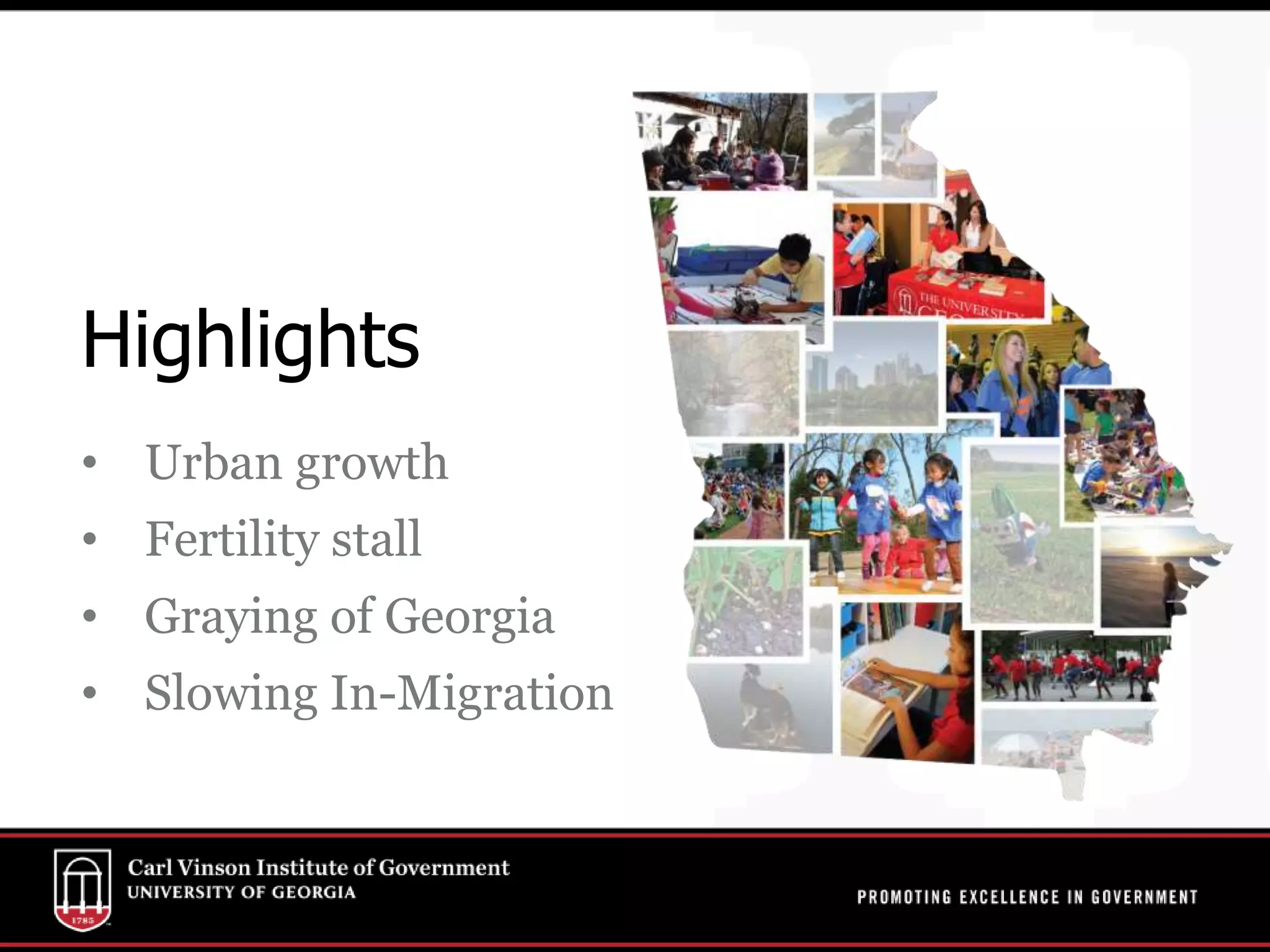
Highlights
• Urban growth
• Fertility stall
• Graying of Georgia
• Slowing In-Migration
What was the 2018 population of
Georgia?
9.5 million 10.5 million
9.9 million9.2 million
What was the 2018 population of
Liberty County?
58,000
61,500
60,0o0
63,500
What was the 2018 population of
the Hinesville MSA?
60,500
90,500
70,500
80,500
What was Liberty County’s population
growth rate 2010-2018?
8.6%
4.1%
6.0%
-3.3%
What Liberty County’s population
growth 2010-2018?
8.6%
4.1%
6.0%
-3.3%
Georgia
Liberty Co. Hinesville MSA
United States
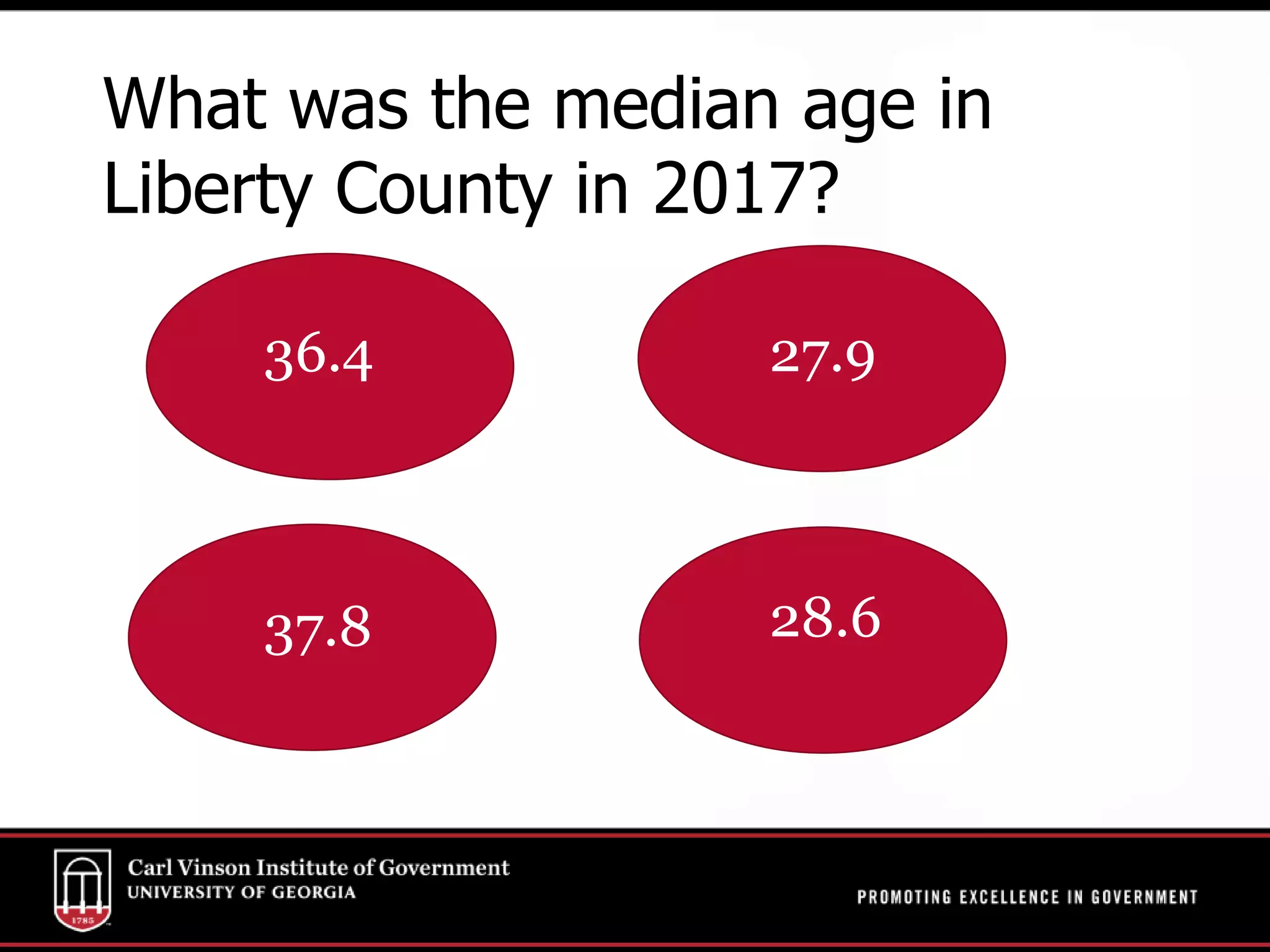
What was the median age in
Liberty County in 2017?
36.4
28.6
27.9
37.8
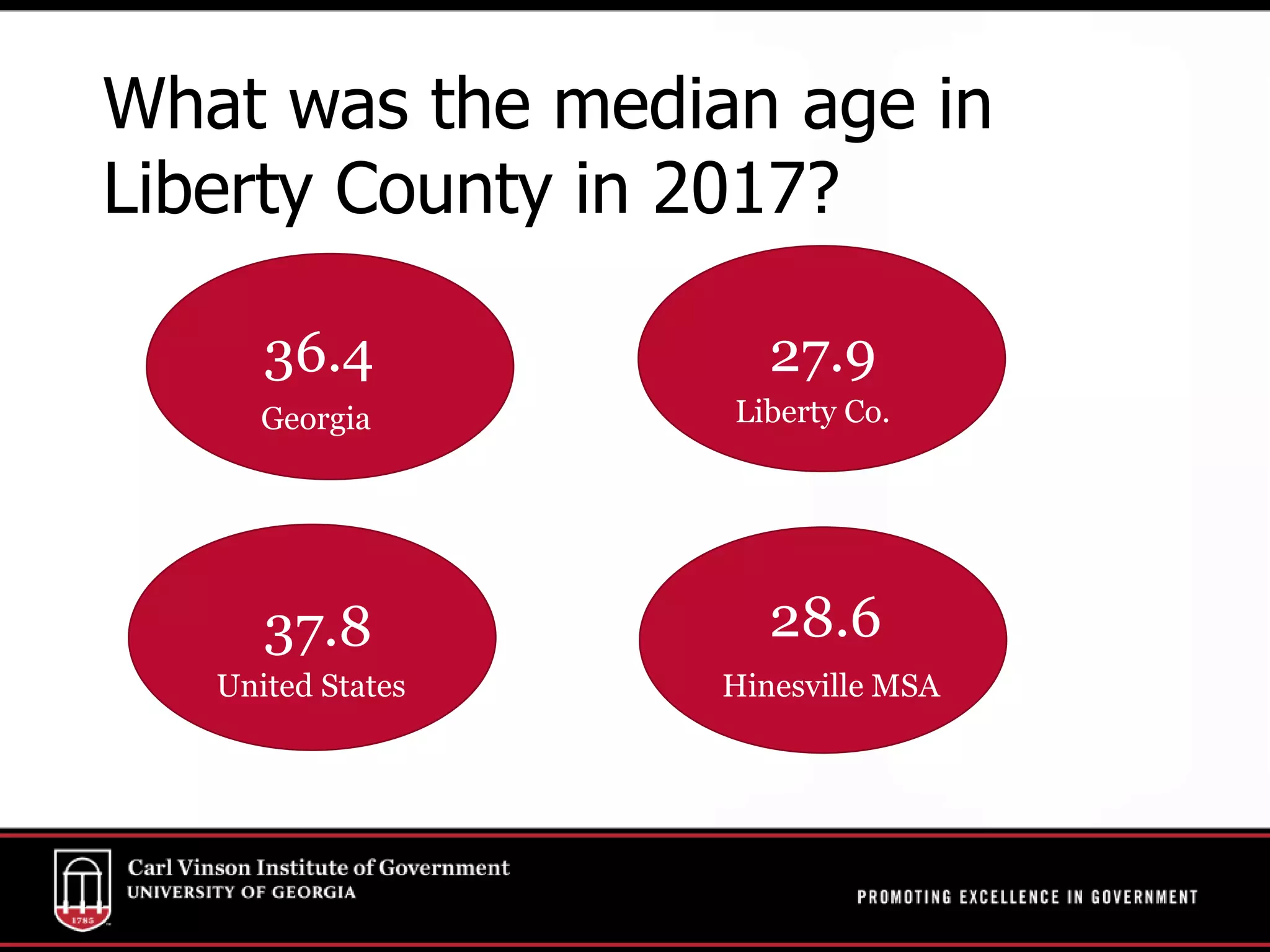
What was the median age in
Liberty County in 2017?
36.4
28.6
27.9
37.8
Georgia Liberty Co.
Hinesville MSAUnited States
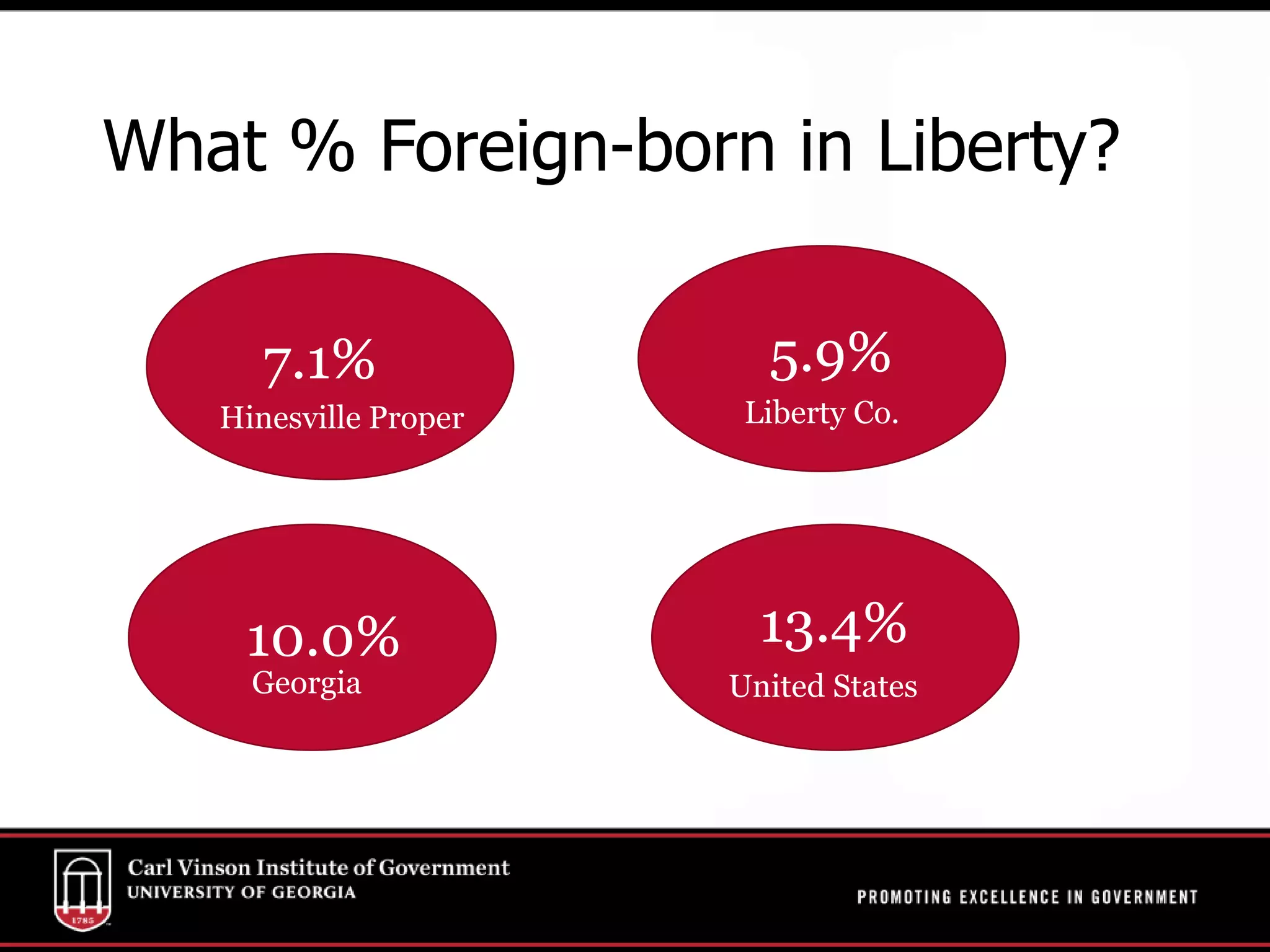
What % Foreign-born in Liberty?
7.1%
13.4%
5.9%
10.0%
What % Foreign-born in Liberty?
7.1%
13.4%
5.9%
10.0%
Georgia
Liberty Co.Hinesville Proper
United States
Recent
Trends
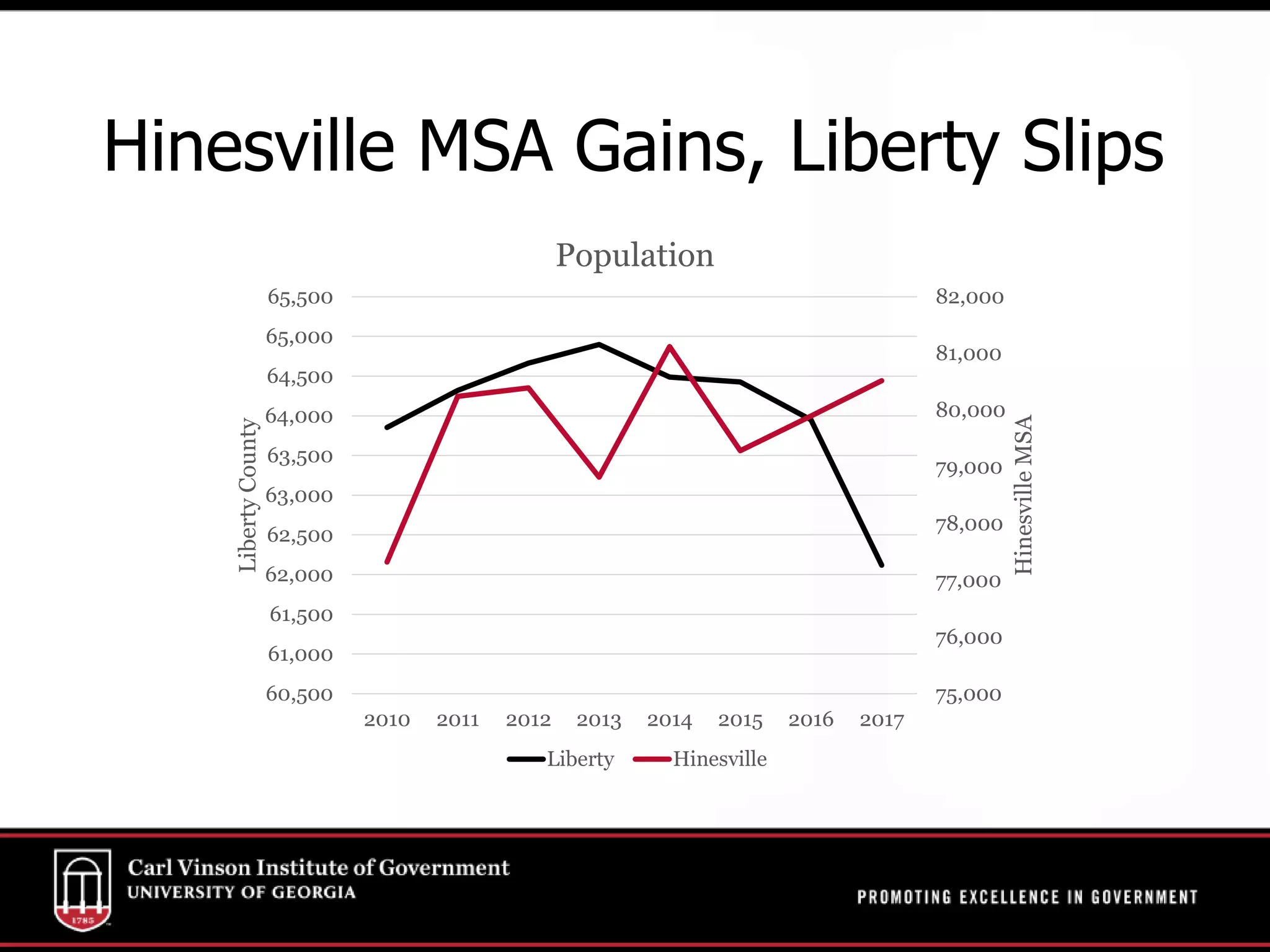
Hinesville MSA Gains, Liberty Slips
75,000
76,000
77,000
78,000
79,000
80,000
81,000
82,000
60,500
61,000
61,500
62,000
62,500
63,000
63,500
64,000
64,500
65,000
65,500
2010 2011 2012 2013 2014 2015 2016 2017
HinesvilleMSA
LibertyCounty Population
Liberty Hinesville
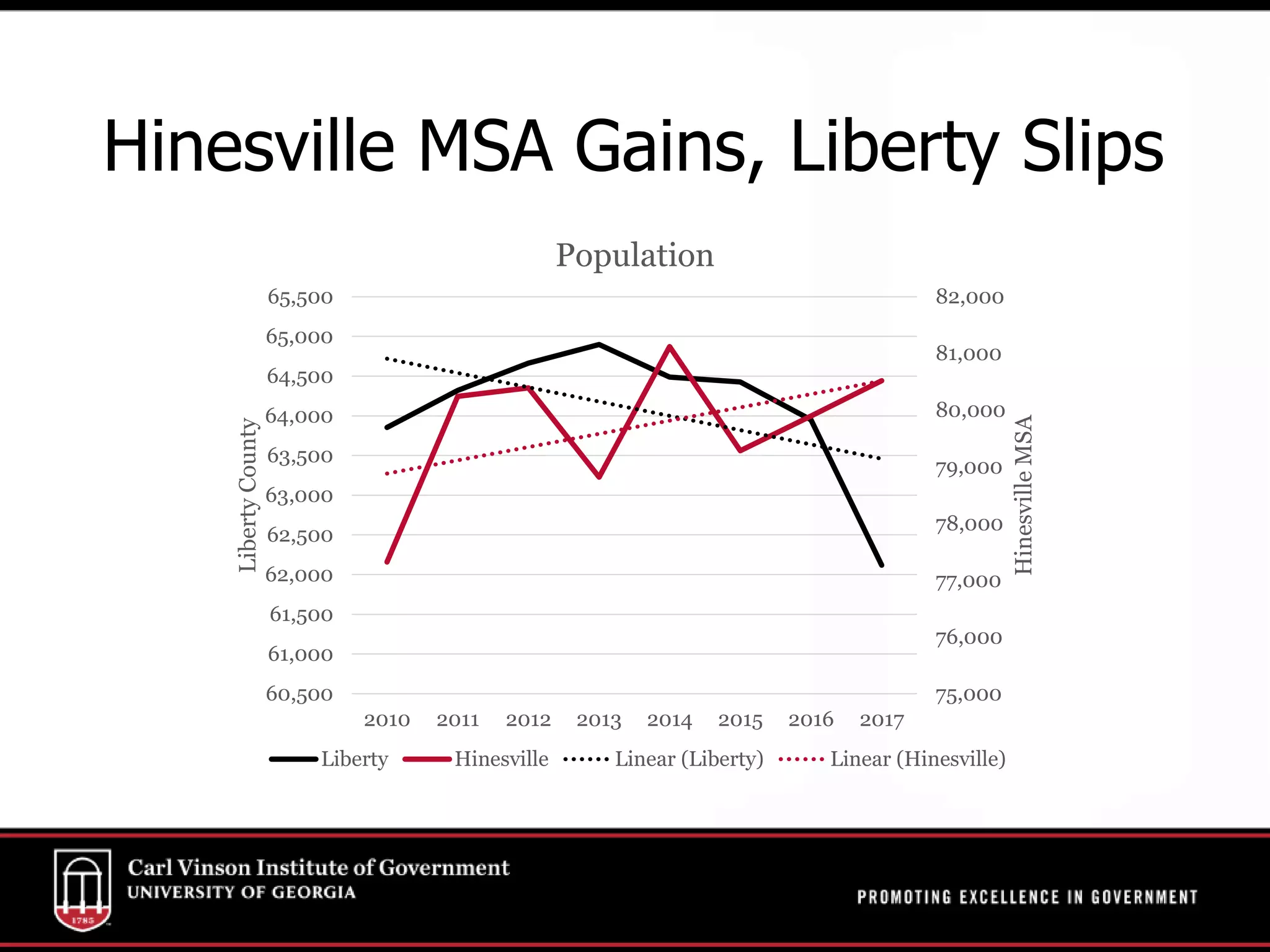
Hinesville MSA Gains, Liberty Slips
75,000
76,000
77,000
78,000
79,000
80,000
81,000
82,000
60,500
61,000
61,500
62,000
62,500
63,000
63,500
64,000
64,500
65,000
65,500
2010 2011 2012 2013 2014 2015 2016 2017
HinesvilleMSA
LibertyCounty Population
Liberty Hinesville Linear (Liberty) Linear (Hinesville)
75,000
76,000
77,000
78,000
79,000
80,000
81,000
82,000
0
2,000
4,000
6,000
8,000
10,000
12,000
14,000
16,000
18,000
20,000
2010 2011 2012 2013 2014 2015 2016 2017
HinesvilleMSAPopulation
LongCountyPopulation
Population
Long Hinesville Linear (Long) Linear (Hinesville)
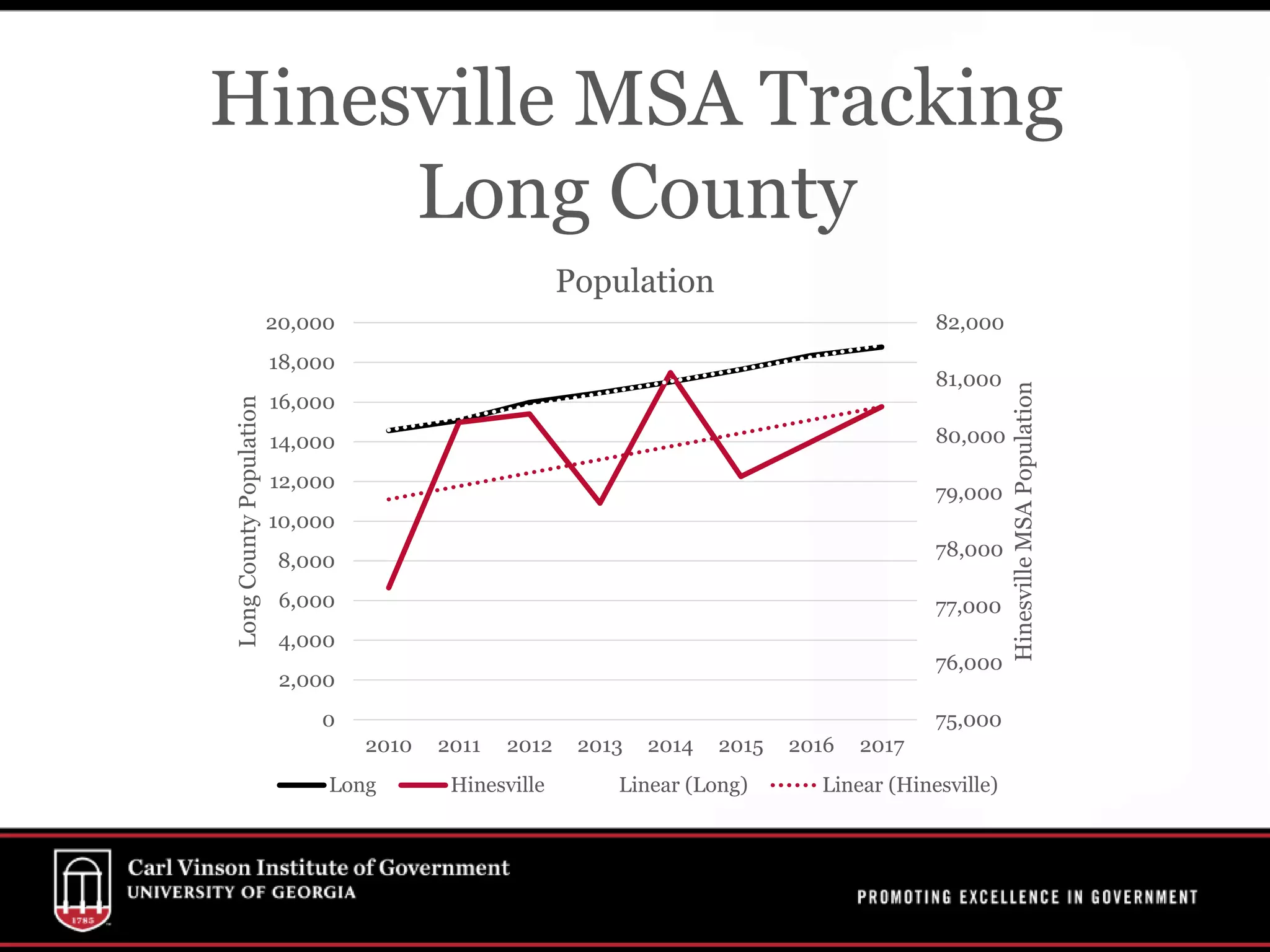
Hinesville MSA Tracking
Long County
Hinesville MSA growing,
Hinesville proper declining
75,000
76,000
77,000
78,000
79,000
80,000
81,000
82,000
32,000
32,500
33,000
33,500
34,000
34,500
35,000
2010 2011 2012 2013 2014 2015 2016 2017
HinesvilleMSAPopulation
HinesvilleCity
Population
Hinesville City Hinesville MSA
Linear (Hinesville City) Linear (Hinesville MSA)
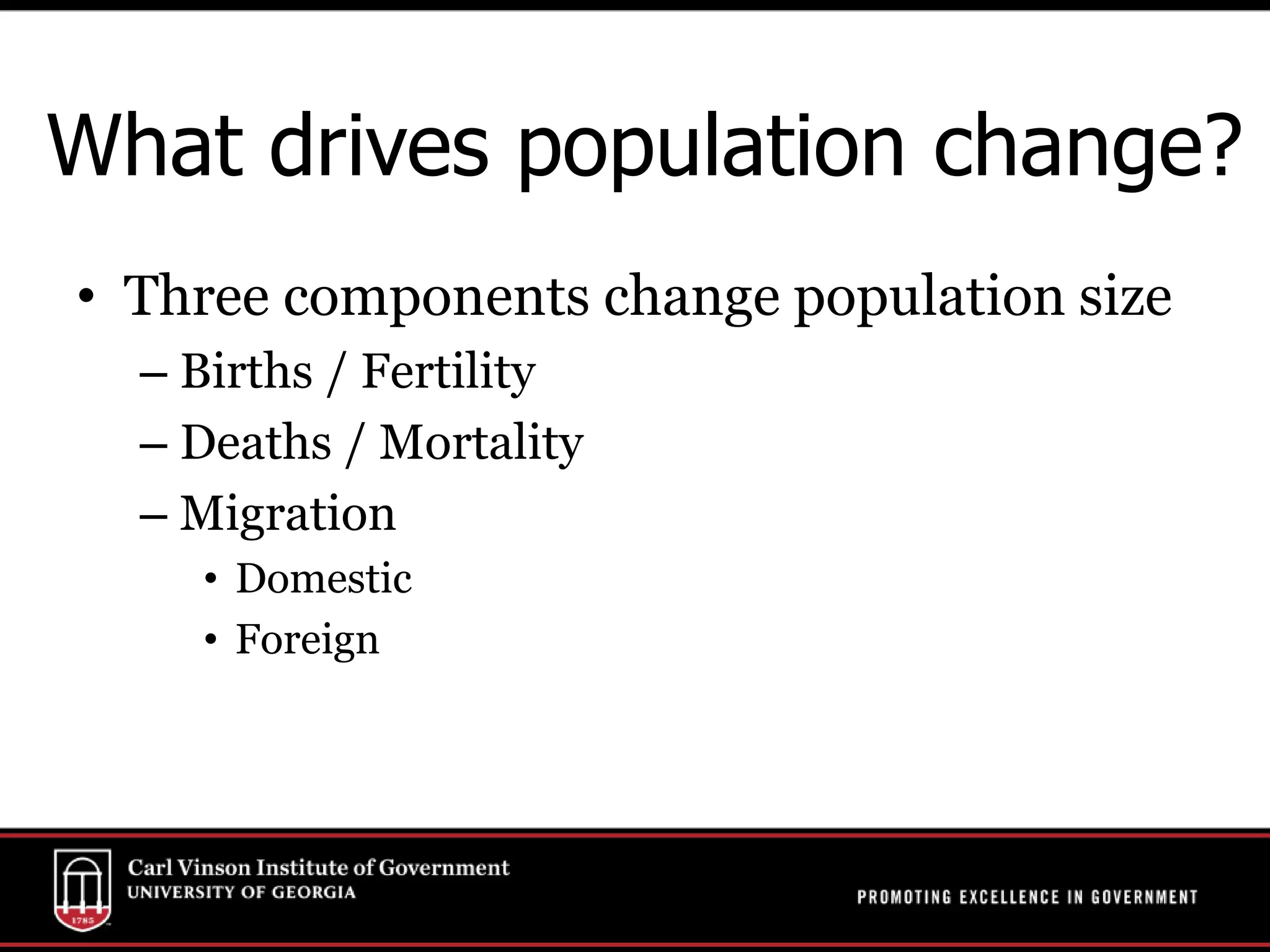
What drives population change?
• Three components change population size
– Births / Fertility
– Deaths / Mortality
– Migration
• Domestic
• Foreign
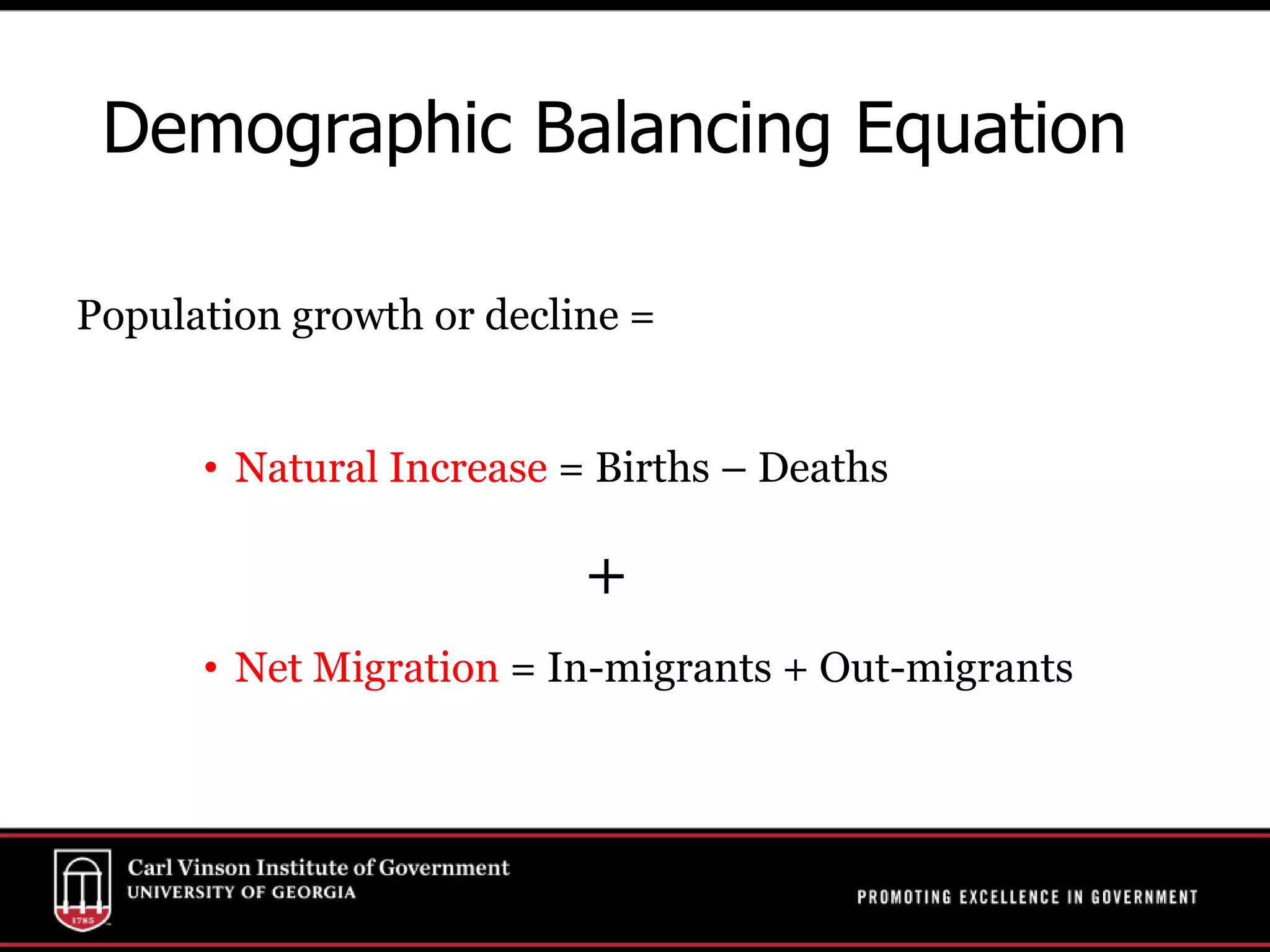
Demographic Balancing Equation
Population growth or decline =
• Natural Increase = Births – Deaths
+
• Net Migration = In-migrants + Out-migrants
Georgia
Liberty Co. Hinesville MSA
United States
Fertility
Replacement rate:
2,100.0
U.S. Birth Rate (TFR), 2017
General Fertility Rate
Tracks Lower in 2018
Source: CDC
Fertility decline, post-recession
50
55
60
65
70
75
1994
1995
1996
1997
1998
1999
2000
2001
2002
2003
2004
2005
2006
2007
2008
2009
2010
2011
2012
2013
2014
2015
2016
2017
2018
Birthsper1,000femalesaged15-44
Georgia General Fertility Rate
Urban Rural Source: Georgia Department of Public Health
But Liberty bucks the trend
50
60
70
80
90
100
110
120
1994
1995
1996
1997
1998
1999
2000
2001
2002
2003
2004
2005
2006
2007
2008
2009
2010
2011
2012
2013
2014
2015
2016
2017
2018
Birthsper1,000femalesaged15-44
General Fertility Rates
Georgia Liberty County
Source: Georgia Department of Public Health
Falling births have ripple effects
Class of 2026
Class of 2032 Class of 2036
Class of 2022
Source: Georgia Department of Public Health, OASIS
Mortality
Source: CDC
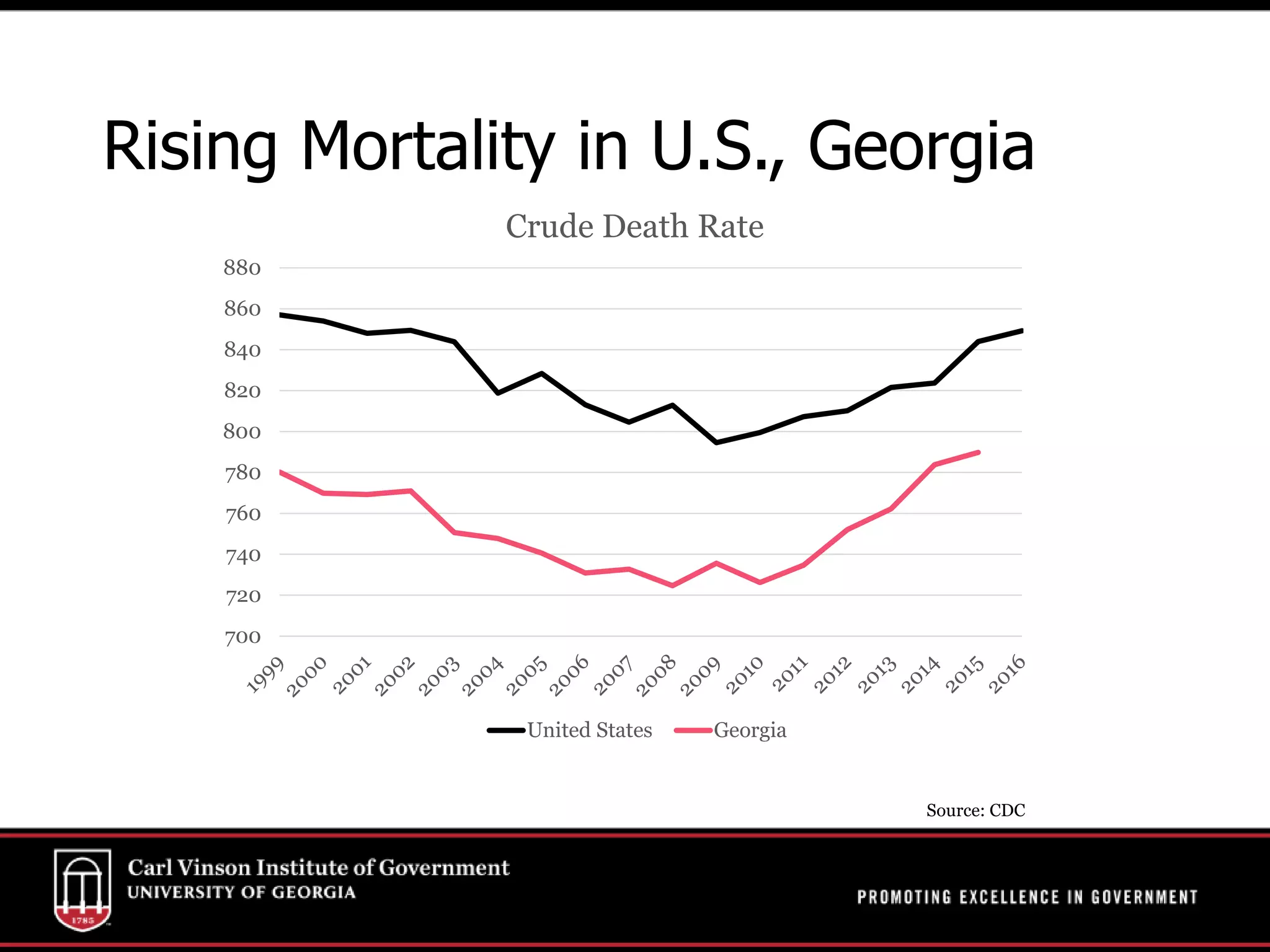
Rising Mortality in U.S., Georgia
700
720
740
760
780
800
820
840
860
880
Crude Death Rate
United States Georgia
Source: Georgia Public Health
Georgia’s Recent Mortality Trends
660
680
700
720
740
760
780
800
820
2010 2011 2012 2013 2014 2015 2016 2017 2018
Deathsper100,000pop.
Crude Death Rate
Source: Georgia Department of Public Health
Georgia’s Recent Mortality Upswing
600
700
800
900
1,000
1,100
1,200
1999 2000 2001 2002 2003 2004 2005 2006 2007 2008 2009 2010 2011 2012 2013 2014 2015 2016 2017 2018
Deathsper100,000pop.
Crude Death Rate
Rural Death Rate Urban Death Rate
First baby boomers
hit age 65
Source: Georgia Department of Public Health
And Liberty has seen an uptick, too
300
400
500
600
700
800
900
1994 1995 1996 1997 1998 1999 2000 2001 2002 2003 2004 2005 2006 2007 2008 2009 2010 2011 2012 2013 2014 2015 2016 2017 2018
Deathsper100,000pop.
Georgia Liberty County
Migration
Migration Component: Slowing
• Migration is key to Georgia’s population growth and
renewal of parents of childbearing age, schools, workforce
• Foreign and domestic in-migration has attenuated
• Asians the exception, foreign and domestic trends are up
• Mexican immigration is petering out
Current Domestic In-migration Snapshot
Source: US Census Estimates Program
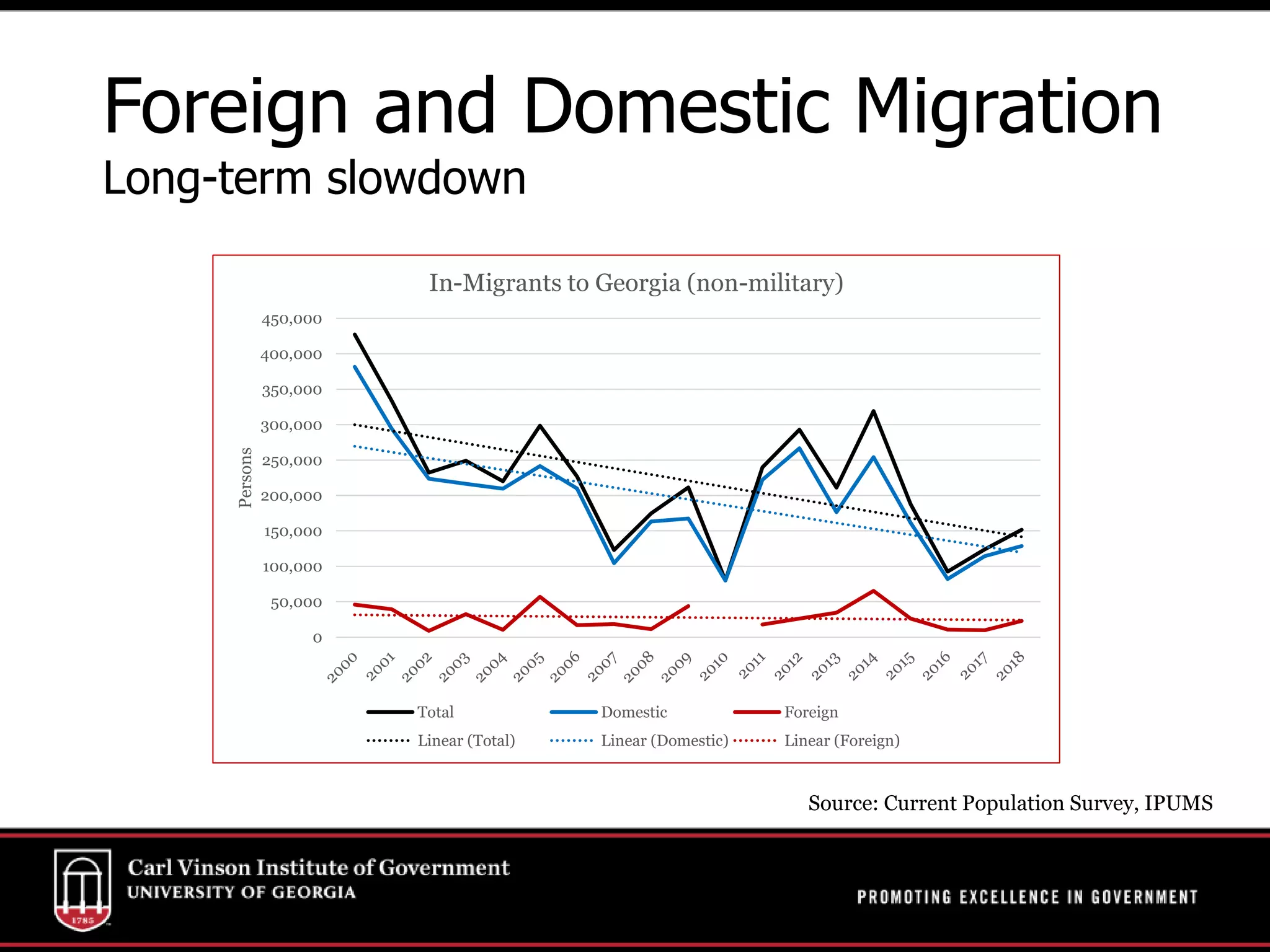
Foreign and Domestic Migration
Long-term slowdown
Source: Current Population Survey, IPUMS
0
50,000
100,000
150,000
200,000
250,000
300,000
350,000
400,000
450,000
Persons
In-Migrants to Georgia (non-military)
Total Domestic Foreign
Linear (Total) Linear (Domestic) Linear (Foreign)
-5,000
-4,000
-3,000
-2,000
-1,000
0
1,000
2,000
2010 2011 2012 2013 2014 2015 2016 2017 2018
Liberty County Migration
Foreign Domestic Net
Projections
Projected Population of Georgia
4.6
10.5
15.4
4
6
8
10
12
14
16
1970 1975 1980 1985 1990 1995 2000 2005 2010 2015 2020 2025 2030 2035 2040 2045 2050 2055 2060
Millions
Source: US Census Bureau, OPB Population Projections
(Projected)
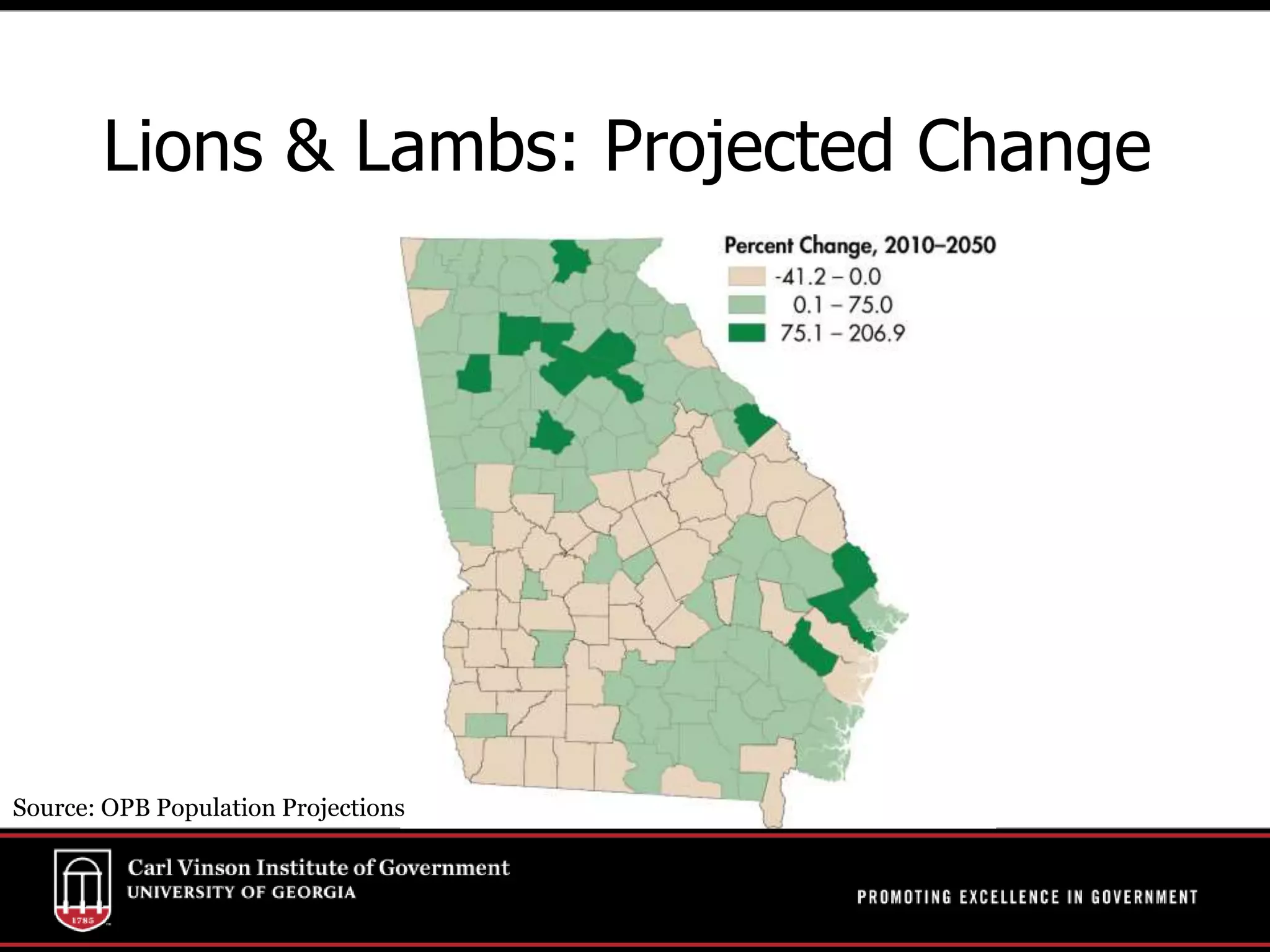
Lions & Lambs: Projected Change
Source: OPB Population Projections
Flat growth projected for Liberty
Source: OPB Population Projections
0
50
100
150
200
250
300
350
400
450
0-4 10-14 20-24 30-34 40-44 50-54 60-64 70-74 80-84
PopulationinThousands
Hispanic
Non-Hispanic Black
Non-Hispanic White
Non-Hispanic Other
Source: US Census Population Estimates
Race/Ethnic Age Diversity,
Georgia 2018
Liberty County diversity
2018 2033 2053
White, NH Black, NH Hispanic Other, NH
Source: US Census Population Estimates
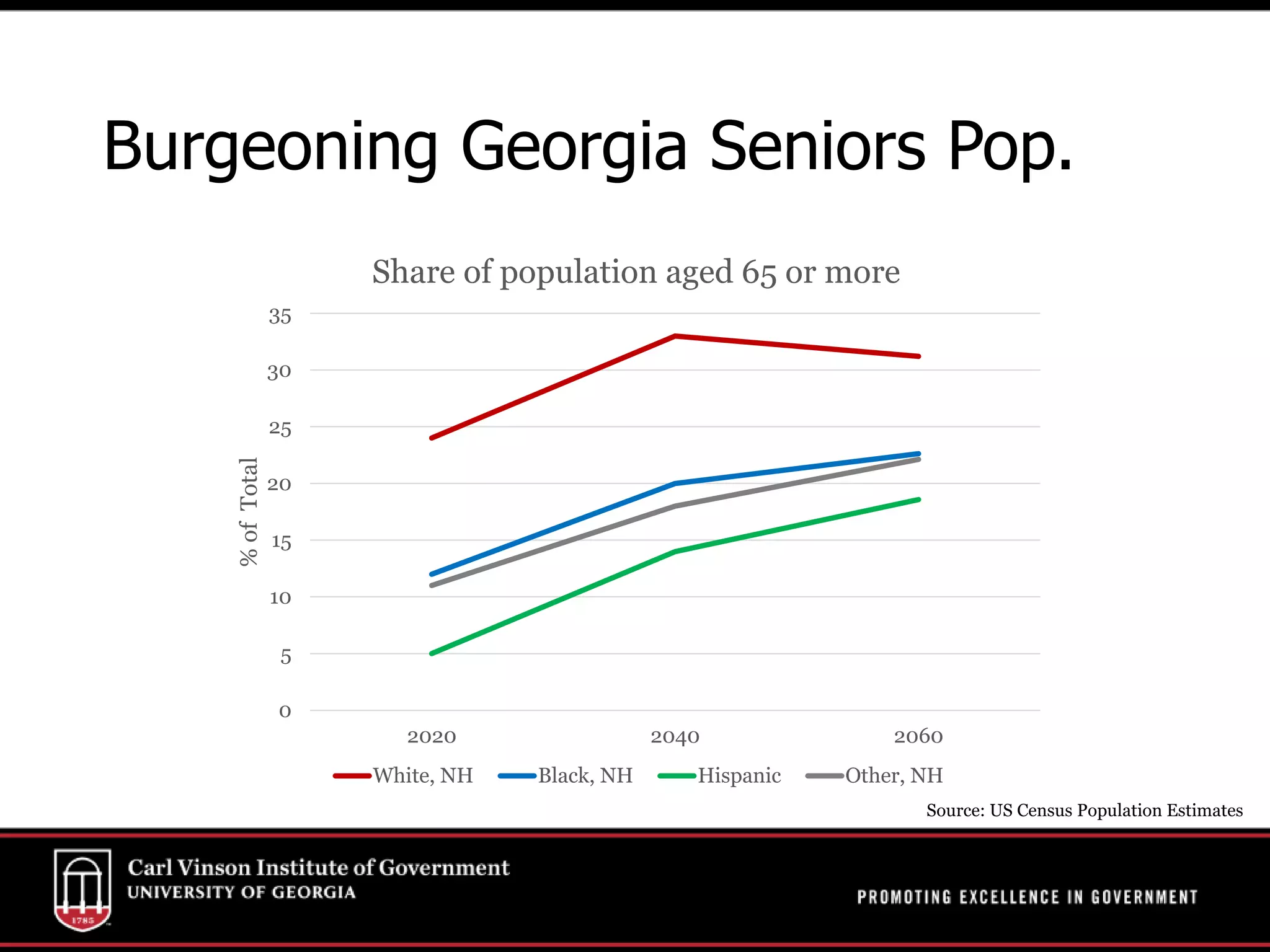
Burgeoning Georgia Seniors Pop.
0
5
10
15
20
25
30
35
2020 2040 2060
%ofTotal
Share of population aged 65 or more
White, NH Black, NH Hispanic Other, NH
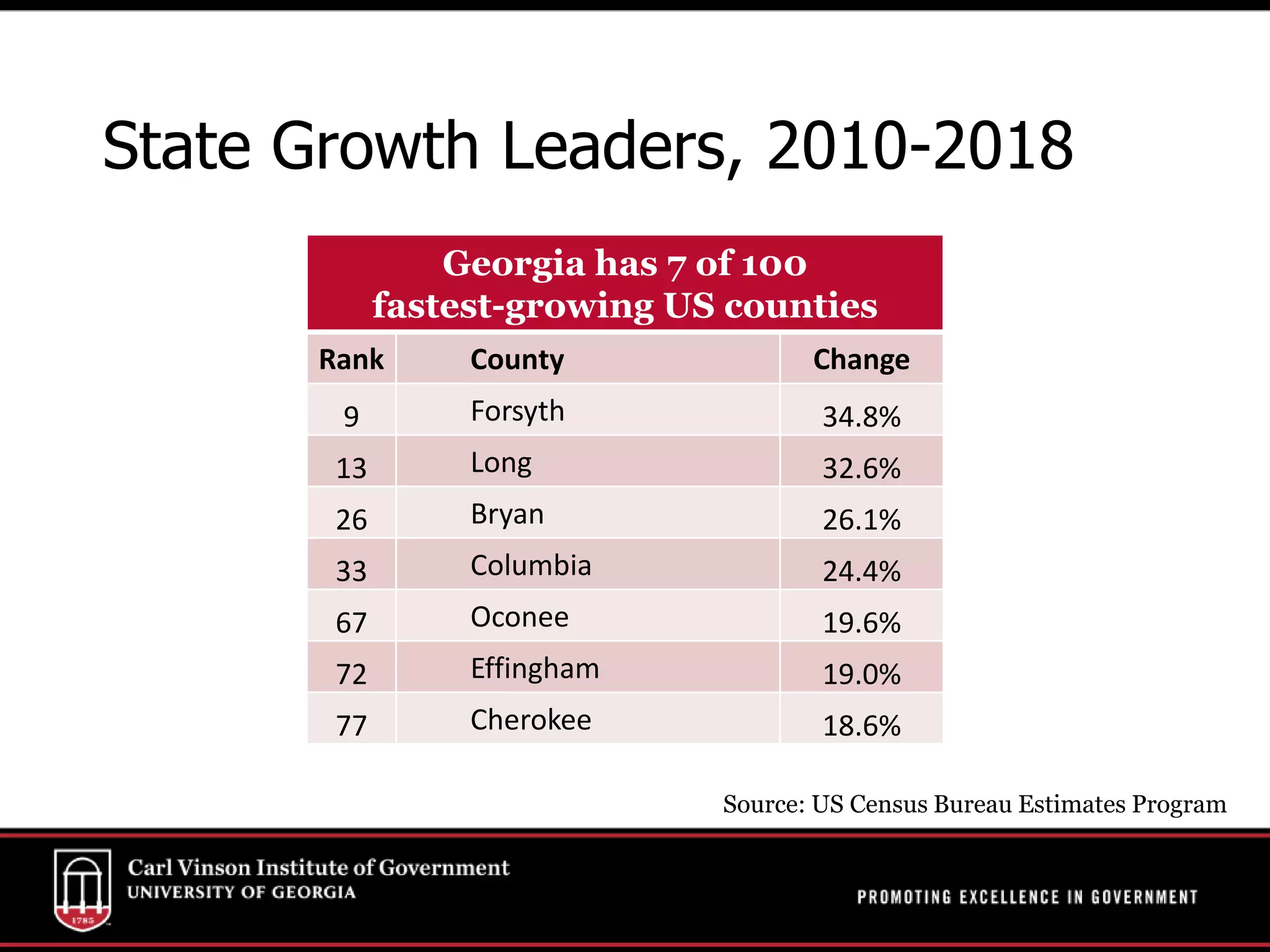
State Growth Leaders, 2010-2018
Georgia has 7 of 100
fastest-growing US counties
Rank County Change
9 Forsyth 34.8%
13 Long 32.6%
26 Bryan 26.1%
33 Columbia 24.4%
67 Oconee 19.6%
72 Effingham 19.0%
77 Cherokee 18.6%
Source: US Census Bureau Estimates Program
Census 2020
https://census.georgia.gov/
Census 2020: Federal Funding
• A recent US Census Bureau study found 132 programs that
use Census Bureau data to distribute funds.
• In 2015, that amounted to more than $675 billion.
• Federal outlays are projected to increase from $3.7 trillion
in 2015 to $4.7 trillion in 2020, so Census-based funds will
grow, too.
Source: Uses of Census Bureau Data in Federal Funds Distribution, Census Bureau, 2017
Source: GW Institute for Public Policy
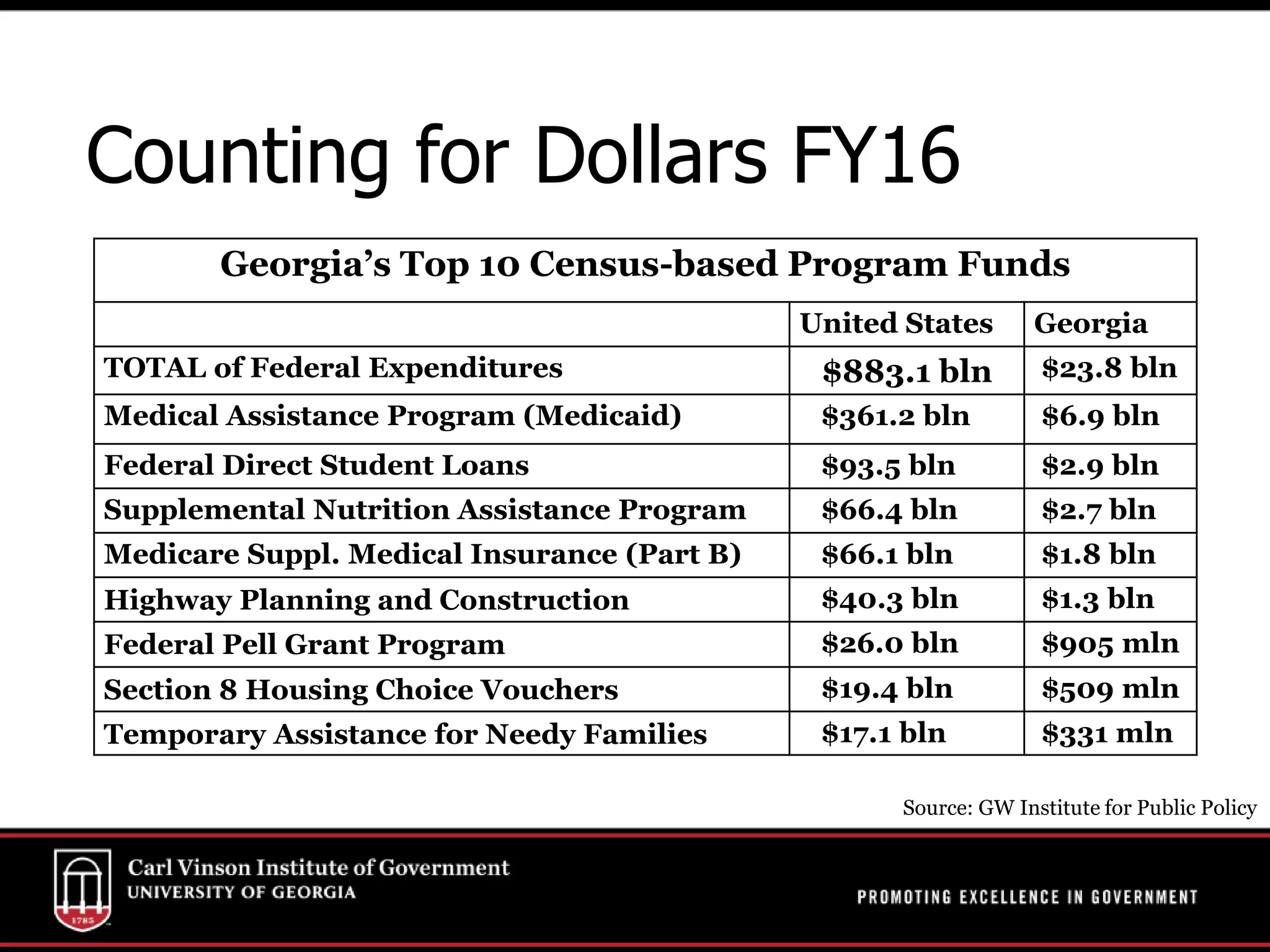
Georgia’s Top 10 Census-based Program Funds
United States Georgia
TOTAL of Federal Expenditures $883.1 bln $23.8 bln
Medical Assistance Program (Medicaid) $361.2 bln $6.9 bln
Federal Direct Student Loans $93.5 bln $2.9 bln
Supplemental Nutrition Assistance Program $66.4 bln $2.7 bln
Medicare Suppl. Medical Insurance (Part B) $66.1 bln $1.8 bln
Highway Planning and Construction $40.3 bln $1.3 bln
Federal Pell Grant Program $26.0 bln $905 mln
Section 8 Housing Choice Vouchers $19.4 bln $509 mln
Temporary Assistance for Needy Families $17.1 bln $331 mln
Counting for Dollars FY16
Progress Through People Luncheon Georgia's Evolving Demographics

Progress Through People Luncheon Georgia's Evolving Demographics

  • 1.
    Georgia’s Evolving Demographics PopulationChange in the Peach State Jeffrey Wright Applied Demography Program
  • 2.
    Highlights • Urban growth •Fertility stall • Graying of Georgia • Slowing In-Migration
  • 3.
    What was the2018 population of Georgia? 9.5 million 10.5 million 9.9 million9.2 million
  • 4.
    What was the2018 population of Liberty County? 58,000 61,500 60,0o0 63,500
  • 5.
    What was the2018 population of the Hinesville MSA? 60,500 90,500 70,500 80,500
  • 6.
    What was LibertyCounty’s population growth rate 2010-2018? 8.6% 4.1% 6.0% -3.3%
  • 7.
    What Liberty County’spopulation growth 2010-2018? 8.6% 4.1% 6.0% -3.3% Georgia Liberty Co. Hinesville MSA United States
  • 8.
    What was themedian age in Liberty County in 2017? 36.4 28.6 27.9 37.8
  • 9.
    What was themedian age in Liberty County in 2017? 36.4 28.6 27.9 37.8 Georgia Liberty Co. Hinesville MSAUnited States
  • 10.
    What % Foreign-bornin Liberty? 7.1% 13.4% 5.9% 10.0%
  • 11.
    What % Foreign-bornin Liberty? 7.1% 13.4% 5.9% 10.0% Georgia Liberty Co.Hinesville Proper United States
  • 12.
  • 13.
    Hinesville MSA Gains,Liberty Slips 75,000 76,000 77,000 78,000 79,000 80,000 81,000 82,000 60,500 61,000 61,500 62,000 62,500 63,000 63,500 64,000 64,500 65,000 65,500 2010 2011 2012 2013 2014 2015 2016 2017 HinesvilleMSA LibertyCounty Population Liberty Hinesville
  • 14.
    Hinesville MSA Gains,Liberty Slips 75,000 76,000 77,000 78,000 79,000 80,000 81,000 82,000 60,500 61,000 61,500 62,000 62,500 63,000 63,500 64,000 64,500 65,000 65,500 2010 2011 2012 2013 2014 2015 2016 2017 HinesvilleMSA LibertyCounty Population Liberty Hinesville Linear (Liberty) Linear (Hinesville)
  • 15.
    75,000 76,000 77,000 78,000 79,000 80,000 81,000 82,000 0 2,000 4,000 6,000 8,000 10,000 12,000 14,000 16,000 18,000 20,000 2010 2011 20122013 2014 2015 2016 2017 HinesvilleMSAPopulation LongCountyPopulation Population Long Hinesville Linear (Long) Linear (Hinesville) Hinesville MSA Tracking Long County
  • 16.
    Hinesville MSA growing, Hinesvilleproper declining 75,000 76,000 77,000 78,000 79,000 80,000 81,000 82,000 32,000 32,500 33,000 33,500 34,000 34,500 35,000 2010 2011 2012 2013 2014 2015 2016 2017 HinesvilleMSAPopulation HinesvilleCity Population Hinesville City Hinesville MSA Linear (Hinesville City) Linear (Hinesville MSA)
  • 17.
    What drives populationchange? • Three components change population size – Births / Fertility – Deaths / Mortality – Migration • Domestic • Foreign
  • 18.
    Demographic Balancing Equation Populationgrowth or decline = • Natural Increase = Births – Deaths + • Net Migration = In-migrants + Out-migrants Georgia Liberty Co. Hinesville MSA United States
  • 19.
  • 20.
  • 21.
    General Fertility Rate TracksLower in 2018 Source: CDC
  • 22.
  • 23.
    But Liberty bucksthe trend 50 60 70 80 90 100 110 120 1994 1995 1996 1997 1998 1999 2000 2001 2002 2003 2004 2005 2006 2007 2008 2009 2010 2011 2012 2013 2014 2015 2016 2017 2018 Birthsper1,000femalesaged15-44 General Fertility Rates Georgia Liberty County Source: Georgia Department of Public Health
  • 24.
    Falling births haveripple effects Class of 2026 Class of 2032 Class of 2036 Class of 2022 Source: Georgia Department of Public Health, OASIS
  • 25.
  • 26.
    Source: CDC Rising Mortalityin U.S., Georgia 700 720 740 760 780 800 820 840 860 880 Crude Death Rate United States Georgia
  • 27.
    Source: Georgia PublicHealth Georgia’s Recent Mortality Trends 660 680 700 720 740 760 780 800 820 2010 2011 2012 2013 2014 2015 2016 2017 2018 Deathsper100,000pop. Crude Death Rate
  • 28.
    Source: Georgia Departmentof Public Health Georgia’s Recent Mortality Upswing 600 700 800 900 1,000 1,100 1,200 1999 2000 2001 2002 2003 2004 2005 2006 2007 2008 2009 2010 2011 2012 2013 2014 2015 2016 2017 2018 Deathsper100,000pop. Crude Death Rate Rural Death Rate Urban Death Rate First baby boomers hit age 65
  • 29.
    Source: Georgia Departmentof Public Health And Liberty has seen an uptick, too 300 400 500 600 700 800 900 1994 1995 1996 1997 1998 1999 2000 2001 2002 2003 2004 2005 2006 2007 2008 2009 2010 2011 2012 2013 2014 2015 2016 2017 2018 Deathsper100,000pop. Georgia Liberty County
  • 30.
  • 31.
    Migration Component: Slowing •Migration is key to Georgia’s population growth and renewal of parents of childbearing age, schools, workforce • Foreign and domestic in-migration has attenuated • Asians the exception, foreign and domestic trends are up • Mexican immigration is petering out
  • 32.
    Current Domestic In-migrationSnapshot Source: US Census Estimates Program
  • 33.
    Foreign and DomesticMigration Long-term slowdown Source: Current Population Survey, IPUMS 0 50,000 100,000 150,000 200,000 250,000 300,000 350,000 400,000 450,000 Persons In-Migrants to Georgia (non-military) Total Domestic Foreign Linear (Total) Linear (Domestic) Linear (Foreign)
  • 34.
    -5,000 -4,000 -3,000 -2,000 -1,000 0 1,000 2,000 2010 2011 20122013 2014 2015 2016 2017 2018 Liberty County Migration Foreign Domestic Net
  • 35.
  • 36.
    Projected Population ofGeorgia 4.6 10.5 15.4 4 6 8 10 12 14 16 1970 1975 1980 1985 1990 1995 2000 2005 2010 2015 2020 2025 2030 2035 2040 2045 2050 2055 2060 Millions Source: US Census Bureau, OPB Population Projections (Projected)
  • 37.
    Lions & Lambs:Projected Change Source: OPB Population Projections
  • 38.
    Flat growth projectedfor Liberty Source: OPB Population Projections
  • 39.
    0 50 100 150 200 250 300 350 400 450 0-4 10-14 20-2430-34 40-44 50-54 60-64 70-74 80-84 PopulationinThousands Hispanic Non-Hispanic Black Non-Hispanic White Non-Hispanic Other Source: US Census Population Estimates Race/Ethnic Age Diversity, Georgia 2018
  • 40.
    Liberty County diversity 20182033 2053 White, NH Black, NH Hispanic Other, NH
  • 41.
    Source: US CensusPopulation Estimates Burgeoning Georgia Seniors Pop. 0 5 10 15 20 25 30 35 2020 2040 2060 %ofTotal Share of population aged 65 or more White, NH Black, NH Hispanic Other, NH
  • 42.
    State Growth Leaders,2010-2018 Georgia has 7 of 100 fastest-growing US counties Rank County Change 9 Forsyth 34.8% 13 Long 32.6% 26 Bryan 26.1% 33 Columbia 24.4% 67 Oconee 19.6% 72 Effingham 19.0% 77 Cherokee 18.6% Source: US Census Bureau Estimates Program
  • 43.
  • 44.
  • 45.
    Census 2020: FederalFunding • A recent US Census Bureau study found 132 programs that use Census Bureau data to distribute funds. • In 2015, that amounted to more than $675 billion. • Federal outlays are projected to increase from $3.7 trillion in 2015 to $4.7 trillion in 2020, so Census-based funds will grow, too. Source: Uses of Census Bureau Data in Federal Funds Distribution, Census Bureau, 2017
  • 46.
    Source: GW Institutefor Public Policy Georgia’s Top 10 Census-based Program Funds United States Georgia TOTAL of Federal Expenditures $883.1 bln $23.8 bln Medical Assistance Program (Medicaid) $361.2 bln $6.9 bln Federal Direct Student Loans $93.5 bln $2.9 bln Supplemental Nutrition Assistance Program $66.4 bln $2.7 bln Medicare Suppl. Medical Insurance (Part B) $66.1 bln $1.8 bln Highway Planning and Construction $40.3 bln $1.3 bln Federal Pell Grant Program $26.0 bln $905 mln Section 8 Housing Choice Vouchers $19.4 bln $509 mln Temporary Assistance for Needy Families $17.1 bln $331 mln Counting for Dollars FY16

Editor's Notes

  • #2 How many of you use demographic data in your businesses? Anyone have any examples?
  • #3 I am also looking for insights, local knowledge, on any trends that affect population. It’s very helpful when we do population projections. Especially given the presence of Ft. Stewart, which is a very large group quarters population and challenging to assess.
  • #4 We are going to start out with a little quiz to warm up your inner demographers. Who knows the population of Georgia according to the most recent Census estimates?
  • #5 How about Liberty County? This might be more challenging since there have been some real ups and downs this decade, as we’ll see later. These numbers are rounded by the way for simplicity’s sake.
  • #6 The Hinesville MSA is interesting as it straddles Long, one of the fastest growing counties in the US, and Liberty, which is
  • #11 We are going to start out with a little competition.
  • #12 We are going to start out with a little competition.
  • #14 As you may all know, the Hinesville MSA comprises almost all of Liberty and all of Long.
  • #15 We are going to start out with a little competition.
  • #16 Long County was one of the fastest growing counties in the United States so far this decade, so this is interesting.
  • #17 Given what we’ve seen, what does this slide tell us? I think this tells us that the Liberty and Hinesville proper are losing population, but Long is picking up the slack for the overall MSA.
  • #18 The reader’s digest guide to demography can be summed up in the next slide. . In Georgia, when babies are born, does the population grow or shrink? When people die, what happens to the population? When people move in from other states or countries, what happens? When  people move away from Georgia, what happens? So demographers are interested in anything relating to births, deaths, and migration.
  • #19 This expresses in a formal way what we were just saying about population change and the three pillars of demography. Natural Increase is a key concept. It refers to what happens to a closed population or a population with no migration. People are born into a population, and people die out of a population. If there are more births than deaths, you have natural increase. If there are more deaths than births, the population shrinks. Net migration is the change, positive or negative, that results from people coming and going, coming and going.
  • #21 Here’s the prevailing trend in fertility. Only two states, Utah and South Dakota, have TFRs at replacement rate or above. Georgia’s in the fourth quintile, slightly higher than the national average but below replacement. Notice that whites in Georgia have the lowest TFR.
  • #22 All race/ethnic groups saw statistically significant declines from 2017 to 2018. Preliminary data for the first quarter of 2019 show another significant decline coming this year.
  • #23 This is consistent with national trends. Only two states are at or above replacement fertility right now. Rural birth rates look to be stabilizing at a slightly higher level than urban, but (a) it’s too early to tell; and (b) it’s still at a relatively low rate. The pattern in Europe and Asia has been a sustained decline in fertility that often hits what we call low-low fertility 1.3. Then you see somewhat of a rebound in some countries. Some government are more proactive. The US philosophy is to not meddle.
  • #24 The good news is that Liberty has the second-highest general fertility rate in Georgia? Why is Liberty experiencing a rise? Youthful population? Young military families getting started? Less expensive to have children here?
  • #25 This is just one example. Another thing to think about is what happens in 20-40 years from now. Fewer grown women to have children. Does anyone here have a business that would be affected by a decline in births? My boss’ wife, for example, provides trampolines at children’s events.
  • #27 You can see that the death rate started really climbing around the beginning of the decade. Georgia data in this dataset only goes through 2015.
  • #28 This is the past decade. On this scale you can see a launch in 2011.
  • #29 This shows that the upswing in mortality has been fairly recent. This is a consequence of the graying of Georgia.
  • #30 Liberty is the third-youngest county among Georgia’s 159 at 27.9 in 2017. The oldest was 53.8 years, Union county. That’s obviously a wide range.
  • #31 The takeaway from this is that with fewer births and more deaths, the state will need to attract new residents either from other US states or from abroad or both in order to revitalize childbearing, schools, the workforce, caregivers, and so on.
  • #33 This shows which counties have gained or lost population due to domestic migration. From which states are people moving to Georgia? Florida 14.1%, New York 11.6%, Alabama 5.9%, Texas 4.9%. In Liberty’s case, people are leaving.
  • #34 All race-ethnic groups except Asians have been demonstrating a long-term slowdown over the past two decades.
  • #35 And here’s what that looks like. Where are they going? Biggest destinations are Fulton, Chatham, Long, and El Paso County, Colorado. Nearly 1,000 residents left for that county in the 2013-2017 period, presumably military personal transferring to one of the bases there. That makes the point that military personnel, due to reassignments, deployments, returns, etc., can really make it hard to determine true migration rates.
  • #37 The Institute of Government assists the Governor’s office in developing state population projections. These were just released. The story is one of slower growth, but none too shabby. Over the projection horizon we see the population going from the current 10 million to more than 15 million. But notice that in the fifty years prior, the population more than doubled. In the next fifty, it will grow by 50%.
  • #38 This is another way of looking at the projections. The previous map reflected numerical change. This is percent change. If Fulton adds a million people, well, that’s not the same as Clarke adding a million people. Here you can see a picture of metro Atlanta all the way up through the Georgia Mountains and all the way over toward Augusta should be growing. Then you have the southeast, anchored by Savannah and coastal regions, but also I personally think there is sort of a Jacksonville-to-Savannah corridor developing here. This growth is being fueled by Hispanics.
  • #39 Our model produced a fairly stable population scenario in the 50-year projections. We just completed another round, and they call for slightly higher population counts, roughly 1,000 to 1,500 higher, but with the same basic shape.
  • #41 These pie charts show projected Liberty County race-ethnic composition in 2018, in 15 years, and in 35 years. Really, the only change projected here is that more Hispanics are expected. However, the presence of Ft. Stewart makes me skeptical that we won’t actually see more diversity. Group quarters are calculated based on 2010 Census data, which is simply because better data are not available. We know that the armed services are growing increasingly diverse. Input from the audience here would be welcome.
  • #42 Challenges: Obesity, divorced, nursing home care, Alzheimers, What happens when we start to see a higher proportion of minorities among the elderly population?
  • #43 These are all metro counties. Oconee and Long are the least urbanized, but they are still classified as metro counties due to their proximity to Atlanta and Savannah, respectively, and their connections to the metropolitan labor markets.
  • #46 Federal outlays are projected to increase from $3.7 trillion in 2015 to $4.7 trillion in 2020, so Census-based funds will grow, too.
  • #47 Three medical-related program areas accounted for half of Georgia’s total funding in 2016. Also bears mention that Georgia was the largest recipient of rural assistance funds among any state.
  • #48 Add a slide with my contact