Lessons learned – actually
http://www.rofrahome.de/
http://www2.lernplattform.schule.at/
Lessons Learned So far
Prepared for presentation at
the Baltic SCOPE Partner Meeting
Szczecin, June 21-22 2016
By Team Nordregio - Michael Kull, Alberto Giacometti, Andrea
Morf & John Moodie
Content of Presentation
I. SETTING THE SCENE
• 1. Methods & Data Collection
• 2. The Territorial Governance Approach: 5 Key
Dimensions
II. LESSONS LEARNED SO FAR
• 4. Coordination & Collaboration of Institutional Actors
• 5. Cross-sectoral Integration & Synergies
• 6. Stakeholder Participation & Engagement
• 7. Maritime Specificities and Jurisdictional Boundaries
III. SUMMING UP & WHERE TO GO FROM HERE
1. Methods & Data Collection
1. Participant Observation
– Fly on the wall = Observation of planners & thematic meetings & stakeholder
events.
– Data collected & structured around a questionnaire/survey based on the concept
of territorial governance (e.g. Schmitt & van Well 2016).
2. Delphi Survey
– Give voice to YOU, the learners & link your perceptions (“the observed ones”)
with interpretations from the participant observation processes.
– Give YOU, the planners ownership of the results & provide space for YOU to
voice concerns & highlight positive outcomes.
3. Focus Groups
– Three separate focus groups with 1) project partners CB, 2) project partners
SWB & 3) case leaders/project managers (+ PL in extra session).
– Focus groups allow YOU to provide more in depth & detailed feedback on the
results from the Delphi survey & YOUR perceptions on the project as a whole.
2. The Territorial Governance Approach: 5 Key Dimensions
RESEARCH PERSPECTIVE on TERRITORIAL GOVERNANCE:
Identify territorial specificities & place-based knowledge & how can it be
integrated into policymaking processes (Schmitt & Van Well 2016).
Focus on co-operation & collaboration between governmental and non-
governmental actors (Lidström 2007; Gualini 2008; Davoudi et al 2008).
EUROPEAN COMMISSION:
Territorial governance essential component in the implementation of an effective
European cohesion policy (European Commission 2007).
No ‘one-size-fits-all’ solutions, but evidence-based policymaking in governance
practices at different levels & in different contexts.
PLANNING & POLICY MAKING:
A holistic approach to support spatial planning work, used as an instrument for
practitioners, policymakers and decision-makers.
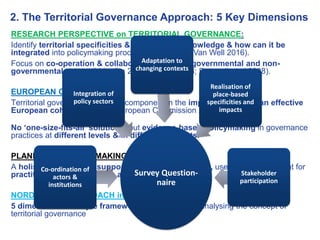
NORDREGIO’s APPROACH in BALTIC SCOPE:
5 dimensions = Simple framework for examining & analysing the concept of
territorial governance
Survey Question-
naire
Co-ordination of
actors &
institutions
Integration of
policy sectors
Adaptation to
changing contexts
Realisation of
place-based
specificities and
impacts
Stakeholder
participation
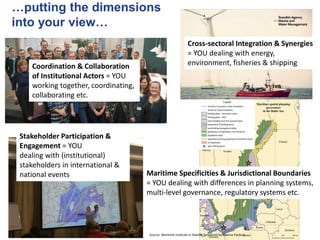
…putting the dimensions
into your view…
Cross-sectoral Integration & Synergies
= YOU dealing with energy,
environment, fisheries & shipping
Stakeholder Participation &
Engagement = YOU
dealing with (institutional)
stakeholders in international &
national events Maritime Specificities & Jurisdictional Boundaries
= YOU dealing with differences in planning systems,
multi-level governance, regulatory systems etc.
Source: Maritime Institute in Gdańsk (prepared by Joanna Pardus).
Coordination & Collaboration
of Institutional Actors = YOU
working together, coordinating,
collaborating etc.
3. Coordination & Collaboration of Institutional Actors
“It is not knowledge, but the
act of learning, not possession
but the act of getting there,
which grants the greatest
enjoyment.”
Carl Friedrich Gauss
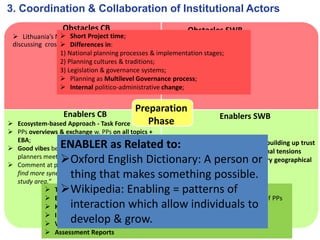
3. Coordination & Collaboration of Institutional Actors
Obstacles CB
 Lithuania’s MSP ready but lack of motivation
discussing cross-border issues
Obstacles SWB
Enablers CB
 Ecosystem-based Approach - Task Force
 PPs overviews & exchange w. PPs on all topics +
EBA;
 Good vibes between all PP during discussions at
planners meetings;
 Comment at planners meet “…remarkable that PP
find more synergies than conflicts in the CB case
study area.”
Enablers SWB
 Transboundary discussions & building up trust
 Case leadership solving internal tensions
 Identification of transboundary geographical
areas
 Common maps
Preparation
Phase
 Short Project time;
 Differences in:
1) National planning processes & implementation stages;
2) Planning cultures & traditions;
3) Legislation & governance systems;
 Planning as Multilevel Governance process;
 Internal politico-administrative change;
 Thematic group meetings inclusive of national experts;
 Emerging awareness: different planning & administrative/legal systems of PPs
 Knowledge sharing & extensive learning;
 Increased understanding of other positions;
 VASAB updates Country Fiches
 Assessment Reports
ENABLER as Related to:
Oxford English Dictionary: A person or
thing that makes something possible.
Wikipedia: Enabling = patterns of
interaction which allow individuals to
develop & grow.
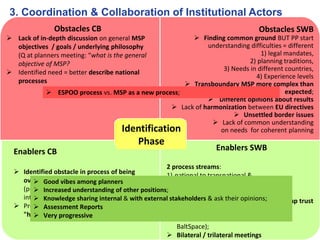
3. Coordination & Collaboration of Institutional Actors
Obstacles CB
 Lack of in-depth discussion on general MSP
objectives / goals / underlying philosophy
(Q at planners meeting: “what is the general
objective of MSP?
 Identified need = better describe national
processes
Obstacles SWB
 Finding common ground BUT PP start
understanding difficulties = different
1) legal mandates,
2) planning traditions,
3) Needs in different countries,
4) Experience levels
 Transboundary MSP more complex than
expected;
 Different opinions about results
 Lack of harmonization between EU directives
 Unsettled border issues
 Lack of common understanding
on needs for coherent planning
Enablers CB
 Identified obstacle in process of being
overcome = Vision on outputs of case & BS
(processes, sectoral processes & their
integration);
 Process of sharing ideas & bringing them
"home";
Enablers SWB
2 process streams:
1) national to transnational &
2) transnational to national;
 Situation analysis,
 Transboundary discussions & building up trust
 Start of “actual” planning
 Links to other projects (BalticLines &
BaltSpace);
 Bilateral / trilateral meetings
Identification
Phase
 ESPOO process vs. MSP as a new process;
 Good vibes among planners
 Increased understanding of other positions;
 Knowledge sharing internal & with external stakeholders & ask their opinions;
 Assessment Reports
 Very progressive
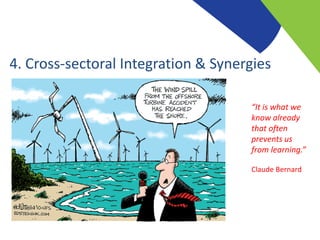
4. Cross-sectoral Integration & Synergies
“It is what we
know already
that often
prevents us
from learning.”
Claude Bernard
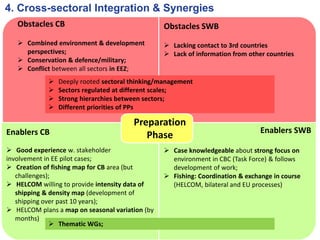
4. Cross-sectoral Integration & Synergies
Obstacles CB
 Combined environment & development
perspectives;
 Conservation & defence/military;
 Conflict between all sectors in EEZ;
Obstacles SWB
 Lacking contact to 3rd countries
 Lack of information from other countries
Enablers CB
 Good experience w. stakeholder
involvement in EE pilot cases;
 Creation of fishing map for CB area (but
challenges);
 HELCOM willing to provide intensity data of
shipping & density map (development of
shipping over past 10 years);
 HELCOM plans a map on seasonal variation (by
months)
Enablers SWB
 Case knowledgeable about strong focus on
environment in CBC (Task Force) & follows
development of work;
 Fishing: Coordination & exchange in course
(HELCOM, bilateral and EU processes)
 Deeply rooted sectoral thinking/management
 Sectors regulated at different scales;
 Strong hierarchies between sectors;
 Different priorities of PPs
Preparation
Phase
 Thematic WGs;
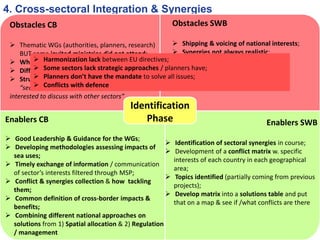
4. Cross-sectoral Integration & Synergies
Obstacles CB
 Thematic WGs (authorities, planners, research)
BUT some invited ministries did not attend;
 What is a synergy & are they realistic?;
 Different traditions of “co-existence”;
 Struggle to generate cross-sectoral thinking:
“sectoral experts are not very
interested to discuss with other sectors”
Obstacles SWB
 Shipping & voicing of national interests;
 Synergies not always realistic;
Enablers CB
 Good Leadership & Guidance for the WGs;
 Developing methodologies assessing impacts of
sea uses;
 Timely exchange of information / communication
of sector’s interests filtered through MSP;
 Conflict & synergies collection & how tackling
them;
 Common definition of cross-border impacts &
benefits;
 Combining different national approaches on
solutions from 1) Spatial allocation & 2) Regulation
/ management
Enablers SWB
 Identification of sectoral synergies in course;
 Development of a conflict matrix w. specific
interests of each country in each geographical
area;
 Topics identified (partially coming from previous
projects);
 Develop matrix into a solutions table and put
that on a map & see if /what conflicts are there
Identification
Phase
 Harmonization lack between EU directives;
 Some sectors lack strategic approaches / planners have;
 Planners don’t have the mandate to solve all issues;
 Conflicts with defence
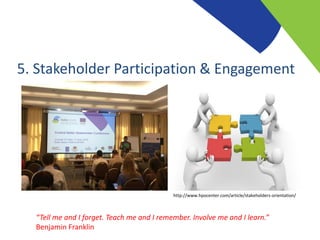
5. Stakeholder Participation & Engagement
http://www.hpocenter.com/article/stakeholders-orientation/
“Tell me and I forget. Teach me and I remember. Involve me and I learn.”
Benjamin Franklin
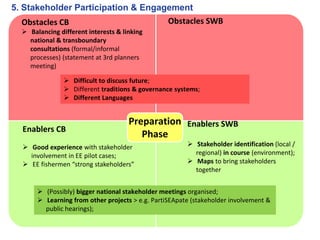
5. Stakeholder Participation & Engagement
Obstacles CB
 Balancing different interests & linking
national & transboundary
consultations (formal/informal
processes) (statement at 3rd planners
meeting)
Obstacles SWB
Enablers CB
 Good experience with stakeholder
involvement in EE pilot cases;
 EE fishermen “strong stakeholders”
Enablers SWB
 Stakeholder identification (local /
regional) in course (environment);
 Maps to bring stakeholders
together
Preparation
Phase
 Difficult to discuss future;
 Different traditions & governance systems;
 Different Languages
 (Possibly) bigger national stakeholder meetings organised;
 Learning from other projects > e.g. PartiSEApate (stakeholder involvement &
public hearings);
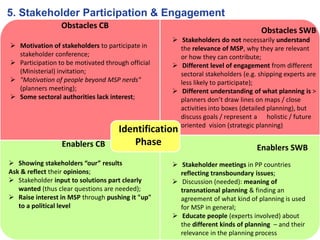
5. Stakeholder Participation & Engagement
Obstacles CB
 Motivation of stakeholders to participate in
stakeholder conference;
 Participation to be motivated through official
(Ministerial) invitation;
 "Motivation of people beyond MSP nerds"
(planners meeting);
 Some sectoral authorities lack interest;
Obstacles SWB
 Stakeholders do not necessarily understand
the relevance of MSP, why they are relevant
or how they can contribute;
 Different level of engagement from different
sectoral stakeholders (e.g. shipping experts are
less likely to participate);
 Different understanding of what planning is >
planners don’t draw lines on maps / close
activities into boxes (detailed planning), but
discuss goals / represent a holistic / future
oriented vision (strategic planning)
Enablers CB
 Showing stakeholders “our” results
Ask & reflect their opinions;
 Stakeholder input to solutions part clearly
wanted (thus clear questions are needed);
 Raise interest in MSP through pushing it "up"
to a political level
Enablers SWB
 Stakeholder meetings in PP countries
reflecting transboundary issues;
 Discussion (needed): meaning of
transnational planning & finding an
agreement of what kind of planning is used
for MSP in general;
 Educate people (experts involved) about
the different kinds of planning – and their
relevance in the planning process
Identification
Phase
6. Maritime Specificities
& Jurisdictional Boundaries
“To make no mistakes is not in
the power of man; but from
their errors and mistakes the
wise and good learn wisdom
for the future.”
Plutarch
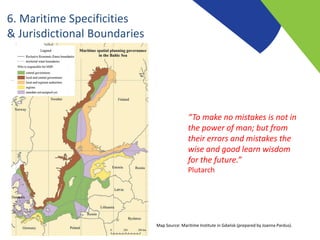
Map Source: Maritime Institute in Gdańsk (prepared by Joanna Pardus).
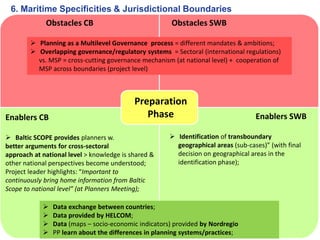
6. Maritime Specificities & Jurisdictional Boundaries
Obstacles CB Obstacles SWB
Enablers CB
 Baltic SCOPE provides planners w.
better arguments for cross-sectoral
approach at national level > knowledge is shared &
other national perspectives become understood;
Project leader highlights: “Important to
continuously bring home information from Baltic
Scope to national level” (at Planners Meeting);
Enablers SWB
 Identification of transboundary
geographical areas (sub-cases)” (with final
decision on geographical areas in the
identification phase);
Preparation
Phase
 Planning as a Multilevel Governance process = different mandates & ambitions;
 Overlapping governance/regulatory systems = Sectoral (international regulations)
vs. MSP = cross-cutting governance mechanism (at national level) + cooperation of
MSP across boundaries (project level)
 Data exchange between countries;
 Data provided by HELCOM;
 Data (maps – socio-economic indicators) provided by Nordregio
 PP learn about the differences in planning systems/practices;
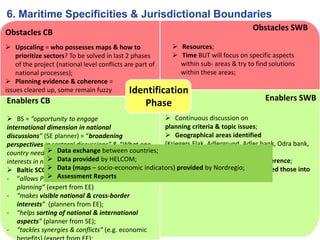
6. Maritime Specificities & Jurisdictional Boundaries
Obstacles CB
 Upscaling = who possesses maps & how to
prioritize sectors? To be solved in last 2 phases
of the project (national level conflicts are part of
national processes);
 Planning evidence & coherence =
issues cleared up, some remain fuzzy
Obstacles SWB
 Resources;
 Time BUT will focus on specific aspects
within sub- areas & try to find solutions
within these areas;
Enablers CB
 BS = “opportunity to engage
international dimension in national
discussions” (SE planner) = “broadening
perspectives in sectoral discussions” & “What one
country needs to know about other countries’
interests in national planning”
 Baltic SCOPE:
- “allows PPs to reflect country approaches to
planning” (expert from EE)
- “makes visible national & cross-border
interests” (planners from EE);
- “helps sorting of national & international
aspects” (planner from SE);
- “tackles synergies & conflicts” (e.g. economic
Enablers SWB
 Continuous discussion on
planning criteria & topic issues;
 Geographical areas identified
(Kriegers Flak, Adlergrund, Adler bank, Odra bank,
Middle bank);
 Discussion on how achieving coherence;
 PP look for solutions & how to feed those into
national processes;
Identification
Phase
 Data exchange between countries;
 Data provided by HELCOM;
 Data (maps – socio-economic indicators) provided by Nordregio;
 Assessment Reports
III. SUMMING UP & WHERE DO WE
GO FROM HERE?
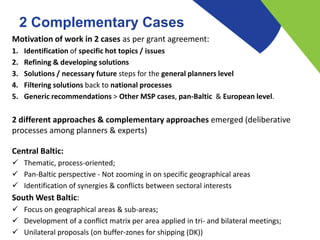
2 Complementary Cases
Motivation of work in 2 cases as per grant agreement:
1. Identification of specific hot topics / issues
2. Refining & developing solutions
3. Solutions / necessary future steps for the general planners level
4. Filtering solutions back to national processes
5. Generic recommendations > Other MSP cases, pan-Baltic & European level.
2 different approaches & complementary approaches emerged (deliberative
processes among planners & experts)
Central Baltic:
 Thematic, process-oriented;
 Pan-Baltic perspective - Not zooming in on specific geographical areas
 Identification of synergies & conflicts between sectoral interests
South West Baltic:
 Focus on geographical areas & sub-areas;
 Development of a conflict matrix per area applied in tri- and bilateral meetings;
 Unilateral proposals (on buffer-zones for shipping (DK))
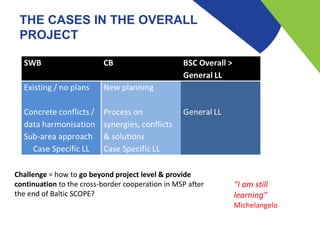
THE CASES IN THE OVERALL
PROJECT
Challenge = how to go beyond project level & provide
continuation to the cross-border cooperation in MSP after
the end of Baltic SCOPE?
“I am still
learning”
Michelangelo
Topic Papers:
Energy, Environment,
Fisheris, Shipping
Bilateral /
thematic
meetings
Defined
Conflicts &
Synergies
Distilling cross-border
& cross sectoral
conflicts & synergies
Questionnaire
for Stakeholder
Conference
Stakeholder Conference:
input for solutions
documement
Solutions
document
- National
- Cross-border
Solutions Document / part of
comrehensive status report:
 Process description
 Authorities / actors to discuss
with
 Data & other knowledge needs
and availability
 Environmental restrictions
 Socio-economic considerations
 Other emerging issues
International
regulatory mechanisms
per sector vs. window
of opportunity for MSP
CB on the Way towards Solutions
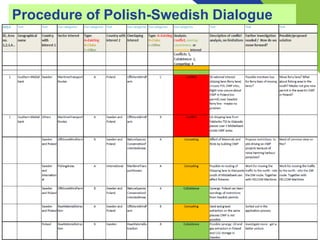
Procedure of Polish-Swedish Dialogue
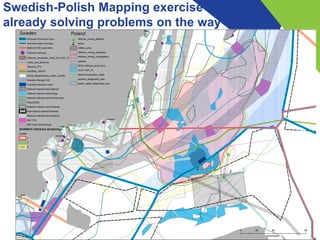
Swedish-Polish Mapping exercise –
already solving problems on the way
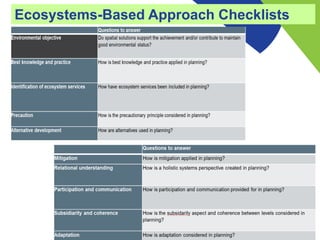
Ecosystems-Based Approach Checklists
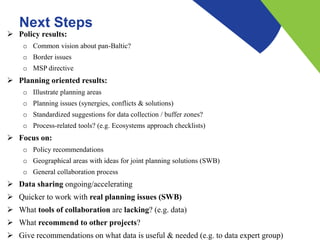
Next Steps
 Policy results:
o Common vision about pan-Baltic?
o Border issues
o MSP directive
 Planning oriented results:
o Illustrate planning areas
o Planning issues (synergies, conflicts & solutions)
o Standardized suggestions for data collection / buffer zones?
o Process-related tools? (e.g. Ecosystems approach checklists)
 Focus on:
o Policy recommendations
o Geographical areas with ideas for joint planning solutions (SWB)
o General collaboration process
 Data sharing ongoing/accelerating
 Quicker to work with real planning issues (SWB)
 What tools of collaboration are lacking? (e.g. data)
 What recommend to other projects?
 Give recommendations on what data is useful & needed (e.g. to data expert group)
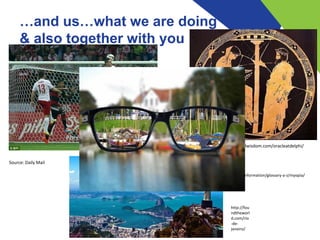
…and us…what we are doing
& also together with you
Source: Daily Mail
http://classicalwisdom.com/oracleatdelphi/
http://fou
ndtheworl
d.com/rio
-de-
janeiro/
http://ergonomic-vision.ifado.de/en/information/glossary-a-z/myopia/
Thank you very much for
being able to be part of the
learning exercise!
“If we knew
what it was we
were doing, it
would not be
called research,
would it?”
Albert Einstein

Progress of the Baltic SCOPE Lessons Learned topic so far *

  • 1.
  • 2.
  • 3.
    Lessons Learned Sofar Prepared for presentation at the Baltic SCOPE Partner Meeting Szczecin, June 21-22 2016 By Team Nordregio - Michael Kull, Alberto Giacometti, Andrea Morf & John Moodie
  • 4.
    Content of Presentation I.SETTING THE SCENE • 1. Methods & Data Collection • 2. The Territorial Governance Approach: 5 Key Dimensions II. LESSONS LEARNED SO FAR • 4. Coordination & Collaboration of Institutional Actors • 5. Cross-sectoral Integration & Synergies • 6. Stakeholder Participation & Engagement • 7. Maritime Specificities and Jurisdictional Boundaries III. SUMMING UP & WHERE TO GO FROM HERE
  • 5.
    1. Methods &Data Collection 1. Participant Observation – Fly on the wall = Observation of planners & thematic meetings & stakeholder events. – Data collected & structured around a questionnaire/survey based on the concept of territorial governance (e.g. Schmitt & van Well 2016). 2. Delphi Survey – Give voice to YOU, the learners & link your perceptions (“the observed ones”) with interpretations from the participant observation processes. – Give YOU, the planners ownership of the results & provide space for YOU to voice concerns & highlight positive outcomes. 3. Focus Groups – Three separate focus groups with 1) project partners CB, 2) project partners SWB & 3) case leaders/project managers (+ PL in extra session). – Focus groups allow YOU to provide more in depth & detailed feedback on the results from the Delphi survey & YOUR perceptions on the project as a whole.
  • 6.
    2. The TerritorialGovernance Approach: 5 Key Dimensions RESEARCH PERSPECTIVE on TERRITORIAL GOVERNANCE: Identify territorial specificities & place-based knowledge & how can it be integrated into policymaking processes (Schmitt & Van Well 2016). Focus on co-operation & collaboration between governmental and non- governmental actors (Lidström 2007; Gualini 2008; Davoudi et al 2008). EUROPEAN COMMISSION: Territorial governance essential component in the implementation of an effective European cohesion policy (European Commission 2007). No ‘one-size-fits-all’ solutions, but evidence-based policymaking in governance practices at different levels & in different contexts. PLANNING & POLICY MAKING: A holistic approach to support spatial planning work, used as an instrument for practitioners, policymakers and decision-makers. NORDREGIO’s APPROACH in BALTIC SCOPE: 5 dimensions = Simple framework for examining & analysing the concept of territorial governance Survey Question- naire Co-ordination of actors & institutions Integration of policy sectors Adaptation to changing contexts Realisation of place-based specificities and impacts Stakeholder participation
  • 7.
    …putting the dimensions intoyour view… Cross-sectoral Integration & Synergies = YOU dealing with energy, environment, fisheries & shipping Stakeholder Participation & Engagement = YOU dealing with (institutional) stakeholders in international & national events Maritime Specificities & Jurisdictional Boundaries = YOU dealing with differences in planning systems, multi-level governance, regulatory systems etc. Source: Maritime Institute in Gdańsk (prepared by Joanna Pardus). Coordination & Collaboration of Institutional Actors = YOU working together, coordinating, collaborating etc.
  • 8.
    3. Coordination &Collaboration of Institutional Actors “It is not knowledge, but the act of learning, not possession but the act of getting there, which grants the greatest enjoyment.” Carl Friedrich Gauss
  • 9.
    3. Coordination &Collaboration of Institutional Actors Obstacles CB  Lithuania’s MSP ready but lack of motivation discussing cross-border issues Obstacles SWB Enablers CB  Ecosystem-based Approach - Task Force  PPs overviews & exchange w. PPs on all topics + EBA;  Good vibes between all PP during discussions at planners meetings;  Comment at planners meet “…remarkable that PP find more synergies than conflicts in the CB case study area.” Enablers SWB  Transboundary discussions & building up trust  Case leadership solving internal tensions  Identification of transboundary geographical areas  Common maps Preparation Phase  Short Project time;  Differences in: 1) National planning processes & implementation stages; 2) Planning cultures & traditions; 3) Legislation & governance systems;  Planning as Multilevel Governance process;  Internal politico-administrative change;  Thematic group meetings inclusive of national experts;  Emerging awareness: different planning & administrative/legal systems of PPs  Knowledge sharing & extensive learning;  Increased understanding of other positions;  VASAB updates Country Fiches  Assessment Reports ENABLER as Related to: Oxford English Dictionary: A person or thing that makes something possible. Wikipedia: Enabling = patterns of interaction which allow individuals to develop & grow.
  • 10.
    3. Coordination &Collaboration of Institutional Actors Obstacles CB  Lack of in-depth discussion on general MSP objectives / goals / underlying philosophy (Q at planners meeting: “what is the general objective of MSP?  Identified need = better describe national processes Obstacles SWB  Finding common ground BUT PP start understanding difficulties = different 1) legal mandates, 2) planning traditions, 3) Needs in different countries, 4) Experience levels  Transboundary MSP more complex than expected;  Different opinions about results  Lack of harmonization between EU directives  Unsettled border issues  Lack of common understanding on needs for coherent planning Enablers CB  Identified obstacle in process of being overcome = Vision on outputs of case & BS (processes, sectoral processes & their integration);  Process of sharing ideas & bringing them "home"; Enablers SWB 2 process streams: 1) national to transnational & 2) transnational to national;  Situation analysis,  Transboundary discussions & building up trust  Start of “actual” planning  Links to other projects (BalticLines & BaltSpace);  Bilateral / trilateral meetings Identification Phase  ESPOO process vs. MSP as a new process;  Good vibes among planners  Increased understanding of other positions;  Knowledge sharing internal & with external stakeholders & ask their opinions;  Assessment Reports  Very progressive
  • 11.
    4. Cross-sectoral Integration& Synergies “It is what we know already that often prevents us from learning.” Claude Bernard
  • 12.
    4. Cross-sectoral Integration& Synergies Obstacles CB  Combined environment & development perspectives;  Conservation & defence/military;  Conflict between all sectors in EEZ; Obstacles SWB  Lacking contact to 3rd countries  Lack of information from other countries Enablers CB  Good experience w. stakeholder involvement in EE pilot cases;  Creation of fishing map for CB area (but challenges);  HELCOM willing to provide intensity data of shipping & density map (development of shipping over past 10 years);  HELCOM plans a map on seasonal variation (by months) Enablers SWB  Case knowledgeable about strong focus on environment in CBC (Task Force) & follows development of work;  Fishing: Coordination & exchange in course (HELCOM, bilateral and EU processes)  Deeply rooted sectoral thinking/management  Sectors regulated at different scales;  Strong hierarchies between sectors;  Different priorities of PPs Preparation Phase  Thematic WGs;
  • 13.
    4. Cross-sectoral Integration& Synergies Obstacles CB  Thematic WGs (authorities, planners, research) BUT some invited ministries did not attend;  What is a synergy & are they realistic?;  Different traditions of “co-existence”;  Struggle to generate cross-sectoral thinking: “sectoral experts are not very interested to discuss with other sectors” Obstacles SWB  Shipping & voicing of national interests;  Synergies not always realistic; Enablers CB  Good Leadership & Guidance for the WGs;  Developing methodologies assessing impacts of sea uses;  Timely exchange of information / communication of sector’s interests filtered through MSP;  Conflict & synergies collection & how tackling them;  Common definition of cross-border impacts & benefits;  Combining different national approaches on solutions from 1) Spatial allocation & 2) Regulation / management Enablers SWB  Identification of sectoral synergies in course;  Development of a conflict matrix w. specific interests of each country in each geographical area;  Topics identified (partially coming from previous projects);  Develop matrix into a solutions table and put that on a map & see if /what conflicts are there Identification Phase  Harmonization lack between EU directives;  Some sectors lack strategic approaches / planners have;  Planners don’t have the mandate to solve all issues;  Conflicts with defence
  • 14.
    5. Stakeholder Participation& Engagement http://www.hpocenter.com/article/stakeholders-orientation/ “Tell me and I forget. Teach me and I remember. Involve me and I learn.” Benjamin Franklin
  • 15.
    5. Stakeholder Participation& Engagement Obstacles CB  Balancing different interests & linking national & transboundary consultations (formal/informal processes) (statement at 3rd planners meeting) Obstacles SWB Enablers CB  Good experience with stakeholder involvement in EE pilot cases;  EE fishermen “strong stakeholders” Enablers SWB  Stakeholder identification (local / regional) in course (environment);  Maps to bring stakeholders together Preparation Phase  Difficult to discuss future;  Different traditions & governance systems;  Different Languages  (Possibly) bigger national stakeholder meetings organised;  Learning from other projects > e.g. PartiSEApate (stakeholder involvement & public hearings);
  • 16.
    5. Stakeholder Participation& Engagement Obstacles CB  Motivation of stakeholders to participate in stakeholder conference;  Participation to be motivated through official (Ministerial) invitation;  "Motivation of people beyond MSP nerds" (planners meeting);  Some sectoral authorities lack interest; Obstacles SWB  Stakeholders do not necessarily understand the relevance of MSP, why they are relevant or how they can contribute;  Different level of engagement from different sectoral stakeholders (e.g. shipping experts are less likely to participate);  Different understanding of what planning is > planners don’t draw lines on maps / close activities into boxes (detailed planning), but discuss goals / represent a holistic / future oriented vision (strategic planning) Enablers CB  Showing stakeholders “our” results Ask & reflect their opinions;  Stakeholder input to solutions part clearly wanted (thus clear questions are needed);  Raise interest in MSP through pushing it "up" to a political level Enablers SWB  Stakeholder meetings in PP countries reflecting transboundary issues;  Discussion (needed): meaning of transnational planning & finding an agreement of what kind of planning is used for MSP in general;  Educate people (experts involved) about the different kinds of planning – and their relevance in the planning process Identification Phase
  • 17.
    6. Maritime Specificities &Jurisdictional Boundaries “To make no mistakes is not in the power of man; but from their errors and mistakes the wise and good learn wisdom for the future.” Plutarch Map Source: Maritime Institute in Gdańsk (prepared by Joanna Pardus).
  • 18.
    6. Maritime Specificities& Jurisdictional Boundaries Obstacles CB Obstacles SWB Enablers CB  Baltic SCOPE provides planners w. better arguments for cross-sectoral approach at national level > knowledge is shared & other national perspectives become understood; Project leader highlights: “Important to continuously bring home information from Baltic Scope to national level” (at Planners Meeting); Enablers SWB  Identification of transboundary geographical areas (sub-cases)” (with final decision on geographical areas in the identification phase); Preparation Phase  Planning as a Multilevel Governance process = different mandates & ambitions;  Overlapping governance/regulatory systems = Sectoral (international regulations) vs. MSP = cross-cutting governance mechanism (at national level) + cooperation of MSP across boundaries (project level)  Data exchange between countries;  Data provided by HELCOM;  Data (maps – socio-economic indicators) provided by Nordregio  PP learn about the differences in planning systems/practices;
  • 19.
    6. Maritime Specificities& Jurisdictional Boundaries Obstacles CB  Upscaling = who possesses maps & how to prioritize sectors? To be solved in last 2 phases of the project (national level conflicts are part of national processes);  Planning evidence & coherence = issues cleared up, some remain fuzzy Obstacles SWB  Resources;  Time BUT will focus on specific aspects within sub- areas & try to find solutions within these areas; Enablers CB  BS = “opportunity to engage international dimension in national discussions” (SE planner) = “broadening perspectives in sectoral discussions” & “What one country needs to know about other countries’ interests in national planning”  Baltic SCOPE: - “allows PPs to reflect country approaches to planning” (expert from EE) - “makes visible national & cross-border interests” (planners from EE); - “helps sorting of national & international aspects” (planner from SE); - “tackles synergies & conflicts” (e.g. economic Enablers SWB  Continuous discussion on planning criteria & topic issues;  Geographical areas identified (Kriegers Flak, Adlergrund, Adler bank, Odra bank, Middle bank);  Discussion on how achieving coherence;  PP look for solutions & how to feed those into national processes; Identification Phase  Data exchange between countries;  Data provided by HELCOM;  Data (maps – socio-economic indicators) provided by Nordregio;  Assessment Reports
  • 20.
    III. SUMMING UP& WHERE DO WE GO FROM HERE?
  • 21.
    2 Complementary Cases Motivationof work in 2 cases as per grant agreement: 1. Identification of specific hot topics / issues 2. Refining & developing solutions 3. Solutions / necessary future steps for the general planners level 4. Filtering solutions back to national processes 5. Generic recommendations > Other MSP cases, pan-Baltic & European level. 2 different approaches & complementary approaches emerged (deliberative processes among planners & experts) Central Baltic:  Thematic, process-oriented;  Pan-Baltic perspective - Not zooming in on specific geographical areas  Identification of synergies & conflicts between sectoral interests South West Baltic:  Focus on geographical areas & sub-areas;  Development of a conflict matrix per area applied in tri- and bilateral meetings;  Unilateral proposals (on buffer-zones for shipping (DK))
  • 22.
    THE CASES INTHE OVERALL PROJECT Challenge = how to go beyond project level & provide continuation to the cross-border cooperation in MSP after the end of Baltic SCOPE? “I am still learning” Michelangelo
  • 23.
    Topic Papers: Energy, Environment, Fisheris,Shipping Bilateral / thematic meetings Defined Conflicts & Synergies Distilling cross-border & cross sectoral conflicts & synergies Questionnaire for Stakeholder Conference Stakeholder Conference: input for solutions documement Solutions document - National - Cross-border Solutions Document / part of comrehensive status report:  Process description  Authorities / actors to discuss with  Data & other knowledge needs and availability  Environmental restrictions  Socio-economic considerations  Other emerging issues International regulatory mechanisms per sector vs. window of opportunity for MSP CB on the Way towards Solutions
  • 24.
  • 25.
    Swedish-Polish Mapping exercise– already solving problems on the way
  • 26.
  • 27.
    Next Steps  Policyresults: o Common vision about pan-Baltic? o Border issues o MSP directive  Planning oriented results: o Illustrate planning areas o Planning issues (synergies, conflicts & solutions) o Standardized suggestions for data collection / buffer zones? o Process-related tools? (e.g. Ecosystems approach checklists)  Focus on: o Policy recommendations o Geographical areas with ideas for joint planning solutions (SWB) o General collaboration process  Data sharing ongoing/accelerating  Quicker to work with real planning issues (SWB)  What tools of collaboration are lacking? (e.g. data)  What recommend to other projects?  Give recommendations on what data is useful & needed (e.g. to data expert group)
  • 28.
    …and us…what weare doing & also together with you Source: Daily Mail http://classicalwisdom.com/oracleatdelphi/ http://fou ndtheworl d.com/rio -de- janeiro/ http://ergonomic-vision.ifado.de/en/information/glossary-a-z/myopia/
  • 29.
    Thank you verymuch for being able to be part of the learning exercise! “If we knew what it was we were doing, it would not be called research, would it?” Albert Einstein