Towards sustainable governance
of Baltic marine space
2015 – 2018
BALTSPACE has received funding from BONUS (Art 185) funded jointly from the European Union‘s Seventh Framework Programme
for research, technological development and demonstration, and from Baltic Sea national funding institutions.
Tackling MSP integration
challenges in the BSR
Michael Gilek, Södertörn University, Sweden
Baltic SCOPE Kick-off/ Riga September 29, 2015
Presentation outline (6 parts)
1) BALTSPACE aims, organisation, scope
2) Key (integration) challenges in marine
governance and MSP
3) Analysing and developing MSP in the BSR
– important considerations (WP1)
4) Case study focus and design (WP2)
5) Development of MSP approaches and
tools (WP3)
6) ‘Extended peer’ review as a key process
in BALTSPACE R&D (WP4)
2/16
1. Basic facts about BALTSPACE
Duration: 2015–2018
Coordinator: Södertörn University
Michael Gilek
Further partners:
• Aarhus University, Dept. of
Bioscience
Karsten Dahl
• Swedish Institute for the Marine
Environment
Andrea Morf
• Maritime Institute in Gdańsk
Jacek Zaucha
• Coastal Planning and Research
Institute
Nerijus Blažauskas
• Helmholtz-Zentrum Geesthacht
Andreas Kannen
• Leibniz Institute for Baltic Sea
Research
Holger Janßen
• s.Pro – sustainable projects
Angela Schultz-Zehden
3/16
30.09.2015 Your footer 4
Providing science-based approaches and tools to clarify and improve
the capacity of MSP as a policy integrator in the Baltic Sea Region
4/16
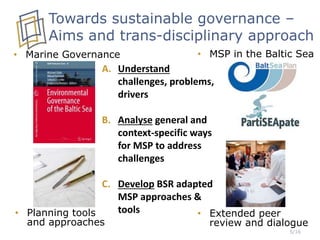
Towards sustainable governance –
Aims and trans-disciplinary approach
• Marine Governance
5/16
• MSP in the Baltic Sea
• Planning tools
and approaches
• Extended peer
review and dialogue
A. Understand
challenges, problems,
drivers
B. Analyse general and
context-specific ways
for MSP to address
challenges
C. Develop BSR adapted
MSP approaches &
tools
6/16
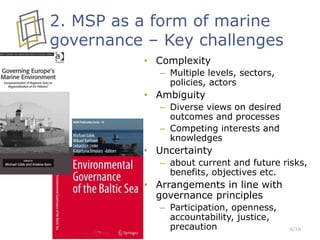
2. MSP as a form of marine
governance – Key challenges
• Complexity
– Multiple levels, sectors,
policies, actors
• Ambiguity
– Diverse views on desired
outcomes and processes
– Competing interests and
knowledges
• Uncertainty
– about current and future risks,
benefits, objectives etc.
• Arrangements in line with
governance principles
– Participation, openness,
accountability, justice,
precaution
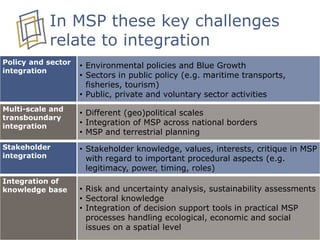
In MSP these key challenges
relate to integration
Policy and sector
integration
• Environmental policies and Blue Growth
• Sectors in public policy (e.g. maritime transports,
fisheries, tourism)
• Public, private and voluntary sector activities
Multi-scale and
transboundary
integration
• Different (geo)political scales
• Integration of MSP across national borders
• MSP and terrestrial planning
Stakeholder
integration
• Stakeholder knowledge, values, interests, critique in MSP
with regard to important procedural aspects (e.g.
legitimacy, power, timing, roles)
Integration of
knowledge base • Risk and uncertainty analysis, sustainability assessments
• Sectoral knowledge
• Integration of decision support tools in practical MSP
processes handling ecological, economic and social
issues on a spatial level 7/16
3. Important considerations for
analysing and developing MSP (WP1)
• How does context influence integration
challenges?
– E.g. cross-border contexts as particularly challenging
owing to strategic interests and different administrative
traditions?
8/16
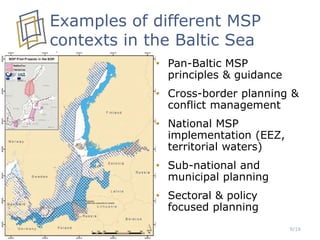
Examples of different MSP
contexts in the Baltic Sea
• Pan-Baltic MSP
principles & guidance
• Cross-border planning &
conflict management
• National MSP
implementation (EEZ,
territorial waters)
• Sub-national and
municipal planning
• Sectoral & policy
focused planning
9/16
10/16
Important considerations for
analysing and developing MSP (WP1)
• How does context influence integration challenges?
– E.g. cross-border contexts as particularly challenging owing to
strategic interests and different administrative traditions?
• Is more integration necessarily better?
• Is consensus always desirable?
– Consensus vs. conflict-based views of planning
– ‘Balance’ vs. ‘trade-offs’ in decision-making
• Are different conceptualisations of MSP important?
– Blue growth vs. environment
– Participatory vs. expert-based; quantitative vs. qualitative
• How can MSP processes, tools, outcomes etc. be
evaluated and developed/adapted?
– Multi-dimensional ‘criteria’ linked to processes, outcomes,
governance principles
– MSP as a ‘wicked’ problem? Reflection, learning, adaptivity
11/16
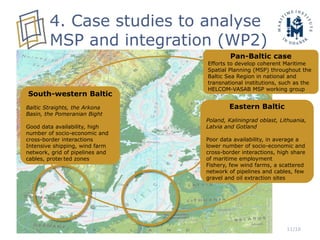
4. Case studies to analyse
MSP and integration (WP2)
South-western Baltic
Baltic Straights, the Arkona
Basin, the Pomeranian Bight
Good data availability, high
number of socio-economic and
cross-border interactions
Intensive shipping, wind farm
network, grid of pipelines and
cables, protected zones
Eastern Baltic
Poland, Kaliningrad oblast, Lithuania,
Latvia and Gotland
Poor data availability, in average a
lower number of socio-economic and
cross-border interactions, high share
of maritime employment
Fishery, few wind farms, a scattered
network of pipelines and cables, few
gravel and oil extraction sites
Pan-Baltic case
Efforts to develop coherent Maritime
Spatial Planning (MSP) throughout the
Baltic Sea Region in national and
transnational institutions, such as the
HELCOM-VASAB MSP working group
12/16
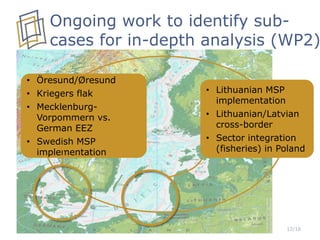
Ongoing work to identify sub-
cases for in-depth analysis (WP2)
• Öresund/Øresund
• Kriegers flak
• Mecklenburg-
Vorpommern vs.
German EEZ
• Swedish MSP
implementation
• Lithuanian MSP
implementation
• Lithuanian/Latvian
cross-border
• Sector integration
(fisheries) in Poland
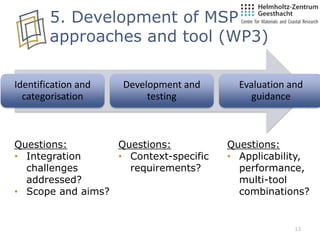
Identification and
categorisation
Development and
testing
Evaluation and
guidance
Questions:
• Integration
challenges
addressed?
• Scope and aims?
13
5. Development of MSP
approaches and tool (WP3)
Questions:
• Context-specific
requirements?
Questions:
• Applicability,
performance,
multi-tool
combinations?
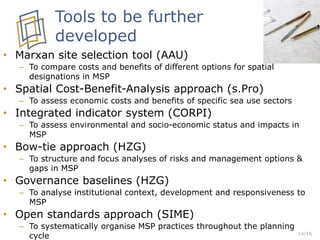
• Marxan site selection tool (AAU)
– To compare costs and benefits of different options for spatial
designations in MSP
• Spatial Cost-Benefit-Analysis approach (s.Pro)
– To assess economic costs and benefits of specific sea use sectors
• Integrated indicator system (CORPI)
– To assess environmental and socio-economic status and impacts in
MSP
• Bow-tie approach (HZG)
– To structure and focus analyses of risks and management options &
gaps in MSP
• Governance baselines (HZG)
– To analyse institutional context, development and responsiveness to
MSP
• Open standards approach (SIME)
– To systematically organise MSP practices throughout the planning
cycle 14/16
Tools to be further
developed
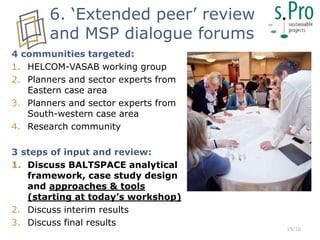
4 communities targeted:
1. HELCOM-VASAB working group
2. Planners and sector experts from
Eastern case area
3. Planners and sector experts from
South-western case area
4. Research community
3 steps of input and review:
1. Discuss BALTSPACE analytical
framework, case study design
and approaches & tools
(starting at today’s workshop)
2. Discuss interim results
3. Discuss final results
6. ‘Extended peer’ review
and MSP dialogue forums
15/16
30.09.2015 Your footer 16
www.baltspace.eu

Baltic SCOPE kick-off - Tackling MSP integration challenges in the BSR*

  • 1.
    Towards sustainable governance ofBaltic marine space 2015 – 2018 BALTSPACE has received funding from BONUS (Art 185) funded jointly from the European Union‘s Seventh Framework Programme for research, technological development and demonstration, and from Baltic Sea national funding institutions. Tackling MSP integration challenges in the BSR Michael Gilek, Södertörn University, Sweden Baltic SCOPE Kick-off/ Riga September 29, 2015
  • 2.
    Presentation outline (6parts) 1) BALTSPACE aims, organisation, scope 2) Key (integration) challenges in marine governance and MSP 3) Analysing and developing MSP in the BSR – important considerations (WP1) 4) Case study focus and design (WP2) 5) Development of MSP approaches and tools (WP3) 6) ‘Extended peer’ review as a key process in BALTSPACE R&D (WP4) 2/16
  • 3.
    1. Basic factsabout BALTSPACE Duration: 2015–2018 Coordinator: Södertörn University Michael Gilek Further partners: • Aarhus University, Dept. of Bioscience Karsten Dahl • Swedish Institute for the Marine Environment Andrea Morf • Maritime Institute in Gdańsk Jacek Zaucha • Coastal Planning and Research Institute Nerijus Blažauskas • Helmholtz-Zentrum Geesthacht Andreas Kannen • Leibniz Institute for Baltic Sea Research Holger Janßen • s.Pro – sustainable projects Angela Schultz-Zehden 3/16
  • 4.
    30.09.2015 Your footer4 Providing science-based approaches and tools to clarify and improve the capacity of MSP as a policy integrator in the Baltic Sea Region 4/16
  • 5.
    Towards sustainable governance– Aims and trans-disciplinary approach • Marine Governance 5/16 • MSP in the Baltic Sea • Planning tools and approaches • Extended peer review and dialogue A. Understand challenges, problems, drivers B. Analyse general and context-specific ways for MSP to address challenges C. Develop BSR adapted MSP approaches & tools
  • 6.
    6/16 2. MSP asa form of marine governance – Key challenges • Complexity – Multiple levels, sectors, policies, actors • Ambiguity – Diverse views on desired outcomes and processes – Competing interests and knowledges • Uncertainty – about current and future risks, benefits, objectives etc. • Arrangements in line with governance principles – Participation, openness, accountability, justice, precaution
  • 7.
    In MSP thesekey challenges relate to integration Policy and sector integration • Environmental policies and Blue Growth • Sectors in public policy (e.g. maritime transports, fisheries, tourism) • Public, private and voluntary sector activities Multi-scale and transboundary integration • Different (geo)political scales • Integration of MSP across national borders • MSP and terrestrial planning Stakeholder integration • Stakeholder knowledge, values, interests, critique in MSP with regard to important procedural aspects (e.g. legitimacy, power, timing, roles) Integration of knowledge base • Risk and uncertainty analysis, sustainability assessments • Sectoral knowledge • Integration of decision support tools in practical MSP processes handling ecological, economic and social issues on a spatial level 7/16
  • 8.
    3. Important considerationsfor analysing and developing MSP (WP1) • How does context influence integration challenges? – E.g. cross-border contexts as particularly challenging owing to strategic interests and different administrative traditions? 8/16
  • 9.
    Examples of differentMSP contexts in the Baltic Sea • Pan-Baltic MSP principles & guidance • Cross-border planning & conflict management • National MSP implementation (EEZ, territorial waters) • Sub-national and municipal planning • Sectoral & policy focused planning 9/16
  • 10.
    10/16 Important considerations for analysingand developing MSP (WP1) • How does context influence integration challenges? – E.g. cross-border contexts as particularly challenging owing to strategic interests and different administrative traditions? • Is more integration necessarily better? • Is consensus always desirable? – Consensus vs. conflict-based views of planning – ‘Balance’ vs. ‘trade-offs’ in decision-making • Are different conceptualisations of MSP important? – Blue growth vs. environment – Participatory vs. expert-based; quantitative vs. qualitative • How can MSP processes, tools, outcomes etc. be evaluated and developed/adapted? – Multi-dimensional ‘criteria’ linked to processes, outcomes, governance principles – MSP as a ‘wicked’ problem? Reflection, learning, adaptivity
  • 11.
    11/16 4. Case studiesto analyse MSP and integration (WP2) South-western Baltic Baltic Straights, the Arkona Basin, the Pomeranian Bight Good data availability, high number of socio-economic and cross-border interactions Intensive shipping, wind farm network, grid of pipelines and cables, protected zones Eastern Baltic Poland, Kaliningrad oblast, Lithuania, Latvia and Gotland Poor data availability, in average a lower number of socio-economic and cross-border interactions, high share of maritime employment Fishery, few wind farms, a scattered network of pipelines and cables, few gravel and oil extraction sites Pan-Baltic case Efforts to develop coherent Maritime Spatial Planning (MSP) throughout the Baltic Sea Region in national and transnational institutions, such as the HELCOM-VASAB MSP working group
  • 12.
    12/16 Ongoing work toidentify sub- cases for in-depth analysis (WP2) • Öresund/Øresund • Kriegers flak • Mecklenburg- Vorpommern vs. German EEZ • Swedish MSP implementation • Lithuanian MSP implementation • Lithuanian/Latvian cross-border • Sector integration (fisheries) in Poland
  • 13.
    Identification and categorisation Development and testing Evaluationand guidance Questions: • Integration challenges addressed? • Scope and aims? 13 5. Development of MSP approaches and tool (WP3) Questions: • Context-specific requirements? Questions: • Applicability, performance, multi-tool combinations?
  • 14.
    • Marxan siteselection tool (AAU) – To compare costs and benefits of different options for spatial designations in MSP • Spatial Cost-Benefit-Analysis approach (s.Pro) – To assess economic costs and benefits of specific sea use sectors • Integrated indicator system (CORPI) – To assess environmental and socio-economic status and impacts in MSP • Bow-tie approach (HZG) – To structure and focus analyses of risks and management options & gaps in MSP • Governance baselines (HZG) – To analyse institutional context, development and responsiveness to MSP • Open standards approach (SIME) – To systematically organise MSP practices throughout the planning cycle 14/16 Tools to be further developed
  • 15.
    4 communities targeted: 1.HELCOM-VASAB working group 2. Planners and sector experts from Eastern case area 3. Planners and sector experts from South-western case area 4. Research community 3 steps of input and review: 1. Discuss BALTSPACE analytical framework, case study design and approaches & tools (starting at today’s workshop) 2. Discuss interim results 3. Discuss final results 6. ‘Extended peer’ review and MSP dialogue forums 15/16
  • 16.
    30.09.2015 Your footer16 www.baltspace.eu