Chapter 13
This presentationexplores the world of programming
languages and program development, covering topics from
low-level languages to object-oriented programming and web
development.
2.
Low-Level Languages
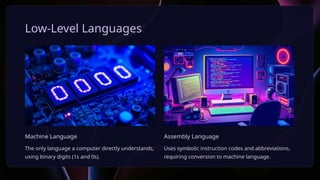
Machine Language
Theonly language a computer directly understands,
using binary digits (1s and 0s).
Assembly Language
Uses symbolic instruction codes and abbreviations,
requiring conversion to machine language.
3.
Procedural Languages
1 Instructions
Programmerwrites
instructions telling the
computer what to
accomplish.
2 Third-Generation
Language (3GL)
Often called 3GL, using
English-like words for
instructions.
3 Compilers and Interpreters
Compilers convert entire programs to machine
language, while interpreters translate and execute one
statement at a time.
4.
Popular Procedural
Languages
COBOL
Designed forbusiness
applications, using
English-like statements
for readability.
C
Powerful language
originally designed for
system software,
requiring professional
programming skills.
5.
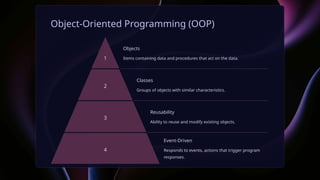
Object-Oriented Programming (OOP)
1
Objects
Itemscontaining data and procedures that act on the data.
2
Classes
Groups of objects with similar characteristics.
3
Reusability
Ability to reuse and modify existing objects.
4
Event-Driven
Responds to events, actions that trigger program
responses.
6.
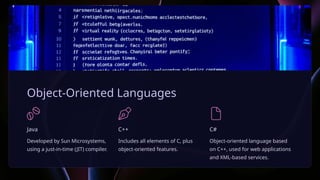
Object-Oriented Languages
Java
Developed bySun Microsystems,
using a just-in-time (JIT) compiler.
C++
Includes all elements of C, plus
object-oriented features.
C#
Object-oriented language based
on C++, used for web applications
and XML-based services.
7.
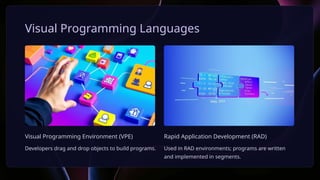
Visual Programming Languages
VisualProgramming Environment (VPE)
Developers drag and drop objects to build programs.
Rapid Application Development (RAD)
Used in RAD environments; programs are written
and implemented in segments.
8.
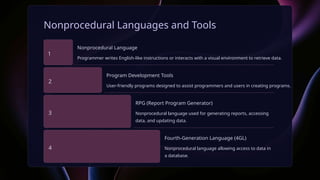
Nonprocedural Languages andTools
1
Nonprocedural Language
Programmer writes English-like instructions or interacts with a visual environment to retrieve data.
2
Program Development Tools
User-friendly programs designed to assist programmers and users in creating programs.
3
RPG (Report Program Generator)
Nonprocedural language used for generating reports, accessing
data, and updating data.
4
Fourth-Generation Language (4GL)
Nonprocedural language allowing access to data in
a database.
9.
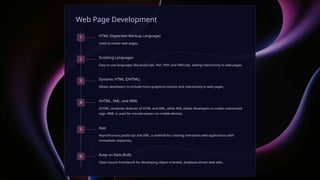
Web Page Development
1HTML (Hypertext Markup Language)
Used to create web pages.
2 Scripting Languages
Easy-to-use languages like JavaScript, Perl, PHP, and VBScript, adding interactivity to web pages.
3 Dynamic HTML (DHTML)
Allows developers to include more graphical interest and interactivity in web pages.
4 XHTML, XML, and WML
XHTML combines features of HTML and XML, while XML allows developers to create customized
tags. WML is used for microbrowsers on mobile devices.
5 Ajax
Asynchronous JavaScript and XML, a method for creating interactive web applications with
immediate responses.
6 Ruby on Rails (RoR)
Open source framework for developing object-oriented, database-driven web sites.
10.
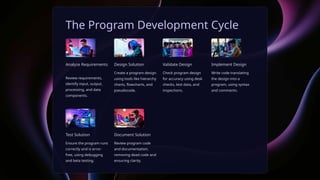
The Program DevelopmentCycle
Analyze Requirements
Review requirements,
identify input, output,
processing, and data
components.
Design Solution
Create a program design
using tools like hierarchy
charts, flowcharts, and
pseudocode.
Validate Design
Check program design
for accuracy using desk
checks, test data, and
inspections.
Implement Design
Write code translating
the design into a
program, using syntax
and comments.
Test Solution
Ensure the program runs
correctly and is error-
free, using debugging
and beta testing.
Document Solution
Review program code
and documentation,
removing dead code and
ensuring clarity.