CHAPTER 2
PROGRAMMING IN C
SLOs
Define header files
Identify reserved words
Describe basic structure of a C program
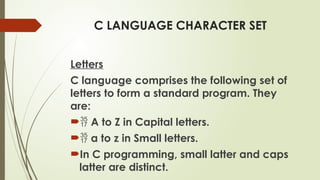
C LANGUAGE CHARACTER SET
Letters
C language comprises the following set of
letters to form a standard program. They
are:
 A to Z in Capital letters.
 a to z in Small letters.
In C programming, small latter and caps
latter are distinct.
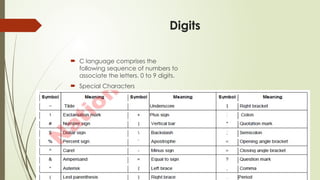
Digits
 C language comprises the
following sequence of numbers to
associate the letters. 0 to 9 digits.
 Special Characters
RESERVED WORDS
 The words that are part of programming language and have special
purposes in computer programs are called reserved words or keyword
 They have predefined use and cannot be used for any other purpose.
 Reserved words are always written in lowercase.
 There are 32 words defined as reserved words in C.
COMPUTER PROGRAM
 A computer program is a set of instructions (statements) written in a programming
language to solve a particular problem and achieving specific results.
 A large variety of programming languages have been developed for writing
computer programs to use the computer as a problem-solving tool. Each
statement of a programming language has syntax and semantic.
Syntax & Semantic
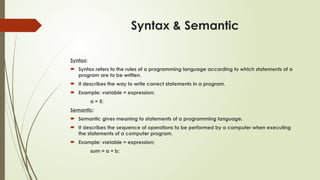
Syntax:
 Syntax refers to the rules of a programming language according to which statements of a
program are to be written.
 It describes the way to write correct statements in a program.
 Example: variable = expression;
a = 5;
Semantic:
 Semantic gives meaning to statements of a programming language.
 It describes the sequence of operations to be performed by a computer when executing
the statements of a computer program.
 Example: variable = expression;
sum = a + b;
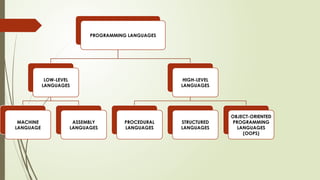
PROGRAMMING LANGUAGES
LOW-LEVEL
LANGUAGES
MACHINE
LANGUAGE
ASSEMBLY
LANGUAGES
HIGH-LEVEL
LANGUAGES
PROCEDURAL
LANGUAGES
STRUCTURED
LANGUAGES
OBJECT-ORIENTED
PROGRAMMING
LANGUAGES
(OOPS)
CHARACTERISTICS OF LOW LEVEL LANGUAGES
 Low level language is machine-oriented language
 To understand low level language, detailed knowledge of
internal working of computer is required.
MACHINE LANGUAGE
 Programming language that is directly understood by computer hardware
is known as machine language.
 It consists of zeroes and ones.
 It is almost impossible for humans to use machine language because it
entirely consists of numbers.
ASSEMBLY LANGUAGE
 Assembly language consists of symbolic codes or abbreviations known as
mnemonics.
 It was developed to make computer programming easier than machine
language.
 A program written in assembly language must be converted into machine
language before it is executed by computer.
 A program known as assembler is used to translate assembly language into
machine language.
 Generally a program written in assembly language will require less storage
and less running time than one prepared in a high level language.
CHARACTERISTICS OF HIGH LEVEL LANGUAGES
 These languages were developed to make computer programming simple, easier
and less prone to errors.
 High level languages are not machine dependent.
 Programs written in high-level languages must be translated into machine
language by a compiler or an interpreter before execution by the computer.
 The process of finding and removing errors in programs (debugging) is easier in
high-level languages compared to low level language.
 High-level language programs are highly structured.
PROCEDURAL LANGUAGES
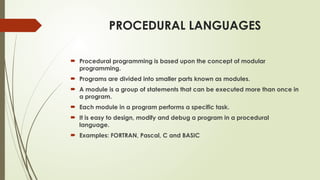
 Procedural programming is based upon the concept of modular
programming.
 Programs are divided into smaller parts known as modules.
 A module is a group of statements that can be executed more than once in
a program.
 Each module in a program performs a specific task.
 It is easy to design, modify and debug a program in a procedural
language.
 Examples: FORTRAN, Pascal, C and BASIC
STRUCTURED LANGUAGES
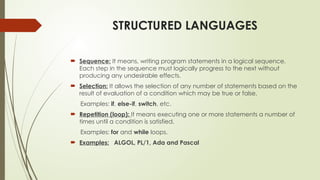
 Sequence: It means, writing program statements in a logical sequence.
Each step in the sequence must logically progress to the next without
producing any undesirable effects.
 Selection: It allows the selection of any number of statements based on the
result of evaluation of a condition which may be true or false.
Examples: if, else-if, switch, etc.
 Repetition (loop): It means executing one or more statements a number of
times until a condition is satisfied.
Examples: for and while loops.
 Examples: ALGOL, PL/1, Ada and Pascal
Object-Oriented Programming
Languages (OOPs)
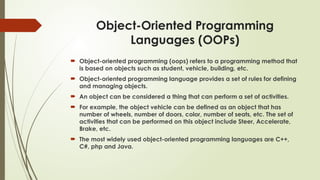
 Object-oriented programming (oops) refers to a programming method that
is based on objects such as student, vehicle, building, etc.
 Object-oriented programming language provides a set of rules for defining
and managing objects.
 An object can be considered a thing that can perform a set of activities.
 For example, the object vehicle can be defined as an object that has
number of wheels, number of doors, color, number of seats, etc. The set of
activities that can be performed on this object include Steer, Accelerate,
Brake, etc.
 The most widely used object-oriented programming languages are C++,
C#, php and Java.
POPULAR HIGH LEVEL LANGUAGES
 C/C++
 Visual Basic
 C#
 Java
C Language
 C language was developed in early 1970s by Dennis Ritchie at Bell
Laboratories.
 It is a highly structures programming language that is easy to understand
and use.
 it is used for writing all types of application programs as well, such as word-
processing programs, spreadsheet programs, database management
systems, educational programs, games, etc.
C++
 C++ was developed by Bjarne Stroustrup also at Bell Laboratories during
1983-1985.
 C++ is a superset of C, meaning that any valid C program is also a valid C+
+ program.
 The purpose of developing C++ was to provide programming facilities to
easily and quickly write more powerful programs.
Visual Basic
 VB is a very popular programming language for writing Windows and Web
applications.
 It provides a graphical development environment to programmers to
develop powerful Windows and Web applications.
 VB is commonly used for developing business programs such as payroll
system and inventory control program.
 The user can also write programs related with engineering, science, arts,
education, games, etc.
C#
 C# (pronounced as C-sharp) is a language developed in 2000 by Microsoft
Corporation.
 It is a simple, modern, general-purpose programming language.
 Syntax of C# is very similar to C and C++. It also has some features of Java.
 It provides facilities to write Web applications that can be used across the
Internet.
 All types of programs including games, utilities, operating systems,
compilers, business applications and Web based applications can be
developed in C#.
Java
 Java is a high-level language developed by Sun Microsystems.
 In Java, the user can write all types of programs as those written in other
programming languages and small programs that can be embedded in a
Web page accessed through Internet. Java is an ideal language for
network computing.
 It is used for writing programs for a wide range of devices, computers and
networks.
 It is widely used in Web applications.
 The current versions of most of the Web browsers are made Java enabled.
 A few browsers that support Java are Microsoft’s Internet Explorer, Firefox
and Mozilla.
Source Program & Object Program
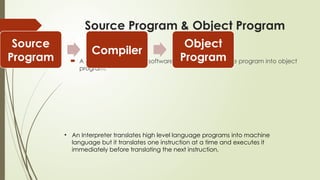
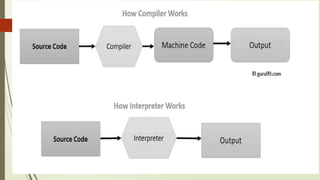
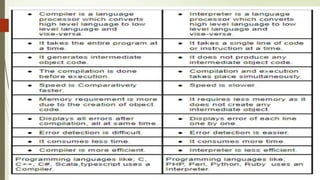
 A compiler is computer software that translates source program into object
program.
Source
Program
Compiler
Object
Program
• An Interpreter translates high level language programs into machine
language but it translates one instruction at a time and executes it
immediately before translating the next instruction.
PROGRAMMING ENVIRONMENT
 Programming environment is the set of processes and programming tools
used to develop computer programs.
 Today, programmers use Integrated Development Environment for
developing computer programs. Integrated Development Environment is
an application package that consists of editor, compiler, linker and
debugger with a graphical user interface.
INTEGRATED DEVELOPMENT
ENVIRONMENT (IDE)
 IDE is computer software that brings all the processes and tools required for
program development into one place.
 IDE’s aim is to make the life of programmers easier by grouping together all
the tasks needed for building applications into one environment.
 Today’s modern IDEs have user -friendly Graphical User Interface (GUI).
PROGRAMMING ENVIRONMENT OF C
LANGUAGE
A C language IDE consists of the following modules.
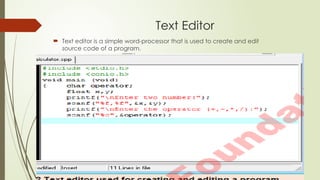
 Text Editor
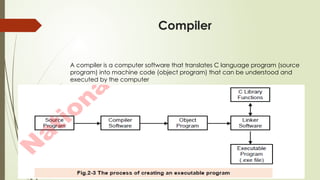
 Compiler
 Linker
 Loader
 Debugger
Text Editor
 Text editor is a simple word-processor that is used to create and edit
source code of a program.
Compiler
A compiler is a computer software that translates C language program (source
program) into machine code (object program) that can be understood and
executed by the computer
LINKER
Linker is a software that translates object program into a single executable
program
Loader
It is a software that loads programs into memory and then executes them.
Debugger
It is a software that executes a program line by line, examines the values stored in
variables and helps in finding and removing errors in programs.

PRESENTATION OF students learning outcomes.pptx

  • 2.
  • 3.
    SLOs Define header files Identifyreserved words Describe basic structure of a C program
  • 4.
    C LANGUAGE CHARACTERSET Letters C language comprises the following set of letters to form a standard program. They are:  A to Z in Capital letters.  a to z in Small letters. In C programming, small latter and caps latter are distinct.
  • 5.
    Digits  C languagecomprises the following sequence of numbers to associate the letters. 0 to 9 digits.  Special Characters
  • 6.
    RESERVED WORDS  Thewords that are part of programming language and have special purposes in computer programs are called reserved words or keyword  They have predefined use and cannot be used for any other purpose.  Reserved words are always written in lowercase.  There are 32 words defined as reserved words in C.
  • 7.
    COMPUTER PROGRAM  Acomputer program is a set of instructions (statements) written in a programming language to solve a particular problem and achieving specific results.  A large variety of programming languages have been developed for writing computer programs to use the computer as a problem-solving tool. Each statement of a programming language has syntax and semantic.
  • 8.
    Syntax & Semantic Syntax: Syntax refers to the rules of a programming language according to which statements of a program are to be written.  It describes the way to write correct statements in a program.  Example: variable = expression; a = 5; Semantic:  Semantic gives meaning to statements of a programming language.  It describes the sequence of operations to be performed by a computer when executing the statements of a computer program.  Example: variable = expression; sum = a + b;
  • 9.
  • 10.
    CHARACTERISTICS OF LOWLEVEL LANGUAGES  Low level language is machine-oriented language  To understand low level language, detailed knowledge of internal working of computer is required.
  • 11.
    MACHINE LANGUAGE  Programminglanguage that is directly understood by computer hardware is known as machine language.  It consists of zeroes and ones.  It is almost impossible for humans to use machine language because it entirely consists of numbers.
  • 12.
    ASSEMBLY LANGUAGE  Assemblylanguage consists of symbolic codes or abbreviations known as mnemonics.  It was developed to make computer programming easier than machine language.  A program written in assembly language must be converted into machine language before it is executed by computer.  A program known as assembler is used to translate assembly language into machine language.  Generally a program written in assembly language will require less storage and less running time than one prepared in a high level language.
  • 13.
    CHARACTERISTICS OF HIGHLEVEL LANGUAGES  These languages were developed to make computer programming simple, easier and less prone to errors.  High level languages are not machine dependent.  Programs written in high-level languages must be translated into machine language by a compiler or an interpreter before execution by the computer.  The process of finding and removing errors in programs (debugging) is easier in high-level languages compared to low level language.  High-level language programs are highly structured.
  • 14.
    PROCEDURAL LANGUAGES  Proceduralprogramming is based upon the concept of modular programming.  Programs are divided into smaller parts known as modules.  A module is a group of statements that can be executed more than once in a program.  Each module in a program performs a specific task.  It is easy to design, modify and debug a program in a procedural language.  Examples: FORTRAN, Pascal, C and BASIC
  • 15.
    STRUCTURED LANGUAGES  Sequence:It means, writing program statements in a logical sequence. Each step in the sequence must logically progress to the next without producing any undesirable effects.  Selection: It allows the selection of any number of statements based on the result of evaluation of a condition which may be true or false. Examples: if, else-if, switch, etc.  Repetition (loop): It means executing one or more statements a number of times until a condition is satisfied. Examples: for and while loops.  Examples: ALGOL, PL/1, Ada and Pascal
  • 16.
    Object-Oriented Programming Languages (OOPs) Object-oriented programming (oops) refers to a programming method that is based on objects such as student, vehicle, building, etc.  Object-oriented programming language provides a set of rules for defining and managing objects.  An object can be considered a thing that can perform a set of activities.  For example, the object vehicle can be defined as an object that has number of wheels, number of doors, color, number of seats, etc. The set of activities that can be performed on this object include Steer, Accelerate, Brake, etc.  The most widely used object-oriented programming languages are C++, C#, php and Java.
  • 17.
    POPULAR HIGH LEVELLANGUAGES  C/C++  Visual Basic  C#  Java
  • 18.
    C Language  Clanguage was developed in early 1970s by Dennis Ritchie at Bell Laboratories.  It is a highly structures programming language that is easy to understand and use.  it is used for writing all types of application programs as well, such as word- processing programs, spreadsheet programs, database management systems, educational programs, games, etc.
  • 19.
    C++  C++ wasdeveloped by Bjarne Stroustrup also at Bell Laboratories during 1983-1985.  C++ is a superset of C, meaning that any valid C program is also a valid C+ + program.  The purpose of developing C++ was to provide programming facilities to easily and quickly write more powerful programs.
  • 20.
    Visual Basic  VBis a very popular programming language for writing Windows and Web applications.  It provides a graphical development environment to programmers to develop powerful Windows and Web applications.  VB is commonly used for developing business programs such as payroll system and inventory control program.  The user can also write programs related with engineering, science, arts, education, games, etc.
  • 21.
    C#  C# (pronouncedas C-sharp) is a language developed in 2000 by Microsoft Corporation.  It is a simple, modern, general-purpose programming language.  Syntax of C# is very similar to C and C++. It also has some features of Java.  It provides facilities to write Web applications that can be used across the Internet.  All types of programs including games, utilities, operating systems, compilers, business applications and Web based applications can be developed in C#.
  • 22.
    Java  Java isa high-level language developed by Sun Microsystems.  In Java, the user can write all types of programs as those written in other programming languages and small programs that can be embedded in a Web page accessed through Internet. Java is an ideal language for network computing.  It is used for writing programs for a wide range of devices, computers and networks.  It is widely used in Web applications.  The current versions of most of the Web browsers are made Java enabled.  A few browsers that support Java are Microsoft’s Internet Explorer, Firefox and Mozilla.
  • 23.
    Source Program &Object Program  A compiler is computer software that translates source program into object program. Source Program Compiler Object Program • An Interpreter translates high level language programs into machine language but it translates one instruction at a time and executes it immediately before translating the next instruction.
  • 26.
    PROGRAMMING ENVIRONMENT  Programmingenvironment is the set of processes and programming tools used to develop computer programs.  Today, programmers use Integrated Development Environment for developing computer programs. Integrated Development Environment is an application package that consists of editor, compiler, linker and debugger with a graphical user interface.
  • 27.
    INTEGRATED DEVELOPMENT ENVIRONMENT (IDE) IDE is computer software that brings all the processes and tools required for program development into one place.  IDE’s aim is to make the life of programmers easier by grouping together all the tasks needed for building applications into one environment.  Today’s modern IDEs have user -friendly Graphical User Interface (GUI).
  • 28.
    PROGRAMMING ENVIRONMENT OFC LANGUAGE A C language IDE consists of the following modules.  Text Editor  Compiler  Linker  Loader  Debugger
  • 29.
    Text Editor  Texteditor is a simple word-processor that is used to create and edit source code of a program.
  • 30.
    Compiler A compiler isa computer software that translates C language program (source program) into machine code (object program) that can be understood and executed by the computer
  • 31.
    LINKER Linker is asoftware that translates object program into a single executable program
  • 32.
    Loader It is asoftware that loads programs into memory and then executes them.
  • 33.
    Debugger It is asoftware that executes a program line by line, examines the values stored in variables and helps in finding and removing errors in programs.