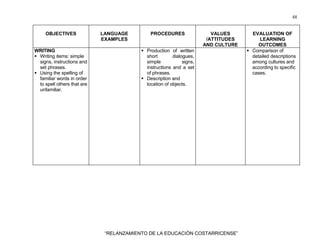
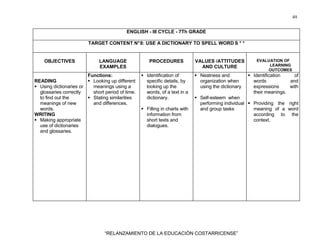
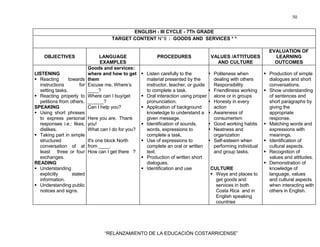
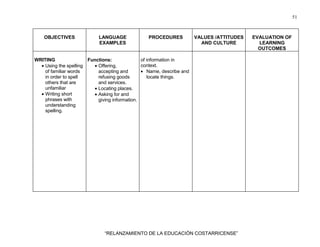
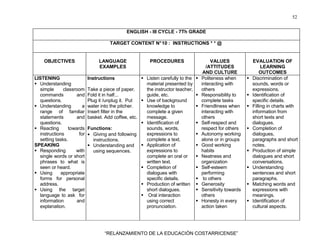
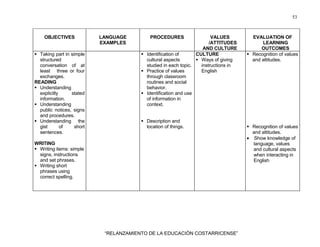
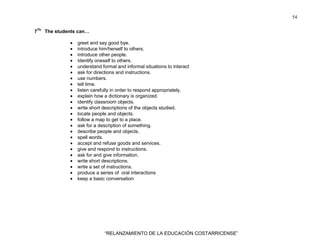
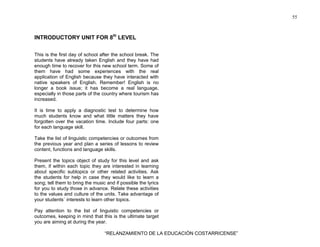
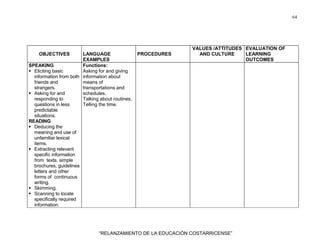
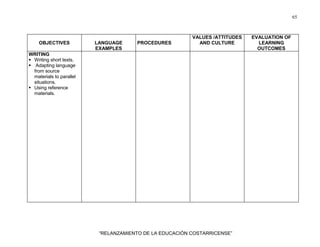
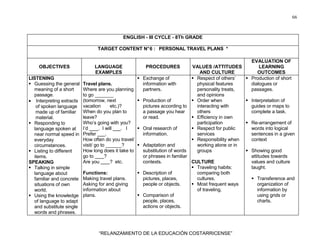
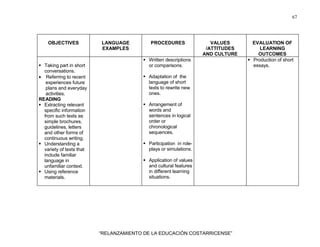
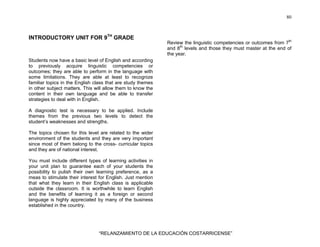
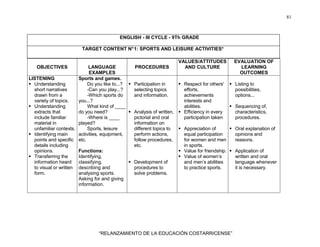
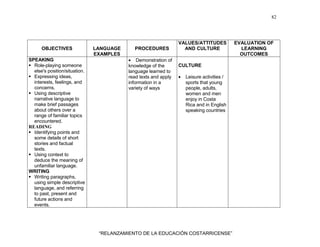
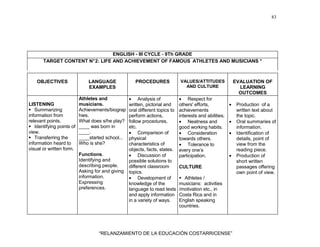
4
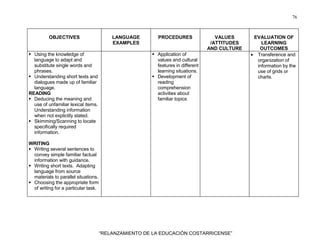
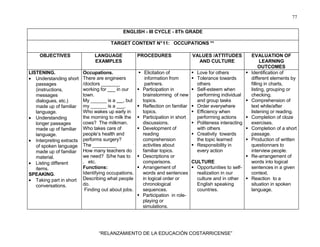
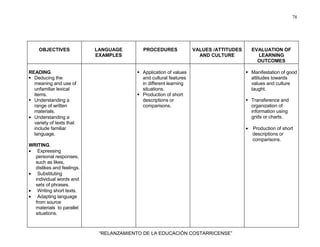
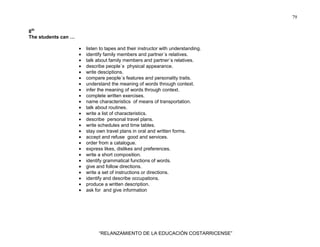
“RELANZAMIENTO DE LA EDUCACIÓN COSTARRICENSE”
LA TRANSVERSALIDAD EN LOS
PROGRAMAS DE ESTUDIO
Los cambios sociales, económicos, culturales, científicos,
ambientales y tecnológicos del mundo contemporáneo,
han exigido al currículo educativo no solo aportar
conocimientos e información, sino también favorecer el
desarrollo de valores, actitudes, habilidades y destrezas
que apunten al mejoramiento de la calidad de vida de las
personas y de las sociedades (Marco de Acción Regional
de “Educación para Todos en las Américas”, Santo
Domingo, 2000). Sin embargo, existe en nuestro Sistema
Educativo una dificultad real de incorporar nuevas
asignaturas o contenidos relacionados con los temas
emergentes de relevancia para nuestra sociedad, pues se
corre el riesgo de saturar y fragmentar los programas de
estudio.
Una alternativa frente a estas limitaciones es la
transversalidad, la cual se entiende como un “Enfoque
Educativo que aprovecha las oportunidades que ofrece el
currículo, incorporando en los procesos de diseño,
desarrollo, evaluación y administración curricular,
determinados aprendizajes para la vida, integradores y
significativos, dirigidos al mejoramiento de la calidad de
vida individual y social. Es de carácter holístico,
axiológico, interdisciplinario y contextualizado” (Comisión
Nacional Ampliada de Transversalidad, 2002).
De acuerdo con los lineamientos emanados del Consejo
Superior de Educación (SE 339-2003), el único eje
transversal del currículo costarricense es el de valores.
De esta manera, el abordaje sistemático de los Valores en
el currículo nacional, pretende potenciar el desarrollo
socio-afectivo y ético de los y las estudiantes, a partir de
la posición humanista expresada en la Política Educativa y
en la Ley Fundamental de Educación.
A partir del Eje transversal de los valores y de las
obligaciones asumidas por el estado desde la legislación
existente, en Costa Rica se han definido los siguientes
Temas transversales: Cultura Ambiental para el
Desarrollo Sostenible, Educación Integral de la
Sexualidad, Educación para la Salud y Vivencia de los
Derechos Humanos para la Democracia y la Paz.
Para cada uno de los temas transversales se han definido
una serie de competencias por desarrollar en los y las
estudiantes a lo largo de su período de formación
educativa. Las Competencias se entienden como: “Un
conjunto integrado de conocimientos, procedimientos,
actitudes y valores, que permite un desempeño
satisfactorio y autónomo ante situaciones concretas de la
vida personal y social” (Comisión Nacional Ampliada de
Transversalidad, 2002). Las mismas deben orientar los
procesos educativos y el desarrollo mismo de la
transversalidad.
Desde la condición pedagógica de las competencias se
han definido competencias de la transversalidad como:
“Aquellas que atraviesan e impregnan horizontal y
verticalmente, todas las asignaturas del currículo y
requieren para su desarrollo del aporte integrado y
coordinado de las diferentes disciplinas de estudio, así
como de una acción pedagógica conjunta” (Beatriz
Castellanos, 2002). De esta manera, están presentes
tanto en las programaciones anuales como a lo largo de
todo el sistema educativo.
A continuación se presenta un resumen del enfoque de
cada tema transversal y las competencias respectivas:
Cultura Ambiental para el Desarrollo Sostenible
5
“RELANZAMIENTO DE LA EDUCACIÓN COSTARRICENSE”
La educación ambiental se considera como el instrumento
idóneo para la construcción de una cultura ambiental de
las personas y las sociedades, en función de alcanzar un
desarrollo humano sostenible, mediante un proceso que
les permita comprender su interdependencia con el
entorno, a partir del conocimiento crítico y reflexivo de la
realidad inmediata, tanto biofísica como social,
económica, política y cultural.
Tiene como objetivo que, a partir de ese conocimiento y
mediante actividades de valoración y respeto, las y los
estudiantes se apropien de la realidad, de manera que, la
comunidad educativa participe activamente en la
detección y solución de problemas, en el ámbito local,
pero con visión planetaria.
Competencias por desarrollar
• Aplica los conocimientos adquiridos mediante
procesos críticos y reflexivos de la realidad, en la
resolución de problemas (ambientales,
económicos, sociales, políticos, éticos) de manera
creativa y mediante actitudes, prácticas y valores
que contribuyan al logro del desarrollo sostenible y
una mejor calidad de vida.
• Participa comprometida, activa y responsablemente
en proyectos tendientes a la conservación,
recuperación y protección del ambiente;
identificando sus principales problemas y
necesidades, generando y desarrollando
alternativas de solución, para contribuir al
mejoramiento de su calidad de vida, la de los
demás y al desarrollo sostenible.
• Practica relaciones armoniosas consigo mismo, con
los demás, y los otros seres vivos por medio de
actitudes y aptitudes responsables, reconociendo la
necesidad de interdependencia con el ambiente.
Educación Integral de la Sexualidad
A partir de las “Políticas de Educación Integral de la
Expresión de la Sexualidad Humana” (2001), una vivencia
madura de la sexualidad humana requiere de una
educación integral, por lo que deben atenderse los
aspectos físicos, biológicos, psicológicos, socioculturales,
éticos y espirituales. No puede reducirse a los aspectos
biológicos reproductivos, ni realizarse en un contexto
desprovisto de valores y principios éticos y morales sobre
la vida, el amor, la familia y la convivencia.
La educación de la sexualidad humana inicia desde la
primera infancia y se prolonga a lo largo de la vida. Es un
derecho y un deber, en primera instancia, de las madres y
los padres de familia. Le corresponde al Estado una
acción subsidaria y potenciar la acción de las familias en
el campo de la educación y la información, como lo
expresa el Código de la Niñez y la Adolescencia.
El sistema educativo debe garantizar vivencias y
estrategias pedagógicas que respondan a las
potencialidades de la población estudiantil, en
concordancia con su etapa de desarrollo y con los
contextos socioculturales en los cuales se desenvuelven.
Competencias por desarrollar
• Se relaciona con hombres y mujeres de manera
equitativa, solidaria y respetuosa de la diversidad.
• Toma decisiones referentes a su sexualidad desde
un proyecto de vida basado en el conocimiento
crítico de sí mismo, su realidad sociocultural y en
sus valores éticos y morales.
6
“RELANZAMIENTO DE LA EDUCACIÓN COSTARRICENSE”
• Enfrenta situaciones de acoso, abuso y violencia,
mediante la identificación de recursos internos y
externos oportunos.
• Expresa su identidad de forma auténtica,
responsable e integral, favoreciendo el desarrollo
personal en un contexto de interrelación y
manifestación permanente de sentimientos,
actitudes, pensamientos, opiniones y derechos.
• Promueve procesos reflexivos y constructivos en su
familia, dignificando su condición de ser humano,
para identificar y proponer soluciones de acuerdo al
contexto sociocultural en el cual se desenvuelve.
Educación para la Salud
La educación para la salud es un derecho fundamental de
todos los niños, niñas y adolescentes. El estado de salud,
está relacionado con su rendimiento escolar y con su
calidad de vida. De manera que, al trabajar en educación
para la salud en los centros educativos, según las
necesidades de la población estudiantil, en cada etapa de
su desarrollo, se están forjando ciudadanos con estilos de
vida saludables, y por ende, personas que construyen y
buscan tener calidad de vida, para sí mismas y para
quienes les rodean.
La educación para la salud debe ser un proceso social,
organizado, dinámico y sistemático que motive y oriente a
las personas a desarrollar, reforzar, modificar o sustituir
prácticas por aquellas que son más saludables en lo
individual, lo familiar y lo colectivo y en su relación con el
medio ambiente.
De manera que, la educación para la salud en el
escenario escolar no se limita únicamente a transmitir
información, sino que busca desarrollar conocimientos,
habilidades y destrezas que contribuyan a la producción
social de la salud, mediante procesos de enseñanza –
aprendizajes dinámicos, donde se privilegia la
comunicación de doble vía, así como la actitud crítica y
participativa del estudiantado.
Competencias por desarrollar
• Vivencia un estilo de vida que le permite, en forma
crítica y reflexiva, mantener y mejorar la salud integral
y la calidad de vida propia y la de los demás.
• Toma decisiones que favorecen su salud integral y la
de quienes lo rodean, a partir del conocimiento de sí
mismo y de los demás, así como del entorno en que se
desenvuelve.
• Elige mediante un proceso de valoración crítica, los
medios personales más adecuados para enfrentar las
situaciones y factores protectores y de riesgo para la
salud integral propia y la de los demás.
• Hace uso en forma responsable, crítica y participativa
de los servicios disponibles en el sector salud,
educación y en su comunidad, adquiriendo
compromisos en beneficio de la calidad de los mismos.
Vivencia de los Derechos Humanos para la
Democracia y la Paz
Costa Rica es una democracia consolidada pero en
permanente estado de revisión y retroalimentación, por lo
cual la vigencia de los derechos humanos es inherente al
compromiso de fortalecer una cultura de paz y de
democracia.
En los escenarios educativos es oportuno gestionar
mecanismos que promuevan una verdadera participación
ciudadana en los ámbitos familiar, comunal, institucional y
nacional. Para ello, la sociedad civil debe estar informada
7
“RELANZAMIENTO DE LA EDUCACIÓN COSTARRICENSE”
y educada en relación con el marco legal brindado por el
país, de manera que, desarrolle una participación efectiva
y no se reduzca a una participación periódica con carácter
electoral.
Se debe propiciar un modelo de sistema democrático que
permita hacer del ejercicio de la ciudadanía una actividad
atractiva, interesante y cívica que conlleva
responsabilidades y derechos.
Competencias por desarrollar
• Practica en la vivencia cotidiana los derechos y
responsabilidades que merece como ser humano y
ser humana, partiendo de una convivencia
democrática, ética, tolerante y pacífica.
• Asume su realidad como persona, sujeto de
derechos y responsabilidades.
• Elige las alternativas personales, familiares y de
convivencia social que propician la tolerancia, la
justicia y la equidad entre géneros de acuerdo a los
contextos donde se desenvuelve.
• Participa en acciones inclusivas para la vivencia de
la equidad en todos los contextos socioculturales.
• Ejercita los derechos y responsabilidades para la
convivencia democrática vinculada a la cultura de
paz.
• Es tolerante para aceptar y entender las diferencias
culturales, religiosas y étnicas que, propician
posibilidades y potencialidades de y en la
convivencia democrática y cultura de paz.
• Valora las diferencias culturales de los distintos
modos de vida.
• Practica acciones, actitudes y conductas dirigidas a
la no violencia en el ámbito escolar, en la
convivencia con el grupo de pares, familia y
comunidad ejercitando la resolución de conflictos
de manera pacífica y la expresión del afecto, la
ternura y el amor.
• Aplica estrategias para la solución pacífica de
conflictos en diferentes contextos
• Respeta las diversidades individuales, culturales
éticas, social y generacional.
Abordaje Metodológico de la Transversalidad desde
los Programas de Estudio y en el Planeamiento
Didáctico
La transversalidad es un proceso que debe evidenciarse
en las labores programáticas del Sistema Educativo
Nacional; desde los presentes Programas de estudio
hasta el Planeamiento didáctico que el ó la docente
realizan en el aula.
Con respecto a los Programas de Estudio, en algunos
Procedimientos y Valores se podrán visualizar procesos
que promueven, explícitamente, la incorporación de los
temas transversales. Sin embargo, las opciones para
realizar convergencias no se limitan a las mencionadas en
los programas, ya que el ó la docente puede identificar
otras posibilidades para el desarrollo de los procesos de
transversalidad.
En este caso, se presenta como tarea para las y los
docentes identificar -a partir de una lectura exhaustiva de
los conocimientos previos del estudiantado, del contexto
sociocultural, de los acontecimientos relevantes y actuales
de la sociedad-, cuáles de los objetivos de los programas
representan oportunidades para abordar la
transversalidad y para el desarrollo de las competencias.
Con respecto al planeamiento didáctico, la transversalidad
debe visualizarse en las columnas de Actividades de
8
“RELANZAMIENTO DE LA EDUCACIÓN COSTARRICENSE”
mediación y de Valores y Actitudes, posterior a la
identificación realizada desde los Programas de Estudio.
El proceso de transversalidad en el aula debe considerar
las características de la población estudiantil y las
particularidades del entorno mediato e inmediato para el
logro de aprendizajes más significativos.
Además del planeamiento didáctico, la transversalidad
debe visualizarse y concretizarse en el plan Institucional,
potenciando la participación activa, crítica y reflexiva de
las madres, los padres y encargados, líderes comunales,
instancias de acción comunal, docentes, personal
administrativo y de toda la comunidad educativa.
En este sentido, el centro educativo debe tomar las
decisiones respectivas para que exista una coherencia
entre la práctica cotidiana institucional y los temas y
principios de la transversalidad. Esto plantea, en
definitiva, un reto importante para cada institución
educativa hacia el desarrollo de postulados humanistas,
críticos y ecológicos.
COMISIÓN TEMAS TRANSVERSALES
M.Sc. Priscilla Arce León. DANEA.
M.Sc. Viviana Richmond. Departamento de Educación
Integral de la Sexualidad Humana
M.Sc. Mario Segura Castillo. Departamento de
Evaluación Educativa
M.Sc. Carlos Rojas Montoya. Departamento de
Educación Ambiental.
9
“RELANZAMIENTO DE LA EDUCACIÓN COSTARRICENSE”
Comisión Programas 2003
M. Sc. Ana Isabel Campos Centeno
M. Sc. Yamileth Cháves
Lic. Doreen Walters Brown
M. A. Leonor Eugenia Cabrera Monge Coordinadora
Agradecimiento a todos los Asesores Regionales de Inglés
por su apoyo y recomendaciones.
COMISIÓN REDACTORA : 1996
Cira Delgado Quesada
Leonor Eugenia Cabrera Monge
Doreen Walters Brown
Rosa Elena Simón Rojas
Coordinadores Revisión : 2001
Leonor Eugenia Cabrera Monge
Marco Tulio Villegas Rubí
ASESORÍA TÉCNICA BRITÁNICA
Michael A. Vaughan
TABLE OF CONTENTS
III CICLO
10
“RELANZAMIENTO DE LA EDUCACIÓN COSTARRICENSE”
Presentation (Temas Transversales)…………………………………………………………………………….… 4
Table of contents……………………………………………………………………………………………………..… 10
Index of units………………………………………………………………………………………………………….…. 11
Unidades de estudio por nivel……………………………………………………………………………………….. 13
I. Introduction…………………………………………………………………………………………………………..… 14
II. The Purpose of English Language Teaching in our Educational System …………….…………………….….. 14
III. Implications of the Educational Policy in the Learning and Teaching of English …………………………...…. 15
IV. English as Means of Implementing the Educational Policy ………..…………………………………………….. 16
V. English as a Foreign Language in the Costa Rican Educational System..……………………………………... 17
- General Guidelines for the Mediation of Learning…………………………………………………………….… 18
- Methodological Approach ……………………………………………………………………………………….… 23
- Learning Strategies………..…………………………………………………………………………………….…. 25
- Learning Styles ………………………………………………………………………………………………….… 27
- Multiple Intelligencies…………………………………………………………………………………………….… 31
VII. E.F.L. Classroom Assesment and Evaluation Suggestions…………..…………………………………………… 33
VIII. Objectives of the English Program in the Third Cycle of Basic Education in Costa Rica………………..…….. 35
IX
- Seventh Grade…………………………………………………………………………………………………….... 37
- Eighth Grade………..………………………………………………………………………………………………. 55
- Ninth Grade…………..……………………………………………………………………………………………... 80
X Glossary ………………………………………………………………………………………………....………….. 100
XII. Bibliography…..…………………………………………………………………………………… …………………... 106
XI. Annex 1……………………………………………………………………………………………………………… 114
Annexo 2…………………………………………………………………………………………………………….. 115
XII. Bibliografía…...…………………………………………………………………………………… ………………….... 118
INDEX OF UNITS
11
“RELANZAMIENTO DE LA EDUCACIÓN COSTARRICENSE”
7º LEVEL
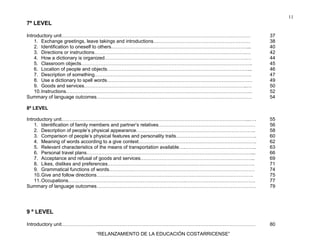
Introductory unit……………………………………………………………………………………………………… 37
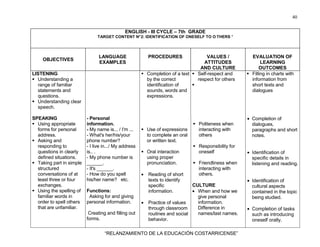
1. Exchange greetings, leave takings and introductions…………………………………………………… 38
2. Identification to oneself to others…………………………………………………………………………... 40
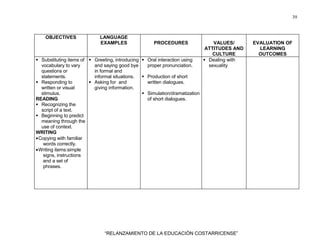
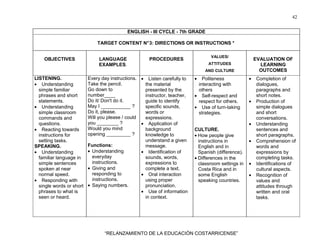
3. Directions or instructions………………………………………………………………………………….… 42
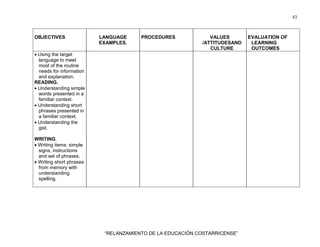
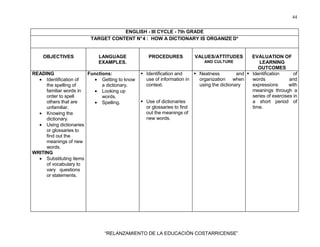
4. How a dictionary is organized…………………………………………………………………………….… 44
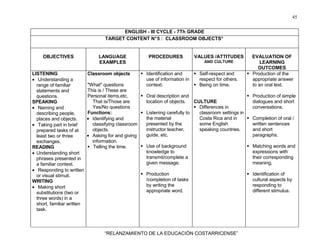
5. Classroom objects……………………………………………………………………………………………. 45
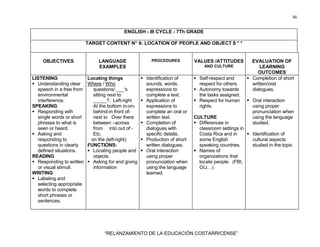
6. Location of people and objects……………………………………………………………………………... 46
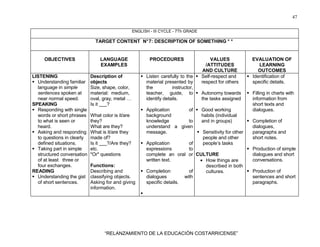
7. Description of something……………………………………………………………………………………. 47
8. Use a dictionary to spell words……………………………………………………………………………… 49
9. Goods and services………………………………………………………………………………………..… 50
10.Instructions……………………………………………………………………………………………………. 52
Summary of language outcomes…………………………………………………………………………………… 54
8º LEVEL
Introductory unit……………………………………………………………………………………………………...…. 55
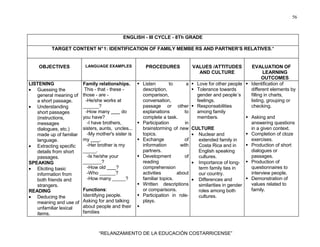
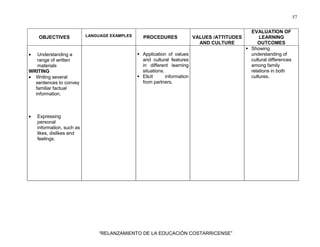
1. Identification of family members and partner’s relatives…………………………………………………… 56
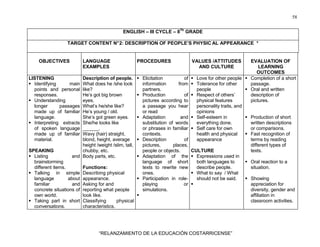
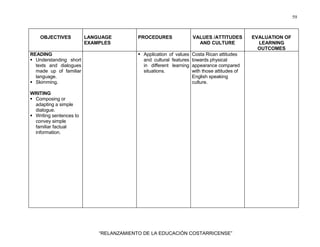
2. Description of people’s physical appearance……………………………………………………………….. 58
3. Comparison of people’s physical features and personality traits………………………………………….. 60
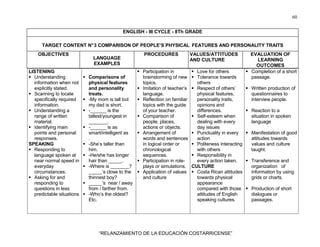
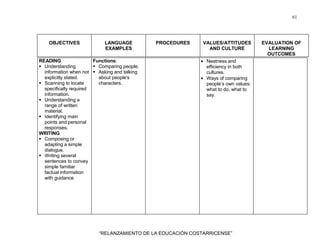
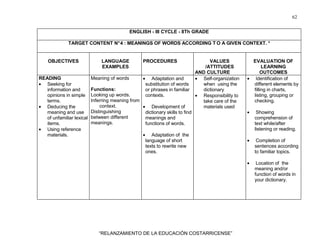
4. Meaning of words according to a give context………………………………………………………………. 62
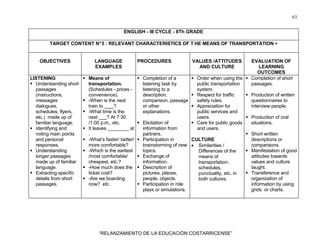
5. Relevant characteristics of the means of transportation available….…………………………………….. 63
6. Personal travel plans…………………………………………………………………………………………... 66
7. Acceptance and refusal of goods and services…………………………………………………………….. 69
8. Likes, dislikes and preferences………………………………………………………………………………. 71
9. Grammatical functions of words……………………………………………………………………………… 74
10.Give and follow directions……………………………………………………………………………………. 75
11.Occupations……………………………………………………………….……………………………………. 77
Summary of language outcomes……………………………………………………………………………………… 79
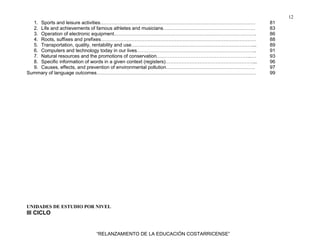
9 º LEVEL
Introductory unit………………………………………………………………………………………………………… 80
12
“RELANZAMIENTO DE LA EDUCACIÓN COSTARRICENSE”
1. Sports and leisure activities…………………………………………………………………………………… 81
2. Life and achievements of famous athletes and musicians………………………………………………… 83
3. Operation of electronic equipment……………………………………………………………………………. 86
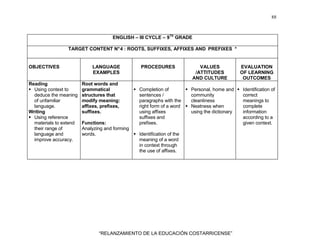
4. Roots, suffixes and prefixes…………………………………………………………………………………… 88
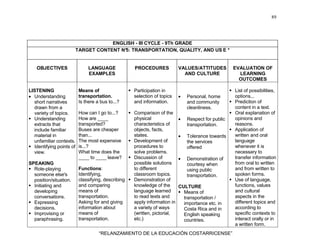
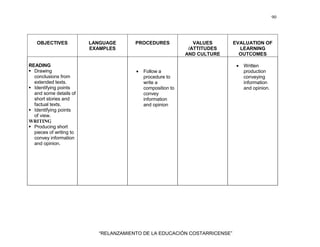
5. Transportation, quality, rentability and use…………………………………………………………………... 89
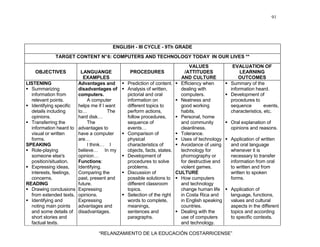
6. Computers and technology today in our lives……………………………………………………………….. 91
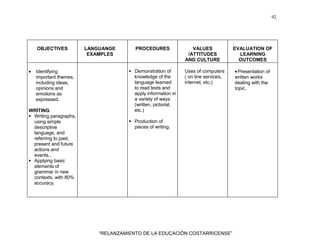
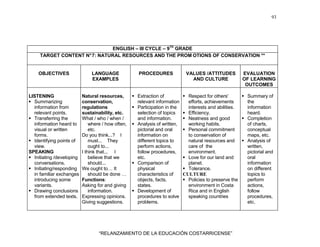
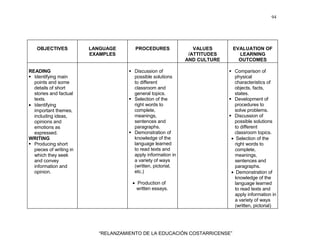
7. Natural resources and the promotions of conservation…………………………………………………..… 93
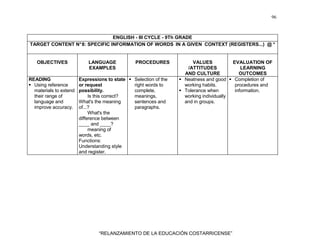
8. Specific information of words in a given context (registers)………………………………………………... 96
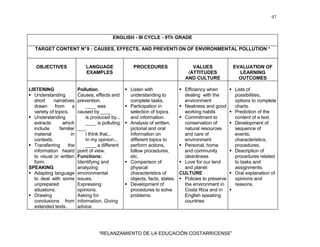
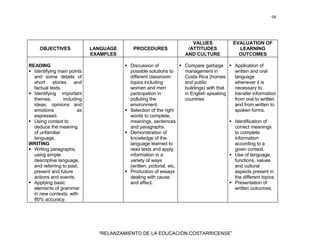
9. Causes, effects, and prevention of environmental pollution………………………………………………. 97
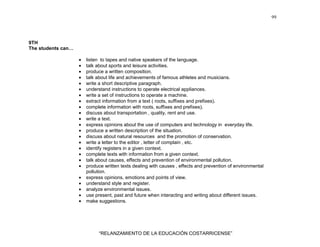
Summary of language outcomes……………………………………………………………………………………… 99
UNIDADES DE ESTUDIO POR NIVEL
III CICLO
13
“RELANZAMIENTO DE LA EDUCACIÓN COSTARRICENSE”
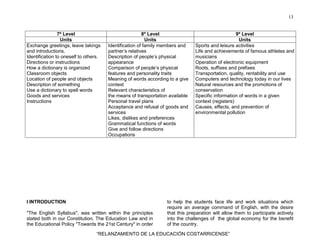
7º Level 8º Level 9º Level
Units Units Units
Exchange greetings, leave takings
and introductions.
Identification to oneself to others.
Directions or instructions
How a dictionary is organized
Classroom objects
Location of people and objects
Description of something
Use a dictionary to spell words
Goods and services
Instructions
Identification of family members and
partner’s relatives
Description of people’s physical
appearance
Comparison of people’s physical
features and personality traits
Meaning of words according to a give
context
Relevant characteristics of
the means of transportation available
Personal travel plans
Acceptance and refusal of goods and
services
Likes, dislikes and preferences
Grammatical functions of words
Give and follow directions
Occupations
Sports and leisure activities
Life and achievements of famous athletes and
musicians
Operation of electronic equipment
Roots, suffixes and prefixes
Transportation, quality, rentability and use
Computers and technology today in our lives
Natural resources and the promotions of
conservation
Specific information of words in a given
context (registers)
Causes, effects, and prevention of
environmental pollution
I INTRODUCTION
"The English Syllabus", was written within the principles
stated both in our Constitution, The Education Law and in
the Educational Policy "Towards the 21st Century" in order
to help the students face life and work situations which
require an average command of English, with the desire
that this preparation will allow them to participate actively
into the challenges of the global economy for the benefit
of the country.
14
“RELANZAMIENTO DE LA EDUCACIÓN COSTARRICENSE”
II. THE PURPOSES OF ENGLISH LANGUAGE
TEACHING IN OUR EDUCATIONAL SYSTEM
The large number of individuals who speak English either
as their first or as a second or foreign language justifies the
fact that Englis is considered a universal language.
Likewise, within the scientific, technological and humanistic
spheres, English is a fundamental linguistic tool. Written.
Consequently, teaching English in our school system
responds to basic needs:
1. To offer students a second language which can
anable them to communicate within a broader social-
economic context in and outside Costa Rica.
2. To give students a tool to directly access scientific,
technological and humanistic information and , in this
way expand their knowledge of the world.
From the perspective of those two basic needs the
educational aims of teaching English are listed as
follows:
- develop the ability to communicate for practical
purposes;
- frame a sound basis of the language skills, and
attitudes required for further study, work and
leisure;
- offer insights into the culture and civilization of
English speaking countries.;
- develop an awareness of the nature of language
and language learning;
- incite enjoyment and intellectual stimulation;
- encourage positive attitudes towards to foreign
languages and cultures;
- promote cognitive skills like application analysis,
memorization, inferring;
- develop students' understanding of themselves
and their own culture.
Along with the required study of the mother tongue, the
study of second languages contributes to enrich the school
curriculum because of the following reasons:
- it provides a combination of linguistic skills both
physical and intellectual with personal and social
development;
- it offers better opportunities to develop oral and written
communication skills;
- it inculcates valuable study skills such predicting,
selecting, comparing, and interpreting information and
memorizing, and focussing on general and detailed
meaning in listening and speaking;
- it helps develop the learners' awareness of cross-
curricular
at the time that builds on the four communication skills.
In addition to the above reasons, the study of a foreign
language, by definition, adds a distinctive dimension of its
own since:
- it exposes learners to new experiences and enables
them to make connections in a way which,
otherwise, would not be possible.
- The sounds and intonation patterns of the second
language present a challenge to learner's capacity to
discriminate and imitate.
- It enhaces the learner´s self confidence of their
abilities provoking a sense of self-achievement and
discovery which grow along with a gradual
proficiency.
- It improves the learners understanding of not only
target cultures but also their own.
15
“RELANZAMIENTO DE LA EDUCACIÓN COSTARRICENSE”
In sum, learning English as a foreign language will
contribute to an integral formation of the learners which will
anable them to be able to insert into the coming century in
a lively and healthy way.
III. IMPLICATIONS OF THE EDUCATIONAL POLICY IN
THE LEARNING AND TEACHING OF ENGLISH IN
OUR EDUCATIONAL SYSTEM.
The Educational Policy "Towards the 21st Century" gives
the learners the opportunity to express their care for their
country, its democratic environment, cultural diversity and
deep respect for law, nature and peace. At the same time,
the policy encourages Costa Rican people to become
positive leaders and critical thinkers through activities
promoting a democratic environment, resulting in the
reinforcement of values such as self-indentity and authentic
growth as independent and interdependent learners.
Some of the basic principles of the Policy can be
summarized as follows:
1. The citizens should be able to develop as persons
through seeking for opportunities of self-fulfillment
and happiness while contributing to the development
of their country.
2. Education should promote the broadening of
understanding through challenging teaching
classroom situations and opportunities that can arise
self-growth and learn how to learn.
3. Education should contribute to narrow down social –
economic gaps by providing the individuals with the
proper opportunities to intergrate into everyday
problem-solving situtations, all this aiming to
promote a self-suficient society.
4. Achieving sustainability in production and the
economic in general represents a challenge for
education. The country needs more qualified people
in order to increase productivity and improve the
spirit of competitiveness. Furthermore, there is a
need to integrate the country more effectively into
the global economy.
5. The information or the content the learners handle
should be up-to-date and should be relevant to
global development in the 21st century.
6. Education should aim to solidly reinforce values and
attitudes. This is a moral imperative.
The underlying principles for our educational approach,
humanism, rationalism and constructivism are clearly stated
in the Policy.
Every person is considered capable of achieving his/her full
potential. This entails interacting harmoniously with her/his
surroundings, in three dimensions of human development:
The cognitive, socio-affective and psychomotive.
Every person constantly contributes both to the common
good and the development of education, and is responsible
for improving the quality of human, individual and collective
life.
Education ought to be a permanent formative process,
which each person has not only a right, but also a duty to
exercise.
Achieving quality in education is an integral process
through which the results express the initial aims. Through
this process learners are offered equality of opportunities to
succeed and appropriate educational provision according to
their needs, problems and aspirations.
Educational research at national, provincial, regional and
institutional levels will ensure more systematic
implementation of the policy from everyday classroom
practice to administrative decision taking.
16
“RELANZAMIENTO DE LA EDUCACIÓN COSTARRICENSE”
The design of the syllabus encourages participative
interaction, and its adaptation.
The implementation of educational provision encourages
democratic participation, cooperative and self-reliant
attitudes.
The process of "mediation" for the construction of learning,
and the transference of knowledge is framed, primarily,
within an epistemological-constructivist position. The ties
with other disciplines allow for deductive as well as for
inductive processes.
The evaluation of the learning processes must reflect
coherence between the three components. It must also
consider both the process and the product.
Evaluation is conceived of as an instrument to monitor
learning, and so provides feedback on the educational
process. In addition, it enhances the quality of education
through its three functions: diagnostic, formative and
summative. The methodology proposed centers on the
activity of the learner as builder of his/her own learning.
The student, as the main focus of the curriculum, carries
out the learning process, is considered to represent an
inherited culture, and has the liberty to select his / her own
way.
The teacher, is conceived of as facilitator, collaborator and
advisor in the student's learning. Therefore, the teacher
acquires responsibility for the quality of learning, together
with the family and the educational authorities.
In summary, learning English as a foreign language in
Costa Rica will allow students to develop communicative
competence, to gain knowledge of a new culture, beliefs
and attitudes and to understand the messages given and,
reflect on them. They also have the opportunity to analyze
the real message and intentions of speakers in order to
distinguish the negative from the positive and to develop
greater and more desirable autonomy.
IV. ENGLISH AS A MEANS OF IMPLEMENTING THE
EDUCATIONAL POLICY
English, in common with other subjects in the Costa Rican
curriculum, must provide the learner with the opportunity to
develop awareness of the urgent need for the balanced
development of our environment, our human resources,
and also the socio-political and the economy and means of
production. This balance is essential to ensure the success
of the new era of sustainable development.
The English language syllabus provides the necessary
situations to support each one of the areas mentioned
above. As far as environment is concerned, it emphasizes
the analysis of the cause and effect of the use and misuse
of natural resources and the possible solutions, as well as
the value of our existing resources and the ecological
diversity we possess. It also reinforces the harmonious
development of human beings and nature.
Our syllabus pays special attention to those topics related
to the basic needs of highly qualified people considering
their successful realization in time, society and in the
national and international surroundings. An example of this
is provided by the topics which conduct research into an
exchange information on health; the symptoms and
prevention of common and more recent diseases.
Likewise, drug abuse is another topic for discussion in the
English class.
The syllabus takes into account other relevant areas of a
well-rounded education, such as the job market and
careers, in terms of active participation in the evolution of
society.
Other aspects like the socio-political development of
citizens is dealt with explicitly, leading to personal, and
collective improvement through themes relating to values
such as: gender equality, political liberties, and respect for
17
“RELANZAMIENTO DE LA EDUCACIÓN COSTARRICENSE”
ethnic and cultural diversity, as well as active involvement
in community activities.
In the field of the economy and production, the syllabus
provides for the promotion of a productive culture in
harmony with the environment, coupled with the efficient
use of energy and resources.
In all cases, English can be the means for exposure to and
acquisition of valuable and permanent behavior patterns.
These patterns, will fulfill his/her own needs, and those of
the country.
The present generations should respect sustainable
development to guarantee that future generations have the
opportunity to satisfy their own needs.
V. ENGLISH AS A FOREIGN LANGUAGE IN THE COSTA
RICAN EDUCATIONAL SYSTEM
English is conceived of as a linguistic and cultural tool for
communication, which allows the learner to complement
his/her whole education. His/her knowledge of
English contributes to the social, economical and
technological development. It also allows the learner to
apply techniques to understand and produce appropriate
oral and written messages.
In the end, the learner will apply his/her knowledge of
English to accept and adapt him/her self to constant
changes confidently.
ENGLISH AS AN OBJECT OF STUDY
The object of study of the English language in our
curriculum is written and oral communication, emphasizing
the four basic linguistic skills: listening, speaking, reading
and writing. The practice of these skills permits the
students to communicate efficiently according to the
knowledge acquired.
Through the learning of the language, the learner can
compare and apply different registers (formal and informal)
and recognize expressions in British, American and other
varieties of English.
BASIC STRUCTURES OF THE SUBJECT MATTER
For the purpose of studying the English language, we have
divided the subject matter into three components:
1. Formal 2. Functional 3. Cultural
Formal Component
This component has been traditionally called the
grammatical component. In this sense, the structures of the
language have been graded, selected and chosen
according to the different functions of the language and the
topics to be studied. Lexics, syntax and morphology are
part of this component.
By itself, the formal component is an important part of the
language, but it has to be studied as a means to effective
communication.
Furthermore, the teaching of grammar should be focused
on the practical use of oral and written language for
communication.
Functional Component
The functional component refers to the communicative
purpose for which we use the language. Language is not
only forms; we have to start looking at what people do with
those forms. For example, expressing one's opinions
asking for someone`s opinion, expressing doubts, etc.
18
“RELANZAMIENTO DE LA EDUCACIÓN COSTARRICENSE”
Cultural Component
This component considers understanding of the culture of
the country or countries where the language is spoken.
Knowing the features of the target culture makes it easier to
understand the language itself. Some of the cultural
features that should be taken into account are: values,
attitudes, behavior, patterns, points of view, ways of
thinking, appreciation, etc.
The cultural component should always be present in the
other components. Language and culture go together in
order to communicate social meanings. This means that the
language must be presented in meaningful situations
according to the appropriate cultural contexts.
The pertinent use of the three components guarantees the
required communicative competence. This competence
does not occur by itself. The speaker must acquire linguistic
competence simultaneously, starting in early stages. The
main objective of the whole process of language learning is
to enable the students to use the language for
communication.
GENERAL GUIDELINES FOR THE MEDIATION OF
LEARNING
The Educational Policy "Towards the 21st Century"
presents the learner as a human being full of potential with
the possibility to develop him/herself in harmony with the
three dimensions of human development: cognitive, socio-
affective and psycho-motive. Education has to provide this
global development in a given context.
The objective of learning is to provide a contribution to
social and personal development. Therefore, education is
seen as a formative and permanent process. Education is
considered as a social process in which human beings
meet human experiences. These experiences, contribute
to shape the capacities and values that will serve humans
to give a contribution to the social welfare.
The Policy establishes an educational process which
provides similar opportunities for everybody: the
achievement of high standards of education as well as
opportunities that take into consideration the participants
needs, problems and expectations. Another feature of the
Policy is the way it emphasizes the need to provide positive
learning conditions.
The Policy also states that learners acquire education to be
able to participate as individuals in their own development
and the development of society; for that reason, they have
to be acquainted with the knowledge that humanity has
been accumulating and
systematizing through history. They must learn about its
common uses, thoughts and actions in a particular social
context. Within this approach "learning" is exploring,
experimenting, discovering and reconstructing the learners
own knowledge. Learning is described as a
comprehensible, dynamic and meaningful process for those
who learn. It is guided by the interest shown by the learner
towards its acquisition and it is orientated to the acquisition
of learning. From this perspective the teacher is the person
who organizes and guides the learning situations, taking
into account not only the students characteristics
(background, learning styles, etc.) but also the curriculum,
and the cultural and natural context).
In the teaching of English, as mentioned earlier the written
and oral aspects of the language are the objects of study.
Emphasis is given to the four basic linguistic abilities:
listening and reading comprehension, oral and written
19
“RELANZAMIENTO DE LA EDUCACIÓN COSTARRICENSE”
production. An equal amount of classroom time should be
devoted to the development of each of the four linguistic
skills. In this sense, any learning activity in the
development of a topic (should take into consideration the
integration of these skills). In addition the teacher should
design different teaching procedures to approach a topic.
This can be done by emphasizing, for example, listening,
then reading, speaking and writing, or by altering the steps
any time the educator deals with a classroom procedure.
The basic idea is to create a highly motivating atmosphere
to encourage learning.
Whenever the teacher is developing an objective, he/she
should know about the topic itself and the different ways
he/she will be introducing the development of the skills
listed above.
To help teachers with a general view of the subskills to be
developed, we are including a summary of the most
relevant aspects of each main skill:
Listening
Listening is one of the most important skills that has to be
developed in early stages of language learning. Through
listening the students should be prepared to cope with:
a. understanding speech in different settings (background
noise, distance or unclear sound reproductions)
b. becoming acquainted with speech containing false
starts hesitations, etc. (everyday speech)
c. understanding speakers who vary in tempo, speech,
clarity of articulation and accent, non-native speakers
of the language as well.
Listening, understanding and responding in an appropriate
way is an essential part of communication and, therefore,
regular practice of aural comprehension is a vital part of the
teaching program although listening is fully practiced in
our classes, there are specific listening activities that should
be included in the syllabus, such as:
1. Distinguishing between sounds, stress and intonation
patterns.
2. Answering quick questions.
3. Understanding comprehension passages.
4. Listening to broadcasts.
5. Listening to lectures.
6. Taking dictation.
Teachers should expose the learner to a considerable
amount of meaningful language input through listening to:
conversations, descriptions, directions, discussions, drama,
films, songs, sports, reports, advertisements and any other
form of authentic spoken language.
The teacher should encourage in the learners the
development of the following strategies:
1. Thinking about the purpose of listening.
2. Thinking ahead about what learners already know and
keep predicting what the speaker will say next.
3. Focus on what they do, understand and use to help
them work out what they don't understand.
When developing listening comprehension, the activities
should:
1. Meet the students' interests and needs.
2. Be designed according to the student's performance
level.
3. Provide practice in distinguishing between sounds,
stress, intonation patterns, to understand sentences,
short texts, etc.
20
“RELANZAMIENTO DE LA EDUCACIÓN COSTARRICENSE”
4. Provide the students with practice in listening
techniques.
5. State the purpose of the task clearly.
6. Make use of background knowledge.
7. Follow an organized procedure.
8. Provide the learners with the necessary steps in the
development of the activity.
9. Engage the learners in a variety of situations which
provide practice, going from memorization to
evaluation.
10. Follow the objectives.
11. Be graded.
12. Integrate other language skills.
Speaking
The development of the skills of speaking is the ultimate
goal for students learning English. It is also a "wish" of
every Costa Rican; parent, politician and in our society.
However, the development of the skill has to be carried out
in conjunction with the development of the other skills. In
particular, speaking and listening are complementary to
each other in the act of communication. For that reason,
both should be practiced in close relation to each other.
The teacher should provide a variety of opportunities for the
students, in order to bring about the necessary models or
language input.
Through speech, learners acquire the fundamentals of
language pertinent to carry out specific interaction where
they have to exercise the use of some functions, through
the appropriate language structures, cultural
appropriateness and acceptable language input.
To promote the development of this skill, it is necessary
that students be aware of the following principles:
1. Oral speech is acquired through listening and through
constant practice.
2. Speech delivery, rhythm, intonation and pronunciation
are learned by listening to appropriate language
models (tapes, native speakers, teachers and other
English speakers).
3. Learning to speak English means knowing what to talk
about. Introducing knowledge of the world and up-to-
date topics are essential.
4. Learning to speak English means saying the
appropriate words for a situation at the right time for a
specific purpose.
5. For the students to speak English it is essential that
English is spoken in class and in any other situation
when it is required.
6. Since learning to speak means speaking to others,
interactive practice must be set up in pairs, groups and
with teachers and visitors.
7. The language tasks designed must be authentic and
the same ones that native speakers of the language
use to communicate with others.
8. The integration of skills is vital when speaking. e.g.
giving an oral explanation of information presented in a
chart or diagram.
Reading
Reading, although often regarded as a passive receptive
skill is, in fact, an active skill which involves guessing,
predicting, and asking questions. These should therefore be
considered when designing reading comprehension
exercises. It is, for instance, possible to develop the
students' powers of inference through systematic practice,
or introduce questions which encourage students to
21
“RELANZAMIENTO DE LA EDUCACIÓN COSTARRICENSE”
anticipate the content of a text from its title and illustrations
or the end of a story from the preceding paragraphs. In
brief, students should be encouraged to transfer the
advanced skills they have when reading Spanish to the
reading of English.
Students learning English expect to be able to read the
language sooner or later. Their personal expectations may
vary from wanting to read the lyrics of popular songs to
newspaper ads to magazines or even classical literature.
Teachers should, therefore offer a variety of texts and also
remember that students in the same class may read at very
different levels of difficulty in English, just as they do in their
native language.
Reading activities should focus on normal reasons for
reading. People normally read because:
1. They want information for some purpose or because
they are curious about the topic;
2. They need instructions in order to perform some tasks
for their work or for their daily life. For instance, they
want to know how an appliance works; they are
interested in a new recipe; they have forms to fill in,
etc.
3. They want to play a new game, do a puzzle or carry
out some activity which is pleasant and amusing.
4. They want to keep in touch with friends by
correspondence.
5. They want to know when or where something will take
place (timetables, program menus, etc.).
6. They want to know what is happening or has
happened (they read newspapers, magazines, etc.).
Activities for developing reading skills should make use of
these natural needs and interests preferably by supplying
something which is interesting, amusing, exciting, useful
or leads to a pleasant or beneficial activity.
Any reading activity should be :
1. interesting to the students.
2. chosen according to the students' interests, age and
needs.
3. authentic . Its purpose must be the same as for native
speakers.
4. leading to a purpose ( information, details, global
meaning).
5. graded according to the students level of proficiency.
6. able to help the students build on information already
acquired in their own language by complementing it
with information learned in English.
7. not too culturally bound.
8. integrated with the other language skills. For example:
- Reading and writing e.g. summarizing, mentioning
what you have read in a letter, note-taking, etc.
- Reading and listening e.g. reading the lyrics while
listening to a song recorded information to solve a
written problem, matching opinions and texts, etc.
Reading and speaking e.g. discussions, debates,
etc
9. flexible and varied.
10. meaningful and related directly to the text.
Teachers should be aware of the students' reading
interests in order to design the appropriate reading
comprehension exercises. It is important to emphasize here
that students must become effective readers. These
reading exercises must be designed to develop the
following reading skills.
22
“RELANZAMIENTO DE LA EDUCACIÓN COSTARRICENSE”
- Skimming: a quick running of the eyes over a text to get
the gist or global meaning of it.
- Scanning: quick overview of a text to find specific
information.
- Extensive reading: reading longer texts for own
pleasure. (involves global understanding).
- Intensive reading: reading shorter texts to extract
specific information (reading for detail).
Writing
Writing is a skill which emphasizes the formal expression of
thoughts through written language or graphic symbols.
The teacher should facilitate the writing process by
providing the necessary guidance for the learner to be able
to express her/his knowledge of the topic.
It is also necessary to define the type of written production
the students will perform.
Any written practice should:
1. be related to the topic being studied.
2. follow the objectives.
3. be creative.
4. take account of the students' cognitive knowledge and
skills.
5. be graded from simple sentence descriptions to more
complex products.
6. include the use of appropriate language, style,
punctuation and other characteristics.
7. involve the teacher and students in the development
and production of writing.
8. use a collaborative approach in which teachers create
together and give each other feedback through the
process.
9. use real-life tasks for students, write authentic texts
notes and letters.
10. integrate the other skills before, while or after the
writing task is performed.
11. motivate the students to express their feelings,
emotions and points of view in a written form.
To promote the development of written skills teachers can
design a series of activities enabling students: to write
notes and shopping lists, keep records, send messages,
write letters to friends, keep diaries, complete reports and
write poetry or fiction. All of these authentic tasks should
be guided by following principles in which the writer :
1. attempts to communicate something.
2. has a goal or purpose in mind.
3. has to establish and maintain contact with the reader.
4. has to organize the material by using certain logical
and grammatical devices.
Besides these general principles, teachers should pay
attention to the rhetorical devices, logical, grammatical and
lexical: appropriate to different types of texts, spelling,
punctuation and other organizational features.
Writing just like listening, has to be taught by practicing
different techniques and types of writing . It should be
preceded by exposure to a wide range of models of written
language. It is also important to show the students how the
written language functions as a system of communication.
The learner also needs to know how to organize sentences
into a coherent text; write different kinds of texts; or select
the appropriate style, formal or informal, according to the
task, subject matter and target audience. However, most of
all, tasks must be as realistic as possible.
Whenever a teacher is ready to introduce an activity
focusing on one of the four basic skills described
above, he/she should take into account five steps:
23
“RELANZAMIENTO DE LA EDUCACIÓN COSTARRICENSE”
a. Preparationb. Demonstrationc. Time to introduce the
skill
d. Correction e. Follow-up
In order to follow these steps, the teacher should
provide : "Pre-activities" to help the students think
about what they already know and find a reason for
listening, speaking, reading or writing; "While-
activities" to exploit oral or written speech. These
exercise different skills to carry out the task assigned
and "Post-activities" to link the new information and
skills with the students own experience and other
skills.
METHODOLOGICAL APPROACH
The Communicative approach provides the basis for the
methodology used in the English classroom. Its main
features are:
1. It creates an stress-free atmosphere conducive to
learning a language with plenty of opportunities to
communicate.
2. It provides ample opportunities for interaction
promoting a pleasant, warm and enjoyable
environment which features positive feedback for the
learner from both the teacher and peers.
3. The learners' needs and interests are taken into
account making them as the center of the learning
process.
4. The methodology used is participative, dynamic and
offers the opportunity for real use of the language.
5. The teacher guides the learning process but shares the
responsibility with the learners. They use critical
thinking to solve problems, work in groups, take risks,
discuss different topics, and appreciate and reinforce
their own as well as English speaking cultures. All
these aspects take place in real-life situations.
6. The teacher and students make decisions together. By
doing this, the learner gets completely involved in the
language-learning process and becomes responsible
for it.
7. The objectives of the syllabus develop the
communicative functions of the language elements.
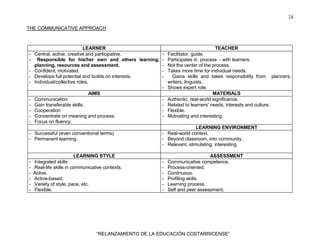
The following chart provides a better idea of some of the
characteristics of the different components of the
communicative approach.
24
“RELANZAMIENTO DE LA EDUCACIÓN COSTARRICENSE”
THE COMMUNICATIVE APPROACH
LEARNER TEACHER
- Central, active, creative and participative.
- Responsible for his/her own and others learning,
planning, resources and assessment.
- Confident, motivated.
- Develops full potential and builds on interests.
- Individual/collective roles.
- Facilitator, guide.
- Participates in process - with learners.
- Not the center of the process.
- Takes more time for individual needs.
- Gains skills and takes responsibility from planners,
writers, linguists.
- Shows expert role.
AIMS MATERIALS
- Communication
- Gain transferable skills.
- Cooperation
- Concentrate on meaning and process.
- Authentic, real-world significance.
- Related to learners' needs, interests and culture.
- Flexible.
- Motivating and interesting.
- Focus on fluency.
LEARNING ENVIRONMENT
- Successful (even conventional terms).
- Permanent learning.
- Real-world context.
- Beyond classroom, into community.
- Relevant, stimulating, interesting.
LEARNING STYLE ASSESSMENT
- Integrated skills
- Real-life skills in communicative contexts.
- Active.
- Active-based.
- Variety of style, pace, etc.
- Flexible.
- Communicative competence.
- Process-oriented.
- Continuous.
- Profiling skills.
- Learning process.
- Self and peer assessment.
25
“RELANZAMIENTO DE LA EDUCACIÓN COSTARRICENSE”
LEARNING STRATEGIES
Learning strategies should be considered when planning at
national, institutional and classroom levels.
Learning strategies are operations employed by the learner
to aid the acquisition, storage, retrieval and use of
information. But they can also be described as specific
actions of the learner to make learning easier, faster, more
enjoyable, self-directed, effective and transferable. In other
words, learning strategies are tools students use when they
have to solve a problem, accomplish a task, meet an
objective or attain a goal.
Teachers should be aware of learning strategies in order to
provide opportunities for all of their students to develop
communicative competence.
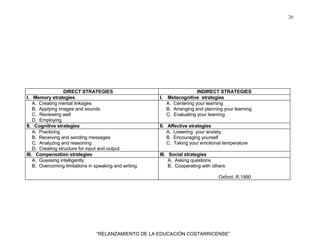
Learning strategies have been divided into two groups:
Direct and Indirect.
Direct strategies include memory, cognitive and
compensation strategies.
Memory strategies help foster particular aspects of
competence (grammatical, sociolinguistic, discourse, etc.)
by using imagery and structured review.
Cognitive strategies strengthen grammatical accuracy by
reasoning deductively and using contrastive analysis.
Compensation strategies help develop strategic
competence by using inference and guessing when the
meaning is not known, using synonyms or gestures to
express meaning of an unknown word or expression.
Indirect strategies group the metacognitive, affective,
and social strategies.
Metacognitive strategies help learners to regulate their own
cognitive processes and to focus, plan and evaluate their
progress as they move toward communicative competence.
Affective strategies develop the self-confidence and
perseverance needed for learners to be actively involved in
language learning.
Social strategies provide increased interaction and more
emphatic understanding with others.
Below is Rebecca Oxford's chart on learning strategies.
26
“RELANZAMIENTO DE LA EDUCACIÓN COSTARRICENSE”
DIRECT STRATEGIES INDIRECT STRATEGIES
I. Memory strategies I. Metacognitive strategies
A. Creating mental linkages
B. Applying images and sounds
C. Reviewing well
D. Employing
A. Centering your learning
B. Arranging and planning your learning
C. Evaluating your learning
II. Cognitive strategies II. Affective strategies
A. Practicing
B. Receiving and sending messages
C. Analyzing and reasoning
D. Creating structure for input and output
A. Lowering your anxiety
B. Encouraging yourself
C. Taking your emotional temperature
III. Compensation strategies III. Social strategies
A. Guessing intelligently
B. Overcoming limitations in speaking and writing
A. Asking questions
B. Cooperating with others
Oxford, R.1990
27
“RELANZAMIENTO DE LA EDUCACIÓN COSTARRICENSE”
LEARNING STYLES
The learning styles are as important as the development of
skills or learning strategies when deciding on how relevant
the curriculum is.
Here learning styles are presented as possibilities to be
included when planning learning to guarantee success.
Gregorc defines learning style as the outward expression to
the human mind's ability to mediate knowledge. i.e. the
means and capacities we employ to receive and express
information.
Two principal factors in determining learning styles are the
ways in which information is perceived and how it is
ordered in our brains.
1. Perceptual abilities are the means whereby we grasp
information: The perception may be:
a. abstract through reason, emotion, or intuition, or b.
concrete through the physical senses of hearing ,
sight, smell, taste and touch.
2. Ordering abilities are the ways in which information is
systematized, arranged and distributed. Ordering may
be a. sequential (linear, step by step and methodical)
or b. random- (non -linear) with multiple patterns of
data being processed simultaneously and holistically.
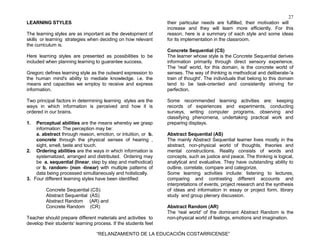
3. Four different learning styles have been identified:
Concrete Sequential (CS)
Abstract Sequential (AS)
Abstract Random (AR) and
Concrete Random (CR)
Teacher should prepare different materials and activities to
develop their students' learning process. If the students feel
their particular needs are fulfilled, their motivation will
increase and they will learn more efficiently. For this
reason, here is a summary of each style and some ideas
for its implementation in the classroom.
Concrete Sequential (CS)
The learner whose style is the Concrete Sequential derives
information primarily through direct sensory experience.
The 'real' world, for this domain, is the concrete world of
senses. The way of thinking is methodical and deliberate-'a
train of thought'. The individuals that belong to this domain
tend to be task-oriented and consistently striving for
perfection.
Some recommended learning activities are: keeping
records of experiences and experiments, conducting
surveys, writing computer programs, observing and
classifying phenomena, undertaking practical work and
preparing displays.
Abstract Sequential (AS)
The mainly Abstract Sequential learner lives mostly in the
abstract, non-physical world of thoughts, theories and
mental constructions. Reality consists of words and
concepts, such as justice and peace. The thinking is logical,
analytical and evaluative. They have outstanding ability to
outline, correlate, compare and categorize.
Some learning activities include: listening to lectures,
comparing and contrasting different accounts and
interpretations of events, project research and the synthesis
of ideas and information in essay or project form, library
study and group plenary discussion.
Abstract Random (AR)
The 'real world' of the dominant Abstract Random is the
non-physical world of feelings, emotions and imagination.
28
“RELANZAMIENTO DE LA EDUCACIÓN COSTARRICENSE”
Learning activities for this domain are: group discussion
work, interpersonal work in small groups, role plays, guided
fantasy and imagery, imaginative writing and the
preparation and production of multimedia presentations.
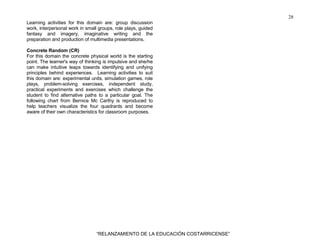
Concrete Random (CR)
For this domain the concrete physical world is the starting
point. The learner's way of thinking is impulsive and she/he
can make intuitive leaps towards identifying and unifying
principles behind experiences. Learning activities to suit
this domain are: experimental units, simulation games, role
plays, problem-solving exercises, independent study,
practical experiments and exercises which challenge the
student to find alternative paths to a particular goal. The
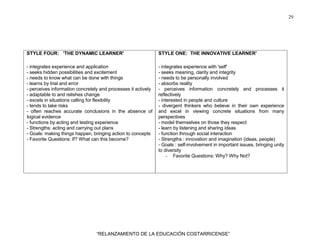
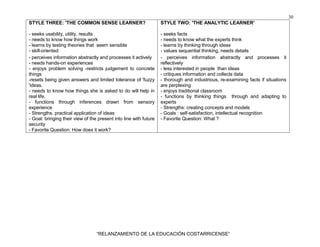
following chart from Bernice Mc Carthy is reproduced to
help teachers visualize the four quadrants and become
aware of their own characteristics for classroom purposes.
29
“RELANZAMIENTO DE LA EDUCACIÓN COSTARRICENSE”
STYLE FOUR: 'THE DYNAMIC LEARNER'
- integrates experience and application
- seeks hidden possibilities and excitement
- needs to know what can be done with things
- learns by trial and error
- perceives information concretely and processes it actively
- adaptable to and relishes change
- excels in situations calling for flexibility
- tends to take risks
- often reaches accurate conclusions in the absence of
logical evidence
- functions by acting and testing experience
- Strengths: acting and carrying out plans
- Goals: making things happen, bringing action to concepts
- Favorite Questions: If? What can this become?
STYLE ONE: THE INNOVATIVE LEARNER'
- integrates experience with 'self'
- seeks meaning, clarity and integrity
- needs to be personally involved
- absorbs reality
- perceives information concretely and processes it
reflectively
- interested in people and culture
- divergent thinkers who believe in their own experience
and excel in viewing concrete situations from many
perspectives
- model themselves on those they respect
- learn by listening and sharing ideas
- function through social interaction
- Strengths : innovation and imagination (ideas, people)
- Goals : self-involvement in important issues, bringing unity
to diversity
- Favorite Questions: Why? Why Not?
30
“RELANZAMIENTO DE LA EDUCACIÓN COSTARRICENSE”
STYLE THREE: 'THE COMMON SENSE LEARNER?
- seeks usability, utility, results
- needs to know how things work
- learns by testing theories that seem sensible
- skill-oriented
STYLE TWO: 'THE ANALYTIC LEARNER'
- seeks facts
- needs to know what the experts think
- learns by thinking through ideas
- values sequential thinking, needs details
- perceives information abstractly and processes it actively
- needs hands-on experiences
- enjoys problem solving -restricts judgement to concrete
things
-resets being given answers and limited tolerance of 'fuzzy
'ideas.
- needs to know how things she is asked to do will help in
real life.
- functions through inferences drawn from sensory
experience
- Strengths. practical application of ideas
- Goal: bringing their view of the present into line with future
security
- Favorite Question: How does it work?
- perceives information abstractly and processes it
reflectively
- less interested in people than ideas
- critiques information and collects data
- thorough and industrious, re-examining facts if situations
are perplexing
- enjoys traditional classroom
- functions by thinking things through and adapting to
experts
- Strengths: creating concepts and models
- Goals : self-satisfaction, intellectual recognition
- Favorite Question: What ?
31
“RELANZAMIENTO DE LA EDUCACIÓN COSTARRICENSE”
MULTIPLE INTELLIGENCES
The theory of multiple intelligences was developed by
Howard Gardner who introduces the concept of developing
more than one type of intelligence. Traditionally, only the
linguistic and logical mathematical intelligences were
considered by teachers and educators. For more than
eighty years an intelligent person was the one who had a
high I.Q.
Thomas Asmstrong in the last plenary session of TESOL’97
in Orlando Florida encouraged teachers to be careful in
their classroom settings when developing the different
types of intelligences and to develop the other types,
besides the two mentioned previously.
The following is a summary presented by Mary Ann
Christison at the National Conference for Teachers of
English, in San Jose, January 1997. In this summary they
have incorporated the naturalistic intelligence.
We present Dr. Mary Ann Christison’s summary of Multiple
Intelligencies.
1. Musical: the ability to produce and recognize simple
songs; play with these melodies, varying speed and
rhythm. How you can nurture: Incorporate music daily.
Use a tape recorder for listening, singing along, and
recording songs and rhythmic and melodic instruments.
2. Logical / mathematical: the ability to understand the
basic properties of numbers, adding or taking away;
appreciate principles of cause and effect, one-to-one
correspondence; ability to predict, as in which objects will
float, sink, etc.How you can nurture: Provide
manipulatives to help children experiment with numbers;
use simple machines to help children think about cause
and effect.
3. Interpersonal: the aiblity to understand other people and
work effectively with them and to notice who plays with
them at school, and why. How you can nurture: Give
children lots of opportunities to talk about one another
and their social interactions, and to problem-solve
conflilcts together, play games in which one has to figure
out the knowledge or intentions of other players.
4. Intrapersonal: The ability to understand things about
oneself, how one is similar to, different from others;
remind oneself to remember to do something; know how
to soothe oneself when sad.How you can nurture: Let
children express their own unique emotions,
preferences, and strategies; help them understan their
own wishes and fears and how best to deal with them.
5. Bodily/kinesthetic: The ability to use the body or parts of
the body (hands, feet, etc.) to solve problems, as in
playing a ballgame, dancing, or making things with the
hands.How you can nurture: Provide opportunities for
physical challenges throughout the day, not just
outdoors.
6. Linguistic. The ability to use language to express
meaning, understand others, tell a simple story; react
appropriately to stories with different moods; learn new
vocabulary or a second language that is used
naturally.How you can nurture: Make sure your program
is rich with language opportunieties and that children’s
linguistic expression is listened to and appreacited.
7. Spatial: the ability to be able to form a mental image of
large ( a home) and local (a block building) spatial
layouts; find one’s way around a new building.How you
can nurture: Provide many opportunities for mapping of
32
“RELANZAMIENTO DE LA EDUCACIÓN COSTARRICENSE”
the classroom encourage children to vary the
arrangementes of materials in the space.
8. Naturalist: The ability to recognize species of plants or
animals in one’s environment, for example, to learn the
characteristics of different birds.How you can nurture:
Play games in which children recognize fine distinctions
among members of a plant or animal group; explore the
outdoors regularly and bring the outdoors in; provide
sample books, visual, and props related to the natural
world.
Lately, they have named as you have noticed two
other types of intelligence: the naturalistic, and the
emotional intelligence. These two inclusions give a wide
range of possibilities to classroom teachers to incorporate
as many experiences as possible to help students develop
wholly. At the same time, teachers must be aware of
receiving new information applicable in their class to
improve the teaching and learning process.
33
“RELANZAMIENTO DE LA EDUCACIÓN COSTARRICENSE”
VI. E.F.L. CLASSROOM ASSESSMENT AND
EVALUATION SUGGESTIONS
As it has been stated previously, The National Educational
Policy, "Towards the 21 st Century", encourages teachers
to create an active and stimulating atmosphere for their
students in the E.F.L. class and also when assessing.
One of the main characteristics of the policy is the belief
that students should exercise their cognitive skills as well as
their linguistic ones. The policy emphasizes learning
processes and sets out the cognitive operations students
should master before they can achieve certain learning
goals. Students are also encouraged to work with each
other and to learn from each other.
To cope with the E.F.L. approach used in teaching, the
assessing techniques used should reflect the dynamic
classroom procedures and should promote critical thinking
among the students in any learning activity they perform
such as: information-gap, opinion-gap, problem solving,
games and critical cultural incidents which help the learners
appreciate their own culture and the culture of the target
language.
The first levels 7, 8 and 9 belong to the III Cycle of the
General Basic Education and are the basic levels where
students are learning the main features of the English
language as well as some relevant sociocultural features
learned through the development of the four basic linguistic
skills: listening, speaking, reading and writing.
Higher levels, 10 and 11, have the opportunity to learn
more about the language and culture they are learning and
their level of performance is also high. As a consequence
the assessment tasks should correspond to their
knowledge of the language and their development of the
language skills.
GENERAL ASSESSMENT PRINCIPLES
When teachers are planning a test, classroom assessment
or student’s self-assessment, the tasks assigned should
follow the following features:
a. Tasks should provide a purpose for using the
language.
b. Tasks should provide a context for language use rather
than just isolated items.
c. Tasks should lead towards real language use, to give
students the opportunities to do the sorts of things
native speakers do with the language.
d. Tasks should promote individual and group activities,
to allow the students to learn by themselves as
individuals as well as from their peers.
e. Tasks should allow students to experience what they
have practiced in the classroom: using activities such
as information gap, problem solving, etc.
f. Tasks should simulate learning situations to allow
students to re-organize and re-plan their learning
strategies.
g. Tasks should provide opportunities for critical thinking;
they should motivate the students creative thinking
skills, so they can solve communication problems by
using the language.
h. Tasks should be suitable for the students age, level in
school and language proficiency.
34
“RELANZAMIENTO DE LA EDUCACIÓN COSTARRICENSE”
PRINCIPLES FOR ASSESSING LISTENING
a. The language used should be delivered at normal
speed.
b. The input should be delivered twice.
c. The language used should be as authentic a possible.
d. If using tapes, recordings should be of excellent
quality.
e. Recording equipment has to be in excellent conditions.
f. The setting should be free of noise.
PRINCIPLES FOR ASSESSING SPEAKING
a. Give the students more than one task to judge the
students speaking ability.
b. Set only tasks and topics that the students should be
able to cope with in their own language.
c. Create a pleasant atmosphere so that students will not
feel threatened.
d. Teachers should avoid talking too much when
interviewing students.
e. Encourage the students to speak.
f. Teachers should design different instruments such as
rating scales and check-lists to recall student’s
performance.
PRINCIPLES FOR ASSESSING READING
a. The tasks should be stated briefly and concisely.
b. In the case of multiple-choice questions, alternatives
should have a parallel structure.
c. A variety of assessment techniques must be used.
d. Skills students master in their native language must be
tested first.
e. Texts length should be appropriate for the students’
level.
f. The chosen texts should be appropriate for the
candidates interests.
g. Texts should not be too culturally bound.
h. Students should be tested on topics they have already
read.
PRINCIPLES FOR ASSESSING WRITING
a. Writing tasks should be similar to the types of writing
students will do in real-life:
- they should specify an audience.
- they should specify a purpose for writing.
- they should specify a context.
b. Tasks should test a wide range of functions
(describing, comparing, contrasting, expressing
opinions, giving reasons, asking for opinions, asking
for information, etc).
c. Tasks should test different registers (formal / informal)
d. Instructions must indicate:
- the amount of time allowed for writing.
- the number of words expected.
- the way the writing will be marked.
e. Instructions must be clear and concise.
35
“RELANZAMIENTO DE LA EDUCACIÓN COSTARRICENSE”
VIII. OBJECTIVES OF THE ENGLISH PROGRAM IN
THE THIRD CYCLE OF BASIC EDUCATION IN
COSTA RICA
1. To provide a motivating learning environment where
the students can feel self-confident to work by
themselves.
2. To motivate the students to carry out critical and
extensive reading in English on different topics.
3. To enable the learners to communicate in the English
language in a variety of interaction types which will
allow them to improve their own and their group's
cultural knowledge.
4. To promote situations which stimulate the use of
English as a foreign language and let the learners
share information about themselves, their family and
the country with responsive native speakers.
5. To give the students opportunities to recognize
psycholinguistic and cultural features of the English
language, and be able to use them when
communicating functions and discussing general
topics.
6. To promote in the students the use of basic language
forms as means to communicate effectively with
others.
7. To develop in the students a clear pronunciation and
the use of prosodic features of the English language
which will allow them to be understood by a responsive
native speaker in controlled and free situations.
8. To encourage the students develop skills in order to be
confident when reacting to familiar expressions in
English.
9. To encourage the development of listening
comprehension abilities in such a way that the students
can identify specific details and understand information
from an oral text.
10. To increase the learners' ability to understand the
main ideas from written texts on familiar topics and
recognize details in context.
11. To promote the development of written communication
in English on known topics, by creating short and clear
texts which express ideas and feelings.
12. To help the learner develop appropriate techniques to
use and apply information gathered from a bilingual
dictionary.
13. To encourage the learners' appreciation of gender,
cultural social and religious values of the target
language and those of their own country.
14. To promote in the learners an appreciation and
sensitiveness of their own culture and the culture of the
new language.
15. To promote self-awareness in the learners towards
their country's economical and sustained development
through a range of information which helps them be
prepared to participate in their country's development.
16. To develop consciousness in the students towards the
need of inserting the country into the global economy.
17. To encourage the learners develop an assertive
attitude towards the use of technology in their every
day life for self and their society improvement.
Dear Teachers:
The syllabus is a very flexible guide to plan your
classroom activities. We have provided you with a
new curricular structure in columns to help you
choose and organize your teaching practice.
However, this is not a recipe to be followed. You
are able to choose from other topics from the same
syllabus, other objectives and procedures
according to the topic you are teaching.
36
“RELANZAMIENTO DE LA EDUCACIÓN COSTARRICENSE”
The topics are broad and you should be able to
study the sub-topics that you want. Example:
Natural Resources, Wetlands, National Parks,
Human Sex Education, Democracy, Human Rights
and some other emergent cross curricular themes.
The same happens with the language, functions, values,
procedures and evaluation. They are there as the
basics to start teaching. It means that you can add
as many language patterns, functions, values,
procedures and evaluation activities as you want
and according to each group progress.
37
“RELANZAMIENTO DE LA EDUCACIÓN COSTARRICENSE”
INTRODUCTORY UNIT FOR 7 TH GRADE
This first English lesson for the students a is the great
opportunity to show them the importance of learning the
language with a high level of proficiency to interact in
different learning, social and work situations.
A good idea is to come to class with information about the
origin of English, some maps of countries where it is
spoken as a native language, some newspaper adds from
local newspapers requesting knowledge of the language
as one of the requisites for getting and stable job.
You can use electronic equipmen to project a short video,
or play a song, a short dialogue, turn on the radio on
RADIO 2, 99. 5, F.M. all of these will help you motivate
the students.
Ask the students to tell you what they know in English and
write it down on the board, but also keep that record
because it tells you how much the students know.
It is recommended to apply a diagnostic test. Remember
that half of the students have taken English in Elementary
Education and what you really want to do is to take
advantage of what they know. If there is a group of
students with some knowledge of the language, plan
strategies to cope with the situation; for example, they can
be your helpers or monitors.
By the end of the first week, you will be able to know the
students and the knowledge of English they have. Use a
lot of visual and aural material to keep them interested in
what you are teaching. Keep in mind that what you are
doing in class must be used in real situations. More than
ever your effort, creativity and enthysiam is essential to
complete your task successfully.
Do not forget to ask the students what they would like to
learn during the school year, relate this to their
expectations about learning the language. It is time then,
to make a commitment for the students, the classroom, the
community and the country. Perhaps it is time to define
responsibilities among each one of the students. Some
may want to learn about some subjects, some may need
some expressions; some others will like to learn to sing
some popular music. Ask them who would like to bring
materials to support each one of their special requests.
Include these into your planning during the year and let
them know in which part of the trimester you will be
teaching and relating their material to the topics from the
syllabus.
Your target is that the students perform in the language,
demonstrating knowledge of the language skills or the
outcomes listed at the end of the study program.
38
“RELANZAMIENTO DE LA EDUCACIÓN COSTARRICENSE”
ENGLISH - III CYCLE – 7th GRADE
TARGET CONTENT N°1: EXCHANGE GREETINGS, LEAVE TAKI NGS AND INTRODUCTIONS *
OBJECTIVES LANGUAGE
EXAMPLES
PROCEDURES VALUES/ATTITUDES
AND CULTURE
EVALUATION OF
LEARNING
OUTCOMES
LISTENING
• Identifying sounds
in context.
• Understanding
simple familiar
phrases and short
statements.
SPEAKING
Responding with
single words or short
phrases to what is
seen or heard.
Understanding
familiar language in
simple sentences
spoken at near
normal speed.
Asking and
responding to
questions in clearly
defined situations.
- Greetings
introductions and
leave takings
- Hi / Hello
- I'd like to introduce
you to …
- How do you do?
- Pleased to meet you.
- Nice meeting you.
- This is …
- My name is .../I'm..
- Good morning
/afternoon /evening
/night
- See you /bye, etc.
Functions:
Writing items: simple
signs, instructions a
set of phrases for
classroom use.
Listen carefully to
the material
presented by the
instructor teacher, or
guide to identify
specific sounds,
words or
expressions.
Application of
background
knowledge to
understand a given
message through
completion of
statements,
paragraphs and
others.
Completion of
dialogues with
specific information.
Politeness when
interacting
socially
Friendliness in
social interaction
Self-respect and
respect for
others.
Self-esteem
when performing
in the new
language
CULTURE
• Ways of greeting,
introducing and
saying good bye by
boys and girls in
English speaking
countries.
Gestures. Social
distance. Formal
and informal
language.
Discrimination of
sounds, words or
expressions.
Completion of
dialogues,
paragraphs and short
notes.
Production of simple
dialogues and short
conversations.
Identification of
cultural aspects.
39
“RELANZAMIENTO DE LA EDUCACIÓN COSTARRICENSE”
OBJECTIVES LANGUAGE
EXAMPLES PROCEDURES VALUES/
ATTITUDES AND
CULTURE
EVALUATION OF
LEARNING
OUTCOMES
Substituting items of
vocabulary to vary
questions or
statements.
Responding to
written or visual
stimulus.
READING
Recognizing the
script of a text.
Beginning to predict
meaning through the
use of context.
WRITING
•Copying with familiar
words correctly.
•Writing items:simple
signs, instructions
and a set of
phrases.
Greeting, introducing
and saying good bye
in formal and
informal situations.
Asking for and
giving information.
Oral interaction using
proper pronunciation.
Production of short
written dialogues.
Simulation/dramatization
of short dialogues.
Dealing with
sexuality
40
“RELANZAMIENTO DE LA EDUCACIÓN COSTARRICENSE”
ENGLISH - III CYCLE – 7th GRADE
TARGET CONTENT N°2: IDENTIFICATION OF ONESELF TO O THERS *
OBJECTIVES
LANGUAGE
EXAMPLES
PROCEDURES VALUES /
ATTITUDES
AND CULTURE
EVALUATION OF
LEARNING
OUTCOMES
LISTENING
Understanding a
range of familiar
statements and
questions.
Understanding clear
speech.
Completion of a text
by the correct
identification of
sounds, words and
expressions.
Self-respect and
respect for others
Filling in charts with
information from
short texts and
dialogues
SPEAKING
Using appropriate
forms for personal
address.
Asking and
responding to
questions in clearly
defined situations.
Taking part in simple
structured
conversations of at
least three or four
exchanges.
Using the spelling of
familiar words in
order to spell others
that are unfamiliar.
- Personal
information.
- My name is... / I'm ...
- What's her/his/your
phone number?
- I live in.../ My address
is.. .
- My phone number is
______.
- It's ______.
- How do you spell
his/her name? etc.
Functions:
Asking for and giving
personal information.
Creating and filling out
forms.
Use of expressions
to complete an oral
or written text.
Oral interaction
using proper
pronunciation.
• Reading of short
texts to identify
specific
information.
• Practice of values
through classroom
routines and social
behavior.
Politeness when
interacting with
others
Responsibility for
oneself
Friendliness when
interacting with
others.
CULTURE
• When and how we
give personal
information.
Difference in
names/last names.
• Completion of
dialogues,
paragraphs and short
notes.
• Identification of
specific details in
listening and reading.
• Identification of
cultural aspects
contained in the topic
being studied.
• Completion of tasks
such as introducing
oneself orally.
41
“RELANZAMIENTO DE LA EDUCACIÓN COSTARRICENSE”
OBJECTIVES
LANGUAGE
EXAMPLES
PROCEDURES VALUES /ATTITUDES
AND CULTURE
EVALUATION OF
LEARNING
OUTCOMES
READING
Understanding
simple vocabulary
and expressions
presented in context.
• Beginning friendship.
• First love (when,
what to do, what not
to do)…
WRITING
Writing short phrases
with understanding
spelling.
42
“RELANZAMIENTO DE LA EDUCACIÓN COSTARRICENSE”
ENGLISH - III CYCLE - 7th GRADE
TARGET CONTENT N°3: DIRECTIONS OR INSTRUCTIONS *
OBJECTIVES LANGUAGE
EXAMPLES.
PROCEDURES
VALUES/
ATTITUDES
AND CULTURE
EVALUATION OF
LEARNING
OUTCOMES
LISTENING.
• Understanding
simple familiar
phrases and short
statements.
• Understanding
simple classroom
commands and
questions.
• Reacting towards
instructions for
setting tasks.
SPEAKING.
• Understanding
familiar language in
simple sentences
spoken at near
normal speed.
• Responding with
single words or short
phrases to what is
seen or heard.
Every day instructions.
Take the pencil.
Go down to
number____
Do it/ Don't do it.
May I ___________ ?
Do it, please.
Will you please / could
you ________ ?
Would you mind
opening _________ ?
Functions:
• Understanding
everyday
instructions.
• Giving and
responding to
instructions.
• Saying numbers.
• Listen carefully to
the material
presented by the
instructor, teacher,
guide to identify
specific sounds,
words or
expressions.
• Application of
background
knowledge to
understand a given
message.
• Identification of
sounds, words,
expressions to
complete a text.
• Oral interaction
using proper
pronunciation.
• Use of information
in context.
• Politeness
interacting with
others
• Self-respect and
respect for others.
• Use of turn-taking
strategies.
CULTURE.
• How people give
instructions in
English and in
Spanish (difference).
• Differences in the
classroom settings in
Costa Rica and in
some English
speaking countries.
• Completion of
dialogues,
paragraphs and
short notes.
• Production of
simple dialogues
and short
conversations.
• Understanding
sentences and
short paragraphs.
• Comprehension of
words and
expressions by
completing tasks.
• Identifications of
cultural aspects.
• Recognition of
values and
attitudes through
written and oral
tasks.
43
“RELANZAMIENTO DE LA EDUCACIÓN COSTARRICENSE”
OBJECTIVES LANGUAGE
EXAMPLES.
PROCEDURES VALUES
/ATTITUDESAND
CULTURE
EVALUATION OF
LEARNING
OUTCOMES
• Using the target
language to meet
most of the routine
needs for information
and explanation.
READING.
• Understanding simple
words presented in a
familiar context.
• Understanding short
phrases presented in
a familiar context.
• Understanding the
gist.
WRITING.
• Writing items: simple
signs, instructions
and set of phrases.
• Writing short phrases
from memory with
understanding
spelling.
44
“RELANZAMIENTO DE LA EDUCACIÓN COSTARRICENSE”
ENGLISH - III CYCLE - 7th GRADE
TARGET CONTENT N°4 : HOW A DICTIONARY IS ORGANIZE D*
OBJECTIVES LANGUAGE
EXAMPLES.
PROCEDURES VALUES/ATTITUDES
AND CULTURE
EVALUATION OF
LEARNING
OUTCOMES
READING
• Identification of
the spelling of
familiar words in
order to spell
others that are
unfamiliar.
• Knowing the
dictionary.
• Using dictionaries
or glossaries to
find out the
meanings of new
words.
WRITING
• Substituting items
of vocabulary to
vary questions
or statements.
Functions:
• Getting to know
a dictionary.
• Looking up
words.
• Spelling.
Identification and
use of information in
context.
Use of dictionaries
or glossaries to find
out the meanings of
new words.
Neatness and
organization when
using the dictionary
Identification of
words and
expressions with
meanings through a
series of exercises in
a short period of
time.
45
“RELANZAMIENTO DE LA EDUCACIÓN COSTARRICENSE”
ENGLISH - III CYCLE - 7Th GRADE
TARGET CONTENT N°5 : CLASSROOM OBJECTS*
OBJECTIVES LANGUAGE
EXAMPLES
PROCEDURES VALUES /ATTITUDES
AND CULTURE
EVALUATION OF
LEARNING
OUTCOMES
LISTENING
• Understanding a
range of familiar
statements and
questions.
SPEAKING
• Naming and
describing people,
places and objects.
• Taking part in brief
prepared tasks of at
least two or three
exchanges.
READING
• Understanding short
phrases presented in
a familiar context.
• Responding to written
or visual stimuli.
WRITING
• Making short
substitutions (two or
three words) in a
short, familiar written
task.
Classroom objects
"What" questions
This is / These are
Personal items,etc.
That is/Those are
Yes/No questions
Functions:
• Identifying and
classifying classroom
objects.
• Asking for and giving
information.
Telling the time.
Identification and
use of information in
context.
Oral description and
location of objects.
Listening carefully to
the material
presented by the
instructor teacher,
guide, etc.
Use of background
knowledge to
transmit/complete a
given message.
Production
/completion of tasks
by writing the
appropriate word.
Self-respect and
respect for others.
Being on time.
CULTURE
Differences in
classroom settings in
Costa Rica and in
some English
speaking countries.
Production of the
appropriate answer
to an oral text.
Production of simple
dialogues and short
conversations.
Completion of oral /
written sentences
and short
paragraphs.
Matching words and
expressions with
their corresponding
meaning.
Identification of
cultural aspects by
responding to
different stimulus.
46
“RELANZAMIENTO DE LA EDUCACIÓN COSTARRICENSE”
ENGLISH - III CYCLE - 7Th GRADE
TARGET CONTENT N° 6: LOCATION OF PEOPLE AND OBJECT S * *
OBJECTIVES LANGUAGE
EXAMPLES
PROCEDURES VALUES /ATTITUDES
AND CULTURE
EVALUATION OF
LEARNING
OUTCOMES
LISTENING
Understanding clear
speech in a free from
environmental
interference.
SPEAKING
Responding with
single words or short
phrases to what is
seen or heard.
Asking and
responding to
questions in clearly
defined situations.
READING
Responding to written
or visual stimuli.
WRITING
Labeling and
selecting appropriate
words to complete
short phrases or
sentences.
Locating things
Where / Who
questions/ ___'s
sitting next to
_____?. Left-right
At the bottom in-on-
behind-in front of-
next to Over there
between –across
from into out of -
Etc.
on the (left-right)
FUNCTIONS:
Locating people and
objects.
Asking for and giving
information
Identification of
sounds, words,
expressions to
complete a text.
Application of
expressions to
complete an oral or
written text.
Completion of
dialogues with
specific details.
Production of short
written dialogues.
Oral interaction
using proper
pronunciation when
using the language
learned.
Self-respect and
respect for others.
Autonomy towards
the tasks assigned.
Respect for human
rights.
CULTURE
Differences in
classroom settings in
Costa Rica and in
some English
speaking countries.
Names of
organizations that
locate people. (FBI,
OIJ…)
Completion of short
written/oral
dialogues.
Oral interaction
using proper
pronunciation when
using the language
studied.
Identification of
cultural aspects
studied in the topic
47
“RELANZAMIENTO DE LA EDUCACIÓN COSTARRICENSE”
ENGLISH - III CYCLE - 7Th GRADE
TARGET CONTENT N°7: DESCRIPTION OF SOMETHING * *
OBJECTIVES LANGUAGE
EXAMPLES
PROCEDURES VALUES
/ATTITUDES
AND CULTURE
EVALUATION OF
LEARNING
OUTCOMES
LISTENING
Understanding familiar
language in simple
sentences spoken at
near normal speed.
SPEAKING
Responding with single
words or short phrases
to what is seen or
heard.
Asking and responding
to questions in clearly
defined situations.
Taking part in simple
structured conversation
of at least three or
four exchanges.
READING
Understanding the gist
of short sentences.
Description of
objects
Size, shape, color,
material: medium,
oval, gray, metal …
Is it ?
What color is it/are
they?
What are they?
What is it/are they
made of?
Is it ?/Are they?
etc.
"Or" questions
Functions:
Describing and
classifying objects.
Asking for and giving
information.
Listen carefully to the
material presented by
the instructor,
teacher, guide, to
identify details.
Application of
background
knowledge to
understand a given
message.
Application of
expressions to
complete an oral or
written text.
Completion of
dialogues with
specific details.
Self-respect and
respect for others
Autonomy towards
the tasks assigned
Good working
habits (individual
and in groups)
Sensitivity for other
people and other
people’s tasks
CULTURE
• How things are
described in both
cultures.
Identification of
specific details.
Filling in charts with
information from
short texts and
dialogues.
Completion of
dialogues,
paragraphs and
short notes.
Production of simple
dialogues and short
conversations.
Production of
sentences and short
paragraphs.
48
“RELANZAMIENTO DE LA EDUCACIÓN COSTARRICENSE”
OBJECTIVES LANGUAGE
EXAMPLES
PROCEDURES VALUES
/ATTITUDES
AND CULTURE
EVALUATION OF
LEARNING
OUTCOMES
WRITING
Writing items: simple
signs, instructions and
set phrases.
Using the spelling of
familiar words in order
to spell others that are
unfamiliar.
Production of written
short dialogues,
simple signs,
instructions and a set
of phrases.
Description and
location of objects.
Comparison of
detailed descriptions
among cultures and
according to specific
cases.
49
“RELANZAMIENTO DE LA EDUCACIÓN COSTARRICENSE”
ENGLISH - III CYCLE - 7Th GRADE
TARGET CONTENT N°8: USE A DICTIONARY TO SPELL WORD S * *
OBJECTIVES LANGUAGE
EXAMPLES
PROCEDURES VALUES /ATTITUDES
AND CULTURE
EVALUATION OF
LEARNING
OUTCOMES
READING
Using dictionaries or
glossaries correctly
to find out the
meanings of new
words.
WRITING
Making appropriate
use of dictionaries
and glossaries.
Functions:
Looking up different
meanings using a
short period of time.
Stating similarities
and differences.
Identification of
specific details, by
looking up the
words, of a text in a
dictionary.
Filling in charts with
information from
short texts and
dialogues.
Neatness and
organization when
using the dictionary
Self-esteem when
performing individual
and group tasks
Identification of
words and
expressions with
their meanings.
Providing the right
meaning of a word
according to the
context.
50
“RELANZAMIENTO DE LA EDUCACIÓN COSTARRICENSE”
ENGLISH - III CYCLE - 7Th GRADE
TARGET CONTENT N°9 : GOODS AND SERVICES * *
OBJECTIVES LANGUAGE
EXAMPLES
PROCEDURES VALUES /ATTITUDES
AND CULTURE
EVALUATION OF
LEARNING
OUTCOMES
LISTENING
Reacting towards
instructions for
setting tasks.
Reacting properly to
petitions from others.
SPEAKING
Using short phrases
to express personal
responses i.e.: likes,
dislikes.
Taking part in simple
structured
conversation of at
least three or four
exchanges.
READING
Understanding
explicitly stated
information.
Understanding public
notices and signs.
Goods and services:
where and how to get
them
Excuse me, Where’s
____?
Where can I buy/get
______?
Can I help you?
Here you are. Thank
you!
What can I do for you?
It's one block North
from ____.
How can I get there ?
Listen carefully to the
material presented by the
instructor, teacher, or guide
to complete a task.
Oral interaction using proper
pronunciation.
Application of background
knowledge to understand a
given message.
Identification of sounds,
words, expressions to
complete a task.
Use of expressions to
complete an oral or written
text.
Production of written short
dialogues.
Identification and use
Politeness when
dealing with others
Responsibility
Friendliness working
alone or in groups
Honesty in every
action
Awareness of
consumerism
Good working habits
Neatness and
organization
Self-esteem when
performing individual
and group tasks.
CULTURE
Ways and places to
get goods and
services in both
Costa Rica and in
English speaking
countries
Production of simple
dialogues and short
conversations.
Show understanding
of sentences and
short paragraphs by
giving the
appropriate
response.
Matching words and
expressions with
meanings.
Identification of
cultural aspects.
Recognition of
values and attitudes.
Demonstration of
knowledge of
language, values
and cultural aspects
when interacting with
others in English.
51
“RELANZAMIENTO DE LA EDUCACIÓN COSTARRICENSE”
OBJECTIVES LANGUAGE
EXAMPLES
PROCEDURES VALUES /ATTITUDES
AND CULTURE
EVALUATION OF
LEARNING
OUTCOMES
WRITING
• Using the spelling
of familiar words
in order to spell
others that are
unfamiliar
• Writing short
phrases with
understanding
spelling.
Functions:
• Offering,
accepting and
refusing goods
and services.
• Locating places.
• Asking for and
giving information.
of information in
context.
• Name, describe and
locate things.
52
“RELANZAMIENTO DE LA EDUCACIÓN COSTARRICENSE”
ENGLISH - III CYCLE - 7Th GRADE
TARGET CONTENT N°10 : INSTRUCTIONS * * @
OBJECTIVES LANGUAGE
EXAMPLES
PROCEDURES VALUES
/ATTITUDES
AND CULTURE
EVALUATION OF
LEARNING
OUTCOMES
LISTENING
Understanding
simple classroom
commands and
questions.
Understanding a
range of familiar
statements and
questions.
Reacting towards
instructions for
setting tasks.
SPEAKING
Responding with
single words or short
phrases to what is
seen or heard.
Using appropriate
forms for personal
address.
Using the target
language to ask for
information and
explanation.
Instructions
Take a piece of paper.
Fold it in half...
Plug it /unplug it. Put
water into the pitcher.
Insert filter in the
basket. Add coffee, etc.
Functions:
• Giving and following
instructions.
Understanding and
using sequences.
Listen carefully to the
material presented by
the instructor teacher,
guide, etc.
Use of background
knowledge to
complete a given
message.
Identification of
sounds, words,
expressions to
complete a text.
Application of
expressions to
complete an oral or
written text.
Completion of
dialogues with
specific details.
Production of written
short dialogues.
Oral interaction
using correct
pronunciation.
Politeness when
interacting with
others
Responsibility to
complete tasks
Friendliness when
interacting with
others
Self-respect and
respect for others
Autonomy working
alone or in groups
Good working
habits
Neatness and
organization
Self-esteem
performing
to others
Generosity
Sensitivity towards
others
Honesty in every
action taken
Discrimination of
sounds, words or
expressions.
Identification of
specific details.
Filling in charts with
information from
short texts and
dialogues.
Completion of
dialogues,
paragraphs and short
notes.
Production of simple
dialogues and short
conversations.
Understanding
sentences and short
paragraphs.
Matching words and
expressions with
meanings.
Identification of
cultural aspects.
53
“RELANZAMIENTO DE LA EDUCACIÓN COSTARRICENSE”
OBJECTIVES LANGUAGE
EXAMPLES
PROCEDURES VALUES
/ATTITUDES
AND CULTURE
EVALUATION OF
LEARNING
OUTCOMES
Taking part in simple
structured
conversation of at
least three or four
exchanges.
READING
Understanding
explicitly stated
information.
Understanding
public notices, signs
and procedures.
Identification of
cultural aspects
studied in each topic.
Practice of values
through classroom
routines and social
behavior.
Identification and use
of information in
context.
CULTURE
Ways of giving
instructions in
English
Recognition of values
and attitudes.
Understanding the
gist of short
sentences.
WRITING
Writing items: simple
signs, instructions
and set phrases.
Writing short
phrases using
correct spelling.
Description and
location of things. Recognition of values
and attitudes.
• Show knowledge of
language, values
and cultural aspects
when interacting in
English
54
“RELANZAMIENTO DE LA EDUCACIÓN COSTARRICENSE”
7Th
The students can…
• greet and say good bye.
• introduce him/herself to others.
• introduce other people.
• Identify oneself to others.
• understand formal and informal situations to interact
• ask for directions and instructions.
• use numbers.
• tell time.
• listen carefully in order to respond appropriately.
• explain how a dictionary is organized.
• identify classroom objects.
• write short descriptions of the objects studied.
• locate people and objects.
• follow a map to get to a place.
• ask for a description of something.
• describe people and objects.
• spell words.
• accept and refuse goods and services.
• give and respond to instructions.
• ask for and give information.
• write short descriptions.
• write a set of instructions.
• produce a series of oral interactions
• keep a basic conversation
55
“RELANZAMIENTO DE LA EDUCACIÓN COSTARRICENSE”
INTRODUCTORY UNIT FOR 8th
LEVEL
This is the first day of school after the school break. The
students have already taken English and they have had
enough time to recover for this new school term. Some of
them have had some experiences with the real
application of English because they have interacted with
native speakers of English. Remember! English is no
longer a book issue; it has become a real language,
especially in those parts of the country where tourism has
increased.
It is time to apply a diagnostic test to determine how
much students know and what little matters they have
forgotten over the vacation time. Include four parts: one
for each language skill.
Take the list of linguistic competencies or outcomes from
the previous year and plan a series of lessons to review
content, functions and language skills.
Present the topics object of study for this level and ask
them, if within each topic they are interested in learning
about specific subtopics or other related activities. Ask
the students for help in case they would like to learn a
song; tell them to bring the music and if possible the lyrics
for you to study those in advance. Relate these activities
to the values and culture of the units. Take advantage of
your students´ interests to learn other topics.
Pay attention to the list of linguistic competencies or
outcomes, keeping in mind that this is the ultimate target
you are aiming at during the year.
56
“RELANZAMIENTO DE LA EDUCACIÓN COSTARRICENSE”
ENGLISH - III CYCLE - 8Th GRADE
TARGET CONTENT N°1: IDENTIFICATION OF FAMILY MEMBE RS AND PARTNER’S RELATIVES.*
OBJECTIVES LANGUAGE EXAMPLES PROCEDURES VALUES /ATTITUDES
AND CULTURE
EVALUATION OF
LEARNING
OUTCOMES
LISTENING
• Guessing the
general meaning of
a short passage.
• Understanding
short passages
(instructions,
messages
dialogues, etc.)
made up of familiar
language.
• Extracting specific
details from short
passages.
SPEAKING
• Eliciting basic
information from
both friends and
strangers.
READING
• Deducing the
meaning and use of
unfamiliar lexical
items.
Family relationships.
This - that - these -
those - are -
-He/she works at
______?
-How many do
you have?
-I have brothers,
sisters, aunts, uncles...
-My mother's sister is
my .
-Her brother is my
_____.
-Is he/she your
_______?
-How old ?
-Who ______?
-How many _____?
Functions:
Identifying people.
Asking for and talking
about people and their
families
Listen to a
description,
comparison,
conversation,
passage or other
explanations to
complete a task.
Participation in
brainstorming of new
topics.
Exchange of
information with
partners.
Development of
reading
comprehension
activities about
familiar topics.
Written descriptions
or comparisons.
Participation in role-
plays.
Love for other people
Tolerance towards
gender and people´s
feelings.
Responsabilities
among family
members.
CULTURE
• Nuclear and
extended family in
Costa Rica and in
English speaking
cultures.
• Importance of long-
term family ties in
our country.
• Differences and
similarities in gender
roles among both
cultures.
Identification of
different elements by
filling in charts,
listing, grouping or
checking.
Asking and
answering questions
in a given context.
Completion of cloze
exercises.
Production of short
dialogues or
passages.
Production of
questionnaires to
interview people.
Demonstration of
values related to
family.
57
“RELANZAMIENTO DE LA EDUCACIÓN COSTARRICENSE”
OBJECTIVES LANGUAGE EXAMPLES PROCEDURES VALUES /ATTITUDES
AND CULTURE
EVALUATION OF
LEARNING
OUTCOMES
• Understanding a
range of written
materials
WRITING
• Writing several
sentences to convey
familiar factual
information.
Application of values
and cultural features
in different learning
situations.
Elicit information
from partners.
Showing
understanding of
cultural differences
among family
relations in both
cultures.
• Expressing
personal
information, such as
likes, dislikes and
feelings.
58
“RELANZAMIENTO DE LA EDUCACIÓN COSTARRICENSE”
ENGLISH – III CYCLE – 8Th
GRADE
TARGET CONTENT N°2: DESCRIPTION OF PEOPLE’S PHYSIC AL APPEARANCE *
OBJECTIVES LANGUAGE
EXAMPLES
PROCEDURES VALUES /ATTITUDES
AND CULTURE
EVALUATION OF
LEARNING
OUTCOMES
LISTENING
Identifying main
points and personal
responses.
Understanding
longer passages
made up of familiar
language.
Interpreting extracts
of spoken language
made up of familiar
material.
SPEAKING
Listing and
brainstorming
different items.
Talking in simple
language about
familiar and
concrete situations of
own world.
Taking part in short
conversations.
Description of people.
What does he /she look
like?
He’s got big brown
eyes.
What’s he/she like?
He’s young / old.
She’s got green eyes.
She/he looks like
______.
Wavy (hair) straight,
blond, height, average
height /weight /slim, tall,
chubby, etc.
Body parts, etc.
Functions:
Describing physical
appearance.
Asking for and
reporting what people
look like.
Classifying physical
characteristics.
Elicitation of
information from
partners.
Production of
pictures according to
a passage you hear
or read
Adaptation and
substitution of words
or phrases in familiar
contexts.
Description of
pictures, places,
people or objects.
Adaptation of the
language of short
texts to rewrite new
ones.
Participation in role-
playing or
simulations.
Love for other people
Tolerance for other
people
Respect of others’
physical features
personality traits, and
opinions
Self-esteem in
everything done.
Self care for own
health and physical
appearance
CULTURE
Expressions used in
both languages to
describe people.
What to say / What
should not be said.
Completion of a short
passage.
Oral and written
description of
pictures.
Production of short
written descriptions
or comparisons.
Fast recognition of
terms by reading
different types of
texts.
Oral reaction to a
situation.
Showing
appreciation for
diversity, gender and
affiliation in
classroom activities.
59
“RELANZAMIENTO DE LA EDUCACIÓN COSTARRICENSE”
OBJECTIVES LANGUAGE
EXAMPLES
PROCEDURES VALUES /ATTITUDES
AND CULTURE
EVALUATION OF
LEARNING
OUTCOMES
READING
Understanding short
texts and dialogues
made up of familiar
language.
Skimming.
Application of values
and cultural features
in different learning
situations.
Costa Rican attitudes
towards physical
appearance compared
with those attitudes of
English speaking
culture.
WRITING
Composing or
adapting a simple
dialogue.
Writing sentences to
convey simple
familiar factual
information.
60
“RELANZAMIENTO DE LA EDUCACIÓN COSTARRICENSE”
LISTENING
Understanding
information when not
explicitly stated.
Scanning to locate
specifically required
information.
Understanding a
range of written
material.
Identifying main
points and personal
responses.
SPEAKING
Responding to
language spoken at
near normal speed in
everyday
circumstances.
Asking for and
responding to
questions in less
predictable situations
Comparisons of
physical features
and personality
treats.
-My mom is tall but
my dad is short.
-______ is the
tallest/youngest in
_______.
-______ is as
smart/intelligent as
.
-She’s taller than
him.
-He/she has longer
hair than _____.
-Where is _______?
_____’s close to the
thinnest boy?
_____’s near / away
from / farther from.
-Who’s the oldest?
Etc.
Participation in
brainstorming of new
topics.
Imitation of teacher’s
language.
Reflection on familiar
topics with the guide
of your teacher.
Comparison of
people, places,
actions or objects.
Arrangement of
words and sentences
in logical order or
chronological
sequences.
Participation in role-
plays or simulations.
Application of values
and culture
Love for others
Tolerance towards
others
Respect of others’
physical features,
personality traits,
opinions and
differences.
Self-esteem when
dealing with every
day issues
Punctuality in every
action
Politeness interacting
with others
Responsibility in
every action taken.
CULTURE
Costa Rican attitudes
towards physical
appearance
compared with those
attitudes of English
speaking cultures.
Completion of a short
passage.
Written production of
questionnaires to
interview people.
Reaction to a
situation in spoken
language
Manifestation of good
attitudes towards
values and culture
taught.
Transference and
organization of
information by using
grids or charts.
Production of short
dialogues or
passages.
ENGLISH - III CYCLE - 8Th GRADE
TARGET CONTENT N°3 COMPARISON OF PEOPLE’S PHYSICAL FEATURES AND PERSONALITY TRAITS
OBJECTIVES
LANGUAGE
EXAMPLES
PROCEDURES VALUES/ATTITUDES
AND CULTURE
EVALUATION OF
LEARNING
OUTCOMES
61
“RELANZAMIENTO DE LA EDUCACIÓN COSTARRICENSE”
OBJECTIVES LANGUAGE
EXAMPLES
PROCEDURES VALUES/ATTITUDES
AND CULTURE
EVALUATION OF
LEARNING
OUTCOMES
READING
Understanding
information when not
explicitly stated.
Scanning to locate
specifically required
information.
Understanding a
range of written
material.
Identifying main
points and personal
responses.
WRITING
Composing or
adapting a simple
dialogue.
Writing several
sentences to convey
simple familiar
factual information
with guidance
Functions:
Comparing people.
Asking and talking
about people's
characters.
• Neatness and
efficiency in both
cultures.
• Ways of comparing
people’s own values:
what to do, what to
say.
62
“RELANZAMIENTO DE LA EDUCACIÓN COSTARRICENSE”
ENGLISH - III CYCLE - 8Th GRADE
TARGET CONTENT N°4 : MEANINGS OF WORDS ACCORDING T O A GIVEN CONTEXT. *
OBJECTIVES LANGUAGE
EXAMPLES
PROCEDURES VALUES
/ATTITUDES
AND CULTURE
EVALUATION OF
LEARNING
OUTCOMES
READING
• Seeking for
information and
opinions in simple
terms.
• Deducing the
meaning and use
of unfamiliar lexical
items.
• Using reference
materials.
Meaning of words
Functions:
Looking up words.
Inferring meaning from
context.
Distinguishing
between different
meanings.
• Adaptation and
substitution of words
or phrases in familiar
contexts.
• Development of
dictionary skills to find
meanings and
functions of words.
• Adaptation of the
language of short
texts to rewrite new
ones.
• Self-organization
when using the
dictionary
• Responsibility to
take care of the
materials used
• Identification of
different elements by
filling in charts,
listing, grouping or
checking.
• Showing
comprehension of
text while/after
listening or reading.
• Completion of
sentences according
to familiar topics.
• Location of the
meaning and/or
function of words in
your dictionary.
63
“RELANZAMIENTO DE LA EDUCACIÓN COSTARRICENSE”
ENGLISH - III CYCLE - 8Th GRADE
TARGET CONTENT N°5 : RELEVANT CHARACTERISTICS OF T HE MEANS OF TRANSPORTATION ∗∗∗∗
OBJECTIVES LANGUAGE
EXAMPLES
PROCEDURES VALUES /ATTITUDES
AND CULTURE
EVALUATION OF
LEARNING
OUTCOMES
LISTENING
Understanding short
passages
(instructions,
messages
dialogues,
schedules, flyers,
etc.) made up of
familiar language.
Identifying and
noting main points
and personal
responses.
Understanding
longer passages
made up of familiar
language.
Extracting specific
details from short
passages.
Means of
transportation.
(Schedules - prices -
convenience).
-When is the next
train to ?
-What time is the
next ? At 7:30
/1:00 p.m., etc.
It leaves ________ at
.
-What’s faster/ better/
more comfortable?
-Which is the earliest
/most comfortable/
cheapest, etc.?
-How much does the
ticket cost?
-Are we boarding
now? etc.
Completion of a
listening task by
listening to a
description,
comparison, passage
or other
explanations.
Elicitation of
information from
partners.
Participation in
brainstorming of new
topics.
Exchange of
information.
Description of
pictures, places,
people, objects.
Participation in role
plays or simulations.
Order when using the
public transportation
system.
Respect for traffic
safety rules.
Appreciation for
public services and
users.
Care for public goods
and users.
CULTURE
• Similarities /
Differences of the
means of
transportation:
schedules,
punctuality, etc. in
both cultures.
Completion of short
passages.
Production of written
questionnaires to
interview people.
Production of oral
situations.
Short written
descriptions or
comparisons.
Manifestation of good
attitudes towards
values and culture
taught.
Transference and
organization of
information by using
grids or charts.
64
“RELANZAMIENTO DE LA EDUCACIÓN COSTARRICENSE”
OBJECTIVES LANGUAGE
EXAMPLES
PROCEDURES
VALUES /ATTITUDES
AND CULTURE
EVALUATION OF
LEARNING
OUTCOMES
SPEAKING
Eliciting basic
information from both
friends and
strangers.
Asking for and
responding to
questions in less
predictable
situations.
READING
Deducing the
meaning and use of
unfamiliar lexical
items.
Extracting relevant
specific information
from texts, simple
brochures, guidelines
Functions:
Asking for and giving
information about
means of
transportations and
schedules.
Talking about routines.
Telling the time.
letters and other
forms of continuous
writing.
Skimming.
Scanning to locate
specifically required
information.
65
“RELANZAMIENTO DE LA EDUCACIÓN COSTARRICENSE”
OBJECTIVES LANGUAGE
EXAMPLES
PROCEDURES
VALUES /ATTITUDES
AND CULTURE
EVALUATION OF
LEARNING
OUTCOMES
WRITING
Writing short texts.
Adapting language
from source
materials to parallel
situations.
Using reference
materials.
66
“RELANZAMIENTO DE LA EDUCACIÓN COSTARRICENSE”
ENGLISH - III CYCLE - 8Th GRADE
TARGET CONTENT N°6 : PERSONAL TRAVEL PLANS *
OBJECTIVES LANGUAGE
EXAMPLES
PROCEDURES VALUES /ATTITUDES
AND CULTURE
EVALUATION OF
LEARNING
OUTCOMES
LISTENING
Guessing the general
meaning of a short
passage.
• Interpreting extracts
of spoken language
made up of familiar
material.
Responding to
language spoken at
near normal speed in
everyday
circumstances.
Listing to different
items.
SPEAKING
Talking in simple
language about
familiar and concrete
situations of own
world.
Using the knowledge
of language to adapt
and substitute single
words and phrases.
Travel plans.
Where are you planning
to go _______
(tomorrow, next
vacation etc.)?
When do you plan to
leave?
Who’s going with you?
I’d . I will . I
Prefer .
How often do you travel/
visit/ go to ______?
How long does it take to
go to ?
Are you ? etc.
Functions:
Making travel plans.
Asking for and giving
information about
plans.
Exchange of
information with
partners.
Production of
pictures according to
a passage you hear
or read.
Oral research of
information.
Adaptation and
substitution of words
or phrases in familiar
contexts.
Description of
pictures, places,
people or objects.
Comparison of
people, places,
actions or objects.
Respect of others’
physical features
personality treats,
and opinions
Order when
interacting with
others
Efficiency in own
participation
Respect for public
services
Responsibility when
working alone or in
groups
CULTURE
Traveling habits:
comparing both
cultures.
Most frequent ways
of traveling.
Production of short
dialogues or
passages.
Interpretation of
guides or maps to
complete a task.
Re-arrangement of
words into logical
sentences in a given
context
Showing good
attitudes towards
values and culture
taught.
Transference and
organization of
information by
using grids or
charts.
67
“RELANZAMIENTO DE LA EDUCACIÓN COSTARRICENSE”
OBJECTIVES LANGUAGE
EXAMPLES
PROCEDURES VALUES
/ATTITUDES
AND CULTURE
EVALUATION OF
LEARNING
OUTCOMES
Taking part in short
conversations.
• Referring to recent
experiences future
plans and everyday
activities.
READING
Extracting relevant
specific information
from such texts as
simple brochures,
guidelines, letters
and other forms of
continuous writing.
Understanding a
variety of texts that
include familiar
language in
unfamiliar context.
Using reference
materials.
Written descriptions
or comparisons.
Adaptation of the
language of short
texts to rewrite new
ones.
Arrangement of
words and
sentences in logical
order or
chronological
sequences.
Participation in role-
plays or simulations.
Application of values
and cultural features
in different learning
situations.
Production of short
essays.
68
“RELANZAMIENTO DE LA EDUCACIÓN COSTARRICENSE”
OBJECTIVES LANGUAGE
EXAMPLES
PROCEDURES VALUES
/ATTITUDES
AND CULTURE
EVALUATION OF
LEARNING
OUTCOMES
WRITING
Composing or
adapting a simple
dialogue.
Expressing personal
responses, such as
likes, dislikes and
feelings
Substituting
individual words and
sets of phrases.
Writing short texts.
Adapting language
from source
materials to parallel
situations.
Expressing personal
responses, such as
likes, dislikes and
feelings.
Choosing the
appropriate form of
writing for a
particular task.
69
“RELANZAMIENTO DE LA EDUCACIÓN COSTARRICENSE”
ENGLISH - III CYCLE - 8Th GRADE
TARGET CONTENT N°7: ACCEPTANCE AND REFUSAL OF GOOD S AND SERVICES. **
OBJECTIVES LANGUAGE
EXAMPLES
PROCEDURES VALUES /ATTITUDES
AND CULTUR
EVALUATION OF
LEARNING
OUTCOMES
LISTENING
Using short phrases
to express personal
responses i.e.: likes,
dislikes.
Reacting towards
instructions,
procedures etc, for
setting tasks.
SPEAKING
Taking part in brief
prepared tasks of at
least two or three
exchanges.
Taking part in simple
structured
conversation of at
least three or four
exchanges.
Goods and services:
where and how to get
them
-Excuse me, Where’s
____?
-Where can I
buy/get ______?
-Can I help you?
-Here you are.
Thank you!
-What can I do for you?
-It’s one block North
from ____.
-How can I get there ?
Functions:
Asking for, locating and
offering goods and
services.
Ordering from a
catalogue.
Elicitation of
information.
Production of pictures
from a passage heard
or read.
Oral research of
information.
Participation in short
discussions.
Description of pictures,
places, people or
objects.
Comparison of people,
places or objects.
Development of
procedures to seek
and give directions.
Development of
reading skilld
comprehension
activities
Tolerance towards
others’ goods.
Order when dealing
with goods, services
and users.
Efficiency in every
action taken.
Respect for public
services and users.
Quality demanding.
Politeness and good
manners when
interacting with
others.
CULTURE
• Services and goods
you can find in
countries like The
United States:
(Stationery stores,
health, fast food, etc.)
• Importance of getting
acquainted with
modern ways for
selecting and
ordering goods and
services.
Participation in a
series of information
exchanges, in
different contexts.
Completion of cloze
exercises.
Production of short
dialogues or
passages.
Re-arrangement of
words into logical
sentences in a
given context.
Manifestation of
good attitudes and
manners towards
public services and
users.
Transference and
organization of
information by using
grids and charts.
70
“RELANZAMIENTO DE LA EDUCACIÓN COSTARRICENSE”
OBJECTIVES LANGUAGE
EXAMPLES
PROCEDURES VALUES
/ATTITUDES
AND CULTURE
EVALUATION OF
LEARNING
OUTCOMES
READING
Understanding
explicitly stated
information.
Understanding public
notices, signs, adds,
etc.
WRITING
Using the spelling of
familiar words in
order to spell others
that are unfamiliar.
• Writing short
phrases with
understanding
spelling.
Adaptation of the
language of short texts
to rewrite new ones.
Role-plays or
simulations.
Application of values
and culture in different
learning situations.
Comprehension of
texts while/after
listening or reading.
Reaction to a situation
in spoken language.
• Advantages and
disadvantages of
consumerism.
71
“RELANZAMIENTO DE LA EDUCACIÓN COSTARRICENSE”
ENGLISH - III CYCLE - 8Th GRADE
TARGET CONTENT N°8: LIKES , DISLIKES AND PREFER ENCES **
OBJECTIVES LANGUAGE
EXAMPLES
PROCEDURES VALUES /ATTITUDES
AND CULTURE
EVALUATION OF
LEARNING
OUTCOMES
LISTENING
Reacting to language
spoken at near
normal speed in
everyday
circumstances.
Eliciting basic
information from both
strangers and
friends.
Asking or responding
to questions in less
predictable
situations.
Comparing
information in simple
terms.
SPEAKING
Taking part in short
conversations.
Likes, dislikes and
preferences.
-I want /like /prefer to
-I don’t like .
Action words: play, run,
jump, swim, talk, dance,
etc.
We always play soccer
on the weekend, but we
seldom ______.
(often, every day,
always, never, every
other day, etc.) play on
weekends, etc.
Functions:
• Expressing likes,
dislikes and
preferences.
• Surveying
Completion of
diverse listening
tasks trough listening
to a description,
passage or other
explanation.
Participation in
brainstorming of new
topics.
Exchange of
information with
partners.
Reflection on familiar
topics.
Description of
pictures, places,
people or objects.
Comparison of
people, places,
actions or objects.
Love for others
Tolerance towards
others
Self-esteem when
participating in
individual or in group
tasks
Self-organization
Respect for personal
likes, diversity,
gender.
Politeness when
participating in
individual or in group
tasks
Creativity
CULTURE
• Compare leisure
activities people
enjoy in both
cultures: weather,
time of the year,
clothes, etc.
Production of written
questionnairs to
interview people.
Exchange of
information in a given
context.
Comprehension of
texts while/after
listening or reading.
Completion of a short
passage.
Production of short
dialogues or
passages.
Demonstration of
knowledge of the
language values and
cultural aspects
when interacting with
others.
72
“RELANZAMIENTO DE LA EDUCACIÓN COSTARRICENSE”
OBJECTIVES LANGUAGE
EXAMPLES
PROCEDURES VALUES /ATTITUDES
AND CULTURE
EVALUATION OF
LEARNING
OUTCOMES
READING
Deducing the
meaning of unfamiliar
lexical items.
Understanding short
texts and dialogues
made up of familiar
language.
Extracting relevant
specific information
from such texts as
simple brochures,
guidelines letters and
other forms of
continuous writing.
Understanding a
variety of texts that
include familiar
language in
unfamiliar context.
Expression of
opinions,
suggestions or
production of
information on
familiar topics in the
written form.
Arrangement of
words and sentences
in logical order or
chronological
sequences.
Participation in role-
plays or simulations.
• Participation in short
discussions.
Application of values
and cultural features
in different situations
• Importance of
expressing one’s
opinion.
Production of a short
essay.
73
“RELANZAMIENTO DE LA EDUCACIÓN COSTARRICENSE”
OBJECTIVES LANGUAGE
EXAMPLES
PROCEDURES VALUES /ATTITUDES
AND CULTURE
EVALUATION OF
LEARNING
OUTCOMES
WRITING
Writing several
sentences to convey
simple familiar
factual information
with guidance.
Substituting
individual words and
sets of phrases.
Writing short texts.
Adapting language
from source
materials to parallel
situations.
Expressing personal
responses, such as
likes, dislikes and
feelings.
Choosing the
appropriate form of
writing for a particular
task.
74
“RELANZAMIENTO DE LA EDUCACIÓN COSTARRICENSE”
TARGET CONTENT N°9: GRAMMATICAL FUNCTIONS OF WOR DS**@
OBJECTIVES LANGUAGE
EXAMPLES
PROCEDURES VALUES /ATTITUDES
AND CULTURE
EVALUATION OF
LEARNING
OUTCOMES
READING/WRITING
Using reference
materials.
Functions of words.
Adjectives, adverbs,
nouns, verbs,
articles, intensifiers,
conjunctions, linking
words, etc.
Functions:
Identifying and
classifying parts of
speech.
Looking at word
order, functions and
formation.
Order when using the
dictionary
Self-organization
Responsibility to
complete the tasks
on time
Identification of
different elements by
filling in charts,
listing, grouping or
checking.
75
“RELANZAMIENTO DE LA EDUCACIÓN COSTARRICENSE”
ENGLISH – III CYCLE – 8Th
GRADE
TARGET CONTENT N°10: GIVE AND FOLLOW DIRECTIONS * *
OBJECTIVES AND
LANGUAGE CONTEXT
LANGUAGE
EXAMPLES
PROCEDURES VALUES /ATTITUDES
AND CULTURE
EVALUATION OF
LEARNING
OUTCOMES
LISTENING
Identifying and noting
main points and
personal responses.
Responding to
language spoken at
near normal speed in
everyday
circumstances.
Eliciting basic
information from both
strangers and friends.
SPEAKING
Asking and
responding to
questions in less
predictable situations.
Comparing
information in simple
terms.
Directions.
Excuse me, where’s
the (post office,
drugstore, barber
shop/beauty shop,
etc.)?
It’s in front of /next to
/behind /between /two
blocks from _____, etc.
Walk straight ahead,
get to the next corner.
Turn left/right.
Could you please tell
me where _______ is?
etc.
Functions:
Asking for, following
and giving
directions.
Understanding
addresses.
Reading maps.
Exchange of
information with
partners.
Production of
pictures according to
a passage heard or
read.
Participation in short
discussions.
Production of
expressions to seek
and give directions.
Expression of
opinions,
suggestions or
information exchange
on familiar topics in
the written form.
Production of written
descriptions or
comparisons.
Participation in role-
playing or
simulations.
Politeness interacting
with others
Responsibility for
own actions taken
CULTURE
Ways of giving
directions
(addresses) in Costa
Rica and in English
speaking countries:
streets, numbers,
points of reference,
etc.
The importance of
learning to read a
map.
• Completion of
charts, maps and
others.
• Exchange of
information in a
given context.
Comprehension of
text while/after
listening or reading.
Production of short
dialogues or
passages.
Production of short
written descriptions
or comparisons.
Manifestation of good
attitudes and
manners towards
values and culture
taught.
76
“RELANZAMIENTO DE LA EDUCACIÓN COSTARRICENSE”
OBJECTIVES LANGUAGE
EXAMPLES
PROCEDURES VALUES
/ATTITUDES
AND CULTURE
EVALUATION OF
LEARNING
OUTCOMES
Using the knowledge of
language to adapt and
substitute single words and
phrases.
Understanding short texts and
dialogues made up of familiar
language.
READING
Deducing the meaning and
use of unfamiliar lexical items.
Understanding information
when not explicitly stated.
Skimming/Scanning to locate
specifically required
information.
WRITING
Writing several sentences to
convey simple familiar factual
information with guidance.
Writing short texts. Adapting
language from source
materials to parallel situations.
Choosing the appropriate form
of writing for a particular task.
Application of
values and cultural
features in different
learning situations.
Development of
reading
comprehension
activities about
familiar topics
• Transference and
organization of
information by the
use of grids or
charts.
77
“RELANZAMIENTO DE LA EDUCACIÓN COSTARRICENSE”
ENGLISH - III CYCLE - 8Th GRADE
TARGET CONTENT N°11: OCCUPATIONS **
OBJECTIVES LANGUAGE
EXAMPLES
PROCEDURES VALUES /ATTITUDES
AND CULTURE
EVALUATION OF
LEARNING
OUTCOMES
LISTENING.
• Understanding short
passages
(instructions,
messages
dialogues, etc.)
made up of familiar
language.
• Understanding
longer passages
made up of familiar
language.
• Interpreting extracts
of spoken language
made up of familiar
material.
• Listing different
items.
SPEAKING.
• Taking part in short
conversations.
Occupations.
There are engineers
/doctors _______
working for in our
town.
My ______ is a , but
my ______ is a .
Who wakes up early in
the morning to milk the
cows? The milkman.
Who takes care of
people’s health and
performs surgery?
The _________
How many teachers do
we need? S/he has to
. etc.
Functions:
Identifying occupations.
Describing what people
do.
Finding out about jobs.
Elicitation of
information from
partners.
Participation in
brainstorming of new
topics.
Reflection on familiar
topics.
Participation in short
discussions.
Development of
reading
comprehension
activities about
familiar topics.
Descriptions or
comparisons.
Arrangement of
words and sentences
in logical order or
chronological
sequences.
Participation in role-
playing or
simulations.
Love for others
Tolerance towards
others
Self-esteem when
performing individual
and group tasks
Order everywhere
Efficiency when
performing actions
Politeness interacting
with others
Creativity towards
the topic learned
Responsibility in
every action
CULTURE
Opportunities to self-
realization in our
culture and in other
English speaking
countries.
Identification of
different elements by
filling in charts,
listing, grouping or
checking.
Comprehension of
text while/after
listening or reading.
Completion of cloze
exercises.
Completion of a short
passage.
Production of written
questionnars to
interview people.
Re-arrangement of
words into logical
sentences in a given
context.
Reaction to a
situation in spoken
language.
78
“RELANZAMIENTO DE LA EDUCACIÓN COSTARRICENSE”
OBJECTIVES LANGUAGE
EXAMPLES
PROCEDURES VALUES /ATTITUDES
AND CULTURE
EVALUATION OF
LEARNING
OUTCOMES
READING.
Deducing the
meaning and use of
unfamiliar lexical
items.
Understanding a
range of written
materials.
• Understanding a
variety of texts that
include familiar
language.
WRITING.
• Expressing
personal responses,
such as likes,
dislikes and feelings.
• Substituting
individual words and
sets of phrases.
• Writing short texts.
• Adapting language
from source
materials to parallel
situations.
Application of values
and cultural features
in different learning
situations.
Production of short
descriptions or
comparisons.
Manifestation of good
attitudes towards
values and culture
taught.
Transference and
organization of
information using
grids or charts.
• Production of short
descriptions or
comparisons.
79
“RELANZAMIENTO DE LA EDUCACIÓN COSTARRICENSE”
8th
The students can …
• listen to tapes and their instructor with understanding.
• identify family members and partner´s relatives.
• talk about family members and partner´s relatives.
• describe people´s physical appearance.
• write desciptions.
• compare people´s features and personality traits.
• understand the meaning of words through context.
• infer the meaning of words through context.
• complete written exercises.
• name characteristics of means of transportation.
• talk about routines.
• write a list of characteristics.
• describe personal travel plans.
• write schedules and time tables.
• stay own travel plans in oral and written forms.
• accept and refuse good and services.
• order from a catalogue.
• express likes, dislikes and preferences.
• write a short composition.
• identify grammatical functions of words.
• give and follow directions.
• write a set of instructions or directions.
• identify and describe occupations.
• produce a written description.
• ask for and give information
80
“RELANZAMIENTO DE LA EDUCACIÓN COSTARRICENSE”
INTRODUCTORY UNIT FOR 9TH
GRADE
Students now have a basic level of English and according
to previously acquire linguistic competencies or
outcomes; they are able to perform in the language with
some limitations. They are able at least to recognize
familiar topics in the English class that are study themes
in other subject matters. This will allow them to know the
content in their own language and be able to transfer
strategies to deal with in English.
A diagnostic test is necessary to be applied. Include
themes from the previous two levels to detect the
student’s weaknesses and strengths.
The topics chosen for this level are related to the wider
environment of the students and they are very important
since most of them belong to the cross- curricular topics
and they are of national interest.
You must include different types of learning activities in
your unit plan to guarantee each of your students the
possibility to pulish their own learning preference, as a
meas to stimulate their interest for English. Just mention
that what they learn in their English class is applicable
outside the classroom. It is worthwhile to learn English
and the benefits of learning it as a foreign or second
language is highly appreciated by many of the business
established in the country.
Review the linguistic competencies or outcomes from 7th
and 8th
levels and those they must master at the end of
the year.
81
“RELANZAMIENTO DE LA EDUCACIÓN COSTARRICENSE”
OBJECTIVES LANGUAGE
EXAMPLES
PROCEDURES
VALUES/ATTITUDES
AND CULTURE
EVALUATION OF
LEARNING
OUTCOMES
LISTENING
Understanding
short narratives
drawn from a
variety of topics.
Understanding
extracts that
include familiar
material in
unfamiliar contexts.
Identifying main
points and specific
details including
opinions.
Transferring the
information heard
to visual or written
form.
Sports and games.
Do you like to...?
-Can you play...?
-Which sports do
you...?
What kind of ____
do you need?
-Where is ____
played?
Sports, leisure
activities, equipment,
etc.
Functions:
Identifying,
classifying,
describing and
analysing sports.
Asking for and giving
information.
Participation in
selecting topics
and information.
Analysis of written,
pictorial and oral
information on
different topics to
perform actions,
follow procedures,
etc.
Development of
procedures to
solve problems.
Respect for others'
efforts,
achievements
interests and
abilities.
Efficiency in every
participation taken
Appreciation of
equal participation
for women and men
in sports.
Value for friendship.
Value of women’s
and men’s abilities
to practice sports.
Listing to
possibilities,
options...
Sequencing of,
characteristics,
procedures.
Oral explanation of
opinions and
reasons.
Application of
written and oral
language whenever
it is necessary.
ENGLISH - III CYCLE - 9Th GRADE
TARGET CONTENT N°1: SPORTS AND LEISURE ACTIVITIES*
82
“RELANZAMIENTO DE LA EDUCACIÓN COSTARRICENSE”
OBJECTIVES LANGUAGE
EXAMPLES
PROCEDURES
VALUES/ATTITUDES
AND CULTURE
EVALUATION OF
LEARNING
OUTCOMES
SPEAKING
Role-playing someone
else's position/situation.
Expressing ideas,
interests, feelings, and
concerns.
Using descriptive
narrative language to
make brief passages
about others over a
range of familiar topics
encountered.
READING
Identifying points and
some details of short
stories and factual
texts.
Using context to
deduce the meaning of
unfamiliar language.
WRITING
Writing paragraphs,
using simple descriptive
language, and referring
to past, present and
future actions and
events.
• Demonstration of
knowledge of the
language learned to
read texts and apply
information in a
variety of ways
CULTURE
• Leisure activities /
sports that young
people, adults,
women and men
enjoy in Costa
Rica and in English
speaking countries
83
“RELANZAMIENTO DE LA EDUCACIÓN COSTARRICENSE”
ENGLISH - III CYCLE - 9Th GRADE
TARGET CONTENT N°2: LIFE AND ACHIEVEMENT OF FAMOUS ATHLETES AND MUSICIANS *
OBJECTIVES LANGUAGE
EXAMPLES
PROCEDURES VALUES/ATTITUDES
AND CULTURE
EVALUATION OF
LEARNING
OUTCOMES
LISTENING
Summarizing
information from
relevant points.
Identifying points of
view.
Transferring the
information heard to
visual or written form.
Athletes and
musicians.
Achievements/biograp
hies.
What does s/he play?
____ was born in
____.
____started school...
Who is she?
Functions.
Identifying and
describing people.
Asking for and giving
information.
Expressing
preferences.
• Analysis of
written, pictorial and
oral different topics to
perform actions,
follow procedures,
etc.
• Comparison of
physical
characteristics of
objects, facts, states.
• Discussion of
possible solutions to
different classroom
topics.
• Development of
knowledge of the
language to read texts
and apply information
in a variety of ways.
• Respect for
others' efforts,
achievements
interests and abilities.
• Neatness and
good working habits.
• Consideration
towards others.
• Tolerance to
every one’s
participation.
CULTURE
Athletes /
musicians: activities
/motivation etc., in
Costa Rica and in
English speaking
countries.
• Production of a
written text about
the topic.
• Oral summaries of
information.
• Identification of
details, point of
view from the
reading piece.
• Production of
short written
passages offering
own point of view.
84
“RELANZAMIENTO DE LA EDUCACIÓN COSTARRICENSE”
OBJECTIVES LANGUAGE
EXAMPLES
PROCEDURES VALUES
/ATTITUDES
AND CULTURE
EVALUATION OF
LEARNING
OUTCOMES
SPEAKING
Initiating and
developing
conversations.
Adapting language
to deal with some
unprepared situations.
READING
Identifying points of
view.
Deducing the
meaning of unfamiliar
language in a variety
of texts using context
and grammatical
understanding.
85
“RELANZAMIENTO DE LA EDUCACIÓN COSTARRICENSE”
OBJECTIVES LANGUAGE
EXAMPLES
VALUES/ATTITUDES
AND CULTURE
PROCEDURES EVALUATION OF
LEARNING
OUTCOMES
WRITING
• Writing paragraphs,
using simple
descriptive
language, and
referring to past,
present and future
actions and events.
• Performing simple
familiar tasks that
require some
elementary linking
of sentences and
structuring of ideas.
• Production of
descriptive
language in a
written form.
Identification of
correct
meanings to
complete
information
according to a
given context.
Oral and written
explanation of
opinions and
reasons.
86
“RELANZAMIENTO DE LA EDUCACIÓN COSTARRICENSE”
ENGLISH - III CYCLE - 9Th GRADE
TARGET CONTENT N°3 : OPERATIONS OF ELECTRICAL EQUI PMENT *
OBJECTIVES LANGUAGE
EXAMPLES
PROCEDURES VALUES /ATTITUDES
AND CULTURE
EVALUATION OF
LEARNING
OUTCOMES
LISTENING
Initiating/responding
in familiar
exchanges
introducing some
variants.
Transferring the
information heard to
visual or written
form.
SPEAKING
Expressing
decisions.
Improvising or
paraphrasing.
Performing simple
familiar tasks that
require some
elementary linking
of sentences and
structuring of ideas.
Electrical
appliances.
Do you know how to
____?
Would you tell me...?
How can I...?
Turn off, plug
in/unplug, insert, etc.
Functions:
Identifying and
describing
electrical
appliances.
Making
suggestions.
Giving instructions.
Asking for
information.
Analysis of written,
pictorial and oral
information on
different topics to
perform actions,
follow procedures,
etc.
Development of
procedures to
solve problems.
Discussion of
possible solutions
to different
classroom topics.
Explanation of the
steps to operate an
electrical
appliance.
Efficiency when
dealing with electrical
appliances.
Consideration
towards others’
goods.
Tolerance towards
those who are able /
not able to deal with
electrical appliances.
Electrical appliances
used by both sexes.
CULTURE
Inventions, places of
origin, use of
electrical appliances
in Costa Rica and in
English speaking
countries.
Follow oral
procedures to
show
understanding.
Analysis of
written, pictorial
and oral
information on
different topics to
perform actions,
follow
procedures, etc.
Development of
procedures to
solve problems.
Discussion of
possible
solutions to
different
classroom topics.
87
“RELANZAMIENTO DE LA EDUCACIÓN COSTARRICENSE”
OBJECTIVES PROCEDURES VALUES /ATTITUDES
AND CULTURE
EVALUATION OF
LEARNING OUTCOMES
READING
Identifying important
themes, including ideas,
opinions and emotions as
expressed.
Identifying and noting main
points and specific details
in texts with familiar
language in contexts.
WRITING
Writing creative
paragraphs of about three
or four simple sentences.
• Production of sets of
instructions to operate
an electrical appliance
or other electronic
devices.
• Demonstration of
knowledge of the
language learned in
order to read texts and
apply information in a
variety of ways
(written, pictorial, etc.
• Presentation of written
work with illustrations
and sets of
operational
instructions.
88
“RELANZAMIENTO DE LA EDUCACIÓN COSTARRICENSE”
ENGLISH – III CYCLE – 9Th
GRADE
TARGET CONTENT N°4 : ROOTS, SUFFIXES, AFFIXES AND PREFIXES *
OBJECTIVES LANGUAGE
EXAMPLES
PROCEDURES VALUES
/ATTITUDES
AND CULTURE
EVALUATION
OF LEARNING
OUTCOMES
Reading
Using context to
deduce the meaning
of unfamiliar
language.
Writing
Using reference
materials to extend
their range of
language and
improve accuracy.
Root words and
grammatical
structures that
modify meaning:
affixes, prefixes,
suffixes.
Functions:
Analyzing and forming
words.
Completion of
sentences /
paragraphs with the
right form of a word
using affixes
suffixes and
prefixes.
Identification of the
meaning of a word
in context through
the use of affixes.
Personal, home and
community
cleanliness
Neatness when
using the dictionary
Identification of
correct
meanings to
complete
information
according to a
given context.
89
“RELANZAMIENTO DE LA EDUCACIÓN COSTARRICENSE”
ENGLISH - III CYCLE - 9Th GRADE
TARGET CONTENT N°5: TRANSPORTATION, QUALITY, AND US E *
OBJECTIVES LANGUAGE
EXAMPLES
PROCEDURES VALUES/ATTITUDES
AND CULTURE
EVALUATION OF
LEARNING
OUTCOMES
LISTENING
• Understanding
short narratives
drawn from a
variety of topics.
Understanding
extracts that
include familiar
material in
unfamiliar contexts.
Identifying points of
view.
SPEAKING
Role-playing
someone else's
position/situation.
Initiating and
developing
conversations.
Expressing
decisions.
Improvising or
paraphrasing.
Means of
transportation.
Is there a bus to...?
How can I go to...?
How are ____
transported?
Buses are cheaper
than...
The most expensive
is...?
What time does the
____ to ____ leave?
Functions:
Identifying,
classifying, describing
and comparing
means of
transportation.
Asking for and giving
information about
means of
transportation.
Participation in
selection of topics
and information.
Comparison of the
physical
characteristics of
objects, facts,
states.
Development of
procedures to
solve problems.
Discussion of
possible solutions
to different
classroom topics.
Demonstration of
knowledge of the
language learned
to read texts and
apply information in
a variety of ways
(written, pictorial,
etc.)
• Personal, home
and community
cleanliness.
• Respect for public
transportation.
• Tolerance towards
the services
offered
• Demonstration of
courtesy when
using public
transportation.
CULTURE
Means of
transportation /
importance etc. in
Costa Rica and in
English speaking
countries.
List of possibilities,
options...
Prediction of
content in a text.
Oral explanation of
opinions and
reasons.
Application of
written and oral
language
whenever it is
necessary to
transfer information
from oral to written
and from written to
spoken forms.
Use of language,
functions, values
and cultural
aspects in the
different topics and
according to
specific contexts to
interact orally or in
a written form.
90
“RELANZAMIENTO DE LA EDUCACIÓN COSTARRICENSE”
OBJECTIVES LANGUAGE
EXAMPLES
PROCEDURES VALUES
/ATTITUDES
AND CULTURE
EVALUATION OF
LEARNING
OUTCOMES
READING
Drawing
conclusions from
extended texts.
Identifying points
and some details of
short stories and
factual texts.
Identifying points
of view.
WRITING
Producing short
pieces of writing to
convey information
and opinion.
• Follow a
procedure to
write a
composition to
convey
information
and opinion
• Written
production
conveying
information
and opinion.
91
“RELANZAMIENTO DE LA EDUCACIÓN COSTARRICENSE”
ENGLISH - III CYCLE - 9Th GRADE
TARGET CONTENT N°6: COMPUTERS AND TECHNOLOGY TODAY IN OUR LIVES **
OBJECTIVES LANGUANGE
EXAMPLES
PROCEDURES
VALUES
/ATTITUDES
AND CULTURE
EVALUATION OF
LEARNING
OUTCOMES
LISTENING
Summarizing
information from
relevant points.
Identifying specific
details including
opinions.
Transferring the
information heard to
visual or written
forms.
SPEAKING
Role-playing
someone else's
position/situation.
Expressing ideas,
interests, feelings,
concerns.
READING
Drawing conclusions
from extended texts.
Identifying and
noting main points
and some details of
short stories and
factual texts.
Advantages and
disadvantages of
computers.
A computer
helps me if I want
to… The
hard disk…
The
advantages to
have a computer
are…
I think… I
believe… In my
opinion…
Functions:
Identifying.
Comparing the
past, present and
future.
Expressing
opinions.
Expressing
advantages and
disadvantages.
Prediction of content.
Analysis of written,
pictorial and oral
information on
different topics to
perform actions,
follow procedures,
sequence of
events…
Comparison of
physical
characteristics of
objects, facts, states.
Development of
procedures to solve
problems.
Discussion of
possible solutions to
different classroom
topics.
Selection of the right
words to complete,
meanings,
sentences and
paragraphs.
Efficiency when
dealing with
computers.
Neatness and
good working
habits.
Personal, home
and community
cleanliness.
Tolerance.
Uses of technology
Avoidance of using
technology for
phornography or
for destructive and
violent games.
CULTURE
How cumputers
and technology
change human life
in Costa Rica and
in English speaking
countries.
Dealing with the
use of computers
and technology.
Summary of the
information heard.
Development of
procedures to
sequence events,
characteristics, etc.
Oral explanation of
opinions and reasons.
Application of written
and oral language
whenever it is
necessary to transfer
information from oral
to written and from
written to spoken
forms.
Application of
language, functions,
values and cultural
aspects in the different
topics and according
to specific contexts.
92
“RELANZAMIENTO DE LA EDUCACIÓN COSTARRICENSE”
OBJECTIVES LANGUANGE
EXAMPLES
PROCEDURES VALUES
/ATTITUDES
AND CULTURE
EVALUATION OF
LEARNING
OUTCOMES
• Identifying
important themes,
including ideas,
opinions and
emotions as
expressed.
WRITING.
Writing paragraphs,
using simple
descriptive
language, and
referring to past,
present and future
actions and
events..
Applying basic
elements of
grammar in new
contexts, with 80%
accuracy.
Demonstration of
knowledge of the
language learned
to read texts and
apply information in
a variety of ways
(written, pictorial,
etc.)
Production of
pieces of writing.
Uses of computers
( on line services,
internet, etc.)
•Presentation of
written works
dealing with the
topic.
93
“RELANZAMIENTO DE LA EDUCACIÓN COSTARRICENSE”
ENGLISH – III CYCLE – 9Th
GRADE
TARGET CONTENT N°7: NATURAL RESOURCES AND THE PROM OTIONS OF CONSERVATION **
OBJECTIVES LANGUAGE
EXAMPLES
PROCEDURES VALUES /ATTITUDES
AND CULTURE
EVALUATION
OF LEARNING
OUTCOMES
LISTENING
Summarizing
information from
relevant points.
Transferring the
information heard to
visual or written
forms.
Identifying points of
view.
SPEAKING
Initiating /developing
conversations.
Initiating/responding
in familiar exchanges
introducing some
variants.
Drawing conclusions
from extended texts.
Natural resources,
conservation,
regulations
sustainability, etc.
What / who / when /
where / how often,
etc.
Do you think...? I
must... They
ought to...
I think that... I
believe that we
should...
We ought to… It
should be done …
Functions:
Asking for and giving
information.
Expressing opinions.
Giving suggestions.
Extraction of
relevant information
Participation in the
selection of topics
and information.
Analysis of written,
pictorial and oral
information on
different topics to
perform actions,
follow procedures,
etc.
Comparison of
physical
characteristics of
objects, facts,
states.
Development of
procedures to solve
problems.
Respect for others'
efforts, achievements
interests and abilities.
Efficiency.
Neatness and good
working habits.
Personal commitment
to conservation of
natural resources and
care of the
environment.
Love for our land and
planet.
Tolerance.
CULTURE
Policies to preserve the
environment in Costa
Rica and in English
speaking countries
Summary of
the
information
heard.
Completion
of charts,
conceptual
maps, etc.
Analysis of
written,
pictorial and
oral
information
on different
topics to
perform
actions,
follow
procedures,
etc.
94
“RELANZAMIENTO DE LA EDUCACIÓN COSTARRICENSE”
OBJECTIVES LANGUAGE
EXAMPLES
PROCEDURES VALUES
/ATTITUDES
AND CULTURE
EVALUATION OF
LEARNING
OUTCOMES
READING
Identifying main
points and some
details of short
stories and factual
texts.
• Identifying
important themes,
including ideas,
opinions and
emotions as
expressed.
WRITING
Producing short
pieces of writing in
which they seek
and convey
information and
opinion.
Discussion of
possible solutions
to different
classroom and
general topics.
Selection of the
right words to
complete,
meanings,
sentences and
paragraphs.
Demonstration of
knowledge of the
language learned
to read texts and
apply information in
a variety of ways
(written, pictorial,
etc.)
• Production of
written essays.
Comparison of
physical
characteristics of
objects, facts,
states.
Development of
procedures to
solve problems.
Discussion of
possible solutions
to different
classroom topics.
• Selection of the
right words to
complete,
meanings,
sentences and
paragraphs.
• Demonstration of
knowledge of the
language learned
to read texts and
apply information in
a variety of ways
(written, pictorial)
95
“RELANZAMIENTO DE LA EDUCACIÓN COSTARRICENSE”
OBJECTIVES LANGUAGE
EXAMPLES
PROCEDURES VALUES
/ATTITUDES
AND CULTURE
EVALUATION OF
LEARNING
OUTCOMES
WRITING
Producing short
pieces of writing in
which they seek
and convey
information and
opinion.
Showing
understanding of
cultural differences
when dealing with the
environment in oral
and written work.
96
“RELANZAMIENTO DE LA EDUCACIÓN COSTARRICENSE”
ENGLISH - III CYCLE - 9Th GRADE
TARGET CONTENT N°8: SPECIFIC INFORMATION OF WORDS IN A GIVEN CONTEXT (REGISTERS...) @ *
OBJECTIVES LANGUAGE
EXAMPLES
PROCEDURES VALUES
/ATTITUDES
AND CULTURE
EVALUATION OF
LEARNING
OUTCOMES
READING
Using reference
materials to extend
their range of
language and
improve accuracy.
Expressions to state
or request
possibility.
Is this correct?
What's the meaning
of...?
What's the
difference between
____ and ____?
meaning of
words, etc.
Functions:
Understanding style
and register.
Selection of the
right words to
complete,
meanings,
sentences and
paragraphs.
Neatness and good
working habits.
Tolerance when
working individually
and in groups.
Completion of
procedures and
information.
97
“RELANZAMIENTO DE LA EDUCACIÓN COSTARRICENSE”
ENGLISH - III CYCLE - 9Th GRADE
TARGET CONTENT N°9 : CAUSES, EFFECTS, AND PREVENTI ON OF ENVIRONMENTAL POLLUTION *
OBJECTIVES LANGUAGE
EXAMPLES
PROCEDURES VALUES
/ATTITUDES
AND CULTURE
EVALUATION OF
LEARNING
OUTCOMES
LISTENING
Understanding
short narratives
drawn from a
variety of topics.
Understanding
extracts which
include familiar
material in
contexts.
Transferring the
information heard
to visual or written
form.
SPEAKING
Adapting language
to deal with some
unprepared
situations.
Drawing
conclusions from
extended texts.
Pollution.
Causes, effects and
prevention.
____ was
caused by ____
is produced by...
____ is polluting
___.
I think that...
In my opinion...
____ a different
point of view.
Functions:
Identifying and
analyzing
environmental
issues.
Expressing
opinions.
Asking for
information. Giving
advice.
Listen with
understanding to
complete tasks.
Participation in
selection of topics
and information.
Analysis of written,
pictorial and oral
information on
different topics to
perform actions,
follow procedures,
etc.
Comparison of
physical
characteristics of
objects, facts, states.
Development of
procedures to solve
problems.
Efficiency when
dealing with the
environment
Neatness and good
working habits
Commitment to
conservation of
natural resources
and care of
environment
Personal, home
and community
cleanliness
Love for our land
and planet
CULTURE
Policies to preserve
the environment in
Costa Rica and in
English speaking
countries
Lists of
possibilities,
options to complete
charts.
Prediction of the
content of a text.
Development of
sequence of
events,
characteristics,
procedures.
Description of
procedures related
to tasks and
assignments.
Oral explanation of
opinions and
reasons.
98
“RELANZAMIENTO DE LA EDUCACIÓN COSTARRICENSE”
OBJECTIVES LANGUAGE
EXAMPLES
PROCEDURES
VALUES
/ATTITUDES
AND CULTURE
EVALUATION OF
LEARNING
OUTCOMES
READING
Identifying main points
and some details of
short stories and
factual texts.
Identifying important
themes, including
ideas, opinions and
emotions as
expressed.
Using context to
deduce the meaning
of unfamiliar
language.
WRITING
Writing paragraphs,
using simple
descriptive language,
and referring to past,
present and future
actions and events.
Applying basic
elements of grammar
in new contexts, with
80% accuracy.
Discussion of
possible solutions to
different classroom
topics including
women and men
participation in
polluting the
environment.
Selection of the right
words to complete,
meanings, sentences
and paragraphs.
Demonstration of
knowledge of the
language learned to
read texts and apply
information in a
variety of ways
(written, pictorial, etc.
Production of essays
dealing with cause
and effect.
Compare garbage
management in
Costa Rica (homes
and public
buildings) with that
in English speaking
countries
Application of
written and oral
language
whenever it is
necessary to
transfer information
from oral to written
and from written to
spoken forms.
Identification of
correct meanings
to complete
information
according to a
given context.
Use of language,
functions, values
and cultural
aspects present in
the different topics.
Presentation of
written outcomes.
99
“RELANZAMIENTO DE LA EDUCACIÓN COSTARRICENSE”
9TH
The students can…
• listen to tapes and native speakers of the language.
• talk about sports and leisure activities.
• produce a written composition.
• talk about life and achievements of famous athletes and musicians.
• write a short descriptive paragraph.
• understand instructions to operate electrical appliances.
• write a set of instructions to operate a machine.
• extract information from a text ( roots, suffixes and prefixes).
• complete information with roots, suffixes and prefixes).
• discuss about transportation , quality, rent and use.
• write a text.
• express opinions about the use of computers and technology in everyday life.
• produce a written description of the situation.
• discuss about natural resources and the promotion of conservation.
• write a letter to the editor , letter of complain , etc.
• identify registers in a given context.
• complete texts with information from a given context.
• talk about causes, effects and prevention of environmental pollution.
• produce written texts dealing with causes , effects and prevention of environmental
pollution.
• express opinions, emotions and points of view.
• understand style and register.
• analyze environmental issues.
• use present, past and future when interacting and writing about different issues.
• make suggestions.
100
“RELANZAMIENTO DE LA EDUCACIÓN COSTARRICENSE”
GLOSSARY
This includes brief, simple definitions of terms which have
been used in this syllabus and which may be unfamiliar
ACTIVITY Situation in which a lot of things
are being done, usually in order to
achieve a particular purpose.
PRE-ACTIVITY Those actions performed to
introduce the topic to, prepare their
cognitive knowledge the learners
with the topic and motivate them
for the forecoming activity.
WHILE-ACTIVITY The actions performed during the
development of an activity in order
to achieve the learning goal.
POST-ACTIVITY The actions related with the activity
and performed after the "while
activity" stage in order to let the
students reinforce and apply the
knowledge acquired.
ASSESSMENT The measurement of the ability of
a person or the quality or success
of the teaching course, etc.
ATTITUDES Expressions of positive or negative
feelings towards the learning of a
new language.
AUTHENTICITY The degree to which language
teaching materials have the
qualities of natural speech or
writing.
AUTHENTIC MATERIALS Texts which are taken from
newspapers, magazines, etc, and
tapes of natural speech taken from
radio or television programs.
AWARENESS Acquaintance, appreciation,
consciousness with knowledge.
BELIEF An acceptance of a thing, fact,
statement, etc.
COMMUNICATION Activity or process of giving
information to other people or
other living things, using signals
such as speech, body movement
or radio signals.
COMMUNICATIVE
COMPETENCE The ability not only to apply the
grammatical rules of a language in
order to form grammatically correct
sentences but also to know when
and where to use these sentences
and to whom. It includes
knowledge of the grammar and
vocabulary of the language.
Knowledge of rules of speaking.
(knowing how to begin and end
conversations, what topics may
be talked about in different types
of speech events, knowing which
address forms should be used
with different persons. Knowing
how to use and respond to
different types of speech acts.
101
“RELANZAMIENTO DE LA EDUCACIÓN COSTARRICENSE”
Knowing how to use language
appropriately.
CURRICULUM The knowledge, skills, materials,
learning activities, and terminal
behavior required in the teaching
of any subject. /see syllabus.
CONVEY Communicate (an idea, meaning,
etc).
CULTURAL
COMPONENT The part of the language which
includes the total set of beliefs,
attitudes, customs, behavior, social
habits, etc, of the members of a
particular society.
CULTURE Ideas, customs, arts, etc, that are
produced or shared by a particular
society.
CROSS-CURRICULARCurricular activities that are
correlated.
CURRICULUM
/ SYLLABUS An educational program which
states:
a- The educational purpose of
the program (the ends).
c- Some means for assessing
whether or not the educational
ends have been achieved.
DIAGNOSTIC A test which enables the tester to
diagnose the strengths and
weaknesses of a candidate.
DIAGRAMMATIC (adj.) The representation of an object
and its parts by a drawing which
shows its general scheme or
outline.
DECODE Convert into intelligible language.
DEDUCTIVE Use to describe a method of
reasoning where conclusions are
deduced logically from other things
that are already known.
ELICIT To get learners to actively produce
speech or writing. To obtain
information about how someone
uses a particular language item.
EPISTEMOLOGY The theory of knowledge, esp. the
critical study of its validity,
methods, and scope.
ENVIRONMENT Conditions, circumstances, etc.
affecting people's lives.
EVALUATION The whole process of determining
the effectiveness of teaching-
which may be by means of formal
tests and examinations, or by
informal or subjective feedback
from students and teachers./ see
assessment.
EXTENSIVE READING Extensive reading means reading
in quantity and in order to gain a
general understanding of what is
read. It is intended to develop
good reading habits, to build up
knowledge of vocabulary and
102
“RELANZAMIENTO DE LA EDUCACIÓN COSTARRICENSE”
structure, and to encourage a
liking for reading.
FEEDBACK Monitoring and adapting one's
actions on the basis of the
perceived effect on the
environment. In language work,
response to the reactions of
listeners and readers.
FORMAL COMPONENT The part of the language which
includes the patterns or "forms" of
the language.
FORMATIVE
EVALUATION A learning activity through which
the students learn from their own
mistakes.
FLUENCY Language work in which the
learner is acting naturally, I In the
same way as when using the
mother tongue.
FUNCTION The communicative purpose of a
piece of language.
FUNCTIONAL
COMPONENT The part of the language which
refers to it as an instrument of
social interaction rather than a
system that is viewed in isolation.
Language is often described as
having three main functions:
descriptive, expressive and social.
GLOBAL DEVELOPMENT The insertion of
individual and national working
forces into the world development.
GROUP WORK Work in which the class is broken
into small groups of from three to
eight people. They may work
simultaneously on the same task,
or be given different tasks of varied
types or levels.
GUIDELINES Principles or criterion guiding or
directing action.
IMPLEMENTATION The process of carrying out a plan,
a system, a law, etc, you carry
them out in order to change or
control the situation.
INDUCTIVE A way of reasoning in which you
use individual ideas or facts to give
you a general rule or conclusion.
INFERENCE The process of arriving at a
hypothesis, idea or judgement on
the basis of other knowledge,
ideas or judgements.
INFORMATION GAP A situation where information is
known by only of those present. In
communicative language teaching
it is said that in order to promote
real communication between
students, there must be
information gap between them or
between them and the teacher.
Without that gap the classroom
103
“RELANZAMIENTO DE LA EDUCACIÓN COSTARRICENSE”
activities and exercises will be
mechanical and artificial.
INPUT Oral, written or visual stimuli from
the formal or informal learning
setting.
INSTRUMENT A person, system or organization
that is a "tool or device" for
achieving a particular aim used by
people as a way of achieving that
aim.
INTEGRATION OF SKILLS The teaching of the
language skills of reading, writing,
listening, and speaking, in
conjunction with each other, as
when a lesson involves activities
that relate listening and speaking
to reading and writing.
INTENSIVE READING Is generally done at a slower
speed, and requires a higher
degree of understanding than
extensive reading.
INTERACTION Communication between two
people.
LEARNER A person who is learning a subject
or skill.
LEARNING The process by which a person
acquires a language.
LEARNING STRATEGY A way in which a learner
attempts to work out the meanings
and uses of words, grammatical
rules, and other aspects of
language, for example by the use
of generalization and inferencing.
LEARNING STYLE The particular way in which a
learner tries to learn something. In
second or foreign language
learning, different learners may
prefer different solutions to
learning problems. For example,
some may feel writing down words
or sentences that may help them
to remember them. Others may
find they remember things better if
they associate them with pictures.
MATERIALS (authentic) Used in the classroom, but not
specifically designed for teaching,
c.g. newspaper articles.
MEDIATION The action of changing events,
experiences or sets of
circumstances.
METHODOLOGY The study of the whole process of
language teaching with the aim of
improving its efficiency.
MONITORING Both language learners and native
speakers typically try to correct
any errors in what they have just
said.
This is referred to as "monitoring".
The learner can monitor
vocabulary, grammar, phonology,
or discourse. (The learner uses
"learned" knowledge to improve
104
“RELANZAMIENTO DE LA EDUCACIÓN COSTARRICENSE”
utterances generated by means of
"acquired" knowledge.
MOTIVATION To stimulate the interest of a
person in an activity in learning, to
stimulate students to comprehend
and learn.
OUT PUT Amount of language learned by
the students.
PAIR-WORK Work in which students operate
simultaneously in pairs on a task,
or on different tasks.
PEER TEACHING Classroom teaching in which one
student teaches another;
particularly within an individualized
approach to teaching. For
example, when students have
learned something, they may
teach it to other students, or test
other students on it.
POLICITY A general set of ideas or plans that
has been officially agreed on by
people in authority and which is
used as a basis for making
decisions.
PRINCIPLE A general rule that you try to obey
in the way that you behave or in
the way that you try to achieve
something.
PROBLEM-SOLVING A learning strategy which involves
selecting from several alternatives
in order to reach a desired goal.
PROCEDURE Action or series of actions to be
completed in order to carry out a
process.
PROCESS A series of actions which are
carried out in order to achieve a
particular result.
PROSODIC FEATURES Sound characteristics which
affect whole sequences of
syllables.
REGISTER The varied styles of language
which are used for different
purposes, varying according to
such dimensions as setting, role of
speakers, topic, mode (speaking
or writing), and so on.
RHETORICAL Concerned with effect or style
rather than content or meaning.
ROLE-PLAY Drama-like classroom activities in
which students take the roles of
different participants in a situation
an act out what might typically
happen in that situation.
SIMULATION A learning experience that
"simulates" a real language
application situation.
SkILL Knowledge and ability that enables
you to do something well.
STUDENT/LEARNER In a communicative approach, a
learner is the person on whom the
105
“RELANZAMIENTO DE LA EDUCACIÓN COSTARRICENSE”
learning process is centered.
Sources, materials, methodology
are chosen to suit his/her learning
needs.
SUBSKILLS A division of the skills, such as
discriminating sounds in
connected speech, understanding
relations within a sentence or
identifying the purpose and scope
of the lecture.
SUMMATIVE
EVALUATION An action carried out to measure
students' knowledge. It normally
takes place at the end of a learning
process.
SUSTAINABLE
DEVELOPMENT A growth scheme which promotes
the rational use of resources in
order to make the growing
permanent.
SYLLABUS-
CURRICULUM A description of the contents of a
course of instruction and the order
in which they are to be taught.
TASKS An activity or action which is
carried out as the result of
processing or understanding
language (i.e. as a response). For
example drawing a map while
listening to a tape, listening to an
instruction and performing a
command may be referred to as
tasks.
TRANSCODE Convert from one form of coded
representation to another.
TEACHER A guide, facilitator of learning, on
whom the responsibility of quality
of education lays.
TEXT A piece of spoken or written
language.
106
“RELANZAMIENTO DE LA EDUCACIÓN COSTARRICENSE”
SUGGESTED BIBLIOGRAPHY TO DEVELOP THE
SYLLABUS
Brown ,G. Editor. Performance and Competence in
Second
Language Acquisition. Cambridge: Cambridge
University Press, 1996.
Celce-Murcia, M. and E. Olshtian. DiscourseContext in
Language Teaching. A Guide for Language
Teachers.
Cambridge: Cambridge University Press, 2000.
Flowerdew, J.and M. Peacock. Editors. Research
Perspectives on English for
Academic Purposes. Cambridge: Cambridge
Univerisity Press, 2001.
- House, Elizabeth. Modern Foreign Language for Ages
11 to
16. London: Department of Education and
Science,
1991.
- Krashen, S.D. and Terrell, T.D. The Natural Approach
Language Acquisition in the Classroom. Great
Britain: Prentice Hall, 1988.
- Ministerio de Educación Pública. Política Educativa
Hacia el Siglo XXI. San José: Despacho del
Ministro, 1994.
- Ministerio de Educación Pública. Perfil de Contenidos
Programáticos Aceptados y Priorizados para la
Asignatura Inglés de X y XI año. San José:
PROMESA, Inédito, 1995.
- Ministerio de Educación Pública. Perfil de Contenidos
Programáticos Aceptados y Priorizados para la
Asignatura Inglés de XII, VIII y IX año. San José:
PROMESA, Inédito, 1995.
- Ministerio de Educación Pública. Programas de
Estudios de Inglés - III Ciclo Educación General
Básica. San José: Departamento de
Publicaciones, 2001.
Ministerio de Educación Pública. Programas de
Estudios de
Programas de Estudio de Inglés. Educación
Diversificada. San José: Departamento de
Publicaciones, 2001.
Minns, H Language Literacy and Gender. Great Britain:
Hodder and Stoughton Lta, 2001.
Munby, J. Communicative Syllabus Design.
Cambridge :
- Cambridge University Press, 1978.
- Oxford, R. Language Learning Strategies - What
every teacher should know. The United States of
America: Heinle & Heinle Publishers, 1990.
- Pike, G. and Selby, D. Global Teacher, Global
Learner. London: Hodder & Stoughton Ltd, 1988.
Teeler,D and P. Gray. Use the Internet in ELT.
England:
Longman, 2000.
METHODOLOGY
Carter,R. and D. Nunan. Editors. The Cambridge
Guide to Teaching of English to Speakers of
Other Languages. Cambridge: Cambridge
University Press. 2001.
107
“RELANZAMIENTO DE LA EDUCACIÓN COSTARRICENSE”
- Brumfit, C. Communicative Methodology in Language
Teaching-The Roles of Fluency and Acccuracy.
Cambridge: Cambridge University Press, 1984.
- Cross, D. A Practical Handbook of Language
Teaching. Great Britain: Prentice-Hall
International, 1992.
- Edge, J. Essentials of English Language. The United
Kingdom: Longman, 1993.
- Finochiaro, M. & Brumfit, C. The Functional National
Approach From Theory to Practice. Oxford:
Oxford University Press, 1983.
- Haycraft, J. An Introduction to English Language
Teaching. The United Kingdom: Longman, 1978.
- Littlewood,W. Communicative Language Teaching.
Cambridge:Cambridge University Press, 1981.
- Nunan, D. Designing Tasks for the Communicative
Classsroom. Great Britain, 1989.
Richards, J.C. and T. Rogers. Approaches and
Methods
in Language Teaching. Second Edition.
Cambridge:
Cambridge University Press, 2001.
Richards, J. Curriculum Development in Language
Teaching. Cambridge: Cambridge Language
Education, 2001.
Robison, P. ESP TODAY: A Practicioner´s Guide .
Great Britain: Prentice Hall International English
Language Teaching,1991.
Uhl Chamot, A and J. M. O´Malley. The CALLA
Handbook. Implementing the Cognitive Academic
Language Learning Approach. The United States
of America: Addison- Wesley Publishing
Company,
1994.
Ur, P. Editor.The Standby Book. Cambridge:
Cambridge
Handbooks for Language Teachers,1997.
- Rivers, W.M. and Temperley, M.S. Practical Guide to
the Teaching of English - As a Second or Foreign
Language. The United States: Oxford University
Press, 1978.
- Terroux G. & Woods, H. Teaching English in a World
at Peace - Professional Handbook. Canada:
Canadian International Development Agency,
1991.
- Yalden, J. The Communicative Syllabus - Evolution,
Design, and Implementation. Great Britain:
Prentice Hall International, 1987.
- __________. Principles of Course Design for
Language Teaching. Cambridge: Cambridge
University Press. 1987.
- Willis, D. The Lexical Syllabus - A New Approach to
Language Teaching. Great Britain: Collins ELT,
1990.
ACTIVITIES FOR LANGUAGE LEARNING
- Davis, D & Rinvolucri, M. The Confidence Book.
England: Longman, 1990.
- Hadfield, J. Classroom Dynamics. Oxford: Oxford
University Press, 1992.
- Hardisty, D. & Woods, S. CALL. Oxford: Oxford
University Press, 1989.
108
“RELANZAMIENTO DE LA EDUCACIÓN COSTARRICENSE”
- Hess, N. Headstarts - One Hundred Original Pre-
activities. 1991.
- Hynes, M & Brichman, M. Breaking the Ice - Basic
Communication Strategies. England. Longman,
1990.
- Jones, L. Ideas - Speaking and Listening Activities for
Upper - Intermediate Students. Cambridge:
Cambridge University Press, 1984.
- Klippel, F. Keep Talking. Cambridge: Cambridge
University Press, 1983.
- Lindstrombery, S. The Recipe Book - Practical Ideas
for the Language Classroom. England: Longman
Group UK limited, 1990.
- Lee, W.R. Language Teaching Games and Contests.
Oxford: Oxford University Press, 1979.
- Morgan, J & Rinvolucri, M. Vocabulary. Oxford:
Oxford University Press, 1986.
- Moskowits, G. Caring and Sharing in the Foreign
Language Class. The United States of America:
Heinle & Heinle, 1978.
- Puchta, H & Scrwtz, M. Teaching Teenagers.
England: Longman, 1984.
- Pattison, P. Developing Communication Skills.
Cambridge: Cambridge University Press, 1987.
- Taylor, L. Vocabulary in Action. Great Britain:
Prentice Hall, 1992.
- Read, C. Tandem Plus - Pair Work Activities for
Begginers, Elementary and Low, Intermediate
Students. Edinburg: Thomas Nelson & Son Ltd.
- Rixon, S. How to Use Games in Language Teaching.
Great Britain: Modern of English Publications,
1991.
- Sion, C. More Recipes for Tired Teachers. The
United States of America: Addison - Wesley
Publishing, Company, 1991.
- Ur, P. Discussion that Works - Task - Centered
Fluency Practice. Cambridge: Cambridge
University Press, 1981.
- Ur, P & Wright, A. Five-Minute Activities - A Resource
Book of Short Activities. Cambridge: Cambridge
University Press, 1992.
- Wright, A.; Betteridge D. & Buckby. Games for
Language Learning. Cambridge: Cambridge
University Press, 1983.
GRAMMAR
Celce-Murcia, M. and D. Larsen-Freeman The
Grammar
Book. The Unites States of America.
Heinle and
Heinle, 1999.
- Leech, G, & Startvik, J. A Communicative Grammar of
English. England: Longman. 1975.
Parrott, M. Grammar for English Language Teachers.
Cambridge: Cambridge University Press, 2000.
Ur, P. Grammar Practice Activities - A Practical Guide
for Teachers. Cambridge: Cambridge University
Press, 1988.
- Werner, P.K. Compact I - A Communicative Based
Grammar. The United States of America: McGraw
Hill, 1990.
109
“RELANZAMIENTO DE LA EDUCACIÓN COSTARRICENSE”
LITERATURE
- Duff, A. & Manby, A. Literature. Oxford: Oxford
University Press, 1990.
- Maccarone, S. Building Dreams. The United States:
D.C. Heath and Company, 1983.
READING
- Cairney, T.V. Teaching Reading Comprehension.
Great Britain: Bidddles limited, 1990.
- Davis, E.; Whitney, N.; Pike Baky, M.; & Blass, L.
Task Reading. Cambridge: Cambridge University
Press, 1990.
- Green, J. Class Readers. Oxford: Oxford University
Press, 1988.
- Grellet, F. Developing Reading Skills. Cambridge:
Cambridge University Press, 1981.
- Holme, R. Talking Texts - Innactive Recipes for
Intensive Reading. England: Longman, 1991.
- Walter, C. Authentic Reading. Cambridge:
Cambridge University Press, 1982.
Wiliams, E. Reading in the Language Classroom.
London:
ELTS, 1984.
LISTENING
- Adelson - Goldstain; Goldman, J.R., Shapiro R. Weiss.
Listening and Speaking Activity Book - The New
Oxford Picture Dictionary - Activity Book. Oxford:
Oxford University Press, 1993.
- Blundell, L. & Stokes J. Task Listening. Oxford:
Oxford University Press, 1981.
- Burgess, S & O'Neill, R. English Works - Workbook 1.
The United Kingdom: Longman, 1993.
- Davis, D. & Rinvolucri, M. Dictation - New Methods,
New Possibilities. Cambridge: Cambridge
University Press, 1988.
- McDowell, J. & Hart, C. Listening Plus. Authentic
Recordings with Tasks to Develop Listening Skills
and Learner Training. Great Britain: Thomas
Nelson & Sons Ltd. 1987.
- Rost, M. Listening in Action. Great Britain: Prentice
Hall International, 1991.
- Schimpff, J. W. Intermediate Workbook - The New
Oxford Picture Dictionary. Oxford: Oxford
University Press, 1988.
SPEAKING
- Bobson, J.M. Effective Techniques for English
Conversation Groups. The United States of
America: USIA, 1974.
- Kirby, S. & Key, P. Speaking Skills - Students' Book.
Great Britain: Pinguin Books, 1989.
- Kirby, S. & Key, P. Speaking Skills - Teacher's Book.
Great Britain: Pinguin Books, 1989.
- Morgan, J & Rinvolucri, M. Once Upon a Time - Using
Stories in the Language Classroom. Cambridge:
Cambridge University Press, 1983.
- Nolasco, R. & Arthur, L. Conversation. Oxford:
Oxford University Press, 1987.
110
“RELANZAMIENTO DE LA EDUCACIÓN COSTARRICENSE”
WRITING
- Byrne, D. Teaching Writing Skills. England:
Longman, 1988.
Leki, I. Academic Writing. Second Edition- Exploring
Processes and Strategies. Cambridge:Cambridge
University Press, 1998.
- Tom, A. & McKay, H. Writing Warm Ups - 20 Activities
for Prewriting. The United States of America:
Alemany Press, 1989.
Turkenik, C. Choices-Writing Projects for Students of
ESL. Cambridge: Cambridge University Press,
1998.
ASSESSMENT AND EVALUATION
Alderson, J. C. , C. Clapham and D. Wall. Language
Test Construction and Evaluation. Cambridge:
Cambridge
Univesity Press, 1995.
Alderson, J. C. Assessing Reading. Cambridge:
Cambridge Language Assessment Series, 2000.
Buck, G. Assessing Listening. Cambridge:
Cambridge Language Assessment Series, 2001.
Cohen, A.D. Assessing Language Ability in the
Classroom. Second Edition. The United States of
America: Heile and Heile, 1994.
Cushing Weigle, S. Assessing Writing. Cambridge:
Cambridge Language Assessment Series,2002.
Read, J. Assessing Vocabulary. Cambridge:
Cambridge Language Assessment Series,2000.
O´Malley, J.M. and L. Valdez Pierce. Authentic
Assessment for English Language Learner. The
United States of America: Addison-Wesley
Publishing Company, 1996.
Richards, J. and J.A. Upshur. Classroom-Based
Evaluation in Second Language Education.
Cambridge: Cambridge Language
Education,1996.
Rogers, B. Complete Guide to the TOEFL Test. The
United States of America: Heinle and Heinle,
2001.
DICTIONARIES
Bilingual dictionaries S/E - Esp.
Diccionarios Bilingües Español-Inglés / Inglés-
Español por escoger:
- Applenton-Cuyas. Applenton-Cuyas - Nuevo
Diccionario Revisado. Editorial Prentice Hall
Hispanoamérica, S.A.
- Cortina M.Graw Hill. Spanish-English / Inglés-
Español. Edición Especial. Editorial McGraw Hill.
- Larousse - Diccionario Práctico Inglés-Español /
Español-Inglés. Ediciones Larousse.
- Universidad de Chicago. Diccionario Inglés-Español /
Español- Inglés. University of Chicago.
Diccionarios en Inglés para años superiores por
escoger:
111
“RELANZAMIENTO DE LA EDUCACIÓN COSTARRICENSE”
- Collins Cobuild-Essential English Dictionary - Collins -
Collins Pocket - English Usage-New. Collins.
- Longman Handy Learner's Dictionary of American
English. Longman.
- Longman Picture Workbbook. 7th
level. Longman.
- Oxford - Learner's Dictionary of English Idioms.
McCaig and Manser.
- Oxford Learner's Pocket Dictionary with Illustrations -
Oxford Webster's II - New Riverside Dictionary.
Houghton Miffin.
BASIC RECOMMENDED LEARNING MATERIALS
- Bonilla, R.M.; Sibaja, A. & Villegas, M.T. Have Fun 1,
-Learning English in Costa Rica. San José:
Farben Norma, 2003. Second edition.
- Bonilla, R.M.; Quirós, O.; Ureña, E. & Villegas, M.T.
Have Fun 3, -Learning English in Costa Rica. San
José: Farben Norma, 2001. Second edition
- Villegas, M.T. & Bonilla, R. Have Fun 2, Learning
English in Costa Rica. San José: Farben Norma,
2001. Second edition
NEWSPAPERS AND MAGAZINES
- The Tico Times. The Central American English
Newspapers - Editorial semanal.
- Magazines, newspapers and books on specific topics
published in English etc.
WEB RELATED RESOURCES FOR THE TEACHER
http://www.ntlf.com/
Site includes an overview of the National Teaching and
Learning Forum, likns to information on the web, current
publications on the web, and a library of published
material, both print and web published.
http://www.nea.org/
This site has a searchable database for educational
material, which is broken down by grade and subject. It
also has information regardingon how to effectively run a
classroom. This huge site has numerous web-based
articles pertaining to education and technology.
http:www.wam.umd.edu/∼mlhall/
“ The World Wide Web sites collected on this page reflect
the considerable variety of uses for comouting and
related forms of electronic technology in teaching.” This
site serves to help implement net based resources into
the classroom, with links to online courses and online
teaching demonstrations.
112
“RELANZAMIENTO DE LA EDUCACIÓN COSTARRICENSE”
http://www.nara.gov/
The National Archives and Records Administration has
information that helps teachers of students ar all levels in
using archival documets in the classroom. The Digital
Calssroom provides materials from NARA, metods for
teaching with primary sources, and sample lesson plans.
http://www.splusnet.com/∼evilcow/tutorial
This site offers simple insturctionin how to produce a web
site for educational purposes. The site has templates,
clip-art graphocs and a tutorial to allow anyone to
produce quick and instructional web-site.
http://ericir.sunsite.syr.edu/
This huge site offers the educator acces to a variety of
services and productos on a broad range of ecuaton-
relates issues.
http://www.nwre.org/sky/
This site contains more than 6,000 links to educatonal
materals for students, teachers,counselors and librarians.
The A-Z of useful resources for the TEFL/TESL sector
is on the TEFL Europe web site at
http://www.tefleurope.com/links.html; also the Academy
of Windsor Institute in Barcelona's homepage:
http://www.windsorinstitute.com/links.html; and
http://www.windsorschools.co.uk/links.html,
http://www.eviews.net/references.shtml,
http://www.windsorenglish.com/links.html, and finally
http://www.windsorlanguages.com/links.html. There is a
reciprocal link back to this site under ESL_Home on all
these pages, courtesy of Craig McLaughlan, webmaster.
(viewed January 2003)
Internet TESL Journal
The Internet TESL Journal's extensive and regularly
maintained site organizes and links many aspects of ESL
such as: •Professional Life: Associations, Conferences,
Journals, Newsgroups, Teacher Training, Web-Based
Discussions & Bulletin Boards •Teaching English:
Bilingual Education, CALL, English for Science &
Technology, Literacy •Articles, Lessons, Linguistics,
Phonetics & Pronunciation, Reference Materials •Raw
Materials for Lessons: Culture, Reading Materials, Poetry
& Song Lyrics, Travel, Vocabulary •Teachers'
Homepages •Projects by ESL Students •Schools
(ESL/EFL) •Education in General: Journals, Links to
Teaching Resources, Using the Internet •Jobs - Where to
Find Them
Under For Students As Well As Teachers, there are:
•Games - Quizzes - Puzzles •Grammar & English Usage
•Listening •Penpals & Communicating With Others
•Reading •Tests: TOEFL •Vocabulary - Idioms - Words
•Writing •Commercially Available ESL Materials &
Services:
These pages were all active in March, 2001
113
“RELANZAMIENTO DE LA EDUCACIÓN COSTARRICENSE”
• The Internet TESL Journal's Activities for ESL
Students: http://www.aitech.ac.jp/~iteslj/s/
• Selected ESL/EFL Links for Students, at
http://www.aitech.ac.jp/~iteslj/ESL.html
• Self-study Quizzes for ESL Students:
http://www.aitech.ac.jp/~iteslj/quizzes/
• Crossword Puzzles for ESL Students:
http://www.aitech.ac.jp/~iteslj/cw/
• Interactive Javascript Quizzes for ESL Students:
http://www.aitech.ac.jp/~iteslj/quizzes/js/
• Daily Page for ESL Students:
http://www.aitech.ac.jp/~itesls/daily/ (has such
things as "Proverb of the Day", "Quiz of the Day")
• Easy Vocabulary Quizzes with Pictures at
http://www.aitech.ac.jp/~itesls/vq/ (Interactive
JavaScript quizzes. Good for beginners.)
• Commonly used Proverbs at
http://www.aitech.ac.jp/~itesls/proverbs/ (Well-
known short sayings presented in a quiz-like
fashion.)
• Commonly-used American Slang at
http://www.aitech.ac.jp/~itesls/slang/ (Slang is
informal, often entertaining, language.)
• Fun with Randomly-Generated Sentences:
http://www.aitech.ac.jp/~itesls/rs/ (These
JavaScript pages will make sentences for you
which you can study.)
• Everyday Vocabulary Anagrams at
http://www.aitech.ac.jp/~itesls/anagrams/ {These
are words made by using letters of another word in
a different order.)
The Internet TESL Journal, ESL links page at
http://www.aitech.ac.jp/~iteslj/ESL3.html displays
the following search engine and at last count 3,000
links. You can search it from here:
TESL/TEFL/TESOL/ESL/EFL/ESOL Links
114
“RELANZAMIENTO DE LA EDUCACIÓN COSTARRICENSE”
ANNEX I
GUIDELINES TO DEVELOP THE SYLLABUS
1. The English syllabus for language teaching and
learning is the official document that organizes
teaching aspects in the Secondary Education in
Costa Rica.
2. Teachers should read the syllabus before planning
their lessons. The introductory pages help
teachers to set their teaching practice in the
communicative approach.
3. The language use to carry out the planning for
teaching must be English.
4. Teachers must take into consideration the
teaching phases: Introduction, Practice, Production
and Consolidation.
5. Classroom and evaluation activities must follow
the objectives.
6. The teaching practice should reflect the principles
of the communicative approach and should
provide opportunities to develop the four basic
skills and to provide (pre,while and post activities).
7. The language use in the classroom to give
instructions and other teaching tasks has to be
English.
8. Teachers should provide the students
opportunities to learn the language to
communicate orally and in written form.
9. It is valid to use as much learning material as
possible.
10. Evaluation activities must reflect those types
already practiced in class.
11. Teachers should use all sources of materials and
devices; realia, authentic print and audio material
(books, newspapers, tourist information, manuals,
brochures, specific software, computer games,
internet software, other games, scenarios, discussion,
round tables, critical thinking exercises, and other
procedures that help improve the students
competence and performance of the language they
learn.
12. Native speakers of English are good resources for
teachers and students. They should be invited to visit
the school and provide real practice on the language
learned to discuss topics on different fields.
13. Both teachers and students should devote time to
do some research to keep updated sources.
14. Language teaching and learning must be in
context.
15. The English class must be dynamic and a unique
opportunity for the students to learn the language.
115
“RELANZAMIENTO DE LA EDUCACIÓN COSTARRICENSE”
Para la elaboración de los programas de
estudio de inglés general (GE) para la
Educación Académica y para los cursos
de inglés especializado, para la
Educación Técnica, se ha tomado como
base filosófica los postulados del enfoque
comunicativo para la enseñanza de las
lenguas extranjeras, los principios para
escribir programas de estudio de John
Munby (1978), en su libro Communicative
Syllabys Design y las funciones del
lenguaje, que hacen posible los actos de
habla.
El enfoque comunicativo centra su atención en el alumno
que aprende, cuyo interés en el aprendizaje permite
organizar el currículo de acuerdo con las necesidades
de aprendizaje específicas. Este ordenamiento, permite
entonces, que la lengua que se aprende tenga un
propósito en especial. Importante sigue siendo dentro del
enfoque comunicativo, el estudio del componente formal;
sin embargo, lo más importante es la función
comunicativa o el propósito por el cual se lleva a cabo el
acto comunicativo.
De igual manera, en la descripción del objeto de estudio
de la asignatura, éste se divide en tres componentes: 1)
Formal, que se debe estudiar como un medio para llegar
a una comunicación eficiente. 2) Funcional, que se
refiere al propósito comunicativo por el cual se usa la
lengua. 3) Cultural, debe estar presente en l estudio de
los otros dos componentes. La lengua es una
manifestación cultural de un grupo lingüístico. El uso
pertinente de los tres componentes garantiza el
desarrollo de la competencia comunicativa requerida.
En este enfoque, se requiere que el estudiante aprenda
diferentes formas para cumplir con una función. Para
pedir un lapicero, el estudiante puede utilizar:
A) Excuse me, do you have an extra pen I
can use?
B) Can I borrow your pen?
ANNEXO 2
MINISTERIO DE EDUCACIÓN PÚBLICA
EDUCACIÓN ACADÉMICA
ASESORÍA NACIONAL DE INGLÉS
III CICLO Y EDUCACIÓN DIVERSIFICADA
FUNDAMENTACIÓN DE LA ELABORACIÓN DE LOS PROGRAMAS DE
ESTUDIO DE LA ASIGNATURA INGLÉS
Leonor Eugenia Cabrera Monge
Asesora Nacional de Inglés
116
“RELANZAMIENTO DE LA EDUCACIÓN COSTARRICENSE”
C) Is there a pen I can use ?
D) May I borrow your pen?
La función del lenguaje es: Asking for and giving
information (Pedir y solicitar información).
ORGANIZACIÓN DEL DISEÑO CURRICULAR DE LOS
PROGRAMAS DE ESTUDIO
Al organizar un curso o programa de lengua extranjera,
dentro del enfoque comunicativo, se puede hacer
utilizando diferentes marcos referenciales como son:
Por temas (gira alrededor de temas o unidades de la
lengua y contenido que están íntimamente relacionadas.)
Por competencias (énfasis en el dominio de ciertas
competencias ( situaciones o actividades específicas.)
Por destrezas o habilidades ( enfatiza el desarrollo de
habilidades y micro habilidades.)
Por tareas (según las tareas o actividades que se
realizan.)
Por funciones (de acuerdo con las funciones
específicas o actos de habla)
Situacional (según las situaciones específicas,
generalmente orales)
Integrado (características de todos los programas , pues
deben concordar la organización de los elementos
lingüísticos con los funcionales y el tipo de tarea por
realizar) (Richards : 2001).
Los programas de inglés de III Ciclo y Educación
Diversificada, están organizados por destrezas o
habilidades, “skills”, Listening, Speaking, Reading and
Wrting. El abordaje de la lengua se hace por medio del
desarrollo de micro habilidades, o destrezas individuales
que en conjunto completan una actividad como sería
“escuchar una clase magistral.”
Algunos ejemplos que Richards nos proporciona,
tomados de Munby son:
WRTING “creating a topic sentence”
LISTENING “recognizing key information”
SPEAKING “recognizing turn-taking signals”
READING “reading for a gist”
En cada uno de los casos anteriores, los micros
habilidades son pasos básicos en el proceso de alcanzar
el desarrollo de cada habilidad.
Cada una de las unidades del programa de estudios,
está escrita alrededor de una meta o unidad de
significación que es la que hace posible que se
materialice el componente formal de la lengua; en otras
palabras, es el contexto en el cual se promueve el
desarrollo de todos los actos de habla de esa unidad.
Los grandes objetivos generales se plantean en términos
de objetivos de ciclo, o perfiles de salida, que se llegan a
alcanzar mediante la ejercitación de las habilidades y
micro habilidades lingüísticas en cada nivel, que están
redactadas en términos de objetivos, que tienen que ver
117
“RELANZAMIENTO DE LA EDUCACIÓN COSTARRICENSE”
con asuntos especiales y muy particulares de la lengua
que se aprende y del producto deseado. Además incluye
estrategias de aprendizaje válidas para el propósito de
cada una de las unidades de significación.
La estructura curricular tiene cinco columnas:
Objectives escritos en términos de habilidades y micro
habilidades por desarrollar y según la taxonomía de
Munby (1978).
Richards(2000) define el skill syullabus o programa por
habilidades, de la siguiente manera “ el que es
organizado alrededor de las habilidades más
sobresalientes que comprende el uso de la lengua por
medio de las habilidades; se basa en la creencia de que
el aprendizaje es una actividad compleja como es
escuchar una ponencia, que requiere del dominio de una
serie de habilidades o micro habilidades, que en conjunto
hace o componen la actividad mayor.” Mi traducción.
En esta línea, los objetivos se escriben de la siguiente
manera:
Understanding the use of graphic presentation, namely,
headings, boldprints, footnotes.
Skimming to obtain the gist of the text.
Scanning to locate specifically required information on a
single point.
Tanscoding information presented in diagrammatic
display, involving completing a diagram/table/graph.
Completing note-frames.
La siguiente columna es la de Language Examples, en
la que se presentan ejemplos de las formas lingüísticas
que se utilizarán en la unidad y las funciones o
propósitos comunicativos. Se incluye esta columna para
dar uniformidad al formato diseñado para los programas,
sin que sean los ejemplos de lengua, el objeto de
aprendizaje, que genere horinzontalidad entre las
columnas, como lo garantizaba un enfoque
estructuralista.
La columna de Procedures, que precisamente Richards
y Rogers (1986), en su libro Approaches in Language
Teaching – A Description and Análisis, definen A
Procedure como “Técnicas de clase, prácticas y
comportamientos observados cuando se usa un método.”
Mi traducción.
El contenido de las columnas de Objetives, más la de
Values /Attitudes and Culture, se concretan al
desarrollar los procedimientos o acciones mediatizadoras
que conjugan el contexto general y los contenidos
funcional, lingüístico y cultural que se materializan
mediante el desarrollo de las habilidades y micro
habilidades de la lengua como el insumo del proceso
enseñanza y aprendizaje.
La columna de Values/Attitudes que también incluye
Culture, por tratarse de una lengua extranjera, se
relaciona con la cultura del grupo social que la habla,
como una manifestación inmediata de esa cultura. Es de
vital importancia, para llegar al menos el comportamiento
de los hablantes de un determinado grupo lingüístico,
118
“RELANZAMIENTO DE LA EDUCACIÓN COSTARRICENSE”
incluir el estudio de la cultura. Las comparaciones entre
aspectos de ambas culturas, la de la lengua materna y la
de la lengua meta, representan un momento de reflexión,
de respeto, de admiración , con el objeto de apreciar lo
nuestro y reforzar nuestros valores. El contenido de esta
columna se escribe en término de frases preposicionales
con el objetivo de llegar a un análisis a un análisis, a un
ejecutar dentro de los procesos de aprendizaje, que
completan la acción mediatizadora.
Finalmente, la cuarta columna se dedica a lo que se ha
denominado en español Aprendizajes por evaluar, cuya
equivalencia más cercana en lengua inglesa es
Evaluation of Language Outcomes, en ella se evalúa el
producto de la acción mediatizadora, derivada del
objetivo y de las estrategias desarrolladas durante el
proceso. En esta línea los productos deseados, son
todos aquellos que resaltan el logro de una sub habilidad.
Si en el objetivo se promueve el desarrollo de la escucha
para completar un cuadro/tabla/gráfico, en esta columna
se espera que el estudiante complete ese
cuadro/tabla/gráfica después de haber escuchado la
cinta, persona o situación.
Al inicio de cada nivel educativo, se presenta una
recomendación para llevar a cabo la unidad introductoria,
de diagnóstico y de motivación para el inicio del curso
lectivo. También se adjunta al final de cada nivel, una
lista de competencias lingüísticas o perfil de salida, que
el alumno adquirirá mediante el estudio de cada unidad o
Target Content.
En otras palabras, lo que el estudiante puede hacer con
la lengua que aprende en cada una de las habilidades
lingüísticas.
Bibliografía
Brown, H.D. (1980). Principles of Language Learning and
Teaching. The United States of America: Prentice
Hall-Hall.
Finocchiaro, M. and C. Brumfit.(1983). The Functional-
Notional Approach From Theory to Practice.
Oxford : Oxford University Press.
Ministerio de Educación Pública.(2001). Programas de
Estudio de Inglés III CICLO Y EDUCACIÓN DI-
VERSIFICADA. San José: MEP.
Munby, J. (1978). Communicative Syllabus Design.
Cambridge : Cambridge University Press.
Richards, J.C. and S. Rodgers. (1986). Approaches
and Methods in Language Teaching. A Descriptive
and analysis. Cambridge: Cambridge University
Press.
Richards, J. (2001). Curriculum Development in
Language Teaching. Cambridge: Cambridge
University Language Education.

Programas de Inglés - Tercer Ciclo (Englishpost.org)

  • 1.
    4 “RELANZAMIENTO DE LAEDUCACIÓN COSTARRICENSE” LA TRANSVERSALIDAD EN LOS PROGRAMAS DE ESTUDIO Los cambios sociales, económicos, culturales, científicos, ambientales y tecnológicos del mundo contemporáneo, han exigido al currículo educativo no solo aportar conocimientos e información, sino también favorecer el desarrollo de valores, actitudes, habilidades y destrezas que apunten al mejoramiento de la calidad de vida de las personas y de las sociedades (Marco de Acción Regional de “Educación para Todos en las Américas”, Santo Domingo, 2000). Sin embargo, existe en nuestro Sistema Educativo una dificultad real de incorporar nuevas asignaturas o contenidos relacionados con los temas emergentes de relevancia para nuestra sociedad, pues se corre el riesgo de saturar y fragmentar los programas de estudio. Una alternativa frente a estas limitaciones es la transversalidad, la cual se entiende como un “Enfoque Educativo que aprovecha las oportunidades que ofrece el currículo, incorporando en los procesos de diseño, desarrollo, evaluación y administración curricular, determinados aprendizajes para la vida, integradores y significativos, dirigidos al mejoramiento de la calidad de vida individual y social. Es de carácter holístico, axiológico, interdisciplinario y contextualizado” (Comisión Nacional Ampliada de Transversalidad, 2002). De acuerdo con los lineamientos emanados del Consejo Superior de Educación (SE 339-2003), el único eje transversal del currículo costarricense es el de valores. De esta manera, el abordaje sistemático de los Valores en el currículo nacional, pretende potenciar el desarrollo socio-afectivo y ético de los y las estudiantes, a partir de la posición humanista expresada en la Política Educativa y en la Ley Fundamental de Educación. A partir del Eje transversal de los valores y de las obligaciones asumidas por el estado desde la legislación existente, en Costa Rica se han definido los siguientes Temas transversales: Cultura Ambiental para el Desarrollo Sostenible, Educación Integral de la Sexualidad, Educación para la Salud y Vivencia de los Derechos Humanos para la Democracia y la Paz. Para cada uno de los temas transversales se han definido una serie de competencias por desarrollar en los y las estudiantes a lo largo de su período de formación educativa. Las Competencias se entienden como: “Un conjunto integrado de conocimientos, procedimientos, actitudes y valores, que permite un desempeño satisfactorio y autónomo ante situaciones concretas de la vida personal y social” (Comisión Nacional Ampliada de Transversalidad, 2002). Las mismas deben orientar los procesos educativos y el desarrollo mismo de la transversalidad. Desde la condición pedagógica de las competencias se han definido competencias de la transversalidad como: “Aquellas que atraviesan e impregnan horizontal y verticalmente, todas las asignaturas del currículo y requieren para su desarrollo del aporte integrado y coordinado de las diferentes disciplinas de estudio, así como de una acción pedagógica conjunta” (Beatriz Castellanos, 2002). De esta manera, están presentes tanto en las programaciones anuales como a lo largo de todo el sistema educativo. A continuación se presenta un resumen del enfoque de cada tema transversal y las competencias respectivas: Cultura Ambiental para el Desarrollo Sostenible
  • 2.
    5 “RELANZAMIENTO DE LAEDUCACIÓN COSTARRICENSE” La educación ambiental se considera como el instrumento idóneo para la construcción de una cultura ambiental de las personas y las sociedades, en función de alcanzar un desarrollo humano sostenible, mediante un proceso que les permita comprender su interdependencia con el entorno, a partir del conocimiento crítico y reflexivo de la realidad inmediata, tanto biofísica como social, económica, política y cultural. Tiene como objetivo que, a partir de ese conocimiento y mediante actividades de valoración y respeto, las y los estudiantes se apropien de la realidad, de manera que, la comunidad educativa participe activamente en la detección y solución de problemas, en el ámbito local, pero con visión planetaria. Competencias por desarrollar • Aplica los conocimientos adquiridos mediante procesos críticos y reflexivos de la realidad, en la resolución de problemas (ambientales, económicos, sociales, políticos, éticos) de manera creativa y mediante actitudes, prácticas y valores que contribuyan al logro del desarrollo sostenible y una mejor calidad de vida. • Participa comprometida, activa y responsablemente en proyectos tendientes a la conservación, recuperación y protección del ambiente; identificando sus principales problemas y necesidades, generando y desarrollando alternativas de solución, para contribuir al mejoramiento de su calidad de vida, la de los demás y al desarrollo sostenible. • Practica relaciones armoniosas consigo mismo, con los demás, y los otros seres vivos por medio de actitudes y aptitudes responsables, reconociendo la necesidad de interdependencia con el ambiente. Educación Integral de la Sexualidad A partir de las “Políticas de Educación Integral de la Expresión de la Sexualidad Humana” (2001), una vivencia madura de la sexualidad humana requiere de una educación integral, por lo que deben atenderse los aspectos físicos, biológicos, psicológicos, socioculturales, éticos y espirituales. No puede reducirse a los aspectos biológicos reproductivos, ni realizarse en un contexto desprovisto de valores y principios éticos y morales sobre la vida, el amor, la familia y la convivencia. La educación de la sexualidad humana inicia desde la primera infancia y se prolonga a lo largo de la vida. Es un derecho y un deber, en primera instancia, de las madres y los padres de familia. Le corresponde al Estado una acción subsidaria y potenciar la acción de las familias en el campo de la educación y la información, como lo expresa el Código de la Niñez y la Adolescencia. El sistema educativo debe garantizar vivencias y estrategias pedagógicas que respondan a las potencialidades de la población estudiantil, en concordancia con su etapa de desarrollo y con los contextos socioculturales en los cuales se desenvuelven. Competencias por desarrollar • Se relaciona con hombres y mujeres de manera equitativa, solidaria y respetuosa de la diversidad. • Toma decisiones referentes a su sexualidad desde un proyecto de vida basado en el conocimiento crítico de sí mismo, su realidad sociocultural y en sus valores éticos y morales.
  • 3.
    6 “RELANZAMIENTO DE LAEDUCACIÓN COSTARRICENSE” • Enfrenta situaciones de acoso, abuso y violencia, mediante la identificación de recursos internos y externos oportunos. • Expresa su identidad de forma auténtica, responsable e integral, favoreciendo el desarrollo personal en un contexto de interrelación y manifestación permanente de sentimientos, actitudes, pensamientos, opiniones y derechos. • Promueve procesos reflexivos y constructivos en su familia, dignificando su condición de ser humano, para identificar y proponer soluciones de acuerdo al contexto sociocultural en el cual se desenvuelve. Educación para la Salud La educación para la salud es un derecho fundamental de todos los niños, niñas y adolescentes. El estado de salud, está relacionado con su rendimiento escolar y con su calidad de vida. De manera que, al trabajar en educación para la salud en los centros educativos, según las necesidades de la población estudiantil, en cada etapa de su desarrollo, se están forjando ciudadanos con estilos de vida saludables, y por ende, personas que construyen y buscan tener calidad de vida, para sí mismas y para quienes les rodean. La educación para la salud debe ser un proceso social, organizado, dinámico y sistemático que motive y oriente a las personas a desarrollar, reforzar, modificar o sustituir prácticas por aquellas que son más saludables en lo individual, lo familiar y lo colectivo y en su relación con el medio ambiente. De manera que, la educación para la salud en el escenario escolar no se limita únicamente a transmitir información, sino que busca desarrollar conocimientos, habilidades y destrezas que contribuyan a la producción social de la salud, mediante procesos de enseñanza – aprendizajes dinámicos, donde se privilegia la comunicación de doble vía, así como la actitud crítica y participativa del estudiantado. Competencias por desarrollar • Vivencia un estilo de vida que le permite, en forma crítica y reflexiva, mantener y mejorar la salud integral y la calidad de vida propia y la de los demás. • Toma decisiones que favorecen su salud integral y la de quienes lo rodean, a partir del conocimiento de sí mismo y de los demás, así como del entorno en que se desenvuelve. • Elige mediante un proceso de valoración crítica, los medios personales más adecuados para enfrentar las situaciones y factores protectores y de riesgo para la salud integral propia y la de los demás. • Hace uso en forma responsable, crítica y participativa de los servicios disponibles en el sector salud, educación y en su comunidad, adquiriendo compromisos en beneficio de la calidad de los mismos. Vivencia de los Derechos Humanos para la Democracia y la Paz Costa Rica es una democracia consolidada pero en permanente estado de revisión y retroalimentación, por lo cual la vigencia de los derechos humanos es inherente al compromiso de fortalecer una cultura de paz y de democracia. En los escenarios educativos es oportuno gestionar mecanismos que promuevan una verdadera participación ciudadana en los ámbitos familiar, comunal, institucional y nacional. Para ello, la sociedad civil debe estar informada
  • 4.
    7 “RELANZAMIENTO DE LAEDUCACIÓN COSTARRICENSE” y educada en relación con el marco legal brindado por el país, de manera que, desarrolle una participación efectiva y no se reduzca a una participación periódica con carácter electoral. Se debe propiciar un modelo de sistema democrático que permita hacer del ejercicio de la ciudadanía una actividad atractiva, interesante y cívica que conlleva responsabilidades y derechos. Competencias por desarrollar • Practica en la vivencia cotidiana los derechos y responsabilidades que merece como ser humano y ser humana, partiendo de una convivencia democrática, ética, tolerante y pacífica. • Asume su realidad como persona, sujeto de derechos y responsabilidades. • Elige las alternativas personales, familiares y de convivencia social que propician la tolerancia, la justicia y la equidad entre géneros de acuerdo a los contextos donde se desenvuelve. • Participa en acciones inclusivas para la vivencia de la equidad en todos los contextos socioculturales. • Ejercita los derechos y responsabilidades para la convivencia democrática vinculada a la cultura de paz. • Es tolerante para aceptar y entender las diferencias culturales, religiosas y étnicas que, propician posibilidades y potencialidades de y en la convivencia democrática y cultura de paz. • Valora las diferencias culturales de los distintos modos de vida. • Practica acciones, actitudes y conductas dirigidas a la no violencia en el ámbito escolar, en la convivencia con el grupo de pares, familia y comunidad ejercitando la resolución de conflictos de manera pacífica y la expresión del afecto, la ternura y el amor. • Aplica estrategias para la solución pacífica de conflictos en diferentes contextos • Respeta las diversidades individuales, culturales éticas, social y generacional. Abordaje Metodológico de la Transversalidad desde los Programas de Estudio y en el Planeamiento Didáctico La transversalidad es un proceso que debe evidenciarse en las labores programáticas del Sistema Educativo Nacional; desde los presentes Programas de estudio hasta el Planeamiento didáctico que el ó la docente realizan en el aula. Con respecto a los Programas de Estudio, en algunos Procedimientos y Valores se podrán visualizar procesos que promueven, explícitamente, la incorporación de los temas transversales. Sin embargo, las opciones para realizar convergencias no se limitan a las mencionadas en los programas, ya que el ó la docente puede identificar otras posibilidades para el desarrollo de los procesos de transversalidad. En este caso, se presenta como tarea para las y los docentes identificar -a partir de una lectura exhaustiva de los conocimientos previos del estudiantado, del contexto sociocultural, de los acontecimientos relevantes y actuales de la sociedad-, cuáles de los objetivos de los programas representan oportunidades para abordar la transversalidad y para el desarrollo de las competencias. Con respecto al planeamiento didáctico, la transversalidad debe visualizarse en las columnas de Actividades de
  • 5.
    8 “RELANZAMIENTO DE LAEDUCACIÓN COSTARRICENSE” mediación y de Valores y Actitudes, posterior a la identificación realizada desde los Programas de Estudio. El proceso de transversalidad en el aula debe considerar las características de la población estudiantil y las particularidades del entorno mediato e inmediato para el logro de aprendizajes más significativos. Además del planeamiento didáctico, la transversalidad debe visualizarse y concretizarse en el plan Institucional, potenciando la participación activa, crítica y reflexiva de las madres, los padres y encargados, líderes comunales, instancias de acción comunal, docentes, personal administrativo y de toda la comunidad educativa. En este sentido, el centro educativo debe tomar las decisiones respectivas para que exista una coherencia entre la práctica cotidiana institucional y los temas y principios de la transversalidad. Esto plantea, en definitiva, un reto importante para cada institución educativa hacia el desarrollo de postulados humanistas, críticos y ecológicos. COMISIÓN TEMAS TRANSVERSALES M.Sc. Priscilla Arce León. DANEA. M.Sc. Viviana Richmond. Departamento de Educación Integral de la Sexualidad Humana M.Sc. Mario Segura Castillo. Departamento de Evaluación Educativa M.Sc. Carlos Rojas Montoya. Departamento de Educación Ambiental.
  • 6.
    9 “RELANZAMIENTO DE LAEDUCACIÓN COSTARRICENSE” Comisión Programas 2003 M. Sc. Ana Isabel Campos Centeno M. Sc. Yamileth Cháves Lic. Doreen Walters Brown M. A. Leonor Eugenia Cabrera Monge Coordinadora Agradecimiento a todos los Asesores Regionales de Inglés por su apoyo y recomendaciones. COMISIÓN REDACTORA : 1996 Cira Delgado Quesada Leonor Eugenia Cabrera Monge Doreen Walters Brown Rosa Elena Simón Rojas Coordinadores Revisión : 2001 Leonor Eugenia Cabrera Monge Marco Tulio Villegas Rubí ASESORÍA TÉCNICA BRITÁNICA Michael A. Vaughan TABLE OF CONTENTS III CICLO
  • 7.
    10 “RELANZAMIENTO DE LAEDUCACIÓN COSTARRICENSE” Presentation (Temas Transversales)…………………………………………………………………………….… 4 Table of contents……………………………………………………………………………………………………..… 10 Index of units………………………………………………………………………………………………………….…. 11 Unidades de estudio por nivel……………………………………………………………………………………….. 13 I. Introduction…………………………………………………………………………………………………………..… 14 II. The Purpose of English Language Teaching in our Educational System …………….…………………….….. 14 III. Implications of the Educational Policy in the Learning and Teaching of English …………………………...…. 15 IV. English as Means of Implementing the Educational Policy ………..…………………………………………….. 16 V. English as a Foreign Language in the Costa Rican Educational System..……………………………………... 17 - General Guidelines for the Mediation of Learning…………………………………………………………….… 18 - Methodological Approach ……………………………………………………………………………………….… 23 - Learning Strategies………..…………………………………………………………………………………….…. 25 - Learning Styles ………………………………………………………………………………………………….… 27 - Multiple Intelligencies…………………………………………………………………………………………….… 31 VII. E.F.L. Classroom Assesment and Evaluation Suggestions…………..…………………………………………… 33 VIII. Objectives of the English Program in the Third Cycle of Basic Education in Costa Rica………………..…….. 35 IX - Seventh Grade…………………………………………………………………………………………………….... 37 - Eighth Grade………..………………………………………………………………………………………………. 55 - Ninth Grade…………..……………………………………………………………………………………………... 80 X Glossary ………………………………………………………………………………………………....………….. 100 XII. Bibliography…..…………………………………………………………………………………… …………………... 106 XI. Annex 1……………………………………………………………………………………………………………… 114 Annexo 2…………………………………………………………………………………………………………….. 115 XII. Bibliografía…...…………………………………………………………………………………… ………………….... 118 INDEX OF UNITS
  • 8.
    11 “RELANZAMIENTO DE LAEDUCACIÓN COSTARRICENSE” 7º LEVEL Introductory unit……………………………………………………………………………………………………… 37 1. Exchange greetings, leave takings and introductions…………………………………………………… 38 2. Identification to oneself to others…………………………………………………………………………... 40 3. Directions or instructions………………………………………………………………………………….… 42 4. How a dictionary is organized…………………………………………………………………………….… 44 5. Classroom objects……………………………………………………………………………………………. 45 6. Location of people and objects……………………………………………………………………………... 46 7. Description of something……………………………………………………………………………………. 47 8. Use a dictionary to spell words……………………………………………………………………………… 49 9. Goods and services………………………………………………………………………………………..… 50 10.Instructions……………………………………………………………………………………………………. 52 Summary of language outcomes…………………………………………………………………………………… 54 8º LEVEL Introductory unit……………………………………………………………………………………………………...…. 55 1. Identification of family members and partner’s relatives…………………………………………………… 56 2. Description of people’s physical appearance……………………………………………………………….. 58 3. Comparison of people’s physical features and personality traits………………………………………….. 60 4. Meaning of words according to a give context………………………………………………………………. 62 5. Relevant characteristics of the means of transportation available….…………………………………….. 63 6. Personal travel plans…………………………………………………………………………………………... 66 7. Acceptance and refusal of goods and services…………………………………………………………….. 69 8. Likes, dislikes and preferences………………………………………………………………………………. 71 9. Grammatical functions of words……………………………………………………………………………… 74 10.Give and follow directions……………………………………………………………………………………. 75 11.Occupations……………………………………………………………….……………………………………. 77 Summary of language outcomes……………………………………………………………………………………… 79 9 º LEVEL Introductory unit………………………………………………………………………………………………………… 80
  • 9.
    12 “RELANZAMIENTO DE LAEDUCACIÓN COSTARRICENSE” 1. Sports and leisure activities…………………………………………………………………………………… 81 2. Life and achievements of famous athletes and musicians………………………………………………… 83 3. Operation of electronic equipment……………………………………………………………………………. 86 4. Roots, suffixes and prefixes…………………………………………………………………………………… 88 5. Transportation, quality, rentability and use…………………………………………………………………... 89 6. Computers and technology today in our lives……………………………………………………………….. 91 7. Natural resources and the promotions of conservation…………………………………………………..… 93 8. Specific information of words in a given context (registers)………………………………………………... 96 9. Causes, effects, and prevention of environmental pollution………………………………………………. 97 Summary of language outcomes……………………………………………………………………………………… 99 UNIDADES DE ESTUDIO POR NIVEL III CICLO
  • 10.
    13 “RELANZAMIENTO DE LAEDUCACIÓN COSTARRICENSE” 7º Level 8º Level 9º Level Units Units Units Exchange greetings, leave takings and introductions. Identification to oneself to others. Directions or instructions How a dictionary is organized Classroom objects Location of people and objects Description of something Use a dictionary to spell words Goods and services Instructions Identification of family members and partner’s relatives Description of people’s physical appearance Comparison of people’s physical features and personality traits Meaning of words according to a give context Relevant characteristics of the means of transportation available Personal travel plans Acceptance and refusal of goods and services Likes, dislikes and preferences Grammatical functions of words Give and follow directions Occupations Sports and leisure activities Life and achievements of famous athletes and musicians Operation of electronic equipment Roots, suffixes and prefixes Transportation, quality, rentability and use Computers and technology today in our lives Natural resources and the promotions of conservation Specific information of words in a given context (registers) Causes, effects, and prevention of environmental pollution I INTRODUCTION "The English Syllabus", was written within the principles stated both in our Constitution, The Education Law and in the Educational Policy "Towards the 21st Century" in order to help the students face life and work situations which require an average command of English, with the desire that this preparation will allow them to participate actively into the challenges of the global economy for the benefit of the country.
  • 11.
    14 “RELANZAMIENTO DE LAEDUCACIÓN COSTARRICENSE” II. THE PURPOSES OF ENGLISH LANGUAGE TEACHING IN OUR EDUCATIONAL SYSTEM The large number of individuals who speak English either as their first or as a second or foreign language justifies the fact that Englis is considered a universal language. Likewise, within the scientific, technological and humanistic spheres, English is a fundamental linguistic tool. Written. Consequently, teaching English in our school system responds to basic needs: 1. To offer students a second language which can anable them to communicate within a broader social- economic context in and outside Costa Rica. 2. To give students a tool to directly access scientific, technological and humanistic information and , in this way expand their knowledge of the world. From the perspective of those two basic needs the educational aims of teaching English are listed as follows: - develop the ability to communicate for practical purposes; - frame a sound basis of the language skills, and attitudes required for further study, work and leisure; - offer insights into the culture and civilization of English speaking countries.; - develop an awareness of the nature of language and language learning; - incite enjoyment and intellectual stimulation; - encourage positive attitudes towards to foreign languages and cultures; - promote cognitive skills like application analysis, memorization, inferring; - develop students' understanding of themselves and their own culture. Along with the required study of the mother tongue, the study of second languages contributes to enrich the school curriculum because of the following reasons: - it provides a combination of linguistic skills both physical and intellectual with personal and social development; - it offers better opportunities to develop oral and written communication skills; - it inculcates valuable study skills such predicting, selecting, comparing, and interpreting information and memorizing, and focussing on general and detailed meaning in listening and speaking; - it helps develop the learners' awareness of cross- curricular at the time that builds on the four communication skills. In addition to the above reasons, the study of a foreign language, by definition, adds a distinctive dimension of its own since: - it exposes learners to new experiences and enables them to make connections in a way which, otherwise, would not be possible. - The sounds and intonation patterns of the second language present a challenge to learner's capacity to discriminate and imitate. - It enhaces the learner´s self confidence of their abilities provoking a sense of self-achievement and discovery which grow along with a gradual proficiency. - It improves the learners understanding of not only target cultures but also their own.
  • 12.
    15 “RELANZAMIENTO DE LAEDUCACIÓN COSTARRICENSE” In sum, learning English as a foreign language will contribute to an integral formation of the learners which will anable them to be able to insert into the coming century in a lively and healthy way. III. IMPLICATIONS OF THE EDUCATIONAL POLICY IN THE LEARNING AND TEACHING OF ENGLISH IN OUR EDUCATIONAL SYSTEM. The Educational Policy "Towards the 21st Century" gives the learners the opportunity to express their care for their country, its democratic environment, cultural diversity and deep respect for law, nature and peace. At the same time, the policy encourages Costa Rican people to become positive leaders and critical thinkers through activities promoting a democratic environment, resulting in the reinforcement of values such as self-indentity and authentic growth as independent and interdependent learners. Some of the basic principles of the Policy can be summarized as follows: 1. The citizens should be able to develop as persons through seeking for opportunities of self-fulfillment and happiness while contributing to the development of their country. 2. Education should promote the broadening of understanding through challenging teaching classroom situations and opportunities that can arise self-growth and learn how to learn. 3. Education should contribute to narrow down social – economic gaps by providing the individuals with the proper opportunities to intergrate into everyday problem-solving situtations, all this aiming to promote a self-suficient society. 4. Achieving sustainability in production and the economic in general represents a challenge for education. The country needs more qualified people in order to increase productivity and improve the spirit of competitiveness. Furthermore, there is a need to integrate the country more effectively into the global economy. 5. The information or the content the learners handle should be up-to-date and should be relevant to global development in the 21st century. 6. Education should aim to solidly reinforce values and attitudes. This is a moral imperative. The underlying principles for our educational approach, humanism, rationalism and constructivism are clearly stated in the Policy. Every person is considered capable of achieving his/her full potential. This entails interacting harmoniously with her/his surroundings, in three dimensions of human development: The cognitive, socio-affective and psychomotive. Every person constantly contributes both to the common good and the development of education, and is responsible for improving the quality of human, individual and collective life. Education ought to be a permanent formative process, which each person has not only a right, but also a duty to exercise. Achieving quality in education is an integral process through which the results express the initial aims. Through this process learners are offered equality of opportunities to succeed and appropriate educational provision according to their needs, problems and aspirations. Educational research at national, provincial, regional and institutional levels will ensure more systematic implementation of the policy from everyday classroom practice to administrative decision taking.
  • 13.
    16 “RELANZAMIENTO DE LAEDUCACIÓN COSTARRICENSE” The design of the syllabus encourages participative interaction, and its adaptation. The implementation of educational provision encourages democratic participation, cooperative and self-reliant attitudes. The process of "mediation" for the construction of learning, and the transference of knowledge is framed, primarily, within an epistemological-constructivist position. The ties with other disciplines allow for deductive as well as for inductive processes. The evaluation of the learning processes must reflect coherence between the three components. It must also consider both the process and the product. Evaluation is conceived of as an instrument to monitor learning, and so provides feedback on the educational process. In addition, it enhances the quality of education through its three functions: diagnostic, formative and summative. The methodology proposed centers on the activity of the learner as builder of his/her own learning. The student, as the main focus of the curriculum, carries out the learning process, is considered to represent an inherited culture, and has the liberty to select his / her own way. The teacher, is conceived of as facilitator, collaborator and advisor in the student's learning. Therefore, the teacher acquires responsibility for the quality of learning, together with the family and the educational authorities. In summary, learning English as a foreign language in Costa Rica will allow students to develop communicative competence, to gain knowledge of a new culture, beliefs and attitudes and to understand the messages given and, reflect on them. They also have the opportunity to analyze the real message and intentions of speakers in order to distinguish the negative from the positive and to develop greater and more desirable autonomy. IV. ENGLISH AS A MEANS OF IMPLEMENTING THE EDUCATIONAL POLICY English, in common with other subjects in the Costa Rican curriculum, must provide the learner with the opportunity to develop awareness of the urgent need for the balanced development of our environment, our human resources, and also the socio-political and the economy and means of production. This balance is essential to ensure the success of the new era of sustainable development. The English language syllabus provides the necessary situations to support each one of the areas mentioned above. As far as environment is concerned, it emphasizes the analysis of the cause and effect of the use and misuse of natural resources and the possible solutions, as well as the value of our existing resources and the ecological diversity we possess. It also reinforces the harmonious development of human beings and nature. Our syllabus pays special attention to those topics related to the basic needs of highly qualified people considering their successful realization in time, society and in the national and international surroundings. An example of this is provided by the topics which conduct research into an exchange information on health; the symptoms and prevention of common and more recent diseases. Likewise, drug abuse is another topic for discussion in the English class. The syllabus takes into account other relevant areas of a well-rounded education, such as the job market and careers, in terms of active participation in the evolution of society. Other aspects like the socio-political development of citizens is dealt with explicitly, leading to personal, and collective improvement through themes relating to values such as: gender equality, political liberties, and respect for
  • 14.
    17 “RELANZAMIENTO DE LAEDUCACIÓN COSTARRICENSE” ethnic and cultural diversity, as well as active involvement in community activities. In the field of the economy and production, the syllabus provides for the promotion of a productive culture in harmony with the environment, coupled with the efficient use of energy and resources. In all cases, English can be the means for exposure to and acquisition of valuable and permanent behavior patterns. These patterns, will fulfill his/her own needs, and those of the country. The present generations should respect sustainable development to guarantee that future generations have the opportunity to satisfy their own needs. V. ENGLISH AS A FOREIGN LANGUAGE IN THE COSTA RICAN EDUCATIONAL SYSTEM English is conceived of as a linguistic and cultural tool for communication, which allows the learner to complement his/her whole education. His/her knowledge of English contributes to the social, economical and technological development. It also allows the learner to apply techniques to understand and produce appropriate oral and written messages. In the end, the learner will apply his/her knowledge of English to accept and adapt him/her self to constant changes confidently. ENGLISH AS AN OBJECT OF STUDY The object of study of the English language in our curriculum is written and oral communication, emphasizing the four basic linguistic skills: listening, speaking, reading and writing. The practice of these skills permits the students to communicate efficiently according to the knowledge acquired. Through the learning of the language, the learner can compare and apply different registers (formal and informal) and recognize expressions in British, American and other varieties of English. BASIC STRUCTURES OF THE SUBJECT MATTER For the purpose of studying the English language, we have divided the subject matter into three components: 1. Formal 2. Functional 3. Cultural Formal Component This component has been traditionally called the grammatical component. In this sense, the structures of the language have been graded, selected and chosen according to the different functions of the language and the topics to be studied. Lexics, syntax and morphology are part of this component. By itself, the formal component is an important part of the language, but it has to be studied as a means to effective communication. Furthermore, the teaching of grammar should be focused on the practical use of oral and written language for communication. Functional Component The functional component refers to the communicative purpose for which we use the language. Language is not only forms; we have to start looking at what people do with those forms. For example, expressing one's opinions asking for someone`s opinion, expressing doubts, etc.
  • 15.
    18 “RELANZAMIENTO DE LAEDUCACIÓN COSTARRICENSE” Cultural Component This component considers understanding of the culture of the country or countries where the language is spoken. Knowing the features of the target culture makes it easier to understand the language itself. Some of the cultural features that should be taken into account are: values, attitudes, behavior, patterns, points of view, ways of thinking, appreciation, etc. The cultural component should always be present in the other components. Language and culture go together in order to communicate social meanings. This means that the language must be presented in meaningful situations according to the appropriate cultural contexts. The pertinent use of the three components guarantees the required communicative competence. This competence does not occur by itself. The speaker must acquire linguistic competence simultaneously, starting in early stages. The main objective of the whole process of language learning is to enable the students to use the language for communication. GENERAL GUIDELINES FOR THE MEDIATION OF LEARNING The Educational Policy "Towards the 21st Century" presents the learner as a human being full of potential with the possibility to develop him/herself in harmony with the three dimensions of human development: cognitive, socio- affective and psycho-motive. Education has to provide this global development in a given context. The objective of learning is to provide a contribution to social and personal development. Therefore, education is seen as a formative and permanent process. Education is considered as a social process in which human beings meet human experiences. These experiences, contribute to shape the capacities and values that will serve humans to give a contribution to the social welfare. The Policy establishes an educational process which provides similar opportunities for everybody: the achievement of high standards of education as well as opportunities that take into consideration the participants needs, problems and expectations. Another feature of the Policy is the way it emphasizes the need to provide positive learning conditions. The Policy also states that learners acquire education to be able to participate as individuals in their own development and the development of society; for that reason, they have to be acquainted with the knowledge that humanity has been accumulating and systematizing through history. They must learn about its common uses, thoughts and actions in a particular social context. Within this approach "learning" is exploring, experimenting, discovering and reconstructing the learners own knowledge. Learning is described as a comprehensible, dynamic and meaningful process for those who learn. It is guided by the interest shown by the learner towards its acquisition and it is orientated to the acquisition of learning. From this perspective the teacher is the person who organizes and guides the learning situations, taking into account not only the students characteristics (background, learning styles, etc.) but also the curriculum, and the cultural and natural context). In the teaching of English, as mentioned earlier the written and oral aspects of the language are the objects of study. Emphasis is given to the four basic linguistic abilities: listening and reading comprehension, oral and written
  • 16.
    19 “RELANZAMIENTO DE LAEDUCACIÓN COSTARRICENSE” production. An equal amount of classroom time should be devoted to the development of each of the four linguistic skills. In this sense, any learning activity in the development of a topic (should take into consideration the integration of these skills). In addition the teacher should design different teaching procedures to approach a topic. This can be done by emphasizing, for example, listening, then reading, speaking and writing, or by altering the steps any time the educator deals with a classroom procedure. The basic idea is to create a highly motivating atmosphere to encourage learning. Whenever the teacher is developing an objective, he/she should know about the topic itself and the different ways he/she will be introducing the development of the skills listed above. To help teachers with a general view of the subskills to be developed, we are including a summary of the most relevant aspects of each main skill: Listening Listening is one of the most important skills that has to be developed in early stages of language learning. Through listening the students should be prepared to cope with: a. understanding speech in different settings (background noise, distance or unclear sound reproductions) b. becoming acquainted with speech containing false starts hesitations, etc. (everyday speech) c. understanding speakers who vary in tempo, speech, clarity of articulation and accent, non-native speakers of the language as well. Listening, understanding and responding in an appropriate way is an essential part of communication and, therefore, regular practice of aural comprehension is a vital part of the teaching program although listening is fully practiced in our classes, there are specific listening activities that should be included in the syllabus, such as: 1. Distinguishing between sounds, stress and intonation patterns. 2. Answering quick questions. 3. Understanding comprehension passages. 4. Listening to broadcasts. 5. Listening to lectures. 6. Taking dictation. Teachers should expose the learner to a considerable amount of meaningful language input through listening to: conversations, descriptions, directions, discussions, drama, films, songs, sports, reports, advertisements and any other form of authentic spoken language. The teacher should encourage in the learners the development of the following strategies: 1. Thinking about the purpose of listening. 2. Thinking ahead about what learners already know and keep predicting what the speaker will say next. 3. Focus on what they do, understand and use to help them work out what they don't understand. When developing listening comprehension, the activities should: 1. Meet the students' interests and needs. 2. Be designed according to the student's performance level. 3. Provide practice in distinguishing between sounds, stress, intonation patterns, to understand sentences, short texts, etc.
  • 17.
    20 “RELANZAMIENTO DE LAEDUCACIÓN COSTARRICENSE” 4. Provide the students with practice in listening techniques. 5. State the purpose of the task clearly. 6. Make use of background knowledge. 7. Follow an organized procedure. 8. Provide the learners with the necessary steps in the development of the activity. 9. Engage the learners in a variety of situations which provide practice, going from memorization to evaluation. 10. Follow the objectives. 11. Be graded. 12. Integrate other language skills. Speaking The development of the skills of speaking is the ultimate goal for students learning English. It is also a "wish" of every Costa Rican; parent, politician and in our society. However, the development of the skill has to be carried out in conjunction with the development of the other skills. In particular, speaking and listening are complementary to each other in the act of communication. For that reason, both should be practiced in close relation to each other. The teacher should provide a variety of opportunities for the students, in order to bring about the necessary models or language input. Through speech, learners acquire the fundamentals of language pertinent to carry out specific interaction where they have to exercise the use of some functions, through the appropriate language structures, cultural appropriateness and acceptable language input. To promote the development of this skill, it is necessary that students be aware of the following principles: 1. Oral speech is acquired through listening and through constant practice. 2. Speech delivery, rhythm, intonation and pronunciation are learned by listening to appropriate language models (tapes, native speakers, teachers and other English speakers). 3. Learning to speak English means knowing what to talk about. Introducing knowledge of the world and up-to- date topics are essential. 4. Learning to speak English means saying the appropriate words for a situation at the right time for a specific purpose. 5. For the students to speak English it is essential that English is spoken in class and in any other situation when it is required. 6. Since learning to speak means speaking to others, interactive practice must be set up in pairs, groups and with teachers and visitors. 7. The language tasks designed must be authentic and the same ones that native speakers of the language use to communicate with others. 8. The integration of skills is vital when speaking. e.g. giving an oral explanation of information presented in a chart or diagram. Reading Reading, although often regarded as a passive receptive skill is, in fact, an active skill which involves guessing, predicting, and asking questions. These should therefore be considered when designing reading comprehension exercises. It is, for instance, possible to develop the students' powers of inference through systematic practice, or introduce questions which encourage students to
  • 18.
    21 “RELANZAMIENTO DE LAEDUCACIÓN COSTARRICENSE” anticipate the content of a text from its title and illustrations or the end of a story from the preceding paragraphs. In brief, students should be encouraged to transfer the advanced skills they have when reading Spanish to the reading of English. Students learning English expect to be able to read the language sooner or later. Their personal expectations may vary from wanting to read the lyrics of popular songs to newspaper ads to magazines or even classical literature. Teachers should, therefore offer a variety of texts and also remember that students in the same class may read at very different levels of difficulty in English, just as they do in their native language. Reading activities should focus on normal reasons for reading. People normally read because: 1. They want information for some purpose or because they are curious about the topic; 2. They need instructions in order to perform some tasks for their work or for their daily life. For instance, they want to know how an appliance works; they are interested in a new recipe; they have forms to fill in, etc. 3. They want to play a new game, do a puzzle or carry out some activity which is pleasant and amusing. 4. They want to keep in touch with friends by correspondence. 5. They want to know when or where something will take place (timetables, program menus, etc.). 6. They want to know what is happening or has happened (they read newspapers, magazines, etc.). Activities for developing reading skills should make use of these natural needs and interests preferably by supplying something which is interesting, amusing, exciting, useful or leads to a pleasant or beneficial activity. Any reading activity should be : 1. interesting to the students. 2. chosen according to the students' interests, age and needs. 3. authentic . Its purpose must be the same as for native speakers. 4. leading to a purpose ( information, details, global meaning). 5. graded according to the students level of proficiency. 6. able to help the students build on information already acquired in their own language by complementing it with information learned in English. 7. not too culturally bound. 8. integrated with the other language skills. For example: - Reading and writing e.g. summarizing, mentioning what you have read in a letter, note-taking, etc. - Reading and listening e.g. reading the lyrics while listening to a song recorded information to solve a written problem, matching opinions and texts, etc. Reading and speaking e.g. discussions, debates, etc 9. flexible and varied. 10. meaningful and related directly to the text. Teachers should be aware of the students' reading interests in order to design the appropriate reading comprehension exercises. It is important to emphasize here that students must become effective readers. These reading exercises must be designed to develop the following reading skills.
  • 19.
    22 “RELANZAMIENTO DE LAEDUCACIÓN COSTARRICENSE” - Skimming: a quick running of the eyes over a text to get the gist or global meaning of it. - Scanning: quick overview of a text to find specific information. - Extensive reading: reading longer texts for own pleasure. (involves global understanding). - Intensive reading: reading shorter texts to extract specific information (reading for detail). Writing Writing is a skill which emphasizes the formal expression of thoughts through written language or graphic symbols. The teacher should facilitate the writing process by providing the necessary guidance for the learner to be able to express her/his knowledge of the topic. It is also necessary to define the type of written production the students will perform. Any written practice should: 1. be related to the topic being studied. 2. follow the objectives. 3. be creative. 4. take account of the students' cognitive knowledge and skills. 5. be graded from simple sentence descriptions to more complex products. 6. include the use of appropriate language, style, punctuation and other characteristics. 7. involve the teacher and students in the development and production of writing. 8. use a collaborative approach in which teachers create together and give each other feedback through the process. 9. use real-life tasks for students, write authentic texts notes and letters. 10. integrate the other skills before, while or after the writing task is performed. 11. motivate the students to express their feelings, emotions and points of view in a written form. To promote the development of written skills teachers can design a series of activities enabling students: to write notes and shopping lists, keep records, send messages, write letters to friends, keep diaries, complete reports and write poetry or fiction. All of these authentic tasks should be guided by following principles in which the writer : 1. attempts to communicate something. 2. has a goal or purpose in mind. 3. has to establish and maintain contact with the reader. 4. has to organize the material by using certain logical and grammatical devices. Besides these general principles, teachers should pay attention to the rhetorical devices, logical, grammatical and lexical: appropriate to different types of texts, spelling, punctuation and other organizational features. Writing just like listening, has to be taught by practicing different techniques and types of writing . It should be preceded by exposure to a wide range of models of written language. It is also important to show the students how the written language functions as a system of communication. The learner also needs to know how to organize sentences into a coherent text; write different kinds of texts; or select the appropriate style, formal or informal, according to the task, subject matter and target audience. However, most of all, tasks must be as realistic as possible. Whenever a teacher is ready to introduce an activity focusing on one of the four basic skills described above, he/she should take into account five steps:
  • 20.
    23 “RELANZAMIENTO DE LAEDUCACIÓN COSTARRICENSE” a. Preparationb. Demonstrationc. Time to introduce the skill d. Correction e. Follow-up In order to follow these steps, the teacher should provide : "Pre-activities" to help the students think about what they already know and find a reason for listening, speaking, reading or writing; "While- activities" to exploit oral or written speech. These exercise different skills to carry out the task assigned and "Post-activities" to link the new information and skills with the students own experience and other skills. METHODOLOGICAL APPROACH The Communicative approach provides the basis for the methodology used in the English classroom. Its main features are: 1. It creates an stress-free atmosphere conducive to learning a language with plenty of opportunities to communicate. 2. It provides ample opportunities for interaction promoting a pleasant, warm and enjoyable environment which features positive feedback for the learner from both the teacher and peers. 3. The learners' needs and interests are taken into account making them as the center of the learning process. 4. The methodology used is participative, dynamic and offers the opportunity for real use of the language. 5. The teacher guides the learning process but shares the responsibility with the learners. They use critical thinking to solve problems, work in groups, take risks, discuss different topics, and appreciate and reinforce their own as well as English speaking cultures. All these aspects take place in real-life situations. 6. The teacher and students make decisions together. By doing this, the learner gets completely involved in the language-learning process and becomes responsible for it. 7. The objectives of the syllabus develop the communicative functions of the language elements. The following chart provides a better idea of some of the characteristics of the different components of the communicative approach.
  • 21.
    24 “RELANZAMIENTO DE LAEDUCACIÓN COSTARRICENSE” THE COMMUNICATIVE APPROACH LEARNER TEACHER - Central, active, creative and participative. - Responsible for his/her own and others learning, planning, resources and assessment. - Confident, motivated. - Develops full potential and builds on interests. - Individual/collective roles. - Facilitator, guide. - Participates in process - with learners. - Not the center of the process. - Takes more time for individual needs. - Gains skills and takes responsibility from planners, writers, linguists. - Shows expert role. AIMS MATERIALS - Communication - Gain transferable skills. - Cooperation - Concentrate on meaning and process. - Authentic, real-world significance. - Related to learners' needs, interests and culture. - Flexible. - Motivating and interesting. - Focus on fluency. LEARNING ENVIRONMENT - Successful (even conventional terms). - Permanent learning. - Real-world context. - Beyond classroom, into community. - Relevant, stimulating, interesting. LEARNING STYLE ASSESSMENT - Integrated skills - Real-life skills in communicative contexts. - Active. - Active-based. - Variety of style, pace, etc. - Flexible. - Communicative competence. - Process-oriented. - Continuous. - Profiling skills. - Learning process. - Self and peer assessment.
  • 22.
    25 “RELANZAMIENTO DE LAEDUCACIÓN COSTARRICENSE” LEARNING STRATEGIES Learning strategies should be considered when planning at national, institutional and classroom levels. Learning strategies are operations employed by the learner to aid the acquisition, storage, retrieval and use of information. But they can also be described as specific actions of the learner to make learning easier, faster, more enjoyable, self-directed, effective and transferable. In other words, learning strategies are tools students use when they have to solve a problem, accomplish a task, meet an objective or attain a goal. Teachers should be aware of learning strategies in order to provide opportunities for all of their students to develop communicative competence. Learning strategies have been divided into two groups: Direct and Indirect. Direct strategies include memory, cognitive and compensation strategies. Memory strategies help foster particular aspects of competence (grammatical, sociolinguistic, discourse, etc.) by using imagery and structured review. Cognitive strategies strengthen grammatical accuracy by reasoning deductively and using contrastive analysis. Compensation strategies help develop strategic competence by using inference and guessing when the meaning is not known, using synonyms or gestures to express meaning of an unknown word or expression. Indirect strategies group the metacognitive, affective, and social strategies. Metacognitive strategies help learners to regulate their own cognitive processes and to focus, plan and evaluate their progress as they move toward communicative competence. Affective strategies develop the self-confidence and perseverance needed for learners to be actively involved in language learning. Social strategies provide increased interaction and more emphatic understanding with others. Below is Rebecca Oxford's chart on learning strategies.
  • 23.
    26 “RELANZAMIENTO DE LAEDUCACIÓN COSTARRICENSE” DIRECT STRATEGIES INDIRECT STRATEGIES I. Memory strategies I. Metacognitive strategies A. Creating mental linkages B. Applying images and sounds C. Reviewing well D. Employing A. Centering your learning B. Arranging and planning your learning C. Evaluating your learning II. Cognitive strategies II. Affective strategies A. Practicing B. Receiving and sending messages C. Analyzing and reasoning D. Creating structure for input and output A. Lowering your anxiety B. Encouraging yourself C. Taking your emotional temperature III. Compensation strategies III. Social strategies A. Guessing intelligently B. Overcoming limitations in speaking and writing A. Asking questions B. Cooperating with others Oxford, R.1990
  • 24.
    27 “RELANZAMIENTO DE LAEDUCACIÓN COSTARRICENSE” LEARNING STYLES The learning styles are as important as the development of skills or learning strategies when deciding on how relevant the curriculum is. Here learning styles are presented as possibilities to be included when planning learning to guarantee success. Gregorc defines learning style as the outward expression to the human mind's ability to mediate knowledge. i.e. the means and capacities we employ to receive and express information. Two principal factors in determining learning styles are the ways in which information is perceived and how it is ordered in our brains. 1. Perceptual abilities are the means whereby we grasp information: The perception may be: a. abstract through reason, emotion, or intuition, or b. concrete through the physical senses of hearing , sight, smell, taste and touch. 2. Ordering abilities are the ways in which information is systematized, arranged and distributed. Ordering may be a. sequential (linear, step by step and methodical) or b. random- (non -linear) with multiple patterns of data being processed simultaneously and holistically. 3. Four different learning styles have been identified: Concrete Sequential (CS) Abstract Sequential (AS) Abstract Random (AR) and Concrete Random (CR) Teacher should prepare different materials and activities to develop their students' learning process. If the students feel their particular needs are fulfilled, their motivation will increase and they will learn more efficiently. For this reason, here is a summary of each style and some ideas for its implementation in the classroom. Concrete Sequential (CS) The learner whose style is the Concrete Sequential derives information primarily through direct sensory experience. The 'real' world, for this domain, is the concrete world of senses. The way of thinking is methodical and deliberate-'a train of thought'. The individuals that belong to this domain tend to be task-oriented and consistently striving for perfection. Some recommended learning activities are: keeping records of experiences and experiments, conducting surveys, writing computer programs, observing and classifying phenomena, undertaking practical work and preparing displays. Abstract Sequential (AS) The mainly Abstract Sequential learner lives mostly in the abstract, non-physical world of thoughts, theories and mental constructions. Reality consists of words and concepts, such as justice and peace. The thinking is logical, analytical and evaluative. They have outstanding ability to outline, correlate, compare and categorize. Some learning activities include: listening to lectures, comparing and contrasting different accounts and interpretations of events, project research and the synthesis of ideas and information in essay or project form, library study and group plenary discussion. Abstract Random (AR) The 'real world' of the dominant Abstract Random is the non-physical world of feelings, emotions and imagination.
  • 25.
    28 “RELANZAMIENTO DE LAEDUCACIÓN COSTARRICENSE” Learning activities for this domain are: group discussion work, interpersonal work in small groups, role plays, guided fantasy and imagery, imaginative writing and the preparation and production of multimedia presentations. Concrete Random (CR) For this domain the concrete physical world is the starting point. The learner's way of thinking is impulsive and she/he can make intuitive leaps towards identifying and unifying principles behind experiences. Learning activities to suit this domain are: experimental units, simulation games, role plays, problem-solving exercises, independent study, practical experiments and exercises which challenge the student to find alternative paths to a particular goal. The following chart from Bernice Mc Carthy is reproduced to help teachers visualize the four quadrants and become aware of their own characteristics for classroom purposes.
  • 26.
    29 “RELANZAMIENTO DE LAEDUCACIÓN COSTARRICENSE” STYLE FOUR: 'THE DYNAMIC LEARNER' - integrates experience and application - seeks hidden possibilities and excitement - needs to know what can be done with things - learns by trial and error - perceives information concretely and processes it actively - adaptable to and relishes change - excels in situations calling for flexibility - tends to take risks - often reaches accurate conclusions in the absence of logical evidence - functions by acting and testing experience - Strengths: acting and carrying out plans - Goals: making things happen, bringing action to concepts - Favorite Questions: If? What can this become? STYLE ONE: THE INNOVATIVE LEARNER' - integrates experience with 'self' - seeks meaning, clarity and integrity - needs to be personally involved - absorbs reality - perceives information concretely and processes it reflectively - interested in people and culture - divergent thinkers who believe in their own experience and excel in viewing concrete situations from many perspectives - model themselves on those they respect - learn by listening and sharing ideas - function through social interaction - Strengths : innovation and imagination (ideas, people) - Goals : self-involvement in important issues, bringing unity to diversity - Favorite Questions: Why? Why Not?
  • 27.
    30 “RELANZAMIENTO DE LAEDUCACIÓN COSTARRICENSE” STYLE THREE: 'THE COMMON SENSE LEARNER? - seeks usability, utility, results - needs to know how things work - learns by testing theories that seem sensible - skill-oriented STYLE TWO: 'THE ANALYTIC LEARNER' - seeks facts - needs to know what the experts think - learns by thinking through ideas - values sequential thinking, needs details - perceives information abstractly and processes it actively - needs hands-on experiences - enjoys problem solving -restricts judgement to concrete things -resets being given answers and limited tolerance of 'fuzzy 'ideas. - needs to know how things she is asked to do will help in real life. - functions through inferences drawn from sensory experience - Strengths. practical application of ideas - Goal: bringing their view of the present into line with future security - Favorite Question: How does it work? - perceives information abstractly and processes it reflectively - less interested in people than ideas - critiques information and collects data - thorough and industrious, re-examining facts if situations are perplexing - enjoys traditional classroom - functions by thinking things through and adapting to experts - Strengths: creating concepts and models - Goals : self-satisfaction, intellectual recognition - Favorite Question: What ?
  • 28.
    31 “RELANZAMIENTO DE LAEDUCACIÓN COSTARRICENSE” MULTIPLE INTELLIGENCES The theory of multiple intelligences was developed by Howard Gardner who introduces the concept of developing more than one type of intelligence. Traditionally, only the linguistic and logical mathematical intelligences were considered by teachers and educators. For more than eighty years an intelligent person was the one who had a high I.Q. Thomas Asmstrong in the last plenary session of TESOL’97 in Orlando Florida encouraged teachers to be careful in their classroom settings when developing the different types of intelligences and to develop the other types, besides the two mentioned previously. The following is a summary presented by Mary Ann Christison at the National Conference for Teachers of English, in San Jose, January 1997. In this summary they have incorporated the naturalistic intelligence. We present Dr. Mary Ann Christison’s summary of Multiple Intelligencies. 1. Musical: the ability to produce and recognize simple songs; play with these melodies, varying speed and rhythm. How you can nurture: Incorporate music daily. Use a tape recorder for listening, singing along, and recording songs and rhythmic and melodic instruments. 2. Logical / mathematical: the ability to understand the basic properties of numbers, adding or taking away; appreciate principles of cause and effect, one-to-one correspondence; ability to predict, as in which objects will float, sink, etc.How you can nurture: Provide manipulatives to help children experiment with numbers; use simple machines to help children think about cause and effect. 3. Interpersonal: the aiblity to understand other people and work effectively with them and to notice who plays with them at school, and why. How you can nurture: Give children lots of opportunities to talk about one another and their social interactions, and to problem-solve conflilcts together, play games in which one has to figure out the knowledge or intentions of other players. 4. Intrapersonal: The ability to understand things about oneself, how one is similar to, different from others; remind oneself to remember to do something; know how to soothe oneself when sad.How you can nurture: Let children express their own unique emotions, preferences, and strategies; help them understan their own wishes and fears and how best to deal with them. 5. Bodily/kinesthetic: The ability to use the body or parts of the body (hands, feet, etc.) to solve problems, as in playing a ballgame, dancing, or making things with the hands.How you can nurture: Provide opportunities for physical challenges throughout the day, not just outdoors. 6. Linguistic. The ability to use language to express meaning, understand others, tell a simple story; react appropriately to stories with different moods; learn new vocabulary or a second language that is used naturally.How you can nurture: Make sure your program is rich with language opportunieties and that children’s linguistic expression is listened to and appreacited. 7. Spatial: the ability to be able to form a mental image of large ( a home) and local (a block building) spatial layouts; find one’s way around a new building.How you can nurture: Provide many opportunities for mapping of
  • 29.
    32 “RELANZAMIENTO DE LAEDUCACIÓN COSTARRICENSE” the classroom encourage children to vary the arrangementes of materials in the space. 8. Naturalist: The ability to recognize species of plants or animals in one’s environment, for example, to learn the characteristics of different birds.How you can nurture: Play games in which children recognize fine distinctions among members of a plant or animal group; explore the outdoors regularly and bring the outdoors in; provide sample books, visual, and props related to the natural world. Lately, they have named as you have noticed two other types of intelligence: the naturalistic, and the emotional intelligence. These two inclusions give a wide range of possibilities to classroom teachers to incorporate as many experiences as possible to help students develop wholly. At the same time, teachers must be aware of receiving new information applicable in their class to improve the teaching and learning process.
  • 30.
    33 “RELANZAMIENTO DE LAEDUCACIÓN COSTARRICENSE” VI. E.F.L. CLASSROOM ASSESSMENT AND EVALUATION SUGGESTIONS As it has been stated previously, The National Educational Policy, "Towards the 21 st Century", encourages teachers to create an active and stimulating atmosphere for their students in the E.F.L. class and also when assessing. One of the main characteristics of the policy is the belief that students should exercise their cognitive skills as well as their linguistic ones. The policy emphasizes learning processes and sets out the cognitive operations students should master before they can achieve certain learning goals. Students are also encouraged to work with each other and to learn from each other. To cope with the E.F.L. approach used in teaching, the assessing techniques used should reflect the dynamic classroom procedures and should promote critical thinking among the students in any learning activity they perform such as: information-gap, opinion-gap, problem solving, games and critical cultural incidents which help the learners appreciate their own culture and the culture of the target language. The first levels 7, 8 and 9 belong to the III Cycle of the General Basic Education and are the basic levels where students are learning the main features of the English language as well as some relevant sociocultural features learned through the development of the four basic linguistic skills: listening, speaking, reading and writing. Higher levels, 10 and 11, have the opportunity to learn more about the language and culture they are learning and their level of performance is also high. As a consequence the assessment tasks should correspond to their knowledge of the language and their development of the language skills. GENERAL ASSESSMENT PRINCIPLES When teachers are planning a test, classroom assessment or student’s self-assessment, the tasks assigned should follow the following features: a. Tasks should provide a purpose for using the language. b. Tasks should provide a context for language use rather than just isolated items. c. Tasks should lead towards real language use, to give students the opportunities to do the sorts of things native speakers do with the language. d. Tasks should promote individual and group activities, to allow the students to learn by themselves as individuals as well as from their peers. e. Tasks should allow students to experience what they have practiced in the classroom: using activities such as information gap, problem solving, etc. f. Tasks should simulate learning situations to allow students to re-organize and re-plan their learning strategies. g. Tasks should provide opportunities for critical thinking; they should motivate the students creative thinking skills, so they can solve communication problems by using the language. h. Tasks should be suitable for the students age, level in school and language proficiency.
  • 31.
    34 “RELANZAMIENTO DE LAEDUCACIÓN COSTARRICENSE” PRINCIPLES FOR ASSESSING LISTENING a. The language used should be delivered at normal speed. b. The input should be delivered twice. c. The language used should be as authentic a possible. d. If using tapes, recordings should be of excellent quality. e. Recording equipment has to be in excellent conditions. f. The setting should be free of noise. PRINCIPLES FOR ASSESSING SPEAKING a. Give the students more than one task to judge the students speaking ability. b. Set only tasks and topics that the students should be able to cope with in their own language. c. Create a pleasant atmosphere so that students will not feel threatened. d. Teachers should avoid talking too much when interviewing students. e. Encourage the students to speak. f. Teachers should design different instruments such as rating scales and check-lists to recall student’s performance. PRINCIPLES FOR ASSESSING READING a. The tasks should be stated briefly and concisely. b. In the case of multiple-choice questions, alternatives should have a parallel structure. c. A variety of assessment techniques must be used. d. Skills students master in their native language must be tested first. e. Texts length should be appropriate for the students’ level. f. The chosen texts should be appropriate for the candidates interests. g. Texts should not be too culturally bound. h. Students should be tested on topics they have already read. PRINCIPLES FOR ASSESSING WRITING a. Writing tasks should be similar to the types of writing students will do in real-life: - they should specify an audience. - they should specify a purpose for writing. - they should specify a context. b. Tasks should test a wide range of functions (describing, comparing, contrasting, expressing opinions, giving reasons, asking for opinions, asking for information, etc). c. Tasks should test different registers (formal / informal) d. Instructions must indicate: - the amount of time allowed for writing. - the number of words expected. - the way the writing will be marked. e. Instructions must be clear and concise.
  • 32.
    35 “RELANZAMIENTO DE LAEDUCACIÓN COSTARRICENSE” VIII. OBJECTIVES OF THE ENGLISH PROGRAM IN THE THIRD CYCLE OF BASIC EDUCATION IN COSTA RICA 1. To provide a motivating learning environment where the students can feel self-confident to work by themselves. 2. To motivate the students to carry out critical and extensive reading in English on different topics. 3. To enable the learners to communicate in the English language in a variety of interaction types which will allow them to improve their own and their group's cultural knowledge. 4. To promote situations which stimulate the use of English as a foreign language and let the learners share information about themselves, their family and the country with responsive native speakers. 5. To give the students opportunities to recognize psycholinguistic and cultural features of the English language, and be able to use them when communicating functions and discussing general topics. 6. To promote in the students the use of basic language forms as means to communicate effectively with others. 7. To develop in the students a clear pronunciation and the use of prosodic features of the English language which will allow them to be understood by a responsive native speaker in controlled and free situations. 8. To encourage the students develop skills in order to be confident when reacting to familiar expressions in English. 9. To encourage the development of listening comprehension abilities in such a way that the students can identify specific details and understand information from an oral text. 10. To increase the learners' ability to understand the main ideas from written texts on familiar topics and recognize details in context. 11. To promote the development of written communication in English on known topics, by creating short and clear texts which express ideas and feelings. 12. To help the learner develop appropriate techniques to use and apply information gathered from a bilingual dictionary. 13. To encourage the learners' appreciation of gender, cultural social and religious values of the target language and those of their own country. 14. To promote in the learners an appreciation and sensitiveness of their own culture and the culture of the new language. 15. To promote self-awareness in the learners towards their country's economical and sustained development through a range of information which helps them be prepared to participate in their country's development. 16. To develop consciousness in the students towards the need of inserting the country into the global economy. 17. To encourage the learners develop an assertive attitude towards the use of technology in their every day life for self and their society improvement. Dear Teachers: The syllabus is a very flexible guide to plan your classroom activities. We have provided you with a new curricular structure in columns to help you choose and organize your teaching practice. However, this is not a recipe to be followed. You are able to choose from other topics from the same syllabus, other objectives and procedures according to the topic you are teaching.
  • 33.
    36 “RELANZAMIENTO DE LAEDUCACIÓN COSTARRICENSE” The topics are broad and you should be able to study the sub-topics that you want. Example: Natural Resources, Wetlands, National Parks, Human Sex Education, Democracy, Human Rights and some other emergent cross curricular themes. The same happens with the language, functions, values, procedures and evaluation. They are there as the basics to start teaching. It means that you can add as many language patterns, functions, values, procedures and evaluation activities as you want and according to each group progress.
  • 34.
    37 “RELANZAMIENTO DE LAEDUCACIÓN COSTARRICENSE” INTRODUCTORY UNIT FOR 7 TH GRADE This first English lesson for the students a is the great opportunity to show them the importance of learning the language with a high level of proficiency to interact in different learning, social and work situations. A good idea is to come to class with information about the origin of English, some maps of countries where it is spoken as a native language, some newspaper adds from local newspapers requesting knowledge of the language as one of the requisites for getting and stable job. You can use electronic equipmen to project a short video, or play a song, a short dialogue, turn on the radio on RADIO 2, 99. 5, F.M. all of these will help you motivate the students. Ask the students to tell you what they know in English and write it down on the board, but also keep that record because it tells you how much the students know. It is recommended to apply a diagnostic test. Remember that half of the students have taken English in Elementary Education and what you really want to do is to take advantage of what they know. If there is a group of students with some knowledge of the language, plan strategies to cope with the situation; for example, they can be your helpers or monitors. By the end of the first week, you will be able to know the students and the knowledge of English they have. Use a lot of visual and aural material to keep them interested in what you are teaching. Keep in mind that what you are doing in class must be used in real situations. More than ever your effort, creativity and enthysiam is essential to complete your task successfully. Do not forget to ask the students what they would like to learn during the school year, relate this to their expectations about learning the language. It is time then, to make a commitment for the students, the classroom, the community and the country. Perhaps it is time to define responsibilities among each one of the students. Some may want to learn about some subjects, some may need some expressions; some others will like to learn to sing some popular music. Ask them who would like to bring materials to support each one of their special requests. Include these into your planning during the year and let them know in which part of the trimester you will be teaching and relating their material to the topics from the syllabus. Your target is that the students perform in the language, demonstrating knowledge of the language skills or the outcomes listed at the end of the study program.
  • 35.
    38 “RELANZAMIENTO DE LAEDUCACIÓN COSTARRICENSE” ENGLISH - III CYCLE – 7th GRADE TARGET CONTENT N°1: EXCHANGE GREETINGS, LEAVE TAKI NGS AND INTRODUCTIONS * OBJECTIVES LANGUAGE EXAMPLES PROCEDURES VALUES/ATTITUDES AND CULTURE EVALUATION OF LEARNING OUTCOMES LISTENING • Identifying sounds in context. • Understanding simple familiar phrases and short statements. SPEAKING Responding with single words or short phrases to what is seen or heard. Understanding familiar language in simple sentences spoken at near normal speed. Asking and responding to questions in clearly defined situations. - Greetings introductions and leave takings - Hi / Hello - I'd like to introduce you to … - How do you do? - Pleased to meet you. - Nice meeting you. - This is … - My name is .../I'm.. - Good morning /afternoon /evening /night - See you /bye, etc. Functions: Writing items: simple signs, instructions a set of phrases for classroom use. Listen carefully to the material presented by the instructor teacher, or guide to identify specific sounds, words or expressions. Application of background knowledge to understand a given message through completion of statements, paragraphs and others. Completion of dialogues with specific information. Politeness when interacting socially Friendliness in social interaction Self-respect and respect for others. Self-esteem when performing in the new language CULTURE • Ways of greeting, introducing and saying good bye by boys and girls in English speaking countries. Gestures. Social distance. Formal and informal language. Discrimination of sounds, words or expressions. Completion of dialogues, paragraphs and short notes. Production of simple dialogues and short conversations. Identification of cultural aspects.
  • 36.
    39 “RELANZAMIENTO DE LAEDUCACIÓN COSTARRICENSE” OBJECTIVES LANGUAGE EXAMPLES PROCEDURES VALUES/ ATTITUDES AND CULTURE EVALUATION OF LEARNING OUTCOMES Substituting items of vocabulary to vary questions or statements. Responding to written or visual stimulus. READING Recognizing the script of a text. Beginning to predict meaning through the use of context. WRITING •Copying with familiar words correctly. •Writing items:simple signs, instructions and a set of phrases. Greeting, introducing and saying good bye in formal and informal situations. Asking for and giving information. Oral interaction using proper pronunciation. Production of short written dialogues. Simulation/dramatization of short dialogues. Dealing with sexuality
  • 37.
    40 “RELANZAMIENTO DE LAEDUCACIÓN COSTARRICENSE” ENGLISH - III CYCLE – 7th GRADE TARGET CONTENT N°2: IDENTIFICATION OF ONESELF TO O THERS * OBJECTIVES LANGUAGE EXAMPLES PROCEDURES VALUES / ATTITUDES AND CULTURE EVALUATION OF LEARNING OUTCOMES LISTENING Understanding a range of familiar statements and questions. Understanding clear speech. Completion of a text by the correct identification of sounds, words and expressions. Self-respect and respect for others Filling in charts with information from short texts and dialogues SPEAKING Using appropriate forms for personal address. Asking and responding to questions in clearly defined situations. Taking part in simple structured conversations of at least three or four exchanges. Using the spelling of familiar words in order to spell others that are unfamiliar. - Personal information. - My name is... / I'm ... - What's her/his/your phone number? - I live in.../ My address is.. . - My phone number is ______. - It's ______. - How do you spell his/her name? etc. Functions: Asking for and giving personal information. Creating and filling out forms. Use of expressions to complete an oral or written text. Oral interaction using proper pronunciation. • Reading of short texts to identify specific information. • Practice of values through classroom routines and social behavior. Politeness when interacting with others Responsibility for oneself Friendliness when interacting with others. CULTURE • When and how we give personal information. Difference in names/last names. • Completion of dialogues, paragraphs and short notes. • Identification of specific details in listening and reading. • Identification of cultural aspects contained in the topic being studied. • Completion of tasks such as introducing oneself orally.
  • 38.
    41 “RELANZAMIENTO DE LAEDUCACIÓN COSTARRICENSE” OBJECTIVES LANGUAGE EXAMPLES PROCEDURES VALUES /ATTITUDES AND CULTURE EVALUATION OF LEARNING OUTCOMES READING Understanding simple vocabulary and expressions presented in context. • Beginning friendship. • First love (when, what to do, what not to do)… WRITING Writing short phrases with understanding spelling.
  • 39.
    42 “RELANZAMIENTO DE LAEDUCACIÓN COSTARRICENSE” ENGLISH - III CYCLE - 7th GRADE TARGET CONTENT N°3: DIRECTIONS OR INSTRUCTIONS * OBJECTIVES LANGUAGE EXAMPLES. PROCEDURES VALUES/ ATTITUDES AND CULTURE EVALUATION OF LEARNING OUTCOMES LISTENING. • Understanding simple familiar phrases and short statements. • Understanding simple classroom commands and questions. • Reacting towards instructions for setting tasks. SPEAKING. • Understanding familiar language in simple sentences spoken at near normal speed. • Responding with single words or short phrases to what is seen or heard. Every day instructions. Take the pencil. Go down to number____ Do it/ Don't do it. May I ___________ ? Do it, please. Will you please / could you ________ ? Would you mind opening _________ ? Functions: • Understanding everyday instructions. • Giving and responding to instructions. • Saying numbers. • Listen carefully to the material presented by the instructor, teacher, guide to identify specific sounds, words or expressions. • Application of background knowledge to understand a given message. • Identification of sounds, words, expressions to complete a text. • Oral interaction using proper pronunciation. • Use of information in context. • Politeness interacting with others • Self-respect and respect for others. • Use of turn-taking strategies. CULTURE. • How people give instructions in English and in Spanish (difference). • Differences in the classroom settings in Costa Rica and in some English speaking countries. • Completion of dialogues, paragraphs and short notes. • Production of simple dialogues and short conversations. • Understanding sentences and short paragraphs. • Comprehension of words and expressions by completing tasks. • Identifications of cultural aspects. • Recognition of values and attitudes through written and oral tasks.
  • 40.
    43 “RELANZAMIENTO DE LAEDUCACIÓN COSTARRICENSE” OBJECTIVES LANGUAGE EXAMPLES. PROCEDURES VALUES /ATTITUDESAND CULTURE EVALUATION OF LEARNING OUTCOMES • Using the target language to meet most of the routine needs for information and explanation. READING. • Understanding simple words presented in a familiar context. • Understanding short phrases presented in a familiar context. • Understanding the gist. WRITING. • Writing items: simple signs, instructions and set of phrases. • Writing short phrases from memory with understanding spelling.
  • 41.
    44 “RELANZAMIENTO DE LAEDUCACIÓN COSTARRICENSE” ENGLISH - III CYCLE - 7th GRADE TARGET CONTENT N°4 : HOW A DICTIONARY IS ORGANIZE D* OBJECTIVES LANGUAGE EXAMPLES. PROCEDURES VALUES/ATTITUDES AND CULTURE EVALUATION OF LEARNING OUTCOMES READING • Identification of the spelling of familiar words in order to spell others that are unfamiliar. • Knowing the dictionary. • Using dictionaries or glossaries to find out the meanings of new words. WRITING • Substituting items of vocabulary to vary questions or statements. Functions: • Getting to know a dictionary. • Looking up words. • Spelling. Identification and use of information in context. Use of dictionaries or glossaries to find out the meanings of new words. Neatness and organization when using the dictionary Identification of words and expressions with meanings through a series of exercises in a short period of time.
  • 42.
    45 “RELANZAMIENTO DE LAEDUCACIÓN COSTARRICENSE” ENGLISH - III CYCLE - 7Th GRADE TARGET CONTENT N°5 : CLASSROOM OBJECTS* OBJECTIVES LANGUAGE EXAMPLES PROCEDURES VALUES /ATTITUDES AND CULTURE EVALUATION OF LEARNING OUTCOMES LISTENING • Understanding a range of familiar statements and questions. SPEAKING • Naming and describing people, places and objects. • Taking part in brief prepared tasks of at least two or three exchanges. READING • Understanding short phrases presented in a familiar context. • Responding to written or visual stimuli. WRITING • Making short substitutions (two or three words) in a short, familiar written task. Classroom objects "What" questions This is / These are Personal items,etc. That is/Those are Yes/No questions Functions: • Identifying and classifying classroom objects. • Asking for and giving information. Telling the time. Identification and use of information in context. Oral description and location of objects. Listening carefully to the material presented by the instructor teacher, guide, etc. Use of background knowledge to transmit/complete a given message. Production /completion of tasks by writing the appropriate word. Self-respect and respect for others. Being on time. CULTURE Differences in classroom settings in Costa Rica and in some English speaking countries. Production of the appropriate answer to an oral text. Production of simple dialogues and short conversations. Completion of oral / written sentences and short paragraphs. Matching words and expressions with their corresponding meaning. Identification of cultural aspects by responding to different stimulus.
  • 43.
    46 “RELANZAMIENTO DE LAEDUCACIÓN COSTARRICENSE” ENGLISH - III CYCLE - 7Th GRADE TARGET CONTENT N° 6: LOCATION OF PEOPLE AND OBJECT S * * OBJECTIVES LANGUAGE EXAMPLES PROCEDURES VALUES /ATTITUDES AND CULTURE EVALUATION OF LEARNING OUTCOMES LISTENING Understanding clear speech in a free from environmental interference. SPEAKING Responding with single words or short phrases to what is seen or heard. Asking and responding to questions in clearly defined situations. READING Responding to written or visual stimuli. WRITING Labeling and selecting appropriate words to complete short phrases or sentences. Locating things Where / Who questions/ ___'s sitting next to _____?. Left-right At the bottom in-on- behind-in front of- next to Over there between –across from into out of - Etc. on the (left-right) FUNCTIONS: Locating people and objects. Asking for and giving information Identification of sounds, words, expressions to complete a text. Application of expressions to complete an oral or written text. Completion of dialogues with specific details. Production of short written dialogues. Oral interaction using proper pronunciation when using the language learned. Self-respect and respect for others. Autonomy towards the tasks assigned. Respect for human rights. CULTURE Differences in classroom settings in Costa Rica and in some English speaking countries. Names of organizations that locate people. (FBI, OIJ…) Completion of short written/oral dialogues. Oral interaction using proper pronunciation when using the language studied. Identification of cultural aspects studied in the topic
  • 44.
    47 “RELANZAMIENTO DE LAEDUCACIÓN COSTARRICENSE” ENGLISH - III CYCLE - 7Th GRADE TARGET CONTENT N°7: DESCRIPTION OF SOMETHING * * OBJECTIVES LANGUAGE EXAMPLES PROCEDURES VALUES /ATTITUDES AND CULTURE EVALUATION OF LEARNING OUTCOMES LISTENING Understanding familiar language in simple sentences spoken at near normal speed. SPEAKING Responding with single words or short phrases to what is seen or heard. Asking and responding to questions in clearly defined situations. Taking part in simple structured conversation of at least three or four exchanges. READING Understanding the gist of short sentences. Description of objects Size, shape, color, material: medium, oval, gray, metal … Is it ? What color is it/are they? What are they? What is it/are they made of? Is it ?/Are they? etc. "Or" questions Functions: Describing and classifying objects. Asking for and giving information. Listen carefully to the material presented by the instructor, teacher, guide, to identify details. Application of background knowledge to understand a given message. Application of expressions to complete an oral or written text. Completion of dialogues with specific details. Self-respect and respect for others Autonomy towards the tasks assigned Good working habits (individual and in groups) Sensitivity for other people and other people’s tasks CULTURE • How things are described in both cultures. Identification of specific details. Filling in charts with information from short texts and dialogues. Completion of dialogues, paragraphs and short notes. Production of simple dialogues and short conversations. Production of sentences and short paragraphs.
  • 45.
    48 “RELANZAMIENTO DE LAEDUCACIÓN COSTARRICENSE” OBJECTIVES LANGUAGE EXAMPLES PROCEDURES VALUES /ATTITUDES AND CULTURE EVALUATION OF LEARNING OUTCOMES WRITING Writing items: simple signs, instructions and set phrases. Using the spelling of familiar words in order to spell others that are unfamiliar. Production of written short dialogues, simple signs, instructions and a set of phrases. Description and location of objects. Comparison of detailed descriptions among cultures and according to specific cases.
  • 46.
    49 “RELANZAMIENTO DE LAEDUCACIÓN COSTARRICENSE” ENGLISH - III CYCLE - 7Th GRADE TARGET CONTENT N°8: USE A DICTIONARY TO SPELL WORD S * * OBJECTIVES LANGUAGE EXAMPLES PROCEDURES VALUES /ATTITUDES AND CULTURE EVALUATION OF LEARNING OUTCOMES READING Using dictionaries or glossaries correctly to find out the meanings of new words. WRITING Making appropriate use of dictionaries and glossaries. Functions: Looking up different meanings using a short period of time. Stating similarities and differences. Identification of specific details, by looking up the words, of a text in a dictionary. Filling in charts with information from short texts and dialogues. Neatness and organization when using the dictionary Self-esteem when performing individual and group tasks Identification of words and expressions with their meanings. Providing the right meaning of a word according to the context.
  • 47.
    50 “RELANZAMIENTO DE LAEDUCACIÓN COSTARRICENSE” ENGLISH - III CYCLE - 7Th GRADE TARGET CONTENT N°9 : GOODS AND SERVICES * * OBJECTIVES LANGUAGE EXAMPLES PROCEDURES VALUES /ATTITUDES AND CULTURE EVALUATION OF LEARNING OUTCOMES LISTENING Reacting towards instructions for setting tasks. Reacting properly to petitions from others. SPEAKING Using short phrases to express personal responses i.e.: likes, dislikes. Taking part in simple structured conversation of at least three or four exchanges. READING Understanding explicitly stated information. Understanding public notices and signs. Goods and services: where and how to get them Excuse me, Where’s ____? Where can I buy/get ______? Can I help you? Here you are. Thank you! What can I do for you? It's one block North from ____. How can I get there ? Listen carefully to the material presented by the instructor, teacher, or guide to complete a task. Oral interaction using proper pronunciation. Application of background knowledge to understand a given message. Identification of sounds, words, expressions to complete a task. Use of expressions to complete an oral or written text. Production of written short dialogues. Identification and use Politeness when dealing with others Responsibility Friendliness working alone or in groups Honesty in every action Awareness of consumerism Good working habits Neatness and organization Self-esteem when performing individual and group tasks. CULTURE Ways and places to get goods and services in both Costa Rica and in English speaking countries Production of simple dialogues and short conversations. Show understanding of sentences and short paragraphs by giving the appropriate response. Matching words and expressions with meanings. Identification of cultural aspects. Recognition of values and attitudes. Demonstration of knowledge of language, values and cultural aspects when interacting with others in English.
  • 48.
    51 “RELANZAMIENTO DE LAEDUCACIÓN COSTARRICENSE” OBJECTIVES LANGUAGE EXAMPLES PROCEDURES VALUES /ATTITUDES AND CULTURE EVALUATION OF LEARNING OUTCOMES WRITING • Using the spelling of familiar words in order to spell others that are unfamiliar • Writing short phrases with understanding spelling. Functions: • Offering, accepting and refusing goods and services. • Locating places. • Asking for and giving information. of information in context. • Name, describe and locate things.
  • 49.
    52 “RELANZAMIENTO DE LAEDUCACIÓN COSTARRICENSE” ENGLISH - III CYCLE - 7Th GRADE TARGET CONTENT N°10 : INSTRUCTIONS * * @ OBJECTIVES LANGUAGE EXAMPLES PROCEDURES VALUES /ATTITUDES AND CULTURE EVALUATION OF LEARNING OUTCOMES LISTENING Understanding simple classroom commands and questions. Understanding a range of familiar statements and questions. Reacting towards instructions for setting tasks. SPEAKING Responding with single words or short phrases to what is seen or heard. Using appropriate forms for personal address. Using the target language to ask for information and explanation. Instructions Take a piece of paper. Fold it in half... Plug it /unplug it. Put water into the pitcher. Insert filter in the basket. Add coffee, etc. Functions: • Giving and following instructions. Understanding and using sequences. Listen carefully to the material presented by the instructor teacher, guide, etc. Use of background knowledge to complete a given message. Identification of sounds, words, expressions to complete a text. Application of expressions to complete an oral or written text. Completion of dialogues with specific details. Production of written short dialogues. Oral interaction using correct pronunciation. Politeness when interacting with others Responsibility to complete tasks Friendliness when interacting with others Self-respect and respect for others Autonomy working alone or in groups Good working habits Neatness and organization Self-esteem performing to others Generosity Sensitivity towards others Honesty in every action taken Discrimination of sounds, words or expressions. Identification of specific details. Filling in charts with information from short texts and dialogues. Completion of dialogues, paragraphs and short notes. Production of simple dialogues and short conversations. Understanding sentences and short paragraphs. Matching words and expressions with meanings. Identification of cultural aspects.
  • 50.
    53 “RELANZAMIENTO DE LAEDUCACIÓN COSTARRICENSE” OBJECTIVES LANGUAGE EXAMPLES PROCEDURES VALUES /ATTITUDES AND CULTURE EVALUATION OF LEARNING OUTCOMES Taking part in simple structured conversation of at least three or four exchanges. READING Understanding explicitly stated information. Understanding public notices, signs and procedures. Identification of cultural aspects studied in each topic. Practice of values through classroom routines and social behavior. Identification and use of information in context. CULTURE Ways of giving instructions in English Recognition of values and attitudes. Understanding the gist of short sentences. WRITING Writing items: simple signs, instructions and set phrases. Writing short phrases using correct spelling. Description and location of things. Recognition of values and attitudes. • Show knowledge of language, values and cultural aspects when interacting in English
  • 51.
    54 “RELANZAMIENTO DE LAEDUCACIÓN COSTARRICENSE” 7Th The students can… • greet and say good bye. • introduce him/herself to others. • introduce other people. • Identify oneself to others. • understand formal and informal situations to interact • ask for directions and instructions. • use numbers. • tell time. • listen carefully in order to respond appropriately. • explain how a dictionary is organized. • identify classroom objects. • write short descriptions of the objects studied. • locate people and objects. • follow a map to get to a place. • ask for a description of something. • describe people and objects. • spell words. • accept and refuse goods and services. • give and respond to instructions. • ask for and give information. • write short descriptions. • write a set of instructions. • produce a series of oral interactions • keep a basic conversation
  • 52.
    55 “RELANZAMIENTO DE LAEDUCACIÓN COSTARRICENSE” INTRODUCTORY UNIT FOR 8th LEVEL This is the first day of school after the school break. The students have already taken English and they have had enough time to recover for this new school term. Some of them have had some experiences with the real application of English because they have interacted with native speakers of English. Remember! English is no longer a book issue; it has become a real language, especially in those parts of the country where tourism has increased. It is time to apply a diagnostic test to determine how much students know and what little matters they have forgotten over the vacation time. Include four parts: one for each language skill. Take the list of linguistic competencies or outcomes from the previous year and plan a series of lessons to review content, functions and language skills. Present the topics object of study for this level and ask them, if within each topic they are interested in learning about specific subtopics or other related activities. Ask the students for help in case they would like to learn a song; tell them to bring the music and if possible the lyrics for you to study those in advance. Relate these activities to the values and culture of the units. Take advantage of your students´ interests to learn other topics. Pay attention to the list of linguistic competencies or outcomes, keeping in mind that this is the ultimate target you are aiming at during the year.
  • 53.
    56 “RELANZAMIENTO DE LAEDUCACIÓN COSTARRICENSE” ENGLISH - III CYCLE - 8Th GRADE TARGET CONTENT N°1: IDENTIFICATION OF FAMILY MEMBE RS AND PARTNER’S RELATIVES.* OBJECTIVES LANGUAGE EXAMPLES PROCEDURES VALUES /ATTITUDES AND CULTURE EVALUATION OF LEARNING OUTCOMES LISTENING • Guessing the general meaning of a short passage. • Understanding short passages (instructions, messages dialogues, etc.) made up of familiar language. • Extracting specific details from short passages. SPEAKING • Eliciting basic information from both friends and strangers. READING • Deducing the meaning and use of unfamiliar lexical items. Family relationships. This - that - these - those - are - -He/she works at ______? -How many do you have? -I have brothers, sisters, aunts, uncles... -My mother's sister is my . -Her brother is my _____. -Is he/she your _______? -How old ? -Who ______? -How many _____? Functions: Identifying people. Asking for and talking about people and their families Listen to a description, comparison, conversation, passage or other explanations to complete a task. Participation in brainstorming of new topics. Exchange of information with partners. Development of reading comprehension activities about familiar topics. Written descriptions or comparisons. Participation in role- plays. Love for other people Tolerance towards gender and people´s feelings. Responsabilities among family members. CULTURE • Nuclear and extended family in Costa Rica and in English speaking cultures. • Importance of long- term family ties in our country. • Differences and similarities in gender roles among both cultures. Identification of different elements by filling in charts, listing, grouping or checking. Asking and answering questions in a given context. Completion of cloze exercises. Production of short dialogues or passages. Production of questionnaires to interview people. Demonstration of values related to family.
  • 54.
    57 “RELANZAMIENTO DE LAEDUCACIÓN COSTARRICENSE” OBJECTIVES LANGUAGE EXAMPLES PROCEDURES VALUES /ATTITUDES AND CULTURE EVALUATION OF LEARNING OUTCOMES • Understanding a range of written materials WRITING • Writing several sentences to convey familiar factual information. Application of values and cultural features in different learning situations. Elicit information from partners. Showing understanding of cultural differences among family relations in both cultures. • Expressing personal information, such as likes, dislikes and feelings.
  • 55.
    58 “RELANZAMIENTO DE LAEDUCACIÓN COSTARRICENSE” ENGLISH – III CYCLE – 8Th GRADE TARGET CONTENT N°2: DESCRIPTION OF PEOPLE’S PHYSIC AL APPEARANCE * OBJECTIVES LANGUAGE EXAMPLES PROCEDURES VALUES /ATTITUDES AND CULTURE EVALUATION OF LEARNING OUTCOMES LISTENING Identifying main points and personal responses. Understanding longer passages made up of familiar language. Interpreting extracts of spoken language made up of familiar material. SPEAKING Listing and brainstorming different items. Talking in simple language about familiar and concrete situations of own world. Taking part in short conversations. Description of people. What does he /she look like? He’s got big brown eyes. What’s he/she like? He’s young / old. She’s got green eyes. She/he looks like ______. Wavy (hair) straight, blond, height, average height /weight /slim, tall, chubby, etc. Body parts, etc. Functions: Describing physical appearance. Asking for and reporting what people look like. Classifying physical characteristics. Elicitation of information from partners. Production of pictures according to a passage you hear or read Adaptation and substitution of words or phrases in familiar contexts. Description of pictures, places, people or objects. Adaptation of the language of short texts to rewrite new ones. Participation in role- playing or simulations. Love for other people Tolerance for other people Respect of others’ physical features personality traits, and opinions Self-esteem in everything done. Self care for own health and physical appearance CULTURE Expressions used in both languages to describe people. What to say / What should not be said. Completion of a short passage. Oral and written description of pictures. Production of short written descriptions or comparisons. Fast recognition of terms by reading different types of texts. Oral reaction to a situation. Showing appreciation for diversity, gender and affiliation in classroom activities.
  • 56.
    59 “RELANZAMIENTO DE LAEDUCACIÓN COSTARRICENSE” OBJECTIVES LANGUAGE EXAMPLES PROCEDURES VALUES /ATTITUDES AND CULTURE EVALUATION OF LEARNING OUTCOMES READING Understanding short texts and dialogues made up of familiar language. Skimming. Application of values and cultural features in different learning situations. Costa Rican attitudes towards physical appearance compared with those attitudes of English speaking culture. WRITING Composing or adapting a simple dialogue. Writing sentences to convey simple familiar factual information.
  • 57.
    60 “RELANZAMIENTO DE LAEDUCACIÓN COSTARRICENSE” LISTENING Understanding information when not explicitly stated. Scanning to locate specifically required information. Understanding a range of written material. Identifying main points and personal responses. SPEAKING Responding to language spoken at near normal speed in everyday circumstances. Asking for and responding to questions in less predictable situations Comparisons of physical features and personality treats. -My mom is tall but my dad is short. -______ is the tallest/youngest in _______. -______ is as smart/intelligent as . -She’s taller than him. -He/she has longer hair than _____. -Where is _______? _____’s close to the thinnest boy? _____’s near / away from / farther from. -Who’s the oldest? Etc. Participation in brainstorming of new topics. Imitation of teacher’s language. Reflection on familiar topics with the guide of your teacher. Comparison of people, places, actions or objects. Arrangement of words and sentences in logical order or chronological sequences. Participation in role- plays or simulations. Application of values and culture Love for others Tolerance towards others Respect of others’ physical features, personality traits, opinions and differences. Self-esteem when dealing with every day issues Punctuality in every action Politeness interacting with others Responsibility in every action taken. CULTURE Costa Rican attitudes towards physical appearance compared with those attitudes of English speaking cultures. Completion of a short passage. Written production of questionnaires to interview people. Reaction to a situation in spoken language Manifestation of good attitudes towards values and culture taught. Transference and organization of information by using grids or charts. Production of short dialogues or passages. ENGLISH - III CYCLE - 8Th GRADE TARGET CONTENT N°3 COMPARISON OF PEOPLE’S PHYSICAL FEATURES AND PERSONALITY TRAITS OBJECTIVES LANGUAGE EXAMPLES PROCEDURES VALUES/ATTITUDES AND CULTURE EVALUATION OF LEARNING OUTCOMES
  • 58.
    61 “RELANZAMIENTO DE LAEDUCACIÓN COSTARRICENSE” OBJECTIVES LANGUAGE EXAMPLES PROCEDURES VALUES/ATTITUDES AND CULTURE EVALUATION OF LEARNING OUTCOMES READING Understanding information when not explicitly stated. Scanning to locate specifically required information. Understanding a range of written material. Identifying main points and personal responses. WRITING Composing or adapting a simple dialogue. Writing several sentences to convey simple familiar factual information with guidance Functions: Comparing people. Asking and talking about people's characters. • Neatness and efficiency in both cultures. • Ways of comparing people’s own values: what to do, what to say.
  • 59.
    62 “RELANZAMIENTO DE LAEDUCACIÓN COSTARRICENSE” ENGLISH - III CYCLE - 8Th GRADE TARGET CONTENT N°4 : MEANINGS OF WORDS ACCORDING T O A GIVEN CONTEXT. * OBJECTIVES LANGUAGE EXAMPLES PROCEDURES VALUES /ATTITUDES AND CULTURE EVALUATION OF LEARNING OUTCOMES READING • Seeking for information and opinions in simple terms. • Deducing the meaning and use of unfamiliar lexical items. • Using reference materials. Meaning of words Functions: Looking up words. Inferring meaning from context. Distinguishing between different meanings. • Adaptation and substitution of words or phrases in familiar contexts. • Development of dictionary skills to find meanings and functions of words. • Adaptation of the language of short texts to rewrite new ones. • Self-organization when using the dictionary • Responsibility to take care of the materials used • Identification of different elements by filling in charts, listing, grouping or checking. • Showing comprehension of text while/after listening or reading. • Completion of sentences according to familiar topics. • Location of the meaning and/or function of words in your dictionary.
  • 60.
    63 “RELANZAMIENTO DE LAEDUCACIÓN COSTARRICENSE” ENGLISH - III CYCLE - 8Th GRADE TARGET CONTENT N°5 : RELEVANT CHARACTERISTICS OF T HE MEANS OF TRANSPORTATION ∗∗∗∗ OBJECTIVES LANGUAGE EXAMPLES PROCEDURES VALUES /ATTITUDES AND CULTURE EVALUATION OF LEARNING OUTCOMES LISTENING Understanding short passages (instructions, messages dialogues, schedules, flyers, etc.) made up of familiar language. Identifying and noting main points and personal responses. Understanding longer passages made up of familiar language. Extracting specific details from short passages. Means of transportation. (Schedules - prices - convenience). -When is the next train to ? -What time is the next ? At 7:30 /1:00 p.m., etc. It leaves ________ at . -What’s faster/ better/ more comfortable? -Which is the earliest /most comfortable/ cheapest, etc.? -How much does the ticket cost? -Are we boarding now? etc. Completion of a listening task by listening to a description, comparison, passage or other explanations. Elicitation of information from partners. Participation in brainstorming of new topics. Exchange of information. Description of pictures, places, people, objects. Participation in role plays or simulations. Order when using the public transportation system. Respect for traffic safety rules. Appreciation for public services and users. Care for public goods and users. CULTURE • Similarities / Differences of the means of transportation: schedules, punctuality, etc. in both cultures. Completion of short passages. Production of written questionnaires to interview people. Production of oral situations. Short written descriptions or comparisons. Manifestation of good attitudes towards values and culture taught. Transference and organization of information by using grids or charts.
  • 61.
    64 “RELANZAMIENTO DE LAEDUCACIÓN COSTARRICENSE” OBJECTIVES LANGUAGE EXAMPLES PROCEDURES VALUES /ATTITUDES AND CULTURE EVALUATION OF LEARNING OUTCOMES SPEAKING Eliciting basic information from both friends and strangers. Asking for and responding to questions in less predictable situations. READING Deducing the meaning and use of unfamiliar lexical items. Extracting relevant specific information from texts, simple brochures, guidelines Functions: Asking for and giving information about means of transportations and schedules. Talking about routines. Telling the time. letters and other forms of continuous writing. Skimming. Scanning to locate specifically required information.
  • 62.
    65 “RELANZAMIENTO DE LAEDUCACIÓN COSTARRICENSE” OBJECTIVES LANGUAGE EXAMPLES PROCEDURES VALUES /ATTITUDES AND CULTURE EVALUATION OF LEARNING OUTCOMES WRITING Writing short texts. Adapting language from source materials to parallel situations. Using reference materials.
  • 63.
    66 “RELANZAMIENTO DE LAEDUCACIÓN COSTARRICENSE” ENGLISH - III CYCLE - 8Th GRADE TARGET CONTENT N°6 : PERSONAL TRAVEL PLANS * OBJECTIVES LANGUAGE EXAMPLES PROCEDURES VALUES /ATTITUDES AND CULTURE EVALUATION OF LEARNING OUTCOMES LISTENING Guessing the general meaning of a short passage. • Interpreting extracts of spoken language made up of familiar material. Responding to language spoken at near normal speed in everyday circumstances. Listing to different items. SPEAKING Talking in simple language about familiar and concrete situations of own world. Using the knowledge of language to adapt and substitute single words and phrases. Travel plans. Where are you planning to go _______ (tomorrow, next vacation etc.)? When do you plan to leave? Who’s going with you? I’d . I will . I Prefer . How often do you travel/ visit/ go to ______? How long does it take to go to ? Are you ? etc. Functions: Making travel plans. Asking for and giving information about plans. Exchange of information with partners. Production of pictures according to a passage you hear or read. Oral research of information. Adaptation and substitution of words or phrases in familiar contexts. Description of pictures, places, people or objects. Comparison of people, places, actions or objects. Respect of others’ physical features personality treats, and opinions Order when interacting with others Efficiency in own participation Respect for public services Responsibility when working alone or in groups CULTURE Traveling habits: comparing both cultures. Most frequent ways of traveling. Production of short dialogues or passages. Interpretation of guides or maps to complete a task. Re-arrangement of words into logical sentences in a given context Showing good attitudes towards values and culture taught. Transference and organization of information by using grids or charts.
  • 64.
    67 “RELANZAMIENTO DE LAEDUCACIÓN COSTARRICENSE” OBJECTIVES LANGUAGE EXAMPLES PROCEDURES VALUES /ATTITUDES AND CULTURE EVALUATION OF LEARNING OUTCOMES Taking part in short conversations. • Referring to recent experiences future plans and everyday activities. READING Extracting relevant specific information from such texts as simple brochures, guidelines, letters and other forms of continuous writing. Understanding a variety of texts that include familiar language in unfamiliar context. Using reference materials. Written descriptions or comparisons. Adaptation of the language of short texts to rewrite new ones. Arrangement of words and sentences in logical order or chronological sequences. Participation in role- plays or simulations. Application of values and cultural features in different learning situations. Production of short essays.
  • 65.
    68 “RELANZAMIENTO DE LAEDUCACIÓN COSTARRICENSE” OBJECTIVES LANGUAGE EXAMPLES PROCEDURES VALUES /ATTITUDES AND CULTURE EVALUATION OF LEARNING OUTCOMES WRITING Composing or adapting a simple dialogue. Expressing personal responses, such as likes, dislikes and feelings Substituting individual words and sets of phrases. Writing short texts. Adapting language from source materials to parallel situations. Expressing personal responses, such as likes, dislikes and feelings. Choosing the appropriate form of writing for a particular task.
  • 66.
    69 “RELANZAMIENTO DE LAEDUCACIÓN COSTARRICENSE” ENGLISH - III CYCLE - 8Th GRADE TARGET CONTENT N°7: ACCEPTANCE AND REFUSAL OF GOOD S AND SERVICES. ** OBJECTIVES LANGUAGE EXAMPLES PROCEDURES VALUES /ATTITUDES AND CULTUR EVALUATION OF LEARNING OUTCOMES LISTENING Using short phrases to express personal responses i.e.: likes, dislikes. Reacting towards instructions, procedures etc, for setting tasks. SPEAKING Taking part in brief prepared tasks of at least two or three exchanges. Taking part in simple structured conversation of at least three or four exchanges. Goods and services: where and how to get them -Excuse me, Where’s ____? -Where can I buy/get ______? -Can I help you? -Here you are. Thank you! -What can I do for you? -It’s one block North from ____. -How can I get there ? Functions: Asking for, locating and offering goods and services. Ordering from a catalogue. Elicitation of information. Production of pictures from a passage heard or read. Oral research of information. Participation in short discussions. Description of pictures, places, people or objects. Comparison of people, places or objects. Development of procedures to seek and give directions. Development of reading skilld comprehension activities Tolerance towards others’ goods. Order when dealing with goods, services and users. Efficiency in every action taken. Respect for public services and users. Quality demanding. Politeness and good manners when interacting with others. CULTURE • Services and goods you can find in countries like The United States: (Stationery stores, health, fast food, etc.) • Importance of getting acquainted with modern ways for selecting and ordering goods and services. Participation in a series of information exchanges, in different contexts. Completion of cloze exercises. Production of short dialogues or passages. Re-arrangement of words into logical sentences in a given context. Manifestation of good attitudes and manners towards public services and users. Transference and organization of information by using grids and charts.
  • 67.
    70 “RELANZAMIENTO DE LAEDUCACIÓN COSTARRICENSE” OBJECTIVES LANGUAGE EXAMPLES PROCEDURES VALUES /ATTITUDES AND CULTURE EVALUATION OF LEARNING OUTCOMES READING Understanding explicitly stated information. Understanding public notices, signs, adds, etc. WRITING Using the spelling of familiar words in order to spell others that are unfamiliar. • Writing short phrases with understanding spelling. Adaptation of the language of short texts to rewrite new ones. Role-plays or simulations. Application of values and culture in different learning situations. Comprehension of texts while/after listening or reading. Reaction to a situation in spoken language. • Advantages and disadvantages of consumerism.
  • 68.
    71 “RELANZAMIENTO DE LAEDUCACIÓN COSTARRICENSE” ENGLISH - III CYCLE - 8Th GRADE TARGET CONTENT N°8: LIKES , DISLIKES AND PREFER ENCES ** OBJECTIVES LANGUAGE EXAMPLES PROCEDURES VALUES /ATTITUDES AND CULTURE EVALUATION OF LEARNING OUTCOMES LISTENING Reacting to language spoken at near normal speed in everyday circumstances. Eliciting basic information from both strangers and friends. Asking or responding to questions in less predictable situations. Comparing information in simple terms. SPEAKING Taking part in short conversations. Likes, dislikes and preferences. -I want /like /prefer to -I don’t like . Action words: play, run, jump, swim, talk, dance, etc. We always play soccer on the weekend, but we seldom ______. (often, every day, always, never, every other day, etc.) play on weekends, etc. Functions: • Expressing likes, dislikes and preferences. • Surveying Completion of diverse listening tasks trough listening to a description, passage or other explanation. Participation in brainstorming of new topics. Exchange of information with partners. Reflection on familiar topics. Description of pictures, places, people or objects. Comparison of people, places, actions or objects. Love for others Tolerance towards others Self-esteem when participating in individual or in group tasks Self-organization Respect for personal likes, diversity, gender. Politeness when participating in individual or in group tasks Creativity CULTURE • Compare leisure activities people enjoy in both cultures: weather, time of the year, clothes, etc. Production of written questionnairs to interview people. Exchange of information in a given context. Comprehension of texts while/after listening or reading. Completion of a short passage. Production of short dialogues or passages. Demonstration of knowledge of the language values and cultural aspects when interacting with others.
  • 69.
    72 “RELANZAMIENTO DE LAEDUCACIÓN COSTARRICENSE” OBJECTIVES LANGUAGE EXAMPLES PROCEDURES VALUES /ATTITUDES AND CULTURE EVALUATION OF LEARNING OUTCOMES READING Deducing the meaning of unfamiliar lexical items. Understanding short texts and dialogues made up of familiar language. Extracting relevant specific information from such texts as simple brochures, guidelines letters and other forms of continuous writing. Understanding a variety of texts that include familiar language in unfamiliar context. Expression of opinions, suggestions or production of information on familiar topics in the written form. Arrangement of words and sentences in logical order or chronological sequences. Participation in role- plays or simulations. • Participation in short discussions. Application of values and cultural features in different situations • Importance of expressing one’s opinion. Production of a short essay.
  • 70.
    73 “RELANZAMIENTO DE LAEDUCACIÓN COSTARRICENSE” OBJECTIVES LANGUAGE EXAMPLES PROCEDURES VALUES /ATTITUDES AND CULTURE EVALUATION OF LEARNING OUTCOMES WRITING Writing several sentences to convey simple familiar factual information with guidance. Substituting individual words and sets of phrases. Writing short texts. Adapting language from source materials to parallel situations. Expressing personal responses, such as likes, dislikes and feelings. Choosing the appropriate form of writing for a particular task.
  • 71.
    74 “RELANZAMIENTO DE LAEDUCACIÓN COSTARRICENSE” TARGET CONTENT N°9: GRAMMATICAL FUNCTIONS OF WOR DS**@ OBJECTIVES LANGUAGE EXAMPLES PROCEDURES VALUES /ATTITUDES AND CULTURE EVALUATION OF LEARNING OUTCOMES READING/WRITING Using reference materials. Functions of words. Adjectives, adverbs, nouns, verbs, articles, intensifiers, conjunctions, linking words, etc. Functions: Identifying and classifying parts of speech. Looking at word order, functions and formation. Order when using the dictionary Self-organization Responsibility to complete the tasks on time Identification of different elements by filling in charts, listing, grouping or checking.
  • 72.
    75 “RELANZAMIENTO DE LAEDUCACIÓN COSTARRICENSE” ENGLISH – III CYCLE – 8Th GRADE TARGET CONTENT N°10: GIVE AND FOLLOW DIRECTIONS * * OBJECTIVES AND LANGUAGE CONTEXT LANGUAGE EXAMPLES PROCEDURES VALUES /ATTITUDES AND CULTURE EVALUATION OF LEARNING OUTCOMES LISTENING Identifying and noting main points and personal responses. Responding to language spoken at near normal speed in everyday circumstances. Eliciting basic information from both strangers and friends. SPEAKING Asking and responding to questions in less predictable situations. Comparing information in simple terms. Directions. Excuse me, where’s the (post office, drugstore, barber shop/beauty shop, etc.)? It’s in front of /next to /behind /between /two blocks from _____, etc. Walk straight ahead, get to the next corner. Turn left/right. Could you please tell me where _______ is? etc. Functions: Asking for, following and giving directions. Understanding addresses. Reading maps. Exchange of information with partners. Production of pictures according to a passage heard or read. Participation in short discussions. Production of expressions to seek and give directions. Expression of opinions, suggestions or information exchange on familiar topics in the written form. Production of written descriptions or comparisons. Participation in role- playing or simulations. Politeness interacting with others Responsibility for own actions taken CULTURE Ways of giving directions (addresses) in Costa Rica and in English speaking countries: streets, numbers, points of reference, etc. The importance of learning to read a map. • Completion of charts, maps and others. • Exchange of information in a given context. Comprehension of text while/after listening or reading. Production of short dialogues or passages. Production of short written descriptions or comparisons. Manifestation of good attitudes and manners towards values and culture taught.
  • 73.
    76 “RELANZAMIENTO DE LAEDUCACIÓN COSTARRICENSE” OBJECTIVES LANGUAGE EXAMPLES PROCEDURES VALUES /ATTITUDES AND CULTURE EVALUATION OF LEARNING OUTCOMES Using the knowledge of language to adapt and substitute single words and phrases. Understanding short texts and dialogues made up of familiar language. READING Deducing the meaning and use of unfamiliar lexical items. Understanding information when not explicitly stated. Skimming/Scanning to locate specifically required information. WRITING Writing several sentences to convey simple familiar factual information with guidance. Writing short texts. Adapting language from source materials to parallel situations. Choosing the appropriate form of writing for a particular task. Application of values and cultural features in different learning situations. Development of reading comprehension activities about familiar topics • Transference and organization of information by the use of grids or charts.
  • 74.
    77 “RELANZAMIENTO DE LAEDUCACIÓN COSTARRICENSE” ENGLISH - III CYCLE - 8Th GRADE TARGET CONTENT N°11: OCCUPATIONS ** OBJECTIVES LANGUAGE EXAMPLES PROCEDURES VALUES /ATTITUDES AND CULTURE EVALUATION OF LEARNING OUTCOMES LISTENING. • Understanding short passages (instructions, messages dialogues, etc.) made up of familiar language. • Understanding longer passages made up of familiar language. • Interpreting extracts of spoken language made up of familiar material. • Listing different items. SPEAKING. • Taking part in short conversations. Occupations. There are engineers /doctors _______ working for in our town. My ______ is a , but my ______ is a . Who wakes up early in the morning to milk the cows? The milkman. Who takes care of people’s health and performs surgery? The _________ How many teachers do we need? S/he has to . etc. Functions: Identifying occupations. Describing what people do. Finding out about jobs. Elicitation of information from partners. Participation in brainstorming of new topics. Reflection on familiar topics. Participation in short discussions. Development of reading comprehension activities about familiar topics. Descriptions or comparisons. Arrangement of words and sentences in logical order or chronological sequences. Participation in role- playing or simulations. Love for others Tolerance towards others Self-esteem when performing individual and group tasks Order everywhere Efficiency when performing actions Politeness interacting with others Creativity towards the topic learned Responsibility in every action CULTURE Opportunities to self- realization in our culture and in other English speaking countries. Identification of different elements by filling in charts, listing, grouping or checking. Comprehension of text while/after listening or reading. Completion of cloze exercises. Completion of a short passage. Production of written questionnars to interview people. Re-arrangement of words into logical sentences in a given context. Reaction to a situation in spoken language.
  • 75.
    78 “RELANZAMIENTO DE LAEDUCACIÓN COSTARRICENSE” OBJECTIVES LANGUAGE EXAMPLES PROCEDURES VALUES /ATTITUDES AND CULTURE EVALUATION OF LEARNING OUTCOMES READING. Deducing the meaning and use of unfamiliar lexical items. Understanding a range of written materials. • Understanding a variety of texts that include familiar language. WRITING. • Expressing personal responses, such as likes, dislikes and feelings. • Substituting individual words and sets of phrases. • Writing short texts. • Adapting language from source materials to parallel situations. Application of values and cultural features in different learning situations. Production of short descriptions or comparisons. Manifestation of good attitudes towards values and culture taught. Transference and organization of information using grids or charts. • Production of short descriptions or comparisons.
  • 76.
    79 “RELANZAMIENTO DE LAEDUCACIÓN COSTARRICENSE” 8th The students can … • listen to tapes and their instructor with understanding. • identify family members and partner´s relatives. • talk about family members and partner´s relatives. • describe people´s physical appearance. • write desciptions. • compare people´s features and personality traits. • understand the meaning of words through context. • infer the meaning of words through context. • complete written exercises. • name characteristics of means of transportation. • talk about routines. • write a list of characteristics. • describe personal travel plans. • write schedules and time tables. • stay own travel plans in oral and written forms. • accept and refuse good and services. • order from a catalogue. • express likes, dislikes and preferences. • write a short composition. • identify grammatical functions of words. • give and follow directions. • write a set of instructions or directions. • identify and describe occupations. • produce a written description. • ask for and give information
  • 77.
    80 “RELANZAMIENTO DE LAEDUCACIÓN COSTARRICENSE” INTRODUCTORY UNIT FOR 9TH GRADE Students now have a basic level of English and according to previously acquire linguistic competencies or outcomes; they are able to perform in the language with some limitations. They are able at least to recognize familiar topics in the English class that are study themes in other subject matters. This will allow them to know the content in their own language and be able to transfer strategies to deal with in English. A diagnostic test is necessary to be applied. Include themes from the previous two levels to detect the student’s weaknesses and strengths. The topics chosen for this level are related to the wider environment of the students and they are very important since most of them belong to the cross- curricular topics and they are of national interest. You must include different types of learning activities in your unit plan to guarantee each of your students the possibility to pulish their own learning preference, as a meas to stimulate their interest for English. Just mention that what they learn in their English class is applicable outside the classroom. It is worthwhile to learn English and the benefits of learning it as a foreign or second language is highly appreciated by many of the business established in the country. Review the linguistic competencies or outcomes from 7th and 8th levels and those they must master at the end of the year.
  • 78.
    81 “RELANZAMIENTO DE LAEDUCACIÓN COSTARRICENSE” OBJECTIVES LANGUAGE EXAMPLES PROCEDURES VALUES/ATTITUDES AND CULTURE EVALUATION OF LEARNING OUTCOMES LISTENING Understanding short narratives drawn from a variety of topics. Understanding extracts that include familiar material in unfamiliar contexts. Identifying main points and specific details including opinions. Transferring the information heard to visual or written form. Sports and games. Do you like to...? -Can you play...? -Which sports do you...? What kind of ____ do you need? -Where is ____ played? Sports, leisure activities, equipment, etc. Functions: Identifying, classifying, describing and analysing sports. Asking for and giving information. Participation in selecting topics and information. Analysis of written, pictorial and oral information on different topics to perform actions, follow procedures, etc. Development of procedures to solve problems. Respect for others' efforts, achievements interests and abilities. Efficiency in every participation taken Appreciation of equal participation for women and men in sports. Value for friendship. Value of women’s and men’s abilities to practice sports. Listing to possibilities, options... Sequencing of, characteristics, procedures. Oral explanation of opinions and reasons. Application of written and oral language whenever it is necessary. ENGLISH - III CYCLE - 9Th GRADE TARGET CONTENT N°1: SPORTS AND LEISURE ACTIVITIES*
  • 79.
    82 “RELANZAMIENTO DE LAEDUCACIÓN COSTARRICENSE” OBJECTIVES LANGUAGE EXAMPLES PROCEDURES VALUES/ATTITUDES AND CULTURE EVALUATION OF LEARNING OUTCOMES SPEAKING Role-playing someone else's position/situation. Expressing ideas, interests, feelings, and concerns. Using descriptive narrative language to make brief passages about others over a range of familiar topics encountered. READING Identifying points and some details of short stories and factual texts. Using context to deduce the meaning of unfamiliar language. WRITING Writing paragraphs, using simple descriptive language, and referring to past, present and future actions and events. • Demonstration of knowledge of the language learned to read texts and apply information in a variety of ways CULTURE • Leisure activities / sports that young people, adults, women and men enjoy in Costa Rica and in English speaking countries
  • 80.
    83 “RELANZAMIENTO DE LAEDUCACIÓN COSTARRICENSE” ENGLISH - III CYCLE - 9Th GRADE TARGET CONTENT N°2: LIFE AND ACHIEVEMENT OF FAMOUS ATHLETES AND MUSICIANS * OBJECTIVES LANGUAGE EXAMPLES PROCEDURES VALUES/ATTITUDES AND CULTURE EVALUATION OF LEARNING OUTCOMES LISTENING Summarizing information from relevant points. Identifying points of view. Transferring the information heard to visual or written form. Athletes and musicians. Achievements/biograp hies. What does s/he play? ____ was born in ____. ____started school... Who is she? Functions. Identifying and describing people. Asking for and giving information. Expressing preferences. • Analysis of written, pictorial and oral different topics to perform actions, follow procedures, etc. • Comparison of physical characteristics of objects, facts, states. • Discussion of possible solutions to different classroom topics. • Development of knowledge of the language to read texts and apply information in a variety of ways. • Respect for others' efforts, achievements interests and abilities. • Neatness and good working habits. • Consideration towards others. • Tolerance to every one’s participation. CULTURE Athletes / musicians: activities /motivation etc., in Costa Rica and in English speaking countries. • Production of a written text about the topic. • Oral summaries of information. • Identification of details, point of view from the reading piece. • Production of short written passages offering own point of view.
  • 81.
    84 “RELANZAMIENTO DE LAEDUCACIÓN COSTARRICENSE” OBJECTIVES LANGUAGE EXAMPLES PROCEDURES VALUES /ATTITUDES AND CULTURE EVALUATION OF LEARNING OUTCOMES SPEAKING Initiating and developing conversations. Adapting language to deal with some unprepared situations. READING Identifying points of view. Deducing the meaning of unfamiliar language in a variety of texts using context and grammatical understanding.
  • 82.
    85 “RELANZAMIENTO DE LAEDUCACIÓN COSTARRICENSE” OBJECTIVES LANGUAGE EXAMPLES VALUES/ATTITUDES AND CULTURE PROCEDURES EVALUATION OF LEARNING OUTCOMES WRITING • Writing paragraphs, using simple descriptive language, and referring to past, present and future actions and events. • Performing simple familiar tasks that require some elementary linking of sentences and structuring of ideas. • Production of descriptive language in a written form. Identification of correct meanings to complete information according to a given context. Oral and written explanation of opinions and reasons.
  • 83.
    86 “RELANZAMIENTO DE LAEDUCACIÓN COSTARRICENSE” ENGLISH - III CYCLE - 9Th GRADE TARGET CONTENT N°3 : OPERATIONS OF ELECTRICAL EQUI PMENT * OBJECTIVES LANGUAGE EXAMPLES PROCEDURES VALUES /ATTITUDES AND CULTURE EVALUATION OF LEARNING OUTCOMES LISTENING Initiating/responding in familiar exchanges introducing some variants. Transferring the information heard to visual or written form. SPEAKING Expressing decisions. Improvising or paraphrasing. Performing simple familiar tasks that require some elementary linking of sentences and structuring of ideas. Electrical appliances. Do you know how to ____? Would you tell me...? How can I...? Turn off, plug in/unplug, insert, etc. Functions: Identifying and describing electrical appliances. Making suggestions. Giving instructions. Asking for information. Analysis of written, pictorial and oral information on different topics to perform actions, follow procedures, etc. Development of procedures to solve problems. Discussion of possible solutions to different classroom topics. Explanation of the steps to operate an electrical appliance. Efficiency when dealing with electrical appliances. Consideration towards others’ goods. Tolerance towards those who are able / not able to deal with electrical appliances. Electrical appliances used by both sexes. CULTURE Inventions, places of origin, use of electrical appliances in Costa Rica and in English speaking countries. Follow oral procedures to show understanding. Analysis of written, pictorial and oral information on different topics to perform actions, follow procedures, etc. Development of procedures to solve problems. Discussion of possible solutions to different classroom topics.
  • 84.
    87 “RELANZAMIENTO DE LAEDUCACIÓN COSTARRICENSE” OBJECTIVES PROCEDURES VALUES /ATTITUDES AND CULTURE EVALUATION OF LEARNING OUTCOMES READING Identifying important themes, including ideas, opinions and emotions as expressed. Identifying and noting main points and specific details in texts with familiar language in contexts. WRITING Writing creative paragraphs of about three or four simple sentences. • Production of sets of instructions to operate an electrical appliance or other electronic devices. • Demonstration of knowledge of the language learned in order to read texts and apply information in a variety of ways (written, pictorial, etc. • Presentation of written work with illustrations and sets of operational instructions.
  • 85.
    88 “RELANZAMIENTO DE LAEDUCACIÓN COSTARRICENSE” ENGLISH – III CYCLE – 9Th GRADE TARGET CONTENT N°4 : ROOTS, SUFFIXES, AFFIXES AND PREFIXES * OBJECTIVES LANGUAGE EXAMPLES PROCEDURES VALUES /ATTITUDES AND CULTURE EVALUATION OF LEARNING OUTCOMES Reading Using context to deduce the meaning of unfamiliar language. Writing Using reference materials to extend their range of language and improve accuracy. Root words and grammatical structures that modify meaning: affixes, prefixes, suffixes. Functions: Analyzing and forming words. Completion of sentences / paragraphs with the right form of a word using affixes suffixes and prefixes. Identification of the meaning of a word in context through the use of affixes. Personal, home and community cleanliness Neatness when using the dictionary Identification of correct meanings to complete information according to a given context.
  • 86.
    89 “RELANZAMIENTO DE LAEDUCACIÓN COSTARRICENSE” ENGLISH - III CYCLE - 9Th GRADE TARGET CONTENT N°5: TRANSPORTATION, QUALITY, AND US E * OBJECTIVES LANGUAGE EXAMPLES PROCEDURES VALUES/ATTITUDES AND CULTURE EVALUATION OF LEARNING OUTCOMES LISTENING • Understanding short narratives drawn from a variety of topics. Understanding extracts that include familiar material in unfamiliar contexts. Identifying points of view. SPEAKING Role-playing someone else's position/situation. Initiating and developing conversations. Expressing decisions. Improvising or paraphrasing. Means of transportation. Is there a bus to...? How can I go to...? How are ____ transported? Buses are cheaper than... The most expensive is...? What time does the ____ to ____ leave? Functions: Identifying, classifying, describing and comparing means of transportation. Asking for and giving information about means of transportation. Participation in selection of topics and information. Comparison of the physical characteristics of objects, facts, states. Development of procedures to solve problems. Discussion of possible solutions to different classroom topics. Demonstration of knowledge of the language learned to read texts and apply information in a variety of ways (written, pictorial, etc.) • Personal, home and community cleanliness. • Respect for public transportation. • Tolerance towards the services offered • Demonstration of courtesy when using public transportation. CULTURE Means of transportation / importance etc. in Costa Rica and in English speaking countries. List of possibilities, options... Prediction of content in a text. Oral explanation of opinions and reasons. Application of written and oral language whenever it is necessary to transfer information from oral to written and from written to spoken forms. Use of language, functions, values and cultural aspects in the different topics and according to specific contexts to interact orally or in a written form.
  • 87.
    90 “RELANZAMIENTO DE LAEDUCACIÓN COSTARRICENSE” OBJECTIVES LANGUAGE EXAMPLES PROCEDURES VALUES /ATTITUDES AND CULTURE EVALUATION OF LEARNING OUTCOMES READING Drawing conclusions from extended texts. Identifying points and some details of short stories and factual texts. Identifying points of view. WRITING Producing short pieces of writing to convey information and opinion. • Follow a procedure to write a composition to convey information and opinion • Written production conveying information and opinion.
  • 88.
    91 “RELANZAMIENTO DE LAEDUCACIÓN COSTARRICENSE” ENGLISH - III CYCLE - 9Th GRADE TARGET CONTENT N°6: COMPUTERS AND TECHNOLOGY TODAY IN OUR LIVES ** OBJECTIVES LANGUANGE EXAMPLES PROCEDURES VALUES /ATTITUDES AND CULTURE EVALUATION OF LEARNING OUTCOMES LISTENING Summarizing information from relevant points. Identifying specific details including opinions. Transferring the information heard to visual or written forms. SPEAKING Role-playing someone else's position/situation. Expressing ideas, interests, feelings, concerns. READING Drawing conclusions from extended texts. Identifying and noting main points and some details of short stories and factual texts. Advantages and disadvantages of computers. A computer helps me if I want to… The hard disk… The advantages to have a computer are… I think… I believe… In my opinion… Functions: Identifying. Comparing the past, present and future. Expressing opinions. Expressing advantages and disadvantages. Prediction of content. Analysis of written, pictorial and oral information on different topics to perform actions, follow procedures, sequence of events… Comparison of physical characteristics of objects, facts, states. Development of procedures to solve problems. Discussion of possible solutions to different classroom topics. Selection of the right words to complete, meanings, sentences and paragraphs. Efficiency when dealing with computers. Neatness and good working habits. Personal, home and community cleanliness. Tolerance. Uses of technology Avoidance of using technology for phornography or for destructive and violent games. CULTURE How cumputers and technology change human life in Costa Rica and in English speaking countries. Dealing with the use of computers and technology. Summary of the information heard. Development of procedures to sequence events, characteristics, etc. Oral explanation of opinions and reasons. Application of written and oral language whenever it is necessary to transfer information from oral to written and from written to spoken forms. Application of language, functions, values and cultural aspects in the different topics and according to specific contexts.
  • 89.
    92 “RELANZAMIENTO DE LAEDUCACIÓN COSTARRICENSE” OBJECTIVES LANGUANGE EXAMPLES PROCEDURES VALUES /ATTITUDES AND CULTURE EVALUATION OF LEARNING OUTCOMES • Identifying important themes, including ideas, opinions and emotions as expressed. WRITING. Writing paragraphs, using simple descriptive language, and referring to past, present and future actions and events.. Applying basic elements of grammar in new contexts, with 80% accuracy. Demonstration of knowledge of the language learned to read texts and apply information in a variety of ways (written, pictorial, etc.) Production of pieces of writing. Uses of computers ( on line services, internet, etc.) •Presentation of written works dealing with the topic.
  • 90.
    93 “RELANZAMIENTO DE LAEDUCACIÓN COSTARRICENSE” ENGLISH – III CYCLE – 9Th GRADE TARGET CONTENT N°7: NATURAL RESOURCES AND THE PROM OTIONS OF CONSERVATION ** OBJECTIVES LANGUAGE EXAMPLES PROCEDURES VALUES /ATTITUDES AND CULTURE EVALUATION OF LEARNING OUTCOMES LISTENING Summarizing information from relevant points. Transferring the information heard to visual or written forms. Identifying points of view. SPEAKING Initiating /developing conversations. Initiating/responding in familiar exchanges introducing some variants. Drawing conclusions from extended texts. Natural resources, conservation, regulations sustainability, etc. What / who / when / where / how often, etc. Do you think...? I must... They ought to... I think that... I believe that we should... We ought to… It should be done … Functions: Asking for and giving information. Expressing opinions. Giving suggestions. Extraction of relevant information Participation in the selection of topics and information. Analysis of written, pictorial and oral information on different topics to perform actions, follow procedures, etc. Comparison of physical characteristics of objects, facts, states. Development of procedures to solve problems. Respect for others' efforts, achievements interests and abilities. Efficiency. Neatness and good working habits. Personal commitment to conservation of natural resources and care of the environment. Love for our land and planet. Tolerance. CULTURE Policies to preserve the environment in Costa Rica and in English speaking countries Summary of the information heard. Completion of charts, conceptual maps, etc. Analysis of written, pictorial and oral information on different topics to perform actions, follow procedures, etc.
  • 91.
    94 “RELANZAMIENTO DE LAEDUCACIÓN COSTARRICENSE” OBJECTIVES LANGUAGE EXAMPLES PROCEDURES VALUES /ATTITUDES AND CULTURE EVALUATION OF LEARNING OUTCOMES READING Identifying main points and some details of short stories and factual texts. • Identifying important themes, including ideas, opinions and emotions as expressed. WRITING Producing short pieces of writing in which they seek and convey information and opinion. Discussion of possible solutions to different classroom and general topics. Selection of the right words to complete, meanings, sentences and paragraphs. Demonstration of knowledge of the language learned to read texts and apply information in a variety of ways (written, pictorial, etc.) • Production of written essays. Comparison of physical characteristics of objects, facts, states. Development of procedures to solve problems. Discussion of possible solutions to different classroom topics. • Selection of the right words to complete, meanings, sentences and paragraphs. • Demonstration of knowledge of the language learned to read texts and apply information in a variety of ways (written, pictorial)
  • 92.
    95 “RELANZAMIENTO DE LAEDUCACIÓN COSTARRICENSE” OBJECTIVES LANGUAGE EXAMPLES PROCEDURES VALUES /ATTITUDES AND CULTURE EVALUATION OF LEARNING OUTCOMES WRITING Producing short pieces of writing in which they seek and convey information and opinion. Showing understanding of cultural differences when dealing with the environment in oral and written work.
  • 93.
    96 “RELANZAMIENTO DE LAEDUCACIÓN COSTARRICENSE” ENGLISH - III CYCLE - 9Th GRADE TARGET CONTENT N°8: SPECIFIC INFORMATION OF WORDS IN A GIVEN CONTEXT (REGISTERS...) @ * OBJECTIVES LANGUAGE EXAMPLES PROCEDURES VALUES /ATTITUDES AND CULTURE EVALUATION OF LEARNING OUTCOMES READING Using reference materials to extend their range of language and improve accuracy. Expressions to state or request possibility. Is this correct? What's the meaning of...? What's the difference between ____ and ____? meaning of words, etc. Functions: Understanding style and register. Selection of the right words to complete, meanings, sentences and paragraphs. Neatness and good working habits. Tolerance when working individually and in groups. Completion of procedures and information.
  • 94.
    97 “RELANZAMIENTO DE LAEDUCACIÓN COSTARRICENSE” ENGLISH - III CYCLE - 9Th GRADE TARGET CONTENT N°9 : CAUSES, EFFECTS, AND PREVENTI ON OF ENVIRONMENTAL POLLUTION * OBJECTIVES LANGUAGE EXAMPLES PROCEDURES VALUES /ATTITUDES AND CULTURE EVALUATION OF LEARNING OUTCOMES LISTENING Understanding short narratives drawn from a variety of topics. Understanding extracts which include familiar material in contexts. Transferring the information heard to visual or written form. SPEAKING Adapting language to deal with some unprepared situations. Drawing conclusions from extended texts. Pollution. Causes, effects and prevention. ____ was caused by ____ is produced by... ____ is polluting ___. I think that... In my opinion... ____ a different point of view. Functions: Identifying and analyzing environmental issues. Expressing opinions. Asking for information. Giving advice. Listen with understanding to complete tasks. Participation in selection of topics and information. Analysis of written, pictorial and oral information on different topics to perform actions, follow procedures, etc. Comparison of physical characteristics of objects, facts, states. Development of procedures to solve problems. Efficiency when dealing with the environment Neatness and good working habits Commitment to conservation of natural resources and care of environment Personal, home and community cleanliness Love for our land and planet CULTURE Policies to preserve the environment in Costa Rica and in English speaking countries Lists of possibilities, options to complete charts. Prediction of the content of a text. Development of sequence of events, characteristics, procedures. Description of procedures related to tasks and assignments. Oral explanation of opinions and reasons.
  • 95.
    98 “RELANZAMIENTO DE LAEDUCACIÓN COSTARRICENSE” OBJECTIVES LANGUAGE EXAMPLES PROCEDURES VALUES /ATTITUDES AND CULTURE EVALUATION OF LEARNING OUTCOMES READING Identifying main points and some details of short stories and factual texts. Identifying important themes, including ideas, opinions and emotions as expressed. Using context to deduce the meaning of unfamiliar language. WRITING Writing paragraphs, using simple descriptive language, and referring to past, present and future actions and events. Applying basic elements of grammar in new contexts, with 80% accuracy. Discussion of possible solutions to different classroom topics including women and men participation in polluting the environment. Selection of the right words to complete, meanings, sentences and paragraphs. Demonstration of knowledge of the language learned to read texts and apply information in a variety of ways (written, pictorial, etc. Production of essays dealing with cause and effect. Compare garbage management in Costa Rica (homes and public buildings) with that in English speaking countries Application of written and oral language whenever it is necessary to transfer information from oral to written and from written to spoken forms. Identification of correct meanings to complete information according to a given context. Use of language, functions, values and cultural aspects present in the different topics. Presentation of written outcomes.
  • 96.
    99 “RELANZAMIENTO DE LAEDUCACIÓN COSTARRICENSE” 9TH The students can… • listen to tapes and native speakers of the language. • talk about sports and leisure activities. • produce a written composition. • talk about life and achievements of famous athletes and musicians. • write a short descriptive paragraph. • understand instructions to operate electrical appliances. • write a set of instructions to operate a machine. • extract information from a text ( roots, suffixes and prefixes). • complete information with roots, suffixes and prefixes). • discuss about transportation , quality, rent and use. • write a text. • express opinions about the use of computers and technology in everyday life. • produce a written description of the situation. • discuss about natural resources and the promotion of conservation. • write a letter to the editor , letter of complain , etc. • identify registers in a given context. • complete texts with information from a given context. • talk about causes, effects and prevention of environmental pollution. • produce written texts dealing with causes , effects and prevention of environmental pollution. • express opinions, emotions and points of view. • understand style and register. • analyze environmental issues. • use present, past and future when interacting and writing about different issues. • make suggestions.
  • 97.
    100 “RELANZAMIENTO DE LAEDUCACIÓN COSTARRICENSE” GLOSSARY This includes brief, simple definitions of terms which have been used in this syllabus and which may be unfamiliar ACTIVITY Situation in which a lot of things are being done, usually in order to achieve a particular purpose. PRE-ACTIVITY Those actions performed to introduce the topic to, prepare their cognitive knowledge the learners with the topic and motivate them for the forecoming activity. WHILE-ACTIVITY The actions performed during the development of an activity in order to achieve the learning goal. POST-ACTIVITY The actions related with the activity and performed after the "while activity" stage in order to let the students reinforce and apply the knowledge acquired. ASSESSMENT The measurement of the ability of a person or the quality or success of the teaching course, etc. ATTITUDES Expressions of positive or negative feelings towards the learning of a new language. AUTHENTICITY The degree to which language teaching materials have the qualities of natural speech or writing. AUTHENTIC MATERIALS Texts which are taken from newspapers, magazines, etc, and tapes of natural speech taken from radio or television programs. AWARENESS Acquaintance, appreciation, consciousness with knowledge. BELIEF An acceptance of a thing, fact, statement, etc. COMMUNICATION Activity or process of giving information to other people or other living things, using signals such as speech, body movement or radio signals. COMMUNICATIVE COMPETENCE The ability not only to apply the grammatical rules of a language in order to form grammatically correct sentences but also to know when and where to use these sentences and to whom. It includes knowledge of the grammar and vocabulary of the language. Knowledge of rules of speaking. (knowing how to begin and end conversations, what topics may be talked about in different types of speech events, knowing which address forms should be used with different persons. Knowing how to use and respond to different types of speech acts.
  • 98.
    101 “RELANZAMIENTO DE LAEDUCACIÓN COSTARRICENSE” Knowing how to use language appropriately. CURRICULUM The knowledge, skills, materials, learning activities, and terminal behavior required in the teaching of any subject. /see syllabus. CONVEY Communicate (an idea, meaning, etc). CULTURAL COMPONENT The part of the language which includes the total set of beliefs, attitudes, customs, behavior, social habits, etc, of the members of a particular society. CULTURE Ideas, customs, arts, etc, that are produced or shared by a particular society. CROSS-CURRICULARCurricular activities that are correlated. CURRICULUM / SYLLABUS An educational program which states: a- The educational purpose of the program (the ends). c- Some means for assessing whether or not the educational ends have been achieved. DIAGNOSTIC A test which enables the tester to diagnose the strengths and weaknesses of a candidate. DIAGRAMMATIC (adj.) The representation of an object and its parts by a drawing which shows its general scheme or outline. DECODE Convert into intelligible language. DEDUCTIVE Use to describe a method of reasoning where conclusions are deduced logically from other things that are already known. ELICIT To get learners to actively produce speech or writing. To obtain information about how someone uses a particular language item. EPISTEMOLOGY The theory of knowledge, esp. the critical study of its validity, methods, and scope. ENVIRONMENT Conditions, circumstances, etc. affecting people's lives. EVALUATION The whole process of determining the effectiveness of teaching- which may be by means of formal tests and examinations, or by informal or subjective feedback from students and teachers./ see assessment. EXTENSIVE READING Extensive reading means reading in quantity and in order to gain a general understanding of what is read. It is intended to develop good reading habits, to build up knowledge of vocabulary and
  • 99.
    102 “RELANZAMIENTO DE LAEDUCACIÓN COSTARRICENSE” structure, and to encourage a liking for reading. FEEDBACK Monitoring and adapting one's actions on the basis of the perceived effect on the environment. In language work, response to the reactions of listeners and readers. FORMAL COMPONENT The part of the language which includes the patterns or "forms" of the language. FORMATIVE EVALUATION A learning activity through which the students learn from their own mistakes. FLUENCY Language work in which the learner is acting naturally, I In the same way as when using the mother tongue. FUNCTION The communicative purpose of a piece of language. FUNCTIONAL COMPONENT The part of the language which refers to it as an instrument of social interaction rather than a system that is viewed in isolation. Language is often described as having three main functions: descriptive, expressive and social. GLOBAL DEVELOPMENT The insertion of individual and national working forces into the world development. GROUP WORK Work in which the class is broken into small groups of from three to eight people. They may work simultaneously on the same task, or be given different tasks of varied types or levels. GUIDELINES Principles or criterion guiding or directing action. IMPLEMENTATION The process of carrying out a plan, a system, a law, etc, you carry them out in order to change or control the situation. INDUCTIVE A way of reasoning in which you use individual ideas or facts to give you a general rule or conclusion. INFERENCE The process of arriving at a hypothesis, idea or judgement on the basis of other knowledge, ideas or judgements. INFORMATION GAP A situation where information is known by only of those present. In communicative language teaching it is said that in order to promote real communication between students, there must be information gap between them or between them and the teacher. Without that gap the classroom
  • 100.
    103 “RELANZAMIENTO DE LAEDUCACIÓN COSTARRICENSE” activities and exercises will be mechanical and artificial. INPUT Oral, written or visual stimuli from the formal or informal learning setting. INSTRUMENT A person, system or organization that is a "tool or device" for achieving a particular aim used by people as a way of achieving that aim. INTEGRATION OF SKILLS The teaching of the language skills of reading, writing, listening, and speaking, in conjunction with each other, as when a lesson involves activities that relate listening and speaking to reading and writing. INTENSIVE READING Is generally done at a slower speed, and requires a higher degree of understanding than extensive reading. INTERACTION Communication between two people. LEARNER A person who is learning a subject or skill. LEARNING The process by which a person acquires a language. LEARNING STRATEGY A way in which a learner attempts to work out the meanings and uses of words, grammatical rules, and other aspects of language, for example by the use of generalization and inferencing. LEARNING STYLE The particular way in which a learner tries to learn something. In second or foreign language learning, different learners may prefer different solutions to learning problems. For example, some may feel writing down words or sentences that may help them to remember them. Others may find they remember things better if they associate them with pictures. MATERIALS (authentic) Used in the classroom, but not specifically designed for teaching, c.g. newspaper articles. MEDIATION The action of changing events, experiences or sets of circumstances. METHODOLOGY The study of the whole process of language teaching with the aim of improving its efficiency. MONITORING Both language learners and native speakers typically try to correct any errors in what they have just said. This is referred to as "monitoring". The learner can monitor vocabulary, grammar, phonology, or discourse. (The learner uses "learned" knowledge to improve
  • 101.
    104 “RELANZAMIENTO DE LAEDUCACIÓN COSTARRICENSE” utterances generated by means of "acquired" knowledge. MOTIVATION To stimulate the interest of a person in an activity in learning, to stimulate students to comprehend and learn. OUT PUT Amount of language learned by the students. PAIR-WORK Work in which students operate simultaneously in pairs on a task, or on different tasks. PEER TEACHING Classroom teaching in which one student teaches another; particularly within an individualized approach to teaching. For example, when students have learned something, they may teach it to other students, or test other students on it. POLICITY A general set of ideas or plans that has been officially agreed on by people in authority and which is used as a basis for making decisions. PRINCIPLE A general rule that you try to obey in the way that you behave or in the way that you try to achieve something. PROBLEM-SOLVING A learning strategy which involves selecting from several alternatives in order to reach a desired goal. PROCEDURE Action or series of actions to be completed in order to carry out a process. PROCESS A series of actions which are carried out in order to achieve a particular result. PROSODIC FEATURES Sound characteristics which affect whole sequences of syllables. REGISTER The varied styles of language which are used for different purposes, varying according to such dimensions as setting, role of speakers, topic, mode (speaking or writing), and so on. RHETORICAL Concerned with effect or style rather than content or meaning. ROLE-PLAY Drama-like classroom activities in which students take the roles of different participants in a situation an act out what might typically happen in that situation. SIMULATION A learning experience that "simulates" a real language application situation. SkILL Knowledge and ability that enables you to do something well. STUDENT/LEARNER In a communicative approach, a learner is the person on whom the
  • 102.
    105 “RELANZAMIENTO DE LAEDUCACIÓN COSTARRICENSE” learning process is centered. Sources, materials, methodology are chosen to suit his/her learning needs. SUBSKILLS A division of the skills, such as discriminating sounds in connected speech, understanding relations within a sentence or identifying the purpose and scope of the lecture. SUMMATIVE EVALUATION An action carried out to measure students' knowledge. It normally takes place at the end of a learning process. SUSTAINABLE DEVELOPMENT A growth scheme which promotes the rational use of resources in order to make the growing permanent. SYLLABUS- CURRICULUM A description of the contents of a course of instruction and the order in which they are to be taught. TASKS An activity or action which is carried out as the result of processing or understanding language (i.e. as a response). For example drawing a map while listening to a tape, listening to an instruction and performing a command may be referred to as tasks. TRANSCODE Convert from one form of coded representation to another. TEACHER A guide, facilitator of learning, on whom the responsibility of quality of education lays. TEXT A piece of spoken or written language.
  • 103.
    106 “RELANZAMIENTO DE LAEDUCACIÓN COSTARRICENSE” SUGGESTED BIBLIOGRAPHY TO DEVELOP THE SYLLABUS Brown ,G. Editor. Performance and Competence in Second Language Acquisition. Cambridge: Cambridge University Press, 1996. Celce-Murcia, M. and E. Olshtian. DiscourseContext in Language Teaching. A Guide for Language Teachers. Cambridge: Cambridge University Press, 2000. Flowerdew, J.and M. Peacock. Editors. Research Perspectives on English for Academic Purposes. Cambridge: Cambridge Univerisity Press, 2001. - House, Elizabeth. Modern Foreign Language for Ages 11 to 16. London: Department of Education and Science, 1991. - Krashen, S.D. and Terrell, T.D. The Natural Approach Language Acquisition in the Classroom. Great Britain: Prentice Hall, 1988. - Ministerio de Educación Pública. Política Educativa Hacia el Siglo XXI. San José: Despacho del Ministro, 1994. - Ministerio de Educación Pública. Perfil de Contenidos Programáticos Aceptados y Priorizados para la Asignatura Inglés de X y XI año. San José: PROMESA, Inédito, 1995. - Ministerio de Educación Pública. Perfil de Contenidos Programáticos Aceptados y Priorizados para la Asignatura Inglés de XII, VIII y IX año. San José: PROMESA, Inédito, 1995. - Ministerio de Educación Pública. Programas de Estudios de Inglés - III Ciclo Educación General Básica. San José: Departamento de Publicaciones, 2001. Ministerio de Educación Pública. Programas de Estudios de Programas de Estudio de Inglés. Educación Diversificada. San José: Departamento de Publicaciones, 2001. Minns, H Language Literacy and Gender. Great Britain: Hodder and Stoughton Lta, 2001. Munby, J. Communicative Syllabus Design. Cambridge : - Cambridge University Press, 1978. - Oxford, R. Language Learning Strategies - What every teacher should know. The United States of America: Heinle & Heinle Publishers, 1990. - Pike, G. and Selby, D. Global Teacher, Global Learner. London: Hodder & Stoughton Ltd, 1988. Teeler,D and P. Gray. Use the Internet in ELT. England: Longman, 2000. METHODOLOGY Carter,R. and D. Nunan. Editors. The Cambridge Guide to Teaching of English to Speakers of Other Languages. Cambridge: Cambridge University Press. 2001.
  • 104.
    107 “RELANZAMIENTO DE LAEDUCACIÓN COSTARRICENSE” - Brumfit, C. Communicative Methodology in Language Teaching-The Roles of Fluency and Acccuracy. Cambridge: Cambridge University Press, 1984. - Cross, D. A Practical Handbook of Language Teaching. Great Britain: Prentice-Hall International, 1992. - Edge, J. Essentials of English Language. The United Kingdom: Longman, 1993. - Finochiaro, M. & Brumfit, C. The Functional National Approach From Theory to Practice. Oxford: Oxford University Press, 1983. - Haycraft, J. An Introduction to English Language Teaching. The United Kingdom: Longman, 1978. - Littlewood,W. Communicative Language Teaching. Cambridge:Cambridge University Press, 1981. - Nunan, D. Designing Tasks for the Communicative Classsroom. Great Britain, 1989. Richards, J.C. and T. Rogers. Approaches and Methods in Language Teaching. Second Edition. Cambridge: Cambridge University Press, 2001. Richards, J. Curriculum Development in Language Teaching. Cambridge: Cambridge Language Education, 2001. Robison, P. ESP TODAY: A Practicioner´s Guide . Great Britain: Prentice Hall International English Language Teaching,1991. Uhl Chamot, A and J. M. O´Malley. The CALLA Handbook. Implementing the Cognitive Academic Language Learning Approach. The United States of America: Addison- Wesley Publishing Company, 1994. Ur, P. Editor.The Standby Book. Cambridge: Cambridge Handbooks for Language Teachers,1997. - Rivers, W.M. and Temperley, M.S. Practical Guide to the Teaching of English - As a Second or Foreign Language. The United States: Oxford University Press, 1978. - Terroux G. & Woods, H. Teaching English in a World at Peace - Professional Handbook. Canada: Canadian International Development Agency, 1991. - Yalden, J. The Communicative Syllabus - Evolution, Design, and Implementation. Great Britain: Prentice Hall International, 1987. - __________. Principles of Course Design for Language Teaching. Cambridge: Cambridge University Press. 1987. - Willis, D. The Lexical Syllabus - A New Approach to Language Teaching. Great Britain: Collins ELT, 1990. ACTIVITIES FOR LANGUAGE LEARNING - Davis, D & Rinvolucri, M. The Confidence Book. England: Longman, 1990. - Hadfield, J. Classroom Dynamics. Oxford: Oxford University Press, 1992. - Hardisty, D. & Woods, S. CALL. Oxford: Oxford University Press, 1989.
  • 105.
    108 “RELANZAMIENTO DE LAEDUCACIÓN COSTARRICENSE” - Hess, N. Headstarts - One Hundred Original Pre- activities. 1991. - Hynes, M & Brichman, M. Breaking the Ice - Basic Communication Strategies. England. Longman, 1990. - Jones, L. Ideas - Speaking and Listening Activities for Upper - Intermediate Students. Cambridge: Cambridge University Press, 1984. - Klippel, F. Keep Talking. Cambridge: Cambridge University Press, 1983. - Lindstrombery, S. The Recipe Book - Practical Ideas for the Language Classroom. England: Longman Group UK limited, 1990. - Lee, W.R. Language Teaching Games and Contests. Oxford: Oxford University Press, 1979. - Morgan, J & Rinvolucri, M. Vocabulary. Oxford: Oxford University Press, 1986. - Moskowits, G. Caring and Sharing in the Foreign Language Class. The United States of America: Heinle & Heinle, 1978. - Puchta, H & Scrwtz, M. Teaching Teenagers. England: Longman, 1984. - Pattison, P. Developing Communication Skills. Cambridge: Cambridge University Press, 1987. - Taylor, L. Vocabulary in Action. Great Britain: Prentice Hall, 1992. - Read, C. Tandem Plus - Pair Work Activities for Begginers, Elementary and Low, Intermediate Students. Edinburg: Thomas Nelson & Son Ltd. - Rixon, S. How to Use Games in Language Teaching. Great Britain: Modern of English Publications, 1991. - Sion, C. More Recipes for Tired Teachers. The United States of America: Addison - Wesley Publishing, Company, 1991. - Ur, P. Discussion that Works - Task - Centered Fluency Practice. Cambridge: Cambridge University Press, 1981. - Ur, P & Wright, A. Five-Minute Activities - A Resource Book of Short Activities. Cambridge: Cambridge University Press, 1992. - Wright, A.; Betteridge D. & Buckby. Games for Language Learning. Cambridge: Cambridge University Press, 1983. GRAMMAR Celce-Murcia, M. and D. Larsen-Freeman The Grammar Book. The Unites States of America. Heinle and Heinle, 1999. - Leech, G, & Startvik, J. A Communicative Grammar of English. England: Longman. 1975. Parrott, M. Grammar for English Language Teachers. Cambridge: Cambridge University Press, 2000. Ur, P. Grammar Practice Activities - A Practical Guide for Teachers. Cambridge: Cambridge University Press, 1988. - Werner, P.K. Compact I - A Communicative Based Grammar. The United States of America: McGraw Hill, 1990.
  • 106.
    109 “RELANZAMIENTO DE LAEDUCACIÓN COSTARRICENSE” LITERATURE - Duff, A. & Manby, A. Literature. Oxford: Oxford University Press, 1990. - Maccarone, S. Building Dreams. The United States: D.C. Heath and Company, 1983. READING - Cairney, T.V. Teaching Reading Comprehension. Great Britain: Bidddles limited, 1990. - Davis, E.; Whitney, N.; Pike Baky, M.; & Blass, L. Task Reading. Cambridge: Cambridge University Press, 1990. - Green, J. Class Readers. Oxford: Oxford University Press, 1988. - Grellet, F. Developing Reading Skills. Cambridge: Cambridge University Press, 1981. - Holme, R. Talking Texts - Innactive Recipes for Intensive Reading. England: Longman, 1991. - Walter, C. Authentic Reading. Cambridge: Cambridge University Press, 1982. Wiliams, E. Reading in the Language Classroom. London: ELTS, 1984. LISTENING - Adelson - Goldstain; Goldman, J.R., Shapiro R. Weiss. Listening and Speaking Activity Book - The New Oxford Picture Dictionary - Activity Book. Oxford: Oxford University Press, 1993. - Blundell, L. & Stokes J. Task Listening. Oxford: Oxford University Press, 1981. - Burgess, S & O'Neill, R. English Works - Workbook 1. The United Kingdom: Longman, 1993. - Davis, D. & Rinvolucri, M. Dictation - New Methods, New Possibilities. Cambridge: Cambridge University Press, 1988. - McDowell, J. & Hart, C. Listening Plus. Authentic Recordings with Tasks to Develop Listening Skills and Learner Training. Great Britain: Thomas Nelson & Sons Ltd. 1987. - Rost, M. Listening in Action. Great Britain: Prentice Hall International, 1991. - Schimpff, J. W. Intermediate Workbook - The New Oxford Picture Dictionary. Oxford: Oxford University Press, 1988. SPEAKING - Bobson, J.M. Effective Techniques for English Conversation Groups. The United States of America: USIA, 1974. - Kirby, S. & Key, P. Speaking Skills - Students' Book. Great Britain: Pinguin Books, 1989. - Kirby, S. & Key, P. Speaking Skills - Teacher's Book. Great Britain: Pinguin Books, 1989. - Morgan, J & Rinvolucri, M. Once Upon a Time - Using Stories in the Language Classroom. Cambridge: Cambridge University Press, 1983. - Nolasco, R. & Arthur, L. Conversation. Oxford: Oxford University Press, 1987.
  • 107.
    110 “RELANZAMIENTO DE LAEDUCACIÓN COSTARRICENSE” WRITING - Byrne, D. Teaching Writing Skills. England: Longman, 1988. Leki, I. Academic Writing. Second Edition- Exploring Processes and Strategies. Cambridge:Cambridge University Press, 1998. - Tom, A. & McKay, H. Writing Warm Ups - 20 Activities for Prewriting. The United States of America: Alemany Press, 1989. Turkenik, C. Choices-Writing Projects for Students of ESL. Cambridge: Cambridge University Press, 1998. ASSESSMENT AND EVALUATION Alderson, J. C. , C. Clapham and D. Wall. Language Test Construction and Evaluation. Cambridge: Cambridge Univesity Press, 1995. Alderson, J. C. Assessing Reading. Cambridge: Cambridge Language Assessment Series, 2000. Buck, G. Assessing Listening. Cambridge: Cambridge Language Assessment Series, 2001. Cohen, A.D. Assessing Language Ability in the Classroom. Second Edition. The United States of America: Heile and Heile, 1994. Cushing Weigle, S. Assessing Writing. Cambridge: Cambridge Language Assessment Series,2002. Read, J. Assessing Vocabulary. Cambridge: Cambridge Language Assessment Series,2000. O´Malley, J.M. and L. Valdez Pierce. Authentic Assessment for English Language Learner. The United States of America: Addison-Wesley Publishing Company, 1996. Richards, J. and J.A. Upshur. Classroom-Based Evaluation in Second Language Education. Cambridge: Cambridge Language Education,1996. Rogers, B. Complete Guide to the TOEFL Test. The United States of America: Heinle and Heinle, 2001. DICTIONARIES Bilingual dictionaries S/E - Esp. Diccionarios Bilingües Español-Inglés / Inglés- Español por escoger: - Applenton-Cuyas. Applenton-Cuyas - Nuevo Diccionario Revisado. Editorial Prentice Hall Hispanoamérica, S.A. - Cortina M.Graw Hill. Spanish-English / Inglés- Español. Edición Especial. Editorial McGraw Hill. - Larousse - Diccionario Práctico Inglés-Español / Español-Inglés. Ediciones Larousse. - Universidad de Chicago. Diccionario Inglés-Español / Español- Inglés. University of Chicago. Diccionarios en Inglés para años superiores por escoger:
  • 108.
    111 “RELANZAMIENTO DE LAEDUCACIÓN COSTARRICENSE” - Collins Cobuild-Essential English Dictionary - Collins - Collins Pocket - English Usage-New. Collins. - Longman Handy Learner's Dictionary of American English. Longman. - Longman Picture Workbbook. 7th level. Longman. - Oxford - Learner's Dictionary of English Idioms. McCaig and Manser. - Oxford Learner's Pocket Dictionary with Illustrations - Oxford Webster's II - New Riverside Dictionary. Houghton Miffin. BASIC RECOMMENDED LEARNING MATERIALS - Bonilla, R.M.; Sibaja, A. & Villegas, M.T. Have Fun 1, -Learning English in Costa Rica. San José: Farben Norma, 2003. Second edition. - Bonilla, R.M.; Quirós, O.; Ureña, E. & Villegas, M.T. Have Fun 3, -Learning English in Costa Rica. San José: Farben Norma, 2001. Second edition - Villegas, M.T. & Bonilla, R. Have Fun 2, Learning English in Costa Rica. San José: Farben Norma, 2001. Second edition NEWSPAPERS AND MAGAZINES - The Tico Times. The Central American English Newspapers - Editorial semanal. - Magazines, newspapers and books on specific topics published in English etc. WEB RELATED RESOURCES FOR THE TEACHER http://www.ntlf.com/ Site includes an overview of the National Teaching and Learning Forum, likns to information on the web, current publications on the web, and a library of published material, both print and web published. http://www.nea.org/ This site has a searchable database for educational material, which is broken down by grade and subject. It also has information regardingon how to effectively run a classroom. This huge site has numerous web-based articles pertaining to education and technology. http:www.wam.umd.edu/∼mlhall/ “ The World Wide Web sites collected on this page reflect the considerable variety of uses for comouting and related forms of electronic technology in teaching.” This site serves to help implement net based resources into the classroom, with links to online courses and online teaching demonstrations.
  • 109.
    112 “RELANZAMIENTO DE LAEDUCACIÓN COSTARRICENSE” http://www.nara.gov/ The National Archives and Records Administration has information that helps teachers of students ar all levels in using archival documets in the classroom. The Digital Calssroom provides materials from NARA, metods for teaching with primary sources, and sample lesson plans. http://www.splusnet.com/∼evilcow/tutorial This site offers simple insturctionin how to produce a web site for educational purposes. The site has templates, clip-art graphocs and a tutorial to allow anyone to produce quick and instructional web-site. http://ericir.sunsite.syr.edu/ This huge site offers the educator acces to a variety of services and productos on a broad range of ecuaton- relates issues. http://www.nwre.org/sky/ This site contains more than 6,000 links to educatonal materals for students, teachers,counselors and librarians. The A-Z of useful resources for the TEFL/TESL sector is on the TEFL Europe web site at http://www.tefleurope.com/links.html; also the Academy of Windsor Institute in Barcelona's homepage: http://www.windsorinstitute.com/links.html; and http://www.windsorschools.co.uk/links.html, http://www.eviews.net/references.shtml, http://www.windsorenglish.com/links.html, and finally http://www.windsorlanguages.com/links.html. There is a reciprocal link back to this site under ESL_Home on all these pages, courtesy of Craig McLaughlan, webmaster. (viewed January 2003) Internet TESL Journal The Internet TESL Journal's extensive and regularly maintained site organizes and links many aspects of ESL such as: •Professional Life: Associations, Conferences, Journals, Newsgroups, Teacher Training, Web-Based Discussions & Bulletin Boards •Teaching English: Bilingual Education, CALL, English for Science & Technology, Literacy •Articles, Lessons, Linguistics, Phonetics & Pronunciation, Reference Materials •Raw Materials for Lessons: Culture, Reading Materials, Poetry & Song Lyrics, Travel, Vocabulary •Teachers' Homepages •Projects by ESL Students •Schools (ESL/EFL) •Education in General: Journals, Links to Teaching Resources, Using the Internet •Jobs - Where to Find Them Under For Students As Well As Teachers, there are: •Games - Quizzes - Puzzles •Grammar & English Usage •Listening •Penpals & Communicating With Others •Reading •Tests: TOEFL •Vocabulary - Idioms - Words •Writing •Commercially Available ESL Materials & Services: These pages were all active in March, 2001
  • 110.
    113 “RELANZAMIENTO DE LAEDUCACIÓN COSTARRICENSE” • The Internet TESL Journal's Activities for ESL Students: http://www.aitech.ac.jp/~iteslj/s/ • Selected ESL/EFL Links for Students, at http://www.aitech.ac.jp/~iteslj/ESL.html • Self-study Quizzes for ESL Students: http://www.aitech.ac.jp/~iteslj/quizzes/ • Crossword Puzzles for ESL Students: http://www.aitech.ac.jp/~iteslj/cw/ • Interactive Javascript Quizzes for ESL Students: http://www.aitech.ac.jp/~iteslj/quizzes/js/ • Daily Page for ESL Students: http://www.aitech.ac.jp/~itesls/daily/ (has such things as "Proverb of the Day", "Quiz of the Day") • Easy Vocabulary Quizzes with Pictures at http://www.aitech.ac.jp/~itesls/vq/ (Interactive JavaScript quizzes. Good for beginners.) • Commonly used Proverbs at http://www.aitech.ac.jp/~itesls/proverbs/ (Well- known short sayings presented in a quiz-like fashion.) • Commonly-used American Slang at http://www.aitech.ac.jp/~itesls/slang/ (Slang is informal, often entertaining, language.) • Fun with Randomly-Generated Sentences: http://www.aitech.ac.jp/~itesls/rs/ (These JavaScript pages will make sentences for you which you can study.) • Everyday Vocabulary Anagrams at http://www.aitech.ac.jp/~itesls/anagrams/ {These are words made by using letters of another word in a different order.) The Internet TESL Journal, ESL links page at http://www.aitech.ac.jp/~iteslj/ESL3.html displays the following search engine and at last count 3,000 links. You can search it from here: TESL/TEFL/TESOL/ESL/EFL/ESOL Links
  • 111.
    114 “RELANZAMIENTO DE LAEDUCACIÓN COSTARRICENSE” ANNEX I GUIDELINES TO DEVELOP THE SYLLABUS 1. The English syllabus for language teaching and learning is the official document that organizes teaching aspects in the Secondary Education in Costa Rica. 2. Teachers should read the syllabus before planning their lessons. The introductory pages help teachers to set their teaching practice in the communicative approach. 3. The language use to carry out the planning for teaching must be English. 4. Teachers must take into consideration the teaching phases: Introduction, Practice, Production and Consolidation. 5. Classroom and evaluation activities must follow the objectives. 6. The teaching practice should reflect the principles of the communicative approach and should provide opportunities to develop the four basic skills and to provide (pre,while and post activities). 7. The language use in the classroom to give instructions and other teaching tasks has to be English. 8. Teachers should provide the students opportunities to learn the language to communicate orally and in written form. 9. It is valid to use as much learning material as possible. 10. Evaluation activities must reflect those types already practiced in class. 11. Teachers should use all sources of materials and devices; realia, authentic print and audio material (books, newspapers, tourist information, manuals, brochures, specific software, computer games, internet software, other games, scenarios, discussion, round tables, critical thinking exercises, and other procedures that help improve the students competence and performance of the language they learn. 12. Native speakers of English are good resources for teachers and students. They should be invited to visit the school and provide real practice on the language learned to discuss topics on different fields. 13. Both teachers and students should devote time to do some research to keep updated sources. 14. Language teaching and learning must be in context. 15. The English class must be dynamic and a unique opportunity for the students to learn the language.
  • 112.
    115 “RELANZAMIENTO DE LAEDUCACIÓN COSTARRICENSE” Para la elaboración de los programas de estudio de inglés general (GE) para la Educación Académica y para los cursos de inglés especializado, para la Educación Técnica, se ha tomado como base filosófica los postulados del enfoque comunicativo para la enseñanza de las lenguas extranjeras, los principios para escribir programas de estudio de John Munby (1978), en su libro Communicative Syllabys Design y las funciones del lenguaje, que hacen posible los actos de habla. El enfoque comunicativo centra su atención en el alumno que aprende, cuyo interés en el aprendizaje permite organizar el currículo de acuerdo con las necesidades de aprendizaje específicas. Este ordenamiento, permite entonces, que la lengua que se aprende tenga un propósito en especial. Importante sigue siendo dentro del enfoque comunicativo, el estudio del componente formal; sin embargo, lo más importante es la función comunicativa o el propósito por el cual se lleva a cabo el acto comunicativo. De igual manera, en la descripción del objeto de estudio de la asignatura, éste se divide en tres componentes: 1) Formal, que se debe estudiar como un medio para llegar a una comunicación eficiente. 2) Funcional, que se refiere al propósito comunicativo por el cual se usa la lengua. 3) Cultural, debe estar presente en l estudio de los otros dos componentes. La lengua es una manifestación cultural de un grupo lingüístico. El uso pertinente de los tres componentes garantiza el desarrollo de la competencia comunicativa requerida. En este enfoque, se requiere que el estudiante aprenda diferentes formas para cumplir con una función. Para pedir un lapicero, el estudiante puede utilizar: A) Excuse me, do you have an extra pen I can use? B) Can I borrow your pen? ANNEXO 2 MINISTERIO DE EDUCACIÓN PÚBLICA EDUCACIÓN ACADÉMICA ASESORÍA NACIONAL DE INGLÉS III CICLO Y EDUCACIÓN DIVERSIFICADA FUNDAMENTACIÓN DE LA ELABORACIÓN DE LOS PROGRAMAS DE ESTUDIO DE LA ASIGNATURA INGLÉS Leonor Eugenia Cabrera Monge Asesora Nacional de Inglés
  • 113.
    116 “RELANZAMIENTO DE LAEDUCACIÓN COSTARRICENSE” C) Is there a pen I can use ? D) May I borrow your pen? La función del lenguaje es: Asking for and giving information (Pedir y solicitar información). ORGANIZACIÓN DEL DISEÑO CURRICULAR DE LOS PROGRAMAS DE ESTUDIO Al organizar un curso o programa de lengua extranjera, dentro del enfoque comunicativo, se puede hacer utilizando diferentes marcos referenciales como son: Por temas (gira alrededor de temas o unidades de la lengua y contenido que están íntimamente relacionadas.) Por competencias (énfasis en el dominio de ciertas competencias ( situaciones o actividades específicas.) Por destrezas o habilidades ( enfatiza el desarrollo de habilidades y micro habilidades.) Por tareas (según las tareas o actividades que se realizan.) Por funciones (de acuerdo con las funciones específicas o actos de habla) Situacional (según las situaciones específicas, generalmente orales) Integrado (características de todos los programas , pues deben concordar la organización de los elementos lingüísticos con los funcionales y el tipo de tarea por realizar) (Richards : 2001). Los programas de inglés de III Ciclo y Educación Diversificada, están organizados por destrezas o habilidades, “skills”, Listening, Speaking, Reading and Wrting. El abordaje de la lengua se hace por medio del desarrollo de micro habilidades, o destrezas individuales que en conjunto completan una actividad como sería “escuchar una clase magistral.” Algunos ejemplos que Richards nos proporciona, tomados de Munby son: WRTING “creating a topic sentence” LISTENING “recognizing key information” SPEAKING “recognizing turn-taking signals” READING “reading for a gist” En cada uno de los casos anteriores, los micros habilidades son pasos básicos en el proceso de alcanzar el desarrollo de cada habilidad. Cada una de las unidades del programa de estudios, está escrita alrededor de una meta o unidad de significación que es la que hace posible que se materialice el componente formal de la lengua; en otras palabras, es el contexto en el cual se promueve el desarrollo de todos los actos de habla de esa unidad. Los grandes objetivos generales se plantean en términos de objetivos de ciclo, o perfiles de salida, que se llegan a alcanzar mediante la ejercitación de las habilidades y micro habilidades lingüísticas en cada nivel, que están redactadas en términos de objetivos, que tienen que ver
  • 114.
    117 “RELANZAMIENTO DE LAEDUCACIÓN COSTARRICENSE” con asuntos especiales y muy particulares de la lengua que se aprende y del producto deseado. Además incluye estrategias de aprendizaje válidas para el propósito de cada una de las unidades de significación. La estructura curricular tiene cinco columnas: Objectives escritos en términos de habilidades y micro habilidades por desarrollar y según la taxonomía de Munby (1978). Richards(2000) define el skill syullabus o programa por habilidades, de la siguiente manera “ el que es organizado alrededor de las habilidades más sobresalientes que comprende el uso de la lengua por medio de las habilidades; se basa en la creencia de que el aprendizaje es una actividad compleja como es escuchar una ponencia, que requiere del dominio de una serie de habilidades o micro habilidades, que en conjunto hace o componen la actividad mayor.” Mi traducción. En esta línea, los objetivos se escriben de la siguiente manera: Understanding the use of graphic presentation, namely, headings, boldprints, footnotes. Skimming to obtain the gist of the text. Scanning to locate specifically required information on a single point. Tanscoding information presented in diagrammatic display, involving completing a diagram/table/graph. Completing note-frames. La siguiente columna es la de Language Examples, en la que se presentan ejemplos de las formas lingüísticas que se utilizarán en la unidad y las funciones o propósitos comunicativos. Se incluye esta columna para dar uniformidad al formato diseñado para los programas, sin que sean los ejemplos de lengua, el objeto de aprendizaje, que genere horinzontalidad entre las columnas, como lo garantizaba un enfoque estructuralista. La columna de Procedures, que precisamente Richards y Rogers (1986), en su libro Approaches in Language Teaching – A Description and Análisis, definen A Procedure como “Técnicas de clase, prácticas y comportamientos observados cuando se usa un método.” Mi traducción. El contenido de las columnas de Objetives, más la de Values /Attitudes and Culture, se concretan al desarrollar los procedimientos o acciones mediatizadoras que conjugan el contexto general y los contenidos funcional, lingüístico y cultural que se materializan mediante el desarrollo de las habilidades y micro habilidades de la lengua como el insumo del proceso enseñanza y aprendizaje. La columna de Values/Attitudes que también incluye Culture, por tratarse de una lengua extranjera, se relaciona con la cultura del grupo social que la habla, como una manifestación inmediata de esa cultura. Es de vital importancia, para llegar al menos el comportamiento de los hablantes de un determinado grupo lingüístico,
  • 115.
    118 “RELANZAMIENTO DE LAEDUCACIÓN COSTARRICENSE” incluir el estudio de la cultura. Las comparaciones entre aspectos de ambas culturas, la de la lengua materna y la de la lengua meta, representan un momento de reflexión, de respeto, de admiración , con el objeto de apreciar lo nuestro y reforzar nuestros valores. El contenido de esta columna se escribe en término de frases preposicionales con el objetivo de llegar a un análisis a un análisis, a un ejecutar dentro de los procesos de aprendizaje, que completan la acción mediatizadora. Finalmente, la cuarta columna se dedica a lo que se ha denominado en español Aprendizajes por evaluar, cuya equivalencia más cercana en lengua inglesa es Evaluation of Language Outcomes, en ella se evalúa el producto de la acción mediatizadora, derivada del objetivo y de las estrategias desarrolladas durante el proceso. En esta línea los productos deseados, son todos aquellos que resaltan el logro de una sub habilidad. Si en el objetivo se promueve el desarrollo de la escucha para completar un cuadro/tabla/gráfico, en esta columna se espera que el estudiante complete ese cuadro/tabla/gráfica después de haber escuchado la cinta, persona o situación. Al inicio de cada nivel educativo, se presenta una recomendación para llevar a cabo la unidad introductoria, de diagnóstico y de motivación para el inicio del curso lectivo. También se adjunta al final de cada nivel, una lista de competencias lingüísticas o perfil de salida, que el alumno adquirirá mediante el estudio de cada unidad o Target Content. En otras palabras, lo que el estudiante puede hacer con la lengua que aprende en cada una de las habilidades lingüísticas. Bibliografía Brown, H.D. (1980). Principles of Language Learning and Teaching. The United States of America: Prentice Hall-Hall. Finocchiaro, M. and C. Brumfit.(1983). The Functional- Notional Approach From Theory to Practice. Oxford : Oxford University Press. Ministerio de Educación Pública.(2001). Programas de Estudio de Inglés III CICLO Y EDUCACIÓN DI- VERSIFICADA. San José: MEP. Munby, J. (1978). Communicative Syllabus Design. Cambridge : Cambridge University Press. Richards, J.C. and S. Rodgers. (1986). Approaches and Methods in Language Teaching. A Descriptive and analysis. Cambridge: Cambridge University Press. Richards, J. (2001). Curriculum Development in Language Teaching. Cambridge: Cambridge University Language Education.