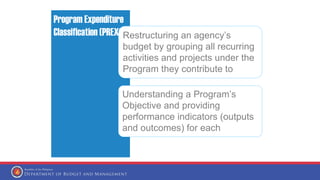
Program Expenditure
Classification (PREXC)Restructuring an agency’s
budget by grouping all recurring
activities and projects under the
Program they contribute to
Understanding a Program’s
Objective and providing
performance indicators (outputs
and outcomes) for each
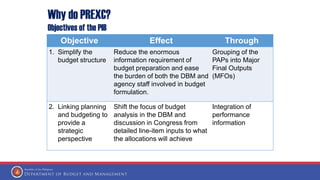
Objective Effect Through
1. Simplify the
budget structure
Reduce the enormous
information requirement of
budget preparation and ease
the burden of both the DBM and
agency staff involved in budget
formulation.
Grouping of the
PAPs into Major
Final Outputs
(MFOs)
2. Linking planning
and budgeting to
provide a
strategic
perspective
Shift the focus of budget
analysis in the DBM and
discussion in Congress from
detailed line-item inputs to what
the allocations will achieve
Integration of
performance
information
Why do PREXC?
Objectives of the PIB
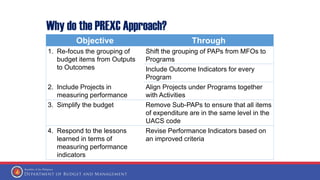
Objective Through
1. Re-focus the grouping of
budget items from Outputs
to Outcomes
Shift the grouping of PAPs from MFOs to
Programs
Include Outcome Indicators for every
Program
2. Include Projects in
measuring performance
Align Projects under Programs together
with Activities
3. Simplify the budget Remove Sub-PAPs to ensure that all items
of expenditure are in the same level in the
UACS code
4. Respond to the lessons
learned in terms of
measuring performance
indicators
Revise Performance Indicators based on
an improved criteria
Why do the PREXC Approach?
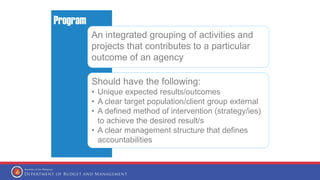
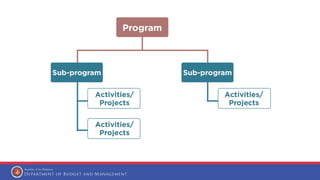
Program
An integrated grouping of activities and
projects that contributes to a particular
outcome of an agency
Should have the following:
• Unique expected results/outcomes
• A clear target population/client group external
• A defined method of intervention (strategy/ies)
to achieve the desired result/s
• A clear management structure that defines
accountabilities
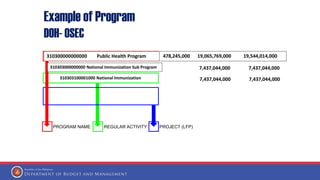
PROGRAM NAME REGULAR ACTIVITY PROJECT (LFP)
Example of Program
DOH- OSEC
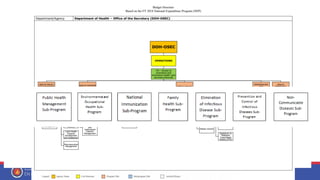
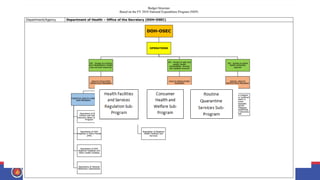
310300000000000 Public Health Program 478,245,000 19,065,769,000 19,544,014,000
310303000000000 National Immunization Sub Program 7,437,044,000 7,437,044,000
310303100001000 National Immunization 7,437,044,000 7,437,044,000
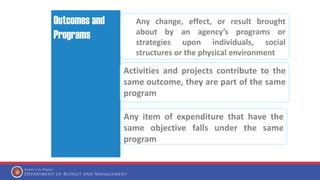
Outcomes and
Programs
Activities and projects contribute to the
same outcome, they are part of the same
program
Any item of expenditure that have the
same objective falls under the same
program
Any change, effect, or result brought
about by an agency’s programs or
strategies upon individuals, social
structures or the physical environment
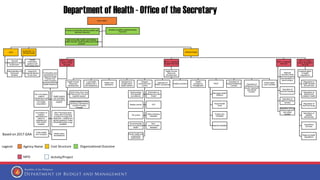
DOH OSEC
GAS
General
Management and
Supervision
Administration of
Personnel
Benefits
SUPPORT TO
OPERATIONS
Health
information
systems and
technology dev’t
Support to
regional delivery
to services
OPERATIONS
MFO 1: Health
Sector Policy
Services
Formulation and
development of
National Health
Policies and
Plans including
essential National
Health Research
Dev’t of policies,
support
mechanisms and
collaboration for
int’l health
cooperation
Health system
dev’t program
including policy
support
Formulation of
policies,
standards and
plans for
hospitals and
other health
facilities
Nat’l Pharmaceutical
Policy Dev’t including
provision of drugs and
medicines , medical and
dental supplies to make
affordable quality drugs
available
Public health
dev’t program Health policy
development
MFO 2: Technical
Support Services
Health Human
Resource
Development
Health Human
Resource
Development
HHR Policy Dev’t and
Planning for LGU and
regional support
Implementation of the
Doctors to the Barrios
and RH Practice
Program
Local health
systems dev’t
and assistance
Health care
assistance
Assistance to
private sector
health centers
Disease
prevention and
control
Epidiomology
and disease
surveillance
Elimination of
disease as public
threat
Rabies control EPI
TB control
Other infectious
diseases
Environmental
and occupational
health
Non-
communicable
diseases
Family health and
responsible
parenthood
Operation of
PMAC secretariat
Health promotion
Health
emergency
management
HFEP
Barangay Health
Stations
Rural Health
Units
Public/LGU
Hospitals
Special Hospitals
Operation of
Regional Medical
Centers
Operation of
Dangerous Drug
Abuse Treatment
and Rehab
Centers
Other Health
Care Facilities
MFO 3: Hospital
Services
National
voluntary blood
services program
and operation of
blood centers
Operation of
special hospitals
Operation of
regional medical
centers
Operation of drug
abuse treatment
and rehab
centers
MFO 4: Health
Sector Regulation
Services
Implementation
of health
regulations
Regulation of
health facilities
and services
Regulation of
devices and
radiation health
Regulation of
food and drugs
Operations of
satellite
laboratories
Quarantine
services
Regional health
regulations
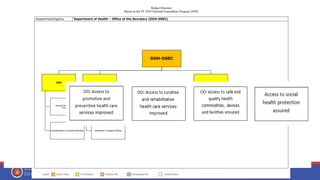
Access to preventive primary health care
services improved
Access to quality hospital services
improved
Safe and quality health commodities,
health devices, health facilities and food
ensured
Department of Health - Office of the Secretary
Legend: Agency Name Cost Structure Organizational Outcome
MFO Activity/Project
Based on 2017 GAA
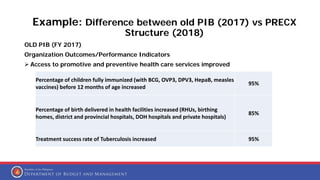
Example: Difference between old PIB (2017) vs PRECX
Structure (2018)
OLD PIB (FY 2017)
Organization Outcomes/Performance Indicators
 Access to promotive and preventive health care services improved
Percentage of children fully immunized (with BCG, OVP3, DPV3, HepaB, measles
vaccines) before 12 months of age increased
95%
Percentage of birth delivered in health facilities increased (RHUs, birthing
homes, district and provincial hospitals, DOH hospitals and private hospitals)
85%
Treatment success rate of Tuberculosis increased 95%
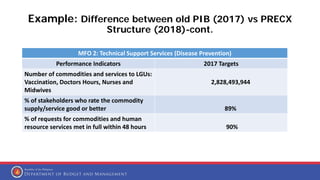
Example: Difference between old PIB (2017) vs PRECX
Structure (2018)-cont.
MFO 2: Technical Support Services (Disease Prevention)
Performance Indicators 2017 Targets
Number of commodities and services to LGUs:
Vaccination, Doctors Hours, Nurses and
Midwives
2,828,493,944
% of stakeholders who rate the commodity
supply/service good or better 89%
% of requests for commodities and human
resource services met in full within 48 hours 90%
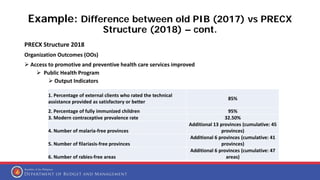
Example: Difference between old PIB (2017) vs PRECX
Structure (2018) – cont.
PRECX Structure 2018
Organization Outcomes (OOs)
 Access to promotive and preventive health care services improved
 Public Health Program
 Output Indicators
1. Percentage of external clients who rated the technical
assistance provided as satisfactory or better
85%
2. Percentage of fully immunized children 95%
3. Modern contraceptive prevalence rate 32.50%
4. Number of malaria-free provinces
Additional 13 provinces (cumulative: 45
provinces)
5. Number of filariasis-free provinces
Additional 6 provinces (cumulative: 41
provinces)
6. Number of rabies-free areas
Additional 6 provinces (cumulative: 47
areas)
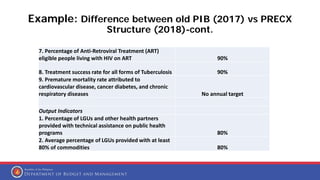
Example: Difference between old PIB (2017) vs PRECX
Structure (2018)-cont.
7. Percentage of Anti-Retroviral Treatment (ART)
eligible people living with HIV on ART 90%
8. Treatment success rate for all forms of Tuberculosis 90%
9. Premature mortality rate attributed to
cardiovascular disease, cancer diabetes, and chronic
respiratory diseases No annual target
Output Indicators
1. Percentage of LGUs and other health partners
provided with technical assistance on public health
programs 80%
2. Average percentage of LGUs provided with at least
80% of commodities 80%
Program expenditure classification - Cristina CLASARA, Philippines

Program expenditure classification - Cristina CLASARA, Philippines

  • 2.
    Program Expenditure Classification (PREXC)Restructuringan agency’s budget by grouping all recurring activities and projects under the Program they contribute to Understanding a Program’s Objective and providing performance indicators (outputs and outcomes) for each
  • 3.
    Objective Effect Through 1.Simplify the budget structure Reduce the enormous information requirement of budget preparation and ease the burden of both the DBM and agency staff involved in budget formulation. Grouping of the PAPs into Major Final Outputs (MFOs) 2. Linking planning and budgeting to provide a strategic perspective Shift the focus of budget analysis in the DBM and discussion in Congress from detailed line-item inputs to what the allocations will achieve Integration of performance information Why do PREXC? Objectives of the PIB
  • 4.
    Objective Through 1. Re-focusthe grouping of budget items from Outputs to Outcomes Shift the grouping of PAPs from MFOs to Programs Include Outcome Indicators for every Program 2. Include Projects in measuring performance Align Projects under Programs together with Activities 3. Simplify the budget Remove Sub-PAPs to ensure that all items of expenditure are in the same level in the UACS code 4. Respond to the lessons learned in terms of measuring performance indicators Revise Performance Indicators based on an improved criteria Why do the PREXC Approach?
  • 5.
    Program An integrated groupingof activities and projects that contributes to a particular outcome of an agency Should have the following: • Unique expected results/outcomes • A clear target population/client group external • A defined method of intervention (strategy/ies) to achieve the desired result/s • A clear management structure that defines accountabilities
  • 7.
    PROGRAM NAME REGULARACTIVITY PROJECT (LFP) Example of Program DOH- OSEC 310300000000000 Public Health Program 478,245,000 19,065,769,000 19,544,014,000 310303000000000 National Immunization Sub Program 7,437,044,000 7,437,044,000 310303100001000 National Immunization 7,437,044,000 7,437,044,000
  • 8.
    Outcomes and Programs Activities andprojects contribute to the same outcome, they are part of the same program Any item of expenditure that have the same objective falls under the same program Any change, effect, or result brought about by an agency’s programs or strategies upon individuals, social structures or the physical environment
  • 9.
    DOH OSEC GAS General Management and Supervision Administrationof Personnel Benefits SUPPORT TO OPERATIONS Health information systems and technology dev’t Support to regional delivery to services OPERATIONS MFO 1: Health Sector Policy Services Formulation and development of National Health Policies and Plans including essential National Health Research Dev’t of policies, support mechanisms and collaboration for int’l health cooperation Health system dev’t program including policy support Formulation of policies, standards and plans for hospitals and other health facilities Nat’l Pharmaceutical Policy Dev’t including provision of drugs and medicines , medical and dental supplies to make affordable quality drugs available Public health dev’t program Health policy development MFO 2: Technical Support Services Health Human Resource Development Health Human Resource Development HHR Policy Dev’t and Planning for LGU and regional support Implementation of the Doctors to the Barrios and RH Practice Program Local health systems dev’t and assistance Health care assistance Assistance to private sector health centers Disease prevention and control Epidiomology and disease surveillance Elimination of disease as public threat Rabies control EPI TB control Other infectious diseases Environmental and occupational health Non- communicable diseases Family health and responsible parenthood Operation of PMAC secretariat Health promotion Health emergency management HFEP Barangay Health Stations Rural Health Units Public/LGU Hospitals Special Hospitals Operation of Regional Medical Centers Operation of Dangerous Drug Abuse Treatment and Rehab Centers Other Health Care Facilities MFO 3: Hospital Services National voluntary blood services program and operation of blood centers Operation of special hospitals Operation of regional medical centers Operation of drug abuse treatment and rehab centers MFO 4: Health Sector Regulation Services Implementation of health regulations Regulation of health facilities and services Regulation of devices and radiation health Regulation of food and drugs Operations of satellite laboratories Quarantine services Regional health regulations Access to preventive primary health care services improved Access to quality hospital services improved Safe and quality health commodities, health devices, health facilities and food ensured Department of Health - Office of the Secretary Legend: Agency Name Cost Structure Organizational Outcome MFO Activity/Project Based on 2017 GAA
  • 13.
    Example: Difference betweenold PIB (2017) vs PRECX Structure (2018) OLD PIB (FY 2017) Organization Outcomes/Performance Indicators  Access to promotive and preventive health care services improved Percentage of children fully immunized (with BCG, OVP3, DPV3, HepaB, measles vaccines) before 12 months of age increased 95% Percentage of birth delivered in health facilities increased (RHUs, birthing homes, district and provincial hospitals, DOH hospitals and private hospitals) 85% Treatment success rate of Tuberculosis increased 95%
  • 14.
    Example: Difference betweenold PIB (2017) vs PRECX Structure (2018)-cont. MFO 2: Technical Support Services (Disease Prevention) Performance Indicators 2017 Targets Number of commodities and services to LGUs: Vaccination, Doctors Hours, Nurses and Midwives 2,828,493,944 % of stakeholders who rate the commodity supply/service good or better 89% % of requests for commodities and human resource services met in full within 48 hours 90%
  • 15.
    Example: Difference betweenold PIB (2017) vs PRECX Structure (2018) – cont. PRECX Structure 2018 Organization Outcomes (OOs)  Access to promotive and preventive health care services improved  Public Health Program  Output Indicators 1. Percentage of external clients who rated the technical assistance provided as satisfactory or better 85% 2. Percentage of fully immunized children 95% 3. Modern contraceptive prevalence rate 32.50% 4. Number of malaria-free provinces Additional 13 provinces (cumulative: 45 provinces) 5. Number of filariasis-free provinces Additional 6 provinces (cumulative: 41 provinces) 6. Number of rabies-free areas Additional 6 provinces (cumulative: 47 areas)
  • 16.
    Example: Difference betweenold PIB (2017) vs PRECX Structure (2018)-cont. 7. Percentage of Anti-Retroviral Treatment (ART) eligible people living with HIV on ART 90% 8. Treatment success rate for all forms of Tuberculosis 90% 9. Premature mortality rate attributed to cardiovascular disease, cancer diabetes, and chronic respiratory diseases No annual target Output Indicators 1. Percentage of LGUs and other health partners provided with technical assistance on public health programs 80% 2. Average percentage of LGUs provided with at least 80% of commodities 80%