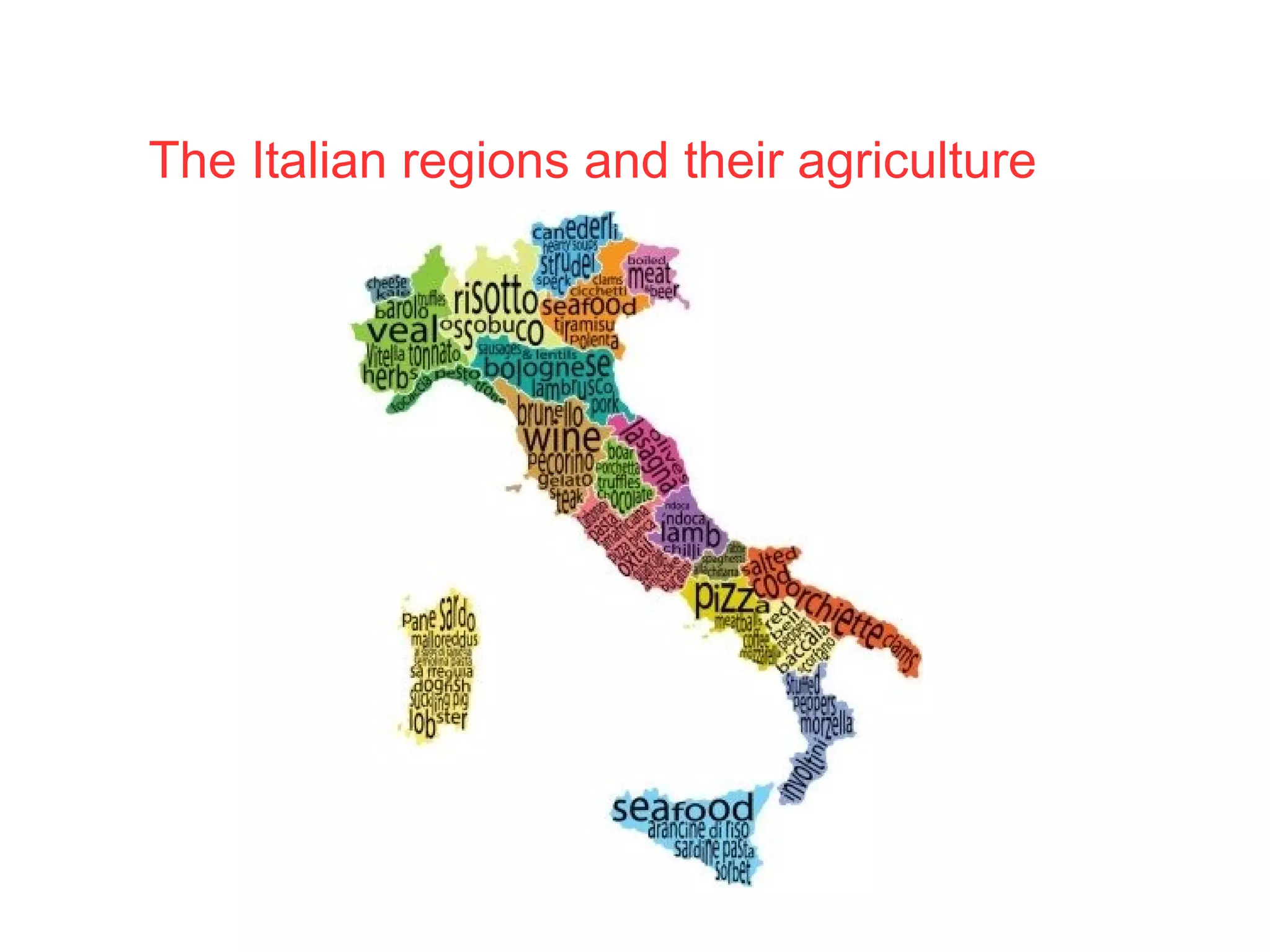
The Italian regions and their agriculture
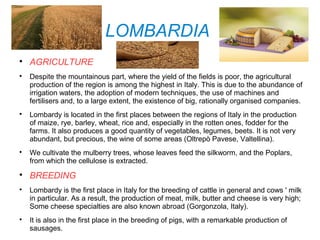
LOMBARDIA

AGRICULTURE

Despite the mountainous part, where the yield of the fields is poor, the agricultural
production of the region is among the highest in Italy. This is due to the abundance of
irrigation waters, the adoption of modern techniques, the use of machines and
fertilisers and, to a large extent, the existence of big, rationally organised companies.

Lombardy is located in the first places between the regions of Italy in the production
of maize, rye, barley, wheat, rice and, especially in the rotten ones, fodder for the
farms. It also produces a good quantity of vegetables, legumes, beets. It is not very
abundant, but precious, the wine of some areas (Oltrepò Pavese, Valtellina).

We cultivate the mulberry trees, whose leaves feed the silkworm, and the Poplars,
from which the cellulose is extracted.

BREEDING

Lombardy is the first place in Italy for the breeding of cattle in general and cows ' milk
in particular. As a result, the production of meat, milk, butter and cheese is very high;
Some cheese specialties are also known abroad (Gorgonzola, Italy).

It is also in the first place in the breeding of pigs, with a remarkable production of
sausages.
VALLE D'AOSTA

AGRICOLTURE: The agricultural activity is the modest one of the mountain
countries. The products, in negligible quantities, are rye, potatoes, apples
and pears. The woods provide construction timber.

BREEDING: It is rather widespread cattle breeding and therefore it has a
good production of meat, butter and cheeses, among which is known the
Jontina.
MOLISE

AGRICULTURE: It is rather limited the specialization in the crops, among
which the most common are the cereal (maize and wheat), the vegetable,
along the littoral, and those of the vine, the tobacco and the sunflower; Even
the breeding, while being able to make use of the pastures in high seas, is in
decline, because it considered activity unpalatable especially by the young
generations. Important is the fishing activity, which has its center in Termoli.
VENETO E
TOSCANA

AGRICULTURE

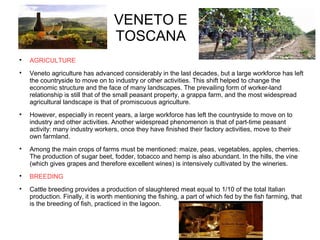
Veneto agriculture has advanced considerably in the last decades, but a large workforce has left
the countryside to move on to industry or other activities. This shift helped to change the
economic structure and the face of many landscapes. The prevailing form of worker-land
relationship is still that of the small peasant property, a grappa farm, and the most widespread
agricultural landscape is that of promiscuous agriculture.

However, especially in recent years, a large workforce has left the countryside to move on to
industry and other activities. Another widespread phenomenon is that of part-time peasant
activity: many industry workers, once they have finished their factory activities, move to their
own farmland.

Among the main crops of farms must be mentioned: maize, peas, vegetables, apples, cherries.
The production of sugar beet, fodder, tobacco and hemp is also abundant. In the hills, the vine
(which gives grapes and therefore excellent wines) is intensively cultivated by the wineries.

BREEDING

Cattle breeding provides a production of slaughtered meat equal to 1/10 of the total Italian
production. Finally, it is worth mentioning the fishing, a part of which fed by the fish farming, that
is the breeding of fish, practiced in the lagoon.
ABRUZZO

AGRICULTURE

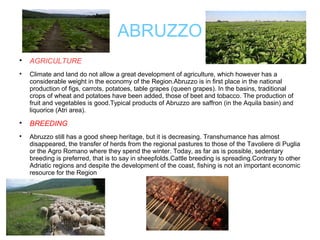
Climate and land do not allow a great development of agriculture, which however has a
considerable weight in the economy of the Region.Abruzzo is in first place in the national
production of figs, carrots, potatoes, table grapes (queen grapes). In the basins, traditional
crops of wheat and potatoes have been added, those of beet and tobacco. The production of
fruit and vegetables is good.Typical products of Abruzzo are saffron (in the Aquila basin) and
liquorice (Atri area).

BREEDING

Abruzzo still has a good sheep heritage, but it is decreasing. Transhumance has almost
disappeared, the transfer of herds from the regional pastures to those of the Tavoliere di Puglia
or the Agro Romano where they spend the winter. Today, as far as is possible, sedentary
breeding is preferred, that is to say in sheepfolds.Cattle breeding is spreading.Contrary to other
Adriatic regions and despite the development of the coast, fishing is not an important economic
resource for the Region
BASILICATA

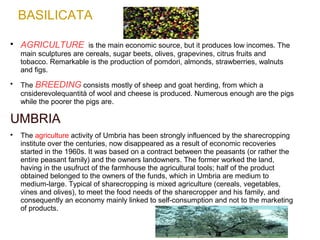
AGRICULTURE is the main economic source, but it produces low incomes. The
main sculptures are cereals, sugar beets, olives, grapevines, citrus fruits and
tobacco. Remarkable is the production of pomdori, almonds, strawberries, walnuts
and figs.

The BREEDING consists mostly of sheep and goat herding, from which a
cnsiderevolequantità of wool and cheese is produced. Numerous enough are the pigs
while the poorer the pigs are.
UMBRIA

The agriculture activity of Umbria has been strongly influenced by the sharecropping
institute over the centuries, now disappeared as a result of economic recoveries
started in the 1960s. It was based on a contract between the peasants (or rather the
entire peasant family) and the owners landowners. The former worked the land,
having in the usufruct of the farmhouse the agricultural tools; half of the product
obtained belonged to the owners of the funds, which in Umbria are medium to
medium-large. Typical of sharecropping is mixed agriculture (cereals, vegetables,
vines and olives), to meet the food needs of the sharecropper and his family, and
consequently an economy mainly linked to self-consumption and not to the marketing
of products.
LAZIO

AGRICULTURE

Apart from Rome, a fundamental city for the economy of Lazio, agriculture and pastoralism are the strong points of this
region.Through the grandiose work of the reclamation of the marshes in Lazio it was possible to introduce new crops.

Agricultural activity, which, despite the exodus of the rural population, increases production thanks to the use of more
profitable techniques, is practiced differently from place to place.In the Frusinate and in the Reatino are in large
number the direct cultivators, as well as in large areas of the province of Latina and Rome.Large farms, over 50
hectares, which represent 45% of the area, and small and very small farms, prevail in Lazio.The distribution of crops is
very different from area to area, in relation to the nature of the land, the variety of agricultural land, the distribution of
rainfall, the possibility of irrigation, the use of agricultural machinery and fertilizers.

In the regions of the Lazio Maremma, Agro Romano and Agro Pontino where the use of agricultural machinery is
possible, the arable crops prevail. This is extensive cereal farming, alternating with rest periods during which sheep
grazing is practiced...

Wine cultivation is characteristic in the Lazio Hills. Fruit growing is increasing.

The horticultural crops (inprevalenza artichokes and tomatoes), initially carried out only in the Roman countryside, are
now practiced on the coast and in the area north of Rome and in the agropontino.

BREEDING

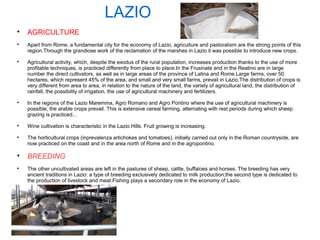
The other uncultivated areas are left in the pastures of sheep, cattle, buffaloes and horses. The breeding has very
ancient traditions in Lazio: a type of breeding exclusively dedicated to milk production;the second type is dedicated to
the production of livestock and meat.Fishing plays a secondary role in the economy of Lazio.
TRENTINO ALTO ADIGE

AGRICULTURE

Agriculture can not have a great development in an area where plains are lacking and where
over half of the soil is unproductive because it consists of rocks, glaciers, lakes and very
extensive woods. The cultivable area is therefore reduced to the fondivalle, whose fertility is
however modest and where the irrigation works require constant work.

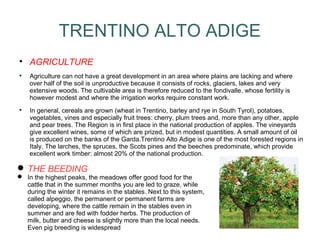
In general, cereals are grown (wheat in Trentino, barley and rye in South Tyrol), potatoes,
vegetables, vines and especially fruit trees: cherry, plum trees and, more than any other, apple
and pear trees. The Region is in first place in the national production of apples. The vineyards
give excellent wines, some of which are prized, but in modest quantities. A small amount of oil
is produced on the banks of the Garda.Trentino Alto Adige is one of the most forested regions in
Italy. The larches, the spruces, the Scots pines and the beeches predominate, which provide
excellent work timber: almost 20% of the national production.
 THE BEEDING
 In the highest peaks, the meadows offer good food for the
cattle that in the summer months you are led to graze, while
during the winter it remains in the stables. Next to this system,
called alpeggio, the permanent or permanent farms are
developing, where the cattle remain in the stables even in
summer and are fed with fodder herbs. The production of
milk, butter and cheese is slightly more than the local needs.
Even pig breeding is widespread

Progetto geografia 2

  • 1.
    The Italian regionsand their agriculture
  • 2.
    LOMBARDIA  AGRICULTURE  Despite the mountainouspart, where the yield of the fields is poor, the agricultural production of the region is among the highest in Italy. This is due to the abundance of irrigation waters, the adoption of modern techniques, the use of machines and fertilisers and, to a large extent, the existence of big, rationally organised companies.  Lombardy is located in the first places between the regions of Italy in the production of maize, rye, barley, wheat, rice and, especially in the rotten ones, fodder for the farms. It also produces a good quantity of vegetables, legumes, beets. It is not very abundant, but precious, the wine of some areas (Oltrepò Pavese, Valtellina).  We cultivate the mulberry trees, whose leaves feed the silkworm, and the Poplars, from which the cellulose is extracted.  BREEDING  Lombardy is the first place in Italy for the breeding of cattle in general and cows ' milk in particular. As a result, the production of meat, milk, butter and cheese is very high; Some cheese specialties are also known abroad (Gorgonzola, Italy).  It is also in the first place in the breeding of pigs, with a remarkable production of sausages.
  • 3.
    VALLE D'AOSTA  AGRICOLTURE: Theagricultural activity is the modest one of the mountain countries. The products, in negligible quantities, are rye, potatoes, apples and pears. The woods provide construction timber.  BREEDING: It is rather widespread cattle breeding and therefore it has a good production of meat, butter and cheeses, among which is known the Jontina. MOLISE  AGRICULTURE: It is rather limited the specialization in the crops, among which the most common are the cereal (maize and wheat), the vegetable, along the littoral, and those of the vine, the tobacco and the sunflower; Even the breeding, while being able to make use of the pastures in high seas, is in decline, because it considered activity unpalatable especially by the young generations. Important is the fishing activity, which has its center in Termoli.
  • 4.
    VENETO E TOSCANA  AGRICULTURE  Veneto agriculturehas advanced considerably in the last decades, but a large workforce has left the countryside to move on to industry or other activities. This shift helped to change the economic structure and the face of many landscapes. The prevailing form of worker-land relationship is still that of the small peasant property, a grappa farm, and the most widespread agricultural landscape is that of promiscuous agriculture.  However, especially in recent years, a large workforce has left the countryside to move on to industry and other activities. Another widespread phenomenon is that of part-time peasant activity: many industry workers, once they have finished their factory activities, move to their own farmland.  Among the main crops of farms must be mentioned: maize, peas, vegetables, apples, cherries. The production of sugar beet, fodder, tobacco and hemp is also abundant. In the hills, the vine (which gives grapes and therefore excellent wines) is intensively cultivated by the wineries.  BREEDING  Cattle breeding provides a production of slaughtered meat equal to 1/10 of the total Italian production. Finally, it is worth mentioning the fishing, a part of which fed by the fish farming, that is the breeding of fish, practiced in the lagoon.
  • 5.
    ABRUZZO  AGRICULTURE  Climate and landdo not allow a great development of agriculture, which however has a considerable weight in the economy of the Region.Abruzzo is in first place in the national production of figs, carrots, potatoes, table grapes (queen grapes). In the basins, traditional crops of wheat and potatoes have been added, those of beet and tobacco. The production of fruit and vegetables is good.Typical products of Abruzzo are saffron (in the Aquila basin) and liquorice (Atri area).  BREEDING  Abruzzo still has a good sheep heritage, but it is decreasing. Transhumance has almost disappeared, the transfer of herds from the regional pastures to those of the Tavoliere di Puglia or the Agro Romano where they spend the winter. Today, as far as is possible, sedentary breeding is preferred, that is to say in sheepfolds.Cattle breeding is spreading.Contrary to other Adriatic regions and despite the development of the coast, fishing is not an important economic resource for the Region
  • 6.
    BASILICATA  AGRICULTURE is themain economic source, but it produces low incomes. The main sculptures are cereals, sugar beets, olives, grapevines, citrus fruits and tobacco. Remarkable is the production of pomdori, almonds, strawberries, walnuts and figs.  The BREEDING consists mostly of sheep and goat herding, from which a cnsiderevolequantità of wool and cheese is produced. Numerous enough are the pigs while the poorer the pigs are. UMBRIA  The agriculture activity of Umbria has been strongly influenced by the sharecropping institute over the centuries, now disappeared as a result of economic recoveries started in the 1960s. It was based on a contract between the peasants (or rather the entire peasant family) and the owners landowners. The former worked the land, having in the usufruct of the farmhouse the agricultural tools; half of the product obtained belonged to the owners of the funds, which in Umbria are medium to medium-large. Typical of sharecropping is mixed agriculture (cereals, vegetables, vines and olives), to meet the food needs of the sharecropper and his family, and consequently an economy mainly linked to self-consumption and not to the marketing of products.
  • 7.
    LAZIO  AGRICULTURE  Apart from Rome,a fundamental city for the economy of Lazio, agriculture and pastoralism are the strong points of this region.Through the grandiose work of the reclamation of the marshes in Lazio it was possible to introduce new crops.  Agricultural activity, which, despite the exodus of the rural population, increases production thanks to the use of more profitable techniques, is practiced differently from place to place.In the Frusinate and in the Reatino are in large number the direct cultivators, as well as in large areas of the province of Latina and Rome.Large farms, over 50 hectares, which represent 45% of the area, and small and very small farms, prevail in Lazio.The distribution of crops is very different from area to area, in relation to the nature of the land, the variety of agricultural land, the distribution of rainfall, the possibility of irrigation, the use of agricultural machinery and fertilizers.  In the regions of the Lazio Maremma, Agro Romano and Agro Pontino where the use of agricultural machinery is possible, the arable crops prevail. This is extensive cereal farming, alternating with rest periods during which sheep grazing is practiced...  Wine cultivation is characteristic in the Lazio Hills. Fruit growing is increasing.  The horticultural crops (inprevalenza artichokes and tomatoes), initially carried out only in the Roman countryside, are now practiced on the coast and in the area north of Rome and in the agropontino.  BREEDING  The other uncultivated areas are left in the pastures of sheep, cattle, buffaloes and horses. The breeding has very ancient traditions in Lazio: a type of breeding exclusively dedicated to milk production;the second type is dedicated to the production of livestock and meat.Fishing plays a secondary role in the economy of Lazio.
  • 8.
    TRENTINO ALTO ADIGE  AGRICULTURE  Agriculturecan not have a great development in an area where plains are lacking and where over half of the soil is unproductive because it consists of rocks, glaciers, lakes and very extensive woods. The cultivable area is therefore reduced to the fondivalle, whose fertility is however modest and where the irrigation works require constant work.  In general, cereals are grown (wheat in Trentino, barley and rye in South Tyrol), potatoes, vegetables, vines and especially fruit trees: cherry, plum trees and, more than any other, apple and pear trees. The Region is in first place in the national production of apples. The vineyards give excellent wines, some of which are prized, but in modest quantities. A small amount of oil is produced on the banks of the Garda.Trentino Alto Adige is one of the most forested regions in Italy. The larches, the spruces, the Scots pines and the beeches predominate, which provide excellent work timber: almost 20% of the national production.  THE BEEDING  In the highest peaks, the meadows offer good food for the cattle that in the summer months you are led to graze, while during the winter it remains in the stables. Next to this system, called alpeggio, the permanent or permanent farms are developing, where the cattle remain in the stables even in summer and are fed with fodder herbs. The production of milk, butter and cheese is slightly more than the local needs. Even pig breeding is widespread