CULTURAL EXCHANGE
EUROPEAN PROJECT

AGRO PONTINO
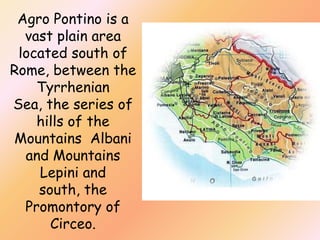
Agro Pontino is a
vast plain area
located south of
Rome, between the
Tyrrhenian
Sea, the series of
hills of the
Mountains Albani
and Mountains
Lepini and
south, the
Promontory of
Circeo.
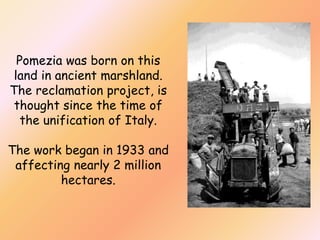
Pomezia was born on this
land in ancient marshland.
The reclamation project, is
thought since the time of
the unification of Italy.
The work began in 1933 and
affecting nearly 2 million
hectares.
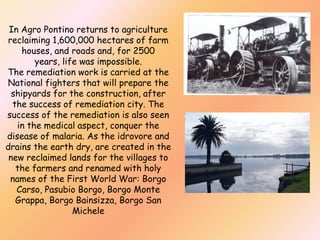
In Agro Pontino returns to agriculture
reclaiming 1,600,000 hectares of farm
houses, and roads and, for 2500
years, life was impossible.
The remediation work is carried at the
National fighters that will prepare the
shipyards for the construction, after
the success of remediation city. The
success of the remediation is also seen
in the medical aspect, conquer the
disease of malaria. As the idrovore and
drains the earth dry, are created in the
new reclaimed lands for the villages to
the farmers and renamed with holy
names of the First World War: Borgo
Carso, Pasubio Borgo, Borgo Monte
Grappa, Borgo Bainsizza, Borgo San
Michele
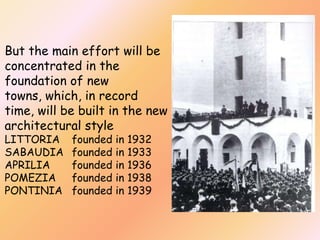
But the main effort will be
concentrated in the
foundation of new
towns, which, in record
time, will be built in the new
architectural style
LITTORIA
SABAUDIA
APRILIA
POMEZIA
PONTINIA

founded in
founded in
founded in
founded in
founded in

1932
1933
1936
1938
1939
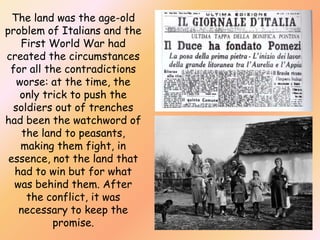
The land was the age-old
problem of Italians and the
First World War had
created the circumstances
for all the contradictions
worse: at the time, the
only trick to push the
soldiers out of trenches
had been the watchword of
the land to peasants,
making them fight, in
essence, not the land that
had to win but for what
was behind them. After
the conflict, it was
necessary to keep the
promise.
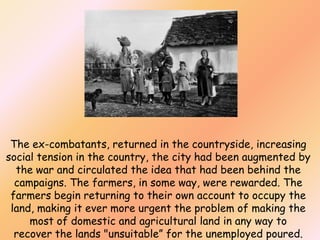
The ex-combatants, returned in the countryside, increasing
social tension in the country, the city had been augmented by
the war and circulated the idea that had been behind the
campaigns. The farmers, in some way, were rewarded. The
farmers begin returning to their own account to occupy the
land, making it ever more urgent the problem of making the
most of domestic and agricultural land in any way to
recover the lands "unsuitable” for the unemployed poured.
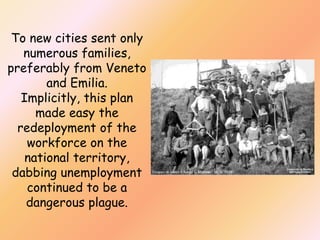
To new cities sent only
numerous families,
preferably from Veneto
and Emilia.
Implicitly, this plan
made easy the
redeployment of the
workforce on the
national territory,
dabbing unemployment
continued to be a
dangerous plague.
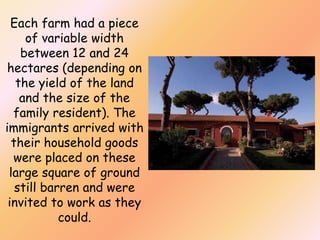
Each farm had a piece
of variable width
between 12 and 24
hectares (depending on
the yield of the land
and the size of the
family resident). The
immigrants arrived with
their household goods
were placed on these
large square of ground
still barren and were
invited to work as they
could.
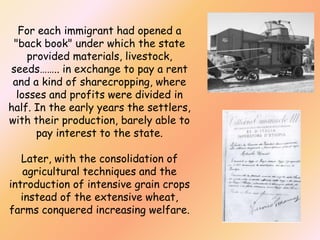
For each immigrant had opened a
"back book" under which the state
provided materials, livestock,
seeds…….. in exchange to pay a rent
and a kind of sharecropping, where
losses and profits were divided in
half. In the early years the settlers,
with their production, barely able to
pay interest to the state.
Later, with the consolidation of
agricultural techniques and the
introduction of intensive grain crops
instead of the extensive wheat,
farms conquered increasing welfare.
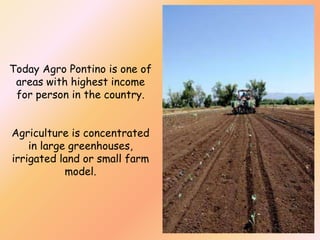
Today Agro Pontino is one of
areas with highest income
for person in the country.

Agriculture is concentrated
in large greenhouses,
irrigated land or small farm
model.
The agro Pontino is area of
Lazio where agriculture is
more developed.
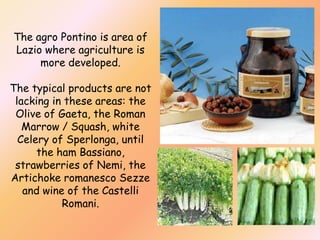
The typical products are not
lacking in these areas: the
Olive of Gaeta, the Roman
Marrow / Squash, white
Celery of Sperlonga, until
the ham Bassiano,
strawberries of Nemi, the
Artichoke romanesco Sezze
and wine of the Castelli
Romani.
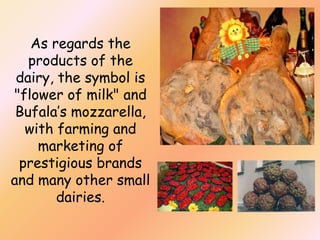
As regards the
products of the
dairy, the symbol is
"flower of milk" and
Bufala’s mozzarella,
with farming and
marketing of
prestigious brands
and many other small
dairies.
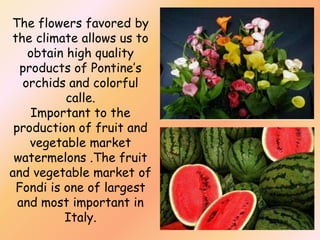
The flowers favored by
the climate allows us to
obtain high quality
products of Pontine’s
orchids and colorful
calle.
Important to the
production of fruit and
vegetable market
watermelons .The fruit
and vegetable market of
Fondi is one of largest
and most important in
Italy.
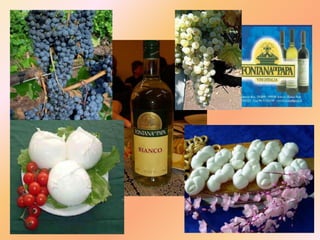
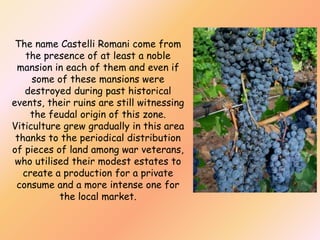
The name Castelli Romani come from
the presence of at least a noble
mansion in each of them and even if
some of these mansions were
destroyed during past historical
events, their ruins are still witnessing
the feudal origin of this zone.
Viticulture grew gradually in this area
thanks to the periodical distribution
of pieces of land among war veterans,
who utilised their modest estates to
create a production for a private
consume and a more intense one for
the local market.
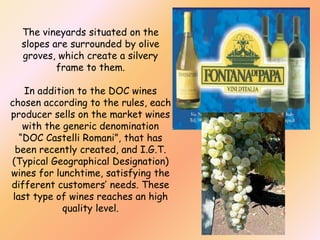
The vineyards situated on the
slopes are surrounded by olive
groves, which create a silvery
frame to them.
In addition to the DOC wines
chosen according to the rules, each
producer sells on the market wines
with the generic denomination
“DOC Castelli Romani”, that has
been recently created, and I.G.T.
(Typical Geographical Designation)
wines for lunchtime, satisfying the
different customers’ needs. These
last type of wines reaches an high
quality level.
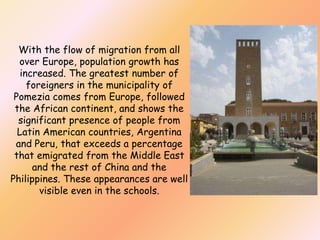
With the flow of migration from all
over Europe, population growth has
increased. The greatest number of
foreigners in the municipality of
Pomezia comes from Europe, followed
the African continent, and shows the
significant presence of people from
Latin American countries, Argentina
and Peru, that exceeds a percentage
that emigrated from the Middle East
and the rest of China and the
Philippines. These appearances are well
visible even in the schools.
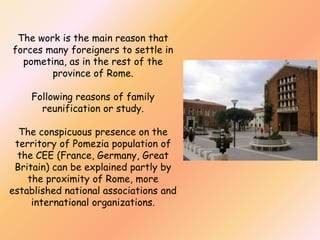
The work is the main reason that
forces many foreigners to settle in
pometina, as in the rest of the
province of Rome.
Following reasons of family
reunification or study.
The conspicuous presence on the
territory of Pomezia population of
the CEE (France, Germany, Great
Britain) can be explained partly by
the proximity of Rome, more
established national associations and
international organizations.
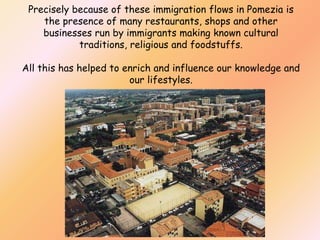
Precisely because of these immigration flows in Pomezia is
the presence of many restaurants, shops and other
businesses run by immigrants making known cultural
traditions, religious and foodstuffs.
All this has helped to enrich and influence our knowledge and
our lifestyles.
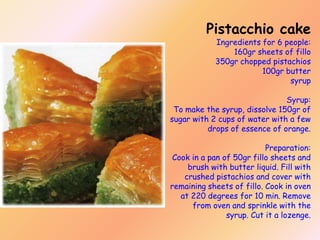
Pistacchio cake

Ingredients for 6 people:
160gr sheets of fillo
350gr chopped pistachios
100gr butter
syrup

Syrup:
To make the syrup, dissolve 150gr of
sugar with 2 cups of water with a few
drops of essence of orange.
Preparation:
Cook in a pan of 50gr fillo sheets and
brush with butter liquid. Fill with
crushed pistachios and cover with
remaining sheets of fillo. Cook in oven
at 220 degrees for 10 min. Remove
from oven and sprinkle with the
syrup. Cut it a lozenge.
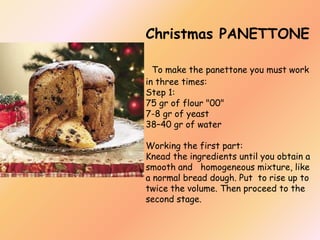
Christmas PANETTONE
To make the panettone you must work
in three times:
Step 1:
75 gr of flour "00"
7-8 gr of yeast
38–40 gr of water
Working the first part:
Knead the ingredients until you obtain a
smooth and homogeneous mixture, like
a normal bread dough. Put to rise up to
twice the volume. Then proceed to the
second stage.
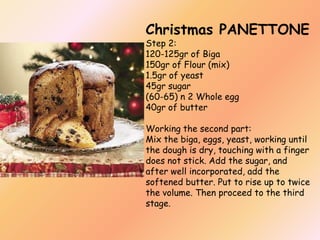
Christmas PANETTONE
Step 2:
120-125gr of Biga
150gr of Flour (mix)
1.5gr of yeast
45gr sugar
(60-65) n 2 Whole egg
40gr of butter

Working the second part:
Mix the biga, eggs, yeast, working until
the dough is dry, touching with a finger
does not stick. Add the sugar, and
after well incorporated, add the
softened butter. Put to rise up to twice
the volume. Then proceed to the third
stage.
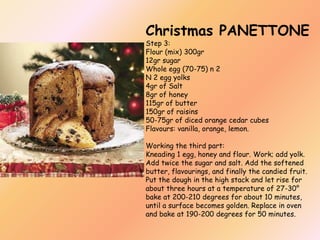
Christmas PANETTONE
Step 3:
Flour (mix) 300gr
12gr sugar
Whole egg (70-75) n 2
N 2 egg yolks
4gr of Salt
8gr of honey
115gr of butter
150gr of raisins
50-75gr of diced orange cedar cubes
Flavours: vanilla, orange, lemon.

Working the third part:
Kneading 1 egg, honey and flour. Work; add yolk.
Add twice the sugar and salt. Add the softened
butter, flavourings, and finally the candied fruit.
Put the dough in the high stack and let rise for
about three hours at a temperature of 27-30°
bake at 200-210 degrees for about 10 minutes,
until a surface becomes golden. Replace in oven
and bake at 190-200 degrees for 50 minutes.
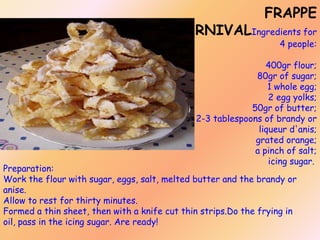
FRAPPE

CARNIVALIngredients for

4 people:

400gr flour;
80gr of sugar;
1 whole egg;
2 egg yolks;
50gr of butter;
2-3 tablespoons of brandy or
liqueur d'anis;
grated orange;
a pinch of salt;
icing sugar.

Preparation:
Work the flour with sugar, eggs, salt, melted butter and the brandy or
anise.
Allow to rest for thirty minutes.
Formed a thin sheet, then with a knife cut thin strips.Do the frying in
oil, pass in the icing sugar. Are ready!
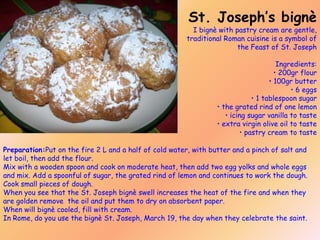
St. Joseph’s bignè

I bignè with pastry cream are gentle,
traditional Roman cuisine is a symbol of
the Feast of St. Joseph

Ingredients:
• 200gr flour
• 100gr butter
• 6 eggs
• 1 tablespoon sugar
• the grated rind of one lemon
• icing sugar vanilla to taste
• extra virgin olive oil to taste
• pastry cream to taste
Preparation:Put on the fire 2 L and a half of cold water, with butter and a pinch of salt and
let boil, then add the flour.
Mix with a wooden spoon and cook on moderate heat, then add two egg yolks and whole eggs
and mix. Add a spoonful of sugar, the grated rind of lemon and continues to work the dough.
Cook small pieces of dough.
When you see that the St. Joseph bignè swell increases the heat of the fire and when they
are golden remove the oil and put them to dry on absorbent paper.
When will bignè cooled, fill with cream.
In Rome, do you use the bignè St. Joseph, March 19, the day when they celebrate the saint.
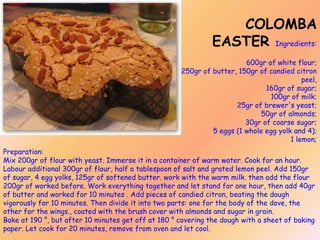
COLOMBA
EASTER Ingredients:
600gr of white flour;
250gr of butter, 150gr of candied citron
peel,
160gr of sugar;
100gr of milk;
25gr of brewer's yeast;
50gr of almonds;
30gr of coarse sugar;
5 eggs (1 whole egg yolk and 4);
1 lemon;
Preparation:
Mix 200gr of flour with yeast. Immerse it in a container of warm water. Cook for an hour.
Labour additional 300gr of flour, half a tablespoon of salt and grated lemon peel. Add 150gr
of sugar, 4 egg yolks, 125gr of softened butter. work with the warm milk. then add the flour
200gr of worked before. Work everything together and let stand for one hour, then add 40gr
of butter and worked for 10 minutes . Add pieces of candied citron, beating the dough
vigorously for 10 minutes. Then divide it into two parts: one for the body of the dove, the
other for the wings., coated with the brush cover with almonds and sugar in grain.
Bake at 190 °, but after 10 minutes get off at 180 ° covering the dough with a sheet of baking
paper. Let cook for 20 minutes, remove from oven and let cool.
THE END

Agro pontino eng def

  • 1.
  • 2.
    Agro Pontino isa vast plain area located south of Rome, between the Tyrrhenian Sea, the series of hills of the Mountains Albani and Mountains Lepini and south, the Promontory of Circeo.
  • 3.
    Pomezia was bornon this land in ancient marshland. The reclamation project, is thought since the time of the unification of Italy. The work began in 1933 and affecting nearly 2 million hectares.
  • 4.
    In Agro Pontinoreturns to agriculture reclaiming 1,600,000 hectares of farm houses, and roads and, for 2500 years, life was impossible. The remediation work is carried at the National fighters that will prepare the shipyards for the construction, after the success of remediation city. The success of the remediation is also seen in the medical aspect, conquer the disease of malaria. As the idrovore and drains the earth dry, are created in the new reclaimed lands for the villages to the farmers and renamed with holy names of the First World War: Borgo Carso, Pasubio Borgo, Borgo Monte Grappa, Borgo Bainsizza, Borgo San Michele
  • 5.
    But the maineffort will be concentrated in the foundation of new towns, which, in record time, will be built in the new architectural style LITTORIA SABAUDIA APRILIA POMEZIA PONTINIA founded in founded in founded in founded in founded in 1932 1933 1936 1938 1939
  • 6.
    The land wasthe age-old problem of Italians and the First World War had created the circumstances for all the contradictions worse: at the time, the only trick to push the soldiers out of trenches had been the watchword of the land to peasants, making them fight, in essence, not the land that had to win but for what was behind them. After the conflict, it was necessary to keep the promise.
  • 7.
    The ex-combatants, returnedin the countryside, increasing social tension in the country, the city had been augmented by the war and circulated the idea that had been behind the campaigns. The farmers, in some way, were rewarded. The farmers begin returning to their own account to occupy the land, making it ever more urgent the problem of making the most of domestic and agricultural land in any way to recover the lands "unsuitable” for the unemployed poured.
  • 8.
    To new citiessent only numerous families, preferably from Veneto and Emilia. Implicitly, this plan made easy the redeployment of the workforce on the national territory, dabbing unemployment continued to be a dangerous plague.
  • 9.
    Each farm hada piece of variable width between 12 and 24 hectares (depending on the yield of the land and the size of the family resident). The immigrants arrived with their household goods were placed on these large square of ground still barren and were invited to work as they could.
  • 10.
    For each immigranthad opened a "back book" under which the state provided materials, livestock, seeds…….. in exchange to pay a rent and a kind of sharecropping, where losses and profits were divided in half. In the early years the settlers, with their production, barely able to pay interest to the state. Later, with the consolidation of agricultural techniques and the introduction of intensive grain crops instead of the extensive wheat, farms conquered increasing welfare.
  • 11.
    Today Agro Pontinois one of areas with highest income for person in the country. Agriculture is concentrated in large greenhouses, irrigated land or small farm model.
  • 12.
    The agro Pontinois area of Lazio where agriculture is more developed. The typical products are not lacking in these areas: the Olive of Gaeta, the Roman Marrow / Squash, white Celery of Sperlonga, until the ham Bassiano, strawberries of Nemi, the Artichoke romanesco Sezze and wine of the Castelli Romani.
  • 13.
    As regards the productsof the dairy, the symbol is "flower of milk" and Bufala’s mozzarella, with farming and marketing of prestigious brands and many other small dairies.
  • 15.
    The flowers favoredby the climate allows us to obtain high quality products of Pontine’s orchids and colorful calle. Important to the production of fruit and vegetable market watermelons .The fruit and vegetable market of Fondi is one of largest and most important in Italy.
  • 16.
    The name CastelliRomani come from the presence of at least a noble mansion in each of them and even if some of these mansions were destroyed during past historical events, their ruins are still witnessing the feudal origin of this zone. Viticulture grew gradually in this area thanks to the periodical distribution of pieces of land among war veterans, who utilised their modest estates to create a production for a private consume and a more intense one for the local market.
  • 17.
    The vineyards situatedon the slopes are surrounded by olive groves, which create a silvery frame to them. In addition to the DOC wines chosen according to the rules, each producer sells on the market wines with the generic denomination “DOC Castelli Romani”, that has been recently created, and I.G.T. (Typical Geographical Designation) wines for lunchtime, satisfying the different customers’ needs. These last type of wines reaches an high quality level.
  • 18.
    With the flowof migration from all over Europe, population growth has increased. The greatest number of foreigners in the municipality of Pomezia comes from Europe, followed the African continent, and shows the significant presence of people from Latin American countries, Argentina and Peru, that exceeds a percentage that emigrated from the Middle East and the rest of China and the Philippines. These appearances are well visible even in the schools.
  • 19.
    The work isthe main reason that forces many foreigners to settle in pometina, as in the rest of the province of Rome. Following reasons of family reunification or study. The conspicuous presence on the territory of Pomezia population of the CEE (France, Germany, Great Britain) can be explained partly by the proximity of Rome, more established national associations and international organizations.
  • 20.
    Precisely because ofthese immigration flows in Pomezia is the presence of many restaurants, shops and other businesses run by immigrants making known cultural traditions, religious and foodstuffs. All this has helped to enrich and influence our knowledge and our lifestyles.
  • 21.
    Pistacchio cake Ingredients for6 people: 160gr sheets of fillo 350gr chopped pistachios 100gr butter syrup Syrup: To make the syrup, dissolve 150gr of sugar with 2 cups of water with a few drops of essence of orange. Preparation: Cook in a pan of 50gr fillo sheets and brush with butter liquid. Fill with crushed pistachios and cover with remaining sheets of fillo. Cook in oven at 220 degrees for 10 min. Remove from oven and sprinkle with the syrup. Cut it a lozenge.
  • 22.
    Christmas PANETTONE To makethe panettone you must work in three times: Step 1: 75 gr of flour "00" 7-8 gr of yeast 38–40 gr of water Working the first part: Knead the ingredients until you obtain a smooth and homogeneous mixture, like a normal bread dough. Put to rise up to twice the volume. Then proceed to the second stage.
  • 23.
    Christmas PANETTONE Step 2: 120-125grof Biga 150gr of Flour (mix) 1.5gr of yeast 45gr sugar (60-65) n 2 Whole egg 40gr of butter Working the second part: Mix the biga, eggs, yeast, working until the dough is dry, touching with a finger does not stick. Add the sugar, and after well incorporated, add the softened butter. Put to rise up to twice the volume. Then proceed to the third stage.
  • 24.
    Christmas PANETTONE Step 3: Flour(mix) 300gr 12gr sugar Whole egg (70-75) n 2 N 2 egg yolks 4gr of Salt 8gr of honey 115gr of butter 150gr of raisins 50-75gr of diced orange cedar cubes Flavours: vanilla, orange, lemon. Working the third part: Kneading 1 egg, honey and flour. Work; add yolk. Add twice the sugar and salt. Add the softened butter, flavourings, and finally the candied fruit. Put the dough in the high stack and let rise for about three hours at a temperature of 27-30° bake at 200-210 degrees for about 10 minutes, until a surface becomes golden. Replace in oven and bake at 190-200 degrees for 50 minutes.
  • 25.
    FRAPPE CARNIVALIngredients for 4 people: 400grflour; 80gr of sugar; 1 whole egg; 2 egg yolks; 50gr of butter; 2-3 tablespoons of brandy or liqueur d'anis; grated orange; a pinch of salt; icing sugar. Preparation: Work the flour with sugar, eggs, salt, melted butter and the brandy or anise. Allow to rest for thirty minutes. Formed a thin sheet, then with a knife cut thin strips.Do the frying in oil, pass in the icing sugar. Are ready!
  • 26.
    St. Joseph’s bignè Ibignè with pastry cream are gentle, traditional Roman cuisine is a symbol of the Feast of St. Joseph Ingredients: • 200gr flour • 100gr butter • 6 eggs • 1 tablespoon sugar • the grated rind of one lemon • icing sugar vanilla to taste • extra virgin olive oil to taste • pastry cream to taste Preparation:Put on the fire 2 L and a half of cold water, with butter and a pinch of salt and let boil, then add the flour. Mix with a wooden spoon and cook on moderate heat, then add two egg yolks and whole eggs and mix. Add a spoonful of sugar, the grated rind of lemon and continues to work the dough. Cook small pieces of dough. When you see that the St. Joseph bignè swell increases the heat of the fire and when they are golden remove the oil and put them to dry on absorbent paper. When will bignè cooled, fill with cream. In Rome, do you use the bignè St. Joseph, March 19, the day when they celebrate the saint.
  • 27.
    COLOMBA EASTER Ingredients: 600gr ofwhite flour; 250gr of butter, 150gr of candied citron peel, 160gr of sugar; 100gr of milk; 25gr of brewer's yeast; 50gr of almonds; 30gr of coarse sugar; 5 eggs (1 whole egg yolk and 4); 1 lemon; Preparation: Mix 200gr of flour with yeast. Immerse it in a container of warm water. Cook for an hour. Labour additional 300gr of flour, half a tablespoon of salt and grated lemon peel. Add 150gr of sugar, 4 egg yolks, 125gr of softened butter. work with the warm milk. then add the flour 200gr of worked before. Work everything together and let stand for one hour, then add 40gr of butter and worked for 10 minutes . Add pieces of candied citron, beating the dough vigorously for 10 minutes. Then divide it into two parts: one for the body of the dove, the other for the wings., coated with the brush cover with almonds and sugar in grain. Bake at 190 °, but after 10 minutes get off at 180 ° covering the dough with a sheet of baking paper. Let cook for 20 minutes, remove from oven and let cool.
  • 28.