Business
Objectives
@tutor2ugeoff
Business Objectives
Profit
Maximisation
Sales Revenue
Maximisation
Business Growth
/ Market Power
Business Survival
in a recession
Not For Profit
Social Enterprises
State-Owned
Businesses
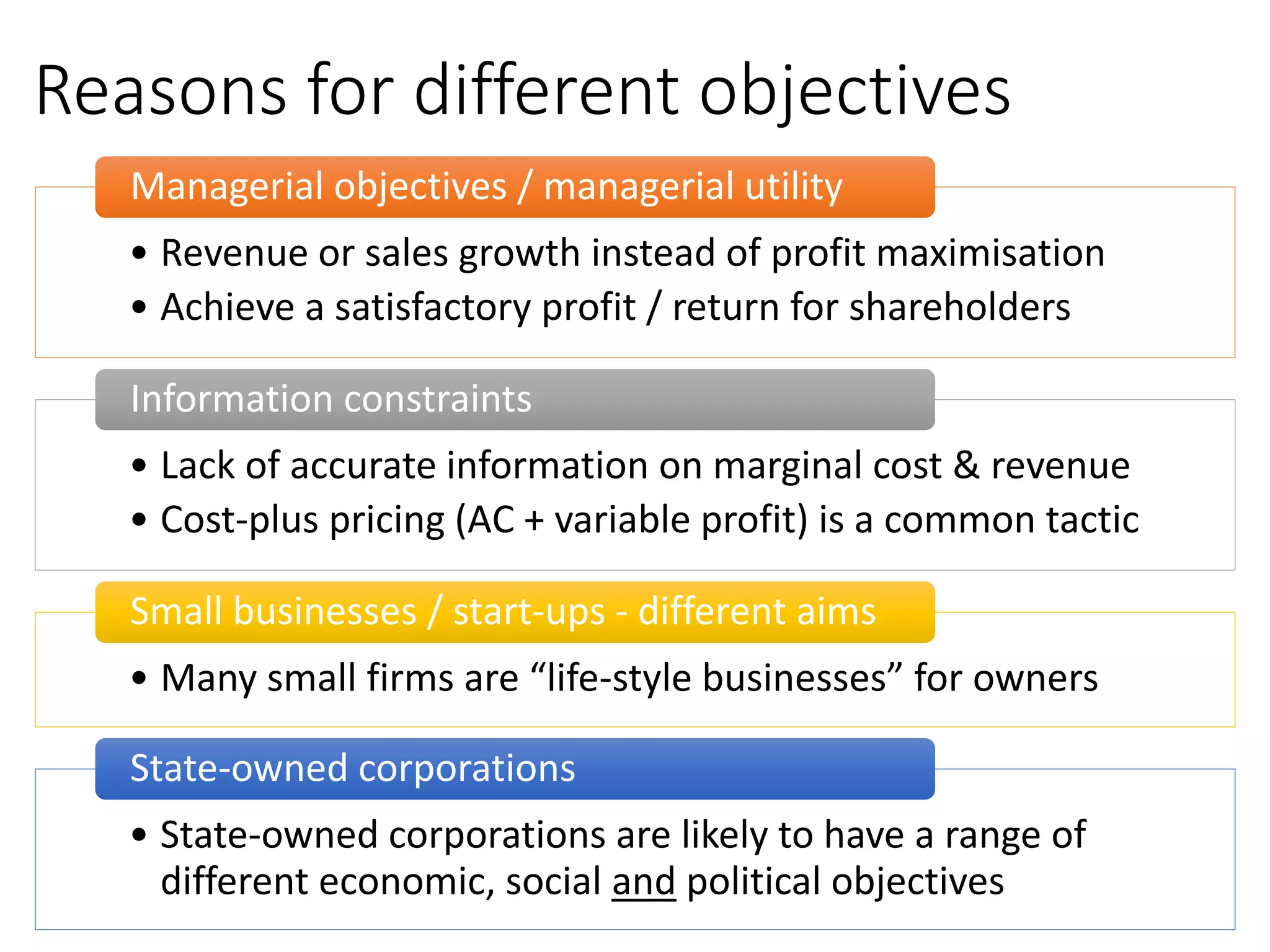
Reasons for different objectives
• Revenue or sales growth instead of profit maximisation
• Achieve a satisfactory profit / return for shareholders
Managerial objectives / managerial utility
• Lack of accurate information on marginal cost & revenue
• Cost-plus pricing (AC + variable profit) is a common tactic
Information constraints
• Many small firms are “life-style businesses” for owners
Small businesses / start-ups - different aims
• State-owned corporations are likely to have a range of
different economic, social and political objectives
State-owned corporations
MC1: When would the aim of a firm be
most likely to be other than profit
maximisation?
Type your answer in the chat window!
Option
A
When there are a large number of firms in the
industry
B
when there are a large number of shareholders
and few paid managers
C
when there is a large investment expenditure
required
D when there is a large output produced
MC1: When would the aim of a firm be
most likely to be other than profit
maximisation?
Type your answer in the chat window!
Option
A
When there are a large number of firms in the
industry
B
when there are a large number of shareholders
and few paid managers
C
when there is a large investment expenditure
required
D when there is a large output produced
The Agency Problem and Objectives
Agency problem
Possible conflicts of interest that may
result between shareholders (principal)
and the management (agent) of a firm
Stakeholders
In most businesses there are many
different stakeholders. These include
customers, managers, employees,
shareholders, debt holders and the
government
Stakeholder conflict
Stakeholder conflict occurs when
different stakeholders have different
objectives. Firms have to choose
between maximizing one objective and
satisfactorily meeting several stakeholder
objectives, so called satisficing
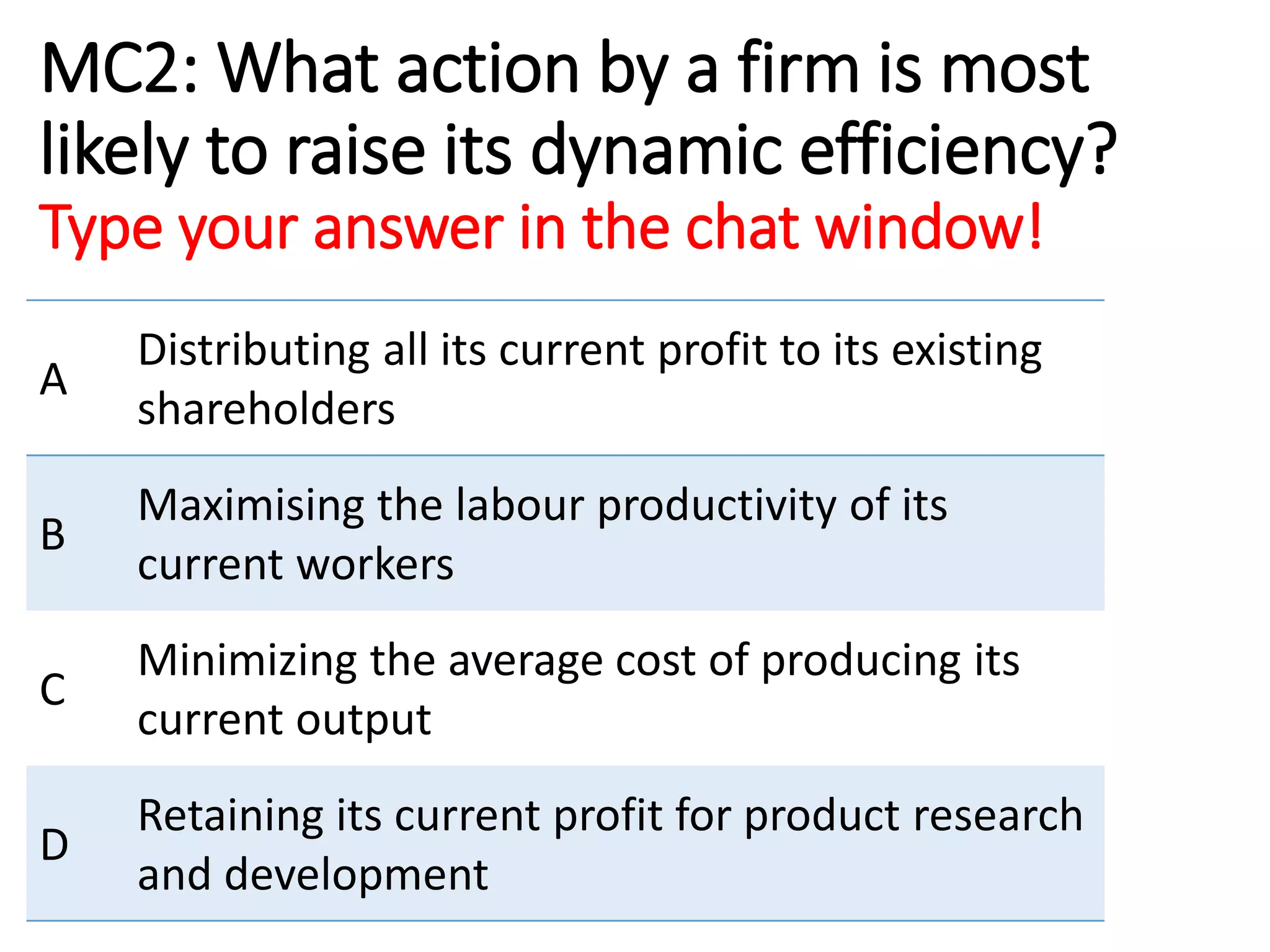
MC2: What action by a firm is most
likely to raise its dynamic efficiency?
Type your answer in the chat window!
A
Distributing all its current profit to its existing
shareholders
B
Maximising the labour productivity of its
current workers
C
Minimizing the average cost of producing its
current output
D
Retaining its current profit for product research
and development
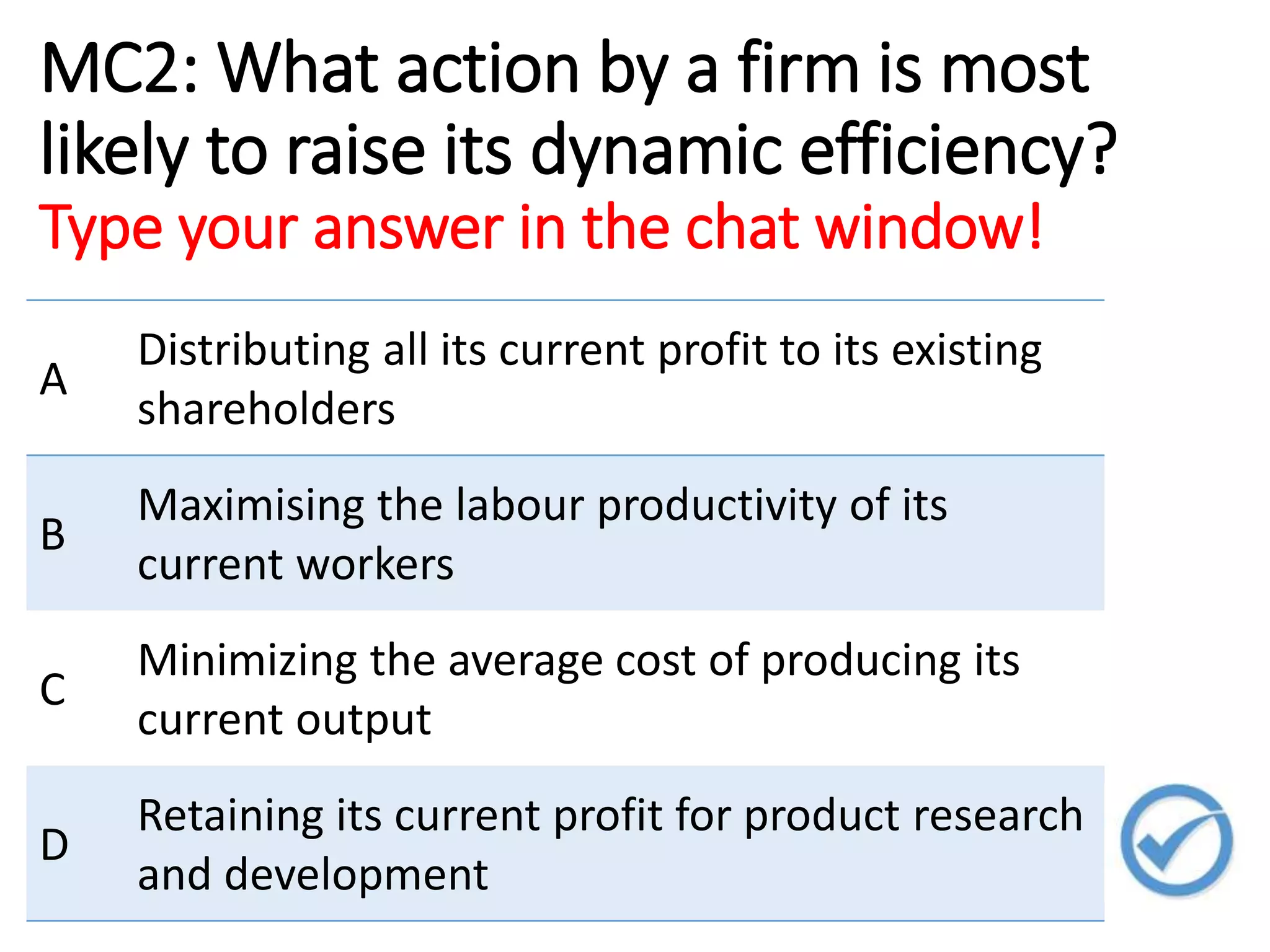
MC2: What action by a firm is most
likely to raise its dynamic efficiency?
Type your answer in the chat window!
A
Distributing all its current profit to its existing
shareholders
B
Maximising the labour productivity of its
current workers
C
Minimizing the average cost of producing its
current output
D
Retaining its current profit for product research
and development
MC3: Changing Business Objectives
Type your answer in the chat window!
MC3: Changing Business Objectives
Type your answer in the chat window!
C
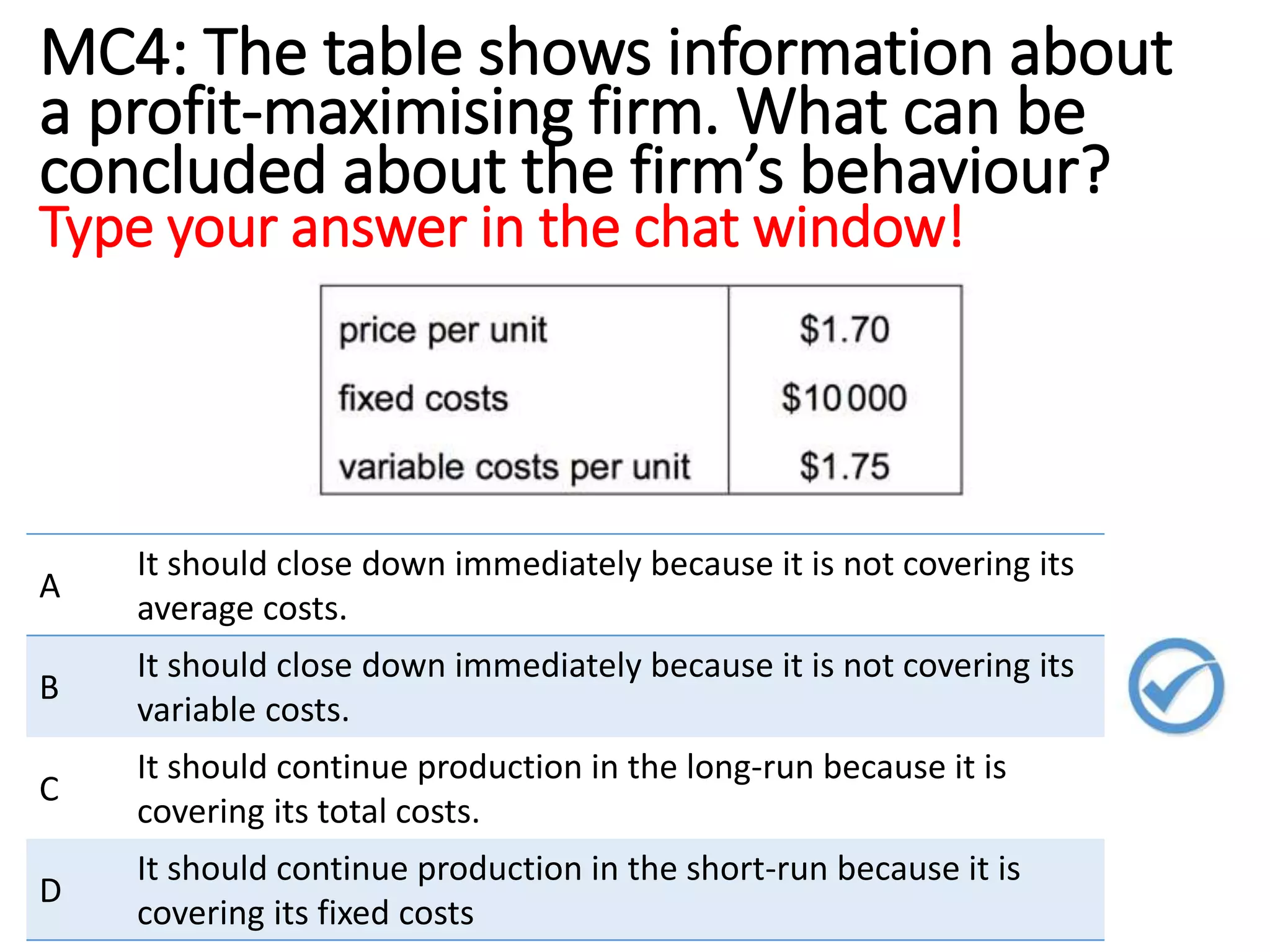
MC4: The table shows information about
a profit-maximising firm. What can be
concluded about the firm’s behaviour?
Type your answer in the chat window!
A
It should close down immediately because it is not covering its
average costs.
B
It should close down immediately because it is not covering its
variable costs.
C
It should continue production in the long-run because it is
covering its total costs.
D
It should continue production in the short-run because it is
covering its fixed costs
MC4: The table shows information about
a profit-maximising firm. What can be
concluded about the firm’s behaviour?
Type your answer in the chat window!
A
It should close down immediately because it is not covering its
average costs.
B
It should close down immediately because it is not covering its
variable costs.
C
It should continue production in the long-run because it is
covering its total costs.
D
It should continue production in the short-run because it is
covering its fixed costs
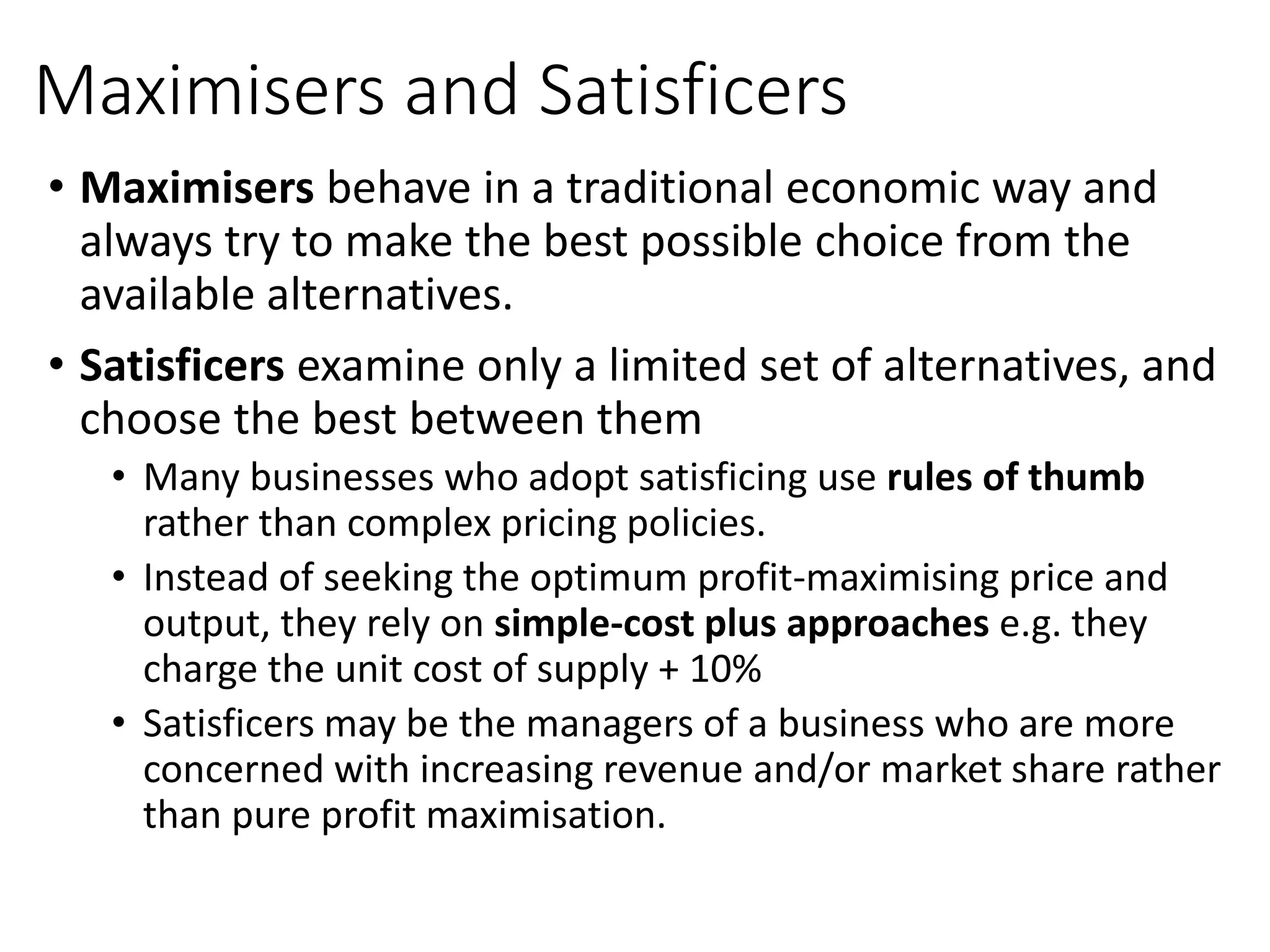
Maximisers and Satisficers
• Maximisers behave in a traditional economic way and
always try to make the best possible choice from the
available alternatives.
• Satisficers examine only a limited set of alternatives, and
choose the best between them
• Many businesses who adopt satisficing use rules of thumb
rather than complex pricing policies.
• Instead of seeking the optimum profit-maximising price and
output, they rely on simple-cost plus approaches e.g. they
charge the unit cost of supply + 10%
• Satisficers may be the managers of a business who are more
concerned with increasing revenue and/or market share rather
than pure profit maximisation.
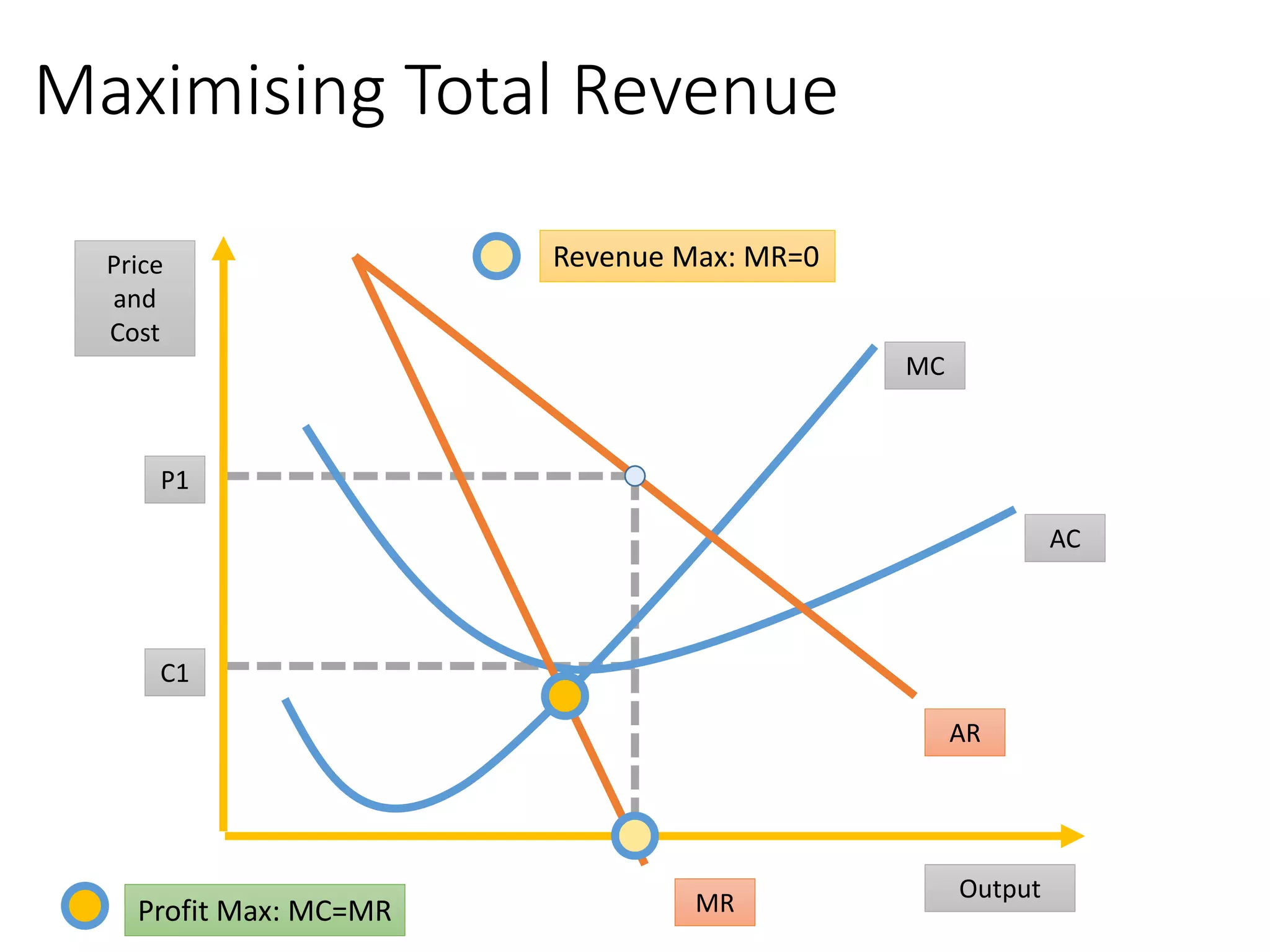
Maximising Total Revenue
MC
Price
and
Cost
Output
AC
MR
AR
Profit Max: MC=MR
Revenue Max: MR=0
P1
C1
Sales Maximisation
When a business sells as much as possible without making a loss
MC
Price
and
Cost
Output
AC
MR
AR
Profit Max: MC=MR
Sales Max is at an output where AR=AC
At this output, normal profits are made
P1
Q1
Profit Satisficing
MC
Price
and
Cost
Output
AC
MR
AR
Possible satisficing price
P1
Q1 Q2
P2
C2
Mini Case Study: Fitness Industry
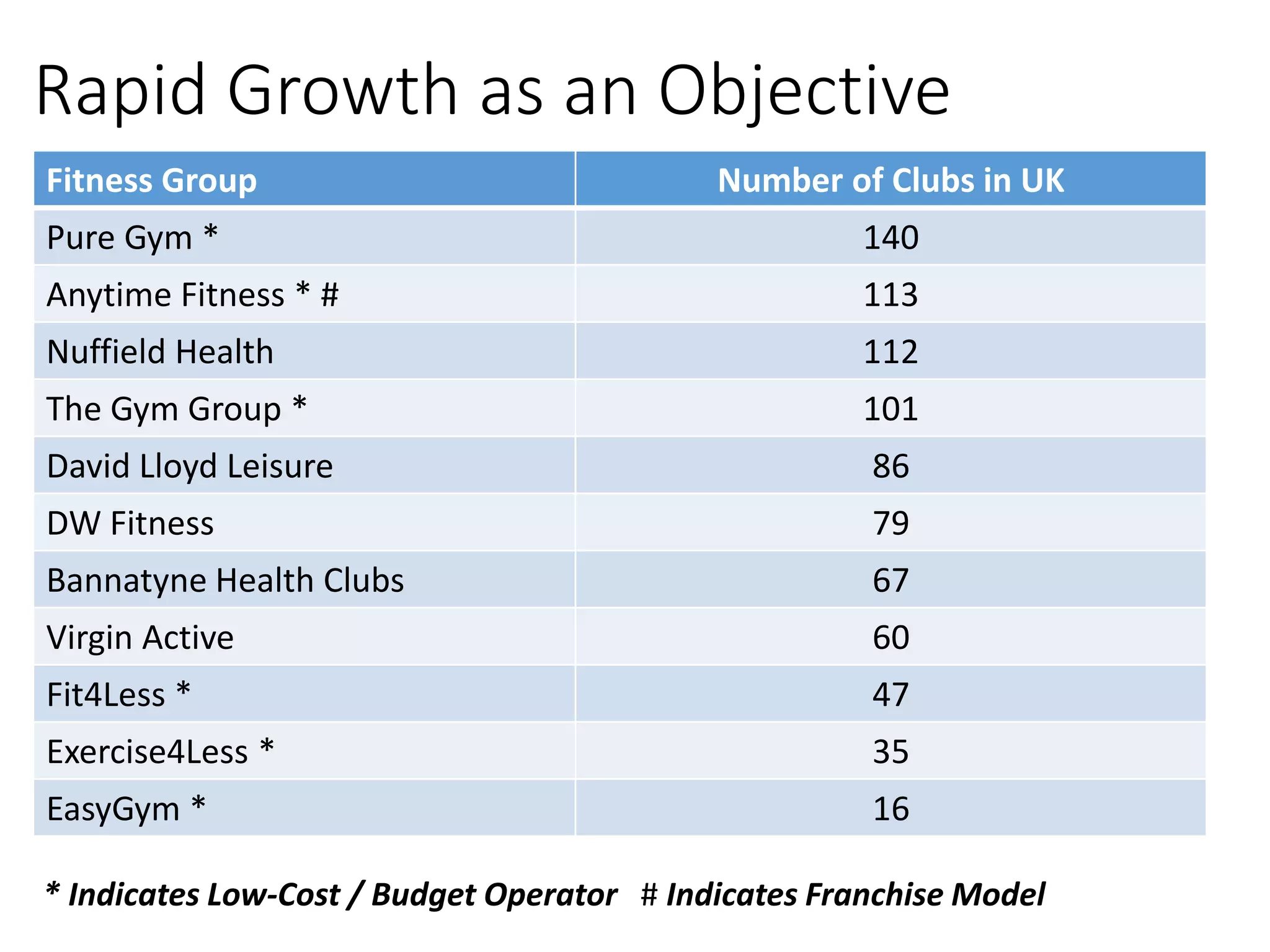
Rapid Growth as an Objective
Fitness Group Number of Clubs in UK
Pure Gym * 140
Anytime Fitness * # 113
Nuffield Health 112
The Gym Group * 101
David Lloyd Leisure 86
DW Fitness 79
Bannatyne Health Clubs 67
Virgin Active 60
Fit4Less * 47
Exercise4Less * 35
EasyGym * 16
* Indicates Low-Cost / Budget Operator # Indicates Franchise Model
Product Differentiation and Competitive
Advantage
Source: tutor2u Analysis
Budget /
Low-Cost
Mid-Market Premium /
Luxury
• Focus on exercise equipment
• Range of exercise classes
• Personal training by self-
employed trainers
• Online booking &
subscription management
• Swimming pool & spas
• Broader range of exercise
equipment & classes
• Catering & family areas
• Personal training by
employees + freelancers
• Direct selling of membership
• Most advanced equipment
• Niche classes & spa treatments
• Luxurious changing rooms
• Specialist trainers
• Direct selling of membership
• Pricing on application!
The changing mix of fitness clubs
6
5
4
3
2
1
0
2011 2012 2013 2014 2015 2016
Budget / Low-Cost Clubs
Traditional Health & Fitness
Clubs
Source: LDB / FT
NumbersofClubs(’000s)
Some Key Terms
Some key definitions
Profit maximisation
Profits are maximised at an output where
marginal cost = marginal revenue
Revenue maximisation
Revenues are maximised at an output
where marginal revenue = zero
Sales maximisation
Producing the largest amount possible
consistent with earning normal profits
Satisficing behaviour
Satisficing involves the owners of a
business (shareholders) setting minimum
acceptable levels of achievement in terms
of revenue and profitability
Social enterprises
Businesses with profits reinvested for
social aims – profit, people and planet
@tutor2ugeoff

Revision Webinar: Business Objectives

  • 1.
  • 2.
  • 3.
    Business Objectives Profit Maximisation Sales Revenue Maximisation BusinessGrowth / Market Power Business Survival in a recession Not For Profit Social Enterprises State-Owned Businesses
  • 4.
    Reasons for differentobjectives • Revenue or sales growth instead of profit maximisation • Achieve a satisfactory profit / return for shareholders Managerial objectives / managerial utility • Lack of accurate information on marginal cost & revenue • Cost-plus pricing (AC + variable profit) is a common tactic Information constraints • Many small firms are “life-style businesses” for owners Small businesses / start-ups - different aims • State-owned corporations are likely to have a range of different economic, social and political objectives State-owned corporations
  • 5.
    MC1: When wouldthe aim of a firm be most likely to be other than profit maximisation? Type your answer in the chat window! Option A When there are a large number of firms in the industry B when there are a large number of shareholders and few paid managers C when there is a large investment expenditure required D when there is a large output produced
  • 6.
    MC1: When wouldthe aim of a firm be most likely to be other than profit maximisation? Type your answer in the chat window! Option A When there are a large number of firms in the industry B when there are a large number of shareholders and few paid managers C when there is a large investment expenditure required D when there is a large output produced
  • 7.
    The Agency Problemand Objectives Agency problem Possible conflicts of interest that may result between shareholders (principal) and the management (agent) of a firm Stakeholders In most businesses there are many different stakeholders. These include customers, managers, employees, shareholders, debt holders and the government Stakeholder conflict Stakeholder conflict occurs when different stakeholders have different objectives. Firms have to choose between maximizing one objective and satisfactorily meeting several stakeholder objectives, so called satisficing
  • 8.
    MC2: What actionby a firm is most likely to raise its dynamic efficiency? Type your answer in the chat window! A Distributing all its current profit to its existing shareholders B Maximising the labour productivity of its current workers C Minimizing the average cost of producing its current output D Retaining its current profit for product research and development
  • 9.
    MC2: What actionby a firm is most likely to raise its dynamic efficiency? Type your answer in the chat window! A Distributing all its current profit to its existing shareholders B Maximising the labour productivity of its current workers C Minimizing the average cost of producing its current output D Retaining its current profit for product research and development
  • 10.
    MC3: Changing BusinessObjectives Type your answer in the chat window!
  • 11.
    MC3: Changing BusinessObjectives Type your answer in the chat window! C
  • 12.
    MC4: The tableshows information about a profit-maximising firm. What can be concluded about the firm’s behaviour? Type your answer in the chat window! A It should close down immediately because it is not covering its average costs. B It should close down immediately because it is not covering its variable costs. C It should continue production in the long-run because it is covering its total costs. D It should continue production in the short-run because it is covering its fixed costs
  • 13.
    MC4: The tableshows information about a profit-maximising firm. What can be concluded about the firm’s behaviour? Type your answer in the chat window! A It should close down immediately because it is not covering its average costs. B It should close down immediately because it is not covering its variable costs. C It should continue production in the long-run because it is covering its total costs. D It should continue production in the short-run because it is covering its fixed costs
  • 14.
    Maximisers and Satisficers •Maximisers behave in a traditional economic way and always try to make the best possible choice from the available alternatives. • Satisficers examine only a limited set of alternatives, and choose the best between them • Many businesses who adopt satisficing use rules of thumb rather than complex pricing policies. • Instead of seeking the optimum profit-maximising price and output, they rely on simple-cost plus approaches e.g. they charge the unit cost of supply + 10% • Satisficers may be the managers of a business who are more concerned with increasing revenue and/or market share rather than pure profit maximisation.
  • 15.
  • 16.
    Sales Maximisation When abusiness sells as much as possible without making a loss MC Price and Cost Output AC MR AR Profit Max: MC=MR Sales Max is at an output where AR=AC At this output, normal profits are made P1 Q1
  • 17.
  • 18.
    Mini Case Study:Fitness Industry
  • 19.
    Rapid Growth asan Objective Fitness Group Number of Clubs in UK Pure Gym * 140 Anytime Fitness * # 113 Nuffield Health 112 The Gym Group * 101 David Lloyd Leisure 86 DW Fitness 79 Bannatyne Health Clubs 67 Virgin Active 60 Fit4Less * 47 Exercise4Less * 35 EasyGym * 16 * Indicates Low-Cost / Budget Operator # Indicates Franchise Model
  • 20.
    Product Differentiation andCompetitive Advantage Source: tutor2u Analysis Budget / Low-Cost Mid-Market Premium / Luxury • Focus on exercise equipment • Range of exercise classes • Personal training by self- employed trainers • Online booking & subscription management • Swimming pool & spas • Broader range of exercise equipment & classes • Catering & family areas • Personal training by employees + freelancers • Direct selling of membership • Most advanced equipment • Niche classes & spa treatments • Luxurious changing rooms • Specialist trainers • Direct selling of membership • Pricing on application!
  • 21.
    The changing mixof fitness clubs 6 5 4 3 2 1 0 2011 2012 2013 2014 2015 2016 Budget / Low-Cost Clubs Traditional Health & Fitness Clubs Source: LDB / FT NumbersofClubs(’000s)
  • 22.
  • 23.
    Some key definitions Profitmaximisation Profits are maximised at an output where marginal cost = marginal revenue Revenue maximisation Revenues are maximised at an output where marginal revenue = zero Sales maximisation Producing the largest amount possible consistent with earning normal profits Satisficing behaviour Satisficing involves the owners of a business (shareholders) setting minimum acceptable levels of achievement in terms of revenue and profitability Social enterprises Businesses with profits reinvested for social aims – profit, people and planet
  • 24.