Finding Order in Countries with
Weak States: The Dilemma of the
        Somali Polities
        David K. Leonard
        Governance Team
              IDS
The Questions
• The former Somalia has not had an effective
  state since 1991.
• What are the causes and consequences of this
  statelessness?
• How can an acceptable level of human
  security and order be found in these
  circumstances?
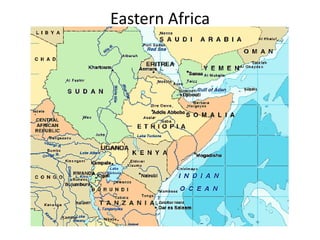
Eastern Africa
The Somali Polities Under Colonialism,
• Somalis are a distinct ethnic group, with their
  own language and culture.
• Largely pastoralist
• Historically stateless
• British Somaliland and (Italian) Somalia
• (French) Djibouti
• Significant numbers in Ethiopia (Ogaden) &
  Kenya (North-east Province)
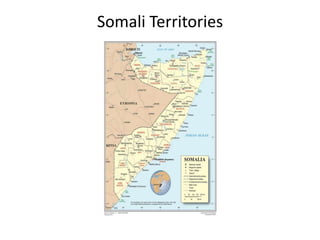
Somali Territories
Current Somali Polities
• Djibouti (Somali dominated)
• Somaliland (reasserted indepin 1991)
• Transitional Federal Government
  – Mogadishu
  – Puntland (autonomous)
  – Mudug (autonomous)
• Islamist (Kismayu and south-central)
• Ethiopian Region V and Kenyan North-east
Livelihoods Under Statelessness
• Livestock production and trade OK
• Fishing hurt by EU toxic dumping
• Inter-riverine crop production hurt and thus
  famine in south
• Service infrastructure hurt as tax base is weak
• Overall – probably better in north than under
  Barre’s state
Governance without States?
• Order maintained by clan-based diya-paying
  groups of ca. 100 adult males
• Tit-for-tat
• Governance is highly egalitarian
• But now also distorted by military and
  commercial patrons
  – Business  Militias not v.v.
• Contract enforcement through shariacourts
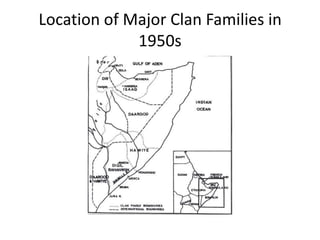
Location of Major Clan Families in
             1950s
Islam: Not Whether but What Type
• A good business partner is a good Muslim
• All Sunnis, but in south
  – Sufis AhluSunnaWaljama'a
  – Wahabisal-Shabab
Failure of State-building from Above
• Continuous international efforts since 1991 to
  recreate the Somalia state
• All based on elite bargains and all have failed
• Most recent is Transitional Federal Government
  (2004)
• Ethiopian incursion of 2006 ended in failure and
  withdrawal
• African Union stalled under Burundi & Uganda
• Kenyan incursion of south?
Successful Governance from the
                Bottom
• Somaliland – elders  elder delegates in +4
  month negotiations (1991-1993)
• Puntland – in +3 month negotiations (1998)
  supported by militia leadership
• SSC (Sool, Sanaag and Cayn) – looks 2 ways
• Galmudug -- AhluSunnaWaljama'a&Hawiye
  clan
• Kismayu and south – al Shabaab/ Hizbul Islam
Encouraging Governance
• Interpeace (WSP); Bryden, Menkhaus
• From the bottom
• Without worrying about UN statehood, size or
  regularity
• Encouraging through UN trust fund aid to
  whatever is working
Challenges -- Piracy
•   Puntland
•   Eyl but
•   Money & power
•   Don’t want to force into Islamist hands
•   More effective NATO corridors
Challenges – Terrorism in Kenya
• Legitimate Kenyan interests
• Now supported by Ethiopia (& US)
• But can it succeed or will it exacerbate?
• Negotiations inhibited by unwillingness to
  deal with Islamist polities or by lack of internal
  control?
• Counter-attacks by drone?

Professor David Leonard, Sussex Development Lecuture, Feb 2012

  • 1.
    Finding Order inCountries with Weak States: The Dilemma of the Somali Polities David K. Leonard Governance Team IDS
  • 2.
    The Questions • Theformer Somalia has not had an effective state since 1991. • What are the causes and consequences of this statelessness? • How can an acceptable level of human security and order be found in these circumstances?
  • 3.
  • 4.
    The Somali PolitiesUnder Colonialism, • Somalis are a distinct ethnic group, with their own language and culture. • Largely pastoralist • Historically stateless • British Somaliland and (Italian) Somalia • (French) Djibouti • Significant numbers in Ethiopia (Ogaden) & Kenya (North-east Province)
  • 5.
  • 6.
    Current Somali Polities •Djibouti (Somali dominated) • Somaliland (reasserted indepin 1991) • Transitional Federal Government – Mogadishu – Puntland (autonomous) – Mudug (autonomous) • Islamist (Kismayu and south-central) • Ethiopian Region V and Kenyan North-east
  • 7.
    Livelihoods Under Statelessness •Livestock production and trade OK • Fishing hurt by EU toxic dumping • Inter-riverine crop production hurt and thus famine in south • Service infrastructure hurt as tax base is weak • Overall – probably better in north than under Barre’s state
  • 8.
    Governance without States? •Order maintained by clan-based diya-paying groups of ca. 100 adult males • Tit-for-tat • Governance is highly egalitarian • But now also distorted by military and commercial patrons – Business  Militias not v.v. • Contract enforcement through shariacourts
  • 9.
    Location of MajorClan Families in 1950s
  • 10.
    Islam: Not Whetherbut What Type • A good business partner is a good Muslim • All Sunnis, but in south – Sufis AhluSunnaWaljama'a – Wahabisal-Shabab
  • 11.
    Failure of State-buildingfrom Above • Continuous international efforts since 1991 to recreate the Somalia state • All based on elite bargains and all have failed • Most recent is Transitional Federal Government (2004) • Ethiopian incursion of 2006 ended in failure and withdrawal • African Union stalled under Burundi & Uganda • Kenyan incursion of south?
  • 12.
    Successful Governance fromthe Bottom • Somaliland – elders  elder delegates in +4 month negotiations (1991-1993) • Puntland – in +3 month negotiations (1998) supported by militia leadership • SSC (Sool, Sanaag and Cayn) – looks 2 ways • Galmudug -- AhluSunnaWaljama'a&Hawiye clan • Kismayu and south – al Shabaab/ Hizbul Islam
  • 13.
    Encouraging Governance • Interpeace(WSP); Bryden, Menkhaus • From the bottom • Without worrying about UN statehood, size or regularity • Encouraging through UN trust fund aid to whatever is working
  • 14.
    Challenges -- Piracy • Puntland • Eyl but • Money & power • Don’t want to force into Islamist hands • More effective NATO corridors
  • 15.
    Challenges – Terrorismin Kenya • Legitimate Kenyan interests • Now supported by Ethiopia (& US) • But can it succeed or will it exacerbate? • Negotiations inhibited by unwillingness to deal with Islamist polities or by lack of internal control? • Counter-attacks by drone?