The importance of soft
skills in professional life
Euraxess 30th
November 2021
Webinar presentation
• You'll see exactly what is meant by soft
skills and then you'll find out what skills
employers most want.
• This will help you focus on improving
your own skills in those areas, giving
you the edge in the job market.
• You'll discover that you probably have a
great many more transferable skills
than you realize – you are using them
all the time, but because they are
second nature, you don't consider
them to be valuable.
• You will also identify a list of skills you
have gained from different areas of
your life.
Webinar presentation
4 Career Transition Stories that will
inspire you
These Career Transition stories will help you explore
the different career paths available to you.
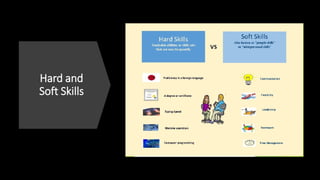
Hard and Soft Skills
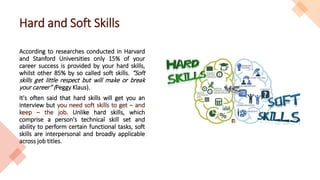
According to researches conducted in Harvard
and Stanford Universities only 15% of your
career success is provided by your hard skills,
whilst other 85% by so called soft skills. “Soft
skills get little respect but will make or break
your career” (Peggy Klaus).
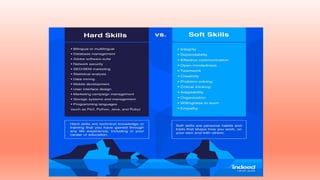
It's often said that hard skills will get you an
interview but you need soft skills to get – and
keep – the job. Unlike hard skills, which
comprise a person's technical skill set and
ability to perform certain functional tasks, soft
skills are interpersonal and broadly applicable
across job titles.
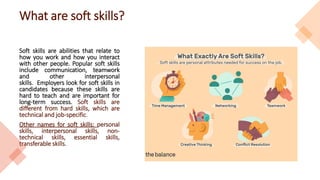
What are soft skills?
Soft skills are abilities that relate to
how you work and how you interact
with other people. Popular soft skills
include communication, teamwork
and other interpersonal
skills. Employers look for soft skills in
candidates because these skills are
hard to teach and are important for
long-term success. Soft skills are
different from hard skills, which are
technical and job-specific.
Other names for soft skills: personal
skills, interpersonal skills, non-
technical skills, essential skills,
transferable skills.
Hard and
Soft Skills
Soft Skills/People Skills
complementing hard skills
“Soft Skills” correlates with some terms of a
very close meaning: “Life Skills”, “Emotional
Intelligence Quotients”, “Social Skills”, and
“Interpersonal Skills”. Soft skills is a term
often associated with a person's Emotional
Intelligence Quotient, the cluster of
personality traits, social graces,
communication, language, personal habits,
friendliness, managing people, leadership,
etc. that characterize relationships with
other people. Soft skills, also known as
people skills, complement hard skills to
enhance an individual's relationships, job
performance and career prospects.
Soft Skills/Interpersonal Skills facilitate interaction and
communication with others.
Soft skills/interpersonal skills are the
skills a person uses to communicate
and interact with others. They include
persuasion, active listening,
delegation, and leadership.
Interpersonal skills are how people
relate to one another.
The term “interpersonal skills” is used
often in business contexts to refer to
the measure of a person's ability to
operate within business organizations
through social communication and
interactions.
Soft Skills enable individuals to deal effectively with the
demands and challenges of everyday life.
These skills are also defined by abilities that
can be practiced, such as leadership,
empathy, communication and sociability.
Soft skills could be defined as life skills which
are behaviors used appropriately and
responsibly in the management of personal
affairs.
They represent the psycho-social skills that
determine valued behavior and include
reflective skills such as problem-solving and
critical thinking, to personal skills such as
self-awareness, and to interpersonal skills.
Webinar presentation
TRANSFERABLE SKILLS
A focus on:
 Communication
 Project Management
 Grant Acquisition and Fundraising
How to commercialize your idea
The nature of researchers’
work in the 21st century
 In Academia and the corporate
sector, researchers need to be
capable communicators, experts in
project and research management as
well as grant acquisition.
 They have to be able to
commercialize their idea and
manage stressful steps in their
research.
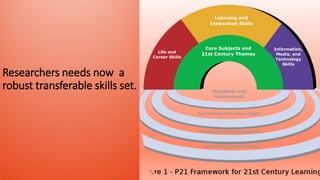
Researchers needs now a
robust transferable skills set.
PhD:
an Academic and Professional Experience
Repackage the PhD: think it in terms of transferable skills
developed in doctoral training.
The pool of skills -core competencies- shared by the majority of PhDs
regardless of their discipline can be used in many contexts and helps
them build a competitive professional profile.
PhD:
an academic and professional experience
The PhD is the highest level of University education awarded
following the conduct of an original research project of at least 3
years, the writing of a thesis and its defence in front of a jury of
experts. It constitutes a professional experience.
 The potential of a PhD is often poorly understood by
employers and PhDs themselves.
 To increase the employability of doctoral graduates it is
vital to raise awareness of doctoral skills among doctoral
graduates and employers.
TRANSFERABLE SKILLS
a deeper insight
Benefits of a PhD
TRANSFERABLE SKILLS
Competencies acquired by Early Reserchers during their doctoral
training and not necessarily related to research.
Transferable skills are any skills that you have learned in one place
that can be used in another.
Transferable skills can be acquired in different contexts:
holding lectures, supervising students, running workshop, family, social
intercations, hobbies, volunteer work.
PhDs are invisible to employers, but they
need PhD because of their
 Ability to do research (collect and gather
information)
 Information processing
 Ability to innovate, to be creative
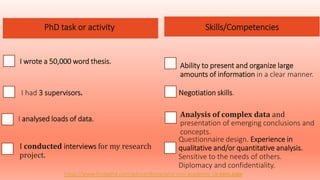
PhD task or activity
I wrote a 50,000 word thesis.
I had 3 supervisors.
I analysed loads of data.
Skills/Competencies
Ability to present and organize large
amounts of information in a clear manner.
Negotiation skills.
Analysis of complex data and
presentation of emerging conclusions and
concepts.
https://www.findaphd.com/advice/doing/phd-non-academic-careers.aspx
I conducted interviews for my research
project.
Questionnaire design. Experience in
qualitative and/or quantitative analysis.
Sensitive to the needs of others.
Diplomacy and confidentiality.
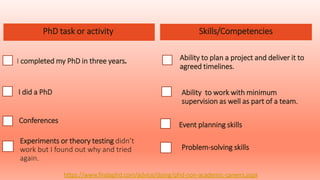
PhD task or activity
I completed my PhD in three years.
I did a PhD
Conferences
Skills/Competencies
Ability to plan a project and deliver it to
agreed timelines.
Ability to work with minimum
supervision as well as part of a team.
Event planning skills
https://www.findaphd.com/advice/doing/phd-non-academic-careers.aspx
Experiments or theory testing didn’t
work but I found out why and tried
again.
Problem-solving skills
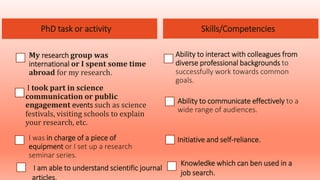
My research group was
international or I spent some time
abroad for my research.
I took part in science
communication or public
engagement events such as science
festivals, visiting schools to explain
your research, etc.
I was in charge of a piece of
equipment or I set up a research
seminar series.
Ability to interact with colleagues from
diverse professional backgrounds to
successfully work towards common
goals.
Ability to communicate effectively to a
wide range of audiences.
Initiative and self-reliance.
PhD task or activity Skills/Competencies
I am able to understand scientific journal
articles.
Knowledke which can ben used in a
job search.
TEACHING SKILLS
Designing, preparing and delivering
lectures
Facilitating small group seminars
Addressing peers at conferences
One to one tuition and coaching
Providing feedback and
assessment.
 Delivering training and lectures
Identifying training needs for
individuals and groups
Designing training interventions
involving external suppliers.
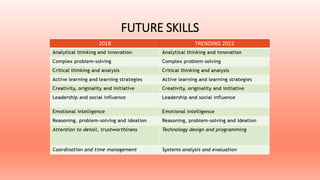
FUTURE SKILLS
2018 TRENDING 2022
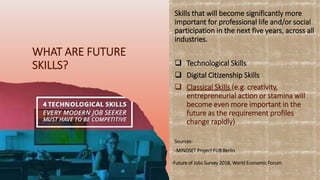
WHAT ARE FUTURE
SKILLS?
Skills that will become significantly more
important for professional life and/or social
participation in the next five years, across all
industries.
 Technological Skills
 Digital Citizenship Skills
 Classical Skills (e.g. creativity,
entrepreneurial action or stamina will
become even more important in the
future as the requirement profiles
change rapidly)
Sources:
-MINDSET Project FUB Berlin
-Future of Jobs Survey 2018, World Economic Forum
FUTURE SKILLS
Technological Skills
Digital skills that shape new professions; technological specialist
knowledge; across all industries.
FUTURE SKILLS
Digital Citizenship
Skills
Digital skills that everyone
needs in professional life and
for participation in society in
the future; this also includes
digital literacy (handling
complex amounts of data).
FUTURE SKILLS
Classical Skills
Creativity, entrepreneurial action or stamina will become even
more important in the future as the requirement profiles change
rapidly.
The Top 13 Jobs Skills Employers Want Now
• Continuous learning
• Time management
• Decision making
• Collaboration
• Emotional intelligence
• Creativity and resilience
• Adaptability
• Change Management
The Top 13 Jobs Skills Employers Want Now
• Coaching Mindset
• Project management
• Cloud computing
• Knowledge of new social and digital media
• Artificial intelligence
The Top 13 Jobs Skills Employers Want Now
About life-long learning
If you want to get ahead you need to
embrace continuous learning. By improving
your skill set, whether it's soft skills or hard
skills, you boost your chances of improving
your career trajectory.
Employers love to hear that candidates enjoy
learning because it's necessary in a business
world where change and growth are
happening at remarkable speed. Those who
don't embrace learning new things will be
left behind.
Skill Tip: check out online class platforms to
see what they have to offer in your
professional field — and don't be afraid to
branch out from that, either.
The Top 13 Jobs Skills Employers Want Now
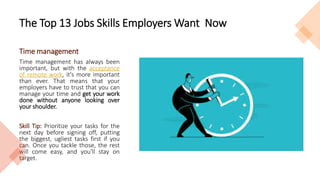
Time management
Time management has always been
important, but with the acceptance
of remote work, it's more important
than ever. That means that your
employers have to trust that you can
manage your time and get your work
done without anyone looking over
your shoulder.
Skill Tip: Prioritize your tasks for the
next day before signing off, putting
the biggest, ugliest tasks first if you
can. Once you tackle those, the rest
will come easy, and you'll stay on
target.
The Top 13 Jobs Skills Employers Want Now
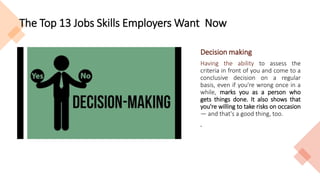
Decision making
Having the ability to assess the
criteria in front of you and come to a
conclusive decision on a regular
basis, even if you're wrong once in a
while, marks you as a person who
gets things done. It also shows that
you're willing to take risks on occasion
— and that's a good thing, too.
.
The Top 13 Jobs Skills Employers Want Now
Collaboration
• Embracing collaboration and
thinking about it proactively as you
begin projects shows hiring
managers that while you may be
working alone in your home, you're
still a team player. 4
• Skill Tip: Learn cross-functionally;
while you may not be able to do
everything, learning how and why
other teams do what they do will
help you work together with them
on any project with understanding
and patience.
The Top 13 Jobs Skills Employers Want Now
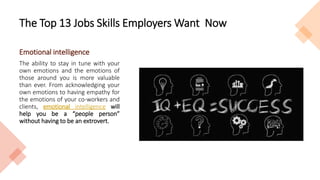
Emotional intelligence
The ability to stay in tune with your
own emotions and the emotions of
those around you is more valuable
than ever. From acknowledging your
own emotions to having empathy for
the emotions of your co-workers and
clients, emotional intelligence will
help you be a “people person”
without having to be an extrovert.
The Top 13 Jobs Skills Employers Want Now
• Creativity and resilience
Having creativity can put you in the
driver's seat for finding solutions and
new ideas that move the needle for
your company. Resilience goes hand
in hand with creativity.
Sometimes new ideas don't work
right away — or at all — and being
able to rebound from a setback with
improvements and new ideas shows
employers that you will keep their
company moving forward.
The Top 13 Jobs Skills Employers Want Now
Adaptability
Have you noticed that things are
changing faster than ever? As
technology evolves, we're finding
new ways to use it. That means the
old “We've always done it this way!”
attitude is nothing but dead weight
on your career.
You need to be adaptable to new
technology, new collaborations, and
new philosophies.
Skill Tip: find books that focus on
adaptability in the workplace.
The Top 13 Jobs Skills Employers Want Now
Change Management
Things are changing faster than ever.
Having a knack for change
management, whether that means
handling changes on your own or
helping to guide whole teams on new
directives, is a great way to make
yourself an irreplaceable part of
nearly any organization.
Skill Tip: Take a class or read a book
on emotional intelligence because a
major part of change management is
understanding how changes affect
employees on a personal level.
Having a strong understanding of EI
gives you a big leg up in succeeding.
The Top 13 Jobs Skills Employers Want Now
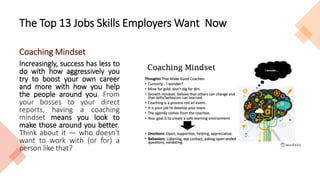
Coaching Mindset
Increasingly, success has less to
do with how aggressively you
try to boost your own career
and more with how you help
the people around you. From
your bosses to your direct
reports, having a coaching
mindset means you look to
make those around you better.
Think about it — who doesn't
want to work with (or for) a
person like that?
The Top 13 Jobs Skills Employers Want Now
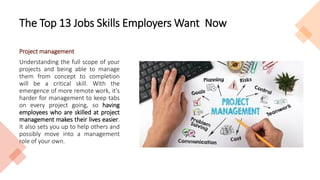
Project management
Understanding the full scope of your
projects and being able to manage
them from concept to completion
will be a critical skill. With the
emergence of more remote work, it's
harder for management to keep tabs
on every project going, so having
employees who are skilled at project
management makes their lives easier.
It also sets you up to help others and
possibly move into a management
role of your own.
The Top 13 Jobs Skills Employers Want Now
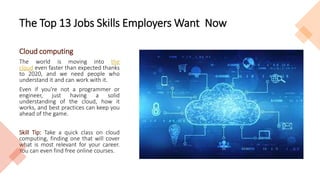
Cloud computing
The world is moving into the
cloud even faster than expected thanks
to 2020, and we need people who
understand it and can work with it.
Even if you're not a programmer or
engineer, just having a solid
understanding of the cloud, how it
works, and best practices can keep you
ahead of the game.
Skill Tip: Take a quick class on cloud
computing, finding one that will cover
what is most relevant for your career.
You can even find free online courses.
The Top 13 Jobs Skills Employers Want Now
Knowledge of new social and
digital media
Digital media is running the show these
days. If you want to compete in the job
market, you need to at least be cognizant of
what's out there, how it works, and what
kind of audience it enjoys.
Skill Tip: There are classes out there that
you can take to brush up on new media, as
well as plenty of articles detailing the
complexities of the different social and
digital media sites out there. But if you
want to save money and get right to the
heart of it, find a college-aged person and
ask them what kinds of media they use and
how they use them.
The Top 13 Jobs Skills Employers Want Now
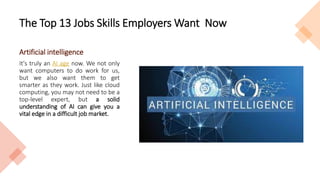
Artificial intelligence
It's truly an AI age now. We not only
want computers to do work for us,
but we also want them to get
smarter as they work. Just like cloud
computing, you may not need to be a
top-level expert, but a solid
understanding of AI can give you a
vital edge in a difficult job market.
The Top 13 Jobs Skills Employers Want Now
Now that you know some of the professional skills and
traits you will need to be successful in the new normal, it's
time to get to work. But remember, you don't just have to
boost your skills — you have to advertise them.
Update your CV to highlight these top 13 skills in 2021, and
then create a killer cover letter.
DOCPRO ABG –Association B. Grégory, Paris
An Operational Tool to Track Skills
DocPro by ABG: a very helpful tool describing the 24 core competencies developed in the course
of doctoral training and it helps:
a) Recruiters to gain better understanding of the potential afforded by doctoral training,
b) Heads of Doctoral Schools, PhD coordinators, career development facilitators at university to
better prepare PhD students for the job market.
PhD-holders, recruiters and academic advisors can speak the same language.
ABG: specialized in recruiting and career development
http://www.mydocpro.org/en/about-docpro
How soft skills improve productivity?
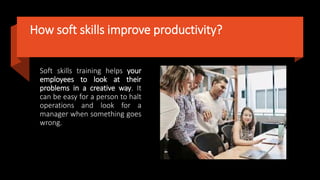
Soft skills training helps your
employees to look at their
problems in a creative way. It
can be easy for a person to halt
operations and look for a
manager when something goes
wrong.
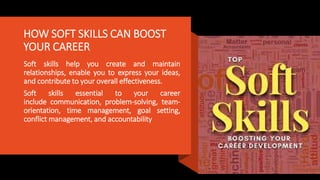
HOW SOFT SKILLS CAN BOOST
YOUR CAREER
Soft skills help you create and maintain
relationships, enable you to express your ideas,
and contribute to your overall effectiveness.
Soft skills essential to your career
include communication, problem-solving, team-
orientation, time management, goal setting,
conflict management, and accountability
How Can You
Highlight Your Soft
Skills in a Job
Search?
When you’re looking for a job,
employers want to know not only
what you can do, but how you’ll
do it and what you’ll be like as a
coworker. You can also “take a
look at LinkedIn profiles for people
who work at the company and see
what skills they have,”. Or you can
talk to people who already work in
a position or at a company you’re
interested in and ask them which
soft skills are most vital to success.
What transferable skills does a PhD have?
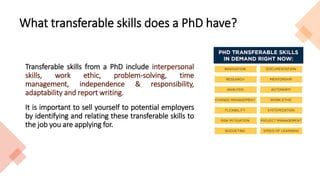
Transferable skills from a PhD include interpersonal
skills, work ethic, problem-solving, time
management, independence & responsibility,
adaptability and report writing.
It is important to sell yourself to potential employers
by identifying and relating these transferable skills to
the job you are applying for.
The investment made to gain a PhD will not be lost. A PhD can be of great benefit
for the wider community.
How Doctoral Training Responds to the Demand
of Labour Market.
Project Management
A top skill sought after by companies
Complex projects need to be well planned and efficiently
managed.
PhDs have managed research projects with limited budget
While working in an academic lab, and this can be transferred
to industry.
Team Work
An essential skill for today’s job market
It is the necessary skill to engage in productive collaboration.
While working in academic research labs, and, therefore, they can
gain experience in teamwork and collaboration.
Organizational Skills
Skills for Today’s Job Market
Candidates will often be involved in multiple projects and
it will be important to prioritize their various duties and
designate adequate timelines to each of them.
Doctoral students are able to organize their work, from their
schedule to complex projects.
Relationship Building
Skills for Today’s Job Market
Build and maintain relationship, use diplomacy, give and receive constructive
criticism, be tolerant and respectful, empathize with the others.
Those interpersonal skills help build teams with a strong foundation of trust
and accountability.
Developing an international perspective. Working with overseas colleagues is an added
value: add information on how things are done in other countries.
Emotional Intelligence/EI
A key ingredient in business environment
Emotional intelligence allows to produce positive results in difficult working environments.
Developing EI will help assess people, predict chances of a possible conflict, develop trust,
and influence decision making in a professional manner.
Entrepreneurial Skills
They ecompass a number of things: commercial awareness, prioritisation, decision
making, innovative and original thinking, strategic thinking, working independetly,
communicating professionally.
These skills are sought after by employers in need of professionals able to
come up with new ideas to improve processes.
Communication Skills
Skills for Today’s Job Market
Communication skills are essential –when on top positions- in industry:
professionals have to deliver presentations to explain new findings to decision
makers. There is high demand for those who can translate scientific information
into a message that can be understood by a broad range of both internal and
external target audiences.
Some of academic activities, such as interacting with undergraduates
through teaching, and delivering PowerPoint presentations for conferences
or graduates, will be helpful in developing the transferable skill of oral
communication.
Skills in scientific writing, developed during the PhD, will be applicable to a series
of responsibilities.
Influencing and Negotiation Skills
Two Skills directly linked to the labour market needs
In most business situations we are expected to negotiate.
PhDs are constantly using negotiation skills while convincing dissertation
committees about steps taken in a PhD research project.
They might have had to discuss the value of their research in a conference whose
audience had a different point of view.
Adaptability and Flexibility
Skills for Today’s Job Market
Employers tend to prefer candidates who are capable of improvising to
find a unique solution to existing problem.
PhDs have to adapt to new challenges. It is also likely that PhDs dealt with
multiple projects requiring different lab equipment.
Creative Problem-Solving
Skills for Today’s Job Market
Companies hire the ones who are able to quickly solve problems. Candidate must be able to
think laterally to find answers to pressing problems and formulate workable solutions.
The techniques developed through carrying out a research project and writing a thesis
enable candidates to pick up new and complex concepts quickly.
Strategic Palnning
Skills for Today’s Job Market
Ability to be strategic is very valuable, where success depends on long-
term planning and the execution of complex innovation projects.
Science PhDs have the know-how to act upon information and plan multiple
research projects based on constantly changing feedbacks.
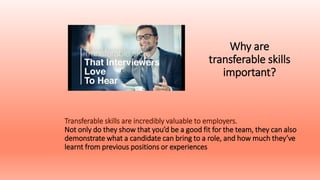
Why are
transferable skills
important?
Transferable skills are incredibly valuable to employers.
Not only do they show that you’d be a good fit for the team, they can also
demonstrate what a candidate can bring to a role, and how much they’ve
learnt from previous positions or experiences..
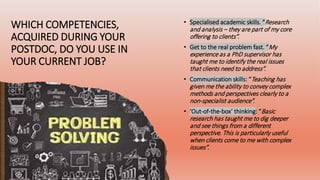
WHICH COMPETENCIES,
ACQUIRED DURING YOUR
POSTDOC, DO YOU USE IN
YOUR CURRENT JOB?
• Specialised academic skills. “Research
and analysis – they are part of my core
offering to clients”.
• Get to the real problem fast. “My
experience as a PhD supervisor has
taught me to identify the real issues
that clients need to address”.
• Communication skills: “Teaching has
given me the ability to convey complex
methods and perspectives clearly to a
non-specialist audience”.
• ‘Out-of-the-box’ thinking: “Basic
research has taught me to dig deeper
and see things from a different
perspective. This is particularly useful
when clients come to me with complex
issues”.
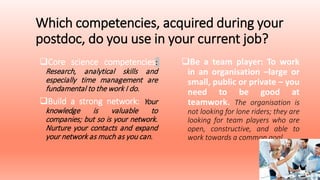
Which competencies, acquired during your
postdoc, do you use in your current job?
Core science competencies:
Research, analytical skills and
especially time management are
fundamental to the work I do.
Build a strong network: Your
knowledge is valuable to
companies; but so is your network.
Nurture your contacts and expand
your network as much as you can.
Be a team player: To work
in an organisation –large or
small, public or private – you
need to be good at
teamwork. The organisation is
not looking for lone riders; they are
looking for team players who are
open, constructive, and able to
work towards a common goal.
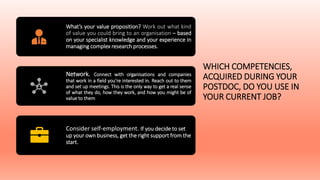
WHICH COMPETENCIES,
ACQUIRED DURING YOUR
POSTDOC, DO YOU USE IN
YOUR CURRENT JOB?
What’s your value proposition? Work out what kind
of value you could bring to an organisation – based
on your specialist knowledge and your experience in
managing complex research processes.
Network. Connect with organisations and companies
that work in a field you’re interested in. Reach out to them
and set up meetings. This is the only way to get a real sense
of what they do, how they work, and how you might be of
value to them
Consider self-employment. If you decide to set
up your own business, get the right support from the
start.
Which competencies, acquired during your
postdoc, do you use in your current job?
Time management: tight
deadlines and impromptu tasks require
flexible time resources –make sure you
can prioritize and often also delegate
tasks well.
Writing skills: Writing articles,
reviewing papers have taught you to
write clear and compelling texts.
Applying for funding: Having
applied for a number of postdoc fellowships,
you know what makes a good proposal.
Organisational skills: As a postdoc
you organized conferences, seminar series,
outreach activities, fieldwork trips, etc. These
experiences have given the confidence and
organizational skills to coordinate various types
of activities at the faculty.
m
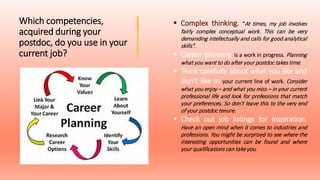
Which competencies,
acquired during your
postdoc, do you use in your
current job?
 Complex thinking. “At times, my job involves
fairly complex conceptual work. This can be very
demanding intellectually and calls for good analytical
skills”.
 Career planning is a work in progress. Planning
what you want to do after your postdoc takes time.
 Think carefully about what you like and
don’t like in your current line of work. Consider
what you enjoy – and what you miss – in your current
professional life and look for professions that match
your preferences. So don’t leave this to the very end
of your postdoc tenure.
 Check out job listings for inspiration.
Have an open mind when it comes to industries and
professions. You might be surprised to see where the
interesting opportunities can be found and where
your qualifications can take you.
Which competencies, acquired during your
postdoc, do you use in your current job?
 Core science competencies. Thinking analytically and being curious are fundamental
prerequisites to the work I do as a scientist.
 Go abroad. If you wish to stay in research, apply for a position at one of the best universities
in your field. Stay there until you have consolidated your competencies. Remember to maintain your
network whilst you’re away – for example, by returning home to give research talks and seminars.
 Work with people that are smarter than you. Learn how they think and act,
and prepare yourself for your future career –
TRANSFERABLE SKILLS
acquired in other contexts
In my military career I coordinated the
training and deployment of over 250
personnel to operations abroad.
Team leadership
Project management
Resource management
Resilience
Establishing a common vocabulary between
Doctoral Graduates and companies that could
hire them.
SKILLS ARE AT THE HEART OF THE HIRING PROCESS
A Skills-Based Approach to the Labour Market
 Degrees are often outdated by the time they are
obtained.
Rapid technological change, digitalization, raising
degrees of work complexity are transforming the
labour market.
Emergence of new kinds of jobs.
A Skills-Based Approach to the Labour Market
 Skills play an important role in private and public sectors. They are the new
«currency» for the labour market (World Economic Forum).
 Soft skills are in great demand now:
combination of personality traits, behavior and social attitudes.
A Skills-Based Approach to the
Labour Market
SOFT SKILLS
You can take them with you anywhere in the company and outside it.
Power skills, durable skills, human skills
 Creativity
 Time management
 Adaptabilty to rapid advancements in technology,
 Leadership
 Problem-solving
Those skills allow people to collaborate, communicate effectively and successfully manage
conflicts.
What Employers
are in need of
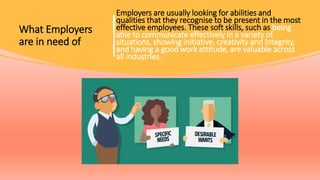
Employers are usually looking for abilities and
qualities that they recognise to be present in the most
effective employees. These soft skills, such as being
able to communicate effectively in a variety of
situations, showing initiative, creativity and integrity,
and having a good work attitude, are valuable across
all industries.
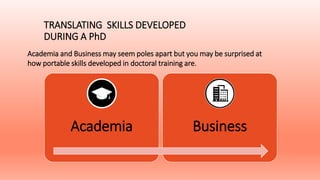
TRANSLATING SKILLS DEVELOPED
DURING A PhD
Academia Business
Academia and Business may seem poles apart but you may be surprised at
how portable skills developed in doctoral training are.
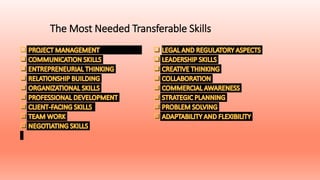
The Most Needed Transferable Skills
 Employability arises from a number of competencies.
 Employers seek for a mix of intellectual, social and
organizational skills.
The Most Needed Transferable Skills
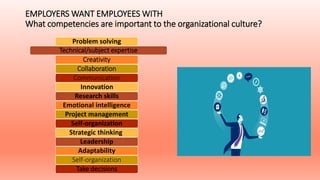
EMPLOYERS WANT EMPLOYEES WITH
What competencies are important to the organizational culture?
Problem solving
Technical/subject expertise
Creativity
Collaboration
Communication
Innovation
Research skills
Emotional intelligence
Project management
Self-organization
Strategic thinking
Leadership
Adaptability
Self-organization
Take decisions
The relevant soft skill:
Leadership
Preparing a Job Interview
Typical question:
Can you tell me about a time when you successfully led a team
through a sticky situation?
The relevant soft skill:
Organization/Time Management
Preparing a Job Interview
Typical question
How do you cope when you have too much
work on your plate?
The relevant soft skill: Problem-solving
Preparing a Job Interview
Typical question
Can you tell me about a
time when you overcame a
significant challenge?
The relevant soft skill: Communication
Preparing a Job Interview
Typical question
Can you walk me through your process of
how you’d explain a complex topic to
someone who was unfamiliar?
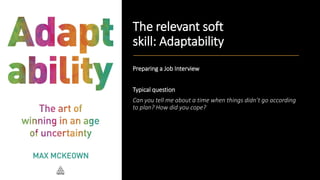
The relevant soft
skill: Adaptability
Preparing a Job Interview
Typical question
Can you tell me about a time when things didn’t go according
to plan? How did you cope?
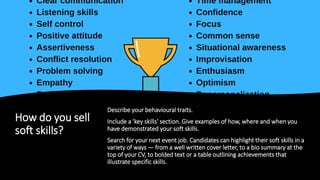
How do you sell
soft skills?
Describe your behavioural traits.
Include a 'key skills' section. Give examples of how, where and when you
have demonstrated your soft skills.
Search for your next event job. Candidates can highlight their soft skills in a
variety of ways — from a well written cover letter, to a bio summary at the
top of your CV, to bolded text or a table outlining achievements that
illustrate specific skills.
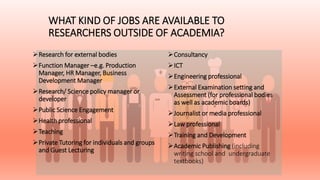
WHAT KIND OF JOBS ARE AVAILABLE TO
RESEARCHERS OUTSIDE OF ACADEMIA?
Research for external bodies
Function Manager –e.g. Production
Manager, HR Manager, Business
Development Manager
Research/ Science policy manager or
developer
Public Science Engagement
Health professional
Teaching
Private Tutoring for individuals and groups
and Guest Lecturing
Consultancy
ICT
Engineering professional
External Examination setting and
Assessment (for professional bodies
as well as academic boards)
Journalist or media professional
Law professional
Training and Development
Academic Publishing (including
writing school and undergraduate
textbooks)
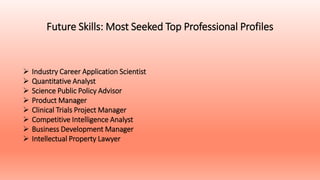
Future Skills: Most Seeked Top Professional Profiles
 Industry Career Application Scientist
 Quantitative Analyst
 Science Public Policy Advisor
 Product Manager
 Clinical Trials Project Manager
 Competitive Intelligence Analyst
 Business Development Manager
 Intellectual Property Lawyer
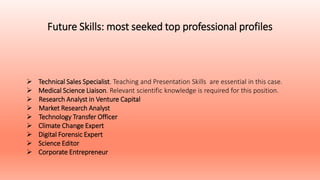
Future Skills: most seeked top professional profiles
 Technical Sales Specialist. Teaching and Presentation Skills are essential in this case.
 Medical Science Liaison. Relevant scientific knowledge is required for this position.
 Research Analyst in Venture Capital
 Market Research Analyst
 Technology Transfer Officer
 Climate Change Expert
 Digital Forensic Expert
 Science Editor
 Corporate Entrepreneur
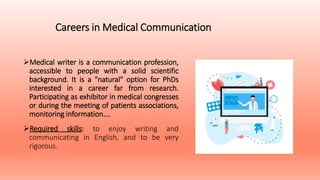
Careers in Medical Communication
Medical writer is a communication profession,
accessible to people with a solid scientific
background. It is a "natural" option for PhDs
interested in a career far from research.
Participating as exhibitor in medical congresses
or during the meeting of patients associations,
monitoring information….
Required skills: to enjoy writing and
communicating in English, and to be very
rigorous.
Original Jobs for PhDs
Alumni Project, University of Torino
Science Communication: science popularization, graphic design, event
management, communication.
Research Grant Manager: dealing with communication activities and
the design of management tools for researchers.
Science Editor: education specialists (High school textbook)
Digital Forensic Expert
Museum Manager
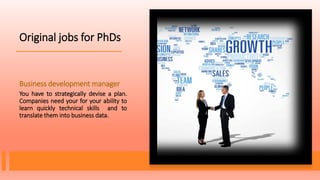
Original jobs for PhDs
Business development manager
You have to strategically devise a plan.
Companies need your for your ability to
learn quickly technical skills and to
translate them into business data.
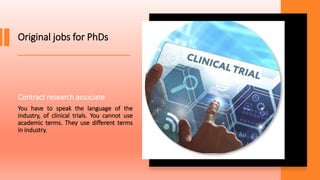
Original jobs for PhDs
Contract research associate
You have to speak the language of the
industry, of clinical trials. You cannot use
academic terms. They use different terms
in industry.
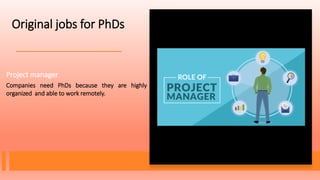
Project manager
Companies need PhDs because they are highly
organized and able to work remotely.
Original jobs for PhDs
Original Jobs for PhDs
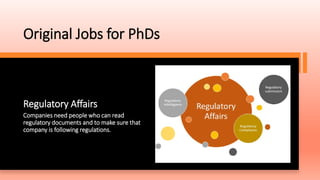
Regulatory Affairs
Companies need people who can read
regulatory documents and to make sure that
company is following regulations.
Original Jobs for
PhDs
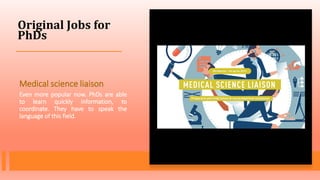
Medical science liaison
Even more popular now. PhDs are able
to learn quickly information, to
coordinate. They have to speak the
language of this field.
Original Jobs for PhDs
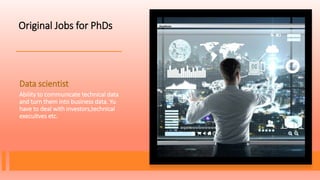
Data scientist
Ability to communicate technical data
and turn them into business data. Yu
have to deal with investors,technical
execuitves etc.
For the following jobs PhD is not
necessarily a prerequisite, but most
definitely an asset.
Communication skills
Climate change, medical care,
advanced technologies like artificial
intelligence…..
Science has very important things to
say about some of the biggest
problems society faces. Scientists
can no longer stay on the sidelines
in these important public debates.
Communication skills
Scientists need to learn to tell their own stories
because society needs their expertise, their
perspective, their evidence-based problem solving
skills for the future.
Communicating Science
Researchers are in need of the necessary
knowledge and skills to communicate their
research to the wider public.
Researchers need to know how to publish their
research in newspapers to reach non-academic
audiences and to be familiarized with social
media channels such as Twitter, which can serve
as a tool for communicating research ideas and
findings.
COMMUNICATING SCIENCE info@scilink.eu | www.scilink.eu
Communication skills
In an increasingly competitive and
global market, researchers and the
institutions they represent need to
communicate their research to an
international audience.
 Researchers need the communication
skills to enable them to publish in
international journals and present at
conferences in English; apply for funding to
national and international bodies;
communicate with a wider audience.
Communication skills
 Without the skills to do this,
researchers and research institutions
can find themselves at a competitive
disadvantage, affecting grant income,
international presence and reputation.
Communication Skills
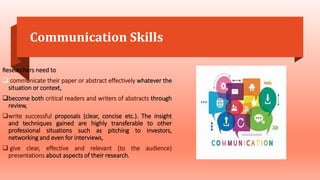
Researchers need to
 communicate their paper or abstract effectively whatever the
situation or context,
become both critical readers and writers of abstracts through
review,
write successful proposals (clear, concise etc.). The insight
and techniques gained are highly transferable to other
professional situations such as pitching to investors,
networking and even for interviews,
 give clear, effective and relevant (to the audience)
presentations about aspects of their research.
Communication skills
Often great ideas cannot be communicated because
of poor content structure, lack of confidence, and
weak vocal delivery. Articulate research to a diverse
audience is not so easy. Researchers need to deliver
their message with credibility, persuasiveness, and
impact.
The British Council has developed the Researcher Connect professional
development course. Training Packed with techniques and practical exercises
based on the very latest developments from the psychology of
communication, vocal performance, linguistic, emotional intelligence, and
successful influence strategies.
WRITING SKILLS
 Directing your research
 Introduction to research articles
 Literature reviews
 Peer reviews
PROJECT
MANAGEMENT
Managing research
with confidence
Organising your work more effectively and with
less stress to become successful leaders or
members of research projects.
Project management is an integral skill for
everyone, especially those in the research
community, whether they’re researchers or
clinicians or managing a lab.
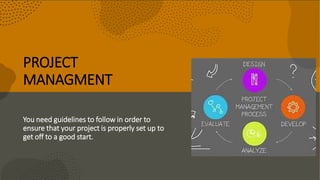
PROJECT
MANAGMENT
You need guidelines to follow in order to
ensure that your project is properly set up to
get off to a good start.
Project management tools for
researchers
Having been successful in attracting funding for your project, you will
now have to lead it from set-up to completion. The following pages take
you through the key stages:
Setting up a research project
 Monitoring a research project
Reporting on your research project
Making the most of your research project
https://www.vitae.ac.uk
PROJECT MANAGEMENT
 Project finances : you have to familiarise yourself with the
finance system and financial processes of your institution.
Make sure that you are aware of any stipulations in the
contract/offer as to what might be ineligible expenditure.
 Approvals: do make sure you allow enough time for this,
bearing in mind how frequently the relevant approvals
review board or committee meets in your organisation.
PROJECT MANAGEMENT
 Staff recruitment liaise with your Personnel or Human
Resources department, who will manage the process for you.
You are likely to be responsible for providing all the details of
the posts you are offering.
 Legal conditions: you should ensure that you review the
contract/terms and conditions of the grant before you start.
PROJECT MANAGEMENT
Monitoring a research project
 Monitoring timescales
 Monitoring finances
Periodic reports
The funders of your research, and the institution at which you are carrying out your research will
both want to be informed at regular intervals about the progress of your project.
The final report
At the end of the project you will almost certainly have to produce a final expenditure statement
and a final report. Your research office may complete the former for you, but you do have overall
responsibility for the accuracy of both reports.
Records
At the end of your project you will need to make sure that your records are complete and in order. It
is possible that your project could be subject to audit at some stage in the following few years and
having a complete set of records at this stage could save a great deal of time later.
GRANT
ACQUISITION
 Improving subsidy proposals and increasing
rate success
 Providing an overview and advice on
subsidies and grants that match the
proposed research or career profile
-General grant schemes,
-the writing life-cycle,
-writing tips, legal aspects (IP management),
-the evaluation process
SciLink https://scilink.eu/
GRANT
ACQUISITION
Learning about the principles of developing multi-
disciplinary collaborative research projects.
More and more researchers need to raise money for
their research projects. But where to find funding
bodies and how to convince them?
How to put a winning proposal together?
How to approach the preparation of a proposal
effectively? particularly focussing on collaborative
projects.
GRANT
ACQUISITION Horizon Europe, the European Union’s Framework Programme for
Research & offers a multitude of opportunities, but also poses
many challenges. The skills acquired are transferable to other
types of programmes supporting research.
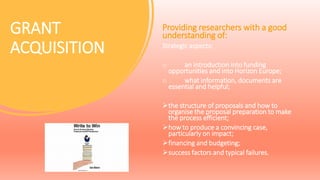
GRANT
ACQUISITION
Providing researchers with a good
understanding of:
Strategic aspects:
o an introduction into funding
opportunities and into Horizon Europe;
o what information, documents are
essential and helpful;
the structure of proposals and how to
organise the proposal preparation to make
the process efficient;
how to produce a convincing case,
particularly on impact;
financing and budgeting;
success factors and typical failures.
FUNDRAISING
for University research projects
Having a clear idea of how to make research
projects sustainable means taking a look
towards the future.
Fundraising, as a set of techniques and
approaches aimed at ensuring the sustainability
of initiatives and projects, is increasingly
assuming an important role within the corpus of
intersectional skills necessary to pursue
medium-long term objectives.
FUNDRAISING for University research projects
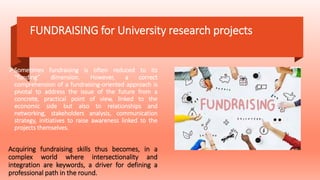
Sometimes fundraising is often reduced to its
“funding” dimension. However, a correct
comprehension of a fundraising-oriented approach is
pivotal to address the issue of the future from a
concrete, practical point of view, linked to the
economic side but also to relationships and
networking, stakeholders analysis, communication
strategy, initiatives to raise awareness linked to the
projects themselves.
Acquiring fundraising skills thus becomes, in a
complex world where intersectionality and
integration are keywords, a driver for defining a
professional path in the round.
Through in-depth study aimed at understanding:
What does fundraising mean,
which skills are required to properly fundraise,
how to identify fundraising objectives and goals,
how and where to look for donors and retain/cultivate
them,
how to set up a multi-target and multi-vehicle
fundraising campaign (including crowdfunding
initiatives),
how to define an operational plan to raise funds,
practical cases will be analyzed - also proposed by the
participants - and useful ideas will be provided for the
launch of a fundraising campaign connected to the
university world.
Example of theoretical-practical training
modules
4-hour workshop
Trainer: Simona Biancu
Engagedin https://www.engagedin.net
RESEARCH, BUSINESS,
ENTREPRENEURSHIP, AND
MANAGEMENT
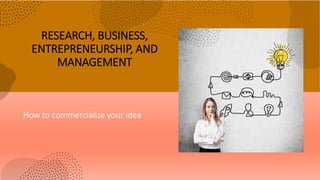
How to commercialize your idea
Entreprenuerial
capacity building
How to start and manage
an innovative business.
How to identify an
entreprenuerial idea,
make it profitable, start a
business and deliver a
successful product
Commercialize
innovation
Academia-Industry
 Understand the “noise” in the system.
 Run a divergent innovation session.
 Hold a convergent innovation session
 Build a works-like prototype.
 Develop a looks-like prototype
 Combine into a full prototype
 Start scaling.
 Conduct a soft launch.
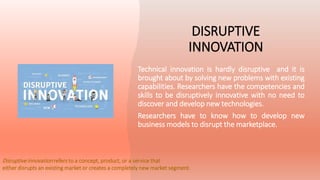
DISRUPTIVE
INNOVATION
Technical innovation is hardly disruptive and it is
brought about by solving new problems with existing
capabilities. Researchers have the competencies and
skills to be disruptively innovative with no need to
discover and develop new technologies.
Researchers have to know how to develop new
business models to disrupt the marketplace.
Disruptive innovation refers to a concept, product, or a service that
either disrupts an existing market or creates a completely new market segment.
Connecting people, ideas
and resources Good practices.
A new approach to the topic
IP&D - Innovation, Projects and
Development Ltd was established in
2003 by Dr. Isser Peer with a vision
of connecting people, ideas and
resources based on expertise in the
creation of start-ups, spin-offs, and
licensing to strategic companies,
focusing on the interface between
Academia and Industry.
Connecting people, ideas
and resources Good practices
IP&D engages in research support
and projects including Technology
Transfer and entrepreneurship,
organizing international training and
workshops, knowledge
management, IPR consultation, and
acquisition of soft skills. Recent
events IPD has implemented include
a Career Fair and Entrepreneur
Workshops in collaboration with the
Weizmann Institute of Science, and
the Technion Institute of Technology.
Connecting people, ideas
and resources
Good practices
IP&D
Dr. Isser Peer - is a Technology
Transfer and entrepreneurship
expert whose areas of expertise are
the exploitation of Intellectual
Property Rights and the creation of
start-ups, spin-offs and licensing to
strategic companies. Peer was the
CEO of BIRAD, the Technology
Transfer Company of BIU and
directed the Research Authority,
Bar-Ilan University. In 2003, Peer
founded IP&D Ltd, a private
company based in Israel, with the
vision of "Connecting People, Ideas
and Resources".
Technology transfer:
defining research commercialization
Research Commercialization
In order for university-based
knowledge to make it out of the
laboratory, individual scientist-
inventors need to take part in the
commercialization process. This
commercialization process, which is
sometimes called "academic
entrepreneurship,” can be hard for
scientists. They were trained and
socialized as scholars and usually see
themselves that way. The business
world can appear alien, daunting and
unconnected to the research world.
Research commercialization allows technology created during
research activities to be further developed into marketable
products for the benefit of the public. This is achieved
through technology transfer. Technology transfer often refers to
transferring a technology between a research laboratory and a
commercial partner, including industry, academia, and state and
local governments.
Technology is typically transferred through a license
agreement in which the university retains ownership of the
intellectual property created during research activities, while
the industrial partner obtains conditional rights to use and
develop a technology.
Intellectual property may be protected
using patents, copyrights, trademarks, and trade secrets. The
rights to an article of intellectual property may be bought,
sold, leased, rented, or transferred between parties.
Additionally, the transfer of intellectual property rights can
affect a product’s marketability.
Intellectual property is an essential component when
evaluating an invention’s commercialization potential.
To ensure that the intellectual property is appropriately
protected, researchers are highly encouraged to first disclose
their discovery to their institution’s technology transfer
office before sharing the invention with people outside the
university.
Universities are operating a so called Tech Transfer Office, but
unfortunately, they are often performing badly as people in
charge don’t have a business background and lack of passion
to help commercialize research results. They are the cause
that a lot of IP is wasted nowadays.
Promoting cooperation between industry, universities and research
institutes, connecting scientific research, education, and industry,
coupling technological innovation in the midstream and
downstream…..
Encouraging more
scientists and
researchers to
become more
entrepreneurial
Organize informal gatherings to
discuss the possibilities from
commercializing scientific
research and get scientists
comfortable with it. Bring in
representatives from established
companies to encourages
scientists to come up with a
solution to a problem and helps
them see the possibilities. Then
give the scientists time to discuss
the ideas among themselves.
Encouraging more
scientists and
researchers to
become more
entrepreneurial
Help scientists visualize how they can
contribute to commercializing an innovation
in a role that makes them comfortable and
plays to their strengths as scientists, such as
Chief Scientific Officer.
Encourage them to take risks, without fear of
failing, and to share their stories so that they
can learn from one another.
Any good scientific researcher has both the
capacity and most of the critical skills necessary
to become a good entrepreneur. What is needed
is a different outlook!
Many of the skills that researchers have are
almost directly applicable and valuable in a
start-up entreprise
The Researcher Entrepreneur
Best practices for successful technological entrepreneurship, G. Vekinis
«You, as inventor researcher, offer the
vision and the scientific and technological
foundations but the day-to-day operations
in the company will be carried out by
skilled workers, each offering their
expertise in their specific area.»
«Both good researchers take the initiative
and are good innovators. The level of
innovativeness in both worlds are the same,
but the outlook and the view point are
different: researchers prepare the inventions
which are then taken over by entrepreneurs
to turn them into valuable innovations.»
The Researcher Entreprenuer
Best practices for successuful technological entrepreneurship, G. Vekinis
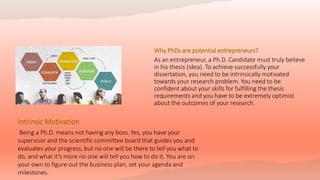
Intrinsic Motivation
Being a Ph.D. means not having any boss. Yes,
you have your supervisor and the scientific
committee board that guides you and
evaluates your progress, but no one will be
there to tell you what to do, and what it’s more
no one will tell you how to do it. You are on
your own to figure out the business plan, set
your agenda and milestones
Why PhDs are potential entrepreneurs?
As an entrepreneur, a Ph.D. Candidate must truly
believe in his thesis (idea). To achieve
successfully your dissertation, you need to be
intrinsically motivated towards your research
problem. You need to be confident about your
skills for fulfilling the thesis requirements and
you have to be extremely optimist about the
outcomes of your research.
The Researcher Entreprenuer
Why PhDs are potential entrepreneurs?
As an entrepreneur, a Ph.D. Candidate must truly believe
in his thesis (idea). To achieve successfully your
dissertation, you need to be intrinsically motivated
towards your research problem. You need to be
confident about your skills for fulfilling the thesis
requirements and you have to be extremely optimist
about the outcomes of your research.
Intrinsic Motivation
Being a Ph.D. means not having any boss. Yes, you have your
supervisor and the scientific committee board that guides you and
evaluates your progress, but no one will be there to tell you what to
do, and what it’s more no one will tell you how to do it. You are on
your own to figure out the business plan, set your agenda and
milestones.
DEVELOPING SKILLS
Professional Development
HOW TO DEVELOP NEW SKILLS
 Observing other people in a company excelling in soft skills.
 Taking on more responsibilities at work.
 Taking on-line soft skills courses.
 Extra curricular activities enable PhDs to develop their network and it is
appreciated by recruiters.
 Non professional experience enable PhDs to gain skills.
 Writing a blog demonstrates writing skills.
HOW TO DEVELOP NEW SKILLS
 Join a society could give them experiences in team work,
planning meetings, hosting seminars.
 Departmental opportunities: PhDs could be a tutor or lab
demonstrator.
 Volunteering
 Public outreach: to communicate their work to the general
public . This could include university festivals and open day
programmes.
HOW TO DEVELOP NEW SKILLS
 A chat with your university career service, or
postgrad/early career research support team.
 Networking: reach out to people who may be able to help
them, friends, mentors, supervisors or colleagues
 Planning any symposiums or events within the
department. This shows great initiative.
TEN BEST WEBSITES FOR SELF-IMPROVEMENT
COURSERA https://www.coursera.org/
KOUDETAT 40 Hours video on entrepreneurship. A must to develop your
entrepeneurial culture. Free of charge
http://www.koudetatondemand.co/
CODEACADEMY https://www.codecademy.com/
DATAMONKEY about big data http://datamonkey.pro/
HOOTSHUTTLE ACADEMY about social media marketing, social network
https://education.hootsuite.com/collections?category=courses
TEN BEST WEBSITES FOR YOUR SELF-IMPROVEMENT
KOOBER digital skills https://discover.koober.com/us
HIGHBROW 5 min. a day (computer science, psychology)
https://gohighbrow.com/
DIGITAL ACTIVE PARGOOGLE Digital Marketing
https://learndigital.withgoogle.com/ateliersnumeriques
GUIDES Crowdsourcing https://guides.co/
LIFEHACKER https://lifehacker.com/
Developing yourself as a PI
Meaningful development does take up some time and effort,
so it is really in your own interest to invest in some personal
reflection and self-analysis to get a clear idea of what your
needs and aims are.
 Reflection
Reflect on your performance and your previous
experiences and capture the learning and development that
you gain from them.
Self analysis
 identify existing knowledge, behaviour and attitudes
 identify core strengths
 evidence your abilities and identify gaps.
Developing yourself
as a PI
What next?
 Opportunity awareness: gain a wider knowledge of the
academic sector to identify, create, investigate and seize areas
for personal and professional development. Identify possible
sources of information and support within your institution
 Decision making: understand your personal priorities and
constraints (internal and external), so that each
developmental opportunity and career step can be made
following an informed decision.
 Networking: develop networks of contacts. You should be able
to define, develop and maintain a support network for advice
and information.
Developing yourself
as a PI
What next?
 Self presentation and promotion: define and promote your
own agenda. Promote your own strengths in a convincing way
 Goal setting and action planning: move your career forward in
a structured way through planning and implementing an
effective course of action, organising time effectively and
preparing contingency plans. You should be able to monitor
and evaluate progress against specific objectives.
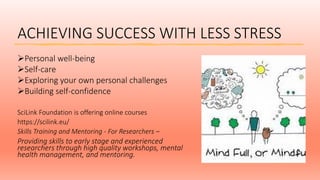
ACHIEVING SUCCESS WITH LESS STRESS
Personal well-being
Self-care
Exploring your own personal challenges
Building self-confidence
SciLink Foundation is offering online courses
https://scilink.eu/
Skills Training and Mentoring - For Researchers –
Providing skills to early stage and experienced
researchers through high quality workshops, mental
health management, and mentoring.
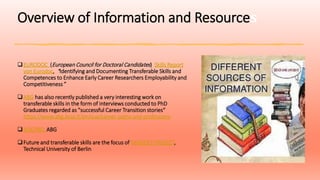
Overview of Information and Resources
EURODOC (European Council for Doctoral Candidates) Skills Report
von Eurodoc, “Identifying and Documenting Transferable Skills and
Competences to Enhance Early Career Researchers Employability and
Competitiveness”
ABG has also recently published a very interesting work on
transferable skills in the form of interviews conducted to PhD
Graduates regarded as "successful Career Transition stories“
https://www.abg.asso.fr/en/vue/career-paths-and-professions
DOCPRO, ABG
Future and transferable skills are the focus of MINDSET PROJECT,
Technical University of Berlin
Overview of Information and Resources
 EUA/CDE is regularly publishing documents on this topic.
 ADOC Talent Management, “The Core Competences of PhD” by B.
Durette, M. Fournier, M. Lafon
 OECD, Transferable Skills Training for Researchers
 VITAE UK provides relevant information on this topic
Vitae Research Development Framework
 “The Researcher Entreprenuer. Best practices for successful technological
entrepreneurship” by George Vekinis.
 Cheeky Scientist Association
Overview of Information and Resources
Why is it not a 'failure' to leave academia ?
 Why is it not a 'failure' to leave academia ? https://www.nature.com/articles/d41586-018-05838-y
 PhD Competencies and Employment Trends in Canada
https://static.wixstatic.com/ugd/c19fb8_4778cc1555784d3a965195ba18de8b73.pdf
 How to Improve your CV while on your PhD https://phdlife.warwick.ac.uk/2016/01/13/how-to-improve-
your-cv-while-on-your-phd/
 Ten Career Paths for PhDs jobs.ak.uk
 MY MOOC PhD Dooc , annual MOOC on transferable skills, career development for PhDs
Overview of Information and Resources
Why is it not a 'failure' to leave academia ?
Researching Career Solutions https://www.insidehighered.com/advice/2016/05/09/applying-
research-skills-explore-careers-essay
How to Write a PhD Elevator Pitch https://academicpositions.be/career-advice/how-to-write-
an-elevator-pitch
How to Write a CV for Roles outside Academia https://www.imperial.ac.uk/media/imperial-
college/administration-and-support-services/careers-
service/public/resources/handouts/series/How-to-write-a-CV-for-roles-outside-academia-
no-cropmarks.pdf
Why Are PhDs Potential Entreprenuers? https://medium.com/@mangelferrero/why-phds-
are-potential-entrepreneurs-df3dec2c544c
Supporting the professional
development of reaserchers
 EURAXESS https://euraxess.ec.europa.eu/
VITAE UK Making the most of your resaerch project
https://www.vitae.ac.uk/doing-research/leadership-
development-for-principal-investigators-pis/leading-a-
research-project/managing-a-research-project/making-the-
most-of-your-research-projectg
 SciLink For Reasearchers. By Researchers
https://scilink.eu/
 Association Bernard Grégory ABG www.abg.asso.fr.
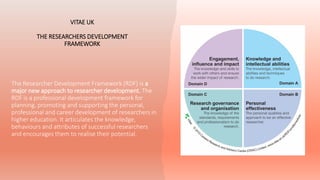
VITAE UK
THE RESEARCHERS DEVELOPMENT
FRAMEWORK
The Researcher Development Framework (RDF) is a
major new approach to researcher development. The
RDF is a professional development framework for
planning, promoting and supporting the personal,
professional and career development of researchers in
higher education. It articulates the knowledge,
behaviours and attributes of successful researchers
and encourages them to realise their potential.
Lucia Salto
Research Dep., University of Turin
Career Development Faciliator for PhDs
lucia.salto@unito.it dottori.phd@unito.it

virtual-semina r-transferable-skills.pdf

  • 1.
    The importance ofsoft skills in professional life Euraxess 30th November 2021
  • 2.
    Webinar presentation • You'llsee exactly what is meant by soft skills and then you'll find out what skills employers most want. • This will help you focus on improving your own skills in those areas, giving you the edge in the job market. • You'll discover that you probably have a great many more transferable skills than you realize – you are using them all the time, but because they are second nature, you don't consider them to be valuable. • You will also identify a list of skills you have gained from different areas of your life.
  • 3.
    Webinar presentation 4 CareerTransition Stories that will inspire you These Career Transition stories will help you explore the different career paths available to you.
  • 4.
    Hard and SoftSkills According to researches conducted in Harvard and Stanford Universities only 15% of your career success is provided by your hard skills, whilst other 85% by so called soft skills. “Soft skills get little respect but will make or break your career” (Peggy Klaus). It's often said that hard skills will get you an interview but you need soft skills to get – and keep – the job. Unlike hard skills, which comprise a person's technical skill set and ability to perform certain functional tasks, soft skills are interpersonal and broadly applicable across job titles.
  • 5.
    What are softskills? Soft skills are abilities that relate to how you work and how you interact with other people. Popular soft skills include communication, teamwork and other interpersonal skills. Employers look for soft skills in candidates because these skills are hard to teach and are important for long-term success. Soft skills are different from hard skills, which are technical and job-specific. Other names for soft skills: personal skills, interpersonal skills, non- technical skills, essential skills, transferable skills.
  • 6.
  • 8.
    Soft Skills/People Skills complementinghard skills “Soft Skills” correlates with some terms of a very close meaning: “Life Skills”, “Emotional Intelligence Quotients”, “Social Skills”, and “Interpersonal Skills”. Soft skills is a term often associated with a person's Emotional Intelligence Quotient, the cluster of personality traits, social graces, communication, language, personal habits, friendliness, managing people, leadership, etc. that characterize relationships with other people. Soft skills, also known as people skills, complement hard skills to enhance an individual's relationships, job performance and career prospects.
  • 9.
    Soft Skills/Interpersonal Skillsfacilitate interaction and communication with others. Soft skills/interpersonal skills are the skills a person uses to communicate and interact with others. They include persuasion, active listening, delegation, and leadership. Interpersonal skills are how people relate to one another. The term “interpersonal skills” is used often in business contexts to refer to the measure of a person's ability to operate within business organizations through social communication and interactions.
  • 10.
    Soft Skills enableindividuals to deal effectively with the demands and challenges of everyday life. These skills are also defined by abilities that can be practiced, such as leadership, empathy, communication and sociability. Soft skills could be defined as life skills which are behaviors used appropriately and responsibly in the management of personal affairs. They represent the psycho-social skills that determine valued behavior and include reflective skills such as problem-solving and critical thinking, to personal skills such as self-awareness, and to interpersonal skills.
  • 11.
    Webinar presentation TRANSFERABLE SKILLS Afocus on:  Communication  Project Management  Grant Acquisition and Fundraising How to commercialize your idea
  • 12.
    The nature ofresearchers’ work in the 21st century  In Academia and the corporate sector, researchers need to be capable communicators, experts in project and research management as well as grant acquisition.  They have to be able to commercialize their idea and manage stressful steps in their research.
  • 13.
    Researchers needs nowa robust transferable skills set.
  • 14.
    PhD: an Academic andProfessional Experience Repackage the PhD: think it in terms of transferable skills developed in doctoral training. The pool of skills -core competencies- shared by the majority of PhDs regardless of their discipline can be used in many contexts and helps them build a competitive professional profile.
  • 15.
    PhD: an academic andprofessional experience The PhD is the highest level of University education awarded following the conduct of an original research project of at least 3 years, the writing of a thesis and its defence in front of a jury of experts. It constitutes a professional experience.
  • 16.
     The potentialof a PhD is often poorly understood by employers and PhDs themselves.  To increase the employability of doctoral graduates it is vital to raise awareness of doctoral skills among doctoral graduates and employers.
  • 17.
    TRANSFERABLE SKILLS a deeperinsight Benefits of a PhD
  • 18.
    TRANSFERABLE SKILLS Competencies acquiredby Early Reserchers during their doctoral training and not necessarily related to research. Transferable skills are any skills that you have learned in one place that can be used in another. Transferable skills can be acquired in different contexts: holding lectures, supervising students, running workshop, family, social intercations, hobbies, volunteer work.
  • 19.
    PhDs are invisibleto employers, but they need PhD because of their  Ability to do research (collect and gather information)  Information processing  Ability to innovate, to be creative
  • 20.
    PhD task oractivity I wrote a 50,000 word thesis. I had 3 supervisors. I analysed loads of data. Skills/Competencies Ability to present and organize large amounts of information in a clear manner. Negotiation skills. Analysis of complex data and presentation of emerging conclusions and concepts. https://www.findaphd.com/advice/doing/phd-non-academic-careers.aspx I conducted interviews for my research project. Questionnaire design. Experience in qualitative and/or quantitative analysis. Sensitive to the needs of others. Diplomacy and confidentiality.
  • 21.
    PhD task oractivity I completed my PhD in three years. I did a PhD Conferences Skills/Competencies Ability to plan a project and deliver it to agreed timelines. Ability to work with minimum supervision as well as part of a team. Event planning skills https://www.findaphd.com/advice/doing/phd-non-academic-careers.aspx Experiments or theory testing didn’t work but I found out why and tried again. Problem-solving skills
  • 22.
    My research groupwas international or I spent some time abroad for my research. I took part in science communication or public engagement events such as science festivals, visiting schools to explain your research, etc. I was in charge of a piece of equipment or I set up a research seminar series. Ability to interact with colleagues from diverse professional backgrounds to successfully work towards common goals. Ability to communicate effectively to a wide range of audiences. Initiative and self-reliance. PhD task or activity Skills/Competencies I am able to understand scientific journal articles. Knowledke which can ben used in a job search.
  • 23.
    TEACHING SKILLS Designing, preparingand delivering lectures Facilitating small group seminars Addressing peers at conferences One to one tuition and coaching Providing feedback and assessment.  Delivering training and lectures Identifying training needs for individuals and groups Designing training interventions involving external suppliers.
  • 24.
  • 25.
    WHAT ARE FUTURE SKILLS? Skillsthat will become significantly more important for professional life and/or social participation in the next five years, across all industries.  Technological Skills  Digital Citizenship Skills  Classical Skills (e.g. creativity, entrepreneurial action or stamina will become even more important in the future as the requirement profiles change rapidly) Sources: -MINDSET Project FUB Berlin -Future of Jobs Survey 2018, World Economic Forum
  • 26.
    FUTURE SKILLS Technological Skills Digitalskills that shape new professions; technological specialist knowledge; across all industries.
  • 27.
    FUTURE SKILLS Digital Citizenship Skills Digitalskills that everyone needs in professional life and for participation in society in the future; this also includes digital literacy (handling complex amounts of data).
  • 28.
    FUTURE SKILLS Classical Skills Creativity,entrepreneurial action or stamina will become even more important in the future as the requirement profiles change rapidly.
  • 29.
    The Top 13Jobs Skills Employers Want Now • Continuous learning • Time management • Decision making • Collaboration • Emotional intelligence • Creativity and resilience • Adaptability • Change Management
  • 30.
    The Top 13Jobs Skills Employers Want Now • Coaching Mindset • Project management • Cloud computing • Knowledge of new social and digital media • Artificial intelligence
  • 31.
    The Top 13Jobs Skills Employers Want Now About life-long learning If you want to get ahead you need to embrace continuous learning. By improving your skill set, whether it's soft skills or hard skills, you boost your chances of improving your career trajectory. Employers love to hear that candidates enjoy learning because it's necessary in a business world where change and growth are happening at remarkable speed. Those who don't embrace learning new things will be left behind. Skill Tip: check out online class platforms to see what they have to offer in your professional field — and don't be afraid to branch out from that, either.
  • 32.
    The Top 13Jobs Skills Employers Want Now Time management Time management has always been important, but with the acceptance of remote work, it's more important than ever. That means that your employers have to trust that you can manage your time and get your work done without anyone looking over your shoulder. Skill Tip: Prioritize your tasks for the next day before signing off, putting the biggest, ugliest tasks first if you can. Once you tackle those, the rest will come easy, and you'll stay on target.
  • 33.
    The Top 13Jobs Skills Employers Want Now Decision making Having the ability to assess the criteria in front of you and come to a conclusive decision on a regular basis, even if you're wrong once in a while, marks you as a person who gets things done. It also shows that you're willing to take risks on occasion — and that's a good thing, too. .
  • 34.
    The Top 13Jobs Skills Employers Want Now Collaboration • Embracing collaboration and thinking about it proactively as you begin projects shows hiring managers that while you may be working alone in your home, you're still a team player. 4 • Skill Tip: Learn cross-functionally; while you may not be able to do everything, learning how and why other teams do what they do will help you work together with them on any project with understanding and patience.
  • 35.
    The Top 13Jobs Skills Employers Want Now Emotional intelligence The ability to stay in tune with your own emotions and the emotions of those around you is more valuable than ever. From acknowledging your own emotions to having empathy for the emotions of your co-workers and clients, emotional intelligence will help you be a “people person” without having to be an extrovert.
  • 36.
    The Top 13Jobs Skills Employers Want Now • Creativity and resilience Having creativity can put you in the driver's seat for finding solutions and new ideas that move the needle for your company. Resilience goes hand in hand with creativity. Sometimes new ideas don't work right away — or at all — and being able to rebound from a setback with improvements and new ideas shows employers that you will keep their company moving forward.
  • 37.
    The Top 13Jobs Skills Employers Want Now Adaptability Have you noticed that things are changing faster than ever? As technology evolves, we're finding new ways to use it. That means the old “We've always done it this way!” attitude is nothing but dead weight on your career. You need to be adaptable to new technology, new collaborations, and new philosophies. Skill Tip: find books that focus on adaptability in the workplace.
  • 38.
    The Top 13Jobs Skills Employers Want Now Change Management Things are changing faster than ever. Having a knack for change management, whether that means handling changes on your own or helping to guide whole teams on new directives, is a great way to make yourself an irreplaceable part of nearly any organization. Skill Tip: Take a class or read a book on emotional intelligence because a major part of change management is understanding how changes affect employees on a personal level. Having a strong understanding of EI gives you a big leg up in succeeding.
  • 39.
    The Top 13Jobs Skills Employers Want Now Coaching Mindset Increasingly, success has less to do with how aggressively you try to boost your own career and more with how you help the people around you. From your bosses to your direct reports, having a coaching mindset means you look to make those around you better. Think about it — who doesn't want to work with (or for) a person like that?
  • 40.
    The Top 13Jobs Skills Employers Want Now Project management Understanding the full scope of your projects and being able to manage them from concept to completion will be a critical skill. With the emergence of more remote work, it's harder for management to keep tabs on every project going, so having employees who are skilled at project management makes their lives easier. It also sets you up to help others and possibly move into a management role of your own.
  • 41.
    The Top 13Jobs Skills Employers Want Now Cloud computing The world is moving into the cloud even faster than expected thanks to 2020, and we need people who understand it and can work with it. Even if you're not a programmer or engineer, just having a solid understanding of the cloud, how it works, and best practices can keep you ahead of the game. Skill Tip: Take a quick class on cloud computing, finding one that will cover what is most relevant for your career. You can even find free online courses.
  • 42.
    The Top 13Jobs Skills Employers Want Now Knowledge of new social and digital media Digital media is running the show these days. If you want to compete in the job market, you need to at least be cognizant of what's out there, how it works, and what kind of audience it enjoys. Skill Tip: There are classes out there that you can take to brush up on new media, as well as plenty of articles detailing the complexities of the different social and digital media sites out there. But if you want to save money and get right to the heart of it, find a college-aged person and ask them what kinds of media they use and how they use them.
  • 43.
    The Top 13Jobs Skills Employers Want Now Artificial intelligence It's truly an AI age now. We not only want computers to do work for us, but we also want them to get smarter as they work. Just like cloud computing, you may not need to be a top-level expert, but a solid understanding of AI can give you a vital edge in a difficult job market.
  • 44.
    The Top 13Jobs Skills Employers Want Now Now that you know some of the professional skills and traits you will need to be successful in the new normal, it's time to get to work. But remember, you don't just have to boost your skills — you have to advertise them. Update your CV to highlight these top 13 skills in 2021, and then create a killer cover letter.
  • 45.
    DOCPRO ABG –AssociationB. Grégory, Paris An Operational Tool to Track Skills DocPro by ABG: a very helpful tool describing the 24 core competencies developed in the course of doctoral training and it helps: a) Recruiters to gain better understanding of the potential afforded by doctoral training, b) Heads of Doctoral Schools, PhD coordinators, career development facilitators at university to better prepare PhD students for the job market. PhD-holders, recruiters and academic advisors can speak the same language. ABG: specialized in recruiting and career development http://www.mydocpro.org/en/about-docpro
  • 46.
    How soft skillsimprove productivity? Soft skills training helps your employees to look at their problems in a creative way. It can be easy for a person to halt operations and look for a manager when something goes wrong.
  • 47.
    HOW SOFT SKILLSCAN BOOST YOUR CAREER Soft skills help you create and maintain relationships, enable you to express your ideas, and contribute to your overall effectiveness. Soft skills essential to your career include communication, problem-solving, team- orientation, time management, goal setting, conflict management, and accountability
  • 48.
    How Can You HighlightYour Soft Skills in a Job Search? When you’re looking for a job, employers want to know not only what you can do, but how you’ll do it and what you’ll be like as a coworker. You can also “take a look at LinkedIn profiles for people who work at the company and see what skills they have,”. Or you can talk to people who already work in a position or at a company you’re interested in and ask them which soft skills are most vital to success.
  • 49.
    What transferable skillsdoes a PhD have? Transferable skills from a PhD include interpersonal skills, work ethic, problem-solving, time management, independence & responsibility, adaptability and report writing. It is important to sell yourself to potential employers by identifying and relating these transferable skills to the job you are applying for.
  • 50.
    The investment madeto gain a PhD will not be lost. A PhD can be of great benefit for the wider community. How Doctoral Training Responds to the Demand of Labour Market.
  • 51.
    Project Management A topskill sought after by companies Complex projects need to be well planned and efficiently managed. PhDs have managed research projects with limited budget While working in an academic lab, and this can be transferred to industry.
  • 52.
    Team Work An essentialskill for today’s job market It is the necessary skill to engage in productive collaboration. While working in academic research labs, and, therefore, they can gain experience in teamwork and collaboration.
  • 53.
    Organizational Skills Skills forToday’s Job Market Candidates will often be involved in multiple projects and it will be important to prioritize their various duties and designate adequate timelines to each of them. Doctoral students are able to organize their work, from their schedule to complex projects.
  • 54.
    Relationship Building Skills forToday’s Job Market Build and maintain relationship, use diplomacy, give and receive constructive criticism, be tolerant and respectful, empathize with the others. Those interpersonal skills help build teams with a strong foundation of trust and accountability. Developing an international perspective. Working with overseas colleagues is an added value: add information on how things are done in other countries.
  • 55.
    Emotional Intelligence/EI A keyingredient in business environment Emotional intelligence allows to produce positive results in difficult working environments. Developing EI will help assess people, predict chances of a possible conflict, develop trust, and influence decision making in a professional manner.
  • 56.
    Entrepreneurial Skills They ecompassa number of things: commercial awareness, prioritisation, decision making, innovative and original thinking, strategic thinking, working independetly, communicating professionally. These skills are sought after by employers in need of professionals able to come up with new ideas to improve processes.
  • 57.
    Communication Skills Skills forToday’s Job Market Communication skills are essential –when on top positions- in industry: professionals have to deliver presentations to explain new findings to decision makers. There is high demand for those who can translate scientific information into a message that can be understood by a broad range of both internal and external target audiences. Some of academic activities, such as interacting with undergraduates through teaching, and delivering PowerPoint presentations for conferences or graduates, will be helpful in developing the transferable skill of oral communication. Skills in scientific writing, developed during the PhD, will be applicable to a series of responsibilities.
  • 58.
    Influencing and NegotiationSkills Two Skills directly linked to the labour market needs In most business situations we are expected to negotiate. PhDs are constantly using negotiation skills while convincing dissertation committees about steps taken in a PhD research project. They might have had to discuss the value of their research in a conference whose audience had a different point of view.
  • 59.
    Adaptability and Flexibility Skillsfor Today’s Job Market Employers tend to prefer candidates who are capable of improvising to find a unique solution to existing problem. PhDs have to adapt to new challenges. It is also likely that PhDs dealt with multiple projects requiring different lab equipment.
  • 60.
    Creative Problem-Solving Skills forToday’s Job Market Companies hire the ones who are able to quickly solve problems. Candidate must be able to think laterally to find answers to pressing problems and formulate workable solutions. The techniques developed through carrying out a research project and writing a thesis enable candidates to pick up new and complex concepts quickly.
  • 61.
    Strategic Palnning Skills forToday’s Job Market Ability to be strategic is very valuable, where success depends on long- term planning and the execution of complex innovation projects. Science PhDs have the know-how to act upon information and plan multiple research projects based on constantly changing feedbacks.
  • 62.
    Why are transferable skills important? Transferableskills are incredibly valuable to employers. Not only do they show that you’d be a good fit for the team, they can also demonstrate what a candidate can bring to a role, and how much they’ve learnt from previous positions or experiences..
  • 63.
    WHICH COMPETENCIES, ACQUIRED DURINGYOUR POSTDOC, DO YOU USE IN YOUR CURRENT JOB? • Specialised academic skills. “Research and analysis – they are part of my core offering to clients”. • Get to the real problem fast. “My experience as a PhD supervisor has taught me to identify the real issues that clients need to address”. • Communication skills: “Teaching has given me the ability to convey complex methods and perspectives clearly to a non-specialist audience”. • ‘Out-of-the-box’ thinking: “Basic research has taught me to dig deeper and see things from a different perspective. This is particularly useful when clients come to me with complex issues”.
  • 64.
    Which competencies, acquiredduring your postdoc, do you use in your current job? Core science competencies: Research, analytical skills and especially time management are fundamental to the work I do. Build a strong network: Your knowledge is valuable to companies; but so is your network. Nurture your contacts and expand your network as much as you can. Be a team player: To work in an organisation –large or small, public or private – you need to be good at teamwork. The organisation is not looking for lone riders; they are looking for team players who are open, constructive, and able to work towards a common goal.
  • 65.
    WHICH COMPETENCIES, ACQUIRED DURINGYOUR POSTDOC, DO YOU USE IN YOUR CURRENT JOB? What’s your value proposition? Work out what kind of value you could bring to an organisation – based on your specialist knowledge and your experience in managing complex research processes. Network. Connect with organisations and companies that work in a field you’re interested in. Reach out to them and set up meetings. This is the only way to get a real sense of what they do, how they work, and how you might be of value to them Consider self-employment. If you decide to set up your own business, get the right support from the start.
  • 66.
    Which competencies, acquiredduring your postdoc, do you use in your current job? Time management: tight deadlines and impromptu tasks require flexible time resources –make sure you can prioritize and often also delegate tasks well. Writing skills: Writing articles, reviewing papers have taught you to write clear and compelling texts. Applying for funding: Having applied for a number of postdoc fellowships, you know what makes a good proposal. Organisational skills: As a postdoc you organized conferences, seminar series, outreach activities, fieldwork trips, etc. These experiences have given the confidence and organizational skills to coordinate various types of activities at the faculty. m
  • 67.
    Which competencies, acquired duringyour postdoc, do you use in your current job?  Complex thinking. “At times, my job involves fairly complex conceptual work. This can be very demanding intellectually and calls for good analytical skills”.  Career planning is a work in progress. Planning what you want to do after your postdoc takes time.  Think carefully about what you like and don’t like in your current line of work. Consider what you enjoy – and what you miss – in your current professional life and look for professions that match your preferences. So don’t leave this to the very end of your postdoc tenure.  Check out job listings for inspiration. Have an open mind when it comes to industries and professions. You might be surprised to see where the interesting opportunities can be found and where your qualifications can take you.
  • 68.
    Which competencies, acquiredduring your postdoc, do you use in your current job?  Core science competencies. Thinking analytically and being curious are fundamental prerequisites to the work I do as a scientist.  Go abroad. If you wish to stay in research, apply for a position at one of the best universities in your field. Stay there until you have consolidated your competencies. Remember to maintain your network whilst you’re away – for example, by returning home to give research talks and seminars.  Work with people that are smarter than you. Learn how they think and act, and prepare yourself for your future career –
  • 69.
    TRANSFERABLE SKILLS acquired inother contexts In my military career I coordinated the training and deployment of over 250 personnel to operations abroad. Team leadership Project management Resource management Resilience
  • 70.
    Establishing a commonvocabulary between Doctoral Graduates and companies that could hire them. SKILLS ARE AT THE HEART OF THE HIRING PROCESS
  • 71.
    A Skills-Based Approachto the Labour Market  Degrees are often outdated by the time they are obtained. Rapid technological change, digitalization, raising degrees of work complexity are transforming the labour market. Emergence of new kinds of jobs.
  • 72.
    A Skills-Based Approachto the Labour Market  Skills play an important role in private and public sectors. They are the new «currency» for the labour market (World Economic Forum).  Soft skills are in great demand now: combination of personality traits, behavior and social attitudes.
  • 73.
    A Skills-Based Approachto the Labour Market SOFT SKILLS You can take them with you anywhere in the company and outside it. Power skills, durable skills, human skills  Creativity  Time management  Adaptabilty to rapid advancements in technology,  Leadership  Problem-solving Those skills allow people to collaborate, communicate effectively and successfully manage conflicts.
  • 74.
    What Employers are inneed of Employers are usually looking for abilities and qualities that they recognise to be present in the most effective employees. These soft skills, such as being able to communicate effectively in a variety of situations, showing initiative, creativity and integrity, and having a good work attitude, are valuable across all industries.
  • 75.
    TRANSLATING SKILLS DEVELOPED DURINGA PhD Academia Business Academia and Business may seem poles apart but you may be surprised at how portable skills developed in doctoral training are.
  • 76.
    The Most NeededTransferable Skills  Employability arises from a number of competencies.  Employers seek for a mix of intellectual, social and organizational skills.
  • 77.
    The Most NeededTransferable Skills
  • 78.
    EMPLOYERS WANT EMPLOYEESWITH What competencies are important to the organizational culture? Problem solving Technical/subject expertise Creativity Collaboration Communication Innovation Research skills Emotional intelligence Project management Self-organization Strategic thinking Leadership Adaptability Self-organization Take decisions
  • 79.
    The relevant softskill: Leadership Preparing a Job Interview Typical question: Can you tell me about a time when you successfully led a team through a sticky situation?
  • 80.
    The relevant softskill: Organization/Time Management Preparing a Job Interview Typical question How do you cope when you have too much work on your plate?
  • 81.
    The relevant softskill: Problem-solving Preparing a Job Interview Typical question Can you tell me about a time when you overcame a significant challenge?
  • 82.
    The relevant softskill: Communication Preparing a Job Interview Typical question Can you walk me through your process of how you’d explain a complex topic to someone who was unfamiliar?
  • 83.
    The relevant soft skill:Adaptability Preparing a Job Interview Typical question Can you tell me about a time when things didn’t go according to plan? How did you cope?
  • 84.
    How do yousell soft skills? Describe your behavioural traits. Include a 'key skills' section. Give examples of how, where and when you have demonstrated your soft skills. Search for your next event job. Candidates can highlight their soft skills in a variety of ways — from a well written cover letter, to a bio summary at the top of your CV, to bolded text or a table outlining achievements that illustrate specific skills.
  • 85.
    WHAT KIND OFJOBS ARE AVAILABLE TO RESEARCHERS OUTSIDE OF ACADEMIA? Research for external bodies Function Manager –e.g. Production Manager, HR Manager, Business Development Manager Research/ Science policy manager or developer Public Science Engagement Health professional Teaching Private Tutoring for individuals and groups and Guest Lecturing Consultancy ICT Engineering professional External Examination setting and Assessment (for professional bodies as well as academic boards) Journalist or media professional Law professional Training and Development Academic Publishing (including writing school and undergraduate textbooks)
  • 86.
    Future Skills: MostSeeked Top Professional Profiles  Industry Career Application Scientist  Quantitative Analyst  Science Public Policy Advisor  Product Manager  Clinical Trials Project Manager  Competitive Intelligence Analyst  Business Development Manager  Intellectual Property Lawyer
  • 87.
    Future Skills: mostseeked top professional profiles  Technical Sales Specialist. Teaching and Presentation Skills are essential in this case.  Medical Science Liaison. Relevant scientific knowledge is required for this position.  Research Analyst in Venture Capital  Market Research Analyst  Technology Transfer Officer  Climate Change Expert  Digital Forensic Expert  Science Editor  Corporate Entrepreneur
  • 88.
    Careers in MedicalCommunication Medical writer is a communication profession, accessible to people with a solid scientific background. It is a "natural" option for PhDs interested in a career far from research. Participating as exhibitor in medical congresses or during the meeting of patients associations, monitoring information…. Required skills: to enjoy writing and communicating in English, and to be very rigorous.
  • 89.
    Original Jobs forPhDs Alumni Project, University of Torino Science Communication: science popularization, graphic design, event management, communication. Research Grant Manager: dealing with communication activities and the design of management tools for researchers. Science Editor: education specialists (High school textbook) Digital Forensic Expert Museum Manager
  • 90.
    Original jobs forPhDs Business development manager You have to strategically devise a plan. Companies need your for your ability to learn quickly technical skills and to translate them into business data.
  • 91.
    Original jobs forPhDs Contract research associate You have to speak the language of the industry, of clinical trials. You cannot use academic terms. They use different terms in industry.
  • 92.
    Project manager Companies needPhDs because they are highly organized and able to work remotely. Original jobs for PhDs
  • 93.
    Original Jobs forPhDs Regulatory Affairs Companies need people who can read regulatory documents and to make sure that company is following regulations.
  • 94.
    Original Jobs for PhDs Medicalscience liaison Even more popular now. PhDs are able to learn quickly information, to coordinate. They have to speak the language of this field.
  • 95.
    Original Jobs forPhDs Data scientist Ability to communicate technical data and turn them into business data. Yu have to deal with investors,technical execuitves etc.
  • 96.
    For the followingjobs PhD is not necessarily a prerequisite, but most definitely an asset.
  • 97.
    Communication skills Climate change,medical care, advanced technologies like artificial intelligence….. Science has very important things to say about some of the biggest problems society faces. Scientists can no longer stay on the sidelines in these important public debates.
  • 98.
    Communication skills Scientists needto learn to tell their own stories because society needs their expertise, their perspective, their evidence-based problem solving skills for the future.
  • 99.
    Communicating Science Researchers arein need of the necessary knowledge and skills to communicate their research to the wider public. Researchers need to know how to publish their research in newspapers to reach non-academic audiences and to be familiarized with social media channels such as Twitter, which can serve as a tool for communicating research ideas and findings. COMMUNICATING SCIENCE info@scilink.eu | www.scilink.eu
  • 100.
    Communication skills In anincreasingly competitive and global market, researchers and the institutions they represent need to communicate their research to an international audience.  Researchers need the communication skills to enable them to publish in international journals and present at conferences in English; apply for funding to national and international bodies; communicate with a wider audience.
  • 101.
    Communication skills  Withoutthe skills to do this, researchers and research institutions can find themselves at a competitive disadvantage, affecting grant income, international presence and reputation.
  • 102.
    Communication Skills Researchers needto  communicate their paper or abstract effectively whatever the situation or context, become both critical readers and writers of abstracts through review, write successful proposals (clear, concise etc.). The insight and techniques gained are highly transferable to other professional situations such as pitching to investors, networking and even for interviews,  give clear, effective and relevant (to the audience) presentations about aspects of their research.
  • 103.
    Communication skills Often greatideas cannot be communicated because of poor content structure, lack of confidence, and weak vocal delivery. Articulate research to a diverse audience is not so easy. Researchers need to deliver their message with credibility, persuasiveness, and impact. The British Council has developed the Researcher Connect professional development course. Training Packed with techniques and practical exercises based on the very latest developments from the psychology of communication, vocal performance, linguistic, emotional intelligence, and successful influence strategies.
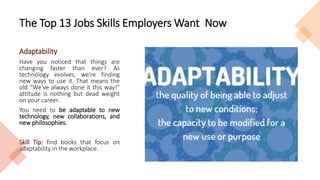
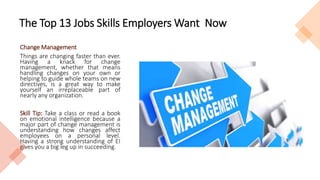
  • 104.
    WRITING SKILLS  Directingyour research  Introduction to research articles  Literature reviews  Peer reviews
  • 105.
    PROJECT MANAGEMENT Managing research with confidence Organisingyour work more effectively and with less stress to become successful leaders or members of research projects. Project management is an integral skill for everyone, especially those in the research community, whether they’re researchers or clinicians or managing a lab.
  • 106.
    PROJECT MANAGMENT You need guidelinesto follow in order to ensure that your project is properly set up to get off to a good start.
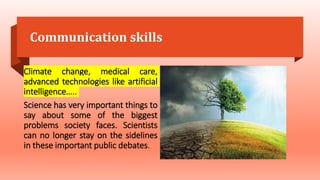
  • 107.
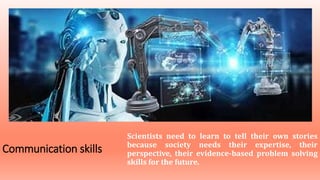
    Project management toolsfor researchers Having been successful in attracting funding for your project, you will now have to lead it from set-up to completion. The following pages take you through the key stages: Setting up a research project  Monitoring a research project Reporting on your research project Making the most of your research project https://www.vitae.ac.uk
  • 108.
    PROJECT MANAGEMENT  Projectfinances : you have to familiarise yourself with the finance system and financial processes of your institution. Make sure that you are aware of any stipulations in the contract/offer as to what might be ineligible expenditure.  Approvals: do make sure you allow enough time for this, bearing in mind how frequently the relevant approvals review board or committee meets in your organisation.
  • 109.
    PROJECT MANAGEMENT  Staffrecruitment liaise with your Personnel or Human Resources department, who will manage the process for you. You are likely to be responsible for providing all the details of the posts you are offering.  Legal conditions: you should ensure that you review the contract/terms and conditions of the grant before you start.
  • 110.
    PROJECT MANAGEMENT Monitoring aresearch project  Monitoring timescales  Monitoring finances Periodic reports The funders of your research, and the institution at which you are carrying out your research will both want to be informed at regular intervals about the progress of your project. The final report At the end of the project you will almost certainly have to produce a final expenditure statement and a final report. Your research office may complete the former for you, but you do have overall responsibility for the accuracy of both reports. Records At the end of your project you will need to make sure that your records are complete and in order. It is possible that your project could be subject to audit at some stage in the following few years and having a complete set of records at this stage could save a great deal of time later.
  • 111.
    GRANT ACQUISITION  Improving subsidyproposals and increasing rate success  Providing an overview and advice on subsidies and grants that match the proposed research or career profile -General grant schemes, -the writing life-cycle, -writing tips, legal aspects (IP management), -the evaluation process SciLink https://scilink.eu/
  • 112.
    GRANT ACQUISITION Learning about theprinciples of developing multi- disciplinary collaborative research projects. More and more researchers need to raise money for their research projects. But where to find funding bodies and how to convince them? How to put a winning proposal together? How to approach the preparation of a proposal effectively? particularly focussing on collaborative projects.
  • 113.
    GRANT ACQUISITION Horizon Europe,the European Union’s Framework Programme for Research & offers a multitude of opportunities, but also poses many challenges. The skills acquired are transferable to other types of programmes supporting research.
  • 114.
    GRANT ACQUISITION Providing researchers witha good understanding of: Strategic aspects: o an introduction into funding opportunities and into Horizon Europe; o what information, documents are essential and helpful; the structure of proposals and how to organise the proposal preparation to make the process efficient; how to produce a convincing case, particularly on impact; financing and budgeting; success factors and typical failures.
  • 115.
    FUNDRAISING for University researchprojects Having a clear idea of how to make research projects sustainable means taking a look towards the future. Fundraising, as a set of techniques and approaches aimed at ensuring the sustainability of initiatives and projects, is increasingly assuming an important role within the corpus of intersectional skills necessary to pursue medium-long term objectives.
  • 116.
    FUNDRAISING for Universityresearch projects Sometimes fundraising is often reduced to its “funding” dimension. However, a correct comprehension of a fundraising-oriented approach is pivotal to address the issue of the future from a concrete, practical point of view, linked to the economic side but also to relationships and networking, stakeholders analysis, communication strategy, initiatives to raise awareness linked to the projects themselves. Acquiring fundraising skills thus becomes, in a complex world where intersectionality and integration are keywords, a driver for defining a professional path in the round.
  • 117.
    Through in-depth studyaimed at understanding: What does fundraising mean, which skills are required to properly fundraise, how to identify fundraising objectives and goals, how and where to look for donors and retain/cultivate them, how to set up a multi-target and multi-vehicle fundraising campaign (including crowdfunding initiatives), how to define an operational plan to raise funds, practical cases will be analyzed - also proposed by the participants - and useful ideas will be provided for the launch of a fundraising campaign connected to the university world. Example of theoretical-practical training modules 4-hour workshop Trainer: Simona Biancu Engagedin https://www.engagedin.net
  • 118.
  • 119.
    Entreprenuerial capacity building How tostart and manage an innovative business. How to identify an entreprenuerial idea, make it profitable, start a business and deliver a successful product
  • 120.
    Commercialize innovation Academia-Industry  Understand the“noise” in the system.  Run a divergent innovation session.  Hold a convergent innovation session  Build a works-like prototype.  Develop a looks-like prototype  Combine into a full prototype  Start scaling.  Conduct a soft launch.
  • 121.
    DISRUPTIVE INNOVATION Technical innovation ishardly disruptive and it is brought about by solving new problems with existing capabilities. Researchers have the competencies and skills to be disruptively innovative with no need to discover and develop new technologies. Researchers have to know how to develop new business models to disrupt the marketplace. Disruptive innovation refers to a concept, product, or a service that either disrupts an existing market or creates a completely new market segment.
  • 122.
    Connecting people, ideas andresources Good practices. A new approach to the topic IP&D - Innovation, Projects and Development Ltd was established in 2003 by Dr. Isser Peer with a vision of connecting people, ideas and resources based on expertise in the creation of start-ups, spin-offs, and licensing to strategic companies, focusing on the interface between Academia and Industry.
  • 123.
    Connecting people, ideas andresources Good practices IP&D engages in research support and projects including Technology Transfer and entrepreneurship, organizing international training and workshops, knowledge management, IPR consultation, and acquisition of soft skills. Recent events IPD has implemented include a Career Fair and Entrepreneur Workshops in collaboration with the Weizmann Institute of Science, and the Technion Institute of Technology.
  • 124.
    Connecting people, ideas andresources Good practices IP&D Dr. Isser Peer - is a Technology Transfer and entrepreneurship expert whose areas of expertise are the exploitation of Intellectual Property Rights and the creation of start-ups, spin-offs and licensing to strategic companies. Peer was the CEO of BIRAD, the Technology Transfer Company of BIU and directed the Research Authority, Bar-Ilan University. In 2003, Peer founded IP&D Ltd, a private company based in Israel, with the vision of "Connecting People, Ideas and Resources".
  • 125.
  • 126.
    Research Commercialization In orderfor university-based knowledge to make it out of the laboratory, individual scientist- inventors need to take part in the commercialization process. This commercialization process, which is sometimes called "academic entrepreneurship,” can be hard for scientists. They were trained and socialized as scholars and usually see themselves that way. The business world can appear alien, daunting and unconnected to the research world.
  • 127.
    Research commercialization allowstechnology created during research activities to be further developed into marketable products for the benefit of the public. This is achieved through technology transfer. Technology transfer often refers to transferring a technology between a research laboratory and a commercial partner, including industry, academia, and state and local governments. Technology is typically transferred through a license agreement in which the university retains ownership of the intellectual property created during research activities, while the industrial partner obtains conditional rights to use and develop a technology.
  • 128.
    Intellectual property maybe protected using patents, copyrights, trademarks, and trade secrets. The rights to an article of intellectual property may be bought, sold, leased, rented, or transferred between parties. Additionally, the transfer of intellectual property rights can affect a product’s marketability. Intellectual property is an essential component when evaluating an invention’s commercialization potential. To ensure that the intellectual property is appropriately protected, researchers are highly encouraged to first disclose their discovery to their institution’s technology transfer office before sharing the invention with people outside the university.
  • 129.
    Universities are operatinga so called Tech Transfer Office, but unfortunately, they are often performing badly as people in charge don’t have a business background and lack of passion to help commercialize research results. They are the cause that a lot of IP is wasted nowadays. Promoting cooperation between industry, universities and research institutes, connecting scientific research, education, and industry, coupling technological innovation in the midstream and downstream…..
  • 130.
    Encouraging more scientists and researchersto become more entrepreneurial Organize informal gatherings to discuss the possibilities from commercializing scientific research and get scientists comfortable with it. Bring in representatives from established companies to encourages scientists to come up with a solution to a problem and helps them see the possibilities. Then give the scientists time to discuss the ideas among themselves.
  • 131.
    Encouraging more scientists and researchersto become more entrepreneurial Help scientists visualize how they can contribute to commercializing an innovation in a role that makes them comfortable and plays to their strengths as scientists, such as Chief Scientific Officer. Encourage them to take risks, without fear of failing, and to share their stories so that they can learn from one another.
  • 132.
    Any good scientificresearcher has both the capacity and most of the critical skills necessary to become a good entrepreneur. What is needed is a different outlook! Many of the skills that researchers have are almost directly applicable and valuable in a start-up entreprise The Researcher Entrepreneur Best practices for successful technological entrepreneurship, G. Vekinis
  • 133.
    «You, as inventorresearcher, offer the vision and the scientific and technological foundations but the day-to-day operations in the company will be carried out by skilled workers, each offering their expertise in their specific area.» «Both good researchers take the initiative and are good innovators. The level of innovativeness in both worlds are the same, but the outlook and the view point are different: researchers prepare the inventions which are then taken over by entrepreneurs to turn them into valuable innovations.» The Researcher Entreprenuer Best practices for successuful technological entrepreneurship, G. Vekinis
  • 134.
    Intrinsic Motivation Being aPh.D. means not having any boss. Yes, you have your supervisor and the scientific committee board that guides you and evaluates your progress, but no one will be there to tell you what to do, and what it’s more no one will tell you how to do it. You are on your own to figure out the business plan, set your agenda and milestones Why PhDs are potential entrepreneurs? As an entrepreneur, a Ph.D. Candidate must truly believe in his thesis (idea). To achieve successfully your dissertation, you need to be intrinsically motivated towards your research problem. You need to be confident about your skills for fulfilling the thesis requirements and you have to be extremely optimist about the outcomes of your research. The Researcher Entreprenuer
  • 135.
    Why PhDs arepotential entrepreneurs? As an entrepreneur, a Ph.D. Candidate must truly believe in his thesis (idea). To achieve successfully your dissertation, you need to be intrinsically motivated towards your research problem. You need to be confident about your skills for fulfilling the thesis requirements and you have to be extremely optimist about the outcomes of your research. Intrinsic Motivation Being a Ph.D. means not having any boss. Yes, you have your supervisor and the scientific committee board that guides you and evaluates your progress, but no one will be there to tell you what to do, and what it’s more no one will tell you how to do it. You are on your own to figure out the business plan, set your agenda and milestones.
  • 136.
  • 137.
    HOW TO DEVELOPNEW SKILLS  Observing other people in a company excelling in soft skills.  Taking on more responsibilities at work.  Taking on-line soft skills courses.  Extra curricular activities enable PhDs to develop their network and it is appreciated by recruiters.  Non professional experience enable PhDs to gain skills.  Writing a blog demonstrates writing skills.
  • 138.
    HOW TO DEVELOPNEW SKILLS  Join a society could give them experiences in team work, planning meetings, hosting seminars.  Departmental opportunities: PhDs could be a tutor or lab demonstrator.  Volunteering  Public outreach: to communicate their work to the general public . This could include university festivals and open day programmes.
  • 139.
    HOW TO DEVELOPNEW SKILLS  A chat with your university career service, or postgrad/early career research support team.  Networking: reach out to people who may be able to help them, friends, mentors, supervisors or colleagues  Planning any symposiums or events within the department. This shows great initiative.
  • 140.
    TEN BEST WEBSITESFOR SELF-IMPROVEMENT COURSERA https://www.coursera.org/ KOUDETAT 40 Hours video on entrepreneurship. A must to develop your entrepeneurial culture. Free of charge http://www.koudetatondemand.co/ CODEACADEMY https://www.codecademy.com/ DATAMONKEY about big data http://datamonkey.pro/ HOOTSHUTTLE ACADEMY about social media marketing, social network https://education.hootsuite.com/collections?category=courses
  • 141.
    TEN BEST WEBSITESFOR YOUR SELF-IMPROVEMENT KOOBER digital skills https://discover.koober.com/us HIGHBROW 5 min. a day (computer science, psychology) https://gohighbrow.com/ DIGITAL ACTIVE PARGOOGLE Digital Marketing https://learndigital.withgoogle.com/ateliersnumeriques GUIDES Crowdsourcing https://guides.co/ LIFEHACKER https://lifehacker.com/
  • 142.
    Developing yourself asa PI Meaningful development does take up some time and effort, so it is really in your own interest to invest in some personal reflection and self-analysis to get a clear idea of what your needs and aims are.  Reflection Reflect on your performance and your previous experiences and capture the learning and development that you gain from them. Self analysis  identify existing knowledge, behaviour and attitudes  identify core strengths  evidence your abilities and identify gaps.
  • 143.
    Developing yourself as aPI What next?  Opportunity awareness: gain a wider knowledge of the academic sector to identify, create, investigate and seize areas for personal and professional development. Identify possible sources of information and support within your institution  Decision making: understand your personal priorities and constraints (internal and external), so that each developmental opportunity and career step can be made following an informed decision.  Networking: develop networks of contacts. You should be able to define, develop and maintain a support network for advice and information.
  • 144.
    Developing yourself as aPI What next?  Self presentation and promotion: define and promote your own agenda. Promote your own strengths in a convincing way  Goal setting and action planning: move your career forward in a structured way through planning and implementing an effective course of action, organising time effectively and preparing contingency plans. You should be able to monitor and evaluate progress against specific objectives.
  • 145.
    ACHIEVING SUCCESS WITHLESS STRESS Personal well-being Self-care Exploring your own personal challenges Building self-confidence SciLink Foundation is offering online courses https://scilink.eu/ Skills Training and Mentoring - For Researchers – Providing skills to early stage and experienced researchers through high quality workshops, mental health management, and mentoring.
  • 146.
    Overview of Informationand Resources EURODOC (European Council for Doctoral Candidates) Skills Report von Eurodoc, “Identifying and Documenting Transferable Skills and Competences to Enhance Early Career Researchers Employability and Competitiveness” ABG has also recently published a very interesting work on transferable skills in the form of interviews conducted to PhD Graduates regarded as "successful Career Transition stories“ https://www.abg.asso.fr/en/vue/career-paths-and-professions DOCPRO, ABG Future and transferable skills are the focus of MINDSET PROJECT, Technical University of Berlin
  • 147.
    Overview of Informationand Resources  EUA/CDE is regularly publishing documents on this topic.  ADOC Talent Management, “The Core Competences of PhD” by B. Durette, M. Fournier, M. Lafon  OECD, Transferable Skills Training for Researchers  VITAE UK provides relevant information on this topic Vitae Research Development Framework  “The Researcher Entreprenuer. Best practices for successful technological entrepreneurship” by George Vekinis.  Cheeky Scientist Association
  • 148.
    Overview of Informationand Resources Why is it not a 'failure' to leave academia ?  Why is it not a 'failure' to leave academia ? https://www.nature.com/articles/d41586-018-05838-y  PhD Competencies and Employment Trends in Canada https://static.wixstatic.com/ugd/c19fb8_4778cc1555784d3a965195ba18de8b73.pdf  How to Improve your CV while on your PhD https://phdlife.warwick.ac.uk/2016/01/13/how-to-improve- your-cv-while-on-your-phd/  Ten Career Paths for PhDs jobs.ak.uk  MY MOOC PhD Dooc , annual MOOC on transferable skills, career development for PhDs
  • 149.
    Overview of Informationand Resources Why is it not a 'failure' to leave academia ? Researching Career Solutions https://www.insidehighered.com/advice/2016/05/09/applying- research-skills-explore-careers-essay How to Write a PhD Elevator Pitch https://academicpositions.be/career-advice/how-to-write- an-elevator-pitch How to Write a CV for Roles outside Academia https://www.imperial.ac.uk/media/imperial- college/administration-and-support-services/careers- service/public/resources/handouts/series/How-to-write-a-CV-for-roles-outside-academia- no-cropmarks.pdf Why Are PhDs Potential Entreprenuers? https://medium.com/@mangelferrero/why-phds- are-potential-entrepreneurs-df3dec2c544c
  • 150.
    Supporting the professional developmentof reaserchers  EURAXESS https://euraxess.ec.europa.eu/ VITAE UK Making the most of your resaerch project https://www.vitae.ac.uk/doing-research/leadership- development-for-principal-investigators-pis/leading-a- research-project/managing-a-research-project/making-the- most-of-your-research-projectg  SciLink For Reasearchers. By Researchers https://scilink.eu/  Association Bernard Grégory ABG www.abg.asso.fr.
  • 151.
    VITAE UK THE RESEARCHERSDEVELOPMENT FRAMEWORK The Researcher Development Framework (RDF) is a major new approach to researcher development. The RDF is a professional development framework for planning, promoting and supporting the personal, professional and career development of researchers in higher education. It articulates the knowledge, behaviours and attributes of successful researchers and encourages them to realise their potential.
  • 152.
    Lucia Salto Research Dep.,University of Turin Career Development Faciliator for PhDs lucia.salto@unito.it dottori.phd@unito.it