Prepared by: Oumayma Chakir
Professional
mistakes
Outline
• I- Introduction
• II- types of professional mistakes
• III- steps to resolve professional mistakes
• IV- Conclusion
Introduction
• All people usually make mistakes at work
especially when they were at their first days
in their career. dealing with making
mistakes and learning from experiences is a
significant area of development.
• Regardless of the mistake scop, there's a
certain series of steps that can resolve the
problem.
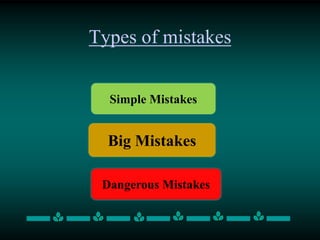
Types of mistakes
Simple Mistakes
Big Mistakes
Dangerous Mistakes
Simple Mistakes
A simple mistake usually does not make a huge
difference; yet, sometimes the simple mistake may
lead to very serious measures against the employees
such as : dismissal from work.
Examples
1. Example one
using social media during your work time at the expense of your
duties.
2. Example two
Being absent for a day for no reason, but just to make your boss feel
nervous.
3. Example three
Refusing to benefit from a training initiative offered by the employer
in favour of the company.
4. Example four
Refusing to go to work in exceptional cases after your work time.
Big Mistakes
A big mistake is when the employer
( boss) cannot maintain, even temporarily,
the employee who made this kind of big
mistakes . The latter usually leads to an
act of dismissal.
Exemples
1. Leaving the work place before the scheduled time .
2. To insult your boss and to refuse leaving the company.
3. Not applying the rules of the company.
4. Sexual harassment.
5. Verbal and physical assault.
Dangerous mistakes:
are the mistakes
committed by the employee with the intention to
damage the company and the employer.
Exemples
1. Diverting customers from their company to
another competitor.
2. Revealing the secrets of the company to damage
its reputation or to make it less successful.
3. Send an anonymous denigrating mail to the
company's clients.
Mistakes Simple Mistakes Big Mistakes Dangerous Mistakes
Abandoning your post X
Absence X X
Late arrival from holiday X X
Being unponctual X X
Constant criticism for other
colleagues
X X
Denigrating the company’s
image
X X
Insult X
Violance X
Steps to resolve professional
mistakes
Take a minute to analyze the
situation and see how much
damage has actually been
done.
Examples: Ask yourself
 how is production
affected?
 How is your brand's
reputation affected?
 How are customers
affected?
 How are your colleagues
affected?
Step One: Assess the damage
• Tell your supervisor about your mistake.
• Admit and be honest.
• It's far better to be straightforward with your mistakes than
to try and cover them up.
• Explain the situation as much as possible, and let everyone
know what you plan to do to recover.
• It's also important to apologize and show that you regret
the situation.
Step two: Admit to the Mistake and
Explain the Situation
Step Three: Be responsible
• Since everyone is affected by the mistake, it's
your job to accept responsibility for making
things right. As a first line of action, start fixing
the damage (if possible)--post an apology on
social media, do whatever is necessary to
preserve the company's reputation and
minimize the effects to its bottom line..
Step four : Do not repeat the same mistake
• Take measures that ensure your mistake isn't repeated.
• Determine the main factors responsible for making the
situation arise in the first place and know if it is possible to
eliminate those factors.
So, making procedural changes, implementing new rules, and
increasing awareness are fantastic tools in almost any recovery
situation.
Conclusion
• Everybody makes mistakes. If someone seems to
never make mistakes, it's only because the person
has been able to recover gracefully. Following these
steps can give you a great deal of respect in the
process, and prove to your bosses and supervisors
that you can handle yourself in a crisis.

professional mistakes

  • 1.
    Prepared by: OumaymaChakir Professional mistakes
  • 2.
    Outline • I- Introduction •II- types of professional mistakes • III- steps to resolve professional mistakes • IV- Conclusion
  • 3.
    Introduction • All peopleusually make mistakes at work especially when they were at their first days in their career. dealing with making mistakes and learning from experiences is a significant area of development. • Regardless of the mistake scop, there's a certain series of steps that can resolve the problem.
  • 4.
    Types of mistakes SimpleMistakes Big Mistakes Dangerous Mistakes
  • 5.
    Simple Mistakes A simplemistake usually does not make a huge difference; yet, sometimes the simple mistake may lead to very serious measures against the employees such as : dismissal from work.
  • 6.
    Examples 1. Example one usingsocial media during your work time at the expense of your duties. 2. Example two Being absent for a day for no reason, but just to make your boss feel nervous. 3. Example three Refusing to benefit from a training initiative offered by the employer in favour of the company. 4. Example four Refusing to go to work in exceptional cases after your work time.
  • 7.
    Big Mistakes A bigmistake is when the employer ( boss) cannot maintain, even temporarily, the employee who made this kind of big mistakes . The latter usually leads to an act of dismissal.
  • 8.
    Exemples 1. Leaving thework place before the scheduled time . 2. To insult your boss and to refuse leaving the company. 3. Not applying the rules of the company. 4. Sexual harassment. 5. Verbal and physical assault.
  • 9.
    Dangerous mistakes: are themistakes committed by the employee with the intention to damage the company and the employer.
  • 10.
    Exemples 1. Diverting customersfrom their company to another competitor. 2. Revealing the secrets of the company to damage its reputation or to make it less successful. 3. Send an anonymous denigrating mail to the company's clients.
  • 11.
    Mistakes Simple MistakesBig Mistakes Dangerous Mistakes Abandoning your post X Absence X X Late arrival from holiday X X Being unponctual X X Constant criticism for other colleagues X X Denigrating the company’s image X X Insult X Violance X
  • 12.
    Steps to resolveprofessional mistakes
  • 13.
    Take a minuteto analyze the situation and see how much damage has actually been done. Examples: Ask yourself  how is production affected?  How is your brand's reputation affected?  How are customers affected?  How are your colleagues affected? Step One: Assess the damage
  • 14.
    • Tell yoursupervisor about your mistake. • Admit and be honest. • It's far better to be straightforward with your mistakes than to try and cover them up. • Explain the situation as much as possible, and let everyone know what you plan to do to recover. • It's also important to apologize and show that you regret the situation. Step two: Admit to the Mistake and Explain the Situation
  • 15.
    Step Three: Beresponsible • Since everyone is affected by the mistake, it's your job to accept responsibility for making things right. As a first line of action, start fixing the damage (if possible)--post an apology on social media, do whatever is necessary to preserve the company's reputation and minimize the effects to its bottom line..
  • 16.
    Step four :Do not repeat the same mistake • Take measures that ensure your mistake isn't repeated. • Determine the main factors responsible for making the situation arise in the first place and know if it is possible to eliminate those factors. So, making procedural changes, implementing new rules, and increasing awareness are fantastic tools in almost any recovery situation.
  • 17.
    Conclusion • Everybody makesmistakes. If someone seems to never make mistakes, it's only because the person has been able to recover gracefully. Following these steps can give you a great deal of respect in the process, and prove to your bosses and supervisors that you can handle yourself in a crisis.

Editor's Notes

  • #7 Is this a mistakes: Sending an e-mail to your boss during your work time at the expense of your duties at work?