TWI Training May 19, 2010
Job Instruction Training (JI) How to teach people to quickly learn to do a job correctly, safely, and conscientiously.
JI Training Results in:  Reduced training time  Increased production  Fewer accidents  Less scrap  Less rework  Less tool and equipment damage  Increased job satisfaction  Improved quality  Increased profits
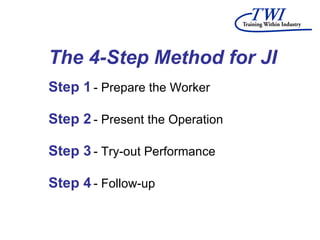
The 4-Step Method for JI Step 1   - Prepare the Worker Step 2   - Present the Operation Step 3   - Try-out Performance Step 4   - Follow-up
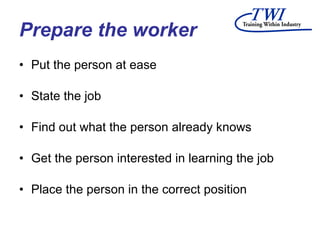
Prepare the worker Put the person at ease State the job Find out what the person already knows Get the person interested in learning the job Place the person in the correct position
Present the Operation Tell the employee how to do the task using words only.  Then, physically show the employee how the task is done.  Do it again, illustrate the task one  Important Step  at a time. Do it again, illustrate the task one Important step at a time along with the  Key Points  for each important step . Do it again, illustrate the task one Important step at a time along with the key points   for each important step stating  reasons for each Key Point. Instruct clearly, completely and patiently but don’t give them more information than they can master at one time.
Try-Out Performance Have the person do the job – correct errors as they occur. Next, have the person explain each  Important Step  to you as they do the job the first time. Next, have the person explain each important step and  Key Point  to you as they do the job the second time. Finally, have the person explain each important step, the key point and  reasons for Key Points   to you as they do the job the third time. Make sure the person understands the  reasons  for the  key points  for each  important step .  Continue until  you  know  they  know.
Follow up Put the person on their own Designate who the person goes to for help Check on the person frequently Encourage questions Taper off extra coaching and close follow-up
A logical segment of the operation  when something happens to advance the work. Putting a new blade in hack saw.   Anything in a step that might—   •Make or break the job   •Injure the worker   •Make the work easier to do, i.e.    ―knack‖, ―trick‖, special    timing, bit of special information,    etc.   That 5 or 10% of a the hard or tricky       parts of a job. The reason for each Key Point   People learn better when they know why    they do things. The JI method of breaking down a job Important Steps HOW Key Points WHAT Reasons WHY
No. __________ JOB INSTRUCTION BREAKDOWN SHEET Operation:________________________________________________ Parts:____________________________________________________ Tools & Materials:__________________________________________   IMPORTANT STEPS  KEY POINTS  REASONS Reasons for each key point   Anything in a step that might— 1. Make or break the job 2. Injure the worker 3. Make the work easier to do, i.e. ―knack‖, ―trick‖, special timing, bit of special information A logical segment of the operation when something happens to advance the work.

Twi training

  • 1.
  • 2.
    Job Instruction Training(JI) How to teach people to quickly learn to do a job correctly, safely, and conscientiously.
  • 3.
    JI Training Resultsin:  Reduced training time  Increased production  Fewer accidents  Less scrap  Less rework  Less tool and equipment damage  Increased job satisfaction  Improved quality  Increased profits
  • 4.
    The 4-Step Methodfor JI Step 1 - Prepare the Worker Step 2 - Present the Operation Step 3 - Try-out Performance Step 4 - Follow-up
  • 5.
    Prepare the workerPut the person at ease State the job Find out what the person already knows Get the person interested in learning the job Place the person in the correct position
  • 6.
    Present the OperationTell the employee how to do the task using words only. Then, physically show the employee how the task is done. Do it again, illustrate the task one Important Step at a time. Do it again, illustrate the task one Important step at a time along with the Key Points for each important step . Do it again, illustrate the task one Important step at a time along with the key points for each important step stating reasons for each Key Point. Instruct clearly, completely and patiently but don’t give them more information than they can master at one time.
  • 7.
    Try-Out Performance Havethe person do the job – correct errors as they occur. Next, have the person explain each Important Step to you as they do the job the first time. Next, have the person explain each important step and Key Point to you as they do the job the second time. Finally, have the person explain each important step, the key point and reasons for Key Points to you as they do the job the third time. Make sure the person understands the reasons for the key points for each important step . Continue until you know they know.
  • 8.
    Follow up Putthe person on their own Designate who the person goes to for help Check on the person frequently Encourage questions Taper off extra coaching and close follow-up
  • 9.
    A logical segmentof the operation when something happens to advance the work. Putting a new blade in hack saw. Anything in a step that might— •Make or break the job •Injure the worker •Make the work easier to do, i.e. ―knack‖, ―trick‖, special timing, bit of special information, etc. That 5 or 10% of a the hard or tricky parts of a job. The reason for each Key Point People learn better when they know why they do things. The JI method of breaking down a job Important Steps HOW Key Points WHAT Reasons WHY
  • 10.
    No. __________ JOBINSTRUCTION BREAKDOWN SHEET Operation:________________________________________________ Parts:____________________________________________________ Tools & Materials:__________________________________________ IMPORTANT STEPS KEY POINTS REASONS Reasons for each key point Anything in a step that might— 1. Make or break the job 2. Injure the worker 3. Make the work easier to do, i.e. ―knack‖, ―trick‖, special timing, bit of special information A logical segment of the operation when something happens to advance the work.