The First World Assembly of Islamic Cities
31 Aug–1 Sep, 2013. Iran.
Ali A. Alraouf, Ph.D.
Prof. of Architecture and Urbanism
Head of Research and Development –QNMP, Qatar.
alialraouf@gmail.com
From Islamophobia to Mosquephobia
The Predicament of Urbanism, Multiculturalism
and Islam.
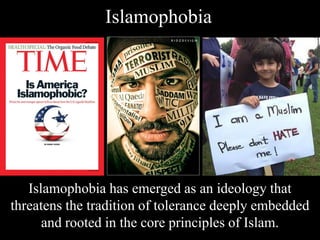
Islamophobia
Islamophobia has emerged as an ideology that
threatens the tradition of tolerance deeply embedded
and rooted in the core principles of Islam.
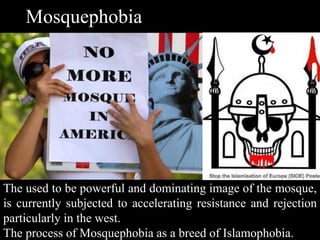
Mosquephobia
The used to be powerful and dominating image of the mosque,
is currently subjected to accelerating resistance and rejection
particularly in the west.
The process of Mosquephobia as a breed of Islamophobia.
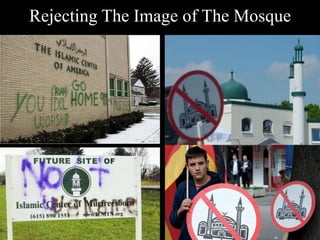
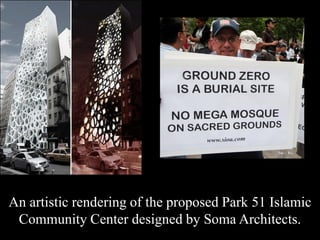
Rejecting The Image of The Mosque
An artistic rendering of the proposed Park 51 Islamic
Community Center designed by Soma Architects.
MOSQUES WITHIN CONTEMPORARY SOCIO-
CULTURAL AND ARTISTIC CONTEXTS
“Traditional Islamic civilization is marked by its emphasize upon beauty being
wedded to every aspect of human life, from the chanting of the Quran to the
making of pots and pans. The traditional Islamic ambience, both the plastic and
the sonoral, have always been beautiful, for traditional Islam sees beauty as a
complement of the Truth.” Nasr (1990) p: 20
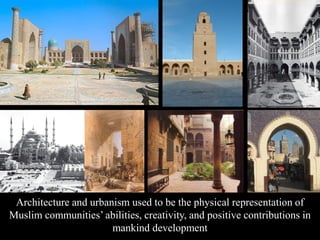
Architecture and urbanism used to be the physical representation of
Muslim communities’ abilities, creativity, and positive contributions in
mankind development
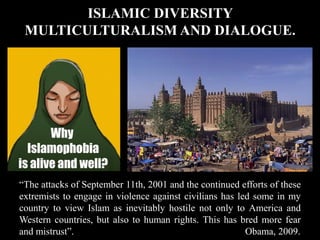
ISLAMIC DIVERSITY
MULTICULTURALISM AND DIALOGUE.
“The attacks of September 11th, 2001 and the continued efforts of these
extremists to engage in violence against civilians has led some in my
country to view Islam as inevitably hostile not only to America and
Western countries, but also to human rights. This has bred more fear
and mistrust”. Obama, 2009.
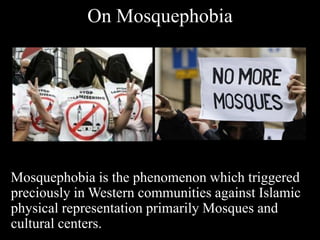
On Mosquephobia
Mosquephobia is the phenomenon which triggered
preciously in Western communities against Islamic
physical representation primarily Mosques and
cultural centers.
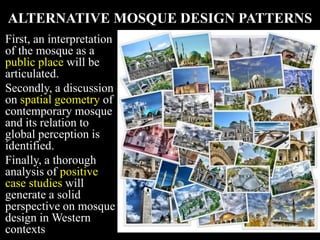
ALTERNATIVE MOSQUE DESIGN PATTERNS
First, an interpretation
of the mosque as a
public place will be
articulated.
Secondly, a discussion
on spatial geometry of
contemporary mosque
and its relation to
global perception is
identified.
Finally, a thorough
analysis of positive
case studies will
generate a solid
perspective on mosque
design in Western
contexts
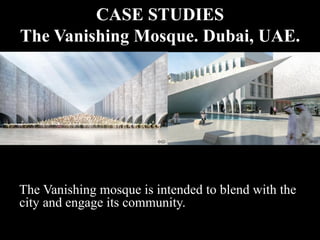
CASE STUDIES
The Vanishing Mosque. Dubai, UAE.
The Vanishing mosque is intended to blend with the
city and engage its community.
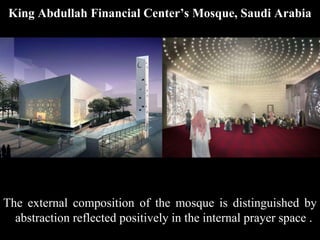
King Abdullah Financial Center’s Mosque, Saudi Arabia
The external composition of the mosque is distinguished by
abstraction reflected positively in the internal prayer space .
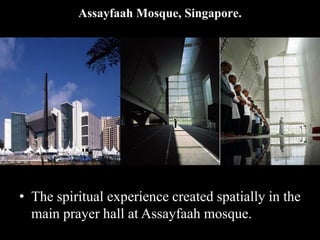
Assayfaah Mosque, Singapore.
• The spiritual experience created spatially in the
main prayer hall at Assayfaah mosque.
The Islamic Forum in Penzberg, a Mosque and Islamic
Center, Bavaria, Germany.
• Penzberg mosque’s transparency created unprecedented visual connectivity
between the internal spaces and outdoor street life.
• The cultural dialogue represented in the opposing entrance walls with Arabic
and German translation of Quran verses.
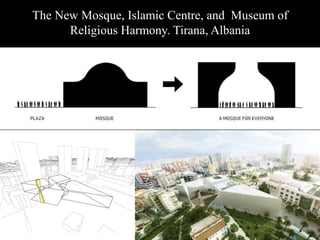
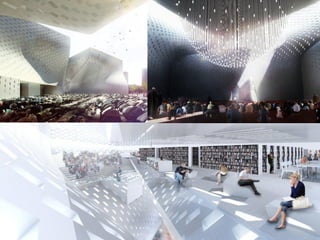
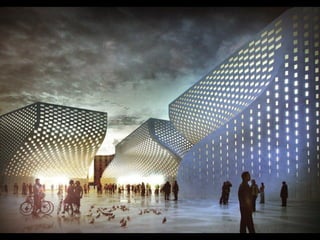
The New Mosque, Islamic Centre, and Museum of
Religious Harmony. Tirana, Albania
”The winning proposal was chosen for its ability to create an inviting public
space flexible enough to accommodate daily users and large religious events,
while harmonically connecting with the Scanderbeg square, the city of Tirana
and its citizens across different religions.
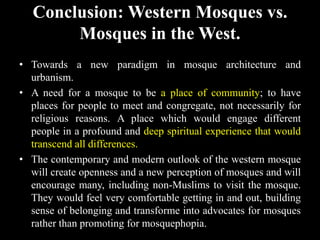
Conclusion: Western Mosques vs.
Mosques in the West.
• Towards a new paradigm in mosque architecture and
urbanism.
• A need for a mosque to be a place of community; to have
places for people to meet and congregate, not necessarily for
religious reasons. A place which would engage different
people in a profound and deep spiritual experience that would
transcend all differences.
• The contemporary and modern outlook of the western mosque
will create openness and a new perception of mosques and will
encourage many, including non-Muslims to visit the mosque.
They would feel very comfortable getting in and out, building
sense of belonging and transforme into advocates for mosques
rather than promoting for mosquephopia.
Thank you
Ali A. Alraouf, Ph.D.
Prof. of Architecture and Urbanism.
Development, Research and Capacity Building Coordinator – QNMP.
Doha, Qatar
alialraouf@gmail.com

From Islamophobia to Mosquephobia The Predicament of Urbanism, Multiculturalism and Islam.

  • 1.
    The First WorldAssembly of Islamic Cities 31 Aug–1 Sep, 2013. Iran. Ali A. Alraouf, Ph.D. Prof. of Architecture and Urbanism Head of Research and Development –QNMP, Qatar. alialraouf@gmail.com From Islamophobia to Mosquephobia The Predicament of Urbanism, Multiculturalism and Islam.
  • 2.
    Islamophobia Islamophobia has emergedas an ideology that threatens the tradition of tolerance deeply embedded and rooted in the core principles of Islam.
  • 3.
    Mosquephobia The used tobe powerful and dominating image of the mosque, is currently subjected to accelerating resistance and rejection particularly in the west. The process of Mosquephobia as a breed of Islamophobia.
  • 4.
    Rejecting The Imageof The Mosque
  • 5.
    An artistic renderingof the proposed Park 51 Islamic Community Center designed by Soma Architects.
  • 6.
    MOSQUES WITHIN CONTEMPORARYSOCIO- CULTURAL AND ARTISTIC CONTEXTS “Traditional Islamic civilization is marked by its emphasize upon beauty being wedded to every aspect of human life, from the chanting of the Quran to the making of pots and pans. The traditional Islamic ambience, both the plastic and the sonoral, have always been beautiful, for traditional Islam sees beauty as a complement of the Truth.” Nasr (1990) p: 20
  • 7.
    Architecture and urbanismused to be the physical representation of Muslim communities’ abilities, creativity, and positive contributions in mankind development
  • 8.
    ISLAMIC DIVERSITY MULTICULTURALISM ANDDIALOGUE. “The attacks of September 11th, 2001 and the continued efforts of these extremists to engage in violence against civilians has led some in my country to view Islam as inevitably hostile not only to America and Western countries, but also to human rights. This has bred more fear and mistrust”. Obama, 2009.
  • 9.
    On Mosquephobia Mosquephobia isthe phenomenon which triggered preciously in Western communities against Islamic physical representation primarily Mosques and cultural centers.
  • 10.
    ALTERNATIVE MOSQUE DESIGNPATTERNS First, an interpretation of the mosque as a public place will be articulated. Secondly, a discussion on spatial geometry of contemporary mosque and its relation to global perception is identified. Finally, a thorough analysis of positive case studies will generate a solid perspective on mosque design in Western contexts
  • 11.
    CASE STUDIES The VanishingMosque. Dubai, UAE. The Vanishing mosque is intended to blend with the city and engage its community.
  • 12.
    King Abdullah FinancialCenter’s Mosque, Saudi Arabia The external composition of the mosque is distinguished by abstraction reflected positively in the internal prayer space .
  • 13.
    Assayfaah Mosque, Singapore. •The spiritual experience created spatially in the main prayer hall at Assayfaah mosque.
  • 14.
    The Islamic Forumin Penzberg, a Mosque and Islamic Center, Bavaria, Germany. • Penzberg mosque’s transparency created unprecedented visual connectivity between the internal spaces and outdoor street life. • The cultural dialogue represented in the opposing entrance walls with Arabic and German translation of Quran verses.
  • 15.
    The New Mosque,Islamic Centre, and Museum of Religious Harmony. Tirana, Albania
  • 17.
    ”The winning proposalwas chosen for its ability to create an inviting public space flexible enough to accommodate daily users and large religious events, while harmonically connecting with the Scanderbeg square, the city of Tirana and its citizens across different religions.
  • 19.
    Conclusion: Western Mosquesvs. Mosques in the West. • Towards a new paradigm in mosque architecture and urbanism. • A need for a mosque to be a place of community; to have places for people to meet and congregate, not necessarily for religious reasons. A place which would engage different people in a profound and deep spiritual experience that would transcend all differences. • The contemporary and modern outlook of the western mosque will create openness and a new perception of mosques and will encourage many, including non-Muslims to visit the mosque. They would feel very comfortable getting in and out, building sense of belonging and transforme into advocates for mosques rather than promoting for mosquephopia.
  • 20.
    Thank you Ali A.Alraouf, Ph.D. Prof. of Architecture and Urbanism. Development, Research and Capacity Building Coordinator – QNMP. Doha, Qatar alialraouf@gmail.com