

Open DataSciCon May 2015
Productionizing
Deep Learning
From the Ground Up
Overview
● What is Deep Learning?
● Why is it hard?
● Problems to think about
● Conclusions
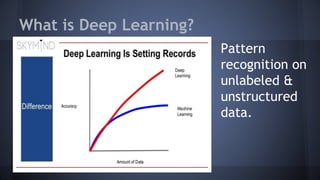
What is Deep Learning?
Pattern
recognition on
unlabeled &
unstructured
data.
What is Deep Learning?
● Deep Neural Networks >= 3 Layers
● For media/unstructured data
● Automatic Feature Engineering
● Benefits From Complex Architectures
● Computationally Intensive
● Accelerates With Special Hardware
Get why it’s hard yet?
Deep Networks >= 3 Layers
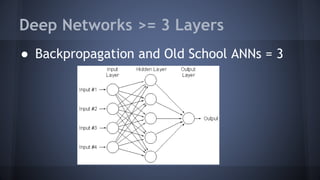
● Backpropagation and Old School ANNs = 3
Deep Networks
● Neural Networks themselves as hidden
Layers
● Different Types of Layers can be
Interchanged/stacked
● Multiple Layer Types, each with own
Hyperparameters and Loss Functions
What Are Common Layer Types?
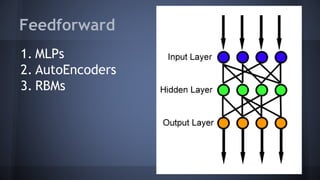
Feedforward
1. MLPs
2. AutoEncoders
3. RBMs
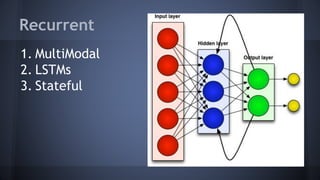
Recurrent
1. MultiModal
2. LSTMs
3. Stateful
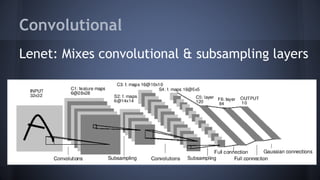
Convolutional
Lenet: Mixes convolutional & subsampling layers
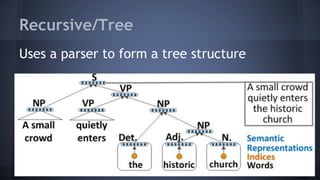
Recursive/Tree
Uses a parser to form a tree structure
Other kinds
● Memory Networks
● Deep Reinforcement Learning
● Adversarial Architectures
● New recursive ConvNet variant to come in
2016?
● Over 9,000 Layers? (22 is already pretty
common)
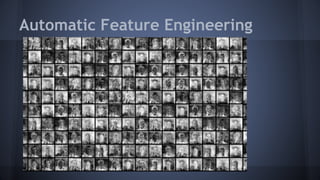
Automatic Feature Engineering
Automatic Feature Engineering (TSNE)
Visualizations are crucial:
Use TSNE to render different kinds of data:
http://lvdmaaten.github.io/tsne/
deeplearning4j.org
presentation@
Google, Nov. 17 2014
“TWO PIZZAS SITTING ON A STOVETOP”
Benefits from Complex Architectures
Google’s result combined:
● LSTMs (learning captions)
● Word Embeddings
● Convolutional features from images (aligned
to be same size as embeddings)
Computationally Intensive
● One iteration of ImageNet (1k label dataset
and over 1MM examples) takes 7 hours on
GPUs
● Project Adam
● Google Brain
Special Hardware required
Unlike most solutions, multiple GPUs are used
today
(Not common in Java-based stacks!)
Software Engineering Concerns
● Pipelines to deal with messy data,
not canned problems...
(Real life is not Kaggle, people.)
● Scale/Maintenance (Clusters of GPUs aren’t
done well today.)
● Different kinds of parallelism (model and
data)
Model vs Data Parallelism
● Model is sharding model across servers
(HPC style)
● Data is mini batch
Vectorizing unstructured data
● Data is stored in different databases
● Different kinds of files (raw)
● Deep Learning works well on mixed signal
Parallelism
● Model (HPC)
● Data (Mini batch param averaging)
Production Stacks today
● Hadoop/Spark not enough
● GPUs not friendly to average programmer
● Cluster management of GPUs as a resource
not typically done
● Many frameworks don’t work well in a
distributed env (getting better, though)
Problems With Neural Nets
● Loss functions
● Scaling data
● Mixing different neural nets
● Hyperparameter tuning
Loss Functions
● Classification
● Regression
● Reconstruction
Scaling Data
● Zero mean and unit variance
● Zero to 1
● Other forms of preprocessing relative to
distribution of data
● Processing can also be columnwise
(categorical?)
Mixing and Matching Neural Networks
● Video: ConvNet + Recurrent
● Convolutional RBMs?
● Convolutional -> Subsampling -> Fully
Connected
● DBNs: Different hidden and visible units for
each layer
Hyperparameter tuning
● Underfit
● Overfit
● Overdescribe (your hidden layers)
● Layerwise interactions
● What activation function? (Competing?
Relu? Good ol’ Sigmoid?)
Hyperparameter Tuning (2)
● Grid search for neural nets (Don’t do it!)
● Bayesian (Getting better. There are at least
priors here.)
● Gradient-based approaches (Your hyper-
parameters are a neural net, so there are
neural nets optimizing your neural nets...)
Questions?
Twitter: @agibsonccc
Github: agibsonccc
LinkedIn: /in/agibsonccc
Email: adam@skymind.io (combo breaker!)
Web: deeplearning4j.org

Productionizing dl from the ground up