BE - PRODUCTION ENGINEERING (Regular)
Programme Profile
As manufacturing activities play a major role in the development of the country, PSG College of Technology envisaged the need for
trained manpower in manufacturing and thus the undergraduate programme in Production Engineering was started in the year 1975.
Subsequently, department grew in several dimensions of academic excellence with time. The programme has been accredited for
five years, in the year 2012, which is the best ranking offered for a BE programme by National Board of Accreditation (NBA), in the
year 2012, maintaining its previous accreditation status. All the laboratories of the department are approved for carrying out
research, leading to Ph.D Degree (full time and part time) by Anna University, Chennai.. Currently, there are 20 research scholars
pursuing their Ph.D work in the department. The department offers consultancy in manufacturing processes, design and testing a
range of products, including product styling. The department maintains a close liaison with a large number of universities, industries
within the country and (outside) overseas through faculty research and collaborative projects. The teams of dedicated faculty
members nurture the programme and actively contribute towards the creation of a high quality learning environment that is
persuasive. There is a strong interaction with industry majors like M/s Larsen &Toubro , General Electric, Bangalore, Ashok Leyland,
TAFE, Tata Consultancy Services Ltd. and a few more.
URRICULUM
Curriculum comprises the following implemented in core courses and electives
Manufacturing
Introduction to Manufacturing Engineering
Engineering Graphics
Machining Technology
Machine Drawing
Foundry Technology
Welding Technology
Manufacturing Metrology
Metal Forming Process
Finite Element Applications in Manufacturing
Micro and Nano-Electro Mechanical System
Lean Manufacturing
Non-Traditional Machining Techniques
Metrology
Management
Statistical Quality Control
Operations Research
Economics for Engineers
Process Planning and Cost Estimation
Production and operations Management
Supply Chain Management
Engineering Design
Engineering Mechanics
Engineering Metallurgy
Strength of Materials
Kinematics of Machinery
Dynamics of Machinery
Design of Machine Elements
Design for Manufacture and
Assembly
Jigs, Fixtures and Die Design
Product Development Strategies
Mechanical Vibrations
One Credit Courses
Precision Machining
Supply Chain Management
Optimization Technology
Lean Six Sigma
Press Tool Design
Theory of Constraints
Allied Engineering
Fluid Mechanics and Machinery
Thermal System and Heat Transfer
Environmental Science and Engineering
Cleaner Production
Computational Fluid Dynamics
Computer programming
Automation/CAD/CAM
Applied Hydraulics and Pneumatics
Instrumentation and Control Systems
Sensors Automation and Modular
Production System
CNC and Robotics
Mechatronics
PLC Programming and Applications
LABORATORY FACILITIES
Machine Shop
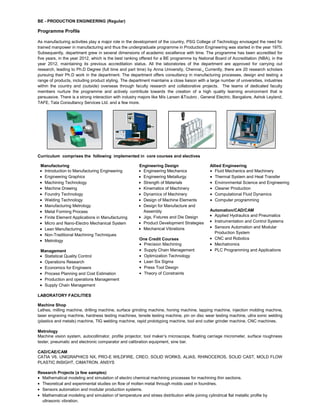
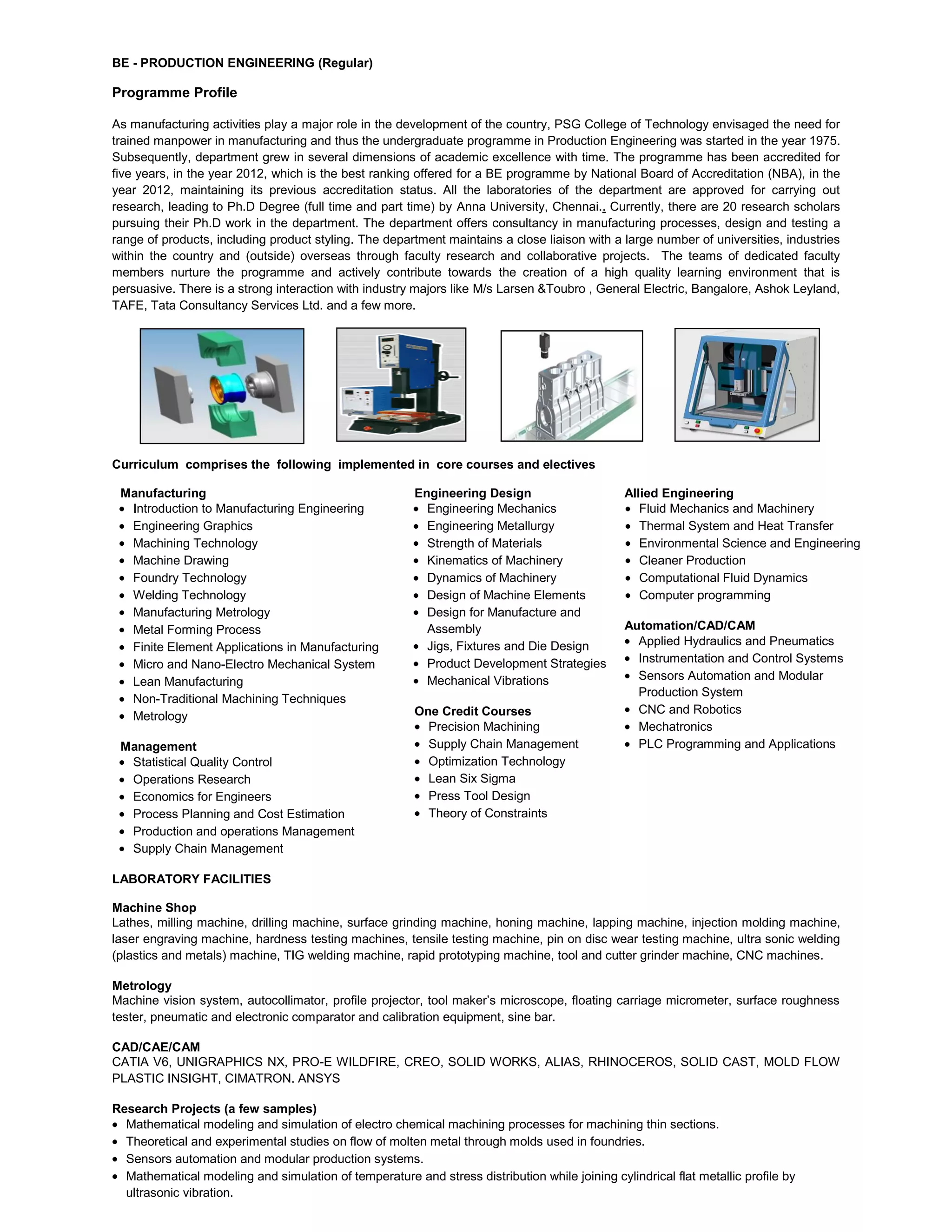
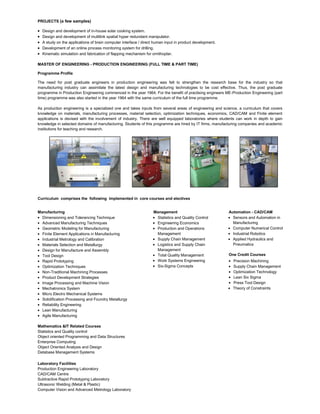
Lathes, milling machine, drilling machine, surface grinding machine, honing machine, lapping machine, injection molding machine,
laser engraving machine, hardness testing machines, tensile testing machine, pin on disc wear testing machine, ultra sonic welding
(plastics and metals) machine, TIG welding machine, rapid prototyping machine, tool and cutter grinder machine, CNC machines.
Metrology
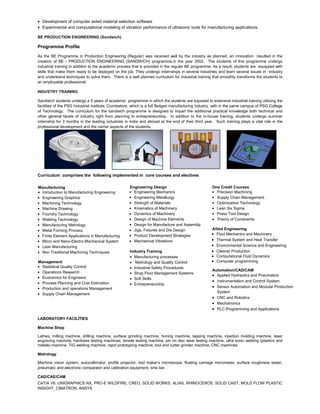
Machine vision system, autocollimator, profile projector, tool maker’s microscope, floating carriage micrometer, surface roughness
tester, pneumatic and electronic comparator and calibration equipment, sine bar.
CAD/CAE/CAM
CATIA V6, UNIGRAPHICS NX, PRO-E WILDFIRE, CREO, SOLID WORKS, ALIAS, RHINOCEROS, SOLID CAST, MOLD FLOW
PLASTIC INSIGHT, CIMATRON. ANSYS
Research Projects (a few samples)
Mathematical modeling and simulation of electro chemical machining processes for machining thin sections.
Theoretical and experimental studies on flow of molten metal through molds used in foundries.
Sensors automation and modular production systems.
Mathematical modeling and simulation of temperature and stress distribution while joining cylindrical flat metallic profile by
ultrasonic vibration.
Development of computer aided material selection software
Experimental and computational modeling of vibration performance of ultrasonic tools for manufacturing applications.
BE PRODUCTION ENGINEERING (Sandwich)
Programme Profile
As the BE Programme in Production Engineering (Regular) was received well by the industry as planned, an innovation resulted in the
creation of BE - PRODUCTION ENGINEERING (SANDWICH) programme,in the year 2002. The students of this programme undergo
industrial training in addition to the academic process that is provided in the regular BE programme. As a result, students are equipped with
skills that make them ready to be deployed on the job. They undergo internships in several industries and learn several issues in industry
and understand techniques to solve them. There is a well planned curriculum for industrial training that smoothly transforms the students to
an employable professional.
INDUSTRY TRAINING
Sandwich students undergo a 5 years of academic programme in which the students are exposed to extensive industrial training utilizing the
facilities of the PSG Industrial Institute, Coimbatore, which is a full fledged manufacturing industry, with in the same campus of PSG College
of Technology. The curriculum for the sandwich programme is designed to impart the additional practical knowledge both technical and
other general facets of industry right from planning to entrepreneurship. In addition to the in-house training, students undergo summer
internship for 3 months in the leading industries in India and abroad at the end of their third year. Such training plays a vital role in the
professional development and the carrier aspects of the students.
Curriculum comprises the following implemented in core courses and electives
Manufacturing
Introduction to Manufacturing Engineering
Engineering Graphics
Machining Technology
Machine Drawing
Foundry Technology
Welding Technology
Manufacturing Metrology
Metal Forming Process
Finite Element Applications in Manufacturing
Micro and Nano-Electro Mechanical System
Lean Manufacturing
Non Traditional Machining Techniques
Management
Statistical Quality Control
Operations Research
Economics for Engineers
Process Planning and Cost Estimation
Production and operations Management
Supply Chain Management
Engineering Design
Engineering Mechanics
Engineering Metallurgy
Strength of Materials
Kinematics of Machinery
Dynamics of Machinery
Design of Machine Elements
Design for Manufacture and Assembly
Jigs, Fixtures and Die Design
Product Development Strategies
Mechanical Vibrations
Industry Training
Manufacturing processes
Metrology and Quality Control
Industrial Safety Procedures
Shop Floor Management Systems
Soft Skills
Entrepreneurship
One Credit Courses
Precision Machining
Supply Chain Management
Optimization Technology
Lean Six Sigma
Press Tool Design
Theory of Constraints
Allied Engineering
Fluid Mechanics and Machinery
Thermal System and Heat Transfer
Environmental Science and Engineering
Cleaner Production
Computational Fluid Dynamics
Computer programming
Automation/CAD/CAM
Applied Hydraulics and Pneumatics
Instrumentation and Control System
Sensor Automation and Modular Production
System
CNC and Robotics
Mechatronics
PLC Programming and Applications
LABORATORY FACILITIES
Machine Shop
Lathes, milling machine, drilling machine, surface grinding machine, honing machine, lapping machine, injection molding machine, laser
engraving machine, hardness testing machines, tensile testing machine, pin on disc wear testing machine, ultra sonic welding (plastics and
metals) machine, TIG welding machine, rapid prototyping machine, tool and cutter grinder machine, CNC machines
Metrology
Machine vision system, autocollimator, profile projector, tool maker’s microscope, floating carriage micrometer, surface roughness tester,
pneumatic and electronic comparator and calibration equipment, sine bar.
CAD/CAE/CAM
CATIA V6, UNIGRAPHICS NX, PRO-E WILDFIRE, CREO, SOLID WORKS, ALIAS, RHINOCEROS, SOLID CAST, MOLD FLOW PLASTIC
INSIGHT, CIMATRON. ANSYS
PROJECTS (a few samples)
Design and development of in-house solar cooking system.
Design and development of multilink spatial hyper redundant manipulator.
A study on the applications of brain computer interface / direct human input in product development.
Development of an online process monitoring system for drilling.
Kinematic simulation and fabrication of flapping mechanism for ornithopter.
MASTER OF ENGINEERING - PRODUCTION ENGINEERING (FULL TIME & PART TIME)
Programme Profile
The need for post graduate engineers in production engineering was felt to strengthen the research base for the industry so that
manufacturing industry can assimilate the latest design and manufacturing technologies to be cost effective. Thus, the post graduate
programme in Production Engineering commenced in the year 1964. For the benefit of practising engineers ME-Production Engineering (part
time) programme was also started in the year 1964 with the same curriculum of the full time programme.
As production engineering is a specialized one and takes inputs from several areas of engineering and science, a curriculum that covers
knowledge on materials, manufacturing processes, material selection, optimization techniques, economics, CAD/CAM and Finite element
applications is devised with the involvement of industry. There are well equipped laboratories where students can work in depth to gain
knowledge in selected domains of manufacturing. Students of this programme are hired by IT firms, manufacturing companies and academic
institutions for teaching and research.
Curriculum comprises the following implemented in core courses and electives
Manufacturing
Dimensioning and Tolerancing Technique
Advanced Manufacturing Techniques
Geometric Modeling for Manufacturing
Finite Element Applications in Manufacturing
Industrial Metrology and Calibration
Materials Selection and Metallurgy
Design for Manufacture and Assembly
Tool Design
Rapid Prototyping
Optimization Techniques
Non-Traditional Machining Processes
Product Development Strategies
Image Processing and Machine Vision
Mechatronics System
Micro Electro Mechanical Systems
Solidification Processing and Foundry Metallurgy
Reliability Engineering
Lean Manufacturing
Agile Manufacturing
Management
Statistics and Quality Control
Engineering Economics
Production and Operations
Management
Supply Chain Management
Logistics and Supply Chain
Management
Total Quality Management
Work Systems Engineering
Six-Sigma Concepts
Automation - CAD/CAM
Sensors and Automation in
Manufacturing
Computer Numerical Control
Industrial Robotics
Applied Hydraulics and
Pneumatics
One Credit Courses
Precision Machining
Supply Chain Management
Optimization Technology
Lean Six Sigma
Press Tool Design
Theory of Constraints
Mathematics &IT Related Courses
Statistics and Quality control
Object oriented Programming and Data Structures
Enterprise Computing
Object Oriented Analysis and Design
Database Management Systems
Laboratory Facilities
Production Engineering Laboratory
CAD/CAM Centre
Subtractive Rapid Prototyping Laboratory
Ultrasonic Welding (Metal & Plastic)
Computer Vision and Advanced Metrology Laboratory
Research Projects (a few samples)
Modeling and simulation of electro chemical machining process.
Mathematical modeling of ultrasonic welding.
Optimisation of process parameters in aluminium press forming.
Knowledge based gating system design for sand casting process.
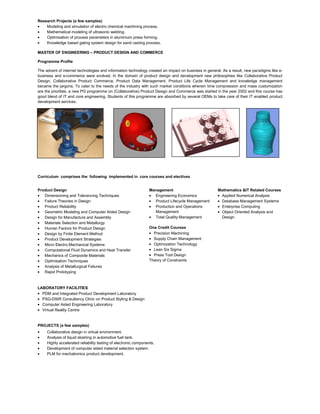
MASTER OF ENGINEERING – PRODUCT DESIGN AND COMMERCE
Programme Profile
The advent of internet technologies and information technology created an impact on business in general. As a result, new paradigms like e-
business and e-commerce were evolved. In the domain of product design and development new philosophies like Collaborative Product
Design, Collaborative Product Commerce, Product Data Management, Product Life Cycle Management and knowledge management
became the jargons. To cater to the needs of the industry with such market conditions wherein time compression and mass customization
are the priorities, a new PG programme on (Collaborative) Product Design and Commerce was started in the year 2002 and this course has
good blend of IT and core engineering. Students of this programme are absorbed by several OEMs to take care of their IT enabled product
development services.
Curriculum comprises the following implemented in core courses and electives
Product Design
Dimensioning and Tolerancing Techniques
Failure Theories in Design
Product Reliability
Geometric Modeling and Computer Aided Design
Design for Manufacture and Assembly
Materials Selection and Metallurgy
Human Factors for Product Design
Design by Finite Element Method
Product Development Strategies
Micro Electro Mechanical Systems
Computational Fluid Dynamics and Heat Transfer
Mechanics of Composite Materials
Optimisation Techniques
Analysis of Metallurgical Failures
Rapid Prototyping
Management
Engineering Economics
Product Lifecycle Management
Production and Operations
Management
Total Quality Management
One Credit Courses
Precision Machining
Supply Chain Management
Optimization Technology
Lean Six Sigma
Press Tool Design
Theory of Constraints
Mathematics &IT Related Courses
Applied Numerical Analysis
Database Management Systems
Enterprise Computing
Object Oriented Analysis and
Design
LABORATORY FACILITIES
PDM and Integrated Product Development Laboratory
PSG-DSIR Consultancy Clinic on Product Styling & Design
Computer Aided Engineering Laboratory
Virtual Reality Centre
PROJECTS (a few samples)
Collaborative design in virtual environment.
Analysis of liquid sloshing in automotive fuel tank.
Highly accelerated reliability testing of electronic components.
Development of computer aided material selection system.
PLM for mechatronics product development.
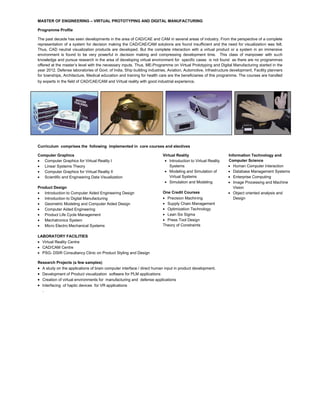
MASTER OF ENGINEERING – VIRTUAL PROTOTYPING AND DIGITAL MANUFACTURING
Programme Profile
The past decade has seen developments in the area of CAD/CAE and CAM in several areas of industry. From the perspective of a complete
representation of a system for decision making the CAD/CAE/CAM solutions are found insufficient and the need for visualization was felt.
Thus, CAD neutral visualization products are developed. But the complete interaction with a virtual product or a system in an immersive
environment is found to be very powerful in decision making and compressing development time. This class of manpower with such
knowledge and pursue research in the area of developing virtual environment for specific cases is not found as there are no programmes
offered at the master’s level with the necessary inputs. Thus, ME-Programme on Virtual Prototyping and Digital Manufacturing started in the
year 2012. Defense laboratories of Govt. of India, Ship building industries, Aviation, Automotive, Infrastructure development, Facility planners
for townships, Architecture, Medical education and training for health care are the beneficiaries of this programme. The courses are handled
by experts in the field of CAD/CAE/CAM and Virtual reality with good industrial experience.
Curriculum comprises the following implemented in core courses and electives
Computer Graphics
Computer Graphics for Virtual Reality I
Linear Systems Theory
Computer Graphics for Virtual Reality II
Scientific and Engineering Data Visualization
Product Design
Introduction to Computer Aided Engineering Design
Introduction to Digital Manufacturing
Geometric Modeling and Computer Aided Design
Computer Aided Engineering
Product Life Cycle Management
Mechatronics System
Micro Electro Mechanical Systems
Virtual Reality
Introduction to Virtual Reality
Systems
Modeling and Simulation of
Virtual Systems
Simulation and Modeling
One Credit Courses
Precision Machining
Supply Chain Management
Optimization Technology
Lean Six Sigma
Press Tool Design
Theory of Constraints
Information Technology and
Computer Science
Human Computer Interaction
Database Management Systems
Enterprise Computing
Image Processing and Machine
Vision
Object oriented analysis and
Design
LABORATORY FACILITIES
Virtual Reality Centre
CAD/CAM Centre
PSG- DSIR Consultancy Clinic on Product Styling and Design
Research Projects (a few samples)
A study on the applications of brain computer interface / direct human input in product development.
Development of Product visualization software for PLM applications
Creation of virtual environments for manufacturing and defense applications
Interfacing of haptic devices for VR applications
.

Production Department Profile13.1

  • 1.
    BE - PRODUCTIONENGINEERING (Regular) Programme Profile As manufacturing activities play a major role in the development of the country, PSG College of Technology envisaged the need for trained manpower in manufacturing and thus the undergraduate programme in Production Engineering was started in the year 1975. Subsequently, department grew in several dimensions of academic excellence with time. The programme has been accredited for five years, in the year 2012, which is the best ranking offered for a BE programme by National Board of Accreditation (NBA), in the year 2012, maintaining its previous accreditation status. All the laboratories of the department are approved for carrying out research, leading to Ph.D Degree (full time and part time) by Anna University, Chennai.. Currently, there are 20 research scholars pursuing their Ph.D work in the department. The department offers consultancy in manufacturing processes, design and testing a range of products, including product styling. The department maintains a close liaison with a large number of universities, industries within the country and (outside) overseas through faculty research and collaborative projects. The teams of dedicated faculty members nurture the programme and actively contribute towards the creation of a high quality learning environment that is persuasive. There is a strong interaction with industry majors like M/s Larsen &Toubro , General Electric, Bangalore, Ashok Leyland, TAFE, Tata Consultancy Services Ltd. and a few more. URRICULUM Curriculum comprises the following implemented in core courses and electives Manufacturing Introduction to Manufacturing Engineering Engineering Graphics Machining Technology Machine Drawing Foundry Technology Welding Technology Manufacturing Metrology Metal Forming Process Finite Element Applications in Manufacturing Micro and Nano-Electro Mechanical System Lean Manufacturing Non-Traditional Machining Techniques Metrology Management Statistical Quality Control Operations Research Economics for Engineers Process Planning and Cost Estimation Production and operations Management Supply Chain Management Engineering Design Engineering Mechanics Engineering Metallurgy Strength of Materials Kinematics of Machinery Dynamics of Machinery Design of Machine Elements Design for Manufacture and Assembly Jigs, Fixtures and Die Design Product Development Strategies Mechanical Vibrations One Credit Courses Precision Machining Supply Chain Management Optimization Technology Lean Six Sigma Press Tool Design Theory of Constraints Allied Engineering Fluid Mechanics and Machinery Thermal System and Heat Transfer Environmental Science and Engineering Cleaner Production Computational Fluid Dynamics Computer programming Automation/CAD/CAM Applied Hydraulics and Pneumatics Instrumentation and Control Systems Sensors Automation and Modular Production System CNC and Robotics Mechatronics PLC Programming and Applications LABORATORY FACILITIES Machine Shop Lathes, milling machine, drilling machine, surface grinding machine, honing machine, lapping machine, injection molding machine, laser engraving machine, hardness testing machines, tensile testing machine, pin on disc wear testing machine, ultra sonic welding (plastics and metals) machine, TIG welding machine, rapid prototyping machine, tool and cutter grinder machine, CNC machines. Metrology Machine vision system, autocollimator, profile projector, tool maker’s microscope, floating carriage micrometer, surface roughness tester, pneumatic and electronic comparator and calibration equipment, sine bar. CAD/CAE/CAM CATIA V6, UNIGRAPHICS NX, PRO-E WILDFIRE, CREO, SOLID WORKS, ALIAS, RHINOCEROS, SOLID CAST, MOLD FLOW PLASTIC INSIGHT, CIMATRON. ANSYS Research Projects (a few samples) Mathematical modeling and simulation of electro chemical machining processes for machining thin sections. Theoretical and experimental studies on flow of molten metal through molds used in foundries. Sensors automation and modular production systems. Mathematical modeling and simulation of temperature and stress distribution while joining cylindrical flat metallic profile by ultrasonic vibration.
  • 2.
    Development of computeraided material selection software Experimental and computational modeling of vibration performance of ultrasonic tools for manufacturing applications. BE PRODUCTION ENGINEERING (Sandwich) Programme Profile As the BE Programme in Production Engineering (Regular) was received well by the industry as planned, an innovation resulted in the creation of BE - PRODUCTION ENGINEERING (SANDWICH) programme,in the year 2002. The students of this programme undergo industrial training in addition to the academic process that is provided in the regular BE programme. As a result, students are equipped with skills that make them ready to be deployed on the job. They undergo internships in several industries and learn several issues in industry and understand techniques to solve them. There is a well planned curriculum for industrial training that smoothly transforms the students to an employable professional. INDUSTRY TRAINING Sandwich students undergo a 5 years of academic programme in which the students are exposed to extensive industrial training utilizing the facilities of the PSG Industrial Institute, Coimbatore, which is a full fledged manufacturing industry, with in the same campus of PSG College of Technology. The curriculum for the sandwich programme is designed to impart the additional practical knowledge both technical and other general facets of industry right from planning to entrepreneurship. In addition to the in-house training, students undergo summer internship for 3 months in the leading industries in India and abroad at the end of their third year. Such training plays a vital role in the professional development and the carrier aspects of the students. Curriculum comprises the following implemented in core courses and electives Manufacturing Introduction to Manufacturing Engineering Engineering Graphics Machining Technology Machine Drawing Foundry Technology Welding Technology Manufacturing Metrology Metal Forming Process Finite Element Applications in Manufacturing Micro and Nano-Electro Mechanical System Lean Manufacturing Non Traditional Machining Techniques Management Statistical Quality Control Operations Research Economics for Engineers Process Planning and Cost Estimation Production and operations Management Supply Chain Management Engineering Design Engineering Mechanics Engineering Metallurgy Strength of Materials Kinematics of Machinery Dynamics of Machinery Design of Machine Elements Design for Manufacture and Assembly Jigs, Fixtures and Die Design Product Development Strategies Mechanical Vibrations Industry Training Manufacturing processes Metrology and Quality Control Industrial Safety Procedures Shop Floor Management Systems Soft Skills Entrepreneurship One Credit Courses Precision Machining Supply Chain Management Optimization Technology Lean Six Sigma Press Tool Design Theory of Constraints Allied Engineering Fluid Mechanics and Machinery Thermal System and Heat Transfer Environmental Science and Engineering Cleaner Production Computational Fluid Dynamics Computer programming Automation/CAD/CAM Applied Hydraulics and Pneumatics Instrumentation and Control System Sensor Automation and Modular Production System CNC and Robotics Mechatronics PLC Programming and Applications LABORATORY FACILITIES Machine Shop Lathes, milling machine, drilling machine, surface grinding machine, honing machine, lapping machine, injection molding machine, laser engraving machine, hardness testing machines, tensile testing machine, pin on disc wear testing machine, ultra sonic welding (plastics and metals) machine, TIG welding machine, rapid prototyping machine, tool and cutter grinder machine, CNC machines Metrology Machine vision system, autocollimator, profile projector, tool maker’s microscope, floating carriage micrometer, surface roughness tester, pneumatic and electronic comparator and calibration equipment, sine bar. CAD/CAE/CAM CATIA V6, UNIGRAPHICS NX, PRO-E WILDFIRE, CREO, SOLID WORKS, ALIAS, RHINOCEROS, SOLID CAST, MOLD FLOW PLASTIC INSIGHT, CIMATRON. ANSYS
  • 3.
    PROJECTS (a fewsamples) Design and development of in-house solar cooking system. Design and development of multilink spatial hyper redundant manipulator. A study on the applications of brain computer interface / direct human input in product development. Development of an online process monitoring system for drilling. Kinematic simulation and fabrication of flapping mechanism for ornithopter. MASTER OF ENGINEERING - PRODUCTION ENGINEERING (FULL TIME & PART TIME) Programme Profile The need for post graduate engineers in production engineering was felt to strengthen the research base for the industry so that manufacturing industry can assimilate the latest design and manufacturing technologies to be cost effective. Thus, the post graduate programme in Production Engineering commenced in the year 1964. For the benefit of practising engineers ME-Production Engineering (part time) programme was also started in the year 1964 with the same curriculum of the full time programme. As production engineering is a specialized one and takes inputs from several areas of engineering and science, a curriculum that covers knowledge on materials, manufacturing processes, material selection, optimization techniques, economics, CAD/CAM and Finite element applications is devised with the involvement of industry. There are well equipped laboratories where students can work in depth to gain knowledge in selected domains of manufacturing. Students of this programme are hired by IT firms, manufacturing companies and academic institutions for teaching and research. Curriculum comprises the following implemented in core courses and electives Manufacturing Dimensioning and Tolerancing Technique Advanced Manufacturing Techniques Geometric Modeling for Manufacturing Finite Element Applications in Manufacturing Industrial Metrology and Calibration Materials Selection and Metallurgy Design for Manufacture and Assembly Tool Design Rapid Prototyping Optimization Techniques Non-Traditional Machining Processes Product Development Strategies Image Processing and Machine Vision Mechatronics System Micro Electro Mechanical Systems Solidification Processing and Foundry Metallurgy Reliability Engineering Lean Manufacturing Agile Manufacturing Management Statistics and Quality Control Engineering Economics Production and Operations Management Supply Chain Management Logistics and Supply Chain Management Total Quality Management Work Systems Engineering Six-Sigma Concepts Automation - CAD/CAM Sensors and Automation in Manufacturing Computer Numerical Control Industrial Robotics Applied Hydraulics and Pneumatics One Credit Courses Precision Machining Supply Chain Management Optimization Technology Lean Six Sigma Press Tool Design Theory of Constraints Mathematics &IT Related Courses Statistics and Quality control Object oriented Programming and Data Structures Enterprise Computing Object Oriented Analysis and Design Database Management Systems Laboratory Facilities Production Engineering Laboratory CAD/CAM Centre Subtractive Rapid Prototyping Laboratory Ultrasonic Welding (Metal & Plastic) Computer Vision and Advanced Metrology Laboratory
  • 4.
    Research Projects (afew samples) Modeling and simulation of electro chemical machining process. Mathematical modeling of ultrasonic welding. Optimisation of process parameters in aluminium press forming. Knowledge based gating system design for sand casting process. MASTER OF ENGINEERING – PRODUCT DESIGN AND COMMERCE Programme Profile The advent of internet technologies and information technology created an impact on business in general. As a result, new paradigms like e- business and e-commerce were evolved. In the domain of product design and development new philosophies like Collaborative Product Design, Collaborative Product Commerce, Product Data Management, Product Life Cycle Management and knowledge management became the jargons. To cater to the needs of the industry with such market conditions wherein time compression and mass customization are the priorities, a new PG programme on (Collaborative) Product Design and Commerce was started in the year 2002 and this course has good blend of IT and core engineering. Students of this programme are absorbed by several OEMs to take care of their IT enabled product development services. Curriculum comprises the following implemented in core courses and electives Product Design Dimensioning and Tolerancing Techniques Failure Theories in Design Product Reliability Geometric Modeling and Computer Aided Design Design for Manufacture and Assembly Materials Selection and Metallurgy Human Factors for Product Design Design by Finite Element Method Product Development Strategies Micro Electro Mechanical Systems Computational Fluid Dynamics and Heat Transfer Mechanics of Composite Materials Optimisation Techniques Analysis of Metallurgical Failures Rapid Prototyping Management Engineering Economics Product Lifecycle Management Production and Operations Management Total Quality Management One Credit Courses Precision Machining Supply Chain Management Optimization Technology Lean Six Sigma Press Tool Design Theory of Constraints Mathematics &IT Related Courses Applied Numerical Analysis Database Management Systems Enterprise Computing Object Oriented Analysis and Design LABORATORY FACILITIES PDM and Integrated Product Development Laboratory PSG-DSIR Consultancy Clinic on Product Styling & Design Computer Aided Engineering Laboratory Virtual Reality Centre PROJECTS (a few samples) Collaborative design in virtual environment. Analysis of liquid sloshing in automotive fuel tank. Highly accelerated reliability testing of electronic components. Development of computer aided material selection system. PLM for mechatronics product development.
  • 5.
    MASTER OF ENGINEERING– VIRTUAL PROTOTYPING AND DIGITAL MANUFACTURING Programme Profile The past decade has seen developments in the area of CAD/CAE and CAM in several areas of industry. From the perspective of a complete representation of a system for decision making the CAD/CAE/CAM solutions are found insufficient and the need for visualization was felt. Thus, CAD neutral visualization products are developed. But the complete interaction with a virtual product or a system in an immersive environment is found to be very powerful in decision making and compressing development time. This class of manpower with such knowledge and pursue research in the area of developing virtual environment for specific cases is not found as there are no programmes offered at the master’s level with the necessary inputs. Thus, ME-Programme on Virtual Prototyping and Digital Manufacturing started in the year 2012. Defense laboratories of Govt. of India, Ship building industries, Aviation, Automotive, Infrastructure development, Facility planners for townships, Architecture, Medical education and training for health care are the beneficiaries of this programme. The courses are handled by experts in the field of CAD/CAE/CAM and Virtual reality with good industrial experience. Curriculum comprises the following implemented in core courses and electives Computer Graphics Computer Graphics for Virtual Reality I Linear Systems Theory Computer Graphics for Virtual Reality II Scientific and Engineering Data Visualization Product Design Introduction to Computer Aided Engineering Design Introduction to Digital Manufacturing Geometric Modeling and Computer Aided Design Computer Aided Engineering Product Life Cycle Management Mechatronics System Micro Electro Mechanical Systems Virtual Reality Introduction to Virtual Reality Systems Modeling and Simulation of Virtual Systems Simulation and Modeling One Credit Courses Precision Machining Supply Chain Management Optimization Technology Lean Six Sigma Press Tool Design Theory of Constraints Information Technology and Computer Science Human Computer Interaction Database Management Systems Enterprise Computing Image Processing and Machine Vision Object oriented analysis and Design LABORATORY FACILITIES Virtual Reality Centre CAD/CAM Centre PSG- DSIR Consultancy Clinic on Product Styling and Design Research Projects (a few samples) A study on the applications of brain computer interface / direct human input in product development. Development of Product visualization software for PLM applications Creation of virtual environments for manufacturing and defense applications Interfacing of haptic devices for VR applications .