











October 8th,
2024 Speaker: Peter Ward
Why M365 product development
is different from project
development
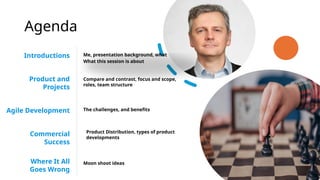
Agenda
Me, presentation background, what
What this session is about
The challenges, and benefits
Compare and contrast, focus and scope,
roles, team structure
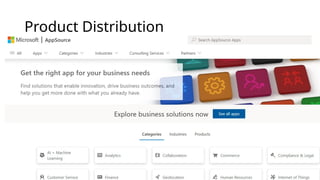
Product Distribution, types of product
developments
Introductions
Agile Development
Product and
Projects
Commercial
Success
Moon shoot ideas
Where It All
Goes Wrong
Preflight Briefing
• All on my blog:
www.wardpeter.com
• Get ready to ask questions
• Feel free to interrupt
• Connect with me on
Linkedin
Introductions
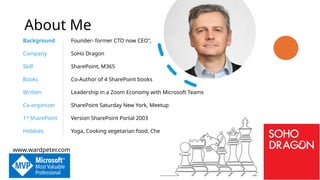
About Me
Background Founder- former CTO now CEO",
Company SoHo Dragon
Skill SharePoint, M365
Books Co-Author of 4 SharePoint books
Written Leadership in a Zoom Economy with Microsoft Teams
Co-organizer SharePoint Saturday New York, Meetup
1St
SharePoint Version SharePoint Portal 2003
Hobbies Yoga, Cooking vegetarian food, Chess
www.wardpeter.com
This
presentation is
on my LinkedIn
Thank you
7
DISCLAIMER
I am not talking about:
• Raising money
• In-depth development
practices
• Scales
• Best Practices
Why M365 product
development is different
from project development
THERE IS A
FUNDAMENTAL
MISUNDERSTANDING:
- MISSION OBJECTIVE
- BUDGET
- DEVELOPMENT LIFE
CYCLE
Presentation Background
Definition of
Projects and
Products
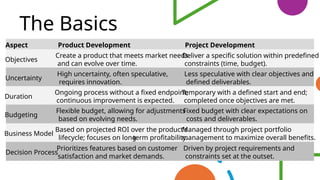
The Basics
Project Development
Product Development
Aspect
Deliver a specific solution within predefined
constraints (time, budget).
Create a product that meets market needs
and can evolve over time.
Objectives
Less speculative with clear objectives and
defined deliverables.
High uncertainty, often speculative,
requires innovation.
Uncertainty
Temporary with a defined start and end;
completed once objectives are met.
Ongoing process without a fixed endpoint;
continuous improvement is expected.
Duration
Fixed budget with clear expectations on
costs and deliverables.
Flexible budget, allowing for adjustments
based on evolving needs.
Budgeting
-
term profitability.
Managed through project portfolio
management to maximize overall benefits.
Based on projected ROI over the product's
lifecycle; focuses on long
Business Model
Driven by project requirements and
constraints set at the outset.
Prioritizes features based on customer
satisfaction and market demands.
Decision Process
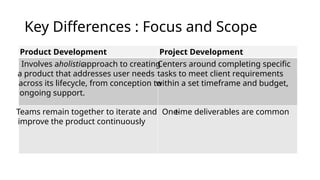
Key Differences : Focus and Scope
Project Development
Product Development
Centers around completing specific
tasks to meet client requirements
within a set timeframe and budget,
Involves aholistic
approach to creating
a product that addresses user needs
across its lifecycle, from conception to
ongoing support.
One-
time deliverables are common
Teams remain together to iterate and
improve the product continuously
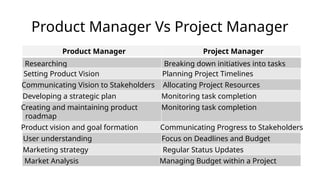
Product Manager Vs Project Manager
Researching
Project Manager
Product Manager
Planning Project Timelines
Setting Product Vision
Allocating Project Resources
Communicating Vision to Stakeholders
Monitoring task completion
Developing a strategic plan
Monitoring task completion
Creating and maintaining product
roadmap
Communicating Progress to Stakeholders
Product vision and goal formation
Focus on Deadlines and Budget
User understanding
Regular Status Updates
Marketing strategy
Managing Budget within a Project
Market Analysis
Breaking down initiatives into tasks
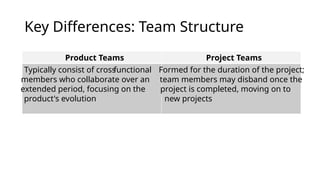
Key Differences: Team Structure
Project Teams
Product Teams
Formed for the duration of the project;
team members may disband once the
project is completed, moving on to
new projects
Typically consist of cross
-functional
members who collaborate over an
extended period, focusing on the
product's evolution
Key Differences:
Conclusion
Product development is an ongoing process
centered around creating and improving a
product for long-term market success.
In contrast, project development is a finite
endeavor that delivers specific outcomes
within defined constraints.
Understanding these differences allows
organizations to choose the appropriate
approach based on their goals and resources.
Agile Methodology with
Product Development-
Challenges
• Scope Creep: The openness to change
can lead to an overwhelming number of
adjustments that may derail timelines2
• Measurement Difficulties: Tracking
progress can be complex since success
is often gauged through iterative
milestones rather than traditional
metrics
• Resource Management: Rapid
changes may strain resources if not
managed properly, especially in long-
term projects where consistent
direction is needed
Agile Methodology with
Product Development-
Benefits
Focus on User Needs: This user-centric
approach ensures that features added to the
product align closely with customer
requirements, leading to higher satisfaction
levels.
Early and Continuous Delivery: Agile
promotes delivering functional increments
of the product at regular intervals (sprints).
Improved Product Quality: Agile’s iterative
nature encourages frequent testing and
review, which helps identify issues early in
the development cycle.
Agile Methodology with
Product Development-
Benefits ..Continued
Flexibility and Adaptability: Agile methodologies are designed
to embrace change, allowing teams to adjust their plans based
on evolving customer needs or market conditions. This
adaptability is crucial in today’s fast-paced business
environment.
1. Enhanced Collaboration: Agile fosters close collaboration
among team members and stakeholders through regular
communication and meetings.
2. Reduced Risk: By breaking down projects into smaller,
manageable parts, Agile allows for ongoing assessment of
progress and risks.
3. Increased Engagement: Agile empowers team members by
involving them in decision-making processes and fostering a
sense of ownership over their work.
4. Predictability: Working in defined timeframes (sprints) helps
teams better estimate timelines and costs, making it easier to
manage resources effectively.
Product Distribution
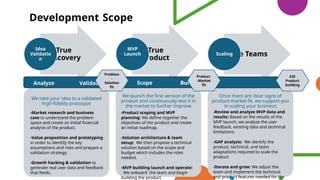
Development Scope
True
Discovery
Idea
Validatio
n
True
Product
MVP
Launch True Teams
Scaling
We take your idea to a validated
high-fidelity prototype
We launch the first version of the
product and continuously test it in
the market to further improve
Once there are clear signs of
product-market-fit, we support you
in scaling your business
Analyze Validate Scope Build
Problem
-
Solution
fit
Product
-Market
fit
E2E
Product
building
-Market research and business
case to understand the problem
space and create an initial financial
analysis of the product.
-Value proposition and prototyping
in order to identify the key
assumptions and risks and prepare a
validation strategy.
-Growth hacking & validation to
generate real user data and feedback
that feeds.
-Product scoping and MVP
planning: We define together the
objectives of the product and create
an initial roadmap.
-Solution architecture & team
setup: We then propose a technical
solution based on the scope and
budget which includes the roles
needed.
-MVP building launch and operate:
We onboard the team and begin
building the product.
-Review and analyze MVP data and
results: Based on the results of the
MVP launch, we analyze the user
feedback, existing data and technical
limitations.
-GAP analysis: We identify the
product, technical, and team
adaptations required to scale the
product.
-Iterate and grow: We adjust the
team and implement the technical
and product features needed for the
Be Curious -
Not
Judgmental
Product Managers Frequently Do Not Do
This
What I Am Witnessing
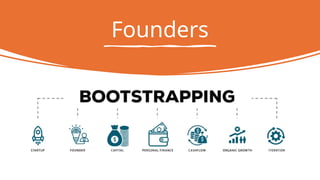
• Founders
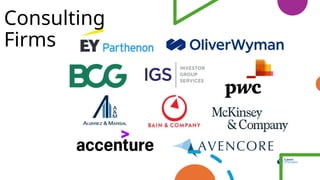
• Consulting Firms
• VC Start Up
Founders
Consulting
Firms
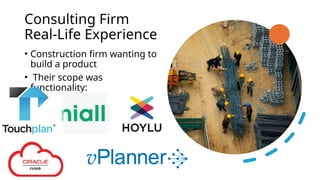
Consulting Firm
Real-Life Experience
• Construction firm wanting to
build a product
• Their scope was
functionality:
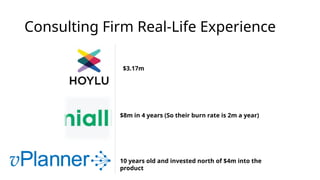
Consulting Firm Real-Life Experience
10 years old and invested north of $4m into the
product
$3.17m
$8m in 4 years (So their burn rate is 2m a year)
Bootstrap Start-Ups
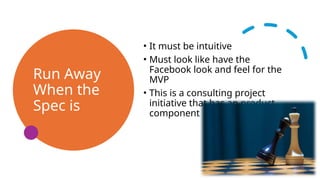
Run Away
When the
Spec is
• It must be intuitive
• Must look like have the
Facebook look and feel for the
MVP
• This is a consulting project
initiative that has an product
component
Moon shots Ideas…
Of lack of them
• 10X Moonshot Ideas are
found in Psychology NOT
Engineering
• Not technical lens
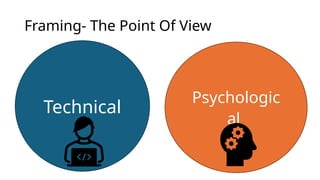
Framing- The Point Of View
Technical
Psychologic
al
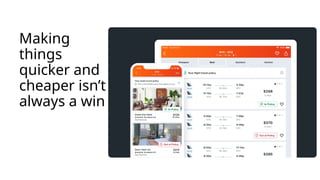
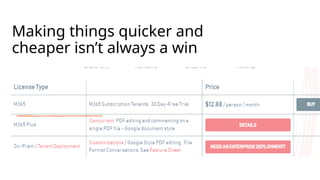
Making
things
quicker and
cheaper isn’t
always a win
Making
things
quicker and
cheaper isn’t
always a win
Making things quicker and
cheaper isn’t always a win
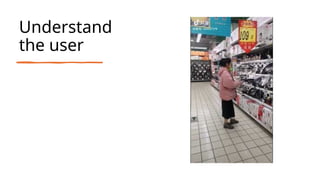
Understand
the user
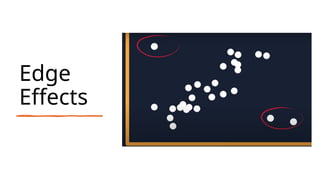
Edge
Effects
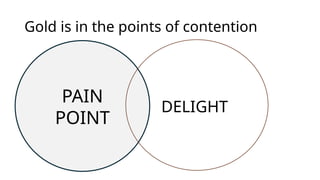
Gold is in the points of contention
PAIN
POINT
DELIGHT
Power Of Asking the
Right Questions
Quest for
Perfect
Measurement
• Data-driven…
Predictable
• Data-informed – Try it
Humans
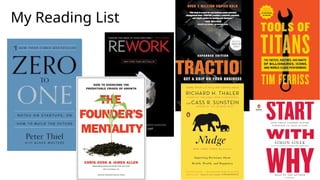
My Reading List

Why M365 product development is different from project development- New.pptx

  • 1.
    October 8th, 2024 Speaker:Peter Ward Why M365 product development is different from project development
  • 2.
    Agenda Me, presentation background,what What this session is about The challenges, and benefits Compare and contrast, focus and scope, roles, team structure Product Distribution, types of product developments Introductions Agile Development Product and Projects Commercial Success Moon shoot ideas Where It All Goes Wrong
  • 3.
    Preflight Briefing • Allon my blog: www.wardpeter.com • Get ready to ask questions • Feel free to interrupt • Connect with me on Linkedin
  • 4.
  • 5.
    About Me Background Founder-former CTO now CEO", Company SoHo Dragon Skill SharePoint, M365 Books Co-Author of 4 SharePoint books Written Leadership in a Zoom Economy with Microsoft Teams Co-organizer SharePoint Saturday New York, Meetup 1St SharePoint Version SharePoint Portal 2003 Hobbies Yoga, Cooking vegetarian food, Chess www.wardpeter.com
  • 6.
  • 7.
  • 8.
    DISCLAIMER I am nottalking about: • Raising money • In-depth development practices • Scales • Best Practices
  • 9.
    Why M365 product developmentis different from project development THERE IS A FUNDAMENTAL MISUNDERSTANDING: - MISSION OBJECTIVE - BUDGET - DEVELOPMENT LIFE CYCLE
  • 10.
  • 15.
  • 16.
    The Basics Project Development ProductDevelopment Aspect Deliver a specific solution within predefined constraints (time, budget). Create a product that meets market needs and can evolve over time. Objectives Less speculative with clear objectives and defined deliverables. High uncertainty, often speculative, requires innovation. Uncertainty Temporary with a defined start and end; completed once objectives are met. Ongoing process without a fixed endpoint; continuous improvement is expected. Duration Fixed budget with clear expectations on costs and deliverables. Flexible budget, allowing for adjustments based on evolving needs. Budgeting - term profitability. Managed through project portfolio management to maximize overall benefits. Based on projected ROI over the product's lifecycle; focuses on long Business Model Driven by project requirements and constraints set at the outset. Prioritizes features based on customer satisfaction and market demands. Decision Process
  • 17.
    Key Differences :Focus and Scope Project Development Product Development Centers around completing specific tasks to meet client requirements within a set timeframe and budget, Involves aholistic approach to creating a product that addresses user needs across its lifecycle, from conception to ongoing support. One- time deliverables are common Teams remain together to iterate and improve the product continuously
  • 18.
    Product Manager VsProject Manager Researching Project Manager Product Manager Planning Project Timelines Setting Product Vision Allocating Project Resources Communicating Vision to Stakeholders Monitoring task completion Developing a strategic plan Monitoring task completion Creating and maintaining product roadmap Communicating Progress to Stakeholders Product vision and goal formation Focus on Deadlines and Budget User understanding Regular Status Updates Marketing strategy Managing Budget within a Project Market Analysis Breaking down initiatives into tasks
  • 19.
    Key Differences: TeamStructure Project Teams Product Teams Formed for the duration of the project; team members may disband once the project is completed, moving on to new projects Typically consist of cross -functional members who collaborate over an extended period, focusing on the product's evolution
  • 20.
    Key Differences: Conclusion Product developmentis an ongoing process centered around creating and improving a product for long-term market success. In contrast, project development is a finite endeavor that delivers specific outcomes within defined constraints. Understanding these differences allows organizations to choose the appropriate approach based on their goals and resources.
  • 21.
    Agile Methodology with ProductDevelopment- Challenges • Scope Creep: The openness to change can lead to an overwhelming number of adjustments that may derail timelines2 • Measurement Difficulties: Tracking progress can be complex since success is often gauged through iterative milestones rather than traditional metrics • Resource Management: Rapid changes may strain resources if not managed properly, especially in long- term projects where consistent direction is needed
  • 22.
    Agile Methodology with ProductDevelopment- Benefits Focus on User Needs: This user-centric approach ensures that features added to the product align closely with customer requirements, leading to higher satisfaction levels. Early and Continuous Delivery: Agile promotes delivering functional increments of the product at regular intervals (sprints). Improved Product Quality: Agile’s iterative nature encourages frequent testing and review, which helps identify issues early in the development cycle.
  • 23.
    Agile Methodology with ProductDevelopment- Benefits ..Continued Flexibility and Adaptability: Agile methodologies are designed to embrace change, allowing teams to adjust their plans based on evolving customer needs or market conditions. This adaptability is crucial in today’s fast-paced business environment. 1. Enhanced Collaboration: Agile fosters close collaboration among team members and stakeholders through regular communication and meetings. 2. Reduced Risk: By breaking down projects into smaller, manageable parts, Agile allows for ongoing assessment of progress and risks. 3. Increased Engagement: Agile empowers team members by involving them in decision-making processes and fostering a sense of ownership over their work. 4. Predictability: Working in defined timeframes (sprints) helps teams better estimate timelines and costs, making it easier to manage resources effectively.
  • 24.
  • 25.
    Development Scope True Discovery Idea Validatio n True Product MVP Launch TrueTeams Scaling We take your idea to a validated high-fidelity prototype We launch the first version of the product and continuously test it in the market to further improve Once there are clear signs of product-market-fit, we support you in scaling your business Analyze Validate Scope Build Problem - Solution fit Product -Market fit E2E Product building -Market research and business case to understand the problem space and create an initial financial analysis of the product. -Value proposition and prototyping in order to identify the key assumptions and risks and prepare a validation strategy. -Growth hacking & validation to generate real user data and feedback that feeds. -Product scoping and MVP planning: We define together the objectives of the product and create an initial roadmap. -Solution architecture & team setup: We then propose a technical solution based on the scope and budget which includes the roles needed. -MVP building launch and operate: We onboard the team and begin building the product. -Review and analyze MVP data and results: Based on the results of the MVP launch, we analyze the user feedback, existing data and technical limitations. -GAP analysis: We identify the product, technical, and team adaptations required to scale the product. -Iterate and grow: We adjust the team and implement the technical and product features needed for the
  • 26.
  • 27.
  • 28.
    What I AmWitnessing • Founders • Consulting Firms • VC Start Up
  • 29.
  • 30.
  • 31.
    Consulting Firm Real-Life Experience •Construction firm wanting to build a product • Their scope was functionality:
  • 32.
    Consulting Firm Real-LifeExperience 10 years old and invested north of $4m into the product $3.17m $8m in 4 years (So their burn rate is 2m a year)
  • 33.
  • 35.
    Run Away When the Specis • It must be intuitive • Must look like have the Facebook look and feel for the MVP • This is a consulting project initiative that has an product component
  • 37.
    Moon shots Ideas… Oflack of them • 10X Moonshot Ideas are found in Psychology NOT Engineering • Not technical lens
  • 40.
    Framing- The PointOf View Technical Psychologic al
  • 41.
  • 42.
  • 43.
    Making things quickerand cheaper isn’t always a win
  • 44.
  • 45.
  • 46.
    Gold is inthe points of contention PAIN POINT DELIGHT
  • 49.
    Power Of Askingthe Right Questions
  • 50.
  • 52.

Editor's Notes

  • #1 Understanding the distinction between product development and project development is essential for organizations aiming to optimize their processes and outcomes. While both involve creating solutions, they differ significantly in objectives, processes, and outcomes. https://www.perplexity.ai/search/what-is-the-difference-between-SyV3jqjURHObwCz8fnZHJg
  • #7 You are the best-looking audience I’ve seen. In fact you are better looking than the people in todays keynote
  • #9 I am witnessing
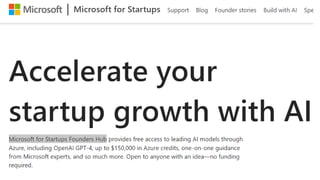
  • #11 https://foundershub.startups.microsoft.com/signup
  • #16 Product Development Focuses on creating a product that meets market needs and can evolve over time. Involves high uncertainty; often speculative, requiring innovation. Ongoing process without a fixed endpoint; continuous improvement is expected. More flexible budget, allowing for adjustments based on evolving needs. Based on projected ROI over the product's lifecycle; focuses on long-term profitability. Prioritizes features based on customer satisfaction and market demands. Project Development Aims to deliver a specific solution within predefined constraints (time, budget). Generally less speculative with clear objectives and defined deliverables. Temporary with a defined start and end; completed once objectives are met. Fixed budget with clear expectations on costs and deliverables. Managed through project portfolio management to maximize overall benefits. Decisions are driven by project requirements and constraints set at the outset.
  • #21 I don’t know why I started off with the negative first
  • #22 In summary, Agile methodologies enhance product development by promoting a user-focused approach, ensuring quality through iterative processes, fostering collaboration, and allowing for flexibility in responding to change. These benefits collectively contribute to delivering better products that meet customer needs more effectively Focus on User Needs: Agile emphasizes understanding and responding to real user feedback throughout the development process. This user-centric approach ensures that features added to the product align closely with customer requirements, leading to higher satisfaction levels Early and Continuous Delivery: Agile promotes delivering functional increments of the product at regular intervals (sprints). This allows teams to provide features to customers more frequently, enabling quicker realization of value and facilitating continuous feedback loops1 Improved Product Quality: The iterative nature of Agile encourages frequent testing and review, which helps identify issues early in the development cycle. This focus on quality control leads to superior products that better meet user expectations.
  • #23 In summary, Agile methodologies enhance product development by promoting a user-focused approach, ensuring quality through iterative processes, fostering collaboration, and allowing for flexibility in responding to change. These benefits collectively contribute to delivering better products that meet customer needs more effectively Flexibility and Adaptability: Agile methodologies are designed to embrace change, allowing teams to adjust their plans based on evolving customer needs or market conditions. This adaptability is crucial in today’s fast-paced business environment Enhanced Collaboration: Agile fosters close collaboration among team members and stakeholders through regular communication and meetings. This collaborative environment ensures that everyone is aligned on goals and can address challenges promptly Reduced Risk: By breaking down projects into smaller, manageable parts, Agile allows for ongoing assessment of progress and risks. This proactive approach helps teams identify potential obstacles early, mitigating risks before they escalate3 Increased Engagement: Agile empowers team members by involving them in decision-making processes and fostering a sense of ownership over their work. This engagement can lead to higher morale and productivity within teams Predictability: Working in defined timeframes (sprints) helps teams better estimate timelines and costs, making it easier to manage resources effectively. This predictability aids in planning and prioritizing tasks
  • #34 Technology isn’t enough
  • #36 Commercial Success
  • #37 Founders are engineers
  • #38 What people aren’t saying Uncover beliefs – Feelings This is an art….. Not thoughts and opinions but insights, feeling Stories – late to an airport
  • #39 I hate it when it takes a long time to turn up……. The engineer would respond to this and say , ‘Better algorism ’ More tasks What bothers people is not the wait, but the degree of uncertainty And it’s more enjoyable to see the progress of the taxi coming. It keeps me busy. People like the wait in a restaurant after the food has been ordered Framing the right problem Also I feel important….. Walk on to the sidewalk….. Don’t like standing in the rain Vision Safety
  • #40 Framing the right problem
  • #41 Perception The delay Known as the Ikea effect
  • #42 Perception The delay Known as the Ikea effect
  • #43 Perception The delay Known as the Ikea effect
  • #45 Counter intuitive Ideas Outlier data, that often doesn’t fit comfortably in the data constructed Two extremes meet Gold is in the points of contention
  • #46 An edge effect Turn pain into delight Restaurant – don’t like waiting for the order… but the experience is better once I’ve ordered
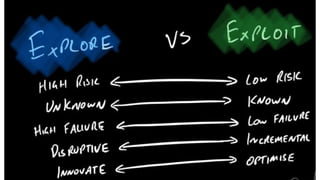
  • #47 Explore Uber Exploit - Consulting Firms Existing processes
  • #48 Creative types…. They will kill most creativity. You need efficiency Observation – HR and Pen pushers Call Center is not a cost center if it serving the customer Need imagination
  • #49 Habit – Subscription- Seen as a service not as a transaction and Social Copying – Online reviews- Trust Pilot How to break the autopilot follow Promotions Referrals Poor conversation Optimize the repeat purchase
  • #50 Both tangible and intangible Explore activities Promotions Explore pricing Data-driven… Predictable Data-informed – Try it Humas