Harvard Business School Case
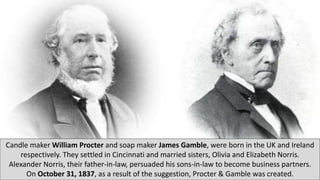
Candle maker William Procter and soap maker James Gamble, were born in the UK and Ireland
respectively. They settled in Cincinnati and married sisters, Olivia and Elizabeth Norris.
Alexander Norris, their father-in-law, persuaded his sons-in-law to become business partners.
On October 31, 1837, as a result of the suggestion, Procter & Gamble was created.
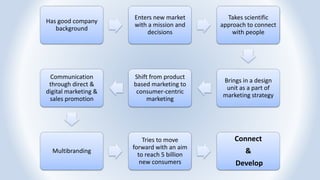
Has good company
background
Enters new market
with a mission and
decisions
Takes scientific
approach to connect
with people
Brings in a design
unit as a part of
marketing strategy
Shift from product
based marketing to
consumer-centric
marketing
Communication
through direct &
digital marketing &
sales promotion
Multibranding
Tries to move
forward with an aim
to reach 5 billion
new consumers
Connect
&
Develop
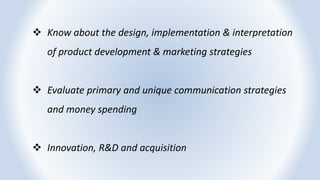
 Know about the design, implementation & interpretation
of product development & marketing strategies
 Evaluate primary and unique communication strategies
and money spending
 Innovation, R&D and acquisition
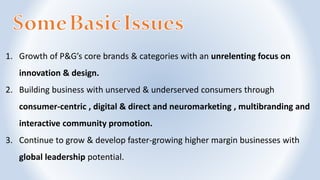
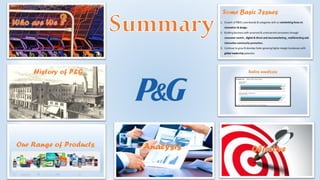
1. Growth of P&G’s core brands & categories with an unrelenting focus on
innovation & design.
2. Building business with unserved & underserved consumers through
consumer-centric , digital & direct and neuromarketing , multibranding and
interactive community promotion.
3. Continue to grow & develop faster-growing higher margin businesses with
global leadership potential.
ISSUE 1
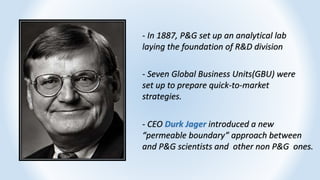
- In 1887, P&G set up an analytical lab
laying the foundation of R&D division
- Seven Global Business Units(GBU) were
set up to prepare quick-to-market
strategies.
- CEO Durk Jager introduced a new
“permeable boundary” approach between
and P&G scientists and other non P&G ones.
ISSUE 2
(A)
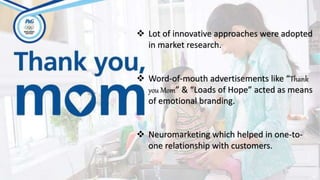
 Lot of innovative approaches were adopted
in market research.
 Word-of-mouth advertisements like “Thank
you Mom” & “Loads of Hope” acted as means
of emotional branding.
 Neuromarketing which helped in one-to-
one relationship with customers.
(B)
 Earlier P&G had pursued a multiband
 New design unit was created for design innovation & strategy
 A consumer-centric marketing approach was followed
 Focus on “shopper marketing experience”
(C)
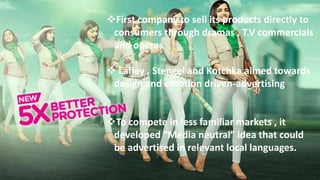
First company to sell its products directly to
consumers through dramas , T.V commercials
and operas
 Lafley , Stengel and Kotchka aimed towards
design and emotion driven-advertising
To compete in less familiar markets , it
developed “Media neutral” idea that could
be advertised in relevant local languages.
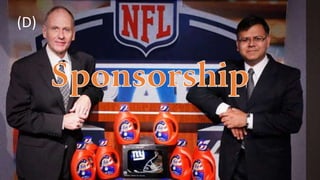
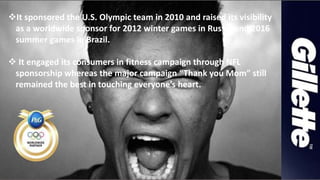
(D)
It sponsored the U.S. Olympic team in 2010 and raised its visibility
as a worldwide sponsor for 2012 winter games in Russia and 2016
summer games in Brazil.
 It engaged its consumers in fitness campaign through NFL
sponsorship whereas the major campaign “Thank you Mom” still
remained the best in touching everyone’s heart.
(E)
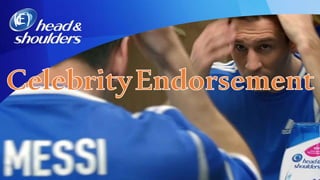
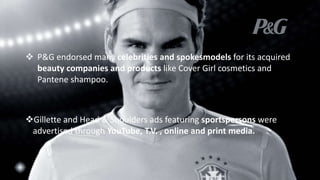
Gillette and Head & Shoulders ads featuring sportspersons were
advertised through YouTube, T.V. , online and print media.
 P&G endorsed many celebrities and spokesmodels for its acquired
beauty companies and products like Cover Girl cosmetics and
Pantene shampoo.
(F)
During recession in 2009 , P&G shifted to coupons
and in-store promotional activities
In 2010, P&G increased ad spending by $1 billion,
with a 20% increase in media impressions
McDonald, who became CEO in 2010, stated that
P&G would maintain the same level of spending,
while shifting dollars to digital advertising
(G)
In 2007, P&G launched two social media sites: Capessa for women on Yahoo!
P&G used Facebook as a marketing supplement, not a replacement
P&G rounded out its earlier social media efforts with Manofthehouse.com,
which featured household advice for men
 Social media was a way to speak to its audience virtually
(H)
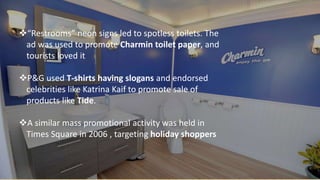
“Restrooms” neon signs led to spotless toilets. The
ad was used to promote Charmin toilet paper, and
tourists loved it
P&G used T-shirts having slogans and endorsed
celebrities like Katrina Kaif to promote sale of
products like Tide.
A similar mass promotional activity was held in
Times Square in 2006 , targeting holiday shoppers
ISSUE 3
Digital marketing with campaigns, Emotional, design and function driven
marketing , R&D , consumer research & product performance.
DISCLAIMER
Created by Prateek Verma, NIT Raipur during
Marketing Internship by Prof Sameer Mathur, IIM
Lucknow

P&G: Case study

  • 1.
  • 7.
    Candle maker WilliamProcter and soap maker James Gamble, were born in the UK and Ireland respectively. They settled in Cincinnati and married sisters, Olivia and Elizabeth Norris. Alexander Norris, their father-in-law, persuaded his sons-in-law to become business partners. On October 31, 1837, as a result of the suggestion, Procter & Gamble was created.
  • 13.
    Has good company background Entersnew market with a mission and decisions Takes scientific approach to connect with people Brings in a design unit as a part of marketing strategy Shift from product based marketing to consumer-centric marketing Communication through direct & digital marketing & sales promotion Multibranding Tries to move forward with an aim to reach 5 billion new consumers Connect & Develop
  • 15.
     Know aboutthe design, implementation & interpretation of product development & marketing strategies  Evaluate primary and unique communication strategies and money spending  Innovation, R&D and acquisition
  • 16.
    1. Growth ofP&G’s core brands & categories with an unrelenting focus on innovation & design. 2. Building business with unserved & underserved consumers through consumer-centric , digital & direct and neuromarketing , multibranding and interactive community promotion. 3. Continue to grow & develop faster-growing higher margin businesses with global leadership potential.
  • 17.
  • 18.
    - In 1887,P&G set up an analytical lab laying the foundation of R&D division - Seven Global Business Units(GBU) were set up to prepare quick-to-market strategies. - CEO Durk Jager introduced a new “permeable boundary” approach between and P&G scientists and other non P&G ones.
  • 19.
  • 20.
  • 21.
     Lot ofinnovative approaches were adopted in market research.  Word-of-mouth advertisements like “Thank you Mom” & “Loads of Hope” acted as means of emotional branding.  Neuromarketing which helped in one-to- one relationship with customers.
  • 22.
  • 23.
     Earlier P&Ghad pursued a multiband  New design unit was created for design innovation & strategy  A consumer-centric marketing approach was followed  Focus on “shopper marketing experience”
  • 24.
  • 25.
    First company tosell its products directly to consumers through dramas , T.V commercials and operas  Lafley , Stengel and Kotchka aimed towards design and emotion driven-advertising To compete in less familiar markets , it developed “Media neutral” idea that could be advertised in relevant local languages.
  • 26.
  • 27.
    It sponsored theU.S. Olympic team in 2010 and raised its visibility as a worldwide sponsor for 2012 winter games in Russia and 2016 summer games in Brazil.  It engaged its consumers in fitness campaign through NFL sponsorship whereas the major campaign “Thank you Mom” still remained the best in touching everyone’s heart.
  • 28.
  • 29.
    Gillette and Head& Shoulders ads featuring sportspersons were advertised through YouTube, T.V. , online and print media.  P&G endorsed many celebrities and spokesmodels for its acquired beauty companies and products like Cover Girl cosmetics and Pantene shampoo.
  • 30.
  • 31.
    During recession in2009 , P&G shifted to coupons and in-store promotional activities In 2010, P&G increased ad spending by $1 billion, with a 20% increase in media impressions McDonald, who became CEO in 2010, stated that P&G would maintain the same level of spending, while shifting dollars to digital advertising
  • 32.
  • 33.
    In 2007, P&Glaunched two social media sites: Capessa for women on Yahoo! P&G used Facebook as a marketing supplement, not a replacement P&G rounded out its earlier social media efforts with Manofthehouse.com, which featured household advice for men  Social media was a way to speak to its audience virtually
  • 34.
  • 35.
    “Restrooms” neon signsled to spotless toilets. The ad was used to promote Charmin toilet paper, and tourists loved it P&G used T-shirts having slogans and endorsed celebrities like Katrina Kaif to promote sale of products like Tide. A similar mass promotional activity was held in Times Square in 2006 , targeting holiday shoppers
  • 36.
  • 37.
    Digital marketing withcampaigns, Emotional, design and function driven marketing , R&D , consumer research & product performance.
  • 39.
    DISCLAIMER Created by PrateekVerma, NIT Raipur during Marketing Internship by Prof Sameer Mathur, IIM Lucknow