Procrastination Presentation by Jegan Sekar
Procrastination – What is it? Voluntarily delay a course of action despite expecting to be worse off for the delay. Put off intentionally and habitually the doing of something that should be done. Someone who knows what she or he wants to do, in some sense can do it, is trying to do it – yet doesn’t do it.
Prevalence Procrastination afflicts millions of people and almost always has negative effects on productivity and sense of well-being. 60% of people are moderate procrastinators 6% of people are frequent procrastinators 95% of those surveyed indicate that they procrastinate occasionally
Excuses I’m waiting for divine inspiration I have to be ready I’ll do it tomorrow If I wait, it might go away I have no control – the cards are stacked against me I work best under pressure I can’t do it now – my desk is messy
Why overcome procrastination? Putting things off to the last minute almost always reduces your ability to perform at your best Procrastinators often never perform the required or desired task (they wait until it is too late) Procrastination leads to stress and/or decreased sense of well-being and/or self-esteem
Causes Stress and anxiety – Too overwhelmed and worried to even being working on tasks Rebellion – I don’t want to do it. You can’t make me do it Difficulty concentrating – Noisy, phone is ringing, desk is cluttered, etc. Fear of failure – If I don’t achieve a certain mark, am a failure.
Causes Lack of enjoyment – I don’t like this task. So, I turn to more enjoyable immediate activities. Unrealistic expectations/perfectionism – I must always achieve ‘A’. Poor time management – Uncertain of your priorities, goals & objectives. Preoccupation with personal problems – Focusing on personal problems like financial difficulty, relationship issues, etc.
Cures for procrastination - 1 Replace ‘should’ & ‘fear’ with ‘want’ & ‘need’ If a task is based on what you truly want or need, you’re likely to be more motivated Don’t sabotage your own want/need just because others also think you should accomplish something
Cures for procrastination - 2 Break down the task into smaller ones When confronted with a task of reading 150 pages, we feel overwhelmed. Instead, if we decide to take up 50 pages at a time, we can endure. The most significant barrier in procrastination is getting started.
Cures for procrastination - 3 Set up a reward-punishment system If I finish this task, I can take a coffee break. If I don’t, I need to skip the break. These rewards and punishments only matter if we consistently implement them.
Cures for procrastination - 4 Modify your goals to include these 4 characteristics 1. Short term 2. Specific 3. Attainable 4. Measurable Change your negative thinking Remind yourself of the skills & abilities you possess Stop focusing on faults & flaws. Remember that ‘failure’ is an opportunity to learn from your mistakes
Cures for procrastination - 5 Reduce stress Stress leads to procrastination which in turn leads to stress. This is a vicious cycle. Maintain stress in the optimum area which will improve performance. Reduce distractions Work in an organized environment Be prepared – have everything at your fingertips
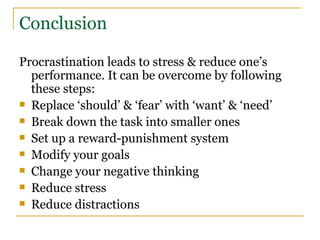
Conclusion Procrastination leads to stress & reduce one’s performance. It can be overcome by following these steps: Replace ‘should’ & ‘fear’ with ‘want’ & ‘need’ Break down the task into smaller ones Set up a reward-punishment system Modify your goals Change your negative thinking Reduce stress Reduce distractions
Thank You

Procrastination

  • 1.
  • 2.
    Procrastination – Whatis it? Voluntarily delay a course of action despite expecting to be worse off for the delay. Put off intentionally and habitually the doing of something that should be done. Someone who knows what she or he wants to do, in some sense can do it, is trying to do it – yet doesn’t do it.
  • 3.
    Prevalence Procrastination afflictsmillions of people and almost always has negative effects on productivity and sense of well-being. 60% of people are moderate procrastinators 6% of people are frequent procrastinators 95% of those surveyed indicate that they procrastinate occasionally
  • 4.
    Excuses I’m waitingfor divine inspiration I have to be ready I’ll do it tomorrow If I wait, it might go away I have no control – the cards are stacked against me I work best under pressure I can’t do it now – my desk is messy
  • 5.
    Why overcome procrastination?Putting things off to the last minute almost always reduces your ability to perform at your best Procrastinators often never perform the required or desired task (they wait until it is too late) Procrastination leads to stress and/or decreased sense of well-being and/or self-esteem
  • 6.
    Causes Stress andanxiety – Too overwhelmed and worried to even being working on tasks Rebellion – I don’t want to do it. You can’t make me do it Difficulty concentrating – Noisy, phone is ringing, desk is cluttered, etc. Fear of failure – If I don’t achieve a certain mark, am a failure.
  • 7.
    Causes Lack ofenjoyment – I don’t like this task. So, I turn to more enjoyable immediate activities. Unrealistic expectations/perfectionism – I must always achieve ‘A’. Poor time management – Uncertain of your priorities, goals & objectives. Preoccupation with personal problems – Focusing on personal problems like financial difficulty, relationship issues, etc.
  • 8.
    Cures for procrastination- 1 Replace ‘should’ & ‘fear’ with ‘want’ & ‘need’ If a task is based on what you truly want or need, you’re likely to be more motivated Don’t sabotage your own want/need just because others also think you should accomplish something
  • 9.
    Cures for procrastination- 2 Break down the task into smaller ones When confronted with a task of reading 150 pages, we feel overwhelmed. Instead, if we decide to take up 50 pages at a time, we can endure. The most significant barrier in procrastination is getting started.
  • 10.
    Cures for procrastination- 3 Set up a reward-punishment system If I finish this task, I can take a coffee break. If I don’t, I need to skip the break. These rewards and punishments only matter if we consistently implement them.
  • 11.
    Cures for procrastination- 4 Modify your goals to include these 4 characteristics 1. Short term 2. Specific 3. Attainable 4. Measurable Change your negative thinking Remind yourself of the skills & abilities you possess Stop focusing on faults & flaws. Remember that ‘failure’ is an opportunity to learn from your mistakes
  • 12.
    Cures for procrastination- 5 Reduce stress Stress leads to procrastination which in turn leads to stress. This is a vicious cycle. Maintain stress in the optimum area which will improve performance. Reduce distractions Work in an organized environment Be prepared – have everything at your fingertips
  • 13.
    Conclusion Procrastination leadsto stress & reduce one’s performance. It can be overcome by following these steps: Replace ‘should’ & ‘fear’ with ‘want’ & ‘need’ Break down the task into smaller ones Set up a reward-punishment system Modify your goals Change your negative thinking Reduce stress Reduce distractions
  • 14.