Psychiatric Interview
Paula Gibbs, MD
Assistant Professor Department of Psychiatry
Medical Director of 5West Med-Psych
University of Utah Hospitals and Clinics
Psychiatric Interview
 The purpose of a psychiatric interview is to establish
a therapeutic relationship with the patient to collect,
organize and formulate a differential diagnosis and
treatment plan.
 A fundamental part of this interview is to establish
and foster a healthy relationship and secure
attachment between the interviewer and the
patient. This allows for open communication for
gathering information and correcting any
misunderstandings in the therapeutic relationship.
Psychiatric Interview
 Few medical encounters are more intimate and
potentially shameful like the psychiatric interview.
 The clinician needs to be mindful of the sensitive
nature of this interview and provide a safe
environment for the patient to reveal such
deeply personal information.
 The clinician needs to be mindful that patients
may have disagreements with the clinician’s
diagnosis and recommended treatments.
 Nothing in medicine is more stigmatized than
mental health and substance misuse.
Elements that Contribute to
a Secure Attachment in a
Therapeutic Relationship:
 Communication that is collaborative, resonant, mutual and
attuned to the cognitive and emotional states of the other.
 Dialogue that is reflective and responsive to the other’s
state of being. Use of empathy as a means of a shared
experience so the other is allowed to feel “heard and
seen.”
 Identify and repair fractures in miscommunications or
misunderstandings in the relationship. Miscommunication
and misunderstandings in a relationship causes
disconnection and shame responses.
Elements that Contribute to
a Secure Attachment in a
Therapeutic Relationship
 Shame responses include:
 Moving away – withdrawing from, isolation, keeping secrets
 Moving in – overcompensation to care for the clinician as a
means to be accepted
 Moving against – taking one’s shame and shaming the other
To repair communication failures (empathic failures) requires
consistent, reflective, intentional and mindful caregiving.
 The nature of the psychiatric interview is getting the patient’s narrative.
 Facilitate the patient’s narrative with compassionate listening and
reflection.
 Mindfulness and reflection is a form of mentoring through modeling for
the patient.
 How a patient puts the narrative of their medical and psychiatric history
together tells the clinician how integrated the patient’s mind is.
 An integrated mind can create a narrative that involves sustained
attention, memory, emotional responses, intellectual analysis, timeline,
mindfulness of self as well as mindfulness of others in their lives.
Psychiatric Interview
 The fundamental tasks of communication:
 Elicit the patient’s narrative while guiding the interview by
diagnostic reasoning.
 Open the discussion by allowing the patient to express his or her
opening statement without interruption.
 Use both open-ended and close-ended questions to gather
information, provide structure, clarify and summarize information
collected.
Psychiatric Interview
 The fundamental tasks of communication (cont’d):
 Understand the patient’s perspective by exploring contextual
issues (e.g., familial, cultural, spiritual, age, gender, and
socioeconomic status).
 Understand the patient’s perspective with eliciting beliefs,
concerns and expectations about health and illness.
 Active listening using verbal and nonverbal methods (eye
contact).
Psychiatric Interview
 The fundamental tasks of communication (cont’d):
 Share information by avoiding medical language/jargon.
 Determine if the patient understands your explanations.
 Encourage questions!
Psychiatric Interview
 The fundamental tasks of communication (cont’d):
 Reach an agreement on the problems and treatment plan by
encouraging the patient’s participation in the decision-making.
 Explore if the patient is amenable to follow a plan of treatment.
 Identify and provide resources, support groups, psychotherapy
and literature to read.
 Provide closure with follow up plans.
Psychiatric Interview
 Behavioral Observation begins the moment the patient engages with
the system of care (i.e. the initial phone call for the appointment). It is
useful to see how the patient interacts with the support staff and with
family, friends or others that may accompany him/her to the
appointment.
 The observation continues before, during and after the interview. Take
note of the patient’s:
 Grooming
 Style and state of the clothing worn
 Mannerisms
 Normal and abnormal movements
 Posture and gait
 Physical features (natural deformities, birth marks, tattoos, piercings, cut marks,
scratches, burns)
 Coloring
 Use of language
 Nonverbal clues such as eye contact, facial expression and posture.
Psychiatric Interview
 The interview of the patient starts with an open ended
question as to what brought the patient in today.
Encourage the patient to tell the story without interruption
if possible.
 Use clarification to move the interview through the data
gathering, being mindful as that patient may have a
different agenda than the diagnostic assessment (e.g.
patient is upset her spouse is unemployed but is in a manic
state during the interview). Always important to validate
the patient’s perspective!
 Remember depression, anxiety and agitation mean
different things to patients vs. Psychiatrist/PCP.
Psychiatric Interview
 It is best to focus on the chief complaint and present
issues and to incorporate the other parts of the history
around this. As the PCP, you are in a position of a long-
term trusting relationship with the patient and can redirect
the patient to ascertain additional information. Many
times the PCP knows about family dynamics as they see
the family also (alcoholism, financial, losses in the family).
 A key component of the psychiatric interview is the
determination of safety. Questions about suicide,
homicide, domestic violence and abuse should not be
omitted from the review of the current situation!
Chief Complaint/Presenting Problems(s)
 What is the chief complaint?
 Onset
 Perceived precipitants
 Signs & Symptoms
 Course and duration
 Treatments: professional and personal
 Effects on the patient’s function: personal, occupational, social or
academic
 Co-morbid psychiatric or medical disorders
 Psychosocial stressors: personal (psychological or medical), family,
friends, occupation/academic, legal, housing and financial
Review of Psychiatric Symptoms
 Depression
 Mania
 Anxiety
 OCD/PTSD
 Attention
 Eating Disorder
 Thought Disorder
Past Psychiatric History
 Previous episode of the problem(s)?
 Symptoms, course, duration and treatment (inpatient,
outpatient, psychopharmacology, psychotherapy)
 Psychiatric diagnoses
 Suicide attempts: #s and how the patient attempted
 Self mutilation: cutting, burning, head banging,
scratching, tattoos
 ECT
Past Medical History
 Medical: past and current
 Surgical: past and current
 Accidents: Include TBI
 Allergies
 Current medications: prescribed and OTC with
dosages
 Other treatments: acupuncture, chiropractic,
homeopathic, yoga, mediation
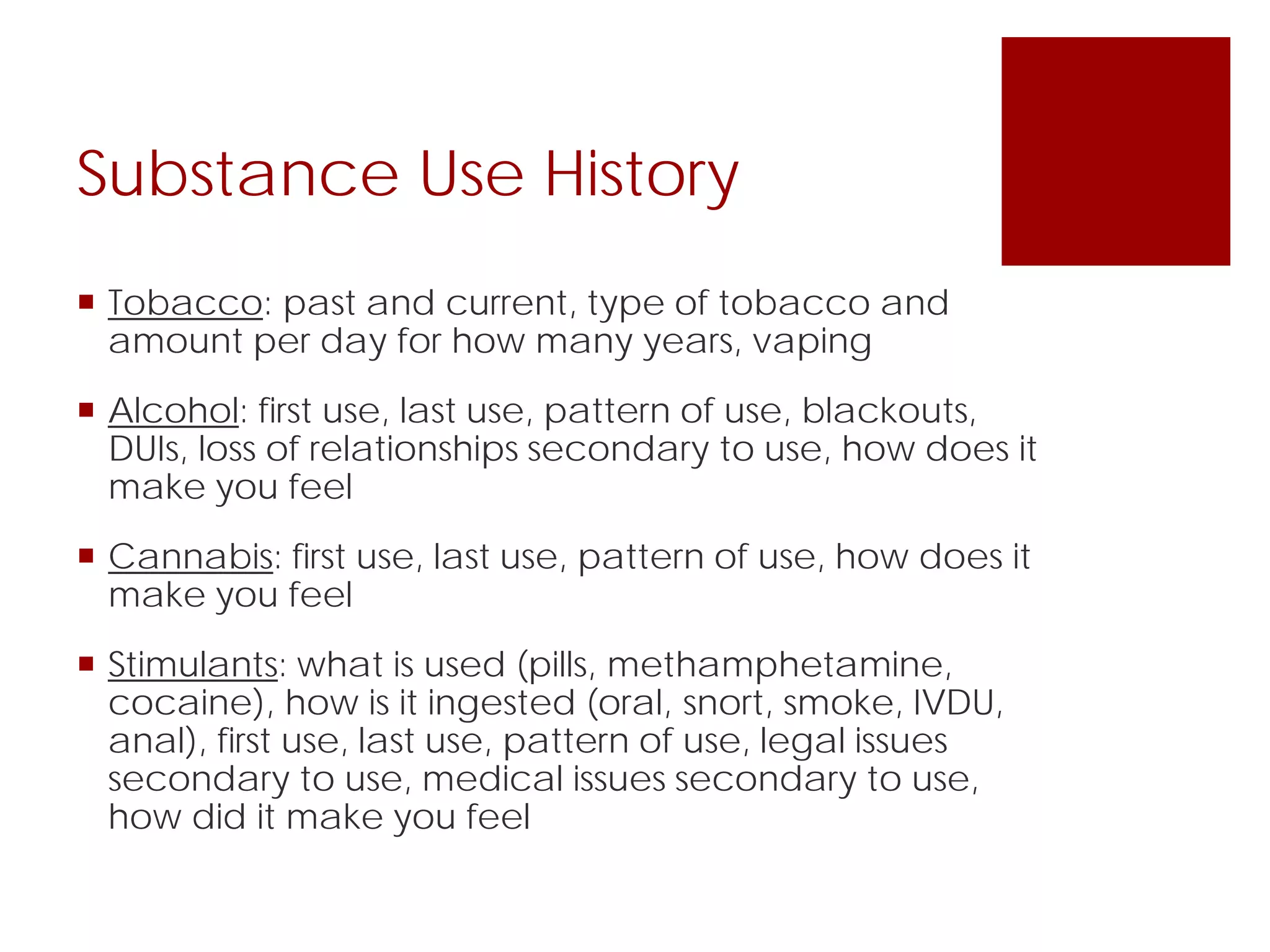
Substance Use History
 Tobacco: past and current, type of tobacco and
amount per day for how many years, vaping
 Alcohol: first use, last use, pattern of use, blackouts,
DUIs, loss of relationships secondary to use, how does it
make you feel
 Cannabis: first use, last use, pattern of use, how does it
make you feel
 Stimulants: what is used (pills, methamphetamine,
cocaine), how is it ingested (oral, snort, smoke, IVDU,
anal), first use, last use, pattern of use, legal issues
secondary to use, medical issues secondary to use,
how did it make you feel
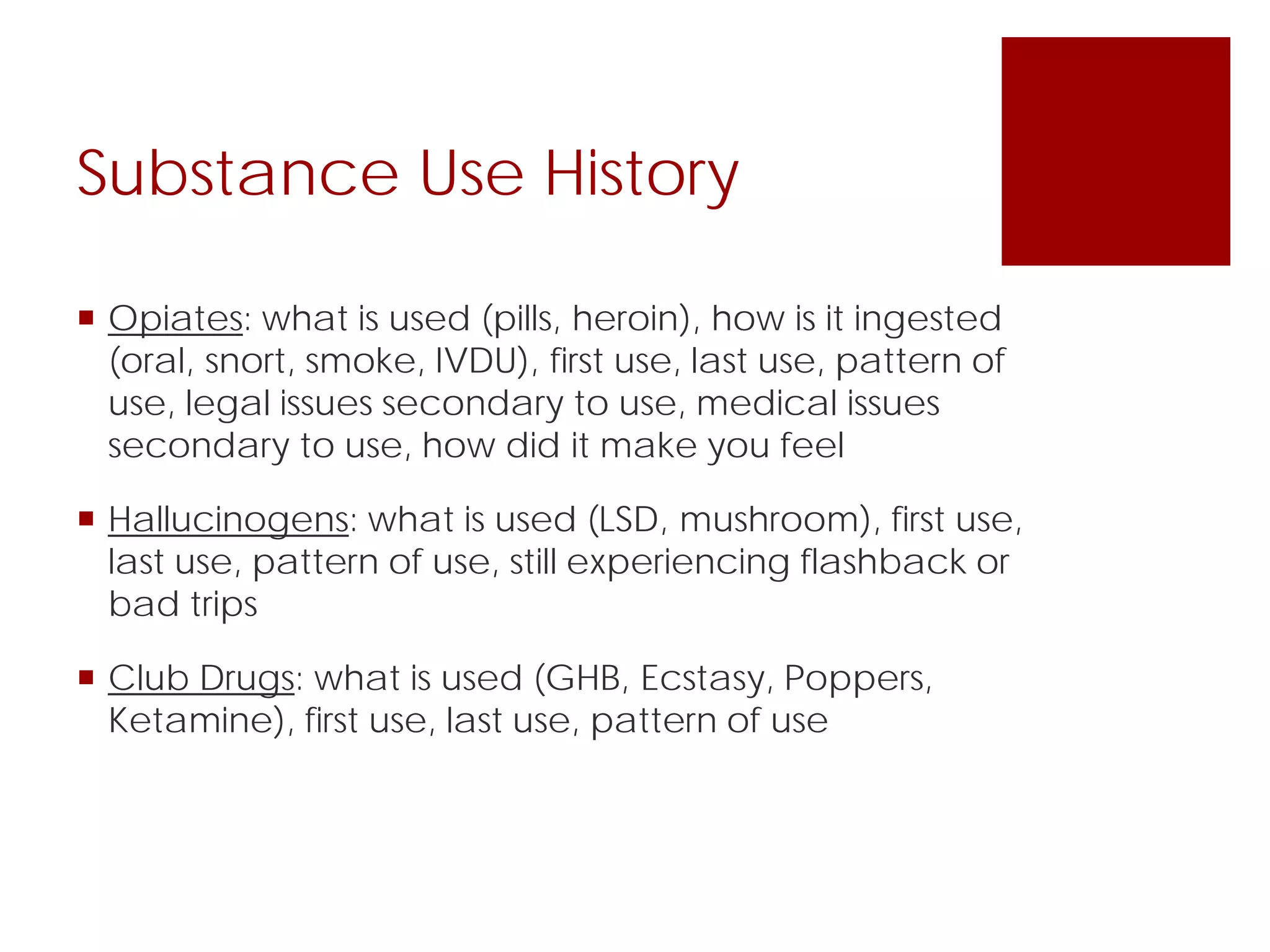
Substance Use History
 Opiates: what is used (pills, heroin), how is it ingested
(oral, snort, smoke, IVDU), first use, last use, pattern of
use, legal issues secondary to use, medical issues
secondary to use, how did it make you feel
 Hallucinogens: what is used (LSD, mushroom), first use,
last use, pattern of use, still experiencing flashback or
bad trips
 Club Drugs: what is used (GHB, Ecstasy, Poppers,
Ketamine), first use, last use, pattern of use
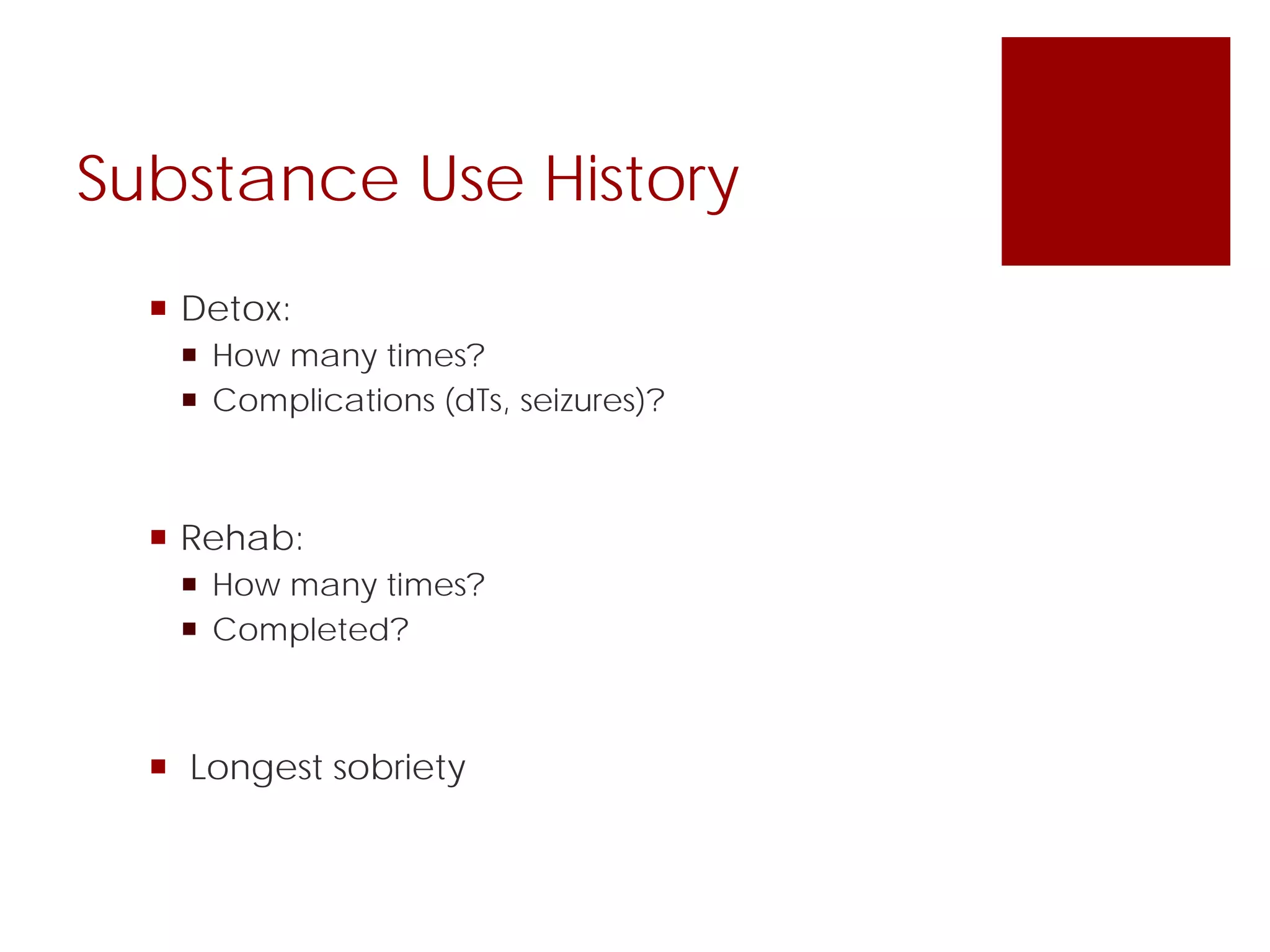
Substance Use History
 Detox:
 How many times?
 Complications (dTs, seizures)?
 Rehab:
 How many times?
 Completed?
 Longest sobriety
Family History
 Family psychiatric history
 Family medical history
Social History
 Place of birth and birth order
 Family relationships
 School performance/learning, attention problems
 College/trade school performance
 Relationships as an adult
 Occupational history
 Military experiences
 Sexual history
 Legal history
Collateral Information
 If possible, and if the patient gives permission with ROI.
 Collateral information from PCP, therapist, partner,
spouse, parents, adult children, friends, or clergy can be
helpful with the assessment.
 With obtaining permission to talk with collateral informants
also allows the opportunity to engage in the treatment
process.
Mental Status Examination
 This is the physical exam for the psychiatrist.
 General appearance: grooming, posture, abnormal
movements, mannerisms, tattoos, scars
 Behavior: normal, fidgety, restless, hyperactive,
hypoactive/retardation, anxious, tense, agitated, tics
 Attitude: cooperative, uncooperative, hostile, indifferent,
oversensitive, negative, polite
 Eye contact: normal, limited, poor, eyes closed, darting,
looking away as if looking at something and distracted
 Speech: rate, flow, latency, coherence, logical, goal
directed, prosody, disorganized, mumbled, volume, rapid,
pressured
Mental Status Examination
 Mood: what the patient reports including normal,
anxious, depressed, sad, elevated, euphoric, on top of
the world, irritable, numb
 Affect: what the provider sees including euthymic,
depressed, elevated, euphoric, irritable/labile,
agitated, perplexed, confused
 FOT: slow, rapid, pressured, blocking, incoherent,
disorganized, logical, linear, circumstantial, tangential,
loose associations
 COT: hallucination, delusions
Mental Status Examination
 Safety: suicidal, homicidal (is there an identified
victim), self harm-intent, plans, means, impulsive
 Insight: good, fair, minimal
 Judgment: good, impaired, minimal
 Motivation: high, moderate, low
 Cognition: level of consciousness, orientation,
attention/concentration, memory, calculation,
abstraction
Mental Status Examination
 FOT
 Circumstantiality: a disorder of association with the
inclusion of unnecessary details until one arrives at the goal
of the thought (over-inclusive)
 Tangentiality: use of oblique, irrelevant and digressive
thoughts that do not convey the central idea to be
communicated
 Loose Associations: jumping from one unconnected topic
to another
 Flight of Ideas: rapid speech with abrupt changes from
topic to topic usually based on understandable links
between topics, distracting internal stimuli or a play on
words
Mental Status Examination
 FOT
 Clanging Associations: pattern of speech in which the
sounds of words, rather than their meaning guide the
choice of words. Puns and rhymes e.g. “Where do I lie? If I
lie, will I die?”
 Perseveration: repeating the same response to stimuli with
an inability to change the response, such as the same
verbal response to different questions
 Neologism: words that are made up; often an
condensation of different words which is unintelligible to
the listener
Mental Status Examination
 FOT
 Echolalia: persistent repetition of words or phases of
another person like the interviewer
 Thought-Blocking: an abrupt interruption in the flow of
thought, in which one cannot recover what was just
said
Mental Status Examination
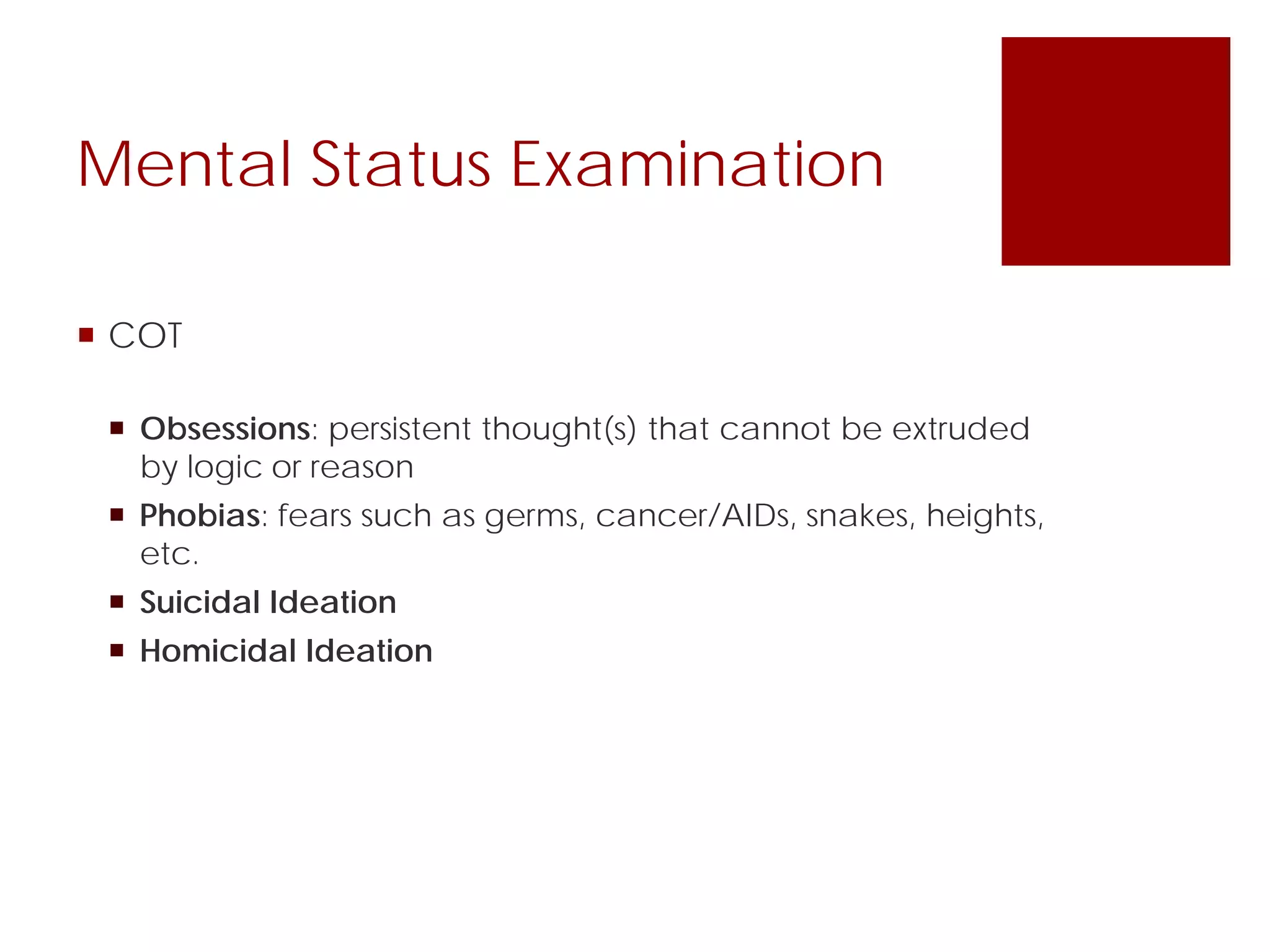
 COT
 Obsessions: persistent thought(s) that cannot be extruded
by logic or reason
 Phobias: fears such as germs, cancer/AIDs, snakes, heights,
etc.
 Suicidal Ideation
 Homicidal Ideation
Mental Status Examination
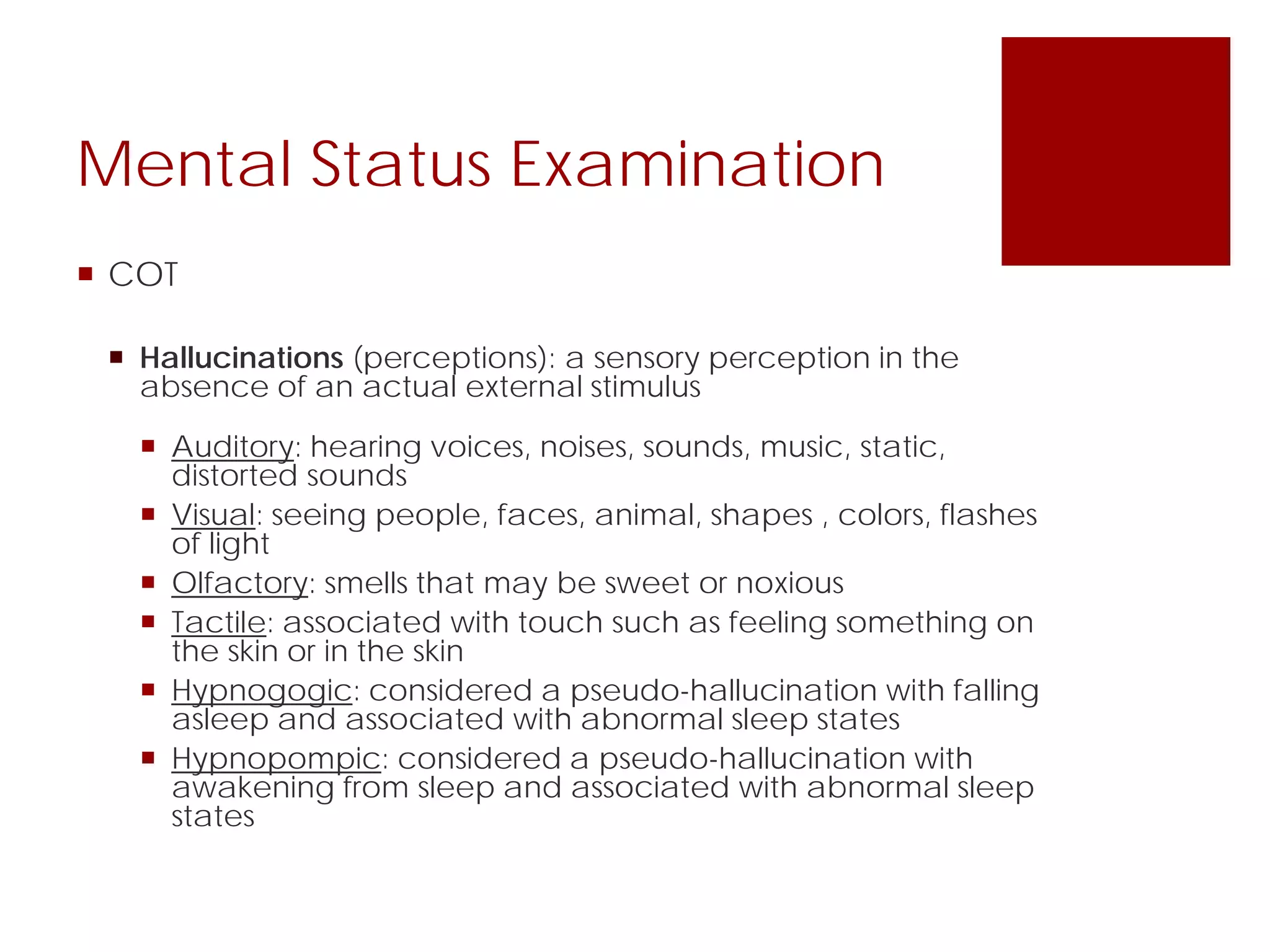
 COT
 Hallucinations (perceptions): a sensory perception in the
absence of an actual external stimulus
 Auditory: hearing voices, noises, sounds, music, static,
distorted sounds
 Visual: seeing people, faces, animal, shapes , colors, flashes
of light
 Olfactory: smells that may be sweet or noxious
 Tactile: associated with touch such as feeling something on
the skin or in the skin
 Hypnogogic: considered a pseudo-hallucination with falling
asleep and associated with abnormal sleep states
 Hypnopompic: considered a pseudo-hallucination with
awakening from sleep and associated with abnormal sleep
states
Mental Status Examination
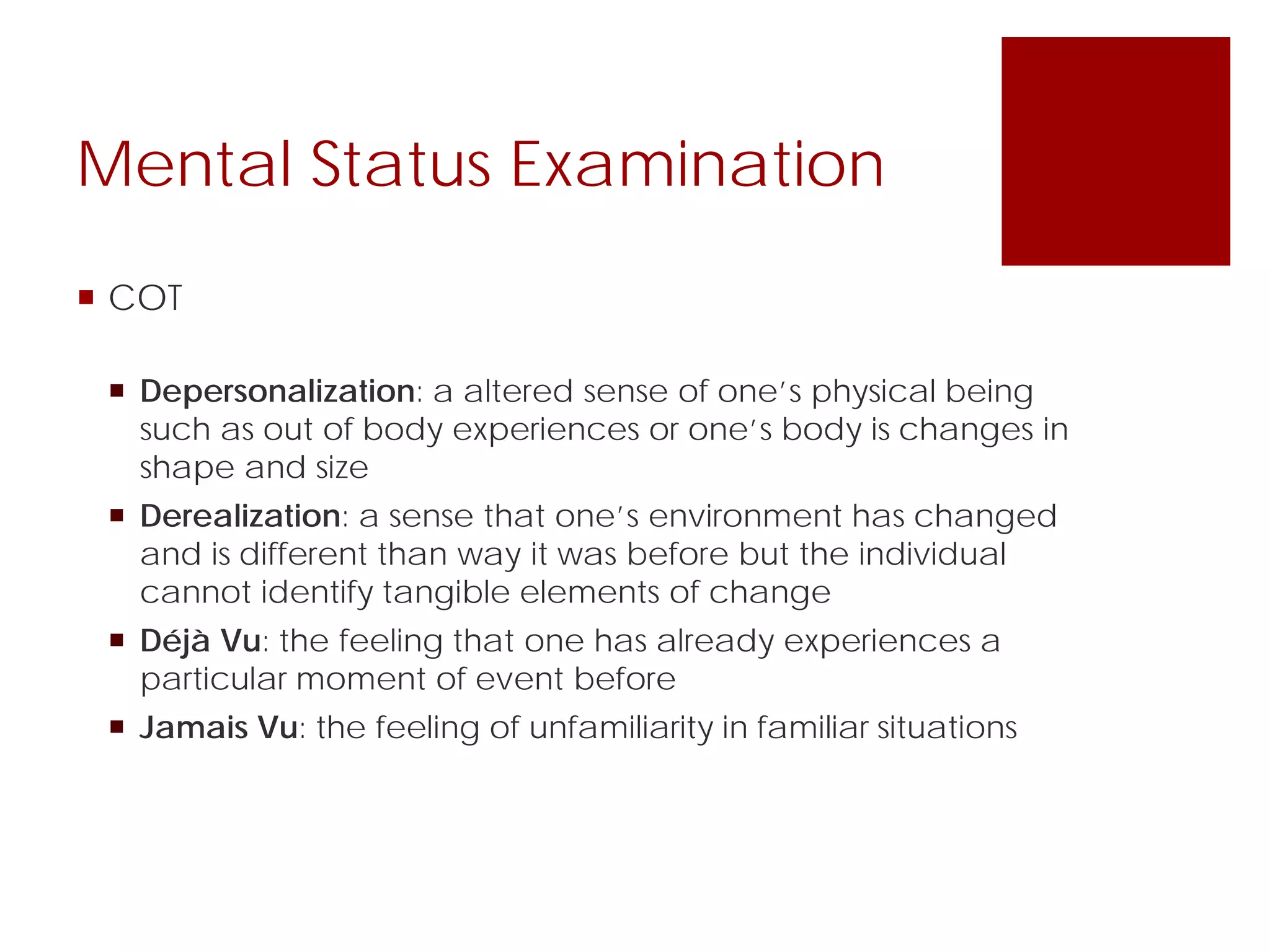
 COT
 Depersonalization: a altered sense of one’s physical being
such as out of body experiences or one’s body is changes in
shape and size
 Derealization: a sense that one’s environment has changed
and is different than way it was before but the individual
cannot identify tangible elements of change
 Déjà Vu: the feeling that one has already experiences a
particular moment of event before
 Jamais Vu: the feeling of unfamiliarity in familiar situations
Mental Status Examination
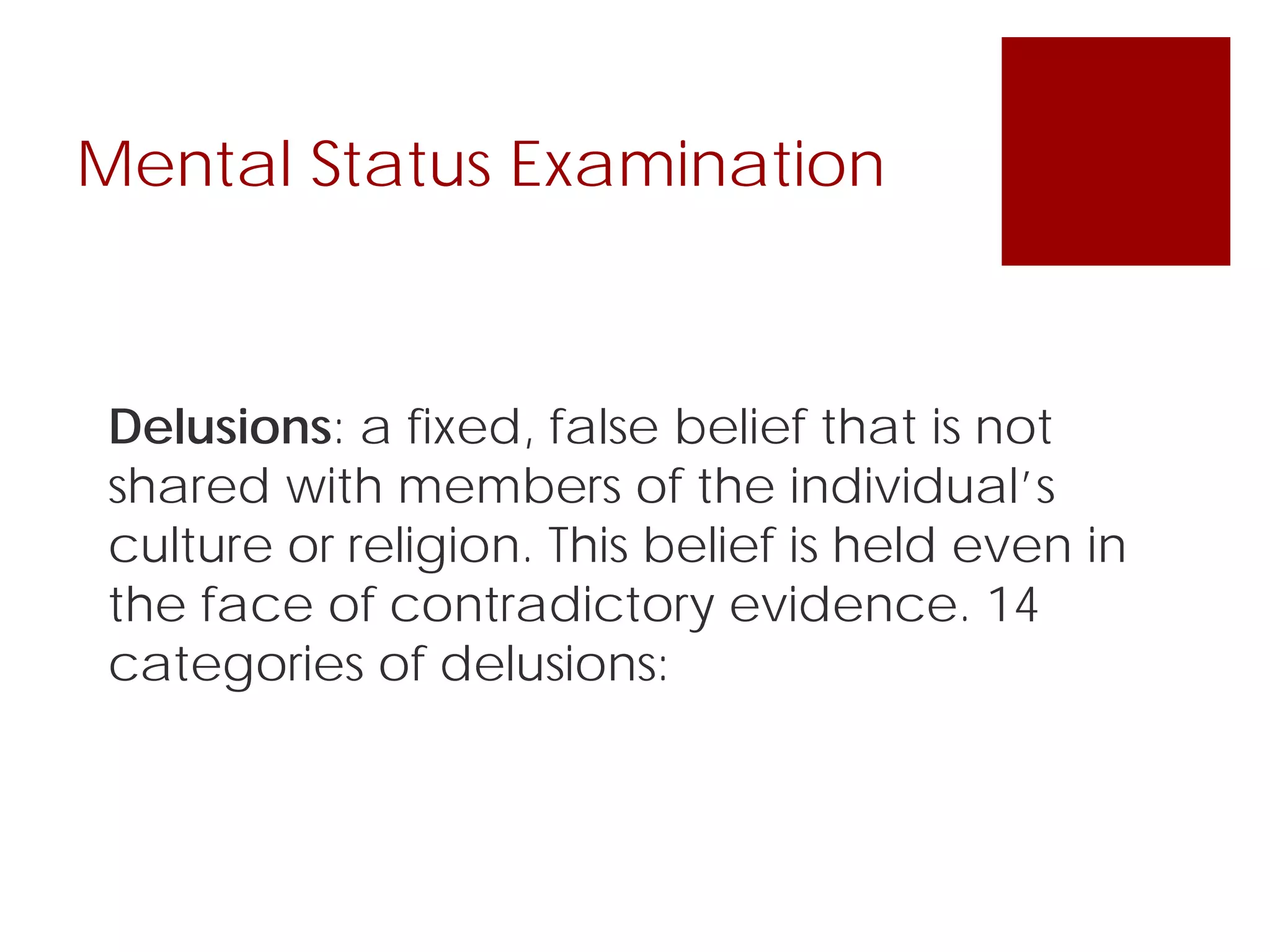
Delusions: a fixed, false belief that is not
shared with members of the individual’s
culture or religion. This belief is held even in
the face of contradictory evidence. 14
categories of delusions:
Mental Status Examination
 Delusions of control: Delusional belief that one’s behavior,
will, thoughts or feelings are not under personal control but
imposed by an external force.
 Delusions of guilt or sin: Delusional belief of responsibility for
tragedy or disaster to which there is no personal connection.
Delusional belief of having done something terrible and now
must face the deserved punishment.
 Delusions of grandiosity: Delusional belief of special power,
talent, abilities, or identity.
Mental Status Examination
 Delusions of jealousy: With little or no evidence, the person
believes one’s partner is unfaithful.
 Delusion of mind reading: Delusional belief that people can
read one’s mind and know one’s thoughts. This does not
include sensing what someone is thinking/feeling bases on
body language or facial expression.
 Delusion of persecution: Delusional belief that one is in
danger, being followed or monitored, harassed or
conspired against. This includes the government, police,
criminal groups, neighbors, coworkers or family.
Mental Status Examination
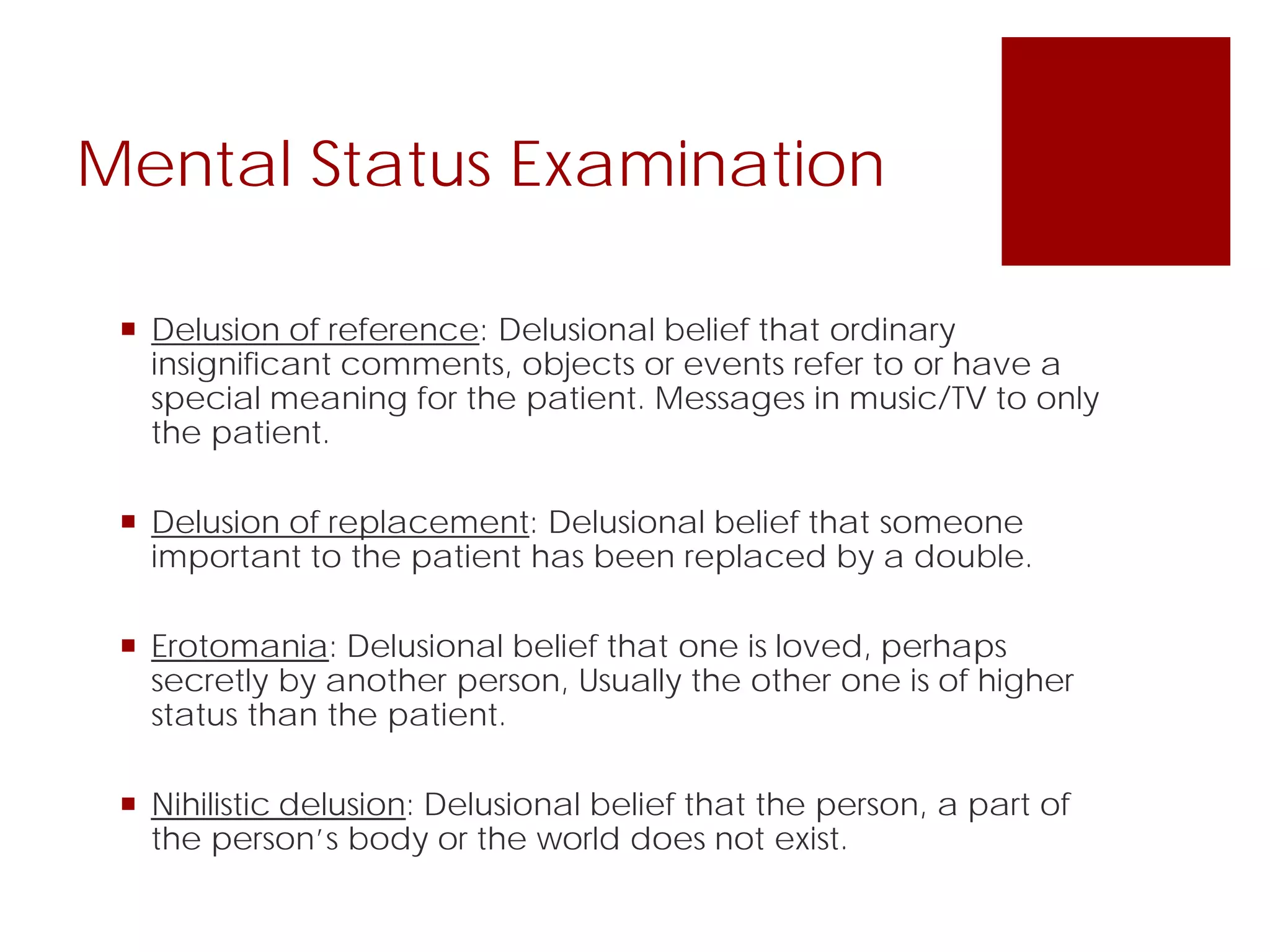
 Delusion of reference: Delusional belief that ordinary
insignificant comments, objects or events refer to or have a
special meaning for the patient. Messages in music/TV to only
the patient.
 Delusion of replacement: Delusional belief that someone
important to the patient has been replaced by a double.
 Erotomania: Delusional belief that one is loved, perhaps
secretly by another person, Usually the other one is of higher
status than the patient.
 Nihilistic delusion: Delusional belief that the person, a part of
the person’s body or the world does not exist.
Mental Status Examination
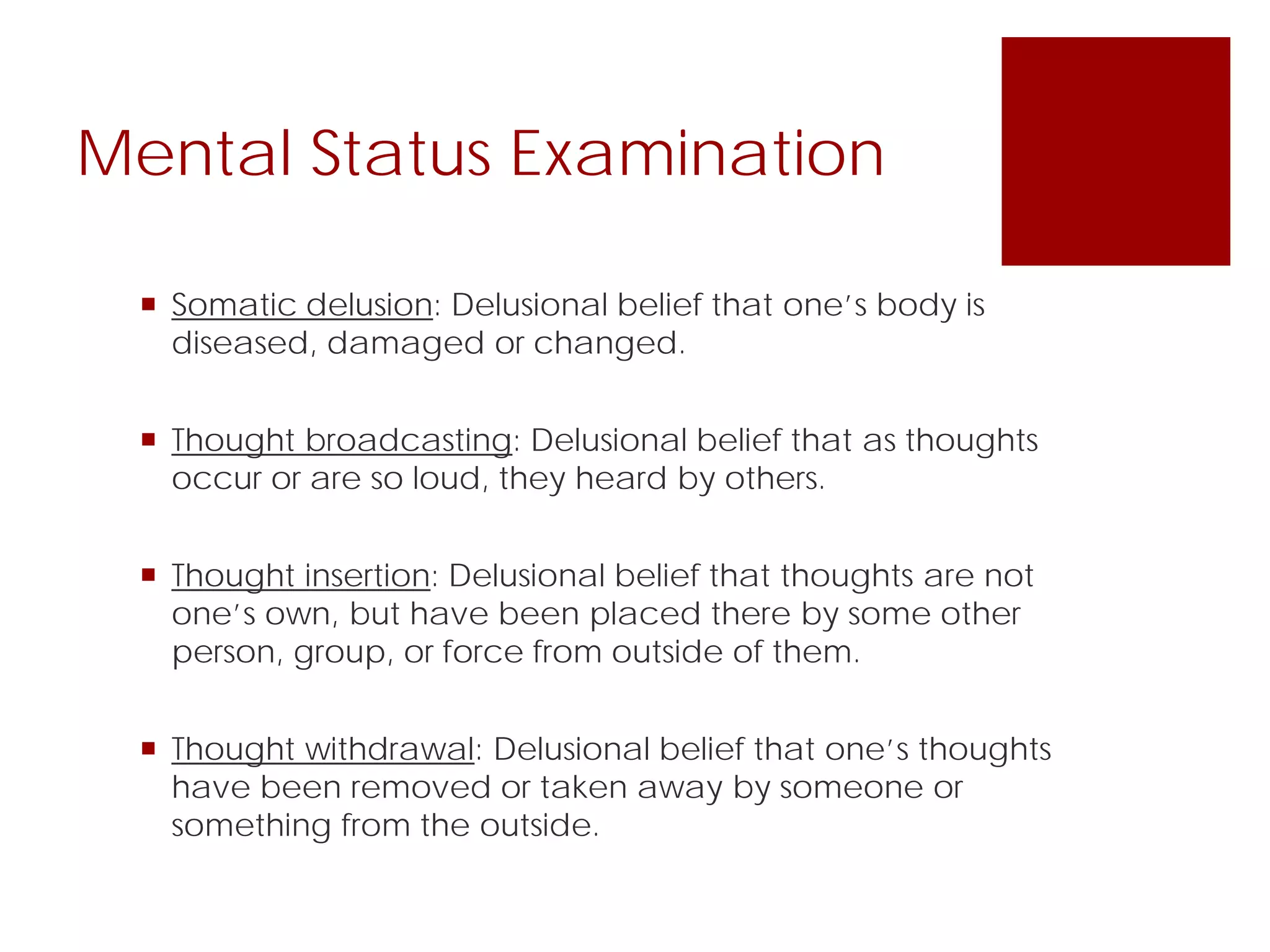
 Somatic delusion: Delusional belief that one’s body is
diseased, damaged or changed.
 Thought broadcasting: Delusional belief that as thoughts
occur or are so loud, they heard by others.
 Thought insertion: Delusional belief that thoughts are not
one’s own, but have been placed there by some other
person, group, or force from outside of them.
 Thought withdrawal: Delusional belief that one’s thoughts
have been removed or taken away by someone or
something from the outside.
Mental Status Examination
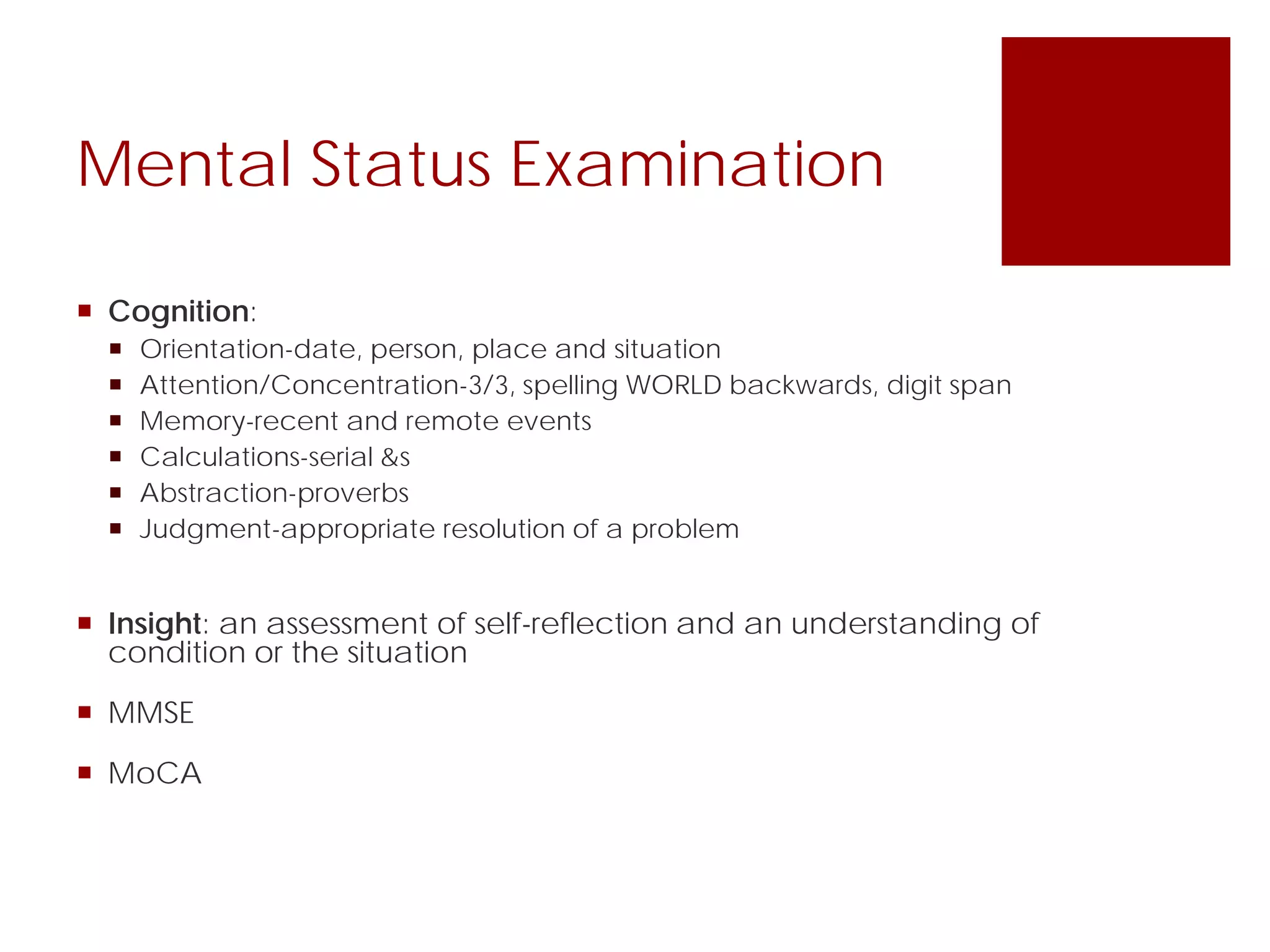
 Cognition:
 Orientation-date, person, place and situation
 Attention/Concentration-3/3, spelling WORLD backwards, digit span
 Memory-recent and remote events
 Calculations-serial &s
 Abstraction-proverbs
 Judgment-appropriate resolution of a problem
 Insight: an assessment of self-reflection and an understanding of
condition or the situation
 MMSE
 MoCA
Common Errors in the
Psychiatric Interview
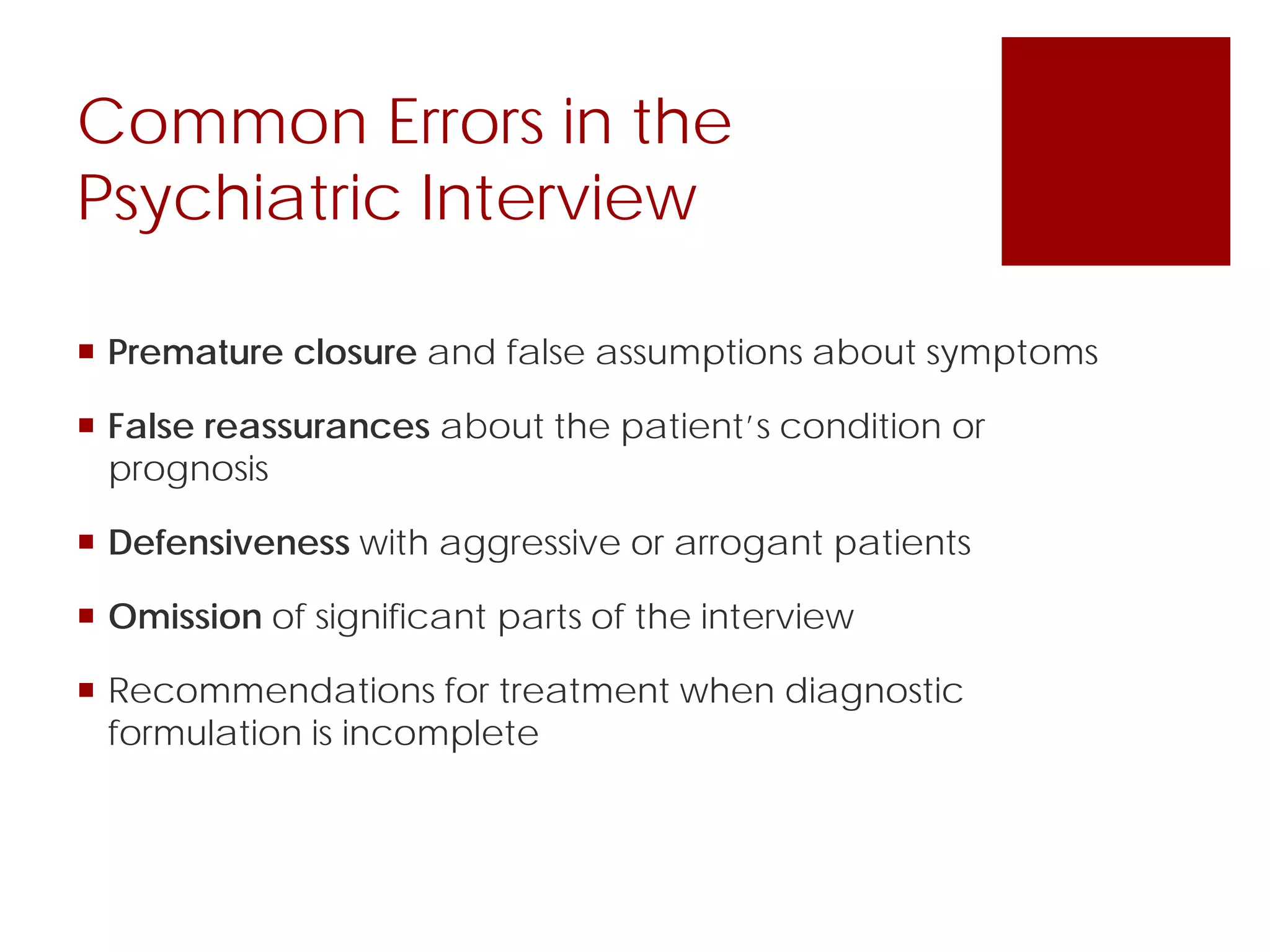
 Premature closure and false assumptions about symptoms
 False reassurances about the patient’s condition or
prognosis
 Defensiveness with aggressive or arrogant patients
 Omission of significant parts of the interview
 Recommendations for treatment when diagnostic
formulation is incomplete
Common Errors in the
Psychiatric Interview
 Inadequate explanation of psychiatric disorders and
treatment options
 Empathic failures by inadvertently shaming or
embarrassing the patient
 Countertransference issues with the patient
 Not exploring in depth safety issues with the patient
 Check to see if the patient has access to weapons or
guns!
Psychiatric Interview – Tools
 Visit www.integration.samhsa.gov for screening tools.
 Massachusetts General Hospital Comprehensive
Clinical Psychiatry; Stern TA, Rosenbaum JF, Fava M,
Biederman J, Rauch SL; 2008
 Interview Guide for DSM 5 Psychiatric Disorder;
Zimmerman M; 2013

psychiatric-interview-module-1.pdf

  • 1.
    Psychiatric Interview Paula Gibbs,MD Assistant Professor Department of Psychiatry Medical Director of 5West Med-Psych University of Utah Hospitals and Clinics
  • 2.
    Psychiatric Interview  Thepurpose of a psychiatric interview is to establish a therapeutic relationship with the patient to collect, organize and formulate a differential diagnosis and treatment plan.  A fundamental part of this interview is to establish and foster a healthy relationship and secure attachment between the interviewer and the patient. This allows for open communication for gathering information and correcting any misunderstandings in the therapeutic relationship.
  • 3.
    Psychiatric Interview  Fewmedical encounters are more intimate and potentially shameful like the psychiatric interview.  The clinician needs to be mindful of the sensitive nature of this interview and provide a safe environment for the patient to reveal such deeply personal information.  The clinician needs to be mindful that patients may have disagreements with the clinician’s diagnosis and recommended treatments.  Nothing in medicine is more stigmatized than mental health and substance misuse.
  • 4.
    Elements that Contributeto a Secure Attachment in a Therapeutic Relationship:  Communication that is collaborative, resonant, mutual and attuned to the cognitive and emotional states of the other.  Dialogue that is reflective and responsive to the other’s state of being. Use of empathy as a means of a shared experience so the other is allowed to feel “heard and seen.”  Identify and repair fractures in miscommunications or misunderstandings in the relationship. Miscommunication and misunderstandings in a relationship causes disconnection and shame responses.
  • 5.
    Elements that Contributeto a Secure Attachment in a Therapeutic Relationship  Shame responses include:  Moving away – withdrawing from, isolation, keeping secrets  Moving in – overcompensation to care for the clinician as a means to be accepted  Moving against – taking one’s shame and shaming the other To repair communication failures (empathic failures) requires consistent, reflective, intentional and mindful caregiving.
  • 6.
     The natureof the psychiatric interview is getting the patient’s narrative.  Facilitate the patient’s narrative with compassionate listening and reflection.  Mindfulness and reflection is a form of mentoring through modeling for the patient.  How a patient puts the narrative of their medical and psychiatric history together tells the clinician how integrated the patient’s mind is.  An integrated mind can create a narrative that involves sustained attention, memory, emotional responses, intellectual analysis, timeline, mindfulness of self as well as mindfulness of others in their lives. Psychiatric Interview
  • 7.
    Psychiatric Interview  Thefundamental tasks of communication:  Elicit the patient’s narrative while guiding the interview by diagnostic reasoning.  Open the discussion by allowing the patient to express his or her opening statement without interruption.  Use both open-ended and close-ended questions to gather information, provide structure, clarify and summarize information collected.
  • 8.
    Psychiatric Interview  Thefundamental tasks of communication (cont’d):  Understand the patient’s perspective by exploring contextual issues (e.g., familial, cultural, spiritual, age, gender, and socioeconomic status).  Understand the patient’s perspective with eliciting beliefs, concerns and expectations about health and illness.  Active listening using verbal and nonverbal methods (eye contact).
  • 9.
    Psychiatric Interview  Thefundamental tasks of communication (cont’d):  Share information by avoiding medical language/jargon.  Determine if the patient understands your explanations.  Encourage questions!
  • 10.
    Psychiatric Interview  Thefundamental tasks of communication (cont’d):  Reach an agreement on the problems and treatment plan by encouraging the patient’s participation in the decision-making.  Explore if the patient is amenable to follow a plan of treatment.  Identify and provide resources, support groups, psychotherapy and literature to read.  Provide closure with follow up plans.
  • 11.
    Psychiatric Interview  BehavioralObservation begins the moment the patient engages with the system of care (i.e. the initial phone call for the appointment). It is useful to see how the patient interacts with the support staff and with family, friends or others that may accompany him/her to the appointment.  The observation continues before, during and after the interview. Take note of the patient’s:  Grooming  Style and state of the clothing worn  Mannerisms  Normal and abnormal movements  Posture and gait  Physical features (natural deformities, birth marks, tattoos, piercings, cut marks, scratches, burns)  Coloring  Use of language  Nonverbal clues such as eye contact, facial expression and posture.
  • 12.
    Psychiatric Interview  Theinterview of the patient starts with an open ended question as to what brought the patient in today. Encourage the patient to tell the story without interruption if possible.  Use clarification to move the interview through the data gathering, being mindful as that patient may have a different agenda than the diagnostic assessment (e.g. patient is upset her spouse is unemployed but is in a manic state during the interview). Always important to validate the patient’s perspective!  Remember depression, anxiety and agitation mean different things to patients vs. Psychiatrist/PCP.
  • 13.
    Psychiatric Interview  Itis best to focus on the chief complaint and present issues and to incorporate the other parts of the history around this. As the PCP, you are in a position of a long- term trusting relationship with the patient and can redirect the patient to ascertain additional information. Many times the PCP knows about family dynamics as they see the family also (alcoholism, financial, losses in the family).  A key component of the psychiatric interview is the determination of safety. Questions about suicide, homicide, domestic violence and abuse should not be omitted from the review of the current situation!
  • 14.
    Chief Complaint/Presenting Problems(s) What is the chief complaint?  Onset  Perceived precipitants  Signs & Symptoms  Course and duration  Treatments: professional and personal  Effects on the patient’s function: personal, occupational, social or academic  Co-morbid psychiatric or medical disorders  Psychosocial stressors: personal (psychological or medical), family, friends, occupation/academic, legal, housing and financial
  • 15.
    Review of PsychiatricSymptoms  Depression  Mania  Anxiety  OCD/PTSD  Attention  Eating Disorder  Thought Disorder
  • 16.
    Past Psychiatric History Previous episode of the problem(s)?  Symptoms, course, duration and treatment (inpatient, outpatient, psychopharmacology, psychotherapy)  Psychiatric diagnoses  Suicide attempts: #s and how the patient attempted  Self mutilation: cutting, burning, head banging, scratching, tattoos  ECT
  • 17.
    Past Medical History Medical: past and current  Surgical: past and current  Accidents: Include TBI  Allergies  Current medications: prescribed and OTC with dosages  Other treatments: acupuncture, chiropractic, homeopathic, yoga, mediation
  • 18.
    Substance Use History Tobacco: past and current, type of tobacco and amount per day for how many years, vaping  Alcohol: first use, last use, pattern of use, blackouts, DUIs, loss of relationships secondary to use, how does it make you feel  Cannabis: first use, last use, pattern of use, how does it make you feel  Stimulants: what is used (pills, methamphetamine, cocaine), how is it ingested (oral, snort, smoke, IVDU, anal), first use, last use, pattern of use, legal issues secondary to use, medical issues secondary to use, how did it make you feel
  • 19.
    Substance Use History Opiates: what is used (pills, heroin), how is it ingested (oral, snort, smoke, IVDU), first use, last use, pattern of use, legal issues secondary to use, medical issues secondary to use, how did it make you feel  Hallucinogens: what is used (LSD, mushroom), first use, last use, pattern of use, still experiencing flashback or bad trips  Club Drugs: what is used (GHB, Ecstasy, Poppers, Ketamine), first use, last use, pattern of use
  • 20.
    Substance Use History Detox:  How many times?  Complications (dTs, seizures)?  Rehab:  How many times?  Completed?  Longest sobriety
  • 21.
    Family History  Familypsychiatric history  Family medical history
  • 22.
    Social History  Placeof birth and birth order  Family relationships  School performance/learning, attention problems  College/trade school performance  Relationships as an adult  Occupational history  Military experiences  Sexual history  Legal history
  • 23.
    Collateral Information  Ifpossible, and if the patient gives permission with ROI.  Collateral information from PCP, therapist, partner, spouse, parents, adult children, friends, or clergy can be helpful with the assessment.  With obtaining permission to talk with collateral informants also allows the opportunity to engage in the treatment process.
  • 24.
    Mental Status Examination This is the physical exam for the psychiatrist.  General appearance: grooming, posture, abnormal movements, mannerisms, tattoos, scars  Behavior: normal, fidgety, restless, hyperactive, hypoactive/retardation, anxious, tense, agitated, tics  Attitude: cooperative, uncooperative, hostile, indifferent, oversensitive, negative, polite  Eye contact: normal, limited, poor, eyes closed, darting, looking away as if looking at something and distracted  Speech: rate, flow, latency, coherence, logical, goal directed, prosody, disorganized, mumbled, volume, rapid, pressured
  • 25.
    Mental Status Examination Mood: what the patient reports including normal, anxious, depressed, sad, elevated, euphoric, on top of the world, irritable, numb  Affect: what the provider sees including euthymic, depressed, elevated, euphoric, irritable/labile, agitated, perplexed, confused  FOT: slow, rapid, pressured, blocking, incoherent, disorganized, logical, linear, circumstantial, tangential, loose associations  COT: hallucination, delusions
  • 26.
    Mental Status Examination Safety: suicidal, homicidal (is there an identified victim), self harm-intent, plans, means, impulsive  Insight: good, fair, minimal  Judgment: good, impaired, minimal  Motivation: high, moderate, low  Cognition: level of consciousness, orientation, attention/concentration, memory, calculation, abstraction
  • 27.
    Mental Status Examination FOT  Circumstantiality: a disorder of association with the inclusion of unnecessary details until one arrives at the goal of the thought (over-inclusive)  Tangentiality: use of oblique, irrelevant and digressive thoughts that do not convey the central idea to be communicated  Loose Associations: jumping from one unconnected topic to another  Flight of Ideas: rapid speech with abrupt changes from topic to topic usually based on understandable links between topics, distracting internal stimuli or a play on words
  • 28.
    Mental Status Examination FOT  Clanging Associations: pattern of speech in which the sounds of words, rather than their meaning guide the choice of words. Puns and rhymes e.g. “Where do I lie? If I lie, will I die?”  Perseveration: repeating the same response to stimuli with an inability to change the response, such as the same verbal response to different questions  Neologism: words that are made up; often an condensation of different words which is unintelligible to the listener
  • 29.
    Mental Status Examination FOT  Echolalia: persistent repetition of words or phases of another person like the interviewer  Thought-Blocking: an abrupt interruption in the flow of thought, in which one cannot recover what was just said
  • 30.
    Mental Status Examination COT  Obsessions: persistent thought(s) that cannot be extruded by logic or reason  Phobias: fears such as germs, cancer/AIDs, snakes, heights, etc.  Suicidal Ideation  Homicidal Ideation
  • 31.
    Mental Status Examination COT  Hallucinations (perceptions): a sensory perception in the absence of an actual external stimulus  Auditory: hearing voices, noises, sounds, music, static, distorted sounds  Visual: seeing people, faces, animal, shapes , colors, flashes of light  Olfactory: smells that may be sweet or noxious  Tactile: associated with touch such as feeling something on the skin or in the skin  Hypnogogic: considered a pseudo-hallucination with falling asleep and associated with abnormal sleep states  Hypnopompic: considered a pseudo-hallucination with awakening from sleep and associated with abnormal sleep states
  • 32.
    Mental Status Examination COT  Depersonalization: a altered sense of one’s physical being such as out of body experiences or one’s body is changes in shape and size  Derealization: a sense that one’s environment has changed and is different than way it was before but the individual cannot identify tangible elements of change  Déjà Vu: the feeling that one has already experiences a particular moment of event before  Jamais Vu: the feeling of unfamiliarity in familiar situations
  • 33.
    Mental Status Examination Delusions:a fixed, false belief that is not shared with members of the individual’s culture or religion. This belief is held even in the face of contradictory evidence. 14 categories of delusions:
  • 34.
    Mental Status Examination Delusions of control: Delusional belief that one’s behavior, will, thoughts or feelings are not under personal control but imposed by an external force.  Delusions of guilt or sin: Delusional belief of responsibility for tragedy or disaster to which there is no personal connection. Delusional belief of having done something terrible and now must face the deserved punishment.  Delusions of grandiosity: Delusional belief of special power, talent, abilities, or identity.
  • 35.
    Mental Status Examination Delusions of jealousy: With little or no evidence, the person believes one’s partner is unfaithful.  Delusion of mind reading: Delusional belief that people can read one’s mind and know one’s thoughts. This does not include sensing what someone is thinking/feeling bases on body language or facial expression.  Delusion of persecution: Delusional belief that one is in danger, being followed or monitored, harassed or conspired against. This includes the government, police, criminal groups, neighbors, coworkers or family.
  • 36.
    Mental Status Examination Delusion of reference: Delusional belief that ordinary insignificant comments, objects or events refer to or have a special meaning for the patient. Messages in music/TV to only the patient.  Delusion of replacement: Delusional belief that someone important to the patient has been replaced by a double.  Erotomania: Delusional belief that one is loved, perhaps secretly by another person, Usually the other one is of higher status than the patient.  Nihilistic delusion: Delusional belief that the person, a part of the person’s body or the world does not exist.
  • 37.
    Mental Status Examination Somatic delusion: Delusional belief that one’s body is diseased, damaged or changed.  Thought broadcasting: Delusional belief that as thoughts occur or are so loud, they heard by others.  Thought insertion: Delusional belief that thoughts are not one’s own, but have been placed there by some other person, group, or force from outside of them.  Thought withdrawal: Delusional belief that one’s thoughts have been removed or taken away by someone or something from the outside.
  • 38.
    Mental Status Examination Cognition:  Orientation-date, person, place and situation  Attention/Concentration-3/3, spelling WORLD backwards, digit span  Memory-recent and remote events  Calculations-serial &s  Abstraction-proverbs  Judgment-appropriate resolution of a problem  Insight: an assessment of self-reflection and an understanding of condition or the situation  MMSE  MoCA
  • 39.
    Common Errors inthe Psychiatric Interview  Premature closure and false assumptions about symptoms  False reassurances about the patient’s condition or prognosis  Defensiveness with aggressive or arrogant patients  Omission of significant parts of the interview  Recommendations for treatment when diagnostic formulation is incomplete
  • 40.
    Common Errors inthe Psychiatric Interview  Inadequate explanation of psychiatric disorders and treatment options  Empathic failures by inadvertently shaming or embarrassing the patient  Countertransference issues with the patient  Not exploring in depth safety issues with the patient  Check to see if the patient has access to weapons or guns!
  • 41.
    Psychiatric Interview –Tools  Visit www.integration.samhsa.gov for screening tools.  Massachusetts General Hospital Comprehensive Clinical Psychiatry; Stern TA, Rosenbaum JF, Fava M, Biederman J, Rauch SL; 2008  Interview Guide for DSM 5 Psychiatric Disorder; Zimmerman M; 2013