PROCESS & METHODOLOGIES
Ben Khalfallah Héla
27 Octobre 2018
OUTLINE
1. Agility
2. Scrum
3. XP
4. Kanban
AGILITY
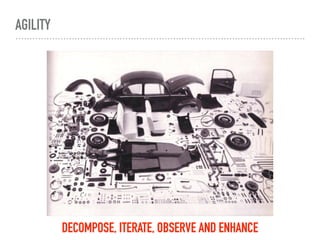
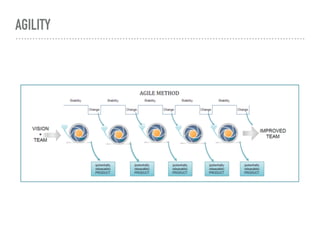
DECOMPOSE, ITERATE, OBSERVE AND ENHANCE
AGILITY
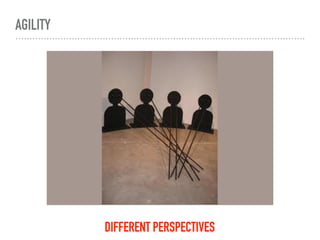
DIFFERENT PERSPECTIVES
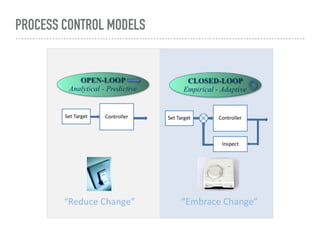
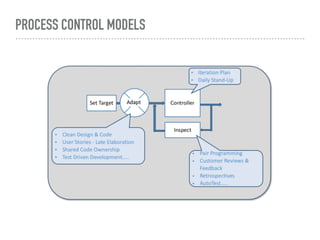
PROCESS CONTROL MODELS
AGILITY
« Why do we talk about ?
« All is about success
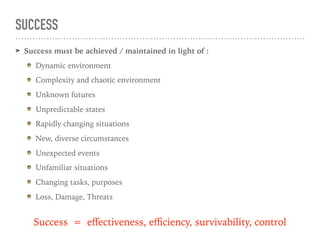
SUCCESS
➤ Success must be achieved / maintained in light of :
Dynamic environment
Complexity and chaotic environment
Unknown futures
Unpredictable states
Rapidly changing situations
New, diverse circumstances
Unexpected events
Unfamiliar situations
Changing tasks, purposes
Loss, Damage, Threats
Success = effectiveness, efficiency, survivability, control
« Agility is the ability to successfully
cope with changes in the
environment.
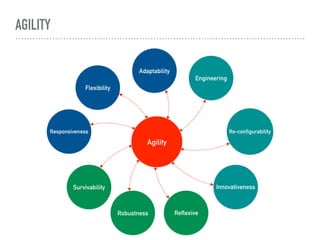
AGILITY
Agility
Re-configurability
Innovativeness
ReflexiveRobustness
Survivability
Responsiveness
Flexibility
Adaptability
Engineering
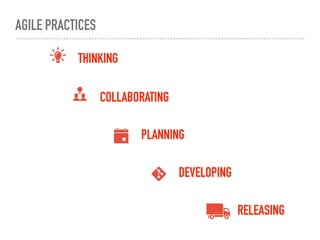
AGILE PRACTICES
THINKING
COLLABORATING
PLANNING
DEVELOPING
RELEASING
AGILE PRACTICES
➤ Thinking - Pair Programming, Energised Work, Informative
Workspace, Root Cause Analysis, Retrospectives etc.
➤ Collaborating – Trust, Sit Together, Real Customer
Involvement, stand-up meeting, coding standards, sprint
demo, reporting etc.
➤ Releasing – Done, No Bugs, Version Control, Continuous
Integration, Collective Code ownership, documentation etc.
➤ Planning – Vision, Release Planning, Iteration Planning,
estimating etc.
➤ Developing – Customer Tests, Test Driven Development,
Simple Design etc.
BEING AGILE
IT IS ABOUT THE PEOPLE AND TEAMS.
IT IS ABOUT CUSTOMER AND DELIVERING SOFTWARE.
IT IS ABOUT CONTINUOUS IMPROVEMENT.
AGILE METHODS
➤ Agile methods are processes that support the agile
philosophy.
➤ Agile methods consist of individual elements called practices.
➤ Practices include using version control, setting coding
standards, and giving weekly demos to your stakeholders.
➤ Agile Methods combine these practices to accentuate parts
that support agile philosophy.
public Method agileMethods {
getMethod(Agile.agile);
}
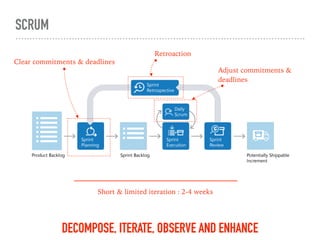
SCRUM
Adjust commitments &
deadlines
Clear commitments & deadlines
Retroaction
DECOMPOSE, ITERATE, OBSERVE AND ENHANCE
Short & limited iteration : 2-4 weeks
SCRUM
➤ Scrum is an agile process that allows us to focus on delivering the
highest business value in the shortest time.
➤ Scrum projects make progress in a series of “sprints”.
➤ It allows us to rapidly and repeatedly inspect actual working
software (every two weeks to one month).
➤ A constant duration leads to a better rhythm.
➤ The business sets the priorities. Teams self-organise to
determine the best way to deliver the highest priority features.
➤ Every two weeks to a month anyone can see real working software
and decide to release it as is or continue to enhance it for
another sprint.
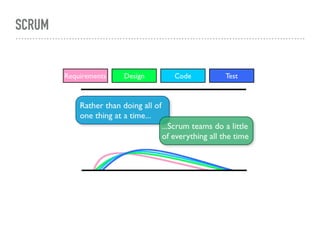
➤ Product is designed, coded, and tested during the sprint.
SCRUM
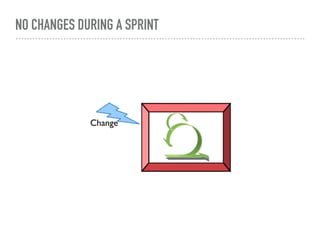
NO CHANGES DURING A SPRINT
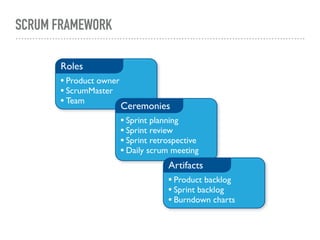
SCRUM FRAMEWORK
• Product owner
• ScrumMaster
• Team
Roles
• Sprint planning
• Sprint review
• Sprint retrospective
• Daily scrum meeting
Ceremonies
• Product backlog
• Sprint backlog
• Burndown charts
Artifacts
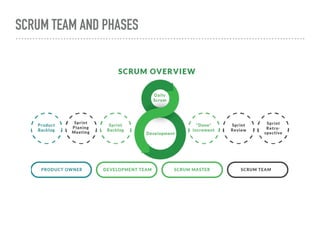
SCRUM TEAM AND PHASES
PRODUCT OWNER
➤ The Product Owner is the sole person responsible for managing the
Product Backlog.
➤ Product Backlog management includes :
Clearly expressing Product Backlog items.
Ordering the items in the Product Backlog to best achieve goals and
missions.
Ensuring that the Product Backlog is visible, transparent, and clear to
all, and shows what the Scrum Team will work on next.
Ensuring the Development Team understands items in the Product
Backlog to the level needed.
➤ The Product Owner is one person, not a committee.
➤ For the Product Owner to succeed, the entire organisation must respect
his decisions.
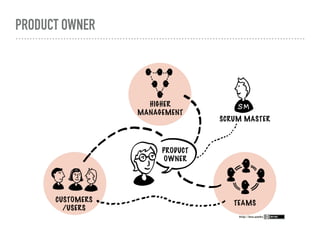
PRODUCT OWNER
SCRUM MASTER
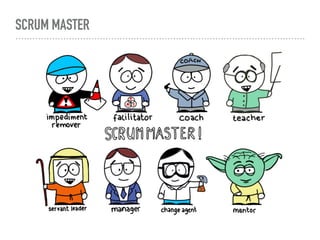
➤ Represents management to the project.
➤ Responsible for enacting Scrum values and practices.
➤ Removes impediments & difficulties.
➤ Ensure that the team is fully functional and productive.
➤ Enable close cooperation across all roles and functions.
➤ Shield the team from external interferences.
SCRUM MASTER
PRODUCT BACKLOG
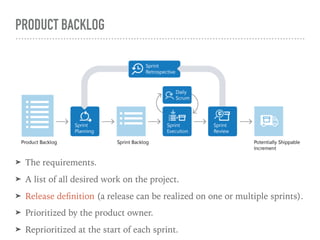
➤ The requirements.
➤ A list of all desired work on the project.
➤ Release definition (a release can be realized on one or multiple sprints).
➤ Prioritized by the product owner.
➤ Reprioritized at the start of each sprint.
PRODUCT BACKLOG - HOW ?
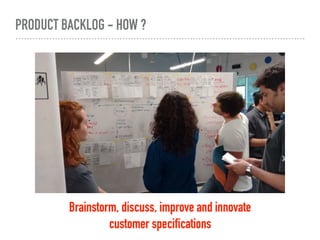
Brainstorm, discuss, improve and innovate
customer specifications
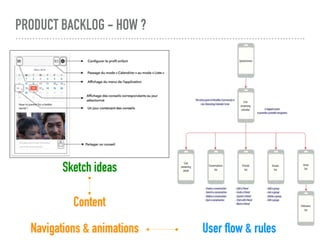
PRODUCT BACKLOG - HOW ?
Sketch ideas
User flow & rules
Content
Navigations & animations
PRODUCT BACKLOG - HOW ?
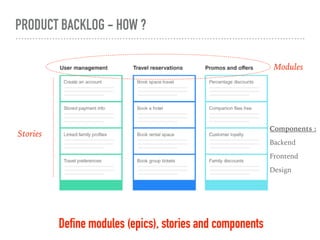
Define modules (epics), stories and components
Modules
Stories
Components :
Backend
Frontend
Design
PRODUCT BACKLOG - HOW ?
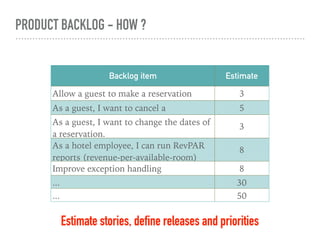
Estimate stories, define releases and priorities
Backlog item Estimate
Allow a guest to make a reservation 3
As a guest, I want to cancel a
reservation.
5
As a guest, I want to change the dates of
a reservation.
3
As a hotel employee, I can run RevPAR
reports (revenue-per-available-room)
8
Improve exception handling 8
... 30
... 50
PRODUCT BACKLOG - HOW ?
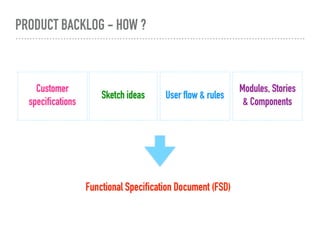
Sketch ideas User flow & rules
Functional Specification Document (FSD)
Customer
specifications
Modules, Stories
& Components
PRODUCT BACKLOG - HOW ?
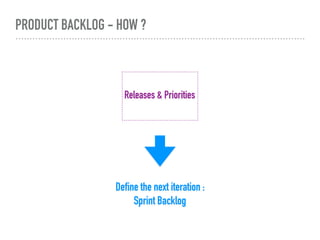
Define the next iteration :
Sprint Backlog
Releases & Priorities
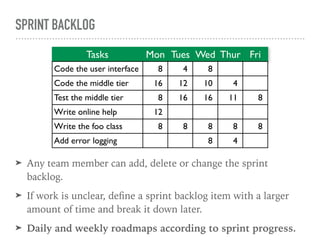
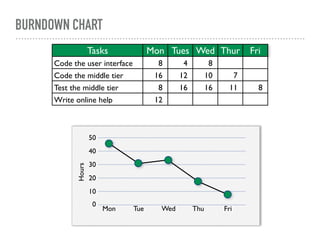
SPRINT BACKLOG
➤ Any team member can add, delete or change the sprint
backlog.
➤ If work is unclear, define a sprint backlog item with a larger
amount of time and break it down later.
➤ Daily and weekly roadmaps according to sprint progress.
Tasks
Code the user interface
Code the middle tier
Test the middle tier
Write online help
Write the foo class
Mon
8
16
8
12
8
Tues
4
12
16
8
Wed Thur
4
11
8
4
Fri
8
8
Add error logging
8
10
16
8
8
BURNDOWN CHART
Hours
40
30
20
10
0
Mon Tue Wed Thu Fri
Tasks
Code the user interface
Code the middle tier
Test the middle tier
Write online help
Mon
8
16
8
12
Tues Wed Thur Fri
4
12
16
7
11
8
10
16 8
50
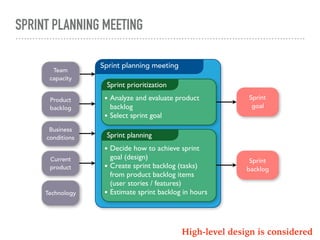
SPRINT PLANNING MEETING
High-level design is considered
Sprint planning meeting
Sprint prioritization
• Analyze and evaluate product
backlog
• Select sprint goal
Sprint planning
• Decide how to achieve sprint
goal (design)
• Create sprint backlog (tasks)
from product backlog items
(user stories / features)
• Estimate sprint backlog in hours
Sprint
goal
Sprint
backlog
Business
conditions
Team
capacity
Product
backlog
Technology
Current
product
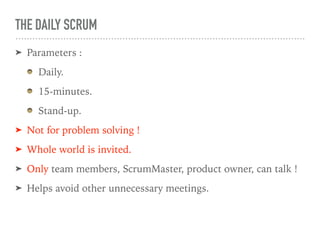
THE DAILY SCRUM
➤ Parameters :
Daily.
15-minutes.
Stand-up.
➤ Not for problem solving !
➤ Whole world is invited.
➤ Only team members, ScrumMaster, product owner, can talk !
➤ Helps avoid other unnecessary meetings.
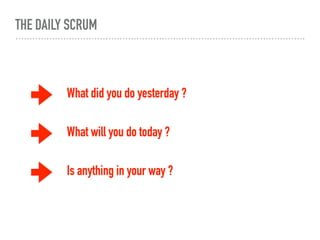
THE DAILY SCRUM
What did you do yesterday ?
What will you do today ?
Is anything in your way ?
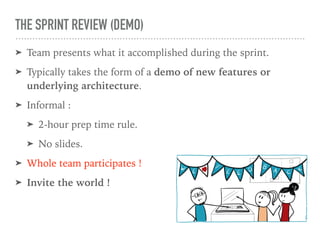
THE SPRINT REVIEW (DEMO)
➤ Team presents what it accomplished during the sprint.
➤ Typically takes the form of a demo of new features or
underlying architecture.
➤ Informal :
➤ 2-hour prep time rule.
➤ No slides.
➤ Whole team participates !
➤ Invite the world !
SPRINT RETROSPECTIVE
➤ Periodically take a look at what is and is not working.
➤ Typically 15–30 minutes.
➤ Done after every sprint.
➤ Whole team participates :
ScrumMaster.
Product owner.
Team.
Possibly customers and others.
DECOMPOSE, ITERATE, OBSERVE AND ENHANCE
RETROACTION
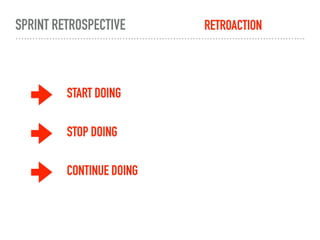
SPRINT RETROSPECTIVE RETROACTION
START DOING
STOP DOING
CONTINUE DOING
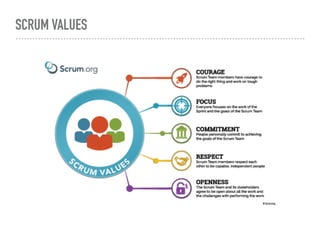
SCRUM VALUES
« Scrum’s roles, events, artifacts, and rules are
immutable and although implementing only parts
of Scrum is possible, the result is not Scrum. Scrum
exists only in its entirety and functions well as a
container for other techniques, methodologies, and
practices.
https://www.scrumguides.org/scrum-guide.html
EXTREME PROGRAMMING (XP) - WHAT ?
XP takes commonsense principles and practices to extreme levels:
➤ If code reviews are good, we’ll review code all the time (pair
programming).
➤ If testing is good, everybody will test all the time (unit testing).
➤ If design is good, we’ll make it part of everybody’s daily
business (refactoring).
➤ If integration testing is important, then we’ll integrate and test
several times a day.
➤ If short iterations are good, we will make the iterations really,
really short – seconds, minutes and hours, not weeks, months
and years.
« XP is a lightweight methodology for
small to medium sized teams developing
software in the face of vague or rapidly
changing requirements.
-Kent Beck
« XP doesn't conduct complete up-front
analysis and design--an XP project starts
with a quick analysis of the entire system,
and XP programmers continue to make
analysis and design decisions throughout
development.
« XP works well when there are uncertain
or volatile requirements.
« Extreme Programming teams don’t use
too much documentation. They usually
solve problems through discussions
inside of the team.
« XP focuses on people and values team
work over power.
« Extreme Programming is focused on the
code rather than on design.
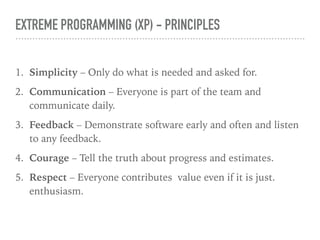
EXTREME PROGRAMMING (XP) - PRINCIPLES
1. Simplicity – Only do what is needed and asked for.
2. Communication – Everyone is part of the team and
communicate daily.
3. Feedback – Demonstrate software early and often and listen
to any feedback.
4. Courage – Tell the truth about progress and estimates.
5. Respect – Everyone contributes value even if it is just.
enthusiasm.
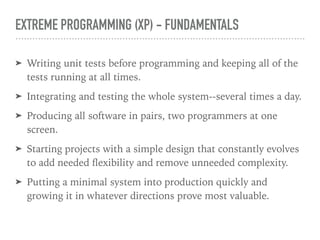
EXTREME PROGRAMMING (XP) - FUNDAMENTALS
➤ Writing unit tests before programming and keeping all of the
tests running at all times.
➤ Integrating and testing the whole system--several times a day.
➤ Producing all software in pairs, two programmers at one
screen.
➤ Starting projects with a simple design that constantly evolves
to add needed flexibility and remove unneeded complexity.
➤ Putting a minimal system into production quickly and
growing it in whatever directions prove most valuable.
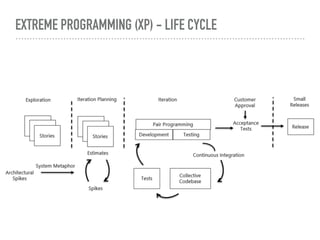
EXTREME PROGRAMMING (XP) - LIFE CYCLE
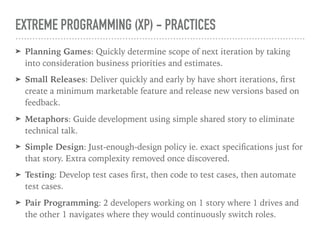
EXTREME PROGRAMMING (XP) - PRACTICES
➤ Planning Games: Quickly determine scope of next iteration by taking
into consideration business priorities and estimates.
➤ Small Releases: Deliver quickly and early by have short iterations, first
create a minimum marketable feature and release new versions based on
feedback.
➤ Metaphors: Guide development using simple shared story to eliminate
technical talk.
➤ Simple Design: Just-enough-design policy ie. exact specifications just for
that story. Extra complexity removed once discovered.
➤ Testing: Develop test cases first, then code to test cases, then automate
test cases.
➤ Pair Programming: 2 developers working on 1 story where 1 drives and
the other 1 navigates where they would continuously switch roles.
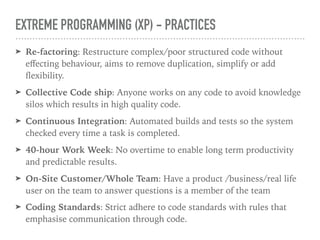
EXTREME PROGRAMMING (XP) - PRACTICES
➤ Re-factoring: Restructure complex/poor structured code without
effecting behaviour, aims to remove duplication, simplify or add
flexibility.
➤ Collective Code ship: Anyone works on any code to avoid knowledge
silos which results in high quality code.
➤ Continuous Integration: Automated builds and tests so the system
checked every time a task is completed.
➤ 40-hour Work Week: No overtime to enable long term productivity
and predictable results.
➤ On-Site Customer/Whole Team: Have a product /business/real life
user on the team to answer questions is a member of the team
➤ Coding Standards: Strict adhere to code standards with rules that
emphasise communication through code.
EXTREME PROGRAMMING (XP) - ROLES
➤ Tracker.
➤ Customer.
➤ Programmer.
➤ Tester.
➤ Coach.
EXTREME PROGRAMMING (XP) - DISADVANTAGES
➤ Extreme Programming is focused on the code rather than on design. That
may be a problem because good design is extremely important for
software applications.
➤ Lack of defect documentation may lead to the occurrence of similar bugs
in the future.
➤ XP is geared toward a single project, developed and maintained by a
single team.
➤ XP will not work in an environment where a customer or manager insists
on a complete specification or design before they begin programming.
➤ XP will not work in an environment where programmers are separated
geographically.
➤ XP has not been proven to work with systems that have scalability issues
(new applications must integrate into existing systems).
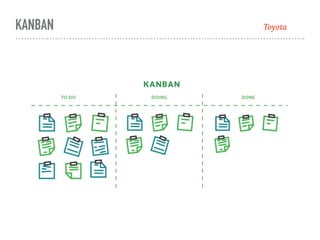
KANBAN Toyota
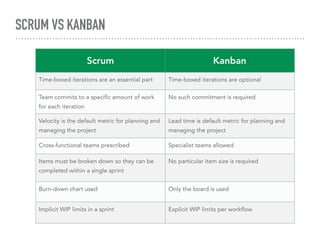
SCRUM VS KANBAN
Scrum Kanban
Time-boxed iterations are an essential part Time-boxed iterations are optional
Team commits to a specific amount of work
for each iteration
No such commitment is required
Velocity is the default metric for planning and
managing the project
Lead time is default metric for planning and
managing the project
Cross-functional teams prescribed Specialist teams allowed
Items must be broken down so they can be
completed within a single sprint
No particular item size is required
Burn-down chart used Only the board is used
Implicit WIP limits in a sprint Explicit WIP limits per workflow
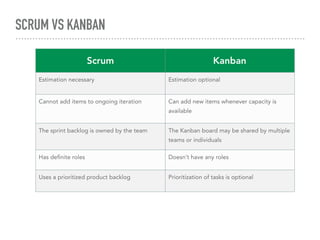
SCRUM VS KANBAN
Scrum Kanban
Estimation necessary Estimation optional
Cannot add items to ongoing iteration Can add new items whenever capacity is
available
The sprint backlog is owned by the team The Kanban board may be shared by multiple
teams or individuals
Has definite roles Doesn’t have any roles
Uses a prioritized product backlog Prioritization of tasks is optional
« Scrum is best-suited for products and
development projects. Kanban is best for
production support.
Kanban
Support phase
No sprints, no
ceremonies, no actors.
Resolve issues as soon as
possible (reduce WIP).
When we don’t have a clear scoop for bugs and
recipes issues.
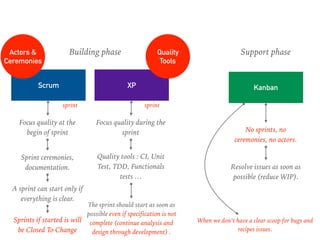
Scrum XP
Building phase
Focus quality at the
begin of sprint
Sprint ceremonies,
documentation.
Focus quality during the
sprint
A sprint can start only if
everything is clear.
Quality tools : CI, Unit
Test, TDD, Functionals
tests …
The sprint should start as soon as
possible even if specification is not
complete (continue analysis and
design through development) .
Actors &
Ceremonies
Quality
Tools
sprintsprint
Sprints if started is will
be Closed To Change
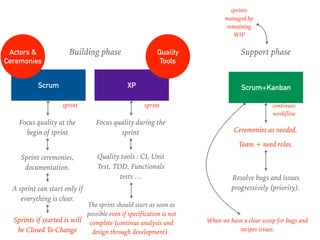
Scrum XP Scrum+Kanban
Building phase Support phase
Focus quality at the
begin of sprint
Sprint ceremonies,
documentation.
Focus quality during the
sprint
A sprint can start only if
everything is clear.
Quality tools : CI, Unit
Test, TDD, Functionals
tests …
The sprint should start as soon as
possible even if specification is not
complete (continue analysis and
design through development) .
Actors &
Ceremonies
Quality
Tools
Ceremonies as needed.
Team + need roles.
Resolve bugs and issues
progressively (priority).
sprintsprint
When we have a clear scoop for bugs and
recipes issues.
continuos
workflow
Sprints if started is will
be Closed To Change
sprints
managed by
remaining
WIP
« Choose the right methodology don't
break the rules.

Process & Methodologies (1.1)

  • 1.
    PROCESS & METHODOLOGIES BenKhalfallah Héla 27 Octobre 2018
  • 2.
  • 3.
  • 4.
  • 5.
  • 6.
  • 7.
  • 8.
    « Why do wetalk about ?
  • 9.
  • 10.
    SUCCESS ➤ Success mustbe achieved / maintained in light of : Dynamic environment Complexity and chaotic environment Unknown futures Unpredictable states Rapidly changing situations New, diverse circumstances Unexpected events Unfamiliar situations Changing tasks, purposes Loss, Damage, Threats Success = effectiveness, efficiency, survivability, control
  • 11.
    « Agility is theability to successfully cope with changes in the environment.
  • 12.
  • 13.
  • 14.
    AGILE PRACTICES ➤ Thinking- Pair Programming, Energised Work, Informative Workspace, Root Cause Analysis, Retrospectives etc. ➤ Collaborating – Trust, Sit Together, Real Customer Involvement, stand-up meeting, coding standards, sprint demo, reporting etc. ➤ Releasing – Done, No Bugs, Version Control, Continuous Integration, Collective Code ownership, documentation etc. ➤ Planning – Vision, Release Planning, Iteration Planning, estimating etc. ➤ Developing – Customer Tests, Test Driven Development, Simple Design etc.
  • 15.
    BEING AGILE IT ISABOUT THE PEOPLE AND TEAMS. IT IS ABOUT CUSTOMER AND DELIVERING SOFTWARE. IT IS ABOUT CONTINUOUS IMPROVEMENT.
  • 16.
    AGILE METHODS ➤ Agilemethods are processes that support the agile philosophy. ➤ Agile methods consist of individual elements called practices. ➤ Practices include using version control, setting coding standards, and giving weekly demos to your stakeholders. ➤ Agile Methods combine these practices to accentuate parts that support agile philosophy. public Method agileMethods { getMethod(Agile.agile); }
  • 17.
    SCRUM Adjust commitments & deadlines Clearcommitments & deadlines Retroaction DECOMPOSE, ITERATE, OBSERVE AND ENHANCE Short & limited iteration : 2-4 weeks
  • 18.
    SCRUM ➤ Scrum isan agile process that allows us to focus on delivering the highest business value in the shortest time. ➤ Scrum projects make progress in a series of “sprints”. ➤ It allows us to rapidly and repeatedly inspect actual working software (every two weeks to one month). ➤ A constant duration leads to a better rhythm. ➤ The business sets the priorities. Teams self-organise to determine the best way to deliver the highest priority features. ➤ Every two weeks to a month anyone can see real working software and decide to release it as is or continue to enhance it for another sprint. ➤ Product is designed, coded, and tested during the sprint.
  • 19.
  • 20.
  • 21.
    SCRUM FRAMEWORK • Productowner • ScrumMaster • Team Roles • Sprint planning • Sprint review • Sprint retrospective • Daily scrum meeting Ceremonies • Product backlog • Sprint backlog • Burndown charts Artifacts
  • 22.
  • 23.
    PRODUCT OWNER ➤ TheProduct Owner is the sole person responsible for managing the Product Backlog. ➤ Product Backlog management includes : Clearly expressing Product Backlog items. Ordering the items in the Product Backlog to best achieve goals and missions. Ensuring that the Product Backlog is visible, transparent, and clear to all, and shows what the Scrum Team will work on next. Ensuring the Development Team understands items in the Product Backlog to the level needed. ➤ The Product Owner is one person, not a committee. ➤ For the Product Owner to succeed, the entire organisation must respect his decisions.
  • 24.
  • 25.
    SCRUM MASTER ➤ Representsmanagement to the project. ➤ Responsible for enacting Scrum values and practices. ➤ Removes impediments & difficulties. ➤ Ensure that the team is fully functional and productive. ➤ Enable close cooperation across all roles and functions. ➤ Shield the team from external interferences.
  • 26.
  • 27.
    PRODUCT BACKLOG ➤ Therequirements. ➤ A list of all desired work on the project. ➤ Release definition (a release can be realized on one or multiple sprints). ➤ Prioritized by the product owner. ➤ Reprioritized at the start of each sprint.
  • 28.
    PRODUCT BACKLOG -HOW ? Brainstorm, discuss, improve and innovate customer specifications
  • 29.
    PRODUCT BACKLOG -HOW ? Sketch ideas User flow & rules Content Navigations & animations
  • 30.
    PRODUCT BACKLOG -HOW ? Define modules (epics), stories and components Modules Stories Components : Backend Frontend Design
  • 31.
    PRODUCT BACKLOG -HOW ? Estimate stories, define releases and priorities Backlog item Estimate Allow a guest to make a reservation 3 As a guest, I want to cancel a reservation. 5 As a guest, I want to change the dates of a reservation. 3 As a hotel employee, I can run RevPAR reports (revenue-per-available-room) 8 Improve exception handling 8 ... 30 ... 50
  • 32.
    PRODUCT BACKLOG -HOW ? Sketch ideas User flow & rules Functional Specification Document (FSD) Customer specifications Modules, Stories & Components
  • 33.
    PRODUCT BACKLOG -HOW ? Define the next iteration : Sprint Backlog Releases & Priorities
  • 34.
    SPRINT BACKLOG ➤ Anyteam member can add, delete or change the sprint backlog. ➤ If work is unclear, define a sprint backlog item with a larger amount of time and break it down later. ➤ Daily and weekly roadmaps according to sprint progress. Tasks Code the user interface Code the middle tier Test the middle tier Write online help Write the foo class Mon 8 16 8 12 8 Tues 4 12 16 8 Wed Thur 4 11 8 4 Fri 8 8 Add error logging 8 10 16 8 8
  • 35.
    BURNDOWN CHART Hours 40 30 20 10 0 Mon TueWed Thu Fri Tasks Code the user interface Code the middle tier Test the middle tier Write online help Mon 8 16 8 12 Tues Wed Thur Fri 4 12 16 7 11 8 10 16 8 50
  • 36.
    SPRINT PLANNING MEETING High-leveldesign is considered Sprint planning meeting Sprint prioritization • Analyze and evaluate product backlog • Select sprint goal Sprint planning • Decide how to achieve sprint goal (design) • Create sprint backlog (tasks) from product backlog items (user stories / features) • Estimate sprint backlog in hours Sprint goal Sprint backlog Business conditions Team capacity Product backlog Technology Current product
  • 37.
    THE DAILY SCRUM ➤Parameters : Daily. 15-minutes. Stand-up. ➤ Not for problem solving ! ➤ Whole world is invited. ➤ Only team members, ScrumMaster, product owner, can talk ! ➤ Helps avoid other unnecessary meetings.
  • 38.
    THE DAILY SCRUM Whatdid you do yesterday ? What will you do today ? Is anything in your way ?
  • 39.
    THE SPRINT REVIEW(DEMO) ➤ Team presents what it accomplished during the sprint. ➤ Typically takes the form of a demo of new features or underlying architecture. ➤ Informal : ➤ 2-hour prep time rule. ➤ No slides. ➤ Whole team participates ! ➤ Invite the world !
  • 40.
    SPRINT RETROSPECTIVE ➤ Periodicallytake a look at what is and is not working. ➤ Typically 15–30 minutes. ➤ Done after every sprint. ➤ Whole team participates : ScrumMaster. Product owner. Team. Possibly customers and others. DECOMPOSE, ITERATE, OBSERVE AND ENHANCE RETROACTION
  • 41.
    SPRINT RETROSPECTIVE RETROACTION STARTDOING STOP DOING CONTINUE DOING
  • 42.
  • 43.
    « Scrum’s roles, events,artifacts, and rules are immutable and although implementing only parts of Scrum is possible, the result is not Scrum. Scrum exists only in its entirety and functions well as a container for other techniques, methodologies, and practices. https://www.scrumguides.org/scrum-guide.html
  • 44.
    EXTREME PROGRAMMING (XP)- WHAT ? XP takes commonsense principles and practices to extreme levels: ➤ If code reviews are good, we’ll review code all the time (pair programming). ➤ If testing is good, everybody will test all the time (unit testing). ➤ If design is good, we’ll make it part of everybody’s daily business (refactoring). ➤ If integration testing is important, then we’ll integrate and test several times a day. ➤ If short iterations are good, we will make the iterations really, really short – seconds, minutes and hours, not weeks, months and years.
  • 45.
    « XP is alightweight methodology for small to medium sized teams developing software in the face of vague or rapidly changing requirements. -Kent Beck
  • 46.
    « XP doesn't conductcomplete up-front analysis and design--an XP project starts with a quick analysis of the entire system, and XP programmers continue to make analysis and design decisions throughout development.
  • 47.
    « XP works wellwhen there are uncertain or volatile requirements.
  • 48.
    « Extreme Programming teamsdon’t use too much documentation. They usually solve problems through discussions inside of the team.
  • 49.
    « XP focuses onpeople and values team work over power.
  • 50.
    « Extreme Programming isfocused on the code rather than on design.
  • 51.
    EXTREME PROGRAMMING (XP)- PRINCIPLES 1. Simplicity – Only do what is needed and asked for. 2. Communication – Everyone is part of the team and communicate daily. 3. Feedback – Demonstrate software early and often and listen to any feedback. 4. Courage – Tell the truth about progress and estimates. 5. Respect – Everyone contributes value even if it is just. enthusiasm.
  • 52.
    EXTREME PROGRAMMING (XP)- FUNDAMENTALS ➤ Writing unit tests before programming and keeping all of the tests running at all times. ➤ Integrating and testing the whole system--several times a day. ➤ Producing all software in pairs, two programmers at one screen. ➤ Starting projects with a simple design that constantly evolves to add needed flexibility and remove unneeded complexity. ➤ Putting a minimal system into production quickly and growing it in whatever directions prove most valuable.
  • 53.
  • 54.
    EXTREME PROGRAMMING (XP)- PRACTICES ➤ Planning Games: Quickly determine scope of next iteration by taking into consideration business priorities and estimates. ➤ Small Releases: Deliver quickly and early by have short iterations, first create a minimum marketable feature and release new versions based on feedback. ➤ Metaphors: Guide development using simple shared story to eliminate technical talk. ➤ Simple Design: Just-enough-design policy ie. exact specifications just for that story. Extra complexity removed once discovered. ➤ Testing: Develop test cases first, then code to test cases, then automate test cases. ➤ Pair Programming: 2 developers working on 1 story where 1 drives and the other 1 navigates where they would continuously switch roles.
  • 55.
    EXTREME PROGRAMMING (XP)- PRACTICES ➤ Re-factoring: Restructure complex/poor structured code without effecting behaviour, aims to remove duplication, simplify or add flexibility. ➤ Collective Code ship: Anyone works on any code to avoid knowledge silos which results in high quality code. ➤ Continuous Integration: Automated builds and tests so the system checked every time a task is completed. ➤ 40-hour Work Week: No overtime to enable long term productivity and predictable results. ➤ On-Site Customer/Whole Team: Have a product /business/real life user on the team to answer questions is a member of the team ➤ Coding Standards: Strict adhere to code standards with rules that emphasise communication through code.
  • 56.
    EXTREME PROGRAMMING (XP)- ROLES ➤ Tracker. ➤ Customer. ➤ Programmer. ➤ Tester. ➤ Coach.
  • 57.
    EXTREME PROGRAMMING (XP)- DISADVANTAGES ➤ Extreme Programming is focused on the code rather than on design. That may be a problem because good design is extremely important for software applications. ➤ Lack of defect documentation may lead to the occurrence of similar bugs in the future. ➤ XP is geared toward a single project, developed and maintained by a single team. ➤ XP will not work in an environment where a customer or manager insists on a complete specification or design before they begin programming. ➤ XP will not work in an environment where programmers are separated geographically. ➤ XP has not been proven to work with systems that have scalability issues (new applications must integrate into existing systems).
  • 58.
  • 59.
    SCRUM VS KANBAN ScrumKanban Time-boxed iterations are an essential part Time-boxed iterations are optional Team commits to a specific amount of work for each iteration No such commitment is required Velocity is the default metric for planning and managing the project Lead time is default metric for planning and managing the project Cross-functional teams prescribed Specialist teams allowed Items must be broken down so they can be completed within a single sprint No particular item size is required Burn-down chart used Only the board is used Implicit WIP limits in a sprint Explicit WIP limits per workflow
  • 60.
    SCRUM VS KANBAN ScrumKanban Estimation necessary Estimation optional Cannot add items to ongoing iteration Can add new items whenever capacity is available The sprint backlog is owned by the team The Kanban board may be shared by multiple teams or individuals Has definite roles Doesn’t have any roles Uses a prioritized product backlog Prioritization of tasks is optional
  • 61.
    « Scrum is best-suitedfor products and development projects. Kanban is best for production support.
  • 62.
    Kanban Support phase No sprints,no ceremonies, no actors. Resolve issues as soon as possible (reduce WIP). When we don’t have a clear scoop for bugs and recipes issues. Scrum XP Building phase Focus quality at the begin of sprint Sprint ceremonies, documentation. Focus quality during the sprint A sprint can start only if everything is clear. Quality tools : CI, Unit Test, TDD, Functionals tests … The sprint should start as soon as possible even if specification is not complete (continue analysis and design through development) . Actors & Ceremonies Quality Tools sprintsprint Sprints if started is will be Closed To Change
  • 63.
    Scrum XP Scrum+Kanban Buildingphase Support phase Focus quality at the begin of sprint Sprint ceremonies, documentation. Focus quality during the sprint A sprint can start only if everything is clear. Quality tools : CI, Unit Test, TDD, Functionals tests … The sprint should start as soon as possible even if specification is not complete (continue analysis and design through development) . Actors & Ceremonies Quality Tools Ceremonies as needed. Team + need roles. Resolve bugs and issues progressively (priority). sprintsprint When we have a clear scoop for bugs and recipes issues. continuos workflow Sprints if started is will be Closed To Change sprints managed by remaining WIP
  • 64.
    « Choose the rightmethodology don't break the rules.