PROBLEM – REACTION - SOLUTION
PROBLEM 
Chronic diseases are often connected to 
anaemia. 
There is a large number of chronics in various 
diseases with iron deficiency. 
These are for instance Chronic kidney 
disease, Inflammatory bowel disease or 
Coronary heart disease patients and many 
others.
PROBLEM 
Iron-deficient chronic primary therapy is 
normally oral iron in tablet form, which is 
non-heme iron where the iron is 
syntethically bound. 
The main forms used are iron salts Ferrous 
sulphate and Ferrous fumarate, Amino 
acids chelates, Carbonyl iron and 
Polysaccharide-iron complexes.
PROBLEM 
Non-heme iron needs to disintegrate in the 
stomach's acidic environment before the 
iron ions can be absorbed. 
If there is a acid-lowering achlorhydria 
therapy going on such as Omeprazole, 
which is often the case, this won’t happen 
and no iron will be absorbed.
PROBLEM 
Free iron ions are basically toxic for the 
organism, so after breaking down of non-heme 
iron there will be free iron ions in the 
stomach. 
This gives the typical side-effects problems 
with oral iron. Absorption of non-heme iron 
is low, 2 – 4 %.
REACTION 
Sooner or later the oral non-heme therapy 
will give increasing side-effects, so that the 
therapy must be discontinued. 
If serious and chronic iron deficiency is 
present for any reason, it must be treated, 
or life-threatening anemia will occur.
REACTION 
The only remaining therapy alternative is 
IV-, or intravenous iron. 
This is administered in daily more or less 
painful injections.
REACTION 
Intravenous or IV-iron, however, also has 
drawbacks. 
There is a risk for allergic reactions and the 
main risk is oxidative stress, since this is not 
a natural way to absorb iron. 
It is also very expensive.
SOLUTION 
As opposed to non-heme iron, natural 
hemoglobin is absorbed as a whole unit, 
Heme iron supplementation works well over 
longer time. 
Efficacy, tolerance or uptake will not change 
over time and there are very few side-effects.
SOLUTION 
Dosage of heme iron tablets once per day is 
very user-friendly. 
Heme iron dosage does not need medical 
assistance, thus freeing the patient to for 
instance travel.
SOLUTION 
Uptake of heme iron is 15 – 25 %, which is 
several times that of oral non-heme. 
In studies side-effects are at placebo-level. 
Heme iron is reasonably priced.
Swedish company FerroCare/MediTec 
has a strong commitment to reach 
people suffering from iron deficiency, 
but have problems with existing 
supplements.
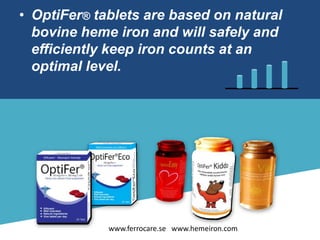
• OptiFer® tablets are based on natural 
bovine heme iron and will safely and 
efficiently keep iron counts at an 
optimal level. 
www.ferrocare.se www.hemeiron.com

Problem reaction - solution

  • 1.
  • 2.
    PROBLEM Chronic diseasesare often connected to anaemia. There is a large number of chronics in various diseases with iron deficiency. These are for instance Chronic kidney disease, Inflammatory bowel disease or Coronary heart disease patients and many others.
  • 3.
    PROBLEM Iron-deficient chronicprimary therapy is normally oral iron in tablet form, which is non-heme iron where the iron is syntethically bound. The main forms used are iron salts Ferrous sulphate and Ferrous fumarate, Amino acids chelates, Carbonyl iron and Polysaccharide-iron complexes.
  • 4.
    PROBLEM Non-heme ironneeds to disintegrate in the stomach's acidic environment before the iron ions can be absorbed. If there is a acid-lowering achlorhydria therapy going on such as Omeprazole, which is often the case, this won’t happen and no iron will be absorbed.
  • 5.
    PROBLEM Free ironions are basically toxic for the organism, so after breaking down of non-heme iron there will be free iron ions in the stomach. This gives the typical side-effects problems with oral iron. Absorption of non-heme iron is low, 2 – 4 %.
  • 6.
    REACTION Sooner orlater the oral non-heme therapy will give increasing side-effects, so that the therapy must be discontinued. If serious and chronic iron deficiency is present for any reason, it must be treated, or life-threatening anemia will occur.
  • 7.
    REACTION The onlyremaining therapy alternative is IV-, or intravenous iron. This is administered in daily more or less painful injections.
  • 8.
    REACTION Intravenous orIV-iron, however, also has drawbacks. There is a risk for allergic reactions and the main risk is oxidative stress, since this is not a natural way to absorb iron. It is also very expensive.
  • 9.
    SOLUTION As opposedto non-heme iron, natural hemoglobin is absorbed as a whole unit, Heme iron supplementation works well over longer time. Efficacy, tolerance or uptake will not change over time and there are very few side-effects.
  • 10.
    SOLUTION Dosage ofheme iron tablets once per day is very user-friendly. Heme iron dosage does not need medical assistance, thus freeing the patient to for instance travel.
  • 11.
    SOLUTION Uptake ofheme iron is 15 – 25 %, which is several times that of oral non-heme. In studies side-effects are at placebo-level. Heme iron is reasonably priced.
  • 12.
    Swedish company FerroCare/MediTec has a strong commitment to reach people suffering from iron deficiency, but have problems with existing supplements.
  • 13.
    • OptiFer® tabletsare based on natural bovine heme iron and will safely and efficiently keep iron counts at an optimal level. www.ferrocare.se www.hemeiron.com