Problem Definition
Build a Date class and a main function to test it.
Specifications
Below is the interface for the Date class: it is our "contract" with you: you have to implement
everything it describes, and show us that it works with a test harness that puts it through its
paces. The comments in the interface below should be sufficient for you to understand the
project (use these comments in your Date declaration), without the need of any further
documentation. But of course, as always, you can ask us any questions you may have on Piazza.
Note: Placing the error messages into the constructors like is not necessarily a good way to
handle constructor errors, but until you learn about exceptions in CS 14, it's the best we can do.
Private Member Functions
The functions declared private above, isLeap, daysPerMonth, name, number, are helper functions
- member functions that will never be needed by a user of the class, and so do not belong to the
public interface (which is why they are "private"). They are, however, needed by the interface
functions (public member functions), which use them to test the validity of arguments and
construct valid dates. For example, the constructor that passes in the month as a string will call
the number function to assign a value to the unsigned member variable month.
isLeap: The rule for whether a year is a leap year is:
(year % 4 == 0) implies leap year
except (year % 100 == 0) implies NOT leap year
except (year % 400 == 0) implies leap year
So, for instance, year 2000 is a leap year, but 1900 is NOT a leap year. Years 2004, 2008, 2012,
2016, etc. are all leap years. Years 2005, 2006, 2007, 2009, 2010, etc. are NOT leap years.
Output Specifications
Read the specifications for the print function carefully. The only cout statements within your
Date member functions should be:
the "Invalid Date" warnings in the constructors
in your two print functions
Required Main Function
You must use this main function and global function getDate as they are here. You may not
change these functions at all. Copy-and-paste these into your main.cpp file and then add the Date
class.
Solution
// Date.h
#include
#include
#include
#include
using namespace std;
class Date
{
private:
unsigned day;
unsigned month;
string monthName;
unsigned year;
public:
Date();
Date(unsigned m, unsigned d, unsigned y);
Date(const string &mn, unsigned d, unsigned y);
void printNumeric() const;
void printAlpha() const;
private:
bool isLeap(unsigned y) const;
unsigned daysPerMonth(unsigned m, unsigned y) const;
string name(unsigned m) const;
unsigned number(const string &mn) const;
};
//Date.cpp
#include
#include
#include
#include
using namespace std;
#include "Date.h"
// creates the date January 1st, 2000.
Date::Date()
{
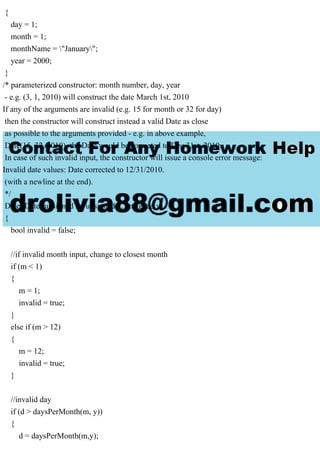
day = 1;
month = 1;
monthName = "January";
year = 2000;
}
/* parameterized constructor: month number, day, year
- e.g. (3, 1, 2010) will construct the date March 1st, 2010
If any of the arguments are invalid (e.g. 15 for month or 32 for day)
then the constructor will construct instead a valid Date as close
as possible to the arguments provided - e.g. in above example,
Date(15, 32, 2010), the Date would be corrected to Dec 31st, 2010.
In case of such invalid input, the constructor will issue a console error message:
Invalid date values: Date corrected to 12/31/2010.
(with a newline at the end).
*/
Date::Date (unsigned m, unsigned d, unsigned y)
{
bool invalid = false;
//if invalid month input, change to closest month
if (m < 1)
{
m = 1;
invalid = true;
}
else if (m > 12)
{
m = 12;
invalid = true;
}
//invalid day
if (d > daysPerMonth(m, y))
{
d = daysPerMonth(m,y);
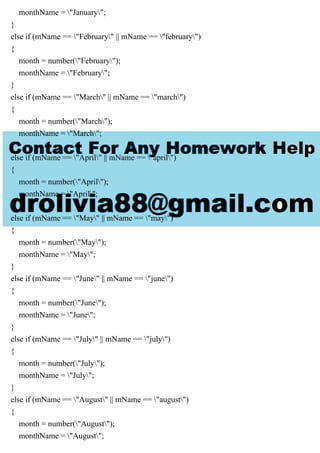
invalid = true;
}
day = d;
month = m;
monthName = name(m);
year = y;
if (invalid)
{
cout << "Invalid date values: Date corrected to ";
cout << month << "/" << day << "/" << year << "." << endl;
}
}
/* parameterized constructor: month name, day, year
- - e.g. (December, 15, 2012) will construct the date December 15th, 2012
If the constructor is unable to recognize the string argument as a valid month name,
then it will issue a console error message:
Invalid month name: the Date was set to 1/1/2000.
(with a newline at the end).
If the day argument is invalid for the given month (but the month name was valid),
then the constructor will handle this error in the same manner as the other
parameterized constructor.
This constructor will recognize both "december" and "December"
as month name.
*/
Date::Date (const string &mName, unsigned d, unsigned y)
{
//will change to true if invalid day
bool invalidDay = false;
//will change to true if invalid month
bool invalidMonth = false;
if (mName == "January" || mName == "january")
{
month = number("January");
monthName = "January";
}
else if (mName == "February" || mName == "february")
{
month = number("February");
monthName = "February";
}
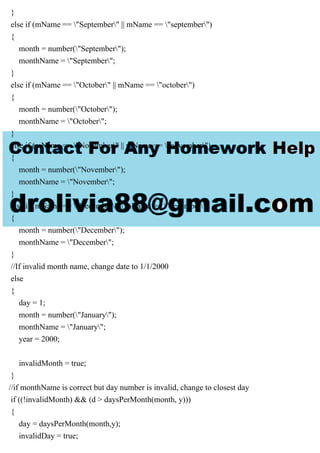
else if (mName == "March" || mName == "march")
{
month = number("March");
monthName = "March";
}
else if (mName == "April" || mName == "april")
{
month = number("April");
monthName = "April";
}
else if (mName == "May" || mName == "may")
{
month = number("May");
monthName = "May";
}
else if (mName == "June" || mName == "june")
{
month = number("June");
monthName = "June";
}
else if (mName == "July" || mName == "july")
{
month = number("July");
monthName = "July";
}
else if (mName == "August" || mName == "august")
{
month = number("August");
monthName = "August";
}
else if (mName == "September" || mName == "september")
{
month = number("September");
monthName = "September";
}
else if (mName == "October" || mName == "october")
{
month = number("October");
monthName = "October";
}
else if (mName == "November" || mName == "november")
{
month = number("November");
monthName = "November";
}
else if (mName == "December" || mName == "december")
{
month = number("December");
monthName = "December";
}
//If invalid month name, change date to 1/1/2000
else
{
day = 1;
month = number("January");
monthName = "January";
year = 2000;
invalidMonth = true;
}
//if monthName is correct but day number is invalid, change to closest day
if ((!invalidMonth) && (d > daysPerMonth(month, y)))
{
day = daysPerMonth(month,y);
invalidDay = true;
}
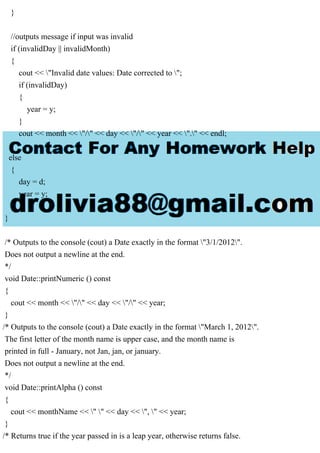
//outputs message if input was invalid
if (invalidDay || invalidMonth)
{
cout << "Invalid date values: Date corrected to ";
if (invalidDay)
{
year = y;
}
cout << month << "/" << day << "/" << year << "." << endl;
}
else
{
day = d;
year = y;
}
}
/* Outputs to the console (cout) a Date exactly in the format "3/1/2012".
Does not output a newline at the end.
*/
void Date::printNumeric () const
{
cout << month << "/" << day << "/" << year;
}
/* Outputs to the console (cout) a Date exactly in the format "March 1, 2012".
The first letter of the month name is upper case, and the month name is
printed in full - January, not Jan, jan, or january.
Does not output a newline at the end.
*/
void Date::printAlpha () const
{
cout << monthName << " " << day << ", " << year;
}
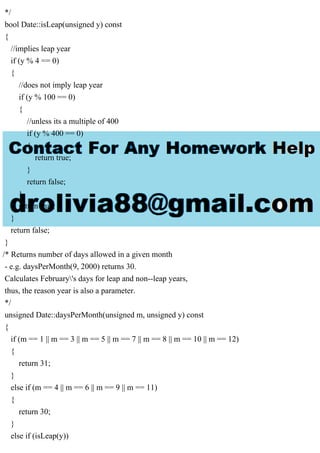
/* Returns true if the year passed in is a leap year, otherwise returns false.
*/
bool Date::isLeap(unsigned y) const
{
//implies leap year
if (y % 4 == 0)
{
//does not imply leap year
if (y % 100 == 0)
{
//unless its a multiple of 400
if (y % 400 == 0)
{
return true;
}
return false;
}
return true;
}
return false;
}
/* Returns number of days allowed in a given month
- e.g. daysPerMonth(9, 2000) returns 30.
Calculates February's days for leap and non--leap years,
thus, the reason year is also a parameter.
*/
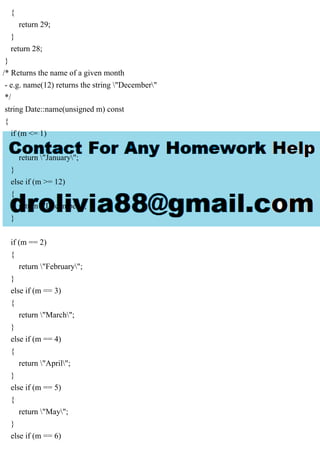
unsigned Date::daysPerMonth(unsigned m, unsigned y) const
{
if (m == 1 || m == 3 || m == 5 || m == 7 || m == 8 || m == 10 || m == 12)
{
return 31;
}
else if (m == 4 || m == 6 || m == 9 || m == 11)
{
return 30;
}
else if (isLeap(y))
{
return 29;
}
return 28;
}
/* Returns the name of a given month
- e.g. name(12) returns the string "December"
*/
string Date::name(unsigned m) const
{
if (m <= 1)
{
return "January";
}
else if (m >= 12)
{
return "December";
}
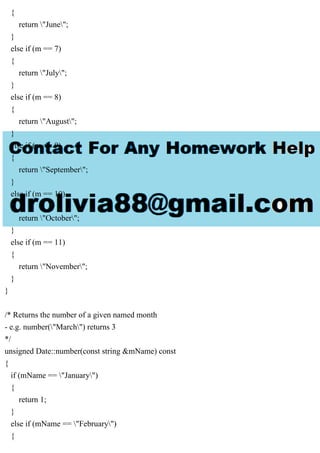
if (m == 2)
{
return "February";
}
else if (m == 3)
{
return "March";
}
else if (m == 4)
{
return "April";
}
else if (m == 5)
{
return "May";
}
else if (m == 6)
{
return "June";
}
else if (m == 7)
{
return "July";
}
else if (m == 8)
{
return "August";
}
else if (m == 9)
{
return "September";
}
else if (m == 10)
{
return "October";
}
else if (m == 11)
{
return "November";
}
}
/* Returns the number of a given named month
- e.g. number("March") returns 3
*/
unsigned Date::number(const string &mName) const
{
if (mName == "January")
{
return 1;
}
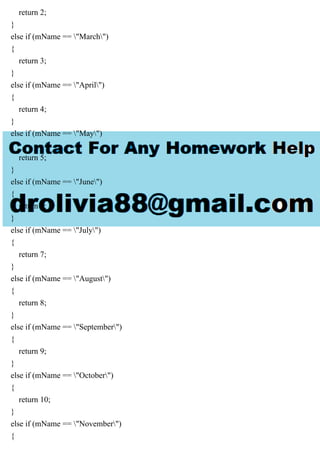
else if (mName == "February")
{
return 2;
}
else if (mName == "March")
{
return 3;
}
else if (mName == "April")
{
return 4;
}
else if (mName == "May")
{
return 5;
}
else if (mName == "June")
{
return 6;
}
else if (mName == "July")
{
return 7;
}
else if (mName == "August")
{
return 8;
}
else if (mName == "September")
{
return 9;
}
else if (mName == "October")
{
return 10;
}
else if (mName == "November")
{
return 11;
}
else if (mName == "December")
{
return 12;
}
}
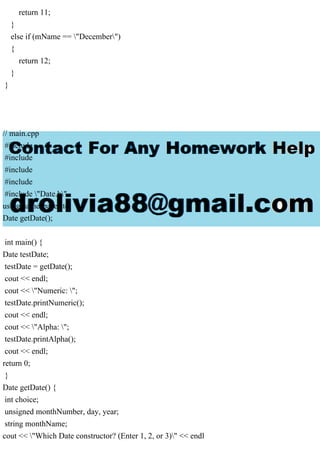
// main.cpp
#include
#include
#include
#include
#include "Date.h"
using namespace std;
Date getDate();
int main() {
Date testDate;
testDate = getDate();
cout << endl;
cout << "Numeric: ";
testDate.printNumeric();
cout << endl;
cout << "Alpha: ";
testDate.printAlpha();
cout << endl;
return 0;
}
Date getDate() {
int choice;
unsigned monthNumber, day, year;
string monthName;
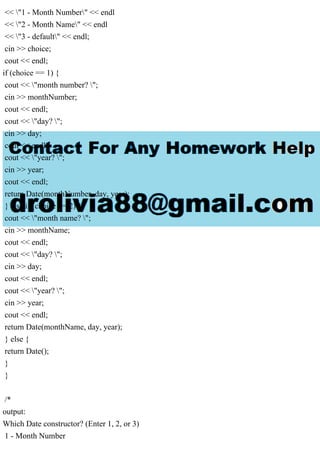
cout << "Which Date constructor? (Enter 1, 2, or 3)" << endl
<< "1 - Month Number" << endl
<< "2 - Month Name" << endl
<< "3 - default" << endl;
cin >> choice;
cout << endl;
if (choice == 1) {
cout << "month number? ";
cin >> monthNumber;
cout << endl;
cout << "day? ";
cin >> day;
cout << endl;
cout << "year? ";
cin >> year;
cout << endl;
return Date(monthNumber, day, year);
} else if (choice == 2) {
cout << "month name? ";
cin >> monthName;
cout << endl;
cout << "day? ";
cin >> day;
cout << endl;
cout << "year? ";
cin >> year;
cout << endl;
return Date(monthName, day, year);
} else {
return Date();
}
}
/*
output:
Which Date constructor? (Enter 1, 2, or 3)
1 - Month Number
2 - Month Name
3 - default
3
Numeric: 1/1/2000
Alpha: January 1, 2000
Which Date constructor? (Enter 1, 2, or 3)
1 - Month Number
2 - Month Name
3 - default
2
month name? march
day? 32
year? 1994
Invalid date values: Date corrected to 3/31/1994.
Numeric: 3/31/1994
Alpha: March 31, 1994
*/

Problem DefinitionBuild a Date class and a main function to test i.pdf

  • 1.
    Problem Definition Build aDate class and a main function to test it. Specifications Below is the interface for the Date class: it is our "contract" with you: you have to implement everything it describes, and show us that it works with a test harness that puts it through its paces. The comments in the interface below should be sufficient for you to understand the project (use these comments in your Date declaration), without the need of any further documentation. But of course, as always, you can ask us any questions you may have on Piazza. Note: Placing the error messages into the constructors like is not necessarily a good way to handle constructor errors, but until you learn about exceptions in CS 14, it's the best we can do. Private Member Functions The functions declared private above, isLeap, daysPerMonth, name, number, are helper functions - member functions that will never be needed by a user of the class, and so do not belong to the public interface (which is why they are "private"). They are, however, needed by the interface functions (public member functions), which use them to test the validity of arguments and construct valid dates. For example, the constructor that passes in the month as a string will call the number function to assign a value to the unsigned member variable month. isLeap: The rule for whether a year is a leap year is: (year % 4 == 0) implies leap year except (year % 100 == 0) implies NOT leap year except (year % 400 == 0) implies leap year So, for instance, year 2000 is a leap year, but 1900 is NOT a leap year. Years 2004, 2008, 2012, 2016, etc. are all leap years. Years 2005, 2006, 2007, 2009, 2010, etc. are NOT leap years. Output Specifications Read the specifications for the print function carefully. The only cout statements within your Date member functions should be: the "Invalid Date" warnings in the constructors in your two print functions Required Main Function You must use this main function and global function getDate as they are here. You may not change these functions at all. Copy-and-paste these into your main.cpp file and then add the Date class. Solution
  • 2.
    // Date.h #include #include #include #include using namespacestd; class Date { private: unsigned day; unsigned month; string monthName; unsigned year; public: Date(); Date(unsigned m, unsigned d, unsigned y); Date(const string &mn, unsigned d, unsigned y); void printNumeric() const; void printAlpha() const; private: bool isLeap(unsigned y) const; unsigned daysPerMonth(unsigned m, unsigned y) const; string name(unsigned m) const; unsigned number(const string &mn) const; }; //Date.cpp #include #include #include #include using namespace std; #include "Date.h" // creates the date January 1st, 2000. Date::Date()
  • 3.
    { day = 1; month= 1; monthName = "January"; year = 2000; } /* parameterized constructor: month number, day, year - e.g. (3, 1, 2010) will construct the date March 1st, 2010 If any of the arguments are invalid (e.g. 15 for month or 32 for day) then the constructor will construct instead a valid Date as close as possible to the arguments provided - e.g. in above example, Date(15, 32, 2010), the Date would be corrected to Dec 31st, 2010. In case of such invalid input, the constructor will issue a console error message: Invalid date values: Date corrected to 12/31/2010. (with a newline at the end). */ Date::Date (unsigned m, unsigned d, unsigned y) { bool invalid = false; //if invalid month input, change to closest month if (m < 1) { m = 1; invalid = true; } else if (m > 12) { m = 12; invalid = true; } //invalid day if (d > daysPerMonth(m, y)) { d = daysPerMonth(m,y);
  • 4.
    invalid = true; } day= d; month = m; monthName = name(m); year = y; if (invalid) { cout << "Invalid date values: Date corrected to "; cout << month << "/" << day << "/" << year << "." << endl; } } /* parameterized constructor: month name, day, year - - e.g. (December, 15, 2012) will construct the date December 15th, 2012 If the constructor is unable to recognize the string argument as a valid month name, then it will issue a console error message: Invalid month name: the Date was set to 1/1/2000. (with a newline at the end). If the day argument is invalid for the given month (but the month name was valid), then the constructor will handle this error in the same manner as the other parameterized constructor. This constructor will recognize both "december" and "December" as month name. */ Date::Date (const string &mName, unsigned d, unsigned y) { //will change to true if invalid day bool invalidDay = false; //will change to true if invalid month bool invalidMonth = false; if (mName == "January" || mName == "january") { month = number("January");
  • 5.
    monthName = "January"; } elseif (mName == "February" || mName == "february") { month = number("February"); monthName = "February"; } else if (mName == "March" || mName == "march") { month = number("March"); monthName = "March"; } else if (mName == "April" || mName == "april") { month = number("April"); monthName = "April"; } else if (mName == "May" || mName == "may") { month = number("May"); monthName = "May"; } else if (mName == "June" || mName == "june") { month = number("June"); monthName = "June"; } else if (mName == "July" || mName == "july") { month = number("July"); monthName = "July"; } else if (mName == "August" || mName == "august") { month = number("August"); monthName = "August";
  • 6.
    } else if (mName== "September" || mName == "september") { month = number("September"); monthName = "September"; } else if (mName == "October" || mName == "october") { month = number("October"); monthName = "October"; } else if (mName == "November" || mName == "november") { month = number("November"); monthName = "November"; } else if (mName == "December" || mName == "december") { month = number("December"); monthName = "December"; } //If invalid month name, change date to 1/1/2000 else { day = 1; month = number("January"); monthName = "January"; year = 2000; invalidMonth = true; } //if monthName is correct but day number is invalid, change to closest day if ((!invalidMonth) && (d > daysPerMonth(month, y))) { day = daysPerMonth(month,y); invalidDay = true;
  • 7.
    } //outputs message ifinput was invalid if (invalidDay || invalidMonth) { cout << "Invalid date values: Date corrected to "; if (invalidDay) { year = y; } cout << month << "/" << day << "/" << year << "." << endl; } else { day = d; year = y; } } /* Outputs to the console (cout) a Date exactly in the format "3/1/2012". Does not output a newline at the end. */ void Date::printNumeric () const { cout << month << "/" << day << "/" << year; } /* Outputs to the console (cout) a Date exactly in the format "March 1, 2012". The first letter of the month name is upper case, and the month name is printed in full - January, not Jan, jan, or january. Does not output a newline at the end. */ void Date::printAlpha () const { cout << monthName << " " << day << ", " << year; } /* Returns true if the year passed in is a leap year, otherwise returns false.
  • 8.
    */ bool Date::isLeap(unsigned y)const { //implies leap year if (y % 4 == 0) { //does not imply leap year if (y % 100 == 0) { //unless its a multiple of 400 if (y % 400 == 0) { return true; } return false; } return true; } return false; } /* Returns number of days allowed in a given month - e.g. daysPerMonth(9, 2000) returns 30. Calculates February's days for leap and non--leap years, thus, the reason year is also a parameter. */ unsigned Date::daysPerMonth(unsigned m, unsigned y) const { if (m == 1 || m == 3 || m == 5 || m == 7 || m == 8 || m == 10 || m == 12) { return 31; } else if (m == 4 || m == 6 || m == 9 || m == 11) { return 30; } else if (isLeap(y))
  • 9.
    { return 29; } return 28; } /*Returns the name of a given month - e.g. name(12) returns the string "December" */ string Date::name(unsigned m) const { if (m <= 1) { return "January"; } else if (m >= 12) { return "December"; } if (m == 2) { return "February"; } else if (m == 3) { return "March"; } else if (m == 4) { return "April"; } else if (m == 5) { return "May"; } else if (m == 6)
  • 10.
    { return "June"; } else if(m == 7) { return "July"; } else if (m == 8) { return "August"; } else if (m == 9) { return "September"; } else if (m == 10) { return "October"; } else if (m == 11) { return "November"; } } /* Returns the number of a given named month - e.g. number("March") returns 3 */ unsigned Date::number(const string &mName) const { if (mName == "January") { return 1; } else if (mName == "February") {
  • 11.
    return 2; } else if(mName == "March") { return 3; } else if (mName == "April") { return 4; } else if (mName == "May") { return 5; } else if (mName == "June") { return 6; } else if (mName == "July") { return 7; } else if (mName == "August") { return 8; } else if (mName == "September") { return 9; } else if (mName == "October") { return 10; } else if (mName == "November") {
  • 12.
    return 11; } else if(mName == "December") { return 12; } } // main.cpp #include #include #include #include #include "Date.h" using namespace std; Date getDate(); int main() { Date testDate; testDate = getDate(); cout << endl; cout << "Numeric: "; testDate.printNumeric(); cout << endl; cout << "Alpha: "; testDate.printAlpha(); cout << endl; return 0; } Date getDate() { int choice; unsigned monthNumber, day, year; string monthName; cout << "Which Date constructor? (Enter 1, 2, or 3)" << endl
  • 13.
    << "1 -Month Number" << endl << "2 - Month Name" << endl << "3 - default" << endl; cin >> choice; cout << endl; if (choice == 1) { cout << "month number? "; cin >> monthNumber; cout << endl; cout << "day? "; cin >> day; cout << endl; cout << "year? "; cin >> year; cout << endl; return Date(monthNumber, day, year); } else if (choice == 2) { cout << "month name? "; cin >> monthName; cout << endl; cout << "day? "; cin >> day; cout << endl; cout << "year? "; cin >> year; cout << endl; return Date(monthName, day, year); } else { return Date(); } } /* output: Which Date constructor? (Enter 1, 2, or 3) 1 - Month Number
  • 14.
    2 - MonthName 3 - default 3 Numeric: 1/1/2000 Alpha: January 1, 2000 Which Date constructor? (Enter 1, 2, or 3) 1 - Month Number 2 - Month Name 3 - default 2 month name? march day? 32 year? 1994 Invalid date values: Date corrected to 3/31/1994. Numeric: 3/31/1994 Alpha: March 31, 1994 */