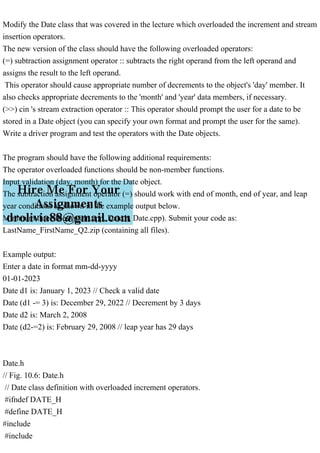
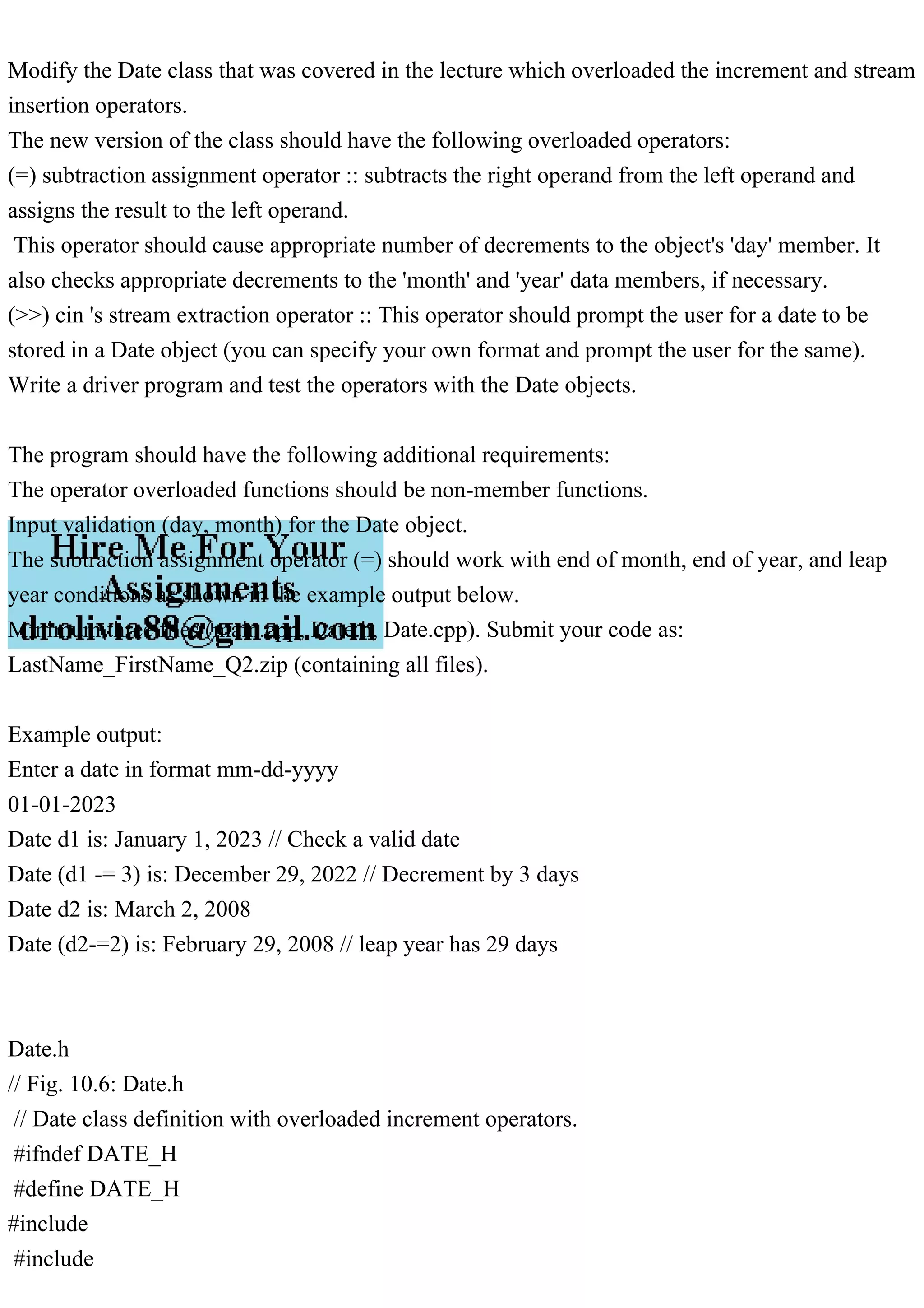
Modify the Date class that was covered in the lecture which overloaded the increment and stream
insertion operators.
The new version of the class should have the following overloaded operators:
(=) subtraction assignment operator :: subtracts the right operand from the left operand and
assigns the result to the left operand.
This operator should cause appropriate number of decrements to the object's 'day' member. It
also checks appropriate decrements to the 'month' and 'year' data members, if necessary.
(>>) cin 's stream extraction operator :: This operator should prompt the user for a date to be
stored in a Date object (you can specify your own format and prompt the user for the same).
Write a driver program and test the operators with the Date objects.
The program should have the following additional requirements:
The operator overloaded functions should be non-member functions.
Input validation (day, month) for the Date object.
The subtraction assignment operator (=) should work with end of month, end of year, and leap
year conditions as shown in the example output below.
Minimum three files (main.cpp, Date.h, Date.cpp). Submit your code as:
LastName_FirstName_Q2.zip (containing all files).
Example output:
Enter a date in format mm-dd-yyyy
01-01-2023
Date d1 is: January 1, 2023 // Check a valid date
Date (d1 -= 3) is: December 29, 2022 // Decrement by 3 days
Date d2 is: March 2, 2008
Date (d2-=2) is: February 29, 2008 // leap year has 29 days
Date.h
// Fig. 10.6: Date.h
// Date class definition with overloaded increment operators.
#ifndef DATE_H
#define DATE_H
#include
#include
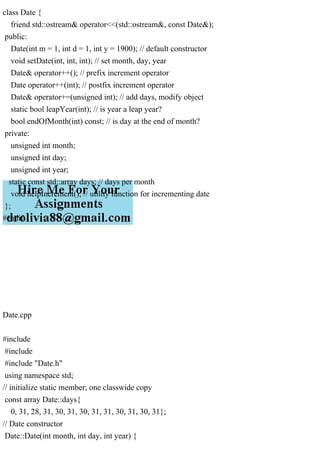
class Date {
friend std::ostream& operator<<(std::ostream&, const Date&);
public:
Date(int m = 1, int d = 1, int y = 1900); // default constructor
void setDate(int, int, int); // set month, day, year
Date& operator++(); // prefix increment operator
Date operator++(int); // postfix increment operator
Date& operator+=(unsigned int); // add days, modify object
static bool leapYear(int); // is year a leap year?
bool endOfMonth(int) const; // is day at the end of month?
private:
unsigned int month;
unsigned int day;
unsigned int year;
static const std::array days; // days per month
void helpIncrement(); // utility function for incrementing date
};
#endif
Date.cpp
#include
#include
#include "Date.h"
using namespace std;
// initialize static member; one classwide copy
const array Date::days{
0, 31, 28, 31, 30, 31, 30, 31, 31, 30, 31, 30, 31};
// Date constructor
Date::Date(int month, int day, int year) {
setDate(month, day, year);
}
// set month, day and year
void Date::setDate(int mm, int dd, int yy) {
if (mm >= 1 && mm <= 12) {
month = mm;
}
else {
throw invalid_argument{"Month must be 1-12"};
}
if (yy >= 1900 && yy <= 2100) {
year = yy;
}
else {
throw invalid_argument{"Year must be >= 1900 and <= 2100"};
}
// test for a leap year
if ((month == 2 && leapYear(year) && dd >= 1 && dd <= 29) ||
(dd >= 1 && dd <= days[month])) {
day = dd;
}
else {
throw invalid_argument{
"Day is out of range for current month and year"};
}
}
// overloaded prefix increment operator
Date& Date::operator++() {
helpIncrement(); // increment date
return *this; // reference return to create an lvalue
}
// overloaded postfix increment operator; note that the
// dummy integer parameter does not have a parameter name
Date Date::operator++(int) {
Date temp{*this}; // hold current state of object
helpIncrement();
// return unincremented, saved, temporary object
return temp; // value return; not a reference return
}
// add specified number of days to date
Date& Date::operator+=(unsigned int additionalDays) {
for (unsigned int i = 0; i < additionalDays; ++i) {
helpIncrement();
}
return *this; // enables cascading
}
// if the year is a leap year, return true; otherwise, return false
bool Date::leapYear(int testYear) {
return (testYear % 400 == 0 ||
(testYear % 100 != 0 && testYear % 4 == 0));
}
// determine whether the day is the last day of the month
bool Date::endOfMonth(int testDay) const {
if (month == 2 && leapYear(year)) {
return testDay == 29; // last day of Feb. in leap year
}
else {
return testDay == days[month];
}
}
// function to help increment the date
void Date::helpIncrement() {
// day is not end of month
if (!endOfMonth(day)) {
++day; // increment day
}
else {
if (month < 12) { // day is end of month and month < 12
++month; // increment month
day = 1; // first day of new month
}
else { // last day of year
++year; // increment year
month = 1; // first month of new year
day = 1; // first day of new month
}
}
}
// overloaded output operator
ostream& operator<<(ostream& output, const Date& d) {
static string monthName[13]{"", "January", "February",
"March", "April", "May", "June", "July", "August",
"September", "October", "November", "December"};
output << monthName[d.month] << ' ' << d.day << ", " << d.year;
return output; // enables cascading
}
main.cpp
#include
#include "Date.h" // Date class definition
using namespace std;
int main() {
Date d1{12, 27, 2010}; // December 27, 2010
Date d2; // defaults to January 1, 1900
cout << "d1 is " << d1 << "nd2 is " << d2;
cout << "nnd1 += 7 is " << (d1 += 7);
d2.setDate(2, 28, 2008);
cout << "nn d2 is " << d2;
cout << "n++d2 is " << ++d2 << " (leap year allows 29th)";
Date d3{7, 13, 2010};
cout << "nnTesting the prefix increment operator:n"
<< " d3 is " << d3 << endl;
cout << "++d3 is " << ++d3 << endl;
cout << " d3 is " << d3;
cout << "nnTesting the postfix increment operator:n"
<< " d3 is " << d3 << endl;
cout << "d3++ is " << d3++ << endl;
cout << " d3 is " << d3 << endl;
}

Modify the Date class that was covered in the lecture which overload.pdf

  • 1.
    Modify the Dateclass that was covered in the lecture which overloaded the increment and stream insertion operators. The new version of the class should have the following overloaded operators: (=) subtraction assignment operator :: subtracts the right operand from the left operand and assigns the result to the left operand. This operator should cause appropriate number of decrements to the object's 'day' member. It also checks appropriate decrements to the 'month' and 'year' data members, if necessary. (>>) cin 's stream extraction operator :: This operator should prompt the user for a date to be stored in a Date object (you can specify your own format and prompt the user for the same). Write a driver program and test the operators with the Date objects. The program should have the following additional requirements: The operator overloaded functions should be non-member functions. Input validation (day, month) for the Date object. The subtraction assignment operator (=) should work with end of month, end of year, and leap year conditions as shown in the example output below. Minimum three files (main.cpp, Date.h, Date.cpp). Submit your code as: LastName_FirstName_Q2.zip (containing all files). Example output: Enter a date in format mm-dd-yyyy 01-01-2023 Date d1 is: January 1, 2023 // Check a valid date Date (d1 -= 3) is: December 29, 2022 // Decrement by 3 days Date d2 is: March 2, 2008 Date (d2-=2) is: February 29, 2008 // leap year has 29 days Date.h // Fig. 10.6: Date.h // Date class definition with overloaded increment operators. #ifndef DATE_H #define DATE_H #include #include
  • 2.
    class Date { friendstd::ostream& operator<<(std::ostream&, const Date&); public: Date(int m = 1, int d = 1, int y = 1900); // default constructor void setDate(int, int, int); // set month, day, year Date& operator++(); // prefix increment operator Date operator++(int); // postfix increment operator Date& operator+=(unsigned int); // add days, modify object static bool leapYear(int); // is year a leap year? bool endOfMonth(int) const; // is day at the end of month? private: unsigned int month; unsigned int day; unsigned int year; static const std::array days; // days per month void helpIncrement(); // utility function for incrementing date }; #endif Date.cpp #include #include #include "Date.h" using namespace std; // initialize static member; one classwide copy const array Date::days{ 0, 31, 28, 31, 30, 31, 30, 31, 31, 30, 31, 30, 31}; // Date constructor Date::Date(int month, int day, int year) {
  • 3.
    setDate(month, day, year); } //set month, day and year void Date::setDate(int mm, int dd, int yy) { if (mm >= 1 && mm <= 12) { month = mm; } else { throw invalid_argument{"Month must be 1-12"}; } if (yy >= 1900 && yy <= 2100) { year = yy; } else { throw invalid_argument{"Year must be >= 1900 and <= 2100"}; } // test for a leap year if ((month == 2 && leapYear(year) && dd >= 1 && dd <= 29) || (dd >= 1 && dd <= days[month])) { day = dd; } else { throw invalid_argument{ "Day is out of range for current month and year"}; } } // overloaded prefix increment operator Date& Date::operator++() { helpIncrement(); // increment date return *this; // reference return to create an lvalue } // overloaded postfix increment operator; note that the // dummy integer parameter does not have a parameter name Date Date::operator++(int) { Date temp{*this}; // hold current state of object helpIncrement();
  • 4.
    // return unincremented,saved, temporary object return temp; // value return; not a reference return } // add specified number of days to date Date& Date::operator+=(unsigned int additionalDays) { for (unsigned int i = 0; i < additionalDays; ++i) { helpIncrement(); } return *this; // enables cascading } // if the year is a leap year, return true; otherwise, return false bool Date::leapYear(int testYear) { return (testYear % 400 == 0 || (testYear % 100 != 0 && testYear % 4 == 0)); } // determine whether the day is the last day of the month bool Date::endOfMonth(int testDay) const { if (month == 2 && leapYear(year)) { return testDay == 29; // last day of Feb. in leap year } else { return testDay == days[month]; } } // function to help increment the date void Date::helpIncrement() { // day is not end of month if (!endOfMonth(day)) { ++day; // increment day } else { if (month < 12) { // day is end of month and month < 12 ++month; // increment month day = 1; // first day of new month } else { // last day of year
  • 5.
    ++year; // incrementyear month = 1; // first month of new year day = 1; // first day of new month } } } // overloaded output operator ostream& operator<<(ostream& output, const Date& d) { static string monthName[13]{"", "January", "February", "March", "April", "May", "June", "July", "August", "September", "October", "November", "December"}; output << monthName[d.month] << ' ' << d.day << ", " << d.year; return output; // enables cascading } main.cpp #include #include "Date.h" // Date class definition using namespace std; int main() { Date d1{12, 27, 2010}; // December 27, 2010 Date d2; // defaults to January 1, 1900 cout << "d1 is " << d1 << "nd2 is " << d2; cout << "nnd1 += 7 is " << (d1 += 7); d2.setDate(2, 28, 2008); cout << "nn d2 is " << d2; cout << "n++d2 is " << ++d2 << " (leap year allows 29th)"; Date d3{7, 13, 2010}; cout << "nnTesting the prefix increment operator:n" << " d3 is " << d3 << endl; cout << "++d3 is " << ++d3 << endl; cout << " d3 is " << d3; cout << "nnTesting the postfix increment operator:n" << " d3 is " << d3 << endl;
  • 6.
    cout << "d3++is " << d3++ << endl; cout << " d3 is " << d3 << endl; }