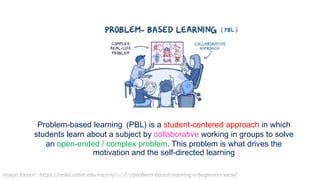
Problem-based learning (PBL) is a student-centered approach in which
students learn about a subject by collaborative working in groups to solve
an open-ended / complex problem. This problem is what drives the
motivation and the self-directed learning
Image Source: https://news.uthm.edu.my/en/2021/07/problem-based-learning-a-beginners-view/
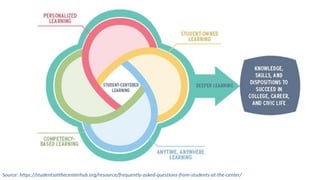
Source: https://studentsatthecenterhub.org/resource/frequently-asked-questions-from-students-at-the-center/
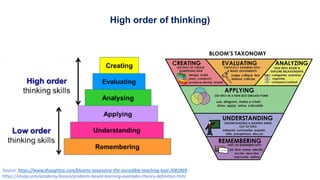
High order of thinking)
Source: https://www.thoughtco.com/blooms-taxonomy-the-incredible-teaching-tool-2081869
https://study.com/academy/lesson/problem-based-learning-examples-theory-definition.html
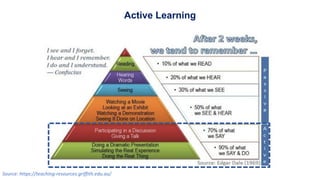
Source: https://teaching-resources.griffith.edu.au/
Active Learning
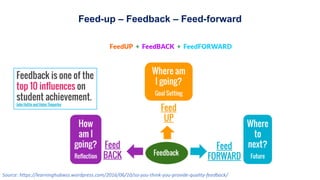
Source: https://learninghubwss.wordpress.com/2016/06/10/so-you-think-you-provide-quality-feedback/
Feed-up – Feedback – Feed-forward
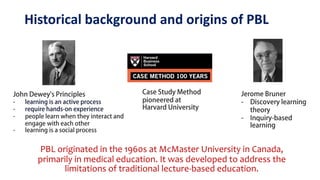
Historical background and origins of PBL
PBL originated in the 1960s at McMaster University in Canada,
primarily in medical education. It was developed to address the
limitations of traditional lecture-based education.
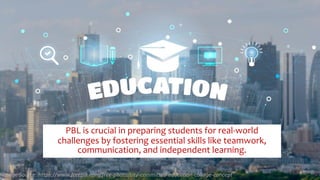
PBL is crucial in preparing students for real-world
challenges by fostering essential skills like teamwork,
communication, and independent learning.
Image Source: https://www.freepik.com/free-photo/city-committed-education-collage-concept
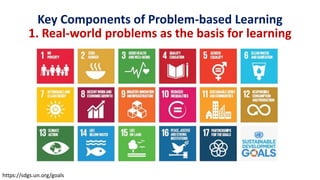
Key Components of Problem-based Learning
1. Real-world problems as the basis for learning
https://sdgs.un.org/goals
Key Components of Problem-based Learning
2. Role of teacher
•Facilitator
•Resource guide
•Consultant
•Encourage students
•Constructive feedbacks
•Monitor and evaluate learning/discussion
Key Components of Problem-based Learning
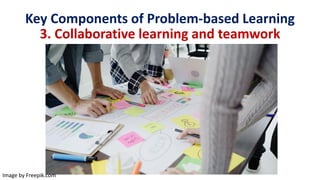
3. Collaborative learning and teamwork
Image by Freepik.com
Key Components of Problem-based Learning
4. Self-directed learning and critical thinking
Image by Freepik.com
Problem-based Learning is a student-centered approach, working in groups to solve a complex problem.

Problem-based Learning is a student-centered approach, working in groups to solve a complex problem.