Problem 2-6 (LO 3, 4, 5, 6) 100% purchase, goodwill,
worksheet.
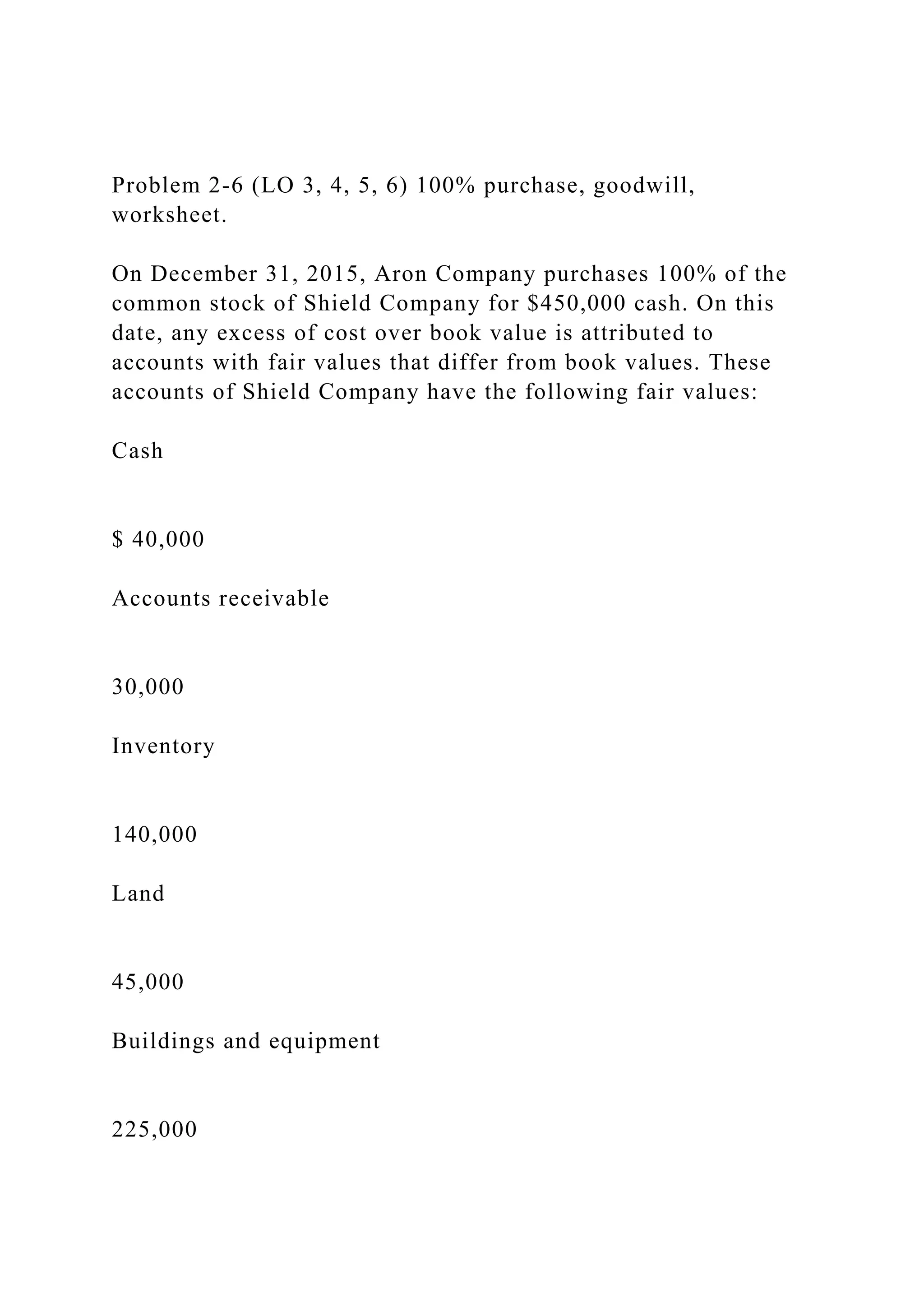
On December 31, 2015, Aron Company purchases 100% of the
common stock of Shield Company for $450,000 cash. On this
date, any excess of cost over book value is attributed to
accounts with fair values that differ from book values. These
accounts of Shield Company have the following fair values:
Cash
$ 40,000
Accounts receivable
30,000
Inventory
140,000
Land
45,000
Buildings and equipment
225,000
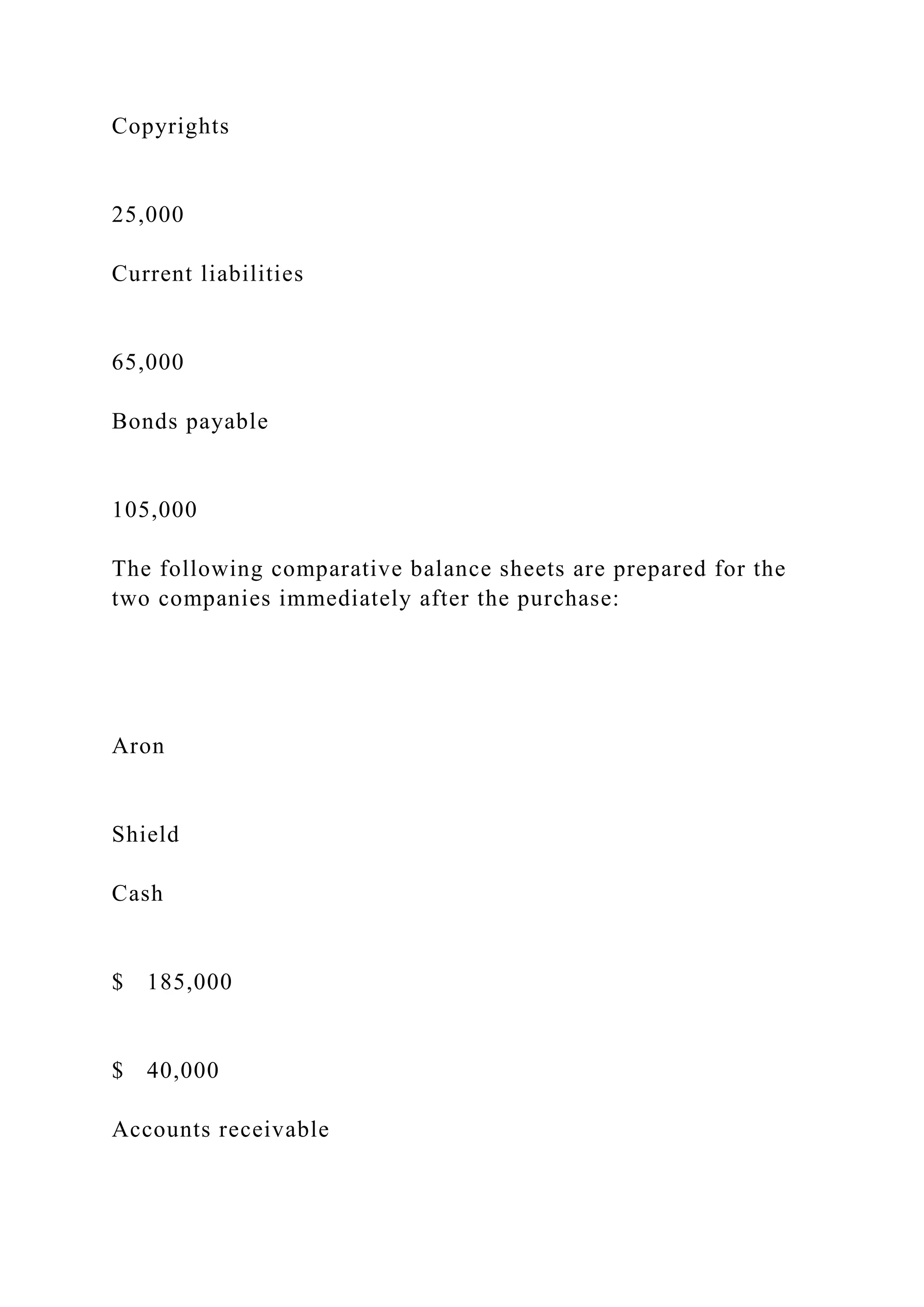
Copyrights
25,000
Current liabilities
65,000
Bonds payable
105,000
The following comparative balance sheets are prepared for the
two companies immediately after the purchase:
Aron
Shield
Cash
$ 185,000
$ 40,000
Accounts receivable
70,000
30,000
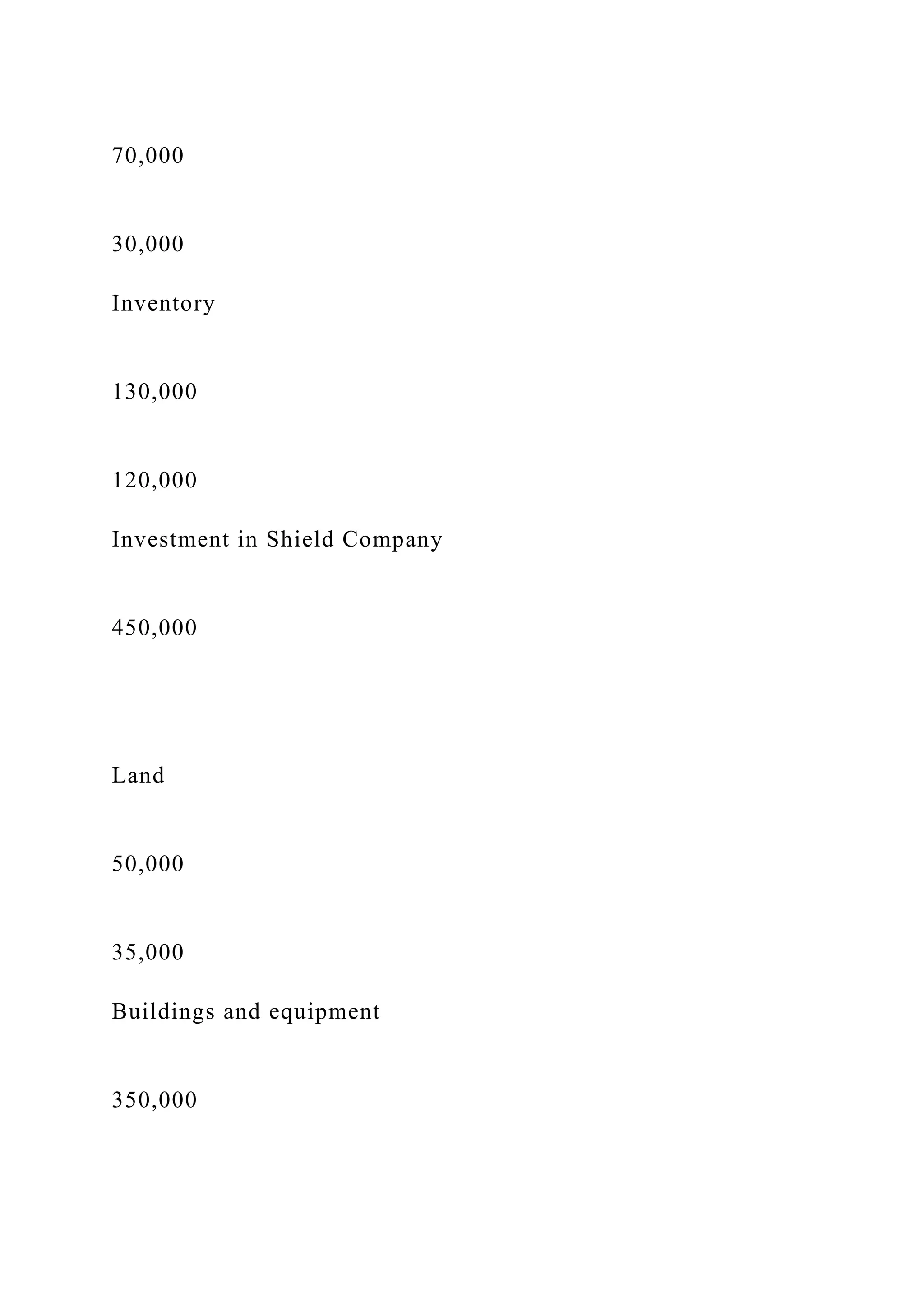
Inventory
130,000
120,000
Investment in Shield Company
450,000
Land
50,000
35,000
Buildings and equipment
350,000
230,000
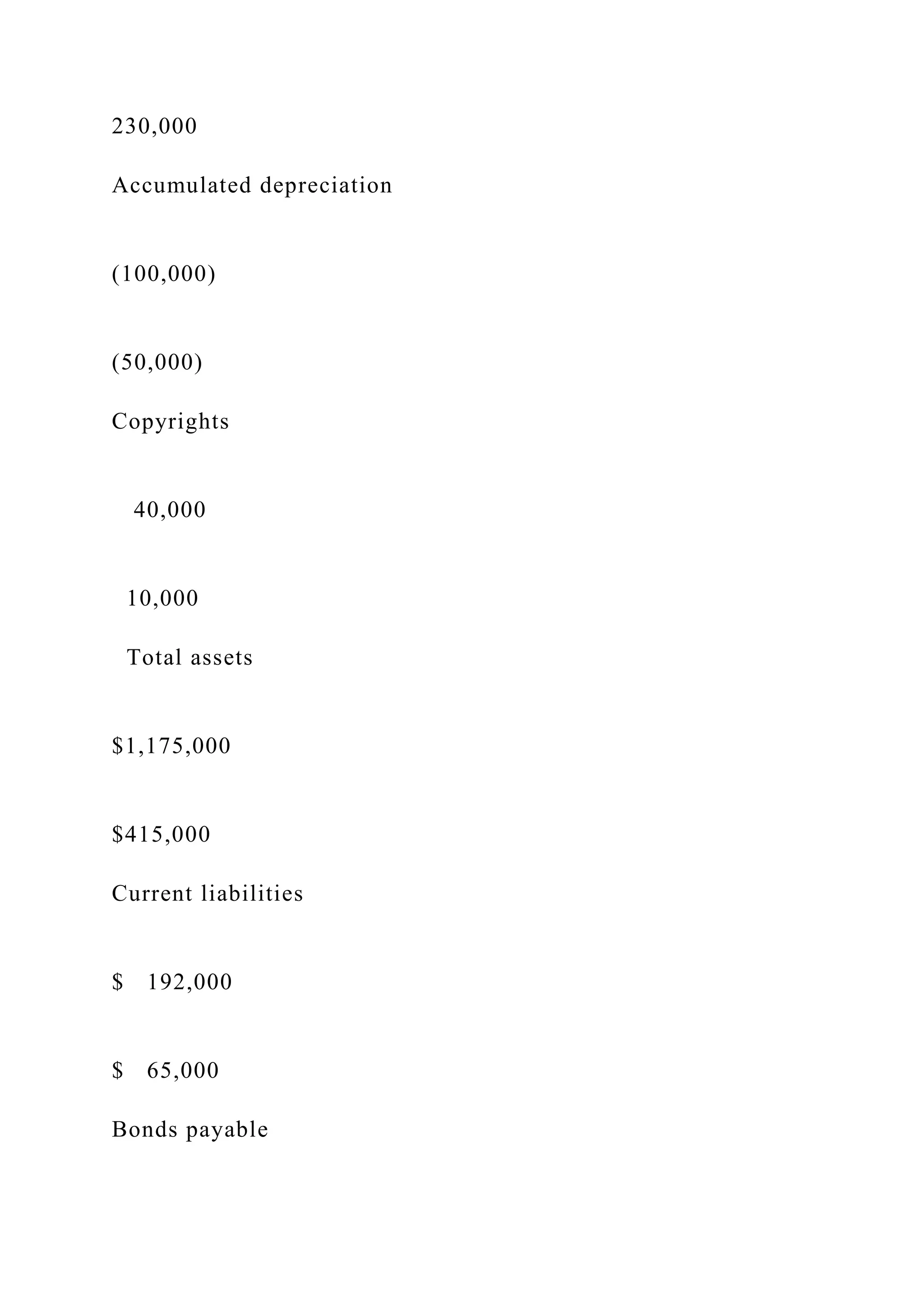
Accumulated depreciation
(100,000)
(50,000)
Copyrights
40,000
10,000
Total assets
$1,175,000
$415,000
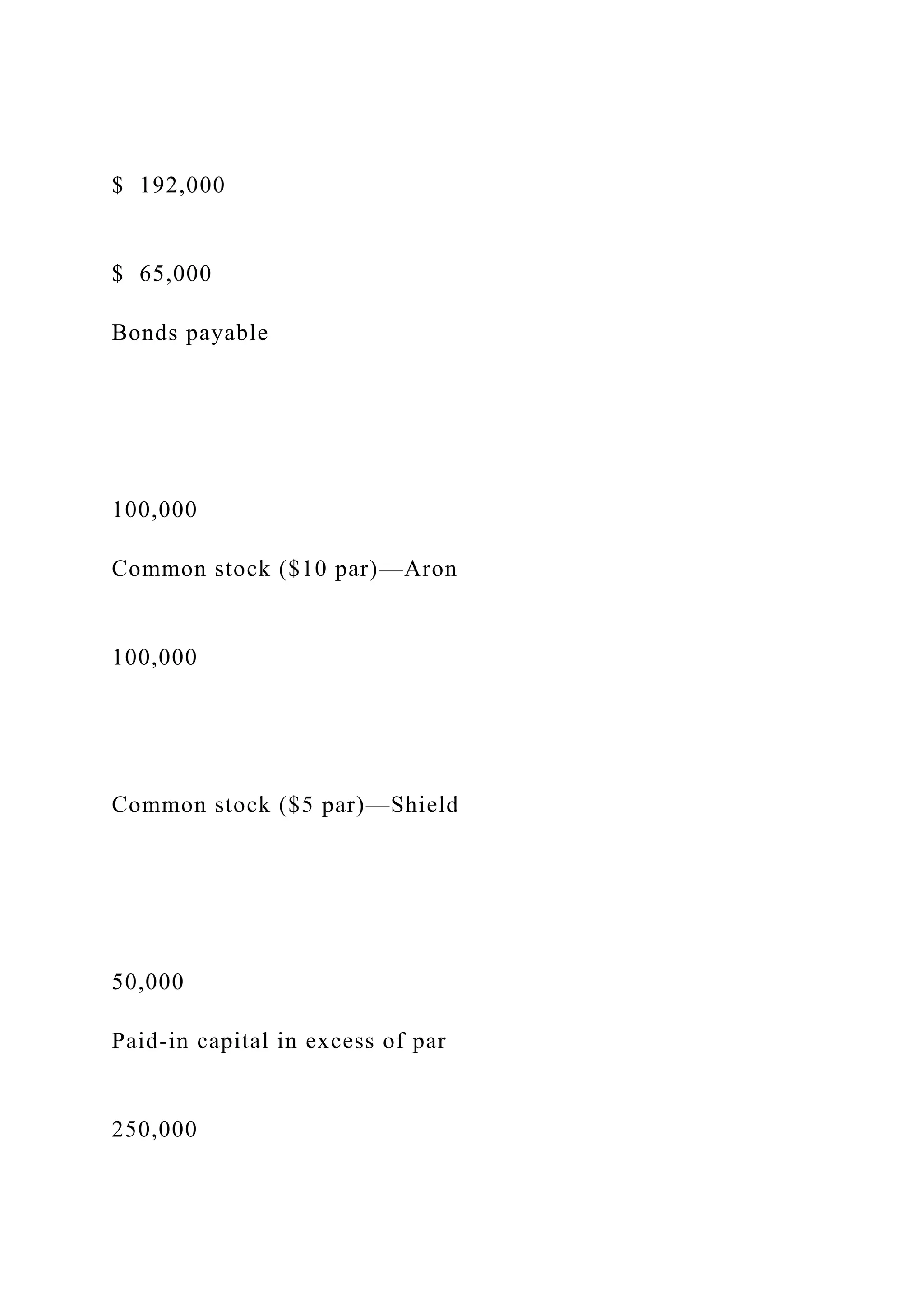
Current liabilities
$ 192,000
$ 65,000
Bonds payable
100,000
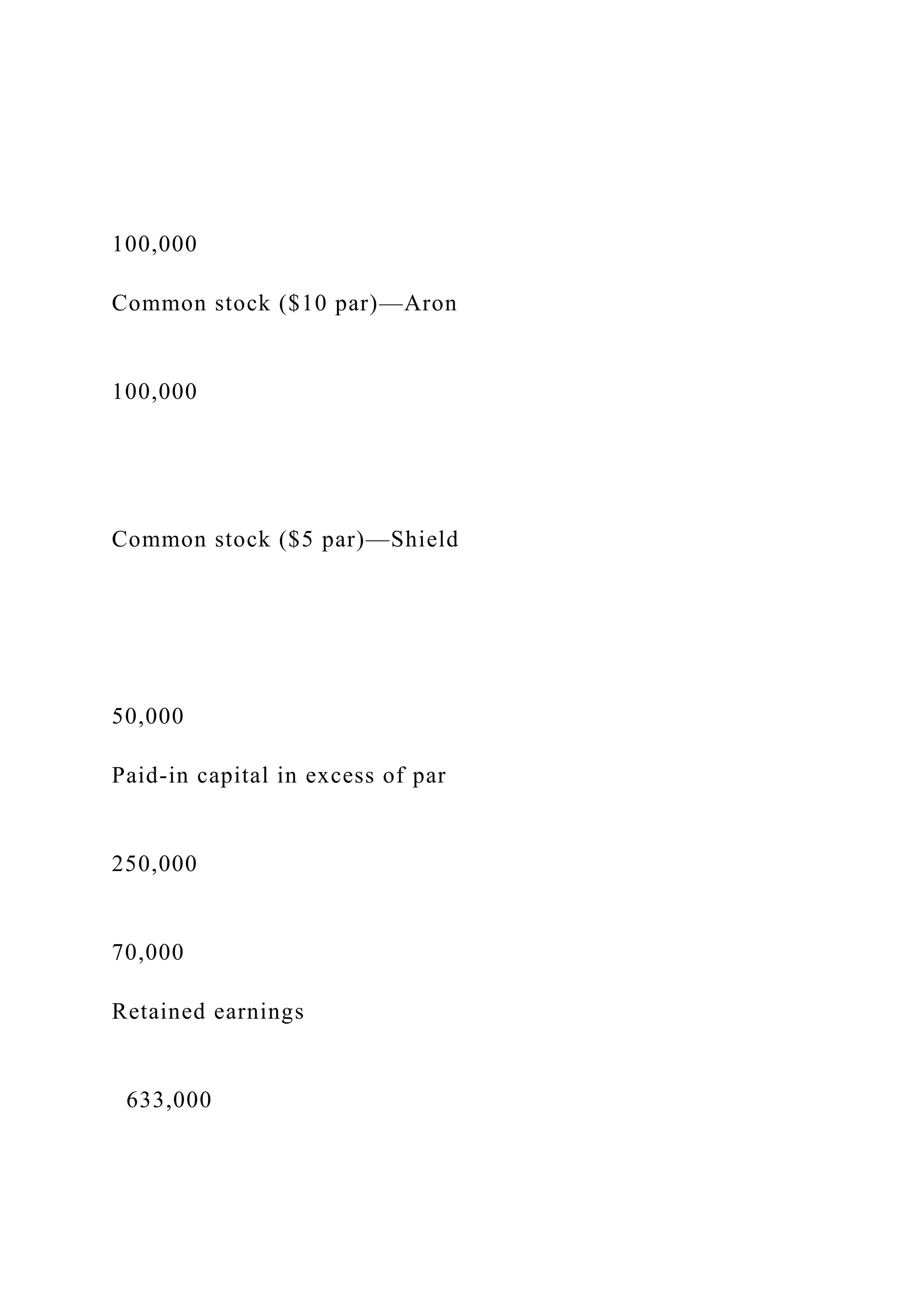
Common stock ($10 par)—Aron
100,000
Common stock ($5 par)—Shield
50,000
Paid-in capital in excess of par
250,000
70,000
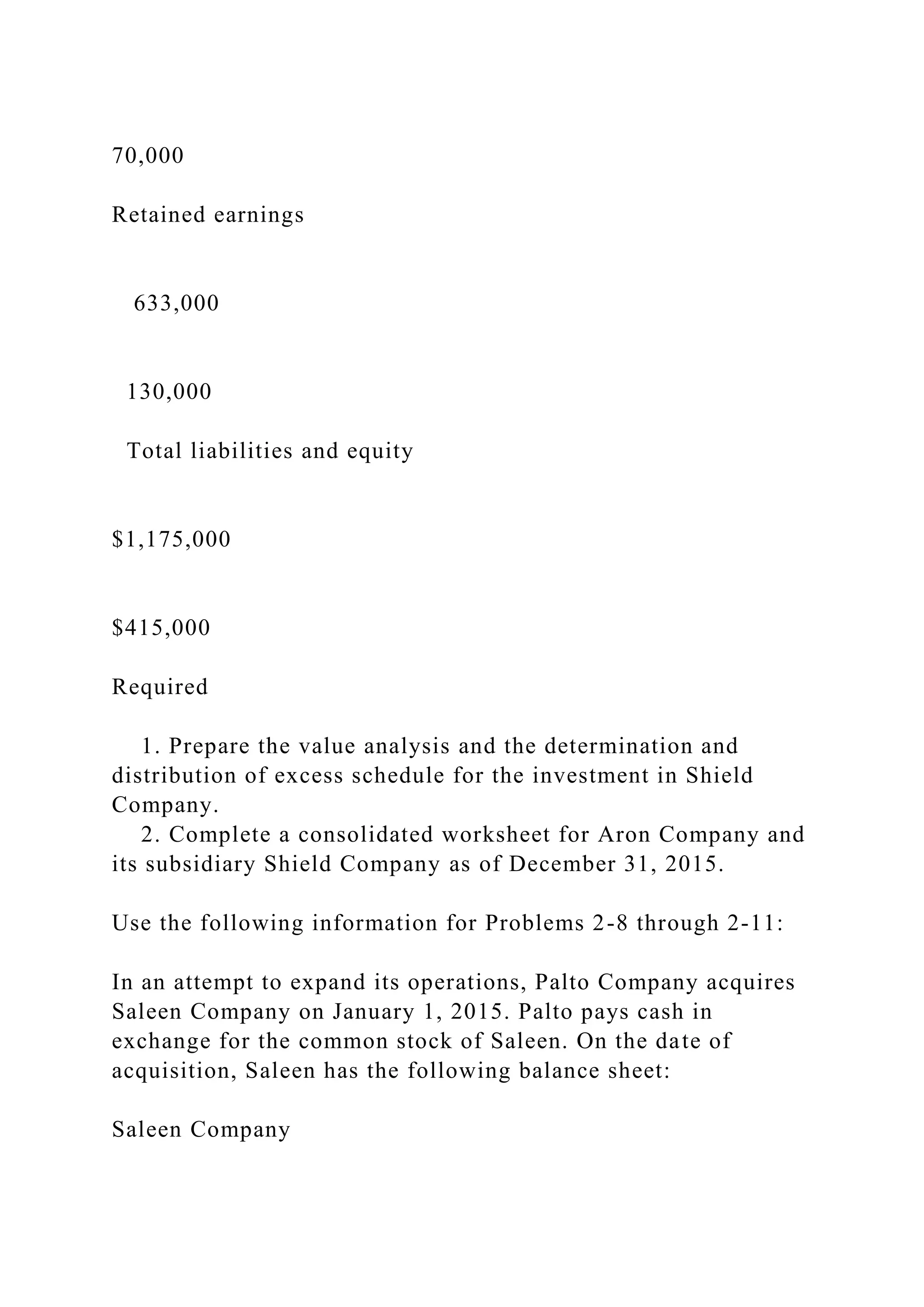
Retained earnings
633,000
130,000
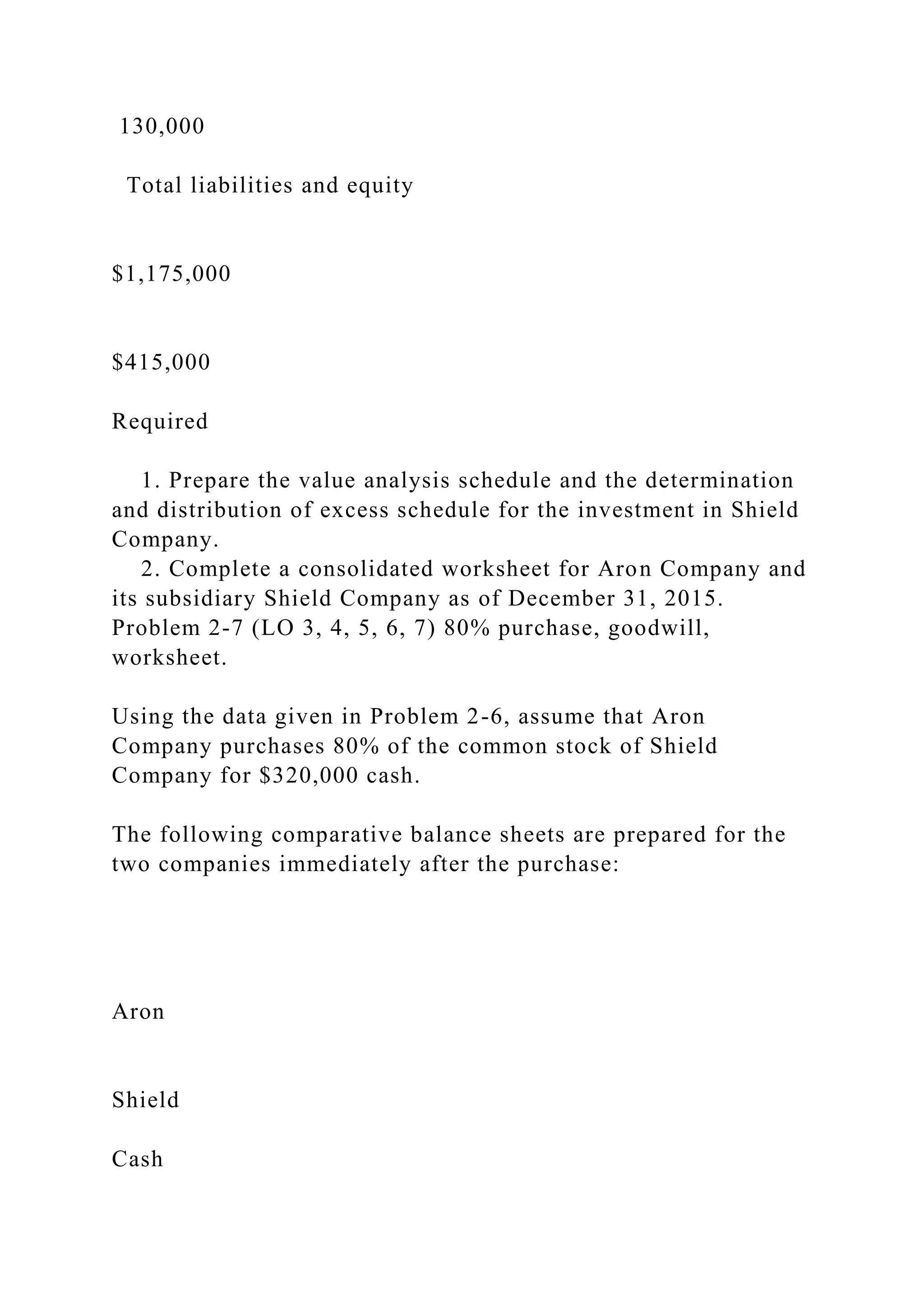
Total liabilities and equity
$1,175,000
$415,000
Required
1. Prepare the value analysis schedule and the determination
and distribution of excess schedule for the investment in Shield
Company.
2. Complete a consolidated worksheet for Aron Company and
its subsidiary Shield Company as of December 31, 2015.
Problem 2-7 (LO 3, 4, 5, 6, 7) 80% purchase, goodwill,
worksheet.
Using the data given in Problem 2-6, assume that Aron
Company purchases 80% of the common stock of Shield
Company for $320,000 cash.
The following comparative balance sheets are prepared for the
two companies immediately after the purchase:
Aron
Shield
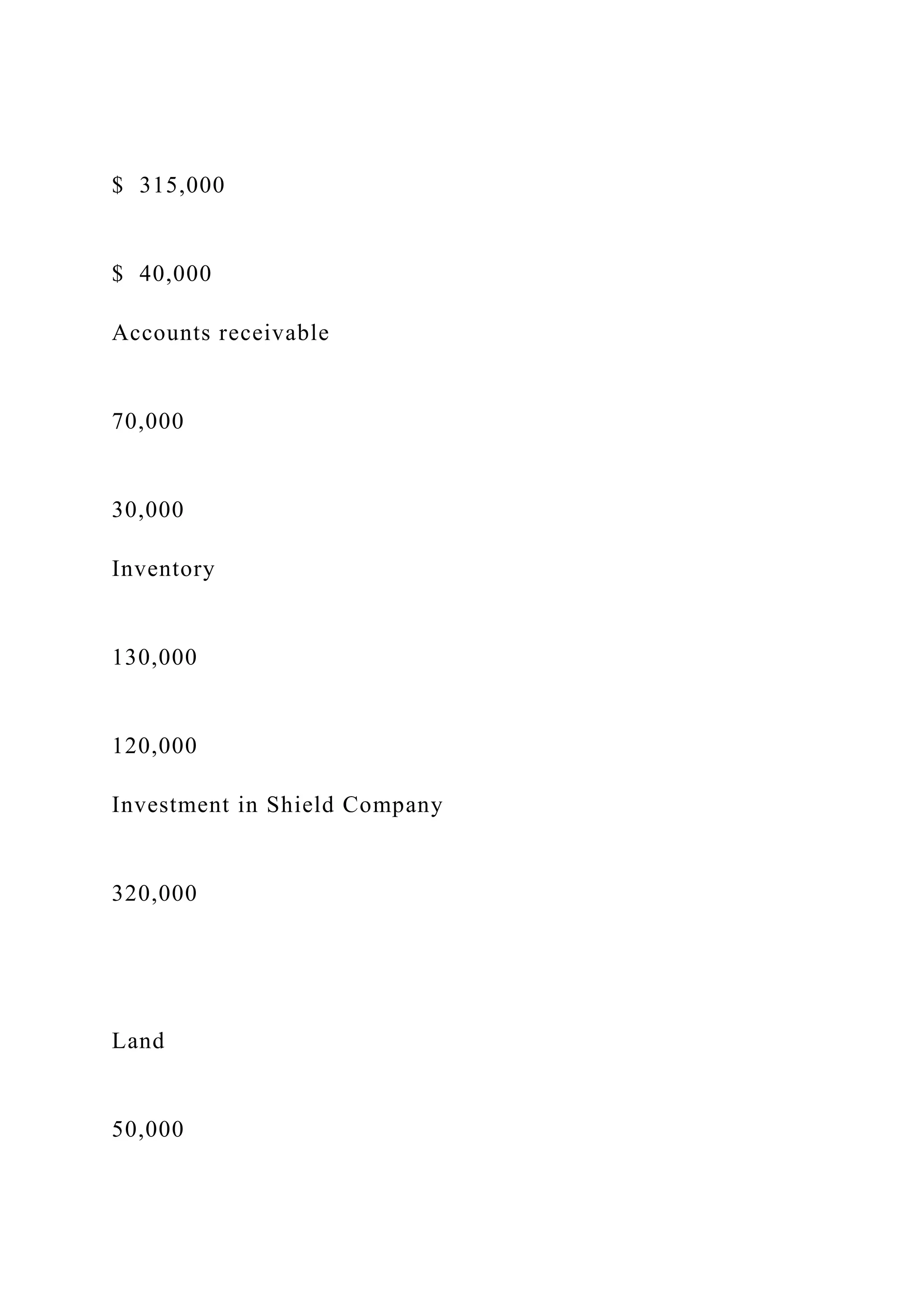
Cash
$ 315,000
$ 40,000
Accounts receivable
70,000
30,000
Inventory
130,000
120,000
Investment in Shield Company
320,000
Land
50,000
35,000
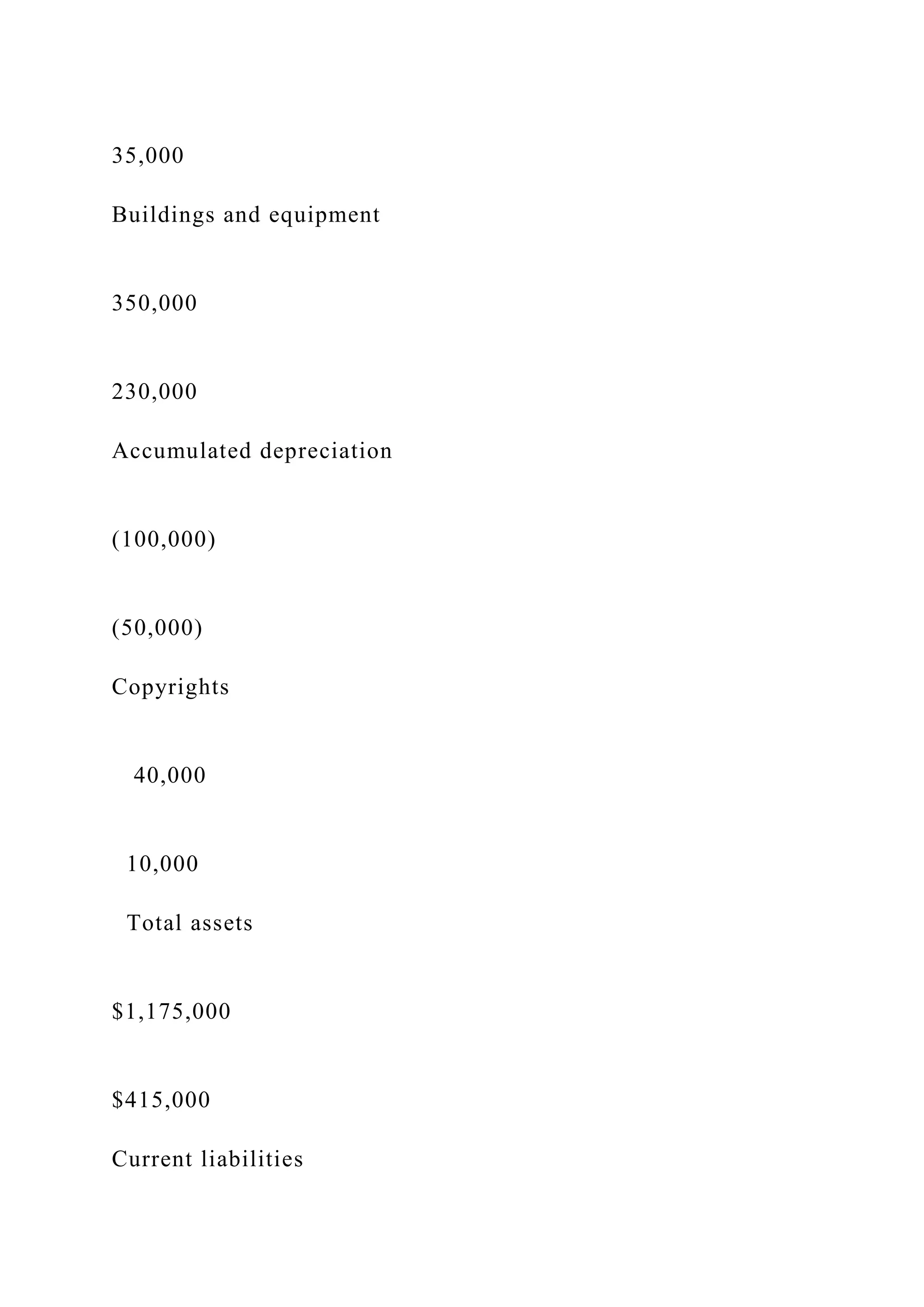
Buildings and equipment
350,000
230,000
Accumulated depreciation
(100,000)
(50,000)
Copyrights
40,000
10,000
Total assets
$1,175,000
$415,000
Current liabilities
$ 192,000
$ 65,000
Bonds payable
100,000
Common stock ($10 par)—Aron
100,000
Common stock ($5 par)—Shield
50,000
Paid-in capital in excess of par
250,000
70,000
Retained earnings
633,000
130,000
Total liabilities and equity
$1,175,000
$415,000
Required
1. Prepare the value analysis and the determination and
distribution of excess schedule for the investment in Shield
Company.
2. Complete a consolidated worksheet for Aron Company and
its subsidiary Shield Company as of December 31, 2015.
Use the following information for Problems 2-8 through 2-11:
In an attempt to expand its operations, Palto Company acquires
Saleen Company on January 1, 2015. Palto pays cash in
exchange for the common stock of Saleen. On the date of
acquisition, Saleen has the following balance sheet:
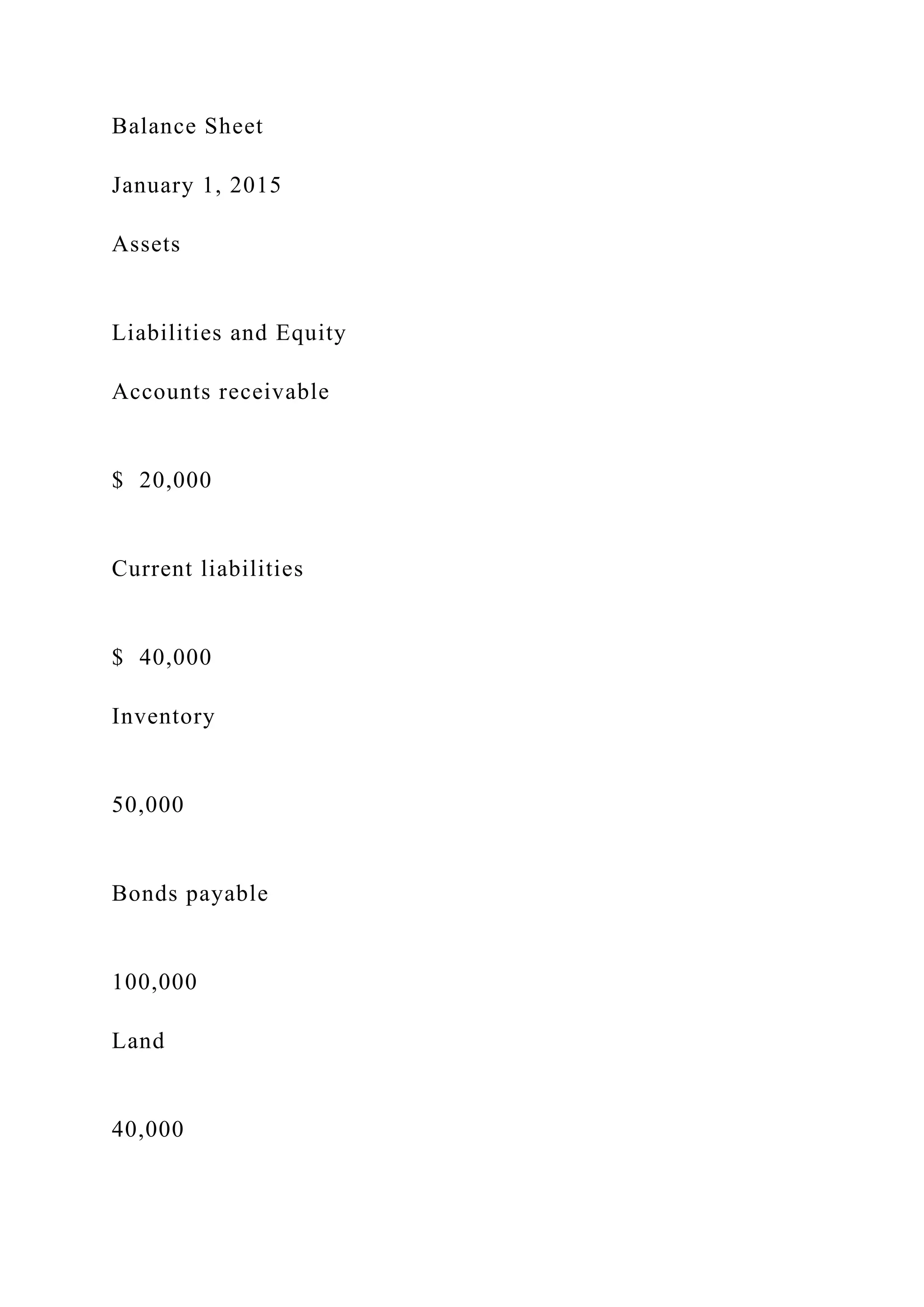
Saleen Company
Balance Sheet
January 1, 2015
Assets
Liabilities and Equity
Accounts receivable
$ 20,000
Current liabilities
$ 40,000
Inventory
50,000
Bonds payable
100,000
Land
40,000
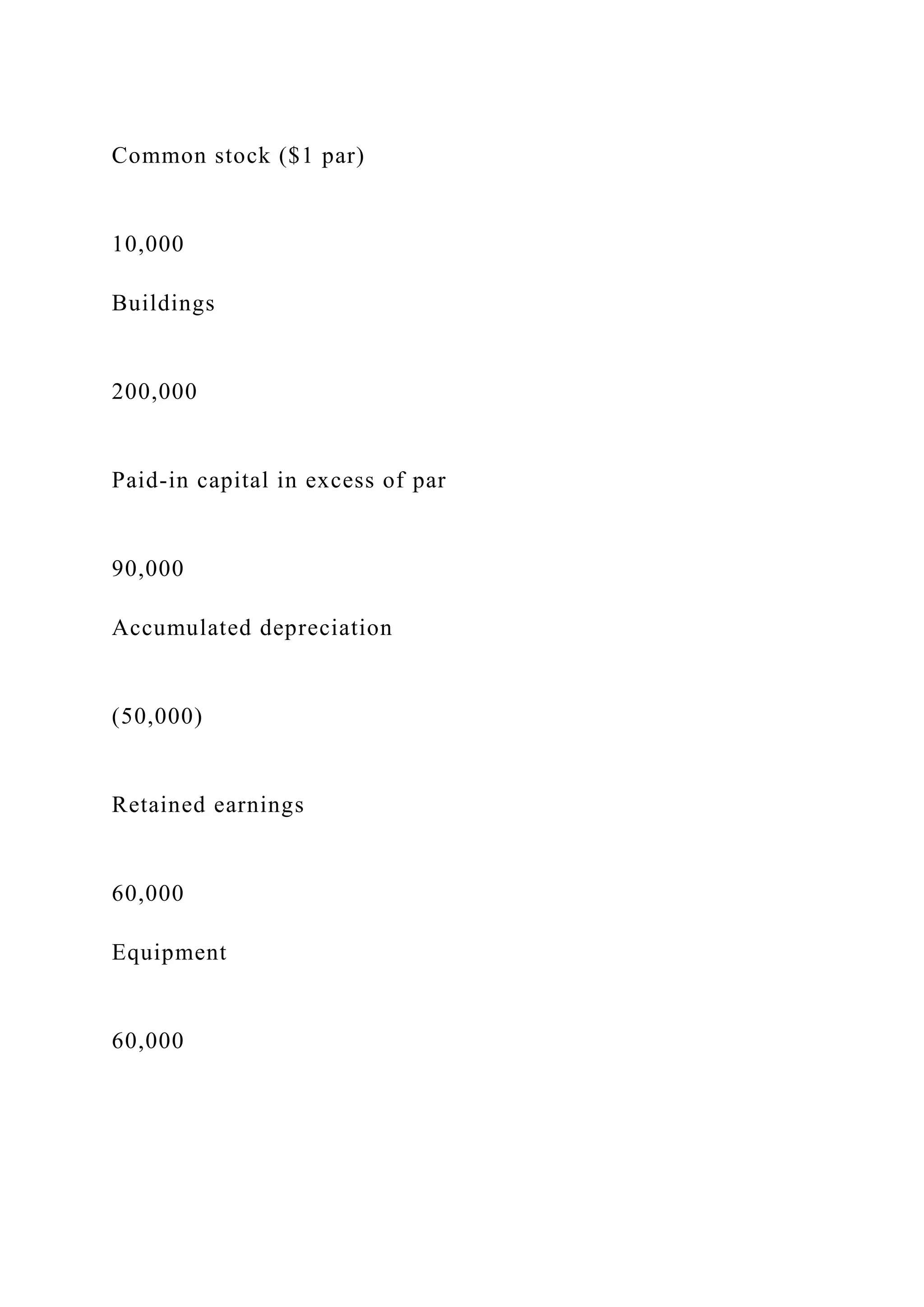
Common stock ($1 par)
10,000
Buildings
200,000
Paid-in capital in excess of par
90,000
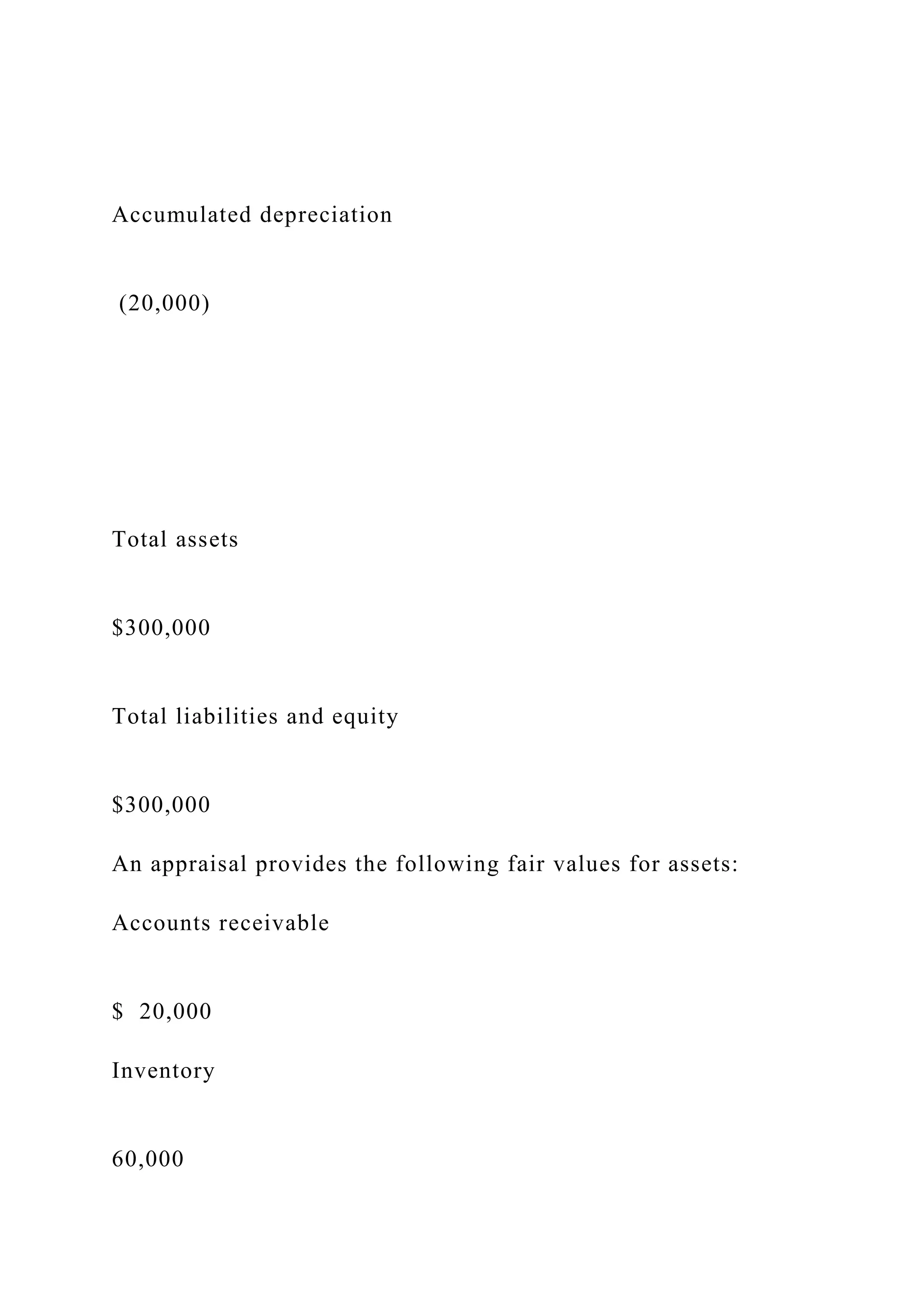
Accumulated depreciation
(50,000)
Retained earnings
60,000
Equipment
60,000
Accumulated depreciation
(20,000)
Total assets
$300,000
Total liabilities and equity
$300,000
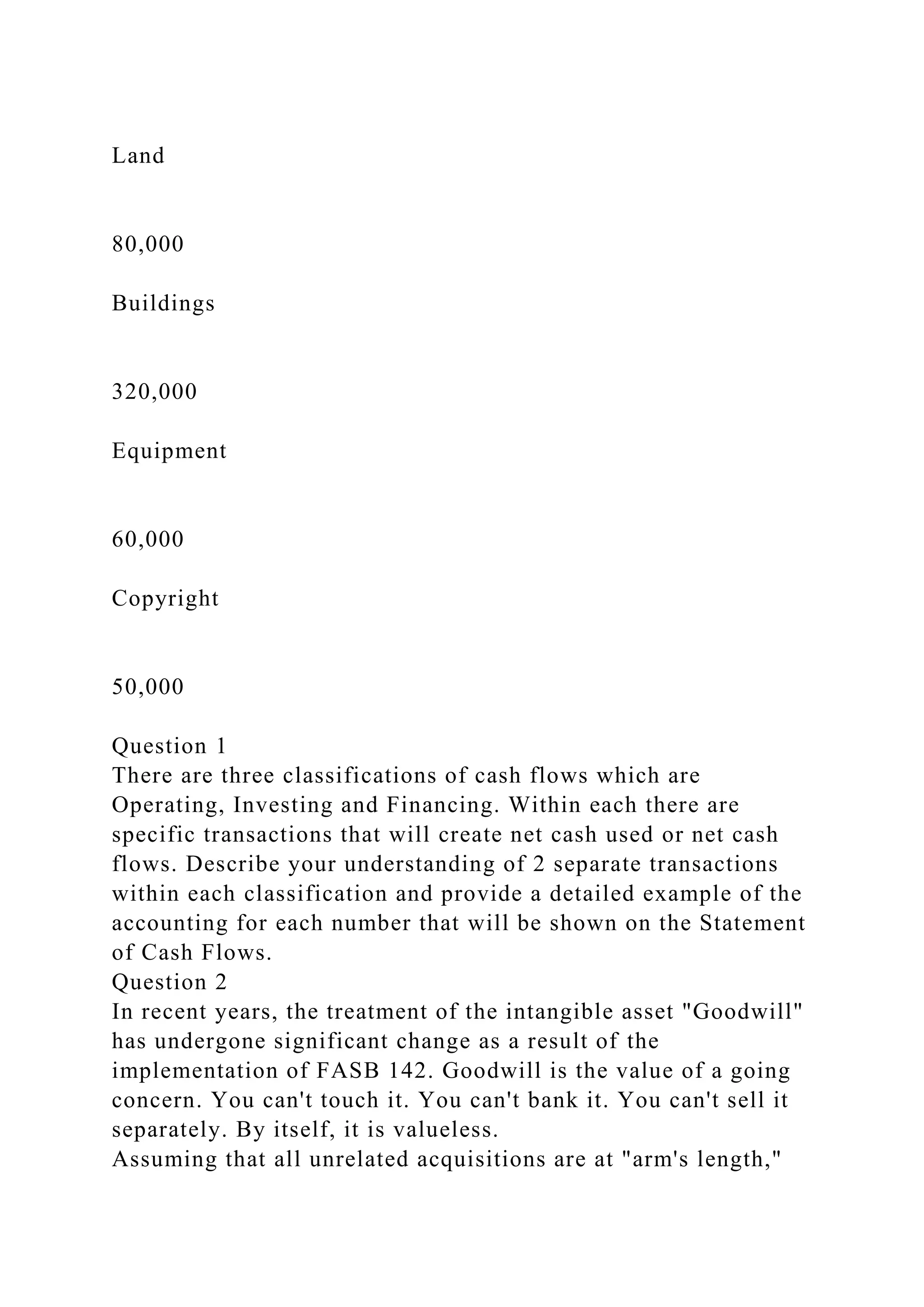
An appraisal provides the following fair values for assets:
Accounts receivable
$ 20,000
Inventory
60,000
Land
80,000
Buildings
320,000
Equipment
60,000
Copyright
50,000
Question 1
There are three classifications of cash flows which are
Operating, Investing and Financing. Within each there are
specific transactions that will create net cash used or net cash
flows. Describe your understanding of 2 separate transactions
within each classification and provide a detailed example of the
accounting for each number that will be shown on the Statement
of Cash Flows.
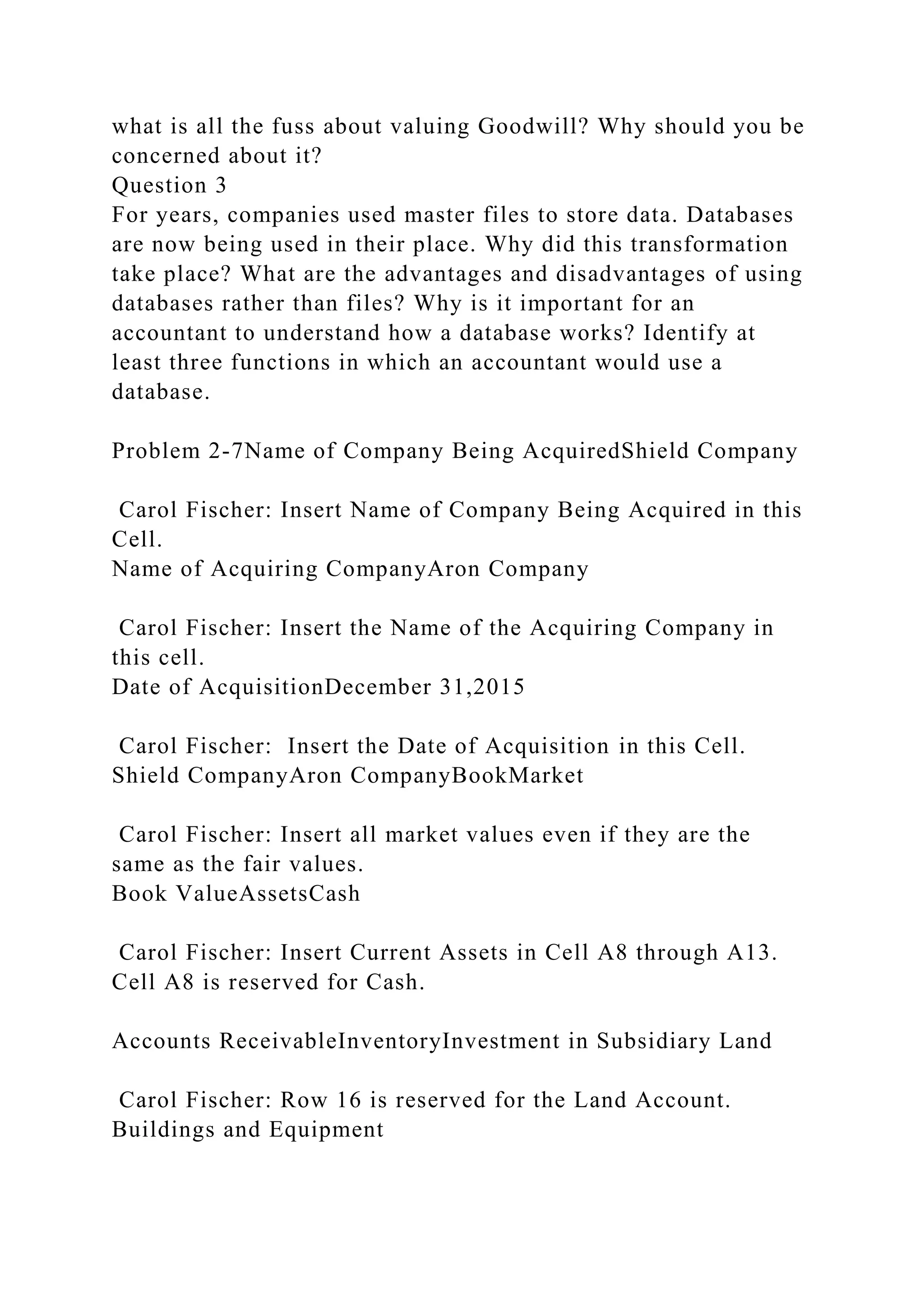
Question 2
In recent years, the treatment of the intangible asset "Goodwill"
has undergone significant change as a result of the
implementation of FASB 142. Goodwill is the value of a going
concern. You can't touch it. You can't bank it. You can't sell it
separately. By itself, it is valueless.
Assuming that all unrelated acquisitions are at "arm's length,"
what is all the fuss about valuing Goodwill? Why should you be
concerned about it?
Question 3
For years, companies used master files to store data. Databases
are now being used in their place. Why did this transformation
take place? What are the advantages and disadvantages of using
databases rather than files? Why is it important for an
accountant to understand how a database works? Identify at
least three functions in which an accountant would use a
database.
Problem 2-7Name of Company Being AcquiredShield Company
Carol Fischer: Insert Name of Company Being Acquired in this
Cell.
Name of Acquiring CompanyAron Company
Carol Fischer: Insert the Name of the Acquiring Company in
this cell.
Date of AcquisitionDecember 31,2015
Carol Fischer: Insert the Date of Acquisition in this Cell.
Shield CompanyAron CompanyBookMarket
Carol Fischer: Insert all market values even if they are the
same as the fair values.
Book ValueAssetsCash
Carol Fischer: Insert Current Assets in Cell A8 through A13.
Cell A8 is reserved for Cash.
Accounts ReceivableInventoryInvestment in Subsidiary Land
Carol Fischer: Row 16 is reserved for the Land Account.
Buildings and Equipment
Carol Fischer: Row 17 is reserved for a Depreciable Fixed
Asset
Accumulated Depreciation
Carol Fischer: Reserved for Accumulated Depreciaion.
Copyrights
Carol Fischer: Rows 23, 24, and 25 are reserved for intangibles
other than goodwill.
GoodwillTotal Assets---LiabilitiesCurrent Liabilities
Carol Fischer: Rows 31, 32, and 33 are reserved for Current
Liabilities.
Bonds Payable
Carol Fischer: Rows 34, 35, and 36 are reserved for Long-Term
Liabilities
Carol Fischer: Insert the Name of the Acquiring Company in
this cell.
Carol Fischer: Insert the Date of Acquisition in this Cell.
Carol Fischer: Insert all market values even if they are the
same as the fair values.
Carol Fischer: Insert Current Assets in Cell A8 through A13.
Cell A8 is reserved for Cash.
Carol Fischer: Do Not insert an account in this cell.
Carol Fischer: Row 16 is reserved for the Land Account.
Carol Fischer: Row 17 is reserved for a Depreciable Fixed
Asset
Carol Fischer: Reserved for Accumulated Depreciaion.
Carol Fischer: Reserved for a Depreciable Fixed Asset
Carol Fischer: Reserved for Accumulated Depreciation
Carol Fischer: Reserved for a Depreciable Fixed Asset.
Carol Fischer: Reserved for Accumulated Depreciation
Carol Fischer: Rows 23, 24, and 25 are reserved for intangibles
other than goodwill.
Carol Fischer: This Cell should be left Blank
Carol Fischer: Rows 31, 32, and 33 are reserved for Current
Liabilities.
Premium on Bonds PayableTotal Liabilities---Equity Acquired
CompanyCommon StockPaid-in Capital in Excess of
ParRetained EarningsEquity Acquiring CompanyCommon
StockPaid-in Capital in Excess of ParRetained EarningsTotal
Equity--Total Liabilities and Equity--Net Assets at Market of
Acquired Co.-Check Balance Sheet EqualityOKOKPurchase
PriceCashNumber of shares exchangedPar value of a share of
stockMarket value of a share of stockMarket value of stock
exchanged-Total purchase price-Ownership Interest enter as .7
for 70%Goodwill Applicable to NCIImplied Value of NCI
InterestERROR:#DIV/0!Estimated Value of NCI interest if not
the implied proportional amount--Enter amount or 0- 0Value
AnalysisCompany Fair ValueParent PriceNCI ValueCompany
Fair ValueERROR:#DIV/0!-ERROR:#DIV/0!Fair Value of Net
Assets Excluding Goodwill---GoodwillERROR:#DIV/0!-
ERROR:#DIV/0!Gain on
AcquisitionERROR:#DIV/0!Determination and Distribution of
Excess ScheduleImplied Company ValueParent PriceNCI
ValueFair Value of CompanyERROR:#DIV/0!-
ERROR:#DIV/0!Less Book Value of Interest AcquiredCommon
Stock-Paid-in Capital in Excess of Par-Retained Earnings-Total
Equity-Interest Acquired- 01.00Book Value0-Excess of Fair
Value over Book Value-ERROR:#DIV/0!Elimination
EntryKeyCommon Stock-ELPaid-in Capital in Excess of Par-
ELRetained Earnings-ELInvestment in Subsidiary-
0ELAdjustment to Identifiable AccountsDebit
(Credit)KeyAccounts Receivable-DInventory-D--D--D--DLand-
DBuildings and Equipment-D--D--DCopyrights-D--D--
DGoodwillERROR:#DIV/0!DCurrent Liabilities-D--D--DBonds
Payable-DPremium on Bonds Payable-D--DInvestment in
Subsidiary -DGain Taken to Acquiring Co.
REERROR:#DIV/0!DAcquired Company
REERROR:#DIV/0!DCheckERROR:#DIV/0!Consolidated
WorksheetTrial BalanceEliminationsAron CompanyShield
CompanyKeyDebitCreditKeyNon Control InterestConsolidated
Balance SheetCash---Accounts Receivable--D00D-Inventory--
D00D----D00D----D00D----D00D-Investment in Subsidiary --
0EL-D00DLand--D00D-Buildings and Equipment--D00D-
Accumulated Depreciation------D00D--------D00D-----
Copyrights--D00D----D00D----D00D-Goodwill--
DERROR:#DIV/0!ERROR:#DIV/0!DERROR:#DIV/0!Current
Liabilities--D00D----D00D----D00D-Bonds Payable--D00D-
Premium on Bonds Payable--D00D----D00D-Common Stock--
EL---Paid-in Capital in Excess of Par--EL---Retained Earnings--
EL-
ERROR:#DIV/0!DERROR:#DIV/0!ERROR:#DIV/0!Common
Stock---Paid-in Capital in Excess of Par---Retained Earnings--
ERROR:#DIV/0!DERROR:#DIV/0!Totals--
ERROR:#DIV/0!ERROR:#DIV/0!Non-Controlling
InterestERROR:#DIV/0!ERROR:#DIV/0!TotalERROR:#DIV/0!

Problem 2-6 (LO 3, 4, 5, 6) 100 purchase, goodwill, worksheet..docx

  • 1.
    Problem 2-6 (LO3, 4, 5, 6) 100% purchase, goodwill, worksheet. On December 31, 2015, Aron Company purchases 100% of the common stock of Shield Company for $450,000 cash. On this date, any excess of cost over book value is attributed to accounts with fair values that differ from book values. These accounts of Shield Company have the following fair values: Cash $ 40,000 Accounts receivable 30,000 Inventory 140,000 Land 45,000 Buildings and equipment 225,000
  • 2.
    Copyrights 25,000 Current liabilities 65,000 Bonds payable 105,000 Thefollowing comparative balance sheets are prepared for the two companies immediately after the purchase: Aron Shield Cash $ 185,000 $ 40,000 Accounts receivable
  • 3.
    70,000 30,000 Inventory 130,000 120,000 Investment in ShieldCompany 450,000 Land 50,000 35,000 Buildings and equipment 350,000
  • 4.
  • 5.
    100,000 Common stock ($10par)—Aron 100,000 Common stock ($5 par)—Shield 50,000 Paid-in capital in excess of par 250,000 70,000 Retained earnings 633,000
  • 6.
    130,000 Total liabilities andequity $1,175,000 $415,000 Required 1. Prepare the value analysis schedule and the determination and distribution of excess schedule for the investment in Shield Company. 2. Complete a consolidated worksheet for Aron Company and its subsidiary Shield Company as of December 31, 2015. Problem 2-7 (LO 3, 4, 5, 6, 7) 80% purchase, goodwill, worksheet. Using the data given in Problem 2-6, assume that Aron Company purchases 80% of the common stock of Shield Company for $320,000 cash. The following comparative balance sheets are prepared for the two companies immediately after the purchase: Aron Shield Cash
  • 7.
    $ 315,000 $ 40,000 Accountsreceivable 70,000 30,000 Inventory 130,000 120,000 Investment in Shield Company 320,000 Land 50,000
  • 8.
    35,000 Buildings and equipment 350,000 230,000 Accumulateddepreciation (100,000) (50,000) Copyrights 40,000 10,000 Total assets $1,175,000 $415,000 Current liabilities
  • 9.
    $ 192,000 $ 65,000 Bondspayable 100,000 Common stock ($10 par)—Aron 100,000 Common stock ($5 par)—Shield 50,000 Paid-in capital in excess of par 250,000
  • 10.
    70,000 Retained earnings 633,000 130,000 Total liabilitiesand equity $1,175,000 $415,000 Required 1. Prepare the value analysis and the determination and distribution of excess schedule for the investment in Shield Company. 2. Complete a consolidated worksheet for Aron Company and its subsidiary Shield Company as of December 31, 2015. Use the following information for Problems 2-8 through 2-11: In an attempt to expand its operations, Palto Company acquires Saleen Company on January 1, 2015. Palto pays cash in exchange for the common stock of Saleen. On the date of acquisition, Saleen has the following balance sheet: Saleen Company
  • 11.
    Balance Sheet January 1,2015 Assets Liabilities and Equity Accounts receivable $ 20,000 Current liabilities $ 40,000 Inventory 50,000 Bonds payable 100,000 Land 40,000
  • 12.
    Common stock ($1par) 10,000 Buildings 200,000 Paid-in capital in excess of par 90,000 Accumulated depreciation (50,000) Retained earnings 60,000 Equipment 60,000
  • 13.
    Accumulated depreciation (20,000) Total assets $300,000 Totalliabilities and equity $300,000 An appraisal provides the following fair values for assets: Accounts receivable $ 20,000 Inventory 60,000
  • 14.
    Land 80,000 Buildings 320,000 Equipment 60,000 Copyright 50,000 Question 1 There arethree classifications of cash flows which are Operating, Investing and Financing. Within each there are specific transactions that will create net cash used or net cash flows. Describe your understanding of 2 separate transactions within each classification and provide a detailed example of the accounting for each number that will be shown on the Statement of Cash Flows. Question 2 In recent years, the treatment of the intangible asset "Goodwill" has undergone significant change as a result of the implementation of FASB 142. Goodwill is the value of a going concern. You can't touch it. You can't bank it. You can't sell it separately. By itself, it is valueless. Assuming that all unrelated acquisitions are at "arm's length,"
  • 15.
    what is allthe fuss about valuing Goodwill? Why should you be concerned about it? Question 3 For years, companies used master files to store data. Databases are now being used in their place. Why did this transformation take place? What are the advantages and disadvantages of using databases rather than files? Why is it important for an accountant to understand how a database works? Identify at least three functions in which an accountant would use a database. Problem 2-7Name of Company Being AcquiredShield Company Carol Fischer: Insert Name of Company Being Acquired in this Cell. Name of Acquiring CompanyAron Company Carol Fischer: Insert the Name of the Acquiring Company in this cell. Date of AcquisitionDecember 31,2015 Carol Fischer: Insert the Date of Acquisition in this Cell. Shield CompanyAron CompanyBookMarket Carol Fischer: Insert all market values even if they are the same as the fair values. Book ValueAssetsCash Carol Fischer: Insert Current Assets in Cell A8 through A13. Cell A8 is reserved for Cash. Accounts ReceivableInventoryInvestment in Subsidiary Land Carol Fischer: Row 16 is reserved for the Land Account. Buildings and Equipment
  • 16.
    Carol Fischer: Row17 is reserved for a Depreciable Fixed Asset Accumulated Depreciation Carol Fischer: Reserved for Accumulated Depreciaion. Copyrights Carol Fischer: Rows 23, 24, and 25 are reserved for intangibles other than goodwill. GoodwillTotal Assets---LiabilitiesCurrent Liabilities Carol Fischer: Rows 31, 32, and 33 are reserved for Current Liabilities. Bonds Payable Carol Fischer: Rows 34, 35, and 36 are reserved for Long-Term Liabilities Carol Fischer: Insert the Name of the Acquiring Company in this cell. Carol Fischer: Insert the Date of Acquisition in this Cell. Carol Fischer: Insert all market values even if they are the same as the fair values. Carol Fischer: Insert Current Assets in Cell A8 through A13. Cell A8 is reserved for Cash. Carol Fischer: Do Not insert an account in this cell.
  • 17.
    Carol Fischer: Row16 is reserved for the Land Account. Carol Fischer: Row 17 is reserved for a Depreciable Fixed Asset Carol Fischer: Reserved for Accumulated Depreciaion. Carol Fischer: Reserved for a Depreciable Fixed Asset Carol Fischer: Reserved for Accumulated Depreciation Carol Fischer: Reserved for a Depreciable Fixed Asset. Carol Fischer: Reserved for Accumulated Depreciation Carol Fischer: Rows 23, 24, and 25 are reserved for intangibles other than goodwill. Carol Fischer: This Cell should be left Blank Carol Fischer: Rows 31, 32, and 33 are reserved for Current Liabilities. Premium on Bonds PayableTotal Liabilities---Equity Acquired CompanyCommon StockPaid-in Capital in Excess of ParRetained EarningsEquity Acquiring CompanyCommon StockPaid-in Capital in Excess of ParRetained EarningsTotal Equity--Total Liabilities and Equity--Net Assets at Market of
  • 18.
    Acquired Co.-Check BalanceSheet EqualityOKOKPurchase PriceCashNumber of shares exchangedPar value of a share of stockMarket value of a share of stockMarket value of stock exchanged-Total purchase price-Ownership Interest enter as .7 for 70%Goodwill Applicable to NCIImplied Value of NCI InterestERROR:#DIV/0!Estimated Value of NCI interest if not the implied proportional amount--Enter amount or 0- 0Value AnalysisCompany Fair ValueParent PriceNCI ValueCompany Fair ValueERROR:#DIV/0!-ERROR:#DIV/0!Fair Value of Net Assets Excluding Goodwill---GoodwillERROR:#DIV/0!- ERROR:#DIV/0!Gain on AcquisitionERROR:#DIV/0!Determination and Distribution of Excess ScheduleImplied Company ValueParent PriceNCI ValueFair Value of CompanyERROR:#DIV/0!- ERROR:#DIV/0!Less Book Value of Interest AcquiredCommon Stock-Paid-in Capital in Excess of Par-Retained Earnings-Total Equity-Interest Acquired- 01.00Book Value0-Excess of Fair Value over Book Value-ERROR:#DIV/0!Elimination EntryKeyCommon Stock-ELPaid-in Capital in Excess of Par- ELRetained Earnings-ELInvestment in Subsidiary- 0ELAdjustment to Identifiable AccountsDebit (Credit)KeyAccounts Receivable-DInventory-D--D--D--DLand- DBuildings and Equipment-D--D--DCopyrights-D--D-- DGoodwillERROR:#DIV/0!DCurrent Liabilities-D--D--DBonds Payable-DPremium on Bonds Payable-D--DInvestment in Subsidiary -DGain Taken to Acquiring Co. REERROR:#DIV/0!DAcquired Company REERROR:#DIV/0!DCheckERROR:#DIV/0!Consolidated WorksheetTrial BalanceEliminationsAron CompanyShield CompanyKeyDebitCreditKeyNon Control InterestConsolidated Balance SheetCash---Accounts Receivable--D00D-Inventory-- D00D----D00D----D00D----D00D-Investment in Subsidiary -- 0EL-D00DLand--D00D-Buildings and Equipment--D00D- Accumulated Depreciation------D00D--------D00D----- Copyrights--D00D----D00D----D00D-Goodwill-- DERROR:#DIV/0!ERROR:#DIV/0!DERROR:#DIV/0!Current
  • 19.
    Liabilities--D00D----D00D----D00D-Bonds Payable--D00D- Premium onBonds Payable--D00D----D00D-Common Stock-- EL---Paid-in Capital in Excess of Par--EL---Retained Earnings-- EL- ERROR:#DIV/0!DERROR:#DIV/0!ERROR:#DIV/0!Common Stock---Paid-in Capital in Excess of Par---Retained Earnings-- ERROR:#DIV/0!DERROR:#DIV/0!Totals-- ERROR:#DIV/0!ERROR:#DIV/0!Non-Controlling InterestERROR:#DIV/0!ERROR:#DIV/0!TotalERROR:#DIV/0!