Probability
Theory
Topics
• Basic Probability Concepts:
Sample Spaces and Events, Simple
Probability, and Joint Probability,
• Conditional Probability
• Bayes’ Theorem
• Probability Distribution
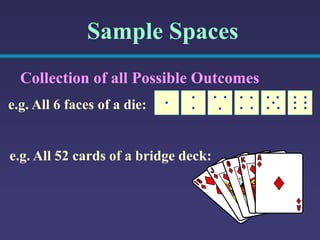
Sample Spaces
Collection of all Possible Outcomes
e.g. All 6 faces of a die:
e.g. All 52 cards of a bridge deck:
Events
• Simple Event: Outcome from a Sample Space
with 1 Characteristic
e.g. A Red Card from a deck of cards.
• Joint Event: Involves 2 Outcomes
Simultaneously
e.g. An Ace which is also a Red Card from a
deck of cards.
Visualizing Events
• Contingency Tables
•
Ace Not Ace Total
Red 2 24 26
Black 2 24 26
Total 4 48 52
Simple Events
The Event of a Happy Face
There are 5 happy faces in this collection of 18 objects
Joint Events
The Event of a Happy Face AND Light Colored
3 Happy Faces which are light in color

Special Events
Null event
Club & diamond on
1 card draw
Complement of event
For event A,
All events not In A:
Null Event
'
A
3 Items: 3 Happy Faces Given they are Light Colored
Dependent or
Independent Events
The Event of a Happy Face GIVEN it is Light Colored
E = Happy FaceLight Color
Contingency Table
A Deck of 52 Cards
Ace
Not an
Ace
Total
Red
Black
Total
2 24
2 24
26
26
4 48 52
Sample Space
Red Ace
2500
Contingency Table
2500 Employees of Company ABC
Agree Neutral Opposed | Total
MALE
FEMALE
Total
900 200
300 100
400 | 1500
600 | 1000
1200 300 1000 |
Sample Space
Tree Diagram
Event Possibilities
Red
Cards
Black
Cards
Ace
Not an Ace
Ace
Not an Ace
Full
Deck
of Cards
Probability
•Probability is the numerical
measure of the likelihood
that the event will occur.
•Value is between 0 and 1.
•Sum of the probabilities of
all mutually exclusive and
collective exhaustive events
is 1.
Certain
Impossible
.5
1
0
Computing Probability
• The Probability of an Event, E:
• Each of the Outcome in the Sample Space
equally likely to occur.
e.g. P( ) = 2/36
(There are 2 ways to get one 6 and the other 4)
P(E) =
Number of Event Outcomes
Total Number of Possible Outcomes in the Sample Space
=
X
T
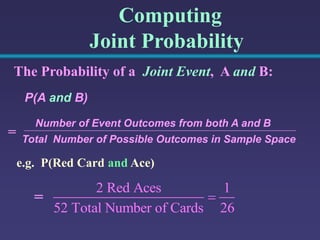
Computing
Joint Probability
The Probability of a Joint Event, A and B:
e.g. P(Red Card and Ace)
P(A and B)
Number of Event Outcomes from both A and B
Total Number of Possible Outcomes in Sample Space
=
=
2 Red Aces 1
52 Total Number of Cards 26

P(A2 and B1)
P(A1 and B1)
Event
Event Total
Total 1
Joint Probability Using
Contingency Table
Joint Probability Marginal (Simple) Probability
P(A1)A1
A2
B1 B2
P(B1) P(B2)
P(A1 and B2)
P(A2 and B2) P(A2)
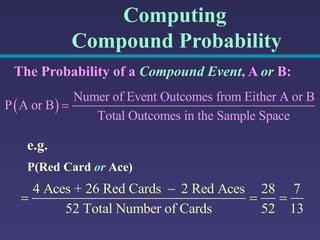
Computing
Compound Probability
The Probability of a Compound Event, A or B:
e.g.
P(Red Card or Ace)
4 Aces + 26 Red Cards 2 Red Aces 28 7
52 Total Number of Cards 52 13

  
 
Numer of Event Outcomes from Either A or B
P A or B
Total Outcomes in the Sample Space

2500
Contingency Table
2500 Employees of Company ABC
Agree Neutral Opposed | Total
MALE
FEMALE
Total
900 200
300 100
400 | 1500
600 | 1000
1200 300 1000 |
Sample Space
The pervious table refers to 2500 employees of ABC Company, classified by gender
and by opinion on a company proposal to emphasize fringe benefits rather than wage
increases in an impending contract discussion
Calculate the probability that an employee selected (at random) from this group will be:
1. A female opposed to the proposal
The pervious table refers to 2500 employees of ABC Company, classified by gender
and by opinion on a company proposal to emphasize fringe benefits rather than wage
increases in an impending contract discussion
Calculate the probability that an employee selected (at random) from this group will be:
1. A female opposed to the proposal 600/2500 = 0.24
The pervious table refers to 2500 employees of ABC Company, classified by gender
and by opinion on a company proposal to emphasize fringe benefits rather than wage
increases in an impending contract discussion
Calculate the probability that an employee selected (at random) from this group will be:
1. A female opposed to the proposal 600/2500 = 0.24
2. Neutral
The pervious table refers to 2500 employees of ABC Company, classified by gender
and by opinion on a company proposal to emphasize fringe benefits rather than wage
increases in an impending contract discussion
Calculate the probability that an employee selected (at random) from this group will be:
1. A female opposed to the proposal 600/2500 = 0.24
2. Neutral 300/2500 = 0.12
The pervious table refers to 2500 employees of ABC Company, classified by gender
and by opinion on a company proposal to emphasize fringe benefits rather than wage
increases in an impending contract discussion
Calculate the probability that an employee selected (at random) from this group will be:
1. A female opposed to the proposal 600/2500 = 0.24
2. Neutral 300/2500 = 0.12
3. Opposed to the proposal, GIVEN that
the employee selected is a female
The pervious table refers to 2500 employees of ABC Company, classified by gender
and by opinion on a company proposal to emphasize fringe benefits rather than wage
increases in an impending contract discussion
Calculate the probability that an employee selected (at random) from this group will be:
1. A female opposed to the proposal 600/2500 = 0.24
2. Neutral 300/2500 = 0.12
3. Opposed to the proposal, GIVEN that
the employee selected is a female 600/1000 = 0.60
The pervious table refers to 2500 employees of ABC Company, classified by gender
and by opinion on a company proposal to emphasize fringe benefits rather than wage
increases in an impending contract discussion
Calculate the probability that an employee selected (at random) from this group will be:
1. A female opposed to the proposal 600/2500 = 0.24
2. Neutral 300/2500 = 0.12
3. Opposed to the proposal, GIVEN that
the employee selected is a female 600/1000 = 0.60
4. Either a female or opposed to the
proposal
The pervious table refers to 2500 employees of ABC Company, classified by gender
and by opinion on a company proposal to emphasize fringe benefits rather than wage
increases in an impending contract discussion
Calculate the probability that an employee selected (at random) from this group will be:
1. A female opposed to the proposal 600/2500 = 0.24
2. Neutral 300/2500 = 0.12
3. Opposed to the proposal, GIVEN that
the employee selected is a female 600/1000 = 0.60
4. Either a female or opposed to the
proposal ……….. 1000/2500 + 1000/2500 - 600/2500 =
1400/2500 = 0.56
The pervious table refers to 2500 employees of ABC Company, classified by gender
and by opinion on a company proposal to emphasize fringe benefits rather than wage
increases in an impending contract discussion
Calculate the probability that an employee selected (at random) from this group will be:
1. A female opposed to the proposal 600/2500 = 0.24
2. Neutral 300/2500 = 0.12
3. Opposed to the proposal, GIVEN that
the employee selected is a female 600/1000 = 0.60
4. Either a female or opposed to the
proposal ……….. 1000/2500 + 1000/2500 - 600/2500 =
1400/2500 = 0.56
5. Are Gender and Opinion (statistically) independent?
The pervious table refers to 2500 employees of ABC Company, classified by gender
and by opinion on a company proposal to emphasize fringe benefits rather than wage
increases in an impending contract discussion
Calculate the probability that an employee selected (at random) from this group will be:
1. A female opposed to the proposal 600/2500 = 0.24
2. Neutral 300/2500 = 0.12
3. Opposed to the proposal, GIVEN that
the employee selected is a female 600/1000 = 0.60
4. Either a female or opposed to the
proposal ……….. 1000/2500 + 1000/2500 - 600/2500 =
1400/2500 = 0.56
5. Are Gender and Opinion (statistically) independent?
For Opinion and Gender to be independent, the joint probability of each pair of
A events (GENDER) and B events (OPINION) should equal the product of the
respective unconditional probabilities….clearly this does not hold…..check, e.g.,
the prob. Of MALE and IN FAVOR against the prob. of MALE times the prob.
of IN FAVOR …they are not equal….900/2500 does not equal 1500/2500 *
1200/2500
P(A1 and B1)
P(B2)P(B1)
P(A2 and B2)P(A2 and B1)
Event
Event Total
Total 1
Compound Probability
Addition Rule
P(A1 and B2) P(A1)A1
A2
B1 B2
P(A2)
P(A1 or B1 ) = P(A1) +P(B1) - P(A1 and B1)
For Mutually Exclusive Events: P(A or B) = P(A) + P(B)
Computing
Conditional Probability
The Probability of Event A given that Event B has
occurred:
P(A B) =
e.g.
P(Red Card given that it is an Ace) =
 
 
P A B
P B
and
2 Red Aces 1
4 Aces 2

Black
Color
Type Red Total
Ace 2 2 4
Non-Ace 24 24 48
Total 26 26 52
Conditional Probability
Using Contingency Table
Conditional Event: Draw 1 Card. Note Kind & Color
26
2
5226
522

/
/
P(Red)
Red)ANDP(Ace
=Red)|P(Ace
Revised
Sample
Space
Conditional Probability and
Statistical Independence
)B(P
)BandA(P
Conditional Probability:
P(AB) =
P(A and B) = P(A B) • P(B)
Multiplication Rule:
= P(B A) • P(A)
Conditional Probability and
Statistical Independence (continued)
Events are Independent:
P(A  B) = P(A)
Or, P(A and B) = P(A) • P(B)
Events A and B are Independent when the
probability of one event, A is not affected by
another event, B.
Or, P(B  A) = P(B)
Bayes’ Theorem
)B(P)BA(P)B(P)BA(P
)B(P)BA(P
kk
ii


11
)A(P
)AandB(P i

P(Bi A) =
Adding up
the parts
of A in all
the B’sSame
Event
Bayes’ Theorem
Given a hypothesis H and an event E
P(H|E) = P(E|H) x P(H)
P(E)
Where P(E) = P(E|H) x P(H) + P(E|H) x
P(H)
Example
You have a physical complaint which is one of
the symptoms of a rare and unpleasant
disease. 1 in 500 people have the disease.
The probability of having the physical
symptom if you have the disease is 0.7.
The probability of having the symptom
without also having the disease is 0.01.
How likely is it that you are suffering from the
disease?
Example
P(E) = P(E|H) x P(H) + P(E|H) x P(H)
P(E) = 0.7 x 0.002 + 0.01 x 0.998 = 0.01138
P(H|E) = P(E|H) x P(H)
P(E)
P(H|E) = 0.7 x 0.002 = 0.123
0.01138
Probability Distribution Models
Probability Distributions
Continuous Discrete

probability theory

  • 1.
  • 2.
    Topics • Basic ProbabilityConcepts: Sample Spaces and Events, Simple Probability, and Joint Probability, • Conditional Probability • Bayes’ Theorem • Probability Distribution
  • 3.
    Sample Spaces Collection ofall Possible Outcomes e.g. All 6 faces of a die: e.g. All 52 cards of a bridge deck:
  • 4.
    Events • Simple Event:Outcome from a Sample Space with 1 Characteristic e.g. A Red Card from a deck of cards. • Joint Event: Involves 2 Outcomes Simultaneously e.g. An Ace which is also a Red Card from a deck of cards.
  • 5.
    Visualizing Events • ContingencyTables • Ace Not Ace Total Red 2 24 26 Black 2 24 26 Total 4 48 52
  • 6.
    Simple Events The Eventof a Happy Face There are 5 happy faces in this collection of 18 objects
  • 7.
    Joint Events The Eventof a Happy Face AND Light Colored 3 Happy Faces which are light in color
  • 8.
     Special Events Null event Club& diamond on 1 card draw Complement of event For event A, All events not In A: Null Event ' A
  • 9.
    3 Items: 3Happy Faces Given they are Light Colored Dependent or Independent Events The Event of a Happy Face GIVEN it is Light Colored E = Happy FaceLight Color
  • 10.
    Contingency Table A Deckof 52 Cards Ace Not an Ace Total Red Black Total 2 24 2 24 26 26 4 48 52 Sample Space Red Ace
  • 11.
    2500 Contingency Table 2500 Employeesof Company ABC Agree Neutral Opposed | Total MALE FEMALE Total 900 200 300 100 400 | 1500 600 | 1000 1200 300 1000 | Sample Space
  • 12.
  • 13.
    Probability •Probability is thenumerical measure of the likelihood that the event will occur. •Value is between 0 and 1. •Sum of the probabilities of all mutually exclusive and collective exhaustive events is 1. Certain Impossible .5 1 0
  • 14.
    Computing Probability • TheProbability of an Event, E: • Each of the Outcome in the Sample Space equally likely to occur. e.g. P( ) = 2/36 (There are 2 ways to get one 6 and the other 4) P(E) = Number of Event Outcomes Total Number of Possible Outcomes in the Sample Space = X T
  • 15.
    Computing Joint Probability The Probabilityof a Joint Event, A and B: e.g. P(Red Card and Ace) P(A and B) Number of Event Outcomes from both A and B Total Number of Possible Outcomes in Sample Space = = 2 Red Aces 1 52 Total Number of Cards 26 
  • 16.
    P(A2 and B1) P(A1and B1) Event Event Total Total 1 Joint Probability Using Contingency Table Joint Probability Marginal (Simple) Probability P(A1)A1 A2 B1 B2 P(B1) P(B2) P(A1 and B2) P(A2 and B2) P(A2)
  • 17.
    Computing Compound Probability The Probabilityof a Compound Event, A or B: e.g. P(Red Card or Ace) 4 Aces + 26 Red Cards 2 Red Aces 28 7 52 Total Number of Cards 52 13       Numer of Event Outcomes from Either A or B P A or B Total Outcomes in the Sample Space 
  • 18.
    2500 Contingency Table 2500 Employeesof Company ABC Agree Neutral Opposed | Total MALE FEMALE Total 900 200 300 100 400 | 1500 600 | 1000 1200 300 1000 | Sample Space
  • 19.
    The pervious tablerefers to 2500 employees of ABC Company, classified by gender and by opinion on a company proposal to emphasize fringe benefits rather than wage increases in an impending contract discussion Calculate the probability that an employee selected (at random) from this group will be: 1. A female opposed to the proposal
  • 20.
    The pervious tablerefers to 2500 employees of ABC Company, classified by gender and by opinion on a company proposal to emphasize fringe benefits rather than wage increases in an impending contract discussion Calculate the probability that an employee selected (at random) from this group will be: 1. A female opposed to the proposal 600/2500 = 0.24
  • 21.
    The pervious tablerefers to 2500 employees of ABC Company, classified by gender and by opinion on a company proposal to emphasize fringe benefits rather than wage increases in an impending contract discussion Calculate the probability that an employee selected (at random) from this group will be: 1. A female opposed to the proposal 600/2500 = 0.24 2. Neutral
  • 22.
    The pervious tablerefers to 2500 employees of ABC Company, classified by gender and by opinion on a company proposal to emphasize fringe benefits rather than wage increases in an impending contract discussion Calculate the probability that an employee selected (at random) from this group will be: 1. A female opposed to the proposal 600/2500 = 0.24 2. Neutral 300/2500 = 0.12
  • 23.
    The pervious tablerefers to 2500 employees of ABC Company, classified by gender and by opinion on a company proposal to emphasize fringe benefits rather than wage increases in an impending contract discussion Calculate the probability that an employee selected (at random) from this group will be: 1. A female opposed to the proposal 600/2500 = 0.24 2. Neutral 300/2500 = 0.12 3. Opposed to the proposal, GIVEN that the employee selected is a female
  • 24.
    The pervious tablerefers to 2500 employees of ABC Company, classified by gender and by opinion on a company proposal to emphasize fringe benefits rather than wage increases in an impending contract discussion Calculate the probability that an employee selected (at random) from this group will be: 1. A female opposed to the proposal 600/2500 = 0.24 2. Neutral 300/2500 = 0.12 3. Opposed to the proposal, GIVEN that the employee selected is a female 600/1000 = 0.60
  • 25.
    The pervious tablerefers to 2500 employees of ABC Company, classified by gender and by opinion on a company proposal to emphasize fringe benefits rather than wage increases in an impending contract discussion Calculate the probability that an employee selected (at random) from this group will be: 1. A female opposed to the proposal 600/2500 = 0.24 2. Neutral 300/2500 = 0.12 3. Opposed to the proposal, GIVEN that the employee selected is a female 600/1000 = 0.60 4. Either a female or opposed to the proposal
  • 26.
    The pervious tablerefers to 2500 employees of ABC Company, classified by gender and by opinion on a company proposal to emphasize fringe benefits rather than wage increases in an impending contract discussion Calculate the probability that an employee selected (at random) from this group will be: 1. A female opposed to the proposal 600/2500 = 0.24 2. Neutral 300/2500 = 0.12 3. Opposed to the proposal, GIVEN that the employee selected is a female 600/1000 = 0.60 4. Either a female or opposed to the proposal ……….. 1000/2500 + 1000/2500 - 600/2500 = 1400/2500 = 0.56
  • 27.
    The pervious tablerefers to 2500 employees of ABC Company, classified by gender and by opinion on a company proposal to emphasize fringe benefits rather than wage increases in an impending contract discussion Calculate the probability that an employee selected (at random) from this group will be: 1. A female opposed to the proposal 600/2500 = 0.24 2. Neutral 300/2500 = 0.12 3. Opposed to the proposal, GIVEN that the employee selected is a female 600/1000 = 0.60 4. Either a female or opposed to the proposal ……….. 1000/2500 + 1000/2500 - 600/2500 = 1400/2500 = 0.56 5. Are Gender and Opinion (statistically) independent?
  • 28.
    The pervious tablerefers to 2500 employees of ABC Company, classified by gender and by opinion on a company proposal to emphasize fringe benefits rather than wage increases in an impending contract discussion Calculate the probability that an employee selected (at random) from this group will be: 1. A female opposed to the proposal 600/2500 = 0.24 2. Neutral 300/2500 = 0.12 3. Opposed to the proposal, GIVEN that the employee selected is a female 600/1000 = 0.60 4. Either a female or opposed to the proposal ……….. 1000/2500 + 1000/2500 - 600/2500 = 1400/2500 = 0.56 5. Are Gender and Opinion (statistically) independent? For Opinion and Gender to be independent, the joint probability of each pair of A events (GENDER) and B events (OPINION) should equal the product of the respective unconditional probabilities….clearly this does not hold…..check, e.g., the prob. Of MALE and IN FAVOR against the prob. of MALE times the prob. of IN FAVOR …they are not equal….900/2500 does not equal 1500/2500 * 1200/2500
  • 29.
    P(A1 and B1) P(B2)P(B1) P(A2and B2)P(A2 and B1) Event Event Total Total 1 Compound Probability Addition Rule P(A1 and B2) P(A1)A1 A2 B1 B2 P(A2) P(A1 or B1 ) = P(A1) +P(B1) - P(A1 and B1) For Mutually Exclusive Events: P(A or B) = P(A) + P(B)
  • 30.
    Computing Conditional Probability The Probabilityof Event A given that Event B has occurred: P(A B) = e.g. P(Red Card given that it is an Ace) =     P A B P B and 2 Red Aces 1 4 Aces 2 
  • 31.
    Black Color Type Red Total Ace2 2 4 Non-Ace 24 24 48 Total 26 26 52 Conditional Probability Using Contingency Table Conditional Event: Draw 1 Card. Note Kind & Color 26 2 5226 522  / / P(Red) Red)ANDP(Ace =Red)|P(Ace Revised Sample Space
  • 32.
    Conditional Probability and StatisticalIndependence )B(P )BandA(P Conditional Probability: P(AB) = P(A and B) = P(A B) • P(B) Multiplication Rule: = P(B A) • P(A)
  • 33.
    Conditional Probability and StatisticalIndependence (continued) Events are Independent: P(A  B) = P(A) Or, P(A and B) = P(A) • P(B) Events A and B are Independent when the probability of one event, A is not affected by another event, B. Or, P(B  A) = P(B)
  • 34.
  • 35.
    Bayes’ Theorem Given ahypothesis H and an event E P(H|E) = P(E|H) x P(H) P(E) Where P(E) = P(E|H) x P(H) + P(E|H) x P(H)
  • 36.
    Example You have aphysical complaint which is one of the symptoms of a rare and unpleasant disease. 1 in 500 people have the disease. The probability of having the physical symptom if you have the disease is 0.7. The probability of having the symptom without also having the disease is 0.01. How likely is it that you are suffering from the disease?
  • 37.
    Example P(E) = P(E|H)x P(H) + P(E|H) x P(H) P(E) = 0.7 x 0.002 + 0.01 x 0.998 = 0.01138 P(H|E) = P(E|H) x P(H) P(E) P(H|E) = 0.7 x 0.002 = 0.123 0.01138
  • 38.
    Probability Distribution Models ProbabilityDistributions Continuous Discrete