Planning Ahead:
Proactive Risk Management and Customer service at
Gestion d’incidents GRS (Canada)
Développement 80/20 inc. (Canada)
Proactive Risk Management Inc. (USA)
Benoit Grenier, November 2013
Los Angeles + 1-323-744-7446
Montreal +1-514-444-3218
Toronto +1-416-660-1514
New York +1-201-204-9082
Mexico City +52 5539648234
Guatemala +502 66284100
Email: benoit@parm8020.com

*
●
●
●
●
●

Why Does Risk Management Matter?
What Events Give Rise to Risk?
Our mission
Value added proposition
What if? Failure of Proactive Risk
Management: An Example
● What Does an Effective Risk
Management Approach Look Like?
● Risk Management Process
● Conclusion

*

Topics for
Discussion

*
2 Significant Risks
●Reputational RiskRisks to

customer base and brand image:
harmful coverage in the press,
internet, or social media that can
damage the company’s reputation.
What do our customers say about
us ?

Why Does Risk
Management
Matter?

●Legal and Regulatory
RiskRisks relating to a retailer’s

position in legal or regulatory
proceedings, increasing the
likelihood that the company will face
a damages award, penalty or
sanction.

*

*
5 Categories of Risks

e.g., safety issues, hazard, slip and
fall incidents
 Product Liability/Product
Quality
Concerns about product quality,
whether or not injury caused,
risks.

What Events
Give Rise to
Risk?

Personal Injury

*

*
5 Categories of Risks






What Events
Give Rise to
Risk? (cont’d)

Customer Service ComplaintsCustomer
interactions
with staff and organization
Loss Prevention IssuesInteractions between
customers and personnel, interaction
between staff and store, internal theft
Trespassing/Difficult CustomersDealing and
Interacting with difficult customers

*
*
Our Mission
Develop an incident
management and customer
service strategy that will
mitigate risk and convert
them into opportunities.
Implement best practices
to create a safer
environment for your
customers and for your
employees.

Our mission :
To provide support

*
● Implementing a strategy
● Proactively manage
● Capacity to identify, analyse
● Take coordinated action
Implementing and managing a strategy that
addresses the stability of your operations, is key
to the sustainability and growth of your
business. Like most companies, the prime
responsibility of your internal incident
management team is to proactively manage
incidents as they occur. The question is: What is
the overall capacity of your employees to
identify, analyse and take co-ordinated action in
response to risk-related events?
*

Value added
proposition
●
●
●
●

Quickly manage
Command Center
7 / 24 availability
Protect your assets

Value added
proposition

Proactive risk Management has
proven its ability to proactively and
quickly manage to incidents through
its command center, special
representative and field operations
team. You can count on our
expertise and on our 7/24 availability
to respond immediately to any new
situation to protect your financial
and reputational
*
●Builds Credibility proactively

○Builds credibility with public,
regulators, and the courts. Be a “Good
citizen”
○Prevent recurring incidents

●Prevents Escalation

○Prevents a complaint from becoming
a formal demand or legal claim
○Prevents recourse to the press or to
the regulator
○Prevents a problem in one store from
becoming a national problem by
identifying systemic problems with
products or with company policies

*

Key Benefits of
Proactive Risk
Management
Helps in Negotiation

Responding early to complaints
typically results in more
manageable expectations on the
part of customers. Communicating
effectively allow better
management of situation and
better outcome.

Key Benefits of
Proactive Risk
Management
(cont’d)

Preserves Evidence

Taking steps to preserve evidence
and build a record can ensure a
strong defence against claims later
on

Ensures Legal Compliance

Legally, retailers have a duty to
report certain incidents
Cannot choose not to be proactive

*

*
 Ensuring up-to-date
understanding of legal and
regulatory responsibilities.
Duties to keep certain
records.
 Clear policies for dealing
with customer complaints
and areas of risk. Formal
process.
 Use of established
response for
communications, but also
training staff on when
ready-made messages not
appropriate
 Focus on collecting
evidence as soon as
possible. Integrated
incident reporting,
statements, pictures etc.

What Does an
Effective Risk
Management
Approach Look
Like?

*

*
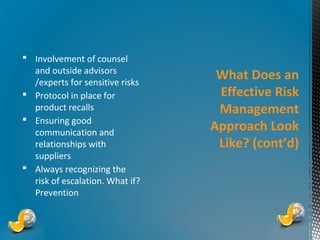
 Involvement of counsel
and outside advisors
/experts for sensitive risks
 Protocol in place for
product recalls
 Ensuring good
communication and
relationships with
suppliers
 Always recognizing the
risk of escalation. What if?
Prevention

What Does an
Effective Risk
Management
Approach Look
Like? (cont’d)

*
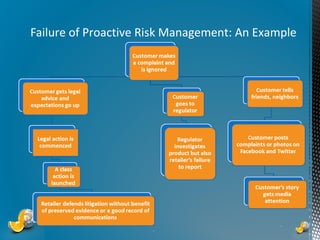
Failure of Proactive Risk Management: An Example

*
*
Risk
Management
Process

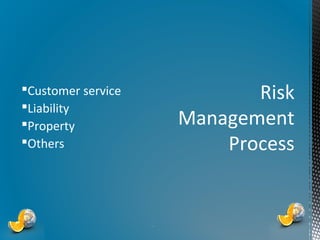
Customer service
Liability
Property
Others

*
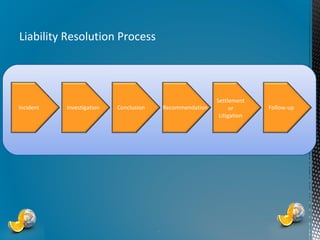
Liability Resolution Process

Incident

Investigation

Conclusion

Recommendation

*

Settlement
or
Litigation

Follow-up
Process Management from Start to Finish
Incident occurence

Method of
Receipt

Information
Recovery

Triage

Customer;
Store / Staff;
Government
Agencies;
Other.

Tracking;
Incident
Report;
Web /contact Mgt Reports.
us;
HR Support
Line
Customer
service Line;
Other Mgt
Sources.

*

Data Gathering Product

Escalation to Product
Product;
Management Retrieval;
/ Risk
Store Level;
Management Investigation
Leadership /
Customer;
C-Level
Government
Agencies

Required Action / Case Resolution

Source of
Information
Data Gathering and Management Reporting
●
●
●
●
●
●
●
●
●
●
●
●

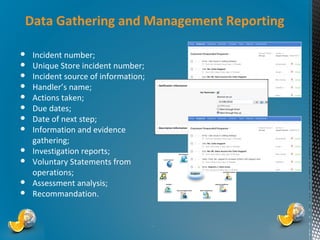
Incident number;
Unique Store incident number;
Incident source of information;
Handler’s name;
Actions taken;
Due dates;
Date of next step;
Information and evidence
gathering;
Investigation reports;
Voluntary Statements from
operations;
Assessment analysis;
Recommandation.

*
Overview of Risk Management Strategies
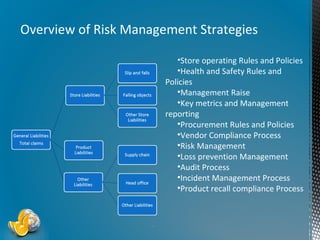
•Store operating Rules and Policies
•Health and Safety Rules and
Policies
•Management Raise
•Key metrics and Management
reporting
•Procurement Rules and Policies
•Vendor Compliance Process
•Risk Management
•Loss prevention Management
•Audit Process
•Incident Management Process
•Product recall compliance Process

*
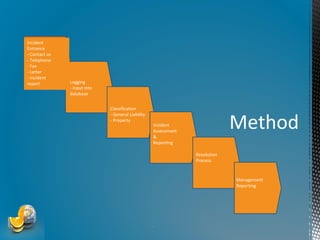
Incident
Entrance
- Contact us
- Telephone
- Fax
- Letter
- Incident
report

Logging
- input into
database
Classification
- General Liability
- Property

Method

Incident
Assessment
&
Reporting
Resolution
Process

Management
Reporting

*
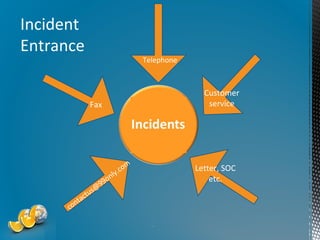
Incident
Entrance

Telephone

Customer
service

Fax

n
co

ctu
ta

99
s@

o
y.c
l
on

m

Letter, SOC
etc.

*
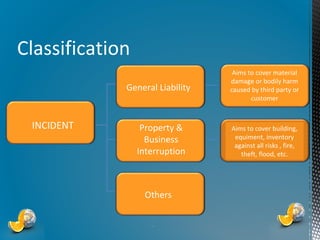
Classification
General Liability

INCIDENT

Property &
Business
Interruption

Others

*

Aims to cover material
damage or bodily harm
caused by third party or
customer

Aims to cover building,
equiment, inventory
against all risks , fire,
theft, flood, etc.
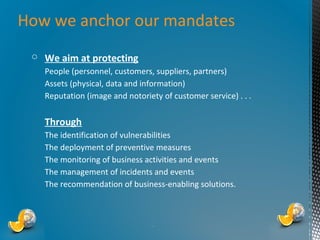
How we anchor our mandates
○ We aim at protecting
People (personnel, customers, suppliers, partners)
Assets (physical, data and information)
Reputation (image and notoriety of customer service) . . .

Through
The identification of vulnerabilities
The deployment of preventive measures
The monitoring of business activities and events
The management of incidents and events
The recommendation of business-enabling solutions.

*
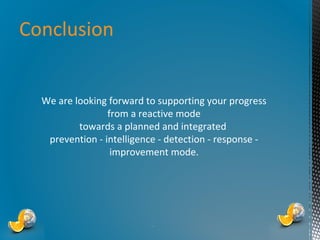
Conclusion
We are looking forward to supporting your progress
from a reactive mode
towards a planned and integrated
prevention - intelligence - detection - response improvement mode.

*

Proactive Risk Management: An Introduction to the Importance of Proactive Risk Management

  • 1.
    Planning Ahead: Proactive RiskManagement and Customer service at Gestion d’incidents GRS (Canada) Développement 80/20 inc. (Canada) Proactive Risk Management Inc. (USA) Benoit Grenier, November 2013 Los Angeles + 1-323-744-7446 Montreal +1-514-444-3218 Toronto +1-416-660-1514 New York +1-201-204-9082 Mexico City +52 5539648234 Guatemala +502 66284100 Email: benoit@parm8020.com *
  • 2.
    ● ● ● ● ● Why Does RiskManagement Matter? What Events Give Rise to Risk? Our mission Value added proposition What if? Failure of Proactive Risk Management: An Example ● What Does an Effective Risk Management Approach Look Like? ● Risk Management Process ● Conclusion * Topics for Discussion *
  • 3.
    2 Significant Risks ●ReputationalRiskRisks to customer base and brand image: harmful coverage in the press, internet, or social media that can damage the company’s reputation. What do our customers say about us ? Why Does Risk Management Matter? ●Legal and Regulatory RiskRisks relating to a retailer’s position in legal or regulatory proceedings, increasing the likelihood that the company will face a damages award, penalty or sanction. * *
  • 4.
    5 Categories ofRisks  e.g., safety issues, hazard, slip and fall incidents  Product Liability/Product Quality Concerns about product quality, whether or not injury caused, risks. What Events Give Rise to Risk? Personal Injury * *
  • 5.
    5 Categories ofRisks    What Events Give Rise to Risk? (cont’d) Customer Service ComplaintsCustomer interactions with staff and organization Loss Prevention IssuesInteractions between customers and personnel, interaction between staff and store, internal theft Trespassing/Difficult CustomersDealing and Interacting with difficult customers * *
  • 6.
    Our Mission Develop anincident management and customer service strategy that will mitigate risk and convert them into opportunities. Implement best practices to create a safer environment for your customers and for your employees. Our mission : To provide support *
  • 7.
    ● Implementing astrategy ● Proactively manage ● Capacity to identify, analyse ● Take coordinated action Implementing and managing a strategy that addresses the stability of your operations, is key to the sustainability and growth of your business. Like most companies, the prime responsibility of your internal incident management team is to proactively manage incidents as they occur. The question is: What is the overall capacity of your employees to identify, analyse and take co-ordinated action in response to risk-related events? * Value added proposition
  • 8.
    ● ● ● ● Quickly manage Command Center 7/ 24 availability Protect your assets Value added proposition Proactive risk Management has proven its ability to proactively and quickly manage to incidents through its command center, special representative and field operations team. You can count on our expertise and on our 7/24 availability to respond immediately to any new situation to protect your financial and reputational *
  • 9.
    ●Builds Credibility proactively ○Buildscredibility with public, regulators, and the courts. Be a “Good citizen” ○Prevent recurring incidents ●Prevents Escalation ○Prevents a complaint from becoming a formal demand or legal claim ○Prevents recourse to the press or to the regulator ○Prevents a problem in one store from becoming a national problem by identifying systemic problems with products or with company policies * Key Benefits of Proactive Risk Management
  • 10.
    Helps in Negotiation Respondingearly to complaints typically results in more manageable expectations on the part of customers. Communicating effectively allow better management of situation and better outcome. Key Benefits of Proactive Risk Management (cont’d) Preserves Evidence Taking steps to preserve evidence and build a record can ensure a strong defence against claims later on Ensures Legal Compliance Legally, retailers have a duty to report certain incidents Cannot choose not to be proactive * *
  • 11.
     Ensuring up-to-date understandingof legal and regulatory responsibilities. Duties to keep certain records.  Clear policies for dealing with customer complaints and areas of risk. Formal process.  Use of established response for communications, but also training staff on when ready-made messages not appropriate  Focus on collecting evidence as soon as possible. Integrated incident reporting, statements, pictures etc. What Does an Effective Risk Management Approach Look Like? * *
  • 12.
     Involvement ofcounsel and outside advisors /experts for sensitive risks  Protocol in place for product recalls  Ensuring good communication and relationships with suppliers  Always recognizing the risk of escalation. What if? Prevention What Does an Effective Risk Management Approach Look Like? (cont’d) *
  • 13.
    Failure of ProactiveRisk Management: An Example * *
  • 14.
  • 15.
  • 16.
    Process Management fromStart to Finish Incident occurence Method of Receipt Information Recovery Triage Customer; Store / Staff; Government Agencies; Other. Tracking; Incident Report; Web /contact Mgt Reports. us; HR Support Line Customer service Line; Other Mgt Sources. * Data Gathering Product Escalation to Product Product; Management Retrieval; / Risk Store Level; Management Investigation Leadership / Customer; C-Level Government Agencies Required Action / Case Resolution Source of Information
  • 17.
    Data Gathering andManagement Reporting ● ● ● ● ● ● ● ● ● ● ● ● Incident number; Unique Store incident number; Incident source of information; Handler’s name; Actions taken; Due dates; Date of next step; Information and evidence gathering; Investigation reports; Voluntary Statements from operations; Assessment analysis; Recommandation. *
  • 18.
    Overview of RiskManagement Strategies •Store operating Rules and Policies •Health and Safety Rules and Policies •Management Raise •Key metrics and Management reporting •Procurement Rules and Policies •Vendor Compliance Process •Risk Management •Loss prevention Management •Audit Process •Incident Management Process •Product recall compliance Process *
  • 19.
    Incident Entrance - Contact us -Telephone - Fax - Letter - Incident report Logging - input into database Classification - General Liability - Property Method Incident Assessment & Reporting Resolution Process Management Reporting *
  • 20.
  • 21.
    Classification General Liability INCIDENT Property & Business Interruption Others * Aimsto cover material damage or bodily harm caused by third party or customer Aims to cover building, equiment, inventory against all risks , fire, theft, flood, etc.
  • 22.
    How we anchorour mandates ○ We aim at protecting People (personnel, customers, suppliers, partners) Assets (physical, data and information) Reputation (image and notoriety of customer service) . . . Through The identification of vulnerabilities The deployment of preventive measures The monitoring of business activities and events The management of incidents and events The recommendation of business-enabling solutions. *
  • 23.
    Conclusion We are lookingforward to supporting your progress from a reactive mode towards a planned and integrated prevention - intelligence - detection - response improvement mode. *