Privacy Preserving Distributed Association Rule
Mining Algorithm for Vertically Partitioned Data
Vadlana Baby
Associate Professor
Department of Computer Science
and Engg., VNR Vignana Jyothi Institute
of Engg. and Technology, Hyderabad, India
Email: baby v@vnrvjiet.in
Dr. N. Subhash Chandra
Principal and Professor
Department of Computer Science
and Engg. Holy Mary Institute of Technology,
Hyderabad, India
Email: subhashchandra n@yahoo.co.in
Abstract—Data mining over diverse data sources is useful
means for discovering valuable patterns, associations, trends, and
dependencies in data. Many variants of this problem are existing,
depending on how the data is distributed, what type of data
mining we wish to do, how to achieve privacy of data and what
restrictions are placed on sharing of information. A transactional
database owner, lacking in the expertise or computational sources
can outsource its mining tasks to a third party service provider
or server. However, both the itemsets along with the association
rules of the outsourced database are considered private property
of the database owner.
In this paper, we consider a scenario where multiple data sources
are willing to share their data with trusted third party called
combiner who runs data mining algorithms over the union
of their data as long as each data source is guaranteed that
its information that does not pertain to another data source
will not be revealed. The proposed algorithm is characterized
with (1) secret sharing based secure key transfer for distributed
transactional databases with its lightweight encryption is used
for preserving the privacy. (2) and rough set based mechanism
for association rules extraction for an efficient and mining task.
Performance analysis and experimental results are provided for
demonstrating the effectiveness of the proposed algorithm.
keywords: Security, Association rule mining, Rough sets,
Secret key sharing, Distributed computation, Transactional-
itemsets, Machine learning.
I. INTRODUCTION
Data mining offers the service to extract the meaningful,
relevant and useful information in form of knowledge. Today
data, which is becoming more and more sensitive and pri-
vate, contains the sensitive information, to process such data
securely become a challenging task. Other most studied prob-
lem is to discover frequent itemsets in various transactional
databases and mining of association rules. Association rules
are utilized in diverse areas e.g. market analysis, weather con-
ditions prediction, risk management, communication networks
etc. [5,6,7,8,9].
In distributed transactional database scenario, the databases are
present in multiple locations and to mine the results globally,
privacy preserving data mining is performed. In this process,
the sensitive and private data at each site is preserved through
different methods. For the purpose of association rule mining,
these parties present at distributed locations need to merge
their corresponding databases.
Some significant approaches like secure multiparty computa-
tion (SMC) along with other cryptographic techniques [1,2,3]
can be employed to acheive privacy preserving database min-
ing. Some threshold cryptography techniques e.g. Shamir’s
secret sharing [4] are also utilized for this purpose.
The general system model of outsourced data mining on joint
database is represented as figure below:-
Fig.1
A. Related Work
The domain of privacy preserving data mining has attracted
lot of people from various research communities. In this
model, private and sensitive data which is stored in distributed
sites is collected at a common location for the purpose of
association rules mining as well as frequent itemsets mining.
In past years, good amount of research has been done to
accept this challenge. This section summarizes some of the
significant research work which has been proposed in past
several years.
International Journal of Computer Science and Information Security (IJCSIS),
Vol. 15, No. 8, August 2017
130 https://sites.google.com/site/ijcsis/
ISSN 1947-5500
Fosca Giannotti et. al. [10] has presented the privacy-
preserving mining of association rules from the outsourced
transaction database. If a customer has a lack of computational
resources, then the customer can outsource his mining needs
to the third party (server). In this paper, they explained about
outsourcing problem of association rule mining task and have
proposed the attack model and created the privacy-preserving
scheme for outsourcing which is sufficiently effective in
nature. Mistery et. al. [11] has employed the heuristic
approach in the data distortion technique. We know that
association rule mining is one of the important and powerful
models among the data mining. The main problem occurs in
this, is the security issue while outsourcing the database to
the servers. The MDSRRC algorithmic procedure which they
have used in this paper is hiding the sensitive association
rules with some database modifications.
Li Lichun et. al. [12] mainly focussed on the privacy-
preserving mining on vertically partitioned databases. To
confirm the data privacy of customer’s sensitive data, they
have designed two schemes - (i) homomorphic encryption
scheme (ii) secure comparison scheme. Later they proposed
the cloud aided frequent itemset mining solution, which is
used for building association rule mining solution. Compared
to all existing solutions, the present solution will leak less
information. Yaoan Jin et. al. [13] improved the performance
of association rule mining on the distributed databases. They
have combined the Apriori algorithm and FP-tree algorithm
in present situation. For the purpose of implementation,
they used merging FP-tree method. They also utilized
homomorphic encryption scheme for comparatively better
security purpose.
Kantarcioglu et. al. [14] proposed secure mining of associ-
ation rules on horizontally partitioned data. They have shown
that distributed association rule mining can be performed more
efficiently under the preferred security assumptions as shown
in secure association rule mining. Vaidya et. al. [15] described
privacy preserving association rule mining in vertically parti-
tioned data. With minimum support levels, they have presented
the two-party algorithm for discovering frequent itemset. For
preserving privacy of individual values, they have given an
efficient protocol for computing the scalar product.
Fukasawa et. al. [16] has given a distributed privacy-
preserving data mining algorithm. With the proposed
algorithm data mining can be performed by a group of sites
with the privacy of every site remains protected. In this
algorithm, it is characterized by its capability to preserve
the privacy without any coordinator site, and specifically its
ability to resist the collusion. Performance analysis along
with experimental results are given for demonstrating the
effectiveness of the proposed algorithm. Cheung et. al. [17]
proposed distributed association rule mining algorithm, FDM
(fast distributed mining of association rules), which produces
a tiny number of candidate sets and extensively reduces
the number of messages. It shows that FDM has a superior
performance over the direct application of a typical sequential
algorithm.
Xinjing et. al. [18] examines the issue of privacy preserving
distributed association rule mining in vertically partitioned
data among multiple parties. Here, they presented a collusion-
resistant algorithm of distributed association rule mining based
on the Shamirs secret sharing technique, it prevents effec-
tively collusive behaviors and without compromising their
data privacy, it handles the computations across the parties.
Moreover, the paper analysed about the security, efficiency,
and correctness of the proposed algorithm. Tassa Tamir et. al.
[19] have proposed a protocol ”secure mining of association
rules in horizontally distributed databases” that improve signif-
icantly upon the current leading protocol regarding privacy and
efficiency. It is based on the Fast Distributed Mining algorithm.
The main components of this protocol are two novel secure
multiparty algorithms those are, one that estimates the union
of private subsets that each of the interacting players holds,
and other is testing the inclusion of an element held by one
player in a subset handled by another.
B. Motivation and Contribution
With the advent of several security threats over internet
and other communication scenarios, customer’s data is more
sensitive and confidential and to process this data requires the
preservation of data privacy. Most of the times, due to lack in
the expertise or computational sources from the owner side,
it need to outsource its mining tasks to a third party service
provider or server, then in this case privacy preserving plays
a crucial role.
Main contributions of this paper includes -
• The existing state-of-the-art methodologies and various
cryptographic techniques available for secure mining
task, which are explored in the literature, are presented
here.
• We have proposed our solution, which concerns the as-
sociation rules mining in a secure manner for distributed
transactional databases, located at different sites. Our
method assimilates secret sharing based secure outsourc-
ing of transactional databases, which consists of different
itemsets and rough set based mechanism for association
rules extraction for an efficient and secure mining task.
C. Organization of the paper
Structure of remaining of the paper is as - In section 2, some
required preliminaries are discussed. The available privacy pre-
serving data mining techniques are sub-categorized in section
3. In section 4, we have presented our proposed algorithm.
Section 5 analyses the security and efficiency analysis of the
algorithm. Experimental results are presented in section 6.
Finally conclusions along with future research plan are given
in section 7.
International Journal of Computer Science and Information Security (IJCSIS),
Vol. 15, No. 8, Augus 2017
131 https://sites.google.com/site/ijcsis/
ISSN 1947-5500
II. PRELIMINARIES
Some of the significant terms and preliminaries required are
summarized as below sub-sections:-
A. Data Mining Techniques
Data mining is the mechanism to fetch useful, relevant
information by processing of raw data available which may be
huge in size, may contains unstructured and irrelevant features
set. With the evolution of big data domain, this area in more
in demand. The process of data collection, it’s analysis and
further mine the significant information are the key process in
all data mining techniques. Some of the core techniques for
data mining are summarized as below-
1) Association-: In this technique, based on patterns and
frequent itemsets discovery, the correlation among two or more
databases is established. For an example - suppose a person
is buying itemsets x and y along with is most of the time he
is also buying some third item z, then the association rule set
will be:-
x y → z
2) Classification-: Classification is the most commonly
used technique in data mining. For example one can classify
different types of fruits into various catagories such that each
decision catagory consists of fruits having same attributes. It
involves training phase and later based on knowledge gained
at training phase, testing phase is performed.
3) Clustering-: Catagorize the different available objects or
itemsets and form clusters based on some particular attribute,
is considered as the clustering process. No training phase is
involved in the process of clustering.
4) Prediction-: This technique is used to predict the future
itemsets association, frequency of various itemsets, confidence
and support factors. These predictions are performed utilizing
some pre-information available in the form of stochastic, prob-
abilistic and statistical knowledge. This involves association
and patterns mining.
5) Decision trees-: As the part of selection criteria or
selecting some part in the overall structure, decision trees may
be employed. [21] Mostly while predictive systems designing
and modeling, decision trees are used. These predictions may
be based on past experiences and they help to define the
structure of the decision tree.
B. Data Privacy
In today’s scenario, when the customer’s data is more sensi-
tive and confidential, to process this data requires the preserva-
tion of data privacy. Suppose transactional database distributed
in different locations are DB1, DB2, DB3, ..., DBn and task
is to mine these databases for rules extraction purpose, an-
alyzation of frequency of itemsets etc. So, these distributed
sites need to transfer their private sensitive data in a secure
manner through communication channel to any combiner or
trusted third party. Then combiner will merge these distributed
databases, DB = DB1 ∪ DB2 ∪ DB3 ∪ .... ∪ DBn. So,
maintaining the data privacy of the distributed transactional
databases is considered as a challenging task.
C. Association Rule Mining
Association rule minning is a significant task which comes
under the domain of data mining and data discovery. The
data mining field and fundamental concepts of association rule
mining was first initiated by R. Agrawal. Association rules are
nothing but the IF-THEN relational concept among different
itemsets. Suppose a person is buying itemsets X, where X
is ’laptop’ and along with is most of the time he is also
buying Y , where Y is an ’antivirus’, then the association rule
set will be: X → Y Association rules have it’s applications
in diverse fields e.g. image processing, prediction modeling,
market business analysis, banking etc.
D. Cryptographic Techniques for Secure Computation
Some significant cryptographic techniques, utilized today
for the purpose of association rule mining are as follows:-
1) Secure Multi-Party Computation-: Good amount of work
has been done on secure multi-party computation to employ it
as an efficient and secure cryptographic technique in various
applications [23].
• Consider distributed parties consisting of their trans-
actional databases, who cann’t believe each other, nor
the channels through which they wish to communicate.
Still, suppose the sites need to correctly compute some
common function of their local transactional databases
inputs, while keeping their sensitive data as private as
possible. That, exactly, is the problem of SMPC.
• For example- Consider a case, where multiple users
jointly work on a project and utilize the services of the
same cloud provider. All of them want to simultane-
ously evaluate their equations without revealing individ-
ual equations to one another. In such scenarios the SMPC
solutions can be highly useful to provide privacy.
2) Homomorphic Encryption-: Homomorphic Encryption
is the most widely used cryptographic technique today.
• Homomorphic Encryption is an special form of encryp-
tion that allows computations to be carried out on ci-
phertext, thus generating an encrypted result which, when
decrypted, matches the result of operations performed on
the plaintext.
• Homomorphic Encryption is of two types - Partially ho-
momorphic encryption and Fully homomorphic encryp-
tion. Fully Homomorphic encryption gains the advantage,
as both the Additive and Multiplicative homomorphic
properties are satisfies here. First FHE cryptosystem [22]
proposed and developed by Craig Gentry in 2010 was
a great breakthrough. So this concept is today utilized
in data mining and association rule mining for privacy
preserving purpose.
3) Secret Sharing-: The idea of secret sharing was first
given by Adi Shamir [4]. In this method, a secret S is
divided into n shares and distributed to the n participants,
each participant is having one share. Later at the time of secret
recovery, at least t shares are required to reconstruct (here t
is considered as threshold).
International Journal of Computer Science and Information Security (IJCSIS),
Vol. 15, No. 8, Augus 2017
132 https://sites.google.com/site/ijcsis/
ISSN 1947-5500
So, the secret sharing phenomenon is applied in data discovery
and mining to prevent collusive behaviors and tries to maintain
the privacy of the user’s sensitive data, which may have been
distributed in various sites in form of transactional databases.
E. Rough Set Theory
In 1982, Rough Set Theory(RST) [20] was initially
proposed by Zdzislaw Pawlak. RST acts such a mathematical
model to describe the knowledge and to handle uncertain
behaviour. An essential concept in RST is reduct selection. A
reduct is the smallest possible set of attributes(features) which
can describe an object with same effectiveness, accuracy and
precision, as it was represented by the initial set of features.
Exclusion of redundant attributes may support to identify
the essential, effective and non-redundant classification
perspectives.
A decision table (also called Data Table) is a system of
the form S = (U, C ∪ {d}) where, C: denotes set of con-
ditional attributes; d: specifies decision attribute. In rough set
theory(RST), two terms- Lower Approximation and the Upper
Approximation, come under the Approximation terminology
of sets.
Let S = (U, R) is an approximation space, X be a concept in
that space, then, the lower approximation is
RlowerX = {x ∈ U|[x] ⊆ X}
upper approximation is
RupperX = {x ∈ U|[x] ∩ X = ∅}
where, [x] is called equivalence class which contains an
element e.
Let, S = (U, C ∪ {d}) considered as decision system, con-
sisting the universe of objects, then a subset R of conditional
attributes(C) is a reduct if, POSR(d) = POSC(d). Comput-
ing the reduct is known to be an NP-hard problem, further
to process the reduct for huge databases needs extraordinary
computational processing environment. We will get Core, by
performing intersection of resulting reducts.
CORE(C) = ∩RED(C)
The reduct is generated from the discernibility matrix. Ob-
jects are distinguishable if for some attributes, they are having
different attribute values, then they are called discernible. And
this property is known as discernibility. Fuzzy Sets involve
the membership between set elements of similar class, while
RS bothers the association among set of several elements in
distinct classes.
III. PRIVACY PRESERVING DATA MINING TECHNIQUES
Due to recent advancements in cloud computing, there
evolves a lot of interest which takes place throughout the
reserch community for outsourced service based data mining.
A database owner or a company, due to limitations like -
expertise and computational resources, may outsource their
data mining task to any third party or trusted cloud. In below
sub-sections we have summarized the horizontal and vertical
partitioning techniques for privacy preserving data mining.
A. Horizontal Techniques
Horizontal partitioning of data is one technique for privacy
preserving data mining. Yaoan Jin et. al. [13] given this type
of technique which has improvement in the performance of
association rule mining on the distributed databases. They
have combined the Apriori algorithm and FP-tree algorithm in
present situation. For the purpose of implementation, they used
merging FP-tree method. They also utilized homomorphic
encryption scheme for comparatively better security purpose.
Kantarcioglu et. al. [14] proposed secure mining of association
rules on horizontally partitioned data. They have shown that
distributed association rule mining can be performed more
efficiently under the preferred security assumptions as shown
in secure association rule mining.
B. Vertical Techniques
Vertical partitioning of data is another technique for privacy
preserving data mining. Li Lichun et. al. [12] mainly focussed
on the privacy-preserving mining on vertically partitioned
databases. To confirm the data privacy of customer’s sensitive
data, they have designed two schemes - (i) homomorphic
encryption scheme (ii) secure comparison scheme. Later they
proposed the cloud aided frequent itemset mining solution,
which is used for building association rule mining solution.
Compared to all existing solutions, the present solution will
leak less information.
Vaidya et. al. [15] described privacy preserving association
rule mining in vertically partitioned data. With minimum
support levels, they have presented the two-party algorithm
for discovering frequent itemset. For preserving privacy of
individual values, they have given an efficient protocol for
computing the scalar product.
IV. PROPOSED PRIVACY-PRESERVING DISTRIBUTED
ASSOCIATION RULE MINING ALGORITHM IN VERTICALLY
PARTITIONED DATA
Central thought of our algorithm: In this section, we
have presented our proposed algorithm for Privacy Preserving
Distributed Association Rule Mining based on Rough Sets.
Our model for entire mechanism consists of some main
algorithmic phases or sub-modules, which are as below:-
• Phase 1: Secure key transfer for distributed transactional
databases consisting of itemsets
• Phase 2: Privacy preservation of distributed databases
• Phase 3: Association rules mining using Rough Sets
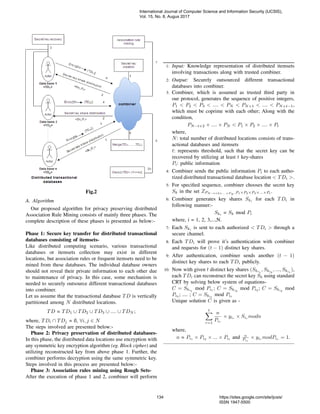
The overall functionality of our proposed mechanism is
shown as below process flow diagram:-
International Journal of Computer Science and Information Security (IJCSIS),
Vol. 15, No. 8, Augus 2017
133 https://sites.google.com/site/ijcsis/
ISSN 1947-5500
Fig.2
A. Algorithm
Our proposed algorithm for privacy preserving distributed
Association Rule Mining consists of mainly three phases. The
complete description of these phases is presented as below:-
Phase 1: Secure key transfer for distributed transactional
databases consisting of itemsets-
Like distributed computing scenario, various transactional
databases or itemsets collection may exist in different
locations, but association rules or frequent itemsets need to be
mined from these databases. The individual database owners
should not reveal their private information to each other due
to maintenance of privacy. In this case, some mechanism is
needed to securely outsource different transactional databases
into combiner.
Let us assume that the transactional database TD is vertically
partitioned among N distributed locations.
TD = TD1 ∪ TD2 ∪ TD3 ∪ .... ∪ TDN ;
where, TDi ∩ TDj = ∅, ∀i, j ∈ N
The steps involved are presented below:-
Phase 2: Privacy preservation of distributed databases-
In this phase, the distributed data locations use encryption with
any symmetric key encryption algorithm (eg. Block cipher) and
utilizing reconstructed key from above phase 1. Further, the
combiner performs decryption using the same symmetric key.
Steps involved in this process are presented below:-
Phase 3: Association rules mining using Rough Sets-
After the execution of phase 1 and 2, combiner will perform
1: Input: Knowledge representation of distributed itemsets
involving transactions along with trusted combiner.
2: Output: Securely outsourced different transactional
databases into combiner.
3: Combiner, which is assumed as trusted third party in
our protocol, generates the sequence of positive integers,
P1 < P2 < P3 < .... < PN < PN+1 < .... < PN+t−1,
which must be coprime with each other; Along with the
condition,
PN−t+2 × .... × PN < P1 × P2 × .... × Pt
where,
N: total number of distributed locations consists of trans-
actional databases and itemsets
t: represents threshold, such that the secret key can be
recovered by utilizing at least t key-shares
Pi: public information
4: Combiner sends the public information Pi to each autho-
rized distributed transactional database location < TDi >.
5: For specified sequence, combiner chooses the secret key
Sk in the set ZPN−t+2×...×PN
,P1×P2×P3×...×Pt
.
6: Combiner generates key shares Ski
for each TDi in
following manner:-
Ski
= Sk mod Pi
where, i = 1, 2, 3,...,N.
7: Each Ski is sent to each authorized < TDi > through a
secure channel.
8: Each TDi will prove it’s authentication with combiner
and requests for (t − 1) distinct key shares.
9: After authentication, combiner sends another (t − 1)
distinct key shares to each TDi publicly.
10: Now with given t distinct key shares (Ski1
, Ski2
, ..., Skit
),
each TDi can reconstruct the secret key Sk using standard
CRT by solving below system of equations-
C = Ski1
mod Pi1 ; C = Ski2
mod Pi2 ; C = Ski3
mod
Pi3
; .... ; C = Skit
mod Pit
Unique solution C is given as -
t
r=1
n
Pir
× yir
× Sir
modn
where,
n = Pi1
× Pi2
× ... × Pit
and n
Pir
× yir
modPir
= 1.
International Journal of Computer Science and Information Security (IJCSIS),
Vol. 15, No. 8, Augus 2017
134 https://sites.google.com/site/ijcsis/
ISSN 1947-5500
1: Consider, M: message space (data); C: ciphertext space
(encrypted data); K: keyspace.
2: Enc (M, k): It is a probabilistic algorithm that takes input
as message and key then outputs ciphertext C.
3: Dec (C, k): It is a deterministic algorithm that takes input
as ciphertext and key then outputs plaintext or message
M.
4: Preferably, we can use any block cipher e.g. TEA(Tiny
Encryption Algorithm) or FEAL(Fast data Encryption
Algorithm) [24,25], which are designed for fast and ef-
ficient encryption and decryption with modest security at
software level. Also these posses low memory requirement
while processing.
5: Encrypted transactional databases < TDi > are send to
combiner.
6: Finally, decrypted transactional database records are
merged into a common knowledge representation system.
the association rules mining algorithm on merged common
database. The steps involved in this process are presented
below:-
V. SECURITY AND EFFICIENCY ANALYSIS OF THE
ALGORITHM
Here, we have analyzed the security and complexity
involved in our proposed protocol.
Proposition 1: Algorithm 1 is semantically secure against
adversaries and communication channel attackers.
Proof: In our proposed algorithm 1 of Secure key transfer
for distributed transactional databases, since one secret key
share is presented with the individual distributed database
owner, so with the publicly available (t − 1) key shares, an
adversary can not recover the original secret key.
Since the numbers incorporated in the t-threshold range
ZPN−t+2×...×PN
,P1×P2×P3×...×Pt
are having upper bound as
P1 × P2 × P3 × ... × Pt, which is the smallest product of
any t moduli, and lower bounded by PN−t+2 × ... × PN , and
this is the largest product of any (t − 1) moduli. The secret
key Sk, choosen in this range will always ensure that- (i)
the secret can be recovered with any t or more than t key -
shares. (ii) the secret cannot be obtained with fewer than t
shares.
Proposition 2: Modern cryptology functions on the Ker-
ckhoff’s principle - attacker is aware of everything about
algorithm, only the keys are assumed to be secret..
Justification: One must make sure that the exhaustive key-
search should not be succeed. Two desired things for any
symmetric key cipher are as -
• For given few plaintext/ciphertext pairs, search must be
performed through all possible keys until the correct
secret key found.
• Key must be large enough.
1: Input: Merged common knowledge representation system
for transactions databases i.e. TD = TD1 ∪TD2 ∪TD3 ∪
....∪TDN . This knowledge information can be considered
in the form of information table (IT).
Information System - An information system in RST is
represented as pair (U, A), where -
U: denotes non-empty finite set of database transactions
or scenarios.
A: denotes non-empty finite set of attributes.
2: Output: Extracted association rules.
3: begin{procedure}
4: i/p: the set X of all attributes, partition {d} on U;
5: Compute reduct set partition X ;
6: P := X;
7: S := Null;
8: if X ≤ {d}
9: then
10: begin
11: for each attr. x in X do
12: begin
13: Q := P − {x}
14: compute partition Q ;
15: if Q ≤ {d} then P := Q
16: end for loop
17: S := P
18: end{then}
19: end{procedure}
20: extracted Association Rules are then send back to the indi-
vidual database owners or transactional database locations
< TDis >.
Block size
In generic way, block size (S) must be reasonably large, S >
64 bits, for avoiding-
1) Text dictionary attacks: pairs of plaintext-ciphertext for
fixed key.
2) Matching ciphertext attacks: uncover the patterns in
plaintext.
Proposition 3: Privacy for distributed data-owner’s private
data is securely preserved during association rule mining in
Algorithm 3.
Analytical justification: Each distributed transactional
database < TDi > is sending the corresponding encrypted
database vectors consisting itemsets to the combiner. Since the
further mining of association rules is taking place in combiner,
so individual < TDi > will be unaware of any others’ private
itemset vector’s information.
After merging the itemset vectors, which were partitioned
vertically, suppose the dimensions of knowledge information
table is (m × n), where -
International Journal of Computer Science and Information Security (IJCSIS),
Vol. 15, No. 8, Augus 2017
135 https://sites.google.com/site/ijcsis/
ISSN 1947-5500
m: represents total different transactions and n: is the total
number of itemset attribute vectors,
then the computational complexity involved in association rule
mining algorithm is O(m2
× n).
VI. EXPERIMENTAL RESULTS
This section presents our experimental analysis which has
been performed on real time databases. We have mainly used
JAVA environment for our implementation purpose. Other
software and hardware specifications are given below:-
A. System Specifications
Our system specifications are as below:-
• Software Specifications -
OS - Ubuntu 16.04 LTS, 64 bit
Java version - ’1.8.0 111’
NetBeans product version - NetBeans IDE 8.2
• Hardware Specifications -
RAM size - 4 GB
Processor - Intel core i3 4030U CPU @1.90GHz × 4
B. Input and Setup
In our experiment, we have performed simulations with
various test cases for different key sizes for encryption and
decryption process and numbers of distributed transactional
database locations. We have considered that the transactional
databases are vertically partitioned. We have mainly used
JAVA environment for our experiments.
Datasets description -
In our experiment, we have employed Reuters-21578 standard
dataset as an input for association rule mining purpose. The
documents in the Reuters-21578 collection [26] appeared on
the Reuters newswire in 1987. The documents were assembled
and indexed with categories by personnel from Reuters Ltd.
(Sam Dobbins, Mike Topliss, Steve Weinstein) and Carnegie
Group, Inc. (Peggy Andersen, Monica Cellio, Phil Hayes,
Laura Knecht, Irene Nirenburg) in 1987. In 1990, the doc-
uments were made available by Reuters and CGI for research
purposes.
C. Our Results
Our experiment results are summarized as below in which
we have taken different parameters e.g. key sizes, no. of
different distributed transactional database locations etc.
• Experimental results by utilizing different key sizes -
The end results of execution performance for varying
key sizes and key reconstruction is presented as table-
1 below:-
max width= 14 cm
Table for execution time utilizing varying key size
Key size(bits) Execution time(in sec.)
7 17
8 22
16 31
25 39
32 47
64 94
128 197
256 398
512 796
1024 1595
Table-1
The performance graph with various key sizes taken in
our experiments and their corresponding key reconstruc-
tion time is presented as graphs below:-
International Journal of Computer Science and Information Security (IJCSIS),
Vol. 15, No. 8, Augus 2017
136 https://sites.google.com/site/ijcsis/
ISSN 1947-5500
• Experimental results with various test cases by consid-
ering different parameters(no. of different distributed
transactional database locations) -
We have performed experiments by taking varying
number of distributed transactional database locations.
Each transactional database consists of various itemsets.
Reuters-21578 standard dataset is taken as input here. In
each case, the corresponding association rules are mined
and optimization performance is analyzed in below tables.
The end results are shown as tables below:-
In table-2 below, we have considered the no. of different
distributed transactional database locations n[TD] = 2.
Further the association rules are mined and execution
time is given.
We have first analyzed the execution time taken in the
process of secret key reconstruction at client locations.
We have performed experiments by taking varying key
sizes (in bits). Simulation results are presented as table-1
above.
Later, we have performed experiments for further as-
sociation rules mining. For this, the standard Reuters-
21578 dataset [26] is utilized. The association rules are
mined at combiner side. We have performed experiments
by taking varying number of distributed transactional
database locations. Further the combiner will send the
mined association rules to distributed clients locations.
• The execution performance analysis is presented
as graphs below- The execution performance analysis
graphs for varying number of distributed transactional
databases locations are given as below:-
Above graphs shows the execution time for association rules
mining process for varying cases of number of distributed
transactional database locations.
VII. CONCLUSION
This section summarizes the conclusion in two aspects.
First, we have presented our contribution in this paper and
secondly we have discussed the limitations, which exist in
current scenario and our future efforts to work towards this
research direction.
A. Contribution
Most of the times, due to lack in the expertise or compu-
tational sources from the owner side, it need to outsource its
mining tasks to a third party service provider or server, then in
this case privacy preserving plays a crucial role. In this paper,
we have proposed our solution, which concerns the association
rules mining in a secure manner for distributed transactional
databases, located at different sites. We have also presented
the critical security and efficiency analysis for our proposed
algorithmic mechanism along with the experimental results.
B. Limitation and future work
Our algorithm should be utilized with some care in practical
scenarios where some assumptions taken in our model are,
that all the distributed database owners should perform the
computation honestly. In some rare practical scenarios, where
prover need to prove the verifier, therefore, zero-knowledge
protocol can be utilized to prevent the hostile behaviour. So,
our future research focus is to discover some more efficient
mechanism designed for adversarial computational model in
this privacy preserving distributed association rule mining
scenario.
REFERENCES
1) A. C. Yao. ”Protocols for secure computations,” Pro-
ceedings of the 23rd Annual IEEE Symposium on Foun-
dations of Computer Science,IEEE Press, New York,
1982.
International Journal of Computer Science and Information Security (IJCSIS),
Vol. 15, No. 8, Augus 2017
137 https://sites.google.com/site/ijcsis/
ISSN 1947-5500
2) P. Paillier. ”Public-key cryptosystems based on
composite degree residuosity classes,” Advances in
Cryptography-EUROCRYPT’99, pp.223-238, Prague,
Czech Republic, 1999.
3) F. Wu, J. Q. Liu and Sh. Zhong. ”An efficient protocol
for private and accurate mining of support counts,”
Pattern Recognition Letters, vol.30(1), pp.80-86, 2009.
4) A. Shamir. ”How to share a secret,” Communications of
the ACM, vol.22(11), pp.612-613, 1979.
5) T. Brijs, G. Swinnen, K. Vanhoof, and G. Wets. ”Using
association rules for product assortment decisions: A
case study,” in Proc. SIGKDD, 1999, pp. 254-260.
6) S. E. Brossette, A. P. Sprague, J. M. Hardin, K. B.
Waites, W. T. Jones, and S. A. Moser. ”Association rules
and data mining in hospital infection control and public
health surveillance,” J. Amer. Med. Inform. Assoc., vol.
5, no. 4, pp. 373-381, 1998.
7) B. Mobasher, H. Dai, T. Luo, and M. Nakagawa. ”Effec-
tive personalization based on association rule discovery
from Web usage data,” in Proc. WIDM, 2001, pp. 9-15.
8) C. Creighton and S. Hanash. ”Mining gene expression
databases for association rules,” Bioinformatics, vol. 19,
no. 1, pp. 79-86, 2003.
9) X. Yin and J. Han. ”CPAR: Classification based on
predictive association rules,” in Proc. SIAM SDM, 2003,
pp. 1-5.
10) Fosca Giannotti, Laks V. S. Lakshmanan, Anna Mon-
reale, Dino Pedreschi, and Hui (Wendy) Wang. ”Privacy-
preserving mining of association rules from out-
sourced transaction databases.” IEEE Systems Journal
7.3 (2013): 385-395.
11) Mistry, Bhoomika R., and Amish Desai. ”Privacy pre-
serving heuristic approach for association rule mining in
distributed database.” International Conference on Inno-
vations in Information Embedded and Communication
Systems-(ICIIECS-2015) IEEE.
12) Li Lichun, Rongxing Lu. ”Privacy-preserving-
outsourced association rule mining on vertically
partitioned databases.” IEEE Transactions on
Information Forensics and Security 11.8 (2016),
1847-1861.
13) Jin Yaoan, Chunhua Su, Na Ruan, and Weijia Jia.
”Privacy-Preserving Mining of Association Rules for
Horizontally Distributed Databases Based on FP-Tree.”
International Conference on Information Security Prac-
tice and Experience. Springer International Publishing,
pp. 300-314, 2016.
14) Kantarcioglu, Murat, and Chris Clifton. ”Privacy-
preserving distributed mining of association rules on
horizontally partitioned data.” IEEE transactions on
knowledge and data engineering 16.9 (2004): 1026-
1037.
15) Vaidya, Jaideep, and Chris Clifton. ”Privacy preserving
association rule mining in vertically partitioned data.”
Proceedings of the eighth ACM SIGKDD international
conference on Knowledge discovery and data mining.
ACM, 2002.
16) Fukasawa Takuya, Jiahong Wang, Toyoo Takata, and
Masatoshi Miyazaki. ”An effective distributed privacy-
preserving data mining algorithm.” International Con-
ference on Intelligent Data Engineering and Automated
Learning, Springer, pp. 320-325, 2004.
17) David W. Cheung, Jiawei Han, Vincent T Ng, Ada W.
Fu, Yongjian Fu. ”A fast distributed algorithm for min-
ing association rules.”, Fourth International Conference
on Parallel and Distributed Information Systems, IEEE,
(1996).
18) Xinjing Ge, Li Yan, Jianming Zhu, Wenjie Shi. ”Privacy-
preserving distributed association rule mining based on
the secret sharing technique.” 2nd International Con-
ference on Software Engineering and Data Mining
(SEDM), (2010), IEEE.
19) Tassa Tamir. ”Secure mining of association rules in
horizontally distributed databases.” IEEE Transactions
on Knowledge and Data Engineering 26.4 (2014): 970-
983.
20) Pawlak, Z. (1982). Rough sets. International Journal of
Computer and Information Sciences, 11(5), 341-356.
21) S.R. Safavian, D. Landgrebe. ”A survey of decision tree
classifier methodology”, IEEE Transactions on Systems,
Man, and Cybernetics, Vol: 21, Issue: 3, p.660-674, 06
August 2002.
22) Craig G. ”Fully homomorphic encryption using ideal
lattices”, STOC. Vol. 9. 2009.
23) O. Goldreich, ”Secure multi-party compu-
tation”, Sept. 1998, [Online]. Available:
http://www.wisdom.weizmann.ac.il/ - oded/pp.html
24) D. Wheeler and R. Needham ”TEA, a Tiny Encryp-
tion Algorithm” (1994), Cambridge University Press,
http : //www.ftp.cl.cam.ac.uk/ftp/papers/djw −
rmn/djw − rmn − tea.html.
25) Akihiro Shimizu, Shoji Miyaguchi. ”FEAL - Fast Data
Encipherment Algorithm”, Systems and Computers in
Japan, Wiley Periodicals, Volume 19, Issue 7, (1988),
Pages 20-34.
26) http://archive.ics.uci.edu/ml/databases/reuters21578/
International Journal of Computer Science and Information Security (IJCSIS),
Vol. 15, No. 8, Augus 2017
138 https://sites.google.com/site/ijcsis/
ISSN 1947-5500

Privacy Preserving Distributed Association Rule Mining Algorithm for Vertically Partitioned Data

  • 1.
    Privacy Preserving DistributedAssociation Rule Mining Algorithm for Vertically Partitioned Data Vadlana Baby Associate Professor Department of Computer Science and Engg., VNR Vignana Jyothi Institute of Engg. and Technology, Hyderabad, India Email: baby v@vnrvjiet.in Dr. N. Subhash Chandra Principal and Professor Department of Computer Science and Engg. Holy Mary Institute of Technology, Hyderabad, India Email: subhashchandra n@yahoo.co.in Abstract—Data mining over diverse data sources is useful means for discovering valuable patterns, associations, trends, and dependencies in data. Many variants of this problem are existing, depending on how the data is distributed, what type of data mining we wish to do, how to achieve privacy of data and what restrictions are placed on sharing of information. A transactional database owner, lacking in the expertise or computational sources can outsource its mining tasks to a third party service provider or server. However, both the itemsets along with the association rules of the outsourced database are considered private property of the database owner. In this paper, we consider a scenario where multiple data sources are willing to share their data with trusted third party called combiner who runs data mining algorithms over the union of their data as long as each data source is guaranteed that its information that does not pertain to another data source will not be revealed. The proposed algorithm is characterized with (1) secret sharing based secure key transfer for distributed transactional databases with its lightweight encryption is used for preserving the privacy. (2) and rough set based mechanism for association rules extraction for an efficient and mining task. Performance analysis and experimental results are provided for demonstrating the effectiveness of the proposed algorithm. keywords: Security, Association rule mining, Rough sets, Secret key sharing, Distributed computation, Transactional- itemsets, Machine learning. I. INTRODUCTION Data mining offers the service to extract the meaningful, relevant and useful information in form of knowledge. Today data, which is becoming more and more sensitive and pri- vate, contains the sensitive information, to process such data securely become a challenging task. Other most studied prob- lem is to discover frequent itemsets in various transactional databases and mining of association rules. Association rules are utilized in diverse areas e.g. market analysis, weather con- ditions prediction, risk management, communication networks etc. [5,6,7,8,9]. In distributed transactional database scenario, the databases are present in multiple locations and to mine the results globally, privacy preserving data mining is performed. In this process, the sensitive and private data at each site is preserved through different methods. For the purpose of association rule mining, these parties present at distributed locations need to merge their corresponding databases. Some significant approaches like secure multiparty computa- tion (SMC) along with other cryptographic techniques [1,2,3] can be employed to acheive privacy preserving database min- ing. Some threshold cryptography techniques e.g. Shamir’s secret sharing [4] are also utilized for this purpose. The general system model of outsourced data mining on joint database is represented as figure below:- Fig.1 A. Related Work The domain of privacy preserving data mining has attracted lot of people from various research communities. In this model, private and sensitive data which is stored in distributed sites is collected at a common location for the purpose of association rules mining as well as frequent itemsets mining. In past years, good amount of research has been done to accept this challenge. This section summarizes some of the significant research work which has been proposed in past several years. International Journal of Computer Science and Information Security (IJCSIS), Vol. 15, No. 8, August 2017 130 https://sites.google.com/site/ijcsis/ ISSN 1947-5500
  • 2.
    Fosca Giannotti et.al. [10] has presented the privacy- preserving mining of association rules from the outsourced transaction database. If a customer has a lack of computational resources, then the customer can outsource his mining needs to the third party (server). In this paper, they explained about outsourcing problem of association rule mining task and have proposed the attack model and created the privacy-preserving scheme for outsourcing which is sufficiently effective in nature. Mistery et. al. [11] has employed the heuristic approach in the data distortion technique. We know that association rule mining is one of the important and powerful models among the data mining. The main problem occurs in this, is the security issue while outsourcing the database to the servers. The MDSRRC algorithmic procedure which they have used in this paper is hiding the sensitive association rules with some database modifications. Li Lichun et. al. [12] mainly focussed on the privacy- preserving mining on vertically partitioned databases. To confirm the data privacy of customer’s sensitive data, they have designed two schemes - (i) homomorphic encryption scheme (ii) secure comparison scheme. Later they proposed the cloud aided frequent itemset mining solution, which is used for building association rule mining solution. Compared to all existing solutions, the present solution will leak less information. Yaoan Jin et. al. [13] improved the performance of association rule mining on the distributed databases. They have combined the Apriori algorithm and FP-tree algorithm in present situation. For the purpose of implementation, they used merging FP-tree method. They also utilized homomorphic encryption scheme for comparatively better security purpose. Kantarcioglu et. al. [14] proposed secure mining of associ- ation rules on horizontally partitioned data. They have shown that distributed association rule mining can be performed more efficiently under the preferred security assumptions as shown in secure association rule mining. Vaidya et. al. [15] described privacy preserving association rule mining in vertically parti- tioned data. With minimum support levels, they have presented the two-party algorithm for discovering frequent itemset. For preserving privacy of individual values, they have given an efficient protocol for computing the scalar product. Fukasawa et. al. [16] has given a distributed privacy- preserving data mining algorithm. With the proposed algorithm data mining can be performed by a group of sites with the privacy of every site remains protected. In this algorithm, it is characterized by its capability to preserve the privacy without any coordinator site, and specifically its ability to resist the collusion. Performance analysis along with experimental results are given for demonstrating the effectiveness of the proposed algorithm. Cheung et. al. [17] proposed distributed association rule mining algorithm, FDM (fast distributed mining of association rules), which produces a tiny number of candidate sets and extensively reduces the number of messages. It shows that FDM has a superior performance over the direct application of a typical sequential algorithm. Xinjing et. al. [18] examines the issue of privacy preserving distributed association rule mining in vertically partitioned data among multiple parties. Here, they presented a collusion- resistant algorithm of distributed association rule mining based on the Shamirs secret sharing technique, it prevents effec- tively collusive behaviors and without compromising their data privacy, it handles the computations across the parties. Moreover, the paper analysed about the security, efficiency, and correctness of the proposed algorithm. Tassa Tamir et. al. [19] have proposed a protocol ”secure mining of association rules in horizontally distributed databases” that improve signif- icantly upon the current leading protocol regarding privacy and efficiency. It is based on the Fast Distributed Mining algorithm. The main components of this protocol are two novel secure multiparty algorithms those are, one that estimates the union of private subsets that each of the interacting players holds, and other is testing the inclusion of an element held by one player in a subset handled by another. B. Motivation and Contribution With the advent of several security threats over internet and other communication scenarios, customer’s data is more sensitive and confidential and to process this data requires the preservation of data privacy. Most of the times, due to lack in the expertise or computational sources from the owner side, it need to outsource its mining tasks to a third party service provider or server, then in this case privacy preserving plays a crucial role. Main contributions of this paper includes - • The existing state-of-the-art methodologies and various cryptographic techniques available for secure mining task, which are explored in the literature, are presented here. • We have proposed our solution, which concerns the as- sociation rules mining in a secure manner for distributed transactional databases, located at different sites. Our method assimilates secret sharing based secure outsourc- ing of transactional databases, which consists of different itemsets and rough set based mechanism for association rules extraction for an efficient and secure mining task. C. Organization of the paper Structure of remaining of the paper is as - In section 2, some required preliminaries are discussed. The available privacy pre- serving data mining techniques are sub-categorized in section 3. In section 4, we have presented our proposed algorithm. Section 5 analyses the security and efficiency analysis of the algorithm. Experimental results are presented in section 6. Finally conclusions along with future research plan are given in section 7. International Journal of Computer Science and Information Security (IJCSIS), Vol. 15, No. 8, Augus 2017 131 https://sites.google.com/site/ijcsis/ ISSN 1947-5500
  • 3.
    II. PRELIMINARIES Some ofthe significant terms and preliminaries required are summarized as below sub-sections:- A. Data Mining Techniques Data mining is the mechanism to fetch useful, relevant information by processing of raw data available which may be huge in size, may contains unstructured and irrelevant features set. With the evolution of big data domain, this area in more in demand. The process of data collection, it’s analysis and further mine the significant information are the key process in all data mining techniques. Some of the core techniques for data mining are summarized as below- 1) Association-: In this technique, based on patterns and frequent itemsets discovery, the correlation among two or more databases is established. For an example - suppose a person is buying itemsets x and y along with is most of the time he is also buying some third item z, then the association rule set will be:- x y → z 2) Classification-: Classification is the most commonly used technique in data mining. For example one can classify different types of fruits into various catagories such that each decision catagory consists of fruits having same attributes. It involves training phase and later based on knowledge gained at training phase, testing phase is performed. 3) Clustering-: Catagorize the different available objects or itemsets and form clusters based on some particular attribute, is considered as the clustering process. No training phase is involved in the process of clustering. 4) Prediction-: This technique is used to predict the future itemsets association, frequency of various itemsets, confidence and support factors. These predictions are performed utilizing some pre-information available in the form of stochastic, prob- abilistic and statistical knowledge. This involves association and patterns mining. 5) Decision trees-: As the part of selection criteria or selecting some part in the overall structure, decision trees may be employed. [21] Mostly while predictive systems designing and modeling, decision trees are used. These predictions may be based on past experiences and they help to define the structure of the decision tree. B. Data Privacy In today’s scenario, when the customer’s data is more sensi- tive and confidential, to process this data requires the preserva- tion of data privacy. Suppose transactional database distributed in different locations are DB1, DB2, DB3, ..., DBn and task is to mine these databases for rules extraction purpose, an- alyzation of frequency of itemsets etc. So, these distributed sites need to transfer their private sensitive data in a secure manner through communication channel to any combiner or trusted third party. Then combiner will merge these distributed databases, DB = DB1 ∪ DB2 ∪ DB3 ∪ .... ∪ DBn. So, maintaining the data privacy of the distributed transactional databases is considered as a challenging task. C. Association Rule Mining Association rule minning is a significant task which comes under the domain of data mining and data discovery. The data mining field and fundamental concepts of association rule mining was first initiated by R. Agrawal. Association rules are nothing but the IF-THEN relational concept among different itemsets. Suppose a person is buying itemsets X, where X is ’laptop’ and along with is most of the time he is also buying Y , where Y is an ’antivirus’, then the association rule set will be: X → Y Association rules have it’s applications in diverse fields e.g. image processing, prediction modeling, market business analysis, banking etc. D. Cryptographic Techniques for Secure Computation Some significant cryptographic techniques, utilized today for the purpose of association rule mining are as follows:- 1) Secure Multi-Party Computation-: Good amount of work has been done on secure multi-party computation to employ it as an efficient and secure cryptographic technique in various applications [23]. • Consider distributed parties consisting of their trans- actional databases, who cann’t believe each other, nor the channels through which they wish to communicate. Still, suppose the sites need to correctly compute some common function of their local transactional databases inputs, while keeping their sensitive data as private as possible. That, exactly, is the problem of SMPC. • For example- Consider a case, where multiple users jointly work on a project and utilize the services of the same cloud provider. All of them want to simultane- ously evaluate their equations without revealing individ- ual equations to one another. In such scenarios the SMPC solutions can be highly useful to provide privacy. 2) Homomorphic Encryption-: Homomorphic Encryption is the most widely used cryptographic technique today. • Homomorphic Encryption is an special form of encryp- tion that allows computations to be carried out on ci- phertext, thus generating an encrypted result which, when decrypted, matches the result of operations performed on the plaintext. • Homomorphic Encryption is of two types - Partially ho- momorphic encryption and Fully homomorphic encryp- tion. Fully Homomorphic encryption gains the advantage, as both the Additive and Multiplicative homomorphic properties are satisfies here. First FHE cryptosystem [22] proposed and developed by Craig Gentry in 2010 was a great breakthrough. So this concept is today utilized in data mining and association rule mining for privacy preserving purpose. 3) Secret Sharing-: The idea of secret sharing was first given by Adi Shamir [4]. In this method, a secret S is divided into n shares and distributed to the n participants, each participant is having one share. Later at the time of secret recovery, at least t shares are required to reconstruct (here t is considered as threshold). International Journal of Computer Science and Information Security (IJCSIS), Vol. 15, No. 8, Augus 2017 132 https://sites.google.com/site/ijcsis/ ISSN 1947-5500
  • 4.
    So, the secretsharing phenomenon is applied in data discovery and mining to prevent collusive behaviors and tries to maintain the privacy of the user’s sensitive data, which may have been distributed in various sites in form of transactional databases. E. Rough Set Theory In 1982, Rough Set Theory(RST) [20] was initially proposed by Zdzislaw Pawlak. RST acts such a mathematical model to describe the knowledge and to handle uncertain behaviour. An essential concept in RST is reduct selection. A reduct is the smallest possible set of attributes(features) which can describe an object with same effectiveness, accuracy and precision, as it was represented by the initial set of features. Exclusion of redundant attributes may support to identify the essential, effective and non-redundant classification perspectives. A decision table (also called Data Table) is a system of the form S = (U, C ∪ {d}) where, C: denotes set of con- ditional attributes; d: specifies decision attribute. In rough set theory(RST), two terms- Lower Approximation and the Upper Approximation, come under the Approximation terminology of sets. Let S = (U, R) is an approximation space, X be a concept in that space, then, the lower approximation is RlowerX = {x ∈ U|[x] ⊆ X} upper approximation is RupperX = {x ∈ U|[x] ∩ X = ∅} where, [x] is called equivalence class which contains an element e. Let, S = (U, C ∪ {d}) considered as decision system, con- sisting the universe of objects, then a subset R of conditional attributes(C) is a reduct if, POSR(d) = POSC(d). Comput- ing the reduct is known to be an NP-hard problem, further to process the reduct for huge databases needs extraordinary computational processing environment. We will get Core, by performing intersection of resulting reducts. CORE(C) = ∩RED(C) The reduct is generated from the discernibility matrix. Ob- jects are distinguishable if for some attributes, they are having different attribute values, then they are called discernible. And this property is known as discernibility. Fuzzy Sets involve the membership between set elements of similar class, while RS bothers the association among set of several elements in distinct classes. III. PRIVACY PRESERVING DATA MINING TECHNIQUES Due to recent advancements in cloud computing, there evolves a lot of interest which takes place throughout the reserch community for outsourced service based data mining. A database owner or a company, due to limitations like - expertise and computational resources, may outsource their data mining task to any third party or trusted cloud. In below sub-sections we have summarized the horizontal and vertical partitioning techniques for privacy preserving data mining. A. Horizontal Techniques Horizontal partitioning of data is one technique for privacy preserving data mining. Yaoan Jin et. al. [13] given this type of technique which has improvement in the performance of association rule mining on the distributed databases. They have combined the Apriori algorithm and FP-tree algorithm in present situation. For the purpose of implementation, they used merging FP-tree method. They also utilized homomorphic encryption scheme for comparatively better security purpose. Kantarcioglu et. al. [14] proposed secure mining of association rules on horizontally partitioned data. They have shown that distributed association rule mining can be performed more efficiently under the preferred security assumptions as shown in secure association rule mining. B. Vertical Techniques Vertical partitioning of data is another technique for privacy preserving data mining. Li Lichun et. al. [12] mainly focussed on the privacy-preserving mining on vertically partitioned databases. To confirm the data privacy of customer’s sensitive data, they have designed two schemes - (i) homomorphic encryption scheme (ii) secure comparison scheme. Later they proposed the cloud aided frequent itemset mining solution, which is used for building association rule mining solution. Compared to all existing solutions, the present solution will leak less information. Vaidya et. al. [15] described privacy preserving association rule mining in vertically partitioned data. With minimum support levels, they have presented the two-party algorithm for discovering frequent itemset. For preserving privacy of individual values, they have given an efficient protocol for computing the scalar product. IV. PROPOSED PRIVACY-PRESERVING DISTRIBUTED ASSOCIATION RULE MINING ALGORITHM IN VERTICALLY PARTITIONED DATA Central thought of our algorithm: In this section, we have presented our proposed algorithm for Privacy Preserving Distributed Association Rule Mining based on Rough Sets. Our model for entire mechanism consists of some main algorithmic phases or sub-modules, which are as below:- • Phase 1: Secure key transfer for distributed transactional databases consisting of itemsets • Phase 2: Privacy preservation of distributed databases • Phase 3: Association rules mining using Rough Sets The overall functionality of our proposed mechanism is shown as below process flow diagram:- International Journal of Computer Science and Information Security (IJCSIS), Vol. 15, No. 8, Augus 2017 133 https://sites.google.com/site/ijcsis/ ISSN 1947-5500
  • 5.
    Fig.2 A. Algorithm Our proposedalgorithm for privacy preserving distributed Association Rule Mining consists of mainly three phases. The complete description of these phases is presented as below:- Phase 1: Secure key transfer for distributed transactional databases consisting of itemsets- Like distributed computing scenario, various transactional databases or itemsets collection may exist in different locations, but association rules or frequent itemsets need to be mined from these databases. The individual database owners should not reveal their private information to each other due to maintenance of privacy. In this case, some mechanism is needed to securely outsource different transactional databases into combiner. Let us assume that the transactional database TD is vertically partitioned among N distributed locations. TD = TD1 ∪ TD2 ∪ TD3 ∪ .... ∪ TDN ; where, TDi ∩ TDj = ∅, ∀i, j ∈ N The steps involved are presented below:- Phase 2: Privacy preservation of distributed databases- In this phase, the distributed data locations use encryption with any symmetric key encryption algorithm (eg. Block cipher) and utilizing reconstructed key from above phase 1. Further, the combiner performs decryption using the same symmetric key. Steps involved in this process are presented below:- Phase 3: Association rules mining using Rough Sets- After the execution of phase 1 and 2, combiner will perform 1: Input: Knowledge representation of distributed itemsets involving transactions along with trusted combiner. 2: Output: Securely outsourced different transactional databases into combiner. 3: Combiner, which is assumed as trusted third party in our protocol, generates the sequence of positive integers, P1 < P2 < P3 < .... < PN < PN+1 < .... < PN+t−1, which must be coprime with each other; Along with the condition, PN−t+2 × .... × PN < P1 × P2 × .... × Pt where, N: total number of distributed locations consists of trans- actional databases and itemsets t: represents threshold, such that the secret key can be recovered by utilizing at least t key-shares Pi: public information 4: Combiner sends the public information Pi to each autho- rized distributed transactional database location < TDi >. 5: For specified sequence, combiner chooses the secret key Sk in the set ZPN−t+2×...×PN ,P1×P2×P3×...×Pt . 6: Combiner generates key shares Ski for each TDi in following manner:- Ski = Sk mod Pi where, i = 1, 2, 3,...,N. 7: Each Ski is sent to each authorized < TDi > through a secure channel. 8: Each TDi will prove it’s authentication with combiner and requests for (t − 1) distinct key shares. 9: After authentication, combiner sends another (t − 1) distinct key shares to each TDi publicly. 10: Now with given t distinct key shares (Ski1 , Ski2 , ..., Skit ), each TDi can reconstruct the secret key Sk using standard CRT by solving below system of equations- C = Ski1 mod Pi1 ; C = Ski2 mod Pi2 ; C = Ski3 mod Pi3 ; .... ; C = Skit mod Pit Unique solution C is given as - t r=1 n Pir × yir × Sir modn where, n = Pi1 × Pi2 × ... × Pit and n Pir × yir modPir = 1. International Journal of Computer Science and Information Security (IJCSIS), Vol. 15, No. 8, Augus 2017 134 https://sites.google.com/site/ijcsis/ ISSN 1947-5500
  • 6.
    1: Consider, M:message space (data); C: ciphertext space (encrypted data); K: keyspace. 2: Enc (M, k): It is a probabilistic algorithm that takes input as message and key then outputs ciphertext C. 3: Dec (C, k): It is a deterministic algorithm that takes input as ciphertext and key then outputs plaintext or message M. 4: Preferably, we can use any block cipher e.g. TEA(Tiny Encryption Algorithm) or FEAL(Fast data Encryption Algorithm) [24,25], which are designed for fast and ef- ficient encryption and decryption with modest security at software level. Also these posses low memory requirement while processing. 5: Encrypted transactional databases < TDi > are send to combiner. 6: Finally, decrypted transactional database records are merged into a common knowledge representation system. the association rules mining algorithm on merged common database. The steps involved in this process are presented below:- V. SECURITY AND EFFICIENCY ANALYSIS OF THE ALGORITHM Here, we have analyzed the security and complexity involved in our proposed protocol. Proposition 1: Algorithm 1 is semantically secure against adversaries and communication channel attackers. Proof: In our proposed algorithm 1 of Secure key transfer for distributed transactional databases, since one secret key share is presented with the individual distributed database owner, so with the publicly available (t − 1) key shares, an adversary can not recover the original secret key. Since the numbers incorporated in the t-threshold range ZPN−t+2×...×PN ,P1×P2×P3×...×Pt are having upper bound as P1 × P2 × P3 × ... × Pt, which is the smallest product of any t moduli, and lower bounded by PN−t+2 × ... × PN , and this is the largest product of any (t − 1) moduli. The secret key Sk, choosen in this range will always ensure that- (i) the secret can be recovered with any t or more than t key - shares. (ii) the secret cannot be obtained with fewer than t shares. Proposition 2: Modern cryptology functions on the Ker- ckhoff’s principle - attacker is aware of everything about algorithm, only the keys are assumed to be secret.. Justification: One must make sure that the exhaustive key- search should not be succeed. Two desired things for any symmetric key cipher are as - • For given few plaintext/ciphertext pairs, search must be performed through all possible keys until the correct secret key found. • Key must be large enough. 1: Input: Merged common knowledge representation system for transactions databases i.e. TD = TD1 ∪TD2 ∪TD3 ∪ ....∪TDN . This knowledge information can be considered in the form of information table (IT). Information System - An information system in RST is represented as pair (U, A), where - U: denotes non-empty finite set of database transactions or scenarios. A: denotes non-empty finite set of attributes. 2: Output: Extracted association rules. 3: begin{procedure} 4: i/p: the set X of all attributes, partition {d} on U; 5: Compute reduct set partition X ; 6: P := X; 7: S := Null; 8: if X ≤ {d} 9: then 10: begin 11: for each attr. x in X do 12: begin 13: Q := P − {x} 14: compute partition Q ; 15: if Q ≤ {d} then P := Q 16: end for loop 17: S := P 18: end{then} 19: end{procedure} 20: extracted Association Rules are then send back to the indi- vidual database owners or transactional database locations < TDis >. Block size In generic way, block size (S) must be reasonably large, S > 64 bits, for avoiding- 1) Text dictionary attacks: pairs of plaintext-ciphertext for fixed key. 2) Matching ciphertext attacks: uncover the patterns in plaintext. Proposition 3: Privacy for distributed data-owner’s private data is securely preserved during association rule mining in Algorithm 3. Analytical justification: Each distributed transactional database < TDi > is sending the corresponding encrypted database vectors consisting itemsets to the combiner. Since the further mining of association rules is taking place in combiner, so individual < TDi > will be unaware of any others’ private itemset vector’s information. After merging the itemset vectors, which were partitioned vertically, suppose the dimensions of knowledge information table is (m × n), where - International Journal of Computer Science and Information Security (IJCSIS), Vol. 15, No. 8, Augus 2017 135 https://sites.google.com/site/ijcsis/ ISSN 1947-5500
  • 7.
    m: represents totaldifferent transactions and n: is the total number of itemset attribute vectors, then the computational complexity involved in association rule mining algorithm is O(m2 × n). VI. EXPERIMENTAL RESULTS This section presents our experimental analysis which has been performed on real time databases. We have mainly used JAVA environment for our implementation purpose. Other software and hardware specifications are given below:- A. System Specifications Our system specifications are as below:- • Software Specifications - OS - Ubuntu 16.04 LTS, 64 bit Java version - ’1.8.0 111’ NetBeans product version - NetBeans IDE 8.2 • Hardware Specifications - RAM size - 4 GB Processor - Intel core i3 4030U CPU @1.90GHz × 4 B. Input and Setup In our experiment, we have performed simulations with various test cases for different key sizes for encryption and decryption process and numbers of distributed transactional database locations. We have considered that the transactional databases are vertically partitioned. We have mainly used JAVA environment for our experiments. Datasets description - In our experiment, we have employed Reuters-21578 standard dataset as an input for association rule mining purpose. The documents in the Reuters-21578 collection [26] appeared on the Reuters newswire in 1987. The documents were assembled and indexed with categories by personnel from Reuters Ltd. (Sam Dobbins, Mike Topliss, Steve Weinstein) and Carnegie Group, Inc. (Peggy Andersen, Monica Cellio, Phil Hayes, Laura Knecht, Irene Nirenburg) in 1987. In 1990, the doc- uments were made available by Reuters and CGI for research purposes. C. Our Results Our experiment results are summarized as below in which we have taken different parameters e.g. key sizes, no. of different distributed transactional database locations etc. • Experimental results by utilizing different key sizes - The end results of execution performance for varying key sizes and key reconstruction is presented as table- 1 below:- max width= 14 cm Table for execution time utilizing varying key size Key size(bits) Execution time(in sec.) 7 17 8 22 16 31 25 39 32 47 64 94 128 197 256 398 512 796 1024 1595 Table-1 The performance graph with various key sizes taken in our experiments and their corresponding key reconstruc- tion time is presented as graphs below:- International Journal of Computer Science and Information Security (IJCSIS), Vol. 15, No. 8, Augus 2017 136 https://sites.google.com/site/ijcsis/ ISSN 1947-5500
  • 8.
    • Experimental resultswith various test cases by consid- ering different parameters(no. of different distributed transactional database locations) - We have performed experiments by taking varying number of distributed transactional database locations. Each transactional database consists of various itemsets. Reuters-21578 standard dataset is taken as input here. In each case, the corresponding association rules are mined and optimization performance is analyzed in below tables. The end results are shown as tables below:- In table-2 below, we have considered the no. of different distributed transactional database locations n[TD] = 2. Further the association rules are mined and execution time is given. We have first analyzed the execution time taken in the process of secret key reconstruction at client locations. We have performed experiments by taking varying key sizes (in bits). Simulation results are presented as table-1 above. Later, we have performed experiments for further as- sociation rules mining. For this, the standard Reuters- 21578 dataset [26] is utilized. The association rules are mined at combiner side. We have performed experiments by taking varying number of distributed transactional database locations. Further the combiner will send the mined association rules to distributed clients locations. • The execution performance analysis is presented as graphs below- The execution performance analysis graphs for varying number of distributed transactional databases locations are given as below:- Above graphs shows the execution time for association rules mining process for varying cases of number of distributed transactional database locations. VII. CONCLUSION This section summarizes the conclusion in two aspects. First, we have presented our contribution in this paper and secondly we have discussed the limitations, which exist in current scenario and our future efforts to work towards this research direction. A. Contribution Most of the times, due to lack in the expertise or compu- tational sources from the owner side, it need to outsource its mining tasks to a third party service provider or server, then in this case privacy preserving plays a crucial role. In this paper, we have proposed our solution, which concerns the association rules mining in a secure manner for distributed transactional databases, located at different sites. We have also presented the critical security and efficiency analysis for our proposed algorithmic mechanism along with the experimental results. B. Limitation and future work Our algorithm should be utilized with some care in practical scenarios where some assumptions taken in our model are, that all the distributed database owners should perform the computation honestly. In some rare practical scenarios, where prover need to prove the verifier, therefore, zero-knowledge protocol can be utilized to prevent the hostile behaviour. So, our future research focus is to discover some more efficient mechanism designed for adversarial computational model in this privacy preserving distributed association rule mining scenario. REFERENCES 1) A. C. Yao. ”Protocols for secure computations,” Pro- ceedings of the 23rd Annual IEEE Symposium on Foun- dations of Computer Science,IEEE Press, New York, 1982. International Journal of Computer Science and Information Security (IJCSIS), Vol. 15, No. 8, Augus 2017 137 https://sites.google.com/site/ijcsis/ ISSN 1947-5500
  • 9.
    2) P. Paillier.”Public-key cryptosystems based on composite degree residuosity classes,” Advances in Cryptography-EUROCRYPT’99, pp.223-238, Prague, Czech Republic, 1999. 3) F. Wu, J. Q. Liu and Sh. Zhong. ”An efficient protocol for private and accurate mining of support counts,” Pattern Recognition Letters, vol.30(1), pp.80-86, 2009. 4) A. Shamir. ”How to share a secret,” Communications of the ACM, vol.22(11), pp.612-613, 1979. 5) T. Brijs, G. Swinnen, K. Vanhoof, and G. Wets. ”Using association rules for product assortment decisions: A case study,” in Proc. SIGKDD, 1999, pp. 254-260. 6) S. E. Brossette, A. P. Sprague, J. M. Hardin, K. B. Waites, W. T. Jones, and S. A. Moser. ”Association rules and data mining in hospital infection control and public health surveillance,” J. Amer. Med. Inform. Assoc., vol. 5, no. 4, pp. 373-381, 1998. 7) B. Mobasher, H. Dai, T. Luo, and M. Nakagawa. ”Effec- tive personalization based on association rule discovery from Web usage data,” in Proc. WIDM, 2001, pp. 9-15. 8) C. Creighton and S. Hanash. ”Mining gene expression databases for association rules,” Bioinformatics, vol. 19, no. 1, pp. 79-86, 2003. 9) X. Yin and J. Han. ”CPAR: Classification based on predictive association rules,” in Proc. SIAM SDM, 2003, pp. 1-5. 10) Fosca Giannotti, Laks V. S. Lakshmanan, Anna Mon- reale, Dino Pedreschi, and Hui (Wendy) Wang. ”Privacy- preserving mining of association rules from out- sourced transaction databases.” IEEE Systems Journal 7.3 (2013): 385-395. 11) Mistry, Bhoomika R., and Amish Desai. ”Privacy pre- serving heuristic approach for association rule mining in distributed database.” International Conference on Inno- vations in Information Embedded and Communication Systems-(ICIIECS-2015) IEEE. 12) Li Lichun, Rongxing Lu. ”Privacy-preserving- outsourced association rule mining on vertically partitioned databases.” IEEE Transactions on Information Forensics and Security 11.8 (2016), 1847-1861. 13) Jin Yaoan, Chunhua Su, Na Ruan, and Weijia Jia. ”Privacy-Preserving Mining of Association Rules for Horizontally Distributed Databases Based on FP-Tree.” International Conference on Information Security Prac- tice and Experience. Springer International Publishing, pp. 300-314, 2016. 14) Kantarcioglu, Murat, and Chris Clifton. ”Privacy- preserving distributed mining of association rules on horizontally partitioned data.” IEEE transactions on knowledge and data engineering 16.9 (2004): 1026- 1037. 15) Vaidya, Jaideep, and Chris Clifton. ”Privacy preserving association rule mining in vertically partitioned data.” Proceedings of the eighth ACM SIGKDD international conference on Knowledge discovery and data mining. ACM, 2002. 16) Fukasawa Takuya, Jiahong Wang, Toyoo Takata, and Masatoshi Miyazaki. ”An effective distributed privacy- preserving data mining algorithm.” International Con- ference on Intelligent Data Engineering and Automated Learning, Springer, pp. 320-325, 2004. 17) David W. Cheung, Jiawei Han, Vincent T Ng, Ada W. Fu, Yongjian Fu. ”A fast distributed algorithm for min- ing association rules.”, Fourth International Conference on Parallel and Distributed Information Systems, IEEE, (1996). 18) Xinjing Ge, Li Yan, Jianming Zhu, Wenjie Shi. ”Privacy- preserving distributed association rule mining based on the secret sharing technique.” 2nd International Con- ference on Software Engineering and Data Mining (SEDM), (2010), IEEE. 19) Tassa Tamir. ”Secure mining of association rules in horizontally distributed databases.” IEEE Transactions on Knowledge and Data Engineering 26.4 (2014): 970- 983. 20) Pawlak, Z. (1982). Rough sets. International Journal of Computer and Information Sciences, 11(5), 341-356. 21) S.R. Safavian, D. Landgrebe. ”A survey of decision tree classifier methodology”, IEEE Transactions on Systems, Man, and Cybernetics, Vol: 21, Issue: 3, p.660-674, 06 August 2002. 22) Craig G. ”Fully homomorphic encryption using ideal lattices”, STOC. Vol. 9. 2009. 23) O. Goldreich, ”Secure multi-party compu- tation”, Sept. 1998, [Online]. Available: http://www.wisdom.weizmann.ac.il/ - oded/pp.html 24) D. Wheeler and R. Needham ”TEA, a Tiny Encryp- tion Algorithm” (1994), Cambridge University Press, http : //www.ftp.cl.cam.ac.uk/ftp/papers/djw − rmn/djw − rmn − tea.html. 25) Akihiro Shimizu, Shoji Miyaguchi. ”FEAL - Fast Data Encipherment Algorithm”, Systems and Computers in Japan, Wiley Periodicals, Volume 19, Issue 7, (1988), Pages 20-34. 26) http://archive.ics.uci.edu/ml/databases/reuters21578/ International Journal of Computer Science and Information Security (IJCSIS), Vol. 15, No. 8, Augus 2017 138 https://sites.google.com/site/ijcsis/ ISSN 1947-5500