This document surveys privacy issues in cloud computing, emphasizing the importance of protecting users' data from unauthorized access due to various risks associated with storing data off-premises. It outlines the service models of cloud computing and the associated privacy challenges, such as data access, compliance, storage, and destruction. Recommendations are provided for both cloud users and providers to enhance data privacy and security practices.
![Natarajan Meghanathan, et al. (Eds): SIPM, FCST, ITCA, WSE, ACSIT, CS & IT 06, pp. 321–330, 2012.
© CS & IT-CSCP 2012 DOI : 10.5121/csit.2012.2331
PRIVACY IN CLOUD COMPUTING: A SURVEY
Dr. Arockiam L1
, Parthasarathy G2
and Monikandan S3
1
Associate Professor,St.Joseph’s College,Trichy, Tamilnadu, India
larockiam@yahoo.co.in
2
Assistant Professor, TRP Engineering College,Trichy,Tamilnadu, India
parthasarathee.g@gmail.com
3
Research Scholar,ManonmaniamSundaranar University, Tirunelveli,India
moni.tamil@gmail.com
ABSTRACT
Various cloud computing models are used to increase the profit of an organization. Cloud
provides a convenient environment and more advantages to business organizations to run their
business. But, it has some issues related to the privacy of data. User’s data are stored and
maintained out of user’s premises. The failure of data protection causes many issues like data
theft which affects the individual organization. The cloud users may be satisfied, if their data
are protected properly from unauthorized access. This paper presents a survey on different
privacy issues involved in the cloud service. It also provides some suggestions to the cloud
users to select their suitable cloud services by knowing their privacy policies.
KEYWORDS
Cloud computing,Security,Privacy
1. INTRODUCTION
Cloud computing is a model for enabling convenient, on demand network access to a shared pool
of configurable computing resources that can be rapidly provisioned and released with minimal
management effort or service provider interaction[1]. It reduces the capital expenditure and
operational expenditure involved in the IT Infrastructure of an organization.
Cloud computing has some attributes that are shared, standard service, solution‐packaged,
self‐service, elastic scaling and usage‐based pricing. Cloud has three different service models.
They are (i) Software as a Service (SaaS) which uses provider’s application over a network.
Instead of purchasing the software, cloud user rents the software for use on a pay per use
model.(ii)Platform as a Service(PaaS):- It deploys user applications in cloud. The Cloud provider
gives an environment to application developers, who develop applications and offer those
services through the provider’s platform.(iii)Infrastructure as a Service(IaaS):- It deals with rent
processing, storage and network capacity. The basic idea is to offer the computing services like
processing power, disk space etc., based on the usage.
The Cloud computing can be deployed in four different models namely,(i)Private Cloud-
Enterprise owned or leased,(ii)Public Cloud- Sold to the public, mega scale
infrastructure,(iii)Hybrid cloud- The combination of two or more cloud types,(iv)Community
Cloud-shared infrastructure for specific community[3].
Cloud computing offers increased amount of storage and processing power to run users
applications. It enables new ways to access information, processes and analyze data. It also
connects people and resources from any location all over the world [4].Even though, the users](https://image.slidesharecdn.com/csit2331-180203050839/85/PRIVACY-IN-CLOUD-COMPUTING-A-SURVEY-1-320.jpg)
![Natarajan Meghanathan, et al. (Eds): SIPM, FCST, ITCA, WSE, ACSIT, CS & IT 06, pp. 321–330, 2012.
© CS & IT-CSCP 2012 DOI : 10.5121/csit.2012.2331
PRIVACY IN CLOUD COMPUTING: A SURVEY
Dr. Arockiam L1
, Parthasarathy G2
and Monikandan S3
1
Associate Professor,St.Joseph’s College,Trichy, Tamilnadu, India
larockiam@yahoo.co.in
2
Assistant Professor, TRP Engineering College,Trichy,Tamilnadu, India
parthasarathee.g@gmail.com
3
Research Scholar,ManonmaniamSundaranar University, Tirunelveli,India
moni.tamil@gmail.com
ABSTRACT
Various cloud computing models are used to increase the profit of an organization. Cloud
provides a convenient environment and more advantages to business organizations to run their
business. But, it has some issues related to the privacy of data. User’s data are stored and
maintained out of user’s premises. The failure of data protection causes many issues like data
theft which affects the individual organization. The cloud users may be satisfied, if their data
are protected properly from unauthorized access. This paper presents a survey on different
privacy issues involved in the cloud service. It also provides some suggestions to the cloud
users to select their suitable cloud services by knowing their privacy policies.
KEYWORDS
Cloud computing,Security,Privacy
1. INTRODUCTION
Cloud computing is a model for enabling convenient, on demand network access to a shared pool
of configurable computing resources that can be rapidly provisioned and released with minimal
management effort or service provider interaction[1]. It reduces the capital expenditure and
operational expenditure involved in the IT Infrastructure of an organization.
Cloud computing has some attributes that are shared, standard service, solution‐packaged,
self‐service, elastic scaling and usage‐based pricing. Cloud has three different service models.
They are (i) Software as a Service (SaaS) which uses provider’s application over a network.
Instead of purchasing the software, cloud user rents the software for use on a pay per use
model.(ii)Platform as a Service(PaaS):- It deploys user applications in cloud. The Cloud provider
gives an environment to application developers, who develop applications and offer those
services through the provider’s platform.(iii)Infrastructure as a Service(IaaS):- It deals with rent
processing, storage and network capacity. The basic idea is to offer the computing services like
processing power, disk space etc., based on the usage.
The Cloud computing can be deployed in four different models namely,(i)Private Cloud-
Enterprise owned or leased,(ii)Public Cloud- Sold to the public, mega scale
infrastructure,(iii)Hybrid cloud- The combination of two or more cloud types,(iv)Community
Cloud-shared infrastructure for specific community[3].
Cloud computing offers increased amount of storage and processing power to run users
applications. It enables new ways to access information, processes and analyze data. It also
connects people and resources from any location all over the world [4].Even though, the users](https://image.slidesharecdn.com/csit2331-180203050839/75/PRIVACY-IN-CLOUD-COMPUTING-A-SURVEY-1-2048.jpg)
![322 Computer Science & Information Technology ( CS & IT )
have gained more advantages in cloud, there are certain limitations faced by the users when it is
implemented. Data protection, operational integrity, vulnerability management, business
continuity (BC), disaster recovery (DR) and identity management (IM) are top concerns of
security issues for Cloud Computing. Among the above, Privacy is the most important key
concern. Security and privacy of Cloud Computing system becomes a key factor for users to
adapt it.
Moreover, many security and privacy incidents are also observed in today’s Cloud Computing
systems. The Below list provides a few of them [7]:
Google Docs found a flaw that inadvertently shares user’s docs in March 2009.
A Salesforce.com employee fell victim to a phishing attack and leaked a customer list, which
generated further targeted phishing attacks in October 2007.
Epic.com lodged a formal complaint to the FTC against Google for its privacy practices in
March 2009. EPIC was successful in an action against Microsoft Passport.
Steven Warshak stops the government’s repeated secret searches and seizures of his stored
email using the federal Stored Communications Act (SCA) in July, 2007. However, the
government argues that the Fourth Amendment doesn’t protect emails at all when they are
stored with an Internet Service Provider (ISP) or a webmail provider like Hotmail or Gmail.
This paper mainly focuses on the issues related to Privacy in cloud computing. Privacy is defined
as a fundamental human right related to the collection, use, disclosure, storage and destruction of
personal data (Personally Identifiable Information-PII). The American Institute of Certified
Public Accountants (AICPA) and Canadian Institute of Charted Accountants (CICA) define that
it is the right and obligation of individuals and organizations with respect to the collection, use,
retention, and disclosure of personal information. Privacy is the protection of appropriate use of
personal information of cloud user [9].
Privacy breaches may create many problems to cloud users. Cloud Users always expect high level
protection for their sensitive data. Violation of protection leads to user’s dissatisfaction. For
example, consider that an organization maintains their sensitive data in the cloud unfortunately
the data may be stolen. This will suffer the organizational growth and it may also leverage the
competitor to come up.
The rest of the paper is organized as follows: Section II introduces the origin of privacy issues.
The privacy issues and challenges are described in Section III. Section IV proposes the
suggestions to preserve privacy to the cloud users and the cloud providers. The observations
made in this survey are mentioned in Section V and finally Section VI concludes the survey.
2. ORGIN OF PRIVACY ISSUES
Data Privacy is about security of the Personally Identifiable Information (PII). Personal
information should be managed as a part of the data used by the organization. According to the
KPMG Data Life Cycle [13], there are different phases, where the user will face some privacy
issues. KPMG stands for the group of people Klynveld,Peat,Marwick and Goerdeler, who formed
the organization.
2.1. Phases in KPMG Data Life Cycle
The KPMG is a global organization which provides Audit, tax and Advisory Services. They are
mostly involved with management of personal information of the customer. According to
KPMG, data may have seven different phases in its life cycle.Figure 1.gives the various phases
available in the KPMG data life cycle.](https://image.slidesharecdn.com/csit2331-180203050839/85/PRIVACY-IN-CLOUD-COMPUTING-A-SURVEY-2-320.jpg)
![Computer Science & Information Technology ( CS & IT )
Fig
2.1.1. Generation of the Information
In this phase, the organization should know about the
and how the ownership is maintained in the organization
2.1.2. Use
It is the usage of the personally identified information.
used by any third party vendor.
2.1.3. Transfer
When information is transferred to
chance of data theft during the data
2.1.4. Transformation
While transferring information, each
process of checking, if any intruder involved during information transfer.
2.1.5. Storage
The appropriate access control mechanism is available to restrict the access of data.
various users to access the storage
2.1.6. Archival
The period of storage is to be mentioned.
provider.
2.1.7. Destruction
Cloud Provider destroys PII obtained from
breach of the information.
3. PRIVACY ISSUES AND
The Personally identifiable information (PII) h
because of the privacy issues [16
Credit card number, it will create many diffi
in computing literature, and many law acts have been published to protect users’ individual
privacy as well as business secret
scenarios, where a new relationship between users and providers (i.e. three parties)
Figure 2.gives the various privacy issues involved in the cloud computing.
Computer Science & Information Technology ( CS & IT )
Figure1. KPMG Data Life Cycle [15]
nformation
the organization should know about the owner of the PII i.e. who has created the PII
maintained in the organization are to be known.
It is the usage of the personally identified information. The PII is used only by an organizati
is transferred to the cloud by an organization using public networks,
the data transfer.
each user should get the assurance for the integrity of PII.
process of checking, if any intruder involved during information transfer.
The appropriate access control mechanism is available to restrict the access of data.
various users to access the storage.
mentioned. i.e., how long the data will be retained by the cloud
destroys PII obtained from cloud users in a secure manner to avoid potential
AND CHALLENGES
identifiable information (PII) has easily found in the cloud computing service
because of the privacy issues [16]. Once the provider known that the PII like Name, Address and
Credit card number, it will create many difficulties to the user. Privacy issues exist for a long time
computing literature, and many law acts have been published to protect users’ individual
privacy as well as business secret. Nevertheless, these acts are expired and inapplicable to
, where a new relationship between users and providers (i.e. three parties) raises [
gives the various privacy issues involved in the cloud computing.
323
i.e. who has created the PII
The PII is used only by an organization or
ublic networks, there is a
the assurance for the integrity of PII. It is the
The appropriate access control mechanism is available to restrict the access of data. It restricts
retained by the cloud
in a secure manner to avoid potential
as easily found in the cloud computing service
like Name, Address and
for a long time
computing literature, and many law acts have been published to protect users’ individual
and inapplicable to new
raises [7].The](https://image.slidesharecdn.com/csit2331-180203050839/85/PRIVACY-IN-CLOUD-COMPUTING-A-SURVEY-3-320.jpg)
![324 Computer Science & Information Technology ( CS & IT )
The above said privacy issues are to be addressed in detail.
3.1. Access.
Cloud provider has the ability to access the individual’s data in the cloud. Confirmation after
deletion must be given to the user when there is a deletion request. Normally, the confirmation
given by the providers will not satisfy the cloud users.
3.2. Compliance.
The list of applicable laws, regulations, standards and contractual commitments govern cloud
data. There are many acts available to protect the data like Electronic communication Privacy Act
(ECPA), USA Patriot Act (UPA) etc. Sometimes, to maintain the law and order in the country,
cloud user’s data may be needed by the government. In this situation, the above acts failed to
maintain the privacy [7].
3.3. Storage.
It indicates the physical location of user’s data in the cloud. There are many physical locations
available throughout the world. Many organizations are not comfortable to store their data away
from their organizations [19]. Storing data in different data centers in different locations, may
lead to unauthorized access and uses. Proper assurance is not given by the cloud providers for the
transparency of data.
3.4. Retention.
It indicates theduration of the data storage .The stored data must be deleted automatically after the
completion of the specified duration. Otherwise, privacy issues will be raised.
3.5. Destruction.
This type of issue is involved with the deletion of data from the cloud. Providers do not have the
rights to delete data, without getting permission from the cloud user.
3.6. Audit and Monitoring.
It is the way of watching the cloud providers by the cloud users. Since, cloud providers are not
monitored properly, it leads to the improper use of user’s data.
3.7. Privacy breaches.
If there is any mischievous act with the cloud user data, cloud user must be able to identify
it[9].The absence of identifying the breach will cause a drawback in the business. Here, the real
Figure 2. The Major Privacy Issues of Cloud computing.
Privacy
Issues Retention
Compliance
Destruction
Law
Audit &
Monitoring
Access Storage
Privacy
Breaches](https://image.slidesharecdn.com/csit2331-180203050839/85/PRIVACY-IN-CLOUD-COMPUTING-A-SURVEY-4-320.jpg)
![Computer Science & Information Technology ( CS & IT ) 325
time attack happened on the user data in the Google Service Provider. In Google, the IT Giant
faced the hacker’s attack in the January 2010 from China. So, they decided to close their large
internet market in China, because the attacks were well organized and dangerous [20].
3.8. Law.
Technology is improving day by day. Whenever the technology changes, the issues related to the
technology will alsochanged. But the law governing the issue is not updated regularly.All the
policies stated by the cloud provider should be transparent. If it is not transparent, then the cloud
user does not understand the policies clearly.
There are many challenges faced by the cloud provider as well as the cloud user before choosing
their service provider. A detailed description of the challenges involved in this behavior is given
below.
The Figure 3.depicts the top level designs of cloud provider policy usecases. Two different
usecases are used in this system. They are:
• Payments
• Cloud Provider Privacy Policy(CP3)
The actors are cloud users and cloud providers. The CP3 usecase provides detailed privacy
policies of the cloud providers. Once users want to select a cloud provider, they should pay more
attention on CP3use case.
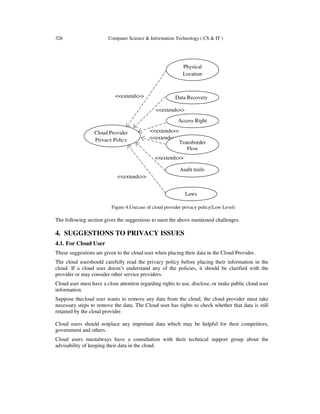
The Figure 4. depicts CP3usecase in detail; it has six different privacy constraints in the cloud
service.CP3usecaseis extended by several usecases that are Physical Location, Data Recovery,
Access Right, Transborder flow, Audit trails and Laws. All these use cases are extending use
cases because they are related to the data storage issues in the cloud. These usecases are providing
optimum information about CP3.
Figure 3.Usecases ofcloud
Cloud
Commercial
user
Cloud
Business
user
Cloud
User
Cloud
Provider
Cloud provider Policy
Cloud
Provider
Privacy Policy
Payments](https://image.slidesharecdn.com/csit2331-180203050839/85/PRIVACY-IN-CLOUD-COMPUTING-A-SURVEY-5-320.jpg)
![328 Computer Science & Information Technology ( CS & IT )
Table 2.Privacy policy of cloud providers
Sl.No Parameter Rackspace Windows Azure
Amazon
Web Services
1.
Disclosure of
PII
Inside the
organization and
the third party ,
those doing work
on behalf of
Rackspace
Inside the
organization and
occasionally contract
with other companies
to provide services on
our behalf
Inside the
organization and third
party people working
on our behalf.
2.
Physical
Location
Eight data centers
in three region viz.,
North America(5),
Europe(2) and
Asia(1)
Six data centers in
three regions viz.,
U.S(2), Europe(2),
Asia(2)
Six data centers in
three regions viz.,
U.S(3),
Europe(1), Asia(2)
3.
Data Loss Recovery Possible
through Unmetered
Managed Backup
Service
Recovery Possible Recovery possible
through Reduced
Redundancy Storage
4.
Access
Control
ACL Based
Security Model
Rule Based
Authorization
SSL encrypted
endpoints using the
HTTPS protocol
5.
Trans
border Flow
Not Available Not Available Not Available
5.5.Transborder Flow
In addition to the above, the cyber law is not universal; it will vary among countries. Since clouds
are located in different regions of the world, the provider should furnish the law when the data are
crossing different borders.
6. CONCLUSION
CloudComputing is a set of network enabled services, providing scalable, QoS guaranteed,
normally personalized, inexpensive computing infrastructures on demand, which could be
accessed in a simple and pervasive way. Most of the IT organizations are preparing themselves to
migrating to cloud computing. The following findings are suggested to the cloud users, when they
are selecting the cloud providers. First, the cloud user should concentrate on how the data is
protected from one another, where their data is located, how the access is limited. Second, Cloud
userhas right to know the rules and laws followed by different countries when it comes
Transborder flow. Cloud users should try to get the proper solution for the above said privacy
issues from the cloud providers. This will help the cloud user to select a suitable cloud provider
who cares their data and provides a high end data protection.
REFERENCES
[1] Mell, P., &Grance, T. (2009, 7 10). The NIST Definition of Cloud Computing, from NIST
Information Technology Laboratory, http://
www.nist.gov/itl/cloud/upload/cloud-def-v15.pdf, retrieved on may 2011.
[2] J. Geelan, “Twenty one experts define cloud computing. Virtualization,” Electronic Magazine,
http://virtualization.sys-con. com/node/612375 , viewed on July 2011.
[3] Ross A. Lumley, “Cyber Security and Privacy in Cloud Computing: Multidisciplinary Research
Problems in Business”, the George Washington University, Report GW-CSPRI-2010-4, December
18, 2010, pp 1-10.
[4] Michael Miller, “Cloud Computing: Web-Based Applications That Change the Way You Work
and Collaborate Online”, QueKnowledge and Grids,2010,ISBN-13: 978-0-7897-3803-5, pp105-](https://image.slidesharecdn.com/csit2331-180203050839/85/PRIVACY-IN-CLOUD-COMPUTING-A-SURVEY-8-320.jpg)
![Computer Science & Information Technology ( CS & IT ) 329
112.
[5] WassimItani, AymanKayssi and Ali Chehab, “Privacy as a Service: Privacy-Aware Data Storage
and Processing in Cloud Computing Architectures”, in Proc. of Eighth IEEE International
Conference on Dependable, Autonomic and Secure Computing, 2009, pp 711-716.
[6] Siani Pearson, AzzedineBenameur,”Privacy, Security and Trust issues arising from cloud
computing”, in Proc. of 2nd
IEEE International Conference on Cloud Computing Technology and
Science, 2010, pp 693-702.
[7] Minqi Zhou et al., “Security and Privacy in Cloud Computing: A Survey”, in Proc. of Sixth
International Conference on Semantics, Publications, First Printing, Augutst 2008, pp149-150.
[8] ReijoM. Savola, ArtoJuhola, IlkkaUusitalo, “Towards Wider Cloud Service Applicability by
Security, Privacy and Trust Measurements”, in Proc. of 4th
International Conference on
Application of Information and Communication Technologies(AICT), 2010,pp1-6.
[9] Tim Mather, SubraKumaraswamy, SahedLatif ,” Cloud Security And Privacy, an Enterprise
Perspective on Risks and Compliance”, O’Reilly Publications, First Edition, September 2009,
ISBN: 978-0-596-80276-9, pp149-150.
[10] R.Savola, “Towards a risk driven methodology for privacy Metrics development”, Symposium on
Privacy and Security Applications (PSA’10), August 2010, pp 20-22.
[11] Wayne A. Jansen, NIST, “Cloud Hook: Security and Privacy Issues in Cloud Computing”, in Proc.
of 44th
Conference on SystemSciences-2011,pp 1-10.
[12] Srijith K Nair, “Toward Secure Cloud Bursting Brokerage and Aggregation”,Eighth IEEE
European Conference on Web Services,2010,pp 189-196.
[13] http://mscerts.programming4.us/programming/cloudsecurityandprivacywhatisthedatalifecycle
.aspx, retrieved on June 2010
[14] Ran Li et al., “Thinking the cloud computing in China”,in Proc. of 2nd
IEEE International
Conference on InformationManagement and Engineering (ICIME),2010,pp669-672.
[15] Frank Gens, “Bringing Cloud into the Enterprise”, Cloud Leader ship Forum.
http://www.eiseverwhere.com/file_uploads/86cde4f4
bf015bb8cd2153ea7e0287ff_Day_1_815am_Frank_Gens_Bringing_Cloud_into_the_
Enterprise.pdf, retrieved on July 2011.
[16] Siani Pearson, “Taking Account of Privacy When Designing Cloud Computing Services”, HP
Laboratories, Tech. Rep. HPL- 2009-54, 2009, http://www.hpl.hp.com/techreports/2009/HPL-
2009-54.pdf.retrieved on July 2011
[17] Rajarshri chakra borty et al., “The Information Assurance Practicesof Cloud Computing
Vendors”,IEEE Trans. Cyber Security,2010,pp 29-37.
[18] Miranda Mowbray,SianiPearson,YunShen, “Enhancing Privacy in Cloud Computing via Policy-
based obfuscation”, Journal of Supercomputing,Springer Science Business Media,LLC 2010.
[19] HassaanTakabi et al, “Security and Privacy Challenges in Cloud ComputingEnvironments”, The
IEEE Computer and Reliability Socieitis,November/December 2010,pp 24-31.
[20] RuiMaximoEsteves,ChunmingRong,”Social Impact of Privacy in Cloud Computig”, in Proc. of 2nd
IEEE International Conference on Cloud Computing Technology and Science,2010,pp 593-596,
[21] I-HsunChauang et al, “An Effective Privacy Protection Scheme for Cloud Computing”, in Proc. of
IEEE Conference ICACT,2011,pp 260-265.
[22] http://www.worldprivacyforum.org/cloudprivacy.html retrieved on August 2011.
[23] PelinAngin, Bharat Bhargava, RohitRanchal, NoopurSingh,MarkLinderman, “An Entity-centric
Approach for Privacy and Identity Management in Cloud Computing”, in Proc. of Practices of
Cloud Computing Vendors”, IEEE Trans,Cyber Security,2010,pp29-37.
[24] https://www.infosecisland.com/blogview/3539-Privacy-and-Cloud-Computing-Challenges.html
retrieved on July 2011
[25] David Tancock, SianiPearson,AndrewCharlesworth,”Analysis of Privacy Impact Assessments
within Major Jurisdictioons”, in Proc. of Eigth IEEE Annual International Conference on
privacy,security and trust,2010,pp119-125.
[26] Frank Doelitzscher,Charistoph Reich, Anthony Sulistio, “Designing Cloud Services Adhering to
Government Privacy Laws”,in Proc. of 10th
IEEE International Conference on Computer and
Information Technology (CIT 2010), pp 930-935.
[27] Shuai Zhang et al., “Cloud Computing Research and Development Trend”, in Proc. of Second
International Conference on Future Networks,2010,pp93-73.](https://image.slidesharecdn.com/csit2331-180203050839/85/PRIVACY-IN-CLOUD-COMPUTING-A-SURVEY-9-320.jpg)
![330 Computer Science & Information Technology ( CS & IT )
[28] George Reese, “Cloud Application Architectures”,O’ReillyMedia,April 2009, First Edition,ISBN:
978-0-596-15636-7, pp 80-84.
Authors
Arockiam L is working as Associate Professor in the Department of Computer
Science, St.Joseph’s College (Autonomous), Tiruchirappalli, Tamil Nadu,
India. He has 23 years of experience in teaching and 16 years of experience in
research. He has published 87 research articles in the International / National
Conferences and Journals. His research interest includes Software metrics,
Data Mining, Mobile Computing, Web Services and Cloud Computing.
Parthasarathy G is working as Assistant Professor in the Department of
Computer Science and Engineering, TRP Engineering College, Tiruchirappalli,
Tamil Nadu, India. His research interests include Cloud Computing, Expert
Systems and Web Services.
Monikandan S is working as a Assistant Professor in Department of MCA in
Christhuraj Institute of Computer Application, Tiruchirappalli, Tamilnadu. He
is doing his Ph.D in ManonmaniamSundaranar University, Tirunelveli,india.
His research interest includes Privacy in Cloud Environment and Web
Technology.](https://image.slidesharecdn.com/csit2331-180203050839/85/PRIVACY-IN-CLOUD-COMPUTING-A-SURVEY-10-320.jpg)


