Maria St. Hilaire
                                                             Activity Sheet:
           Background Information: Understanding Multiple Intelligences*


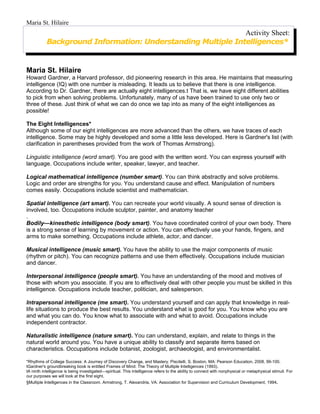
Maria St. Hilaire
Howard Gardner, a Harvard professor, did pioneering research in this area. He maintains that measuring
intelligence (IQ) with one number is misleading. It leads us to believe that there is one intelligence.
According to Dr. Gardner, there are actually eight intelligences.t That is, we have eight different abilities
to pick from when solving problems. Unfortunately, many of us have been trained to use only two or
three of these. Just think of what we can do once we tap into as many of the eight intelligences as
possible!

The Eight Intelligences*
Although some of our eight intelligences are more advanced than the others, we have traces of each
intelligence. Some may be highly developed and some a little less developed. Here is Gardner's list (with
clarification in parentheses provided from the work of Thomas Armstrong).

Linguistic intelligence (word smart). You are good with the written word. You can express yourself with
language. Occupations include writer, speaker, lawyer, and teacher.

Logical mathematical intelligence (number smart). You can think abstractly and solve problems.
Logic and order are strengths for you. You understand cause and effect. Manipulation of numbers
comes easily. Occupations include scientist and mathematician.

Spatial intelligence (art smart). You can recreate your world visually. A sound sense of direction is
involved, too. Occupations include sculptor, painter, and anatomy teacher
.
Bodily—kinesthetic intelligence (body smart). You have coordinated control of your own body. There
is a strong sense of learning by movement or action. You can effectively use your hands, fingers, and
arms to make something. Occupations include athlete, actor, and dancer.

Musical intelligence (music smart). You have the ability to use the major components of music
(rhythm or pitch). You can recognize patterns and use them effectively. Occupations include musician
and dancer.

Interpersonal intelligence (people smart). You have an understanding of the mood and motives of
those with whom you associate. If you are to effectively deal with other people you must be skilled in this
intelligence. Occupations include teacher, politician, and salesperson.

Intrapersonal intelligence (me smart). You understand yourself and can apply that knowledge in real-
life situations to produce the best results. You understand what is good for you. You know who you are
and what you can do. You know what to associate with and what to avoid. Occupations include
independent contractor.

Naturalistic intelligence (nature smart). You can understand, explain, and relate to things in the
natural world around you. You have a unique ability to classify and separate items based on
characteristics. Occupations include botanist, zoologist, archaeologist, and environmentalist.

*Rhythms of College Success: A Journey of Discovery Change, and Mastery. Piscitelli, S. Boston, MA: Pearson Education, 2008, 99-100.
tGardner's groundbreaking book is entitled Frames of Mind: The Theory of Multiple Intelligences (1993).
tA ninth intelligence is being investigated—spiritual. This intelligence refers to the ability to connect with nonphysical or metaphysical stimuli. For
our purposes we will look at the first eight.
§Multiple Intelligences in the Classroom. Armstrong, T. Alexandria, VA: Association for Supervision and Curriculum Development, 1994.
Maria St. Hilaire


                                                                                 Activity Sheet:
                                                 Prioritize Your Intelligences*


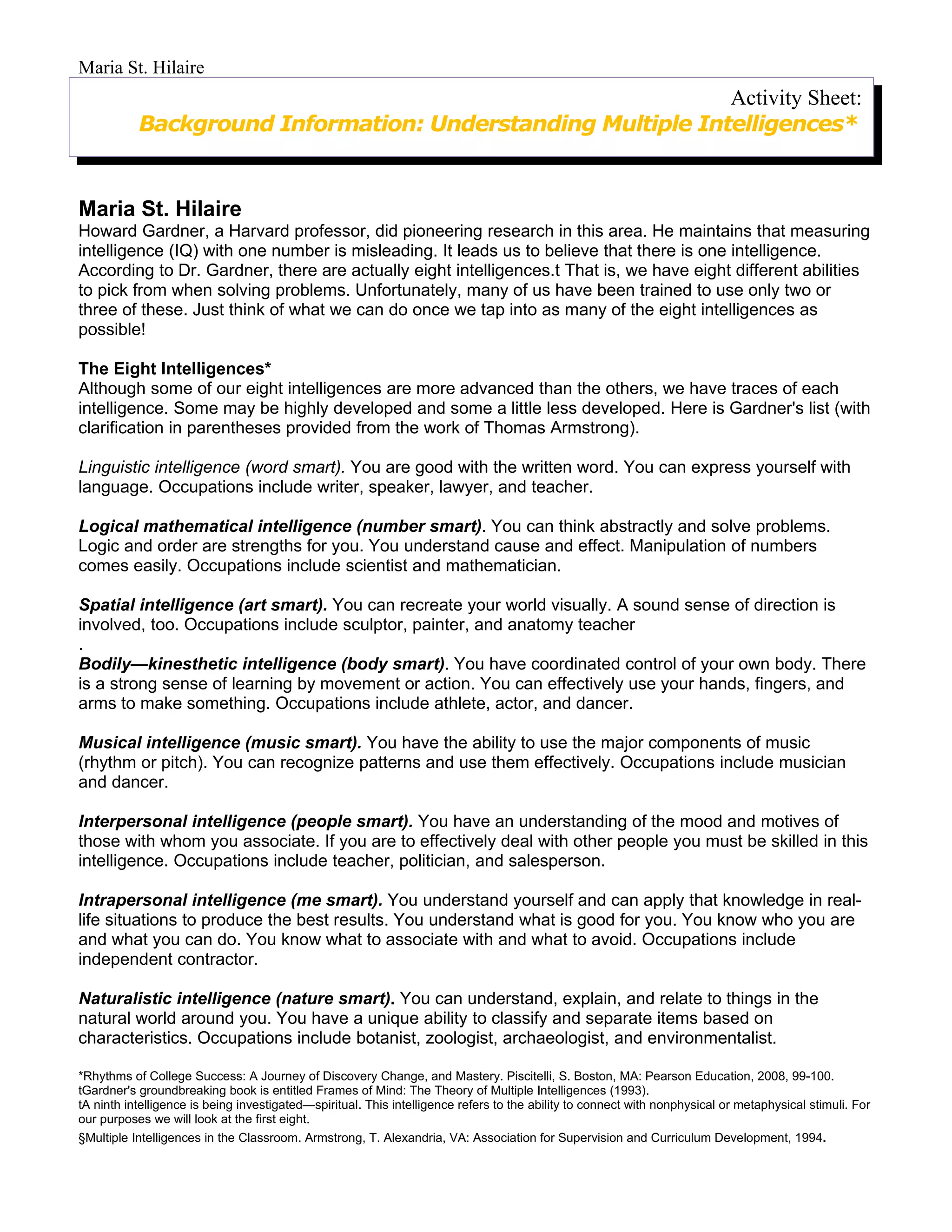
NAME: Maria St. Hilaire
List the intelligences in order from the one intelligence that is most developed in you to
the one that is least developed as they relate to you. Write a brief description how you
have come to believe this. Be specific (perhaps give an example that explains your
ranking).

      1.


           My most (1st) developed intelligence is: Linguistic intelligence (word smart)

           My evidence is: I express my self well to others so that they can understand

           me. People always tell me that I make them understand more because I know

           how to better explain things they don’t understand.


      2.

           My 2nd most developed intelligence is: My evidence is: Interpersonal

           intelligence (people smart)

           My evidence is: I understand others moods and motives when and

           how to deal with them. If someone wants their space I give it. I

           respect others.


      3.


           My 3rd most developed intelligence is: Naturalistic intelligence (nature smart)

           My evidence is: I can see how things relate and like to put thing in the right

           place. I make connections all the time.
Maria St. Hilaire


      4.


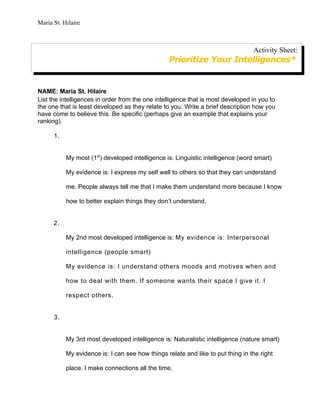
           My 4th most developed intelligence is: Logical mathematical intelligence

           (number smart)

           My evidence is: I use to like math when I was younger. I am good at

           solving problems, and understanding cause and effect.


      5.


           My 5th most developed intelligence is: Bodily—kinesthetic intelligence (body

           smart)

           My evidence is: I love dancing I like using my hands when I draw and

           cook.


      6.


           My 6th most developed intelligence is: Spatial intelligence (art smart).

           My evidence is: I get what I see. I like to look deep into details. If I

           drive somewhere myself I remember the directions.


      7.


           My 7th most developed intelligence is: Musical intelligence (music smart)

           My evidence is: When I have rhythm and recognize pattern. I am good at

           guessing what comes next after a sequence.
Maria St. Hilaire


       8.


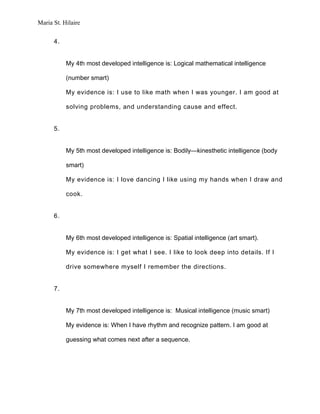
            My 8th most developed intelligence is: Intrapersonal intelligence (me smart)

            My evidence is : when I know who I am what I like what I can do can

            not do I get myself, understand what is good for me, what to avoid

            what to attract or associate myself with.


Finally, what insights can you draw from this activity?

There is more then one kind of intelligence. Each person can have different

combinations of them. It’s good to know the various kinds so that one can discovery

them in their selves and others. This activity can help to understand self and others.

Also help to figure out what you’re good at, and how to improve on the other kind of

intelligence that you are lacking.


*Instructor's manual to accompany Study Skills: Do 1 Really Need This Stuff? 2nd Edition. Piscitelli, S.
Boston, MA: Pearson Education, 2009.

Prioritize your intelligences

  • 1.
    Maria St. Hilaire Activity Sheet: Background Information: Understanding Multiple Intelligences* Maria St. Hilaire Howard Gardner, a Harvard professor, did pioneering research in this area. He maintains that measuring intelligence (IQ) with one number is misleading. It leads us to believe that there is one intelligence. According to Dr. Gardner, there are actually eight intelligences.t That is, we have eight different abilities to pick from when solving problems. Unfortunately, many of us have been trained to use only two or three of these. Just think of what we can do once we tap into as many of the eight intelligences as possible! The Eight Intelligences* Although some of our eight intelligences are more advanced than the others, we have traces of each intelligence. Some may be highly developed and some a little less developed. Here is Gardner's list (with clarification in parentheses provided from the work of Thomas Armstrong). Linguistic intelligence (word smart). You are good with the written word. You can express yourself with language. Occupations include writer, speaker, lawyer, and teacher. Logical mathematical intelligence (number smart). You can think abstractly and solve problems. Logic and order are strengths for you. You understand cause and effect. Manipulation of numbers comes easily. Occupations include scientist and mathematician. Spatial intelligence (art smart). You can recreate your world visually. A sound sense of direction is involved, too. Occupations include sculptor, painter, and anatomy teacher . Bodily—kinesthetic intelligence (body smart). You have coordinated control of your own body. There is a strong sense of learning by movement or action. You can effectively use your hands, fingers, and arms to make something. Occupations include athlete, actor, and dancer. Musical intelligence (music smart). You have the ability to use the major components of music (rhythm or pitch). You can recognize patterns and use them effectively. Occupations include musician and dancer. Interpersonal intelligence (people smart). You have an understanding of the mood and motives of those with whom you associate. If you are to effectively deal with other people you must be skilled in this intelligence. Occupations include teacher, politician, and salesperson. Intrapersonal intelligence (me smart). You understand yourself and can apply that knowledge in real- life situations to produce the best results. You understand what is good for you. You know who you are and what you can do. You know what to associate with and what to avoid. Occupations include independent contractor. Naturalistic intelligence (nature smart). You can understand, explain, and relate to things in the natural world around you. You have a unique ability to classify and separate items based on characteristics. Occupations include botanist, zoologist, archaeologist, and environmentalist. *Rhythms of College Success: A Journey of Discovery Change, and Mastery. Piscitelli, S. Boston, MA: Pearson Education, 2008, 99-100. tGardner's groundbreaking book is entitled Frames of Mind: The Theory of Multiple Intelligences (1993). tA ninth intelligence is being investigated—spiritual. This intelligence refers to the ability to connect with nonphysical or metaphysical stimuli. For our purposes we will look at the first eight. §Multiple Intelligences in the Classroom. Armstrong, T. Alexandria, VA: Association for Supervision and Curriculum Development, 1994.
  • 2.
    Maria St. Hilaire Activity Sheet: Prioritize Your Intelligences* NAME: Maria St. Hilaire List the intelligences in order from the one intelligence that is most developed in you to the one that is least developed as they relate to you. Write a brief description how you have come to believe this. Be specific (perhaps give an example that explains your ranking). 1. My most (1st) developed intelligence is: Linguistic intelligence (word smart) My evidence is: I express my self well to others so that they can understand me. People always tell me that I make them understand more because I know how to better explain things they don’t understand. 2. My 2nd most developed intelligence is: My evidence is: Interpersonal intelligence (people smart) My evidence is: I understand others moods and motives when and how to deal with them. If someone wants their space I give it. I respect others. 3. My 3rd most developed intelligence is: Naturalistic intelligence (nature smart) My evidence is: I can see how things relate and like to put thing in the right place. I make connections all the time.
  • 3.
    Maria St. Hilaire 4. My 4th most developed intelligence is: Logical mathematical intelligence (number smart) My evidence is: I use to like math when I was younger. I am good at solving problems, and understanding cause and effect. 5. My 5th most developed intelligence is: Bodily—kinesthetic intelligence (body smart) My evidence is: I love dancing I like using my hands when I draw and cook. 6. My 6th most developed intelligence is: Spatial intelligence (art smart). My evidence is: I get what I see. I like to look deep into details. If I drive somewhere myself I remember the directions. 7. My 7th most developed intelligence is: Musical intelligence (music smart) My evidence is: When I have rhythm and recognize pattern. I am good at guessing what comes next after a sequence.
  • 4.
    Maria St. Hilaire 8. My 8th most developed intelligence is: Intrapersonal intelligence (me smart) My evidence is : when I know who I am what I like what I can do can not do I get myself, understand what is good for me, what to avoid what to attract or associate myself with. Finally, what insights can you draw from this activity? There is more then one kind of intelligence. Each person can have different combinations of them. It’s good to know the various kinds so that one can discovery them in their selves and others. This activity can help to understand self and others. Also help to figure out what you’re good at, and how to improve on the other kind of intelligence that you are lacking. *Instructor's manual to accompany Study Skills: Do 1 Really Need This Stuff? 2nd Edition. Piscitelli, S. Boston, MA: Pearson Education, 2009.