
Printmaking Research
By: Hoda Mikati
Research Questions:
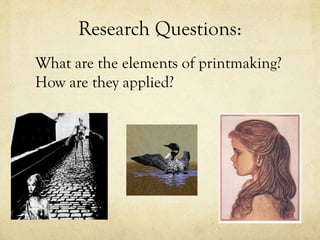
What are the elements of printmaking?
How are they applied?
Printmaking:
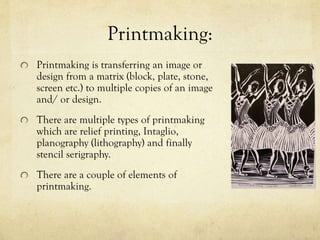
Printmaking is transferring an image or
design from a matrix (block, plate, stone,
screen etc.) to multiple copies of an image
and/ or design.
There are multiple types of printmaking
which are relief printing, Intaglio,
planography (lithography) and finally
stencil serigraphy.
There are a couple of elements of
printmaking.
Elements of Printmaking:
Line
Form
Color
Space
Texture
The Element of
Line:
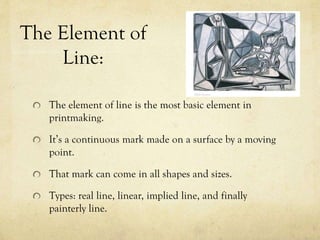
The element of line is the most basic element in
printmaking.
It’s a continuous mark made on a surface by a moving
point.
That mark can come in all shapes and sizes.
Types: real line, linear, implied line, and finally
painterly line.
The Element of
Form:
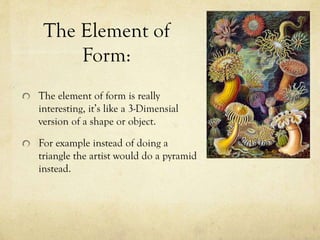
The element of form is really
interesting, it’s like a 3-Dimensial
version of a shape or object.
For example instead of doing a
triangle the artist would do a pyramid
instead.
The Element of
Color:
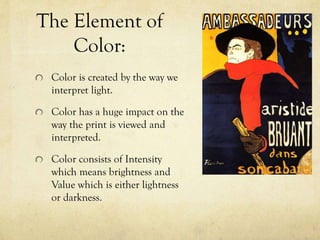
Color is created by the way we
interpret light.
Color has a huge impact on the
way the print is viewed and
interpreted.
Color consists of Intensity
which means brightness and
Value which is either lightness
or darkness.
The Element of
Space:
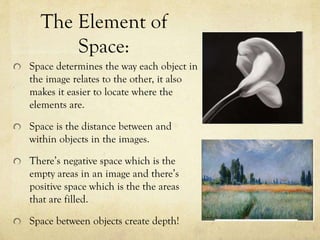
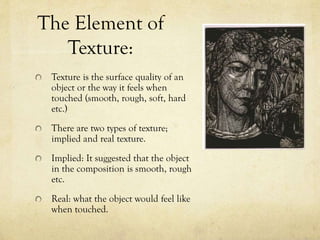
Space determines the way each object in
the image relates to the other, it also
makes it easier to locate where the
elements are.
Space is the distance between and
within objects in the images.
There’s negative space which is the
empty areas in an image and there’s
positive space which is the the areas
that are filled.
Space between objects create depth!
The Element of
Texture:
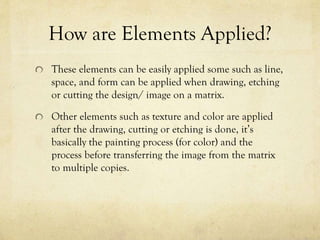
Texture is the surface quality of an
object or the way it feels when
touched (smooth, rough, soft, hard
etc.)
There are two types of texture;
implied and real texture.
Implied: It suggested that the object
in the composition is smooth, rough
etc.
Real: what the object would feel like
when touched.
How are Elements Applied?
These elements can be easily applied some such as line,
space, and form can be applied when drawing, etching
or cutting the design/ image on a matrix.
Other elements such as texture and color are applied
after the drawing, cutting or etching is done, it’s
basically the painting process (for color) and the
process before transferring the image from the matrix
to multiple copies.
Why Use Elements?
Printmaking elements are elements provided for us to
help and guide us into making good, and creative
multiple copies of artistic images and/ or design.
We should use the elements of line, space, color, form
etc. to give the prints more texture, more value, more
depth, creativity and it makes it look much more
interesting than a print with none of the printmaking
elements.
Thanks for Watching!

Printmaking research

  • 1.
  • 2.
    Research Questions: What arethe elements of printmaking? How are they applied?
  • 3.
    Printmaking: Printmaking is transferringan image or design from a matrix (block, plate, stone, screen etc.) to multiple copies of an image and/ or design. There are multiple types of printmaking which are relief printing, Intaglio, planography (lithography) and finally stencil serigraphy. There are a couple of elements of printmaking.
  • 4.
  • 5.
    The Element of Line: Theelement of line is the most basic element in printmaking. It’s a continuous mark made on a surface by a moving point. That mark can come in all shapes and sizes. Types: real line, linear, implied line, and finally painterly line.
  • 6.
    The Element of Form: Theelement of form is really interesting, it’s like a 3-Dimensial version of a shape or object. For example instead of doing a triangle the artist would do a pyramid instead.
  • 7.
    The Element of Color: Coloris created by the way we interpret light. Color has a huge impact on the way the print is viewed and interpreted. Color consists of Intensity which means brightness and Value which is either lightness or darkness.
  • 8.
    The Element of Space: Spacedetermines the way each object in the image relates to the other, it also makes it easier to locate where the elements are. Space is the distance between and within objects in the images. There’s negative space which is the empty areas in an image and there’s positive space which is the the areas that are filled. Space between objects create depth!
  • 9.
    The Element of Texture: Textureis the surface quality of an object or the way it feels when touched (smooth, rough, soft, hard etc.) There are two types of texture; implied and real texture. Implied: It suggested that the object in the composition is smooth, rough etc. Real: what the object would feel like when touched.
  • 10.
    How are ElementsApplied? These elements can be easily applied some such as line, space, and form can be applied when drawing, etching or cutting the design/ image on a matrix. Other elements such as texture and color are applied after the drawing, cutting or etching is done, it’s basically the painting process (for color) and the process before transferring the image from the matrix to multiple copies.
  • 11.
    Why Use Elements? Printmakingelements are elements provided for us to help and guide us into making good, and creative multiple copies of artistic images and/ or design. We should use the elements of line, space, color, form etc. to give the prints more texture, more value, more depth, creativity and it makes it look much more interesting than a print with none of the printmaking elements.
  • 12.