PRINTERS: HISTORY,
TYPES AND DIFFERENCES
Conten
ts
Histor
y
Impac
tPrinte
rs
Non
-Impac
tPrinte
rs
Other
s
Presented by:
• Zainab Anjum
• Azka Muzzamil
• Zahra Fatima
• Rabia Altaf
• Iman Naeem
HISTORY OF PRINTERS
First mechanical
printer by Charles
Babbage
Chester Carlson
invented
Xerographic
process
IBM created their
first printer,
called the
IBM3800
HP created the
first LaserJet
Printer
DEC introduced
dot matrix
printer, LA30
First wireless
printer
Fritz K. Preikschat
built a dot matrix
teletypewriter
First high-speed
printer developed
by Remington-
Rand
HP invented the
Desk Jet Printers
Zcorp created one
of the first space-
age 3D printers
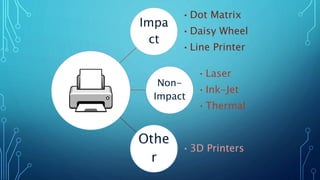
Impa
ct
•Dot Matrix
•Daisy Wheel
•Line Printer
Non-
Impact
•Laser
•Ink-Jet
•Thermal
Othe
r
•3D Printers
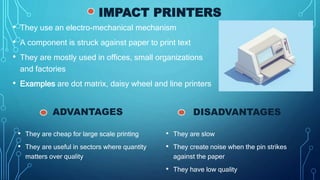
IMPACT PRINTERS
ADVANTAGES
• They are cheap for large scale printing
• They are useful in sectors where quantity
matters over quality
DISADVANTAGES
• They are slow
• They create noise when the pin strikes
against the paper
• They have low quality
• They use an electro-mechanical mechanism
• A component is struck against paper to print text
• They are mostly used in offices, small organizations
and factories
• Examples are dot matrix, daisy wheel and line printers
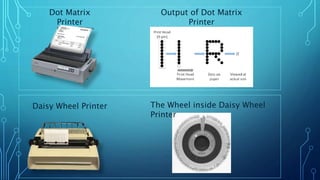
Dot Matrix
Printer
Output of Dot Matrix
Printer
Daisy Wheel Printer The Wheel inside Daisy Wheel
Printer
NON-IMPACT PRINTERS
ADVANTAGES
• They are faster
• Produce very high-quality result
• They make no noise
DISADVANTAGES
• Their ink-cartridges are very costly
• They use latest technologies; Laser, Thermal and Ink-
jet
• They are speedier than impact printers
• Their speed is measured in PPM (Pages Per Minute)
• Examples are laser, ink-jet and thermal printers
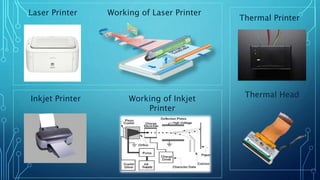
Laser Printer Working of Laser Printer
Inkjet Printer Working of Inkjet
Printer
Thermal Printer
Thermal Head
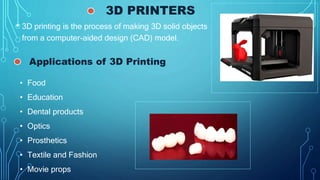
3D PRINTERS
• 3D printing is the process of making 3D solid objects
from a computer-aided design (CAD) model.
Applications of 3D Printing
• Food
• Education
• Dental products
• Optics
• Prosthetics
• Textile and Fashion
• Movie props
• Architecture
• Electronics
• Automotive
• Robotics
• Aeronautics and Space
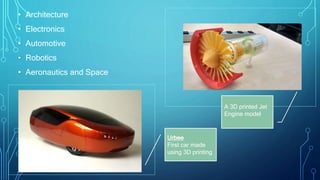
Urbee
First car made
using 3D printing
A 3D printed Jet
Engine model

Printers

  • 1.
    PRINTERS: HISTORY, TYPES ANDDIFFERENCES Conten ts Histor y Impac tPrinte rs Non -Impac tPrinte rs Other s Presented by: • Zainab Anjum • Azka Muzzamil • Zahra Fatima • Rabia Altaf • Iman Naeem
  • 2.
    HISTORY OF PRINTERS Firstmechanical printer by Charles Babbage Chester Carlson invented Xerographic process IBM created their first printer, called the IBM3800 HP created the first LaserJet Printer DEC introduced dot matrix printer, LA30 First wireless printer Fritz K. Preikschat built a dot matrix teletypewriter First high-speed printer developed by Remington- Rand HP invented the Desk Jet Printers Zcorp created one of the first space- age 3D printers
  • 3.
    Impa ct •Dot Matrix •Daisy Wheel •LinePrinter Non- Impact •Laser •Ink-Jet •Thermal Othe r •3D Printers
  • 4.
    IMPACT PRINTERS ADVANTAGES • Theyare cheap for large scale printing • They are useful in sectors where quantity matters over quality DISADVANTAGES • They are slow • They create noise when the pin strikes against the paper • They have low quality • They use an electro-mechanical mechanism • A component is struck against paper to print text • They are mostly used in offices, small organizations and factories • Examples are dot matrix, daisy wheel and line printers
  • 5.
    Dot Matrix Printer Output ofDot Matrix Printer Daisy Wheel Printer The Wheel inside Daisy Wheel Printer
  • 6.
    NON-IMPACT PRINTERS ADVANTAGES • Theyare faster • Produce very high-quality result • They make no noise DISADVANTAGES • Their ink-cartridges are very costly • They use latest technologies; Laser, Thermal and Ink- jet • They are speedier than impact printers • Their speed is measured in PPM (Pages Per Minute) • Examples are laser, ink-jet and thermal printers
  • 7.
    Laser Printer Workingof Laser Printer Inkjet Printer Working of Inkjet Printer Thermal Printer Thermal Head
  • 8.
    3D PRINTERS • 3Dprinting is the process of making 3D solid objects from a computer-aided design (CAD) model. Applications of 3D Printing • Food • Education • Dental products • Optics • Prosthetics • Textile and Fashion • Movie props
  • 9.
    • Architecture • Electronics •Automotive • Robotics • Aeronautics and Space Urbee First car made using 3D printing A 3D printed Jet Engine model