

BA MULTIMEDIA 5th SEMESTER
News Paper Organization
Business Department- Front Office
Editorial Department-News Room
Mechanical Department-Back Shop
Business Department
 The business office is the counting house of the
newspaper.
 It has an obvious duty to keep the organization afloat
financially.
 It co-ordinates the functioning of different
departments and manages human and financial
resources and promotes good relations with the
newspaper and its clients.
 The major divisions of this department are
 Advertising department,
 Circulation department,
 Promotion department and
 Accounting or auditing department.
Advertising department
 The advertising department is headed by an advertising
manager.
 It deals with the selling of newspaper space.
 The advertising department has various subsections to
handle
 Regional or local advertising,
 Classified and display advertising,
 Foreign and national advertising
 Merchandise or service division.
 Advertising is a major source of revenue besides
subscription.
 A creative and research department also functions under
advertising department to help in the preparation of
advertisements.
Circulation department
 The circulation and sales promotion department deals
with the packing and distribution of copies to the city
and beyond city by road, rail and air.
 It is headed by a circulation manager who supervises
its various subsections such as city circulation, area
circulation and sales promotion.
Promotion Department
 Promotion is essentially the activity of public relations
department of the newspaper.
 It is usually responsible for initiating promotion
policies and strategies, subject to the approval of the
publisher.
 A public relations department is working in tandem
with adjunct to promote good relationship between
the public inside outside the organization and to boost
up the image of the organization.
Accounting or auditing department
 An accounting and audit department is also the
integral part of newspaper organization.
 It prepares audit and annual reports.
 It is headed by a senior charted accountant.
Mechanical department
 The works carried out in this department is known as
pre-press operations.
 In the traditional publishing process, more than a
dozen people had to work for publishing a single page.
 The production department is headed by a production
manager.
 Desk Top Publishing reduced the number of
professionals and laborious production work.
 The DTP team includes the following key
professionals:
i. Type setter or data entry operator
 Those who typeset by Desk Top Publishing software
are ‘ designated as type setters. ‘
ii. Designer
 The designer coordinates with the editor to design
page layout.
 He or she takes the decision about the column width,
type size, the size of the illustrations etc.
 A template is created to lend uniformity and efficiency
to the pages under process.
iii. Graphic artist
 The artist creates sketches, colour graphics and other
types 0f images which pertain directly to the text. He
also creates graphics and sends the electronic file to
the designer.
iv. Camera operator
 He operates a processing camera to photograph the
layout pages to prepare their negatives in their desired
sizes.
v. Paste-up artist
 The lay-out planned by the designer is followed by the
paste -up department where a paste up artist pastes
camera negatives and the typed text in the proper
places using special gum
vi. The press-operator
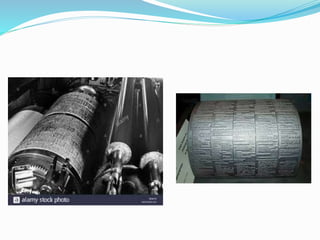
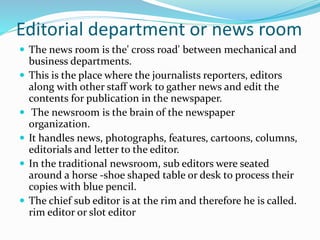
 The press operator makes plates from film negatives
Now a days plates can be made directly using digital
method from electronic file
Editorial department or news room
 The news room is the' cross road' between mechanical and
business departments.
 This is the place where the journalists reporters, editors
along with other staff work to gather news and edit the
contents for publication in the newspaper.
 The newsroom is the brain of the newspaper
organization.
 It handles news, photographs, features, cartoons, columns,
editorials and letter to the editor.
 In the traditional newsroom, sub editors were seated
around a horse -shoe shaped table or desk to process their
copies with blue pencil.
 The chief sub editor is at the rim and therefore he is called.
rim editor or slot editor
Organizational structure and
environment of the news desk/
newsroom
 Reporters and sub editors are the two main pillars that support the
newspaper.
 Chief Editor or Editor -in -chief is the head of the department
 He manages the headquarters of the newspaper
 Under him are,
 Managing editor
 Associate editor,
 Assistant editor,
 News editor or resident editor
 City editor
 Chief sub-editor
 A team of sub-editors and journalist trainees.
 A wide network of reporters forms an integral part of the
system .
 The nodal points in this network are called bureaux which
are supervised by chief reporters.
 In big news papers, there are separate divisions such as
foreign desk,
 business desk,
 sports desk,
 cultural desk,
 theatre, music,
 film desk and so on
 Each desk is managed by specialist in the respective
discipline and the content is provided by news agencies
and special correspondents.
 Reader's editor, wire editor and on line editor are other job
titles in the news r00m
Managing Editor
 He or she is the owner or main stakeholder of the newspaper
company
 In some organizations he is the managing director or chief
executive of the newspaper.
 H e leads conferences, occasionally discuss matters concerning his
organization and he finally takes important decisions
 He is the senior member of the publication team of a newspaper or
magazine and shoulders many responsibilities. He is responsible for
the daily operation of the news room.
 In other words, he runs the newsroom.
 He acts as a supervisor, mentor and guide to all other editors and
works closely with them.
 He takes decisions about the coverage of stories.
 The managing editor also plays a key role in setting up the standards
of house style book.
 He conducts editorial conferences everyday at a particular time to
discuss matters concerning his organization.
Chief Editor
 He is ' described as the supreme authority 0f everything
that 1s published or to be published on a newspaper.
 He is responsible for editorial content, news, articles,
features, cartoons, photos and editorials.
 If a legal, defamation, contempt of court or legislate
parliament privileges case is filed against the newspaper, he
has to appear and answer before the authorities.
 He takes decisions on important matters concerning the
organization, determine editorial policy and guide his staff.
The duties and responsibilities of
the Chief Editor or Editor Chief are
 responsibility in keeping the overall integrity of the
newspaper (editorial content, appearance, coverage,
production, scheduling, staff/personnel issues and
advertising);
 coordination of training programmes for editors through a
summer retreat or workshops.
 chairing the editorial board meetings
 taking the managing editor into confidence in all matters
regarding editorial content
 ensuring submission of editorial content on time
 ensuring the production and distribution of the paper
Associate Editor
 In the news room hierarchy, he 1s the second superior
editor In some newspaper offices he is the Leader/
Editorial writer. Associate Editors are given special
duties/ tasks by the Chief Editor.
Assistant Editor
 He performs duties delegated to him by the Chief
Editor. He sometimes writes editorials.
Executive Editor
 He assists in the editorial and production functions of
a newspaper. He supervises the work of Resident
Editor, Associate Editor and Assistant Editors.
RESIDENT EDITOR
 He is the editor based at the places from where
editions are being published. He is described as an
extended arm of the Chief Editor. In some
newspapers, Resident Editor is known as News Editor.
News Editor
 He is one of the key figures who plan a day's
newspaper, the one who selects top stories for the front
page and regional pages of that edition.
 He conducts newsroom conference everyday in which
a post-mortem examination of the day's newspaper
vis-a-vis the major competiting newspapers will be
done.
 The meeting will also discuss the strategies for making
the next day's issue an excellent production.
 Selfcriticism is the best policy to improve
performance.
Assistant News editor
 Assistant news editors assist the News Editors. ‘
Chief Sub Editor
 He or she is popularly known as 'chief sub' and the 'captain'
of desk.
 Under him are several sub-editors who edit different copies
assigned to them.
 His duties can be highlighted as follows:
 distributes work among sub ordinates
 decides the treatment of stories
 keeps tab on major happenings and developments
 co-ordinates and receives news stories from different sources
 co-ordinates the functions between mechanical and
circulation department
Sub Editor
 A subeditor is often described as 'the unsung hero' or ‘the
unknown soldier‘, behind the newspaper production.
 He is not popular as a reporter who develops harmonious
social relations.
 He sticks to the news desk, most of the time brooding over
the copy.
 He never gets a byline or the name published along with
the story which is a recognition given by the newspaper
and its readers.
 He processes the copy with utmost care to attain
maximum readability.
 He is also called the copy reader or copy editor.
What is the nature of his duty?
 A person who edits is called an editor.
 According to Oxford English Dictionary, the word editor comes from
the Latin phrase 'editus' which means to 'put forward”.
 The subeditor does some or all of these to every story:
 reads the story for clarity of language and meaning and rewrites if it is
necessary
 checks various types of errors in the copy that may originate in spelling,
grammar, punctuation, syntax and facts and figures
 polishes the first paragraph or lead of the story, if the reporter fails to
do it
 rewrites the dull unorganized story to a readable one
 boils down stories and saves space when verbosity creeps in without
losing news values
 translates and rewrites wire service reports
 writes appropriate headlines for each story
 writes captions for news and feature photographs
 guard the newspaper against the legal pitfalls of libel, defamation,
contempt of court, contempt of parliament etc.
 makes typographical specifications for the compositor
 removes elements of bad taste and ‘editorializing
News Bureau
 Consist of a team of reporters assigned to collect news
in that particular area.
 Different categories of reporters working under the
bureau in chief and the chief reporter
Reporter
 The link between the news paper and the readers
 There is a tacit agreement of credibility between the
reader and reporter.
 The credibility of newspaper or television channel is
the success of that agreement.
A sucCessful reporter has many
qualities and skills.
 The primary quality is news sense -the intelligence of the reporter to
distinguish what is news or non news in terms of various news values
or having a nose for news' .
 Clarity 1n language, accuracy in facts and figures, unbiased
reporting or keeping objectivity are other qualities.
 Observational skills and memory power helps him /her to practice
the above mentioned principles.
 Speed in doing multiple tasks and patience to wait for an interview
or press conference, self discipline to face critical situations help him
to sustain in his career.
 The word integrity means sincerity, dedication and loyalty to the
organisation he/ she works.
 He should be a self-starter, a leader who does not wait for others to do
some assignment.
 He is very friendly with people and enjoys meeting and talking to
everyone.
 Staff Reporter
He belongs to the regular staff of the organisation and has the
privileges, but rarely gets credit or byline.
Beat Reporter
Reporters are constantly assigned to collect information from specific
areas. The exclusive territory allotted to a reporter or special
correspondent is called his/her beat. The reporter regularly monitors '
happenings in his beat through his trustworthy sources.
Correspondent
A reporter who supplies ‘out of town stories‘ is called a correspondent.
 Senior Special Correspondent
A senior reporter who has been entrusted with a special task to
cover special news stories, for example to cover the President's or
Prime Minister 5 visit to a foreign country. There are special
correspondents for subject areas like science, business, sports
and games, industry, politics, law and order etc.
Foreign Correspondent
Big newspapers have bureau in foreign countries. A foreign
correspondent is a representative of the news paper in a foreign
Why. He is a special reporter who keeps tab on host country's
activities with special reference to his mother country.
 Mofussil Correspondent
He is also called dak reporter. He reports from small town or rural area, He may
or may not belong to the regular newspaper
staff.
 Stringer
A stringer is a part time reporter or correspondent His remuneration is based
on the column length and quality of the story. A liner is also a reporter working
on contract basis
Freelancer
A reporter or writer who works independently without any organisation is a
freelancer In other words, one who writes on all kinds of topics in several
newspapers and periodicals without having a regular pay roll rs known as a
freelancer They always keep in touch with newspapers Virtually, anybody can
become a freelancer if he has courage and determination.
 Cartoonist
Cartoonist comments upon news and events through
cartoons and caricatures. He discusses his ideas with
the Chief Editor.
 Columnists
They write personal opinion pieces. Readers' Editor
plays the role of newspaper ombudsman and answers
the complaints of readers. Feature writers write the
content for magazines or pull-outs.
Qualities of a Journalist
 News sense/Nose for news
 Every reporter should have an ability to recognize a
news story when it comes along. Quite oiien most of
the incidents appear to ac mere publicity matter. So
the reporter must observe the incident closely and
filter the news that would be of interest to his readers.
A sharp sense of observation is needed to gather
relevant background information of a story. Nose for
news is an acquired quality and can be developed and
improved over the years.
 Commonsense-An ideal reporter, however brilliant and
imaginative he may be! must maintain a sense of
responsibility. He must maintain a balance in reporting
without sacrificing the public good. His over-enthusiasm
should not land him into dangerous situations. .
Objectivity A reporter should not allow personal bias or
ideas to creep into a story at any circumstance. He can try
to present different Viewpoints but never take sides. The
information he collects should be checked and rechecked.
 Accuracy Maintaining accuracy is the best way to protect
credibility. In the case of dates and names the reporter
should confirm the accuracy of the same from reference
materials as much as possible. It is better not to say a thing‘
than to say it wrong.
Alertness Alertness is an unavoidable quality of a
reporter. Scoops or exclusive stories don't walk into the
newspaper offices. A reporter has to rise to the occasion to
collect news, otherwise readers may miss the chance of
getting significant information.
 Speed A person who doesn't catch up with time can't
be a good reporter. While maintaining all other
desirable qualities, a reporter should try to work faster.
To meet deadlines, a reporter must think fast, decide
fast and present fast.
Calmness Being in the field, a reporter may face many
disturbing experiences. He should train himself to
overcome such situations. Self confidence and power
of mind help him It overcome difficult situations.
 Curiosity Curiosity quite often leads to bigger story
ideas. I f a reporter shows lukewarm interest to know
more about any issue of importance he may miss an
exclusive story.
Scepticism . Before taking any in formation for
granted, a reporter should be doubtful until he gets
undeniable proof. Many persons may try to plant
wrong information for vested interests. A reporter with
clear sense of scepticism doesn't fall into such traps.
 Punctuality ~ ‘Punctuality has a direct impact on accuracy
as well as credibility. A late reporter has a chance to get
misinformed
by the rival. A punctual reporter leaves any possibility to
depend a secondary source. .
Patience -Self control helps a reporter to endure waiting,
provocation, injustice or any other unpleasant experiences.
Farsightedness A reporter should have an ability to think
beyond. An intelligent envisioning of the future will help a
reporter in a great way. Reporters should always keep an eye
on sociopolitical and development issues which will have
impact on people infuture.
Photo journalists: the visual
reporters
 Pictures have a universal language.
 “a picture is worth thousand words!"
 There are so many reasons why newspaper and
magazines use photographs:
 to beautify the page or page make-up '
to present as proof of reality/authenticity
 to Show that the reporter was at the scene of the event
 to attract the attention of readers
 they could be used as tillers.
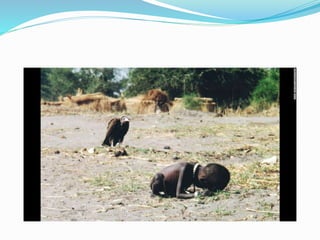
 Kevin Carter’s 1993 photograph of a starving child in
southern Sudan brought him worldwide attention --
and criticism. Carter said the girl reached a nearby
feeding center after he drove the vulture off, but
questions persisted about why he didn’t carry her there
himself. Months after winning a Pulitzer Prize for the
image, the South African photographer committed
suicide. He was struggling with depression and coping
with the recent death of his close friend and colleague
Ken Oosterbroek.
Principles of News Editing
 A good sub editor always follows these principles while at Work;
 Accuracy
 Accuracy is the mantra a sub editor always chants. It is achieved by
cross checking of everything inthe story, from facts and figures to
attribution.
 Balance and fairness
 Balance can be achieved by keeping obj ectivity, Objectivity in editing
means presenting the story without bias or personal opinion. It is
against 'editorialisation' or reflecting personal views in news writing. It
is presenting the both sides of the story. The sub editor should not
write in favour of any one. Fairness means truthiiilness. It is earned by
right observation. ' '
 v Brevity
 Brevity is the soul of j ournalism. It is telling a story as it should be,
without beating about the bush. It saves time and‘space and wins '
applause when consummated to perfection.
 Clarity
 Clarity in expression is achieved byusing simple language, choosing the
right word for the right context and simplesentences.
 . Simplicity
 ~ Simplicity and clarity are essentially needed in a news report.While
editing, long and complicated words should be replaced by short and
clear ones. For simplicity in expression, do away with clutter and
jargon. Minute attention should be paid to the words in the story in
order to improve its quality and appeal.
 ‘ Readability
 A sub editor should be vigilant about the mistakes 1n languftlge for
 readers. Apt words, expressions and grammar are very important for
developing a good language. Readability 18 achieved by USlflg
readability formulae. Among them, the Widely used formula IS
developed by RndolfFlesch.
Newspaper Layout and Printing
 It is not enough to fill the pages with news stories and
pictures but it should attract and appeal to the readers.
 Newspaper layout has come to play an important role.
 An editor's goal in packaging (layout) to help the.
reader read faster and read more of what has been
written on all pages
The objectives of layout
 1. Layout is done primarily to facilitate readership..
 2. There is a need to make the pages find attractive.
 3 . Layout in a newspaper should reflect the
contemporary design found outside the newspaper.
 4. Layout in a newspaper should be more exciting to
the readers than ever before
 5. A newspaper should be attractive both as a visual art
medium and as a modern package because beauty for
its own sake is one of the most important values in a
consumer society.
There are four guiding principles in
the layout process.
 Balance
 Balance means equilibrium. That is, a, page shouldvti
overwhelmingly heavy on one section or extremely
light in another.
 The goal is to distribute prominently weighted objects
pleasantly on the page.
 Sub-editor would avoid top-heaviness and also side-
heaviness on pages.
 Contrast
 Contrast is the principle of using at least two or more
elements on a page, each of which is dramatically
different from the other.
 The page is made to appear lively and interesting, as
one element is different from the other.
 If the page has too much contrast it is likely to cause
uneasiness to readers.
 Contrast maybe achieved by four general ways: by
shape, size, weight rid direction.
 Proportion
 Proportion is the principle of comparative
relationships.
 In a newspaper design the length of one line may be
compared with the length of another or the shape of
one story with the shapes of others or the width of a
photograph with its depth.
 The goal of the layout is to create pages in which the
proportion of the various elements are pleasing to the
eyes.
 Unity
 The principle of unity concerns the effect of a page
layout that creates a single impression rather than
multiple impressions.
 Stories on a page that has unity appear as if each
contributes a significant share to the total page layout
Printing
 About 1440, Johannes Gutenberg and his associates in
Germany developed printing with movable types.
 Gutenberg and his associates developed a printing
press in Mainz, Germany, and it could print about 300
copies a day.
 By 1456, the famous 42-line Gutenberg Bible was
completed. Each column had 42 lines of type
Composing methods/typesetting
 Typesetting is the process of putting into type the
words to be printed.
 It is also called composition.
 The major methods of typesetting from the
Gutenberg era are briefly explained below:
a. Hand Composing
 Typesetting at the beginning of printing was a
laborious manual process.
 Workers called compositors took individual pieces of
metal type from compartments in a shallow drawer
called a case.
 They assembled the type piece by piece and line by
line in a small tray called composing stick.
 When the stick was full, they transferred the type to a
larger tray known as galley. This style of typesetting is
called hand composing.
b. Mechanical Composing
 There were two types of machines that set types
mechanically.
 Linecasters, such as the Linotype, form an entire line
of type at one time.
 In many parts of Africa, Asia, and South America,
Linotype typesetters are still commonly used. ‘
 The monotype casts each character as a separate unit.
When a key on its keyboard is pressed, the machine
punches a code of holes in a paper tape.
 Linotype and the Monotype were introduced in the
1890s in United States of America.
c. Photocomposition
 Phototypesetting also called photocomposition
replaced hot-metal composition for most printing.
 Photocomposition has many advantages over the older
method of typesetting, which uses metal types.
 Photocomposition is much faster and most phototypesetting
machines can enlarge or reduce the size of types
 The use of computers in photocomposition simplifies many
typesetting operations. For example, changes in a line or page
of text can be made without altering the entire line or page.
 The new information is simply fed into the computer and it
makes the necessary changes in the text.
d. Desktop Publishing
 Desk Top Publishing often referred to as DTP, began in
mid 1980’s.
 Presently most newspapers and magazines including
several language publications use DTP technology.
 It can save time and money Besides, it can provide
attractive and quality print materials.
Printing Methods
 A. Letter Press
 Letterpress printing consists of transferring a thin film of
link from the printing surface of the typeform to that of the
paper by pressing the two together.
 The entire book for printing was assembled from
individual types by a typesetter or compositor, letter by
letter and line by line Letterpress presses are thus made up
of two principal elements, one bearing the type form, the
other exerting the pressure.
 Printing in a letter press is a time consuming and laborious
process. Besides it was slow and left many rooms for quality
printing
b. Lithography
 Lithography is a leading method of printing books. Magazine
newspapers and other publications. It is a method of printing 5pm 1
flat surface. It is based on the fact that grease and water do not mail.
 Lithography was discovered by Alois Senefelder, a German, in 189% He
drew a design on a lithographic stone with a greasy crayon Then he
dampened the stone, and the water stuck only to the parts not covered
by the design. Next, he inked the stone and the greasy ink stuckpnly to
the design. Senefelder then pressed paper against the stone and
transferred the image to the paper.
 Presently, the same principle is used in commercial printing as well.
Thin metal plates have replaced the stone and images are pu on the
plates photographically. The printing press does not transfer the inked
images directly from the plates to the paper. Instead, the press tirst
offsets (transfer) the images onto a rubber covered cylind .which then
sets them onto the paper or other materials tobe printed
c. Gravure
 Gravure is an intaglio (process of carving deeply into
star or metal) method of printing.
 That is, the words, pictures or designs to be printed are
sunk or engraved into the printing plate or cylinder.
 For hundreds of years, artists have used the intaglio
principle to make engravings.
d.Offset Technologly
 The term ‘offset’ describes the transfer or offsetting of
the ink from a printing plate to the rubber surface and
then to the paper
 All ordinary offset printing is done from the metal
surface of plates.
 The main advantage of offset printing is that it can
turn out several thousands of impressions in an hour.
 It can also print on different surface.
 Offset technology was developed in 1990’s in United
states.
Headline Writing
 The most important creative duty of sub editor is writing headlines for stories.
 By definition, a news headline is short and catchy single line or multiple line
title of the subject matter of the story that appears above the news story. It is a
summary of the story and at the same time an advertisement inviting the
readers to read the story.
 Headlines in news papers perform the following functions: '
 summarise the story
 catch the reader’s attention.
 help to organise the news on the printed page
 indicate the relative importance of each story with the other
 grade news
 sell news
 form the elements of make up and
 facilitate reading and selection of stories
 A sub editor writes sub headings too. Sub headlines support main headline.
They are small, subsidiary headings of the body.
 Kicker is a small headline that is placed above the main headline indicating
the idea or theme of the story. It is also called strap line or eye brow.
How to write headlines that attract
the reader?
 Headline writing is also a craft. The craft lies in accuracy of
content, attractiveness of appearance and practicality.
 When you write catchy headlines for your campus newspaper k
select key words in the lead.
 Write a short telegraphic sentence using key word.
 Divide the sentence in to two or three lines.
 Use the correct verb form. Omit 'is' and 'are' wherever possible.
 Use the present tense to indicate current and past happenings.
 Use the infinitive wherever possible to indicate future
happenings.
 Use active verb (voice) rather than passive.
 Don't use the articles a, an or the.
 Don't divide words in one line.
 Don't begin with a verb.
 Avoid using full stops.
 ‘ Don't use abbreviations except for the well known.
 Avoid starting headline with a number; use only if they are
important
 Use single quotation marks.
While writing a headline for a hard news story, the sub editor has
to keep the following important points in his mind:
 a headline is the summary of the main points in the
lead.
 Write in present tense with action verb.
 a headline must be short, punchy and attractive in
order to catch the attention of readers.
 the language of the headline should be straight
forward for a soft news or feature story
 the headline should match the' tone of the story.
 the headline should pick up the curiosity of the reader.
.
 How to display headlines on newspaper page? 
 The written headlines have to be attractively displayed on the neWSpaper page. The
newspaper editor creates headlines, in the way you build a'jigsaw puzzle. Headlines have
to fit into a limited ' space. The sub editor has to point down the size of the headline and
its diSplay pattern. The amount of space required for placing a headline is called headline
counting. They are counted by units such as pica, points and inches. This is a
conventional system not practiced in the digital era. One can test the headline space in
the computer screen without counting the pica. .
 There is a printed sample of various available headline patterns, indicating the type faces
and the unit Count per column of each in ‘ the type sizes or fonts available and assigning
a number to each.
 It is called headline schedule and sub editor follows this schedule to display headlines on
a page.
 Headlines can be multi deck or multiline in a single deck. They may be set in bold, upper
case, lower case or italics. Headlines may spread over one or many columns. A deck is a
unit consisting of one or more lines. If the headline is spread over multiple columns in a
single line then it is called single deck; if there are two'such units, say two lines of each,
the headline will be double deck.
 On the basis of typo graphic arrangement and spread, headlines are named under
different label.
Print journalism

Print journalism

  • 1.
  • 2.
    News Paper Organization BusinessDepartment- Front Office Editorial Department-News Room Mechanical Department-Back Shop
  • 3.
    Business Department  Thebusiness office is the counting house of the newspaper.  It has an obvious duty to keep the organization afloat financially.  It co-ordinates the functioning of different departments and manages human and financial resources and promotes good relations with the newspaper and its clients.  The major divisions of this department are  Advertising department,  Circulation department,  Promotion department and  Accounting or auditing department.
  • 4.
    Advertising department  Theadvertising department is headed by an advertising manager.  It deals with the selling of newspaper space.  The advertising department has various subsections to handle  Regional or local advertising,  Classified and display advertising,  Foreign and national advertising  Merchandise or service division.  Advertising is a major source of revenue besides subscription.  A creative and research department also functions under advertising department to help in the preparation of advertisements.
  • 5.
    Circulation department  Thecirculation and sales promotion department deals with the packing and distribution of copies to the city and beyond city by road, rail and air.  It is headed by a circulation manager who supervises its various subsections such as city circulation, area circulation and sales promotion.
  • 6.
    Promotion Department  Promotionis essentially the activity of public relations department of the newspaper.  It is usually responsible for initiating promotion policies and strategies, subject to the approval of the publisher.  A public relations department is working in tandem with adjunct to promote good relationship between the public inside outside the organization and to boost up the image of the organization.
  • 7.
    Accounting or auditingdepartment  An accounting and audit department is also the integral part of newspaper organization.  It prepares audit and annual reports.  It is headed by a senior charted accountant.
  • 8.
    Mechanical department  Theworks carried out in this department is known as pre-press operations.  In the traditional publishing process, more than a dozen people had to work for publishing a single page.  The production department is headed by a production manager.  Desk Top Publishing reduced the number of professionals and laborious production work.  The DTP team includes the following key professionals:
  • 9.
    i. Type setteror data entry operator  Those who typeset by Desk Top Publishing software are ‘ designated as type setters. ‘ ii. Designer  The designer coordinates with the editor to design page layout.  He or she takes the decision about the column width, type size, the size of the illustrations etc.  A template is created to lend uniformity and efficiency to the pages under process. iii. Graphic artist  The artist creates sketches, colour graphics and other types 0f images which pertain directly to the text. He also creates graphics and sends the electronic file to the designer.
  • 10.
    iv. Camera operator He operates a processing camera to photograph the layout pages to prepare their negatives in their desired sizes. v. Paste-up artist  The lay-out planned by the designer is followed by the paste -up department where a paste up artist pastes camera negatives and the typed text in the proper places using special gum vi. The press-operator  The press operator makes plates from film negatives Now a days plates can be made directly using digital method from electronic file
  • 12.
    Editorial department ornews room  The news room is the' cross road' between mechanical and business departments.  This is the place where the journalists reporters, editors along with other staff work to gather news and edit the contents for publication in the newspaper.  The newsroom is the brain of the newspaper organization.  It handles news, photographs, features, cartoons, columns, editorials and letter to the editor.  In the traditional newsroom, sub editors were seated around a horse -shoe shaped table or desk to process their copies with blue pencil.  The chief sub editor is at the rim and therefore he is called. rim editor or slot editor
  • 14.
    Organizational structure and environmentof the news desk/ newsroom  Reporters and sub editors are the two main pillars that support the newspaper.  Chief Editor or Editor -in -chief is the head of the department  He manages the headquarters of the newspaper  Under him are,  Managing editor  Associate editor,  Assistant editor,  News editor or resident editor  City editor  Chief sub-editor  A team of sub-editors and journalist trainees.
  • 15.
     A widenetwork of reporters forms an integral part of the system .  The nodal points in this network are called bureaux which are supervised by chief reporters.  In big news papers, there are separate divisions such as foreign desk,  business desk,  sports desk,  cultural desk,  theatre, music,  film desk and so on  Each desk is managed by specialist in the respective discipline and the content is provided by news agencies and special correspondents.  Reader's editor, wire editor and on line editor are other job titles in the news r00m
  • 16.
    Managing Editor  Heor she is the owner or main stakeholder of the newspaper company  In some organizations he is the managing director or chief executive of the newspaper.  H e leads conferences, occasionally discuss matters concerning his organization and he finally takes important decisions  He is the senior member of the publication team of a newspaper or magazine and shoulders many responsibilities. He is responsible for the daily operation of the news room.  In other words, he runs the newsroom.  He acts as a supervisor, mentor and guide to all other editors and works closely with them.  He takes decisions about the coverage of stories.  The managing editor also plays a key role in setting up the standards of house style book.  He conducts editorial conferences everyday at a particular time to discuss matters concerning his organization.
  • 17.
    Chief Editor  Heis ' described as the supreme authority 0f everything that 1s published or to be published on a newspaper.  He is responsible for editorial content, news, articles, features, cartoons, photos and editorials.  If a legal, defamation, contempt of court or legislate parliament privileges case is filed against the newspaper, he has to appear and answer before the authorities.  He takes decisions on important matters concerning the organization, determine editorial policy and guide his staff.
  • 18.
    The duties andresponsibilities of the Chief Editor or Editor Chief are  responsibility in keeping the overall integrity of the newspaper (editorial content, appearance, coverage, production, scheduling, staff/personnel issues and advertising);  coordination of training programmes for editors through a summer retreat or workshops.  chairing the editorial board meetings  taking the managing editor into confidence in all matters regarding editorial content  ensuring submission of editorial content on time  ensuring the production and distribution of the paper
  • 19.
    Associate Editor  Inthe news room hierarchy, he 1s the second superior editor In some newspaper offices he is the Leader/ Editorial writer. Associate Editors are given special duties/ tasks by the Chief Editor.
  • 20.
    Assistant Editor  Heperforms duties delegated to him by the Chief Editor. He sometimes writes editorials.
  • 21.
    Executive Editor  Heassists in the editorial and production functions of a newspaper. He supervises the work of Resident Editor, Associate Editor and Assistant Editors.
  • 22.
    RESIDENT EDITOR  Heis the editor based at the places from where editions are being published. He is described as an extended arm of the Chief Editor. In some newspapers, Resident Editor is known as News Editor.
  • 23.
    News Editor  Heis one of the key figures who plan a day's newspaper, the one who selects top stories for the front page and regional pages of that edition.  He conducts newsroom conference everyday in which a post-mortem examination of the day's newspaper vis-a-vis the major competiting newspapers will be done.  The meeting will also discuss the strategies for making the next day's issue an excellent production.  Selfcriticism is the best policy to improve performance.
  • 24.
    Assistant News editor Assistant news editors assist the News Editors. ‘
  • 25.
    Chief Sub Editor He or she is popularly known as 'chief sub' and the 'captain' of desk.  Under him are several sub-editors who edit different copies assigned to them.  His duties can be highlighted as follows:  distributes work among sub ordinates  decides the treatment of stories  keeps tab on major happenings and developments  co-ordinates and receives news stories from different sources  co-ordinates the functions between mechanical and circulation department
  • 26.
    Sub Editor  Asubeditor is often described as 'the unsung hero' or ‘the unknown soldier‘, behind the newspaper production.  He is not popular as a reporter who develops harmonious social relations.  He sticks to the news desk, most of the time brooding over the copy.  He never gets a byline or the name published along with the story which is a recognition given by the newspaper and its readers.  He processes the copy with utmost care to attain maximum readability.  He is also called the copy reader or copy editor.
  • 27.
    What is thenature of his duty?  A person who edits is called an editor.  According to Oxford English Dictionary, the word editor comes from the Latin phrase 'editus' which means to 'put forward”.  The subeditor does some or all of these to every story:  reads the story for clarity of language and meaning and rewrites if it is necessary  checks various types of errors in the copy that may originate in spelling, grammar, punctuation, syntax and facts and figures  polishes the first paragraph or lead of the story, if the reporter fails to do it  rewrites the dull unorganized story to a readable one  boils down stories and saves space when verbosity creeps in without losing news values  translates and rewrites wire service reports  writes appropriate headlines for each story  writes captions for news and feature photographs  guard the newspaper against the legal pitfalls of libel, defamation, contempt of court, contempt of parliament etc.  makes typographical specifications for the compositor  removes elements of bad taste and ‘editorializing
  • 28.
    News Bureau  Consistof a team of reporters assigned to collect news in that particular area.  Different categories of reporters working under the bureau in chief and the chief reporter
  • 29.
    Reporter  The linkbetween the news paper and the readers  There is a tacit agreement of credibility between the reader and reporter.  The credibility of newspaper or television channel is the success of that agreement.
  • 30.
    A sucCessful reporterhas many qualities and skills.  The primary quality is news sense -the intelligence of the reporter to distinguish what is news or non news in terms of various news values or having a nose for news' .  Clarity 1n language, accuracy in facts and figures, unbiased reporting or keeping objectivity are other qualities.  Observational skills and memory power helps him /her to practice the above mentioned principles.  Speed in doing multiple tasks and patience to wait for an interview or press conference, self discipline to face critical situations help him to sustain in his career.  The word integrity means sincerity, dedication and loyalty to the organisation he/ she works.  He should be a self-starter, a leader who does not wait for others to do some assignment.  He is very friendly with people and enjoys meeting and talking to everyone.
  • 31.
     Staff Reporter Hebelongs to the regular staff of the organisation and has the privileges, but rarely gets credit or byline. Beat Reporter Reporters are constantly assigned to collect information from specific areas. The exclusive territory allotted to a reporter or special correspondent is called his/her beat. The reporter regularly monitors ' happenings in his beat through his trustworthy sources. Correspondent A reporter who supplies ‘out of town stories‘ is called a correspondent.
  • 32.
     Senior SpecialCorrespondent A senior reporter who has been entrusted with a special task to cover special news stories, for example to cover the President's or Prime Minister 5 visit to a foreign country. There are special correspondents for subject areas like science, business, sports and games, industry, politics, law and order etc. Foreign Correspondent Big newspapers have bureau in foreign countries. A foreign correspondent is a representative of the news paper in a foreign Why. He is a special reporter who keeps tab on host country's activities with special reference to his mother country.
  • 33.
     Mofussil Correspondent Heis also called dak reporter. He reports from small town or rural area, He may or may not belong to the regular newspaper staff.  Stringer A stringer is a part time reporter or correspondent His remuneration is based on the column length and quality of the story. A liner is also a reporter working on contract basis Freelancer A reporter or writer who works independently without any organisation is a freelancer In other words, one who writes on all kinds of topics in several newspapers and periodicals without having a regular pay roll rs known as a freelancer They always keep in touch with newspapers Virtually, anybody can become a freelancer if he has courage and determination.
  • 34.
     Cartoonist Cartoonist commentsupon news and events through cartoons and caricatures. He discusses his ideas with the Chief Editor.  Columnists They write personal opinion pieces. Readers' Editor plays the role of newspaper ombudsman and answers the complaints of readers. Feature writers write the content for magazines or pull-outs.
  • 35.
    Qualities of aJournalist  News sense/Nose for news  Every reporter should have an ability to recognize a news story when it comes along. Quite oiien most of the incidents appear to ac mere publicity matter. So the reporter must observe the incident closely and filter the news that would be of interest to his readers. A sharp sense of observation is needed to gather relevant background information of a story. Nose for news is an acquired quality and can be developed and improved over the years.
  • 36.
     Commonsense-An idealreporter, however brilliant and imaginative he may be! must maintain a sense of responsibility. He must maintain a balance in reporting without sacrificing the public good. His over-enthusiasm should not land him into dangerous situations. . Objectivity A reporter should not allow personal bias or ideas to creep into a story at any circumstance. He can try to present different Viewpoints but never take sides. The information he collects should be checked and rechecked.
  • 37.
     Accuracy Maintainingaccuracy is the best way to protect credibility. In the case of dates and names the reporter should confirm the accuracy of the same from reference materials as much as possible. It is better not to say a thing‘ than to say it wrong. Alertness Alertness is an unavoidable quality of a reporter. Scoops or exclusive stories don't walk into the newspaper offices. A reporter has to rise to the occasion to collect news, otherwise readers may miss the chance of getting significant information.
  • 38.
     Speed Aperson who doesn't catch up with time can't be a good reporter. While maintaining all other desirable qualities, a reporter should try to work faster. To meet deadlines, a reporter must think fast, decide fast and present fast. Calmness Being in the field, a reporter may face many disturbing experiences. He should train himself to overcome such situations. Self confidence and power of mind help him It overcome difficult situations.
  • 39.
     Curiosity Curiosityquite often leads to bigger story ideas. I f a reporter shows lukewarm interest to know more about any issue of importance he may miss an exclusive story. Scepticism . Before taking any in formation for granted, a reporter should be doubtful until he gets undeniable proof. Many persons may try to plant wrong information for vested interests. A reporter with clear sense of scepticism doesn't fall into such traps.
  • 40.
     Punctuality ~‘Punctuality has a direct impact on accuracy as well as credibility. A late reporter has a chance to get misinformed by the rival. A punctual reporter leaves any possibility to depend a secondary source. . Patience -Self control helps a reporter to endure waiting, provocation, injustice or any other unpleasant experiences. Farsightedness A reporter should have an ability to think beyond. An intelligent envisioning of the future will help a reporter in a great way. Reporters should always keep an eye on sociopolitical and development issues which will have impact on people infuture.
  • 41.
    Photo journalists: thevisual reporters  Pictures have a universal language.  “a picture is worth thousand words!"  There are so many reasons why newspaper and magazines use photographs:  to beautify the page or page make-up ' to present as proof of reality/authenticity  to Show that the reporter was at the scene of the event  to attract the attention of readers  they could be used as tillers.
  • 42.
     Kevin Carter’s1993 photograph of a starving child in southern Sudan brought him worldwide attention -- and criticism. Carter said the girl reached a nearby feeding center after he drove the vulture off, but questions persisted about why he didn’t carry her there himself. Months after winning a Pulitzer Prize for the image, the South African photographer committed suicide. He was struggling with depression and coping with the recent death of his close friend and colleague Ken Oosterbroek.
  • 44.
    Principles of NewsEditing  A good sub editor always follows these principles while at Work;  Accuracy  Accuracy is the mantra a sub editor always chants. It is achieved by cross checking of everything inthe story, from facts and figures to attribution.  Balance and fairness  Balance can be achieved by keeping obj ectivity, Objectivity in editing means presenting the story without bias or personal opinion. It is against 'editorialisation' or reflecting personal views in news writing. It is presenting the both sides of the story. The sub editor should not write in favour of any one. Fairness means truthiiilness. It is earned by right observation. ' '  v Brevity  Brevity is the soul of j ournalism. It is telling a story as it should be, without beating about the bush. It saves time and‘space and wins ' applause when consummated to perfection.
  • 45.
     Clarity  Clarityin expression is achieved byusing simple language, choosing the right word for the right context and simplesentences.  . Simplicity  ~ Simplicity and clarity are essentially needed in a news report.While editing, long and complicated words should be replaced by short and clear ones. For simplicity in expression, do away with clutter and jargon. Minute attention should be paid to the words in the story in order to improve its quality and appeal.  ‘ Readability  A sub editor should be vigilant about the mistakes 1n languftlge for  readers. Apt words, expressions and grammar are very important for developing a good language. Readability 18 achieved by USlflg readability formulae. Among them, the Widely used formula IS developed by RndolfFlesch.
  • 46.
    Newspaper Layout andPrinting  It is not enough to fill the pages with news stories and pictures but it should attract and appeal to the readers.  Newspaper layout has come to play an important role.  An editor's goal in packaging (layout) to help the. reader read faster and read more of what has been written on all pages
  • 47.
    The objectives oflayout  1. Layout is done primarily to facilitate readership..  2. There is a need to make the pages find attractive.  3 . Layout in a newspaper should reflect the contemporary design found outside the newspaper.  4. Layout in a newspaper should be more exciting to the readers than ever before  5. A newspaper should be attractive both as a visual art medium and as a modern package because beauty for its own sake is one of the most important values in a consumer society.
  • 48.
    There are fourguiding principles in the layout process.  Balance  Balance means equilibrium. That is, a, page shouldvti overwhelmingly heavy on one section or extremely light in another.  The goal is to distribute prominently weighted objects pleasantly on the page.  Sub-editor would avoid top-heaviness and also side- heaviness on pages.
  • 49.
     Contrast  Contrastis the principle of using at least two or more elements on a page, each of which is dramatically different from the other.  The page is made to appear lively and interesting, as one element is different from the other.  If the page has too much contrast it is likely to cause uneasiness to readers.  Contrast maybe achieved by four general ways: by shape, size, weight rid direction.
  • 50.
     Proportion  Proportionis the principle of comparative relationships.  In a newspaper design the length of one line may be compared with the length of another or the shape of one story with the shapes of others or the width of a photograph with its depth.  The goal of the layout is to create pages in which the proportion of the various elements are pleasing to the eyes.
  • 51.
     Unity  Theprinciple of unity concerns the effect of a page layout that creates a single impression rather than multiple impressions.  Stories on a page that has unity appear as if each contributes a significant share to the total page layout
  • 52.
    Printing  About 1440,Johannes Gutenberg and his associates in Germany developed printing with movable types.  Gutenberg and his associates developed a printing press in Mainz, Germany, and it could print about 300 copies a day.  By 1456, the famous 42-line Gutenberg Bible was completed. Each column had 42 lines of type
  • 53.
    Composing methods/typesetting  Typesettingis the process of putting into type the words to be printed.  It is also called composition.  The major methods of typesetting from the Gutenberg era are briefly explained below:
  • 54.
    a. Hand Composing Typesetting at the beginning of printing was a laborious manual process.  Workers called compositors took individual pieces of metal type from compartments in a shallow drawer called a case.  They assembled the type piece by piece and line by line in a small tray called composing stick.  When the stick was full, they transferred the type to a larger tray known as galley. This style of typesetting is called hand composing.
  • 55.
    b. Mechanical Composing There were two types of machines that set types mechanically.  Linecasters, such as the Linotype, form an entire line of type at one time.  In many parts of Africa, Asia, and South America, Linotype typesetters are still commonly used. ‘  The monotype casts each character as a separate unit. When a key on its keyboard is pressed, the machine punches a code of holes in a paper tape.  Linotype and the Monotype were introduced in the 1890s in United States of America.
  • 56.
    c. Photocomposition  Phototypesettingalso called photocomposition replaced hot-metal composition for most printing.  Photocomposition has many advantages over the older method of typesetting, which uses metal types.  Photocomposition is much faster and most phototypesetting machines can enlarge or reduce the size of types  The use of computers in photocomposition simplifies many typesetting operations. For example, changes in a line or page of text can be made without altering the entire line or page.  The new information is simply fed into the computer and it makes the necessary changes in the text.
  • 57.
    d. Desktop Publishing Desk Top Publishing often referred to as DTP, began in mid 1980’s.  Presently most newspapers and magazines including several language publications use DTP technology.  It can save time and money Besides, it can provide attractive and quality print materials.
  • 58.
    Printing Methods  A.Letter Press  Letterpress printing consists of transferring a thin film of link from the printing surface of the typeform to that of the paper by pressing the two together.  The entire book for printing was assembled from individual types by a typesetter or compositor, letter by letter and line by line Letterpress presses are thus made up of two principal elements, one bearing the type form, the other exerting the pressure.  Printing in a letter press is a time consuming and laborious process. Besides it was slow and left many rooms for quality printing
  • 59.
    b. Lithography  Lithographyis a leading method of printing books. Magazine newspapers and other publications. It is a method of printing 5pm 1 flat surface. It is based on the fact that grease and water do not mail.  Lithography was discovered by Alois Senefelder, a German, in 189% He drew a design on a lithographic stone with a greasy crayon Then he dampened the stone, and the water stuck only to the parts not covered by the design. Next, he inked the stone and the greasy ink stuckpnly to the design. Senefelder then pressed paper against the stone and transferred the image to the paper.  Presently, the same principle is used in commercial printing as well. Thin metal plates have replaced the stone and images are pu on the plates photographically. The printing press does not transfer the inked images directly from the plates to the paper. Instead, the press tirst offsets (transfer) the images onto a rubber covered cylind .which then sets them onto the paper or other materials tobe printed
  • 60.
    c. Gravure  Gravureis an intaglio (process of carving deeply into star or metal) method of printing.  That is, the words, pictures or designs to be printed are sunk or engraved into the printing plate or cylinder.  For hundreds of years, artists have used the intaglio principle to make engravings.
  • 61.
    d.Offset Technologly  Theterm ‘offset’ describes the transfer or offsetting of the ink from a printing plate to the rubber surface and then to the paper  All ordinary offset printing is done from the metal surface of plates.  The main advantage of offset printing is that it can turn out several thousands of impressions in an hour.  It can also print on different surface.  Offset technology was developed in 1990’s in United states.
  • 62.
    Headline Writing  Themost important creative duty of sub editor is writing headlines for stories.  By definition, a news headline is short and catchy single line or multiple line title of the subject matter of the story that appears above the news story. It is a summary of the story and at the same time an advertisement inviting the readers to read the story.  Headlines in news papers perform the following functions: '  summarise the story  catch the reader’s attention.  help to organise the news on the printed page  indicate the relative importance of each story with the other  grade news  sell news  form the elements of make up and  facilitate reading and selection of stories  A sub editor writes sub headings too. Sub headlines support main headline. They are small, subsidiary headings of the body.  Kicker is a small headline that is placed above the main headline indicating the idea or theme of the story. It is also called strap line or eye brow.
  • 63.
    How to writeheadlines that attract the reader?  Headline writing is also a craft. The craft lies in accuracy of content, attractiveness of appearance and practicality.  When you write catchy headlines for your campus newspaper k select key words in the lead.  Write a short telegraphic sentence using key word.  Divide the sentence in to two or three lines.  Use the correct verb form. Omit 'is' and 'are' wherever possible.  Use the present tense to indicate current and past happenings.  Use the infinitive wherever possible to indicate future happenings.  Use active verb (voice) rather than passive.  Don't use the articles a, an or the.  Don't divide words in one line.  Don't begin with a verb.  Avoid using full stops.  ‘ Don't use abbreviations except for the well known.  Avoid starting headline with a number; use only if they are important  Use single quotation marks.
  • 64.
    While writing aheadline for a hard news story, the sub editor has to keep the following important points in his mind:  a headline is the summary of the main points in the lead.  Write in present tense with action verb.  a headline must be short, punchy and attractive in order to catch the attention of readers.  the language of the headline should be straight forward for a soft news or feature story  the headline should match the' tone of the story.  the headline should pick up the curiosity of the reader. .
  • 65.
     How todisplay headlines on newspaper page?  The written headlines have to be attractively displayed on the neWSpaper page. The newspaper editor creates headlines, in the way you build a'jigsaw puzzle. Headlines have to fit into a limited ' space. The sub editor has to point down the size of the headline and its diSplay pattern. The amount of space required for placing a headline is called headline counting. They are counted by units such as pica, points and inches. This is a conventional system not practiced in the digital era. One can test the headline space in the computer screen without counting the pica. .  There is a printed sample of various available headline patterns, indicating the type faces and the unit Count per column of each in ‘ the type sizes or fonts available and assigning a number to each.  It is called headline schedule and sub editor follows this schedule to display headlines on a page.  Headlines can be multi deck or multiline in a single deck. They may be set in bold, upper case, lower case or italics. Headlines may spread over one or many columns. A deck is a unit consisting of one or more lines. If the headline is spread over multiple columns in a single line then it is called single deck; if there are two'such units, say two lines of each, the headline will be double deck.  On the basis of typo graphic arrangement and spread, headlines are named under different label.