Control Systems
A. Saksena
Introduction
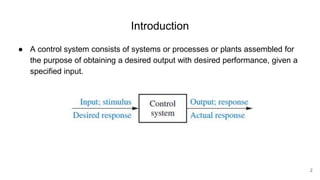
● A control system consists of systems or processes or plants assembled for
the purpose of obtaining a desired output with desired performance, given a
specified input.
2
Example - Elevator Control
● For example, consider an elevator.When the fourth-floor button is pressed on
the first floor, the elevator rises to the fourth floor with a speed and floor
leveling accuracy designed for passenger comfort.
● Two major measures of performance are apparent: the transient response and the
steady-state error.
○ The push of the fourth-floor button is an input that represents our desired output.
○ The performance of the elevator can be seen from the elevator response.
○ In our example, passenger comfort and passenger patience are dependent upon
the transient response.
■ If this response is too fast, passenger comfort is sacrificed; if too slow, passenger
patience is sacrificed.
■ The steady-state error is another important performance specification since passenger
safety and convenience would be sacrificed if the elevator did not level properly.
3
Applications of Control Systems
● Control systems are an integral part of modern society. Numerous
applications are all around, some examples are:
○ Rockets fire
○ Space shuttle lifts off to earth orbit
○ Splashing cooling water, a metallic part is automatically machined
○ Self-guided vehicle delivering material to workstations in an aerospace assembly
plant glides along the floor seeking its destination.
4
Natural Control System
● Within our own bodies are numerous control systems, such as:
○ The pancreas, which regulates our blood sugar.
○ In time of “fight or flight,” our adrenaline increases along with our heart rate,
causing more oxygen to be delivered to our cells.
○ Our eyes follow a moving object to keep it in view
○ Our hands grasp the object and place it precisely at a predetermined location.
5
Examples of Control Systems
● Drone Control:
○ https://www.youtube.com/watch?v=2BwUMk10WqI
● Elevator Control
○ https://www.youtube.com/watch?v=CvY-G2FTbGM
● Communication based train Control System
○ https://www.mobility.siemens.com/global/en/portfolio/rail/automation/automatic-
train-control/communications-based-train-control-system.html
● Moving Block Train Control System
○ https://www.youtube.com/watch?v=a52ZSCIAoRk
6
Objectives of Control Systems
● Some of the reasons for control systems:
○ Remote control
○ Convenience of input form
○ Compensation for disturbances
○ Achieving stability
7
Components of Control System
● Input or Reference
● Input transducer
● Error or Actuating Signals
● Amplifier
● Controller
● Process/ Plant
● Disturbance
● Summing Junction
● Output Actuators/ transducer
● Feedback Amplifier
● Output or Controlled variable
8
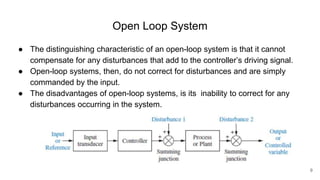
Open Loop System
● The distinguishing characteristic of an open-loop system is that it cannot
compensate for any disturbances that add to the controller’s driving signal.
● Open-loop systems, then, do not correct for disturbances and are simply
commanded by the input.
● The disadvantages of open-loop systems, is its inability to correct for any
disturbances occurring in the system.
9
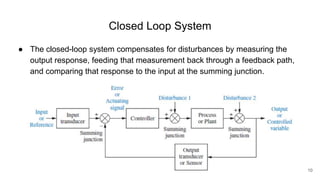
Closed Loop System
● The closed-loop system compensates for disturbances by measuring the
output response, feeding that measurement back through a feedback path,
and comparing that response to the input at the summing junction.
10
Closed Loop System
● Closed-loop systems, have the obvious advantage of greater accuracy than
open-loop systems. They are less sensitive to noise, disturbances, and
changes in the environment.
● On the other hand, closed-loop systems are more complex and expensive
than open-loop systems.
11
Objectives of Control System
● Two main objectives of study of control system:- Analysis and Design
● Analysis is the process by which a system’s performance is determined.
● Design is the process by which a system’s performance is created or
changed.
● To satisfy either following parameters will be studied:
○ Transient Response - Output variation when input changes
○ Steady State Response - stability of the output
12
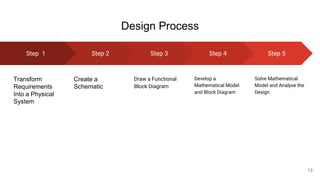
Design Process
Step 1
Transform
Requirements
Into a Physical
System
Step 2
Create a
Schematic
Step 3
Draw a Functional
Block Diagram
Step 5
Solve Mathematical
Model and Analyse the
Design
Step 4
Develop a
Mathematical Model
and Block Diagram
13
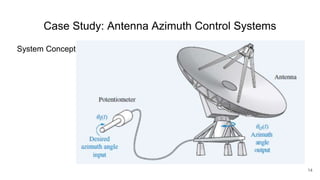
Case Study: Antenna Azimuth Control Systems
System Concept
14
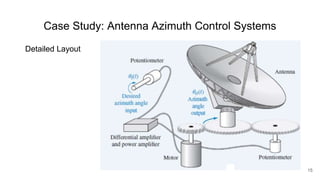
Case Study: Antenna Azimuth Control Systems
Detailed Layout
15
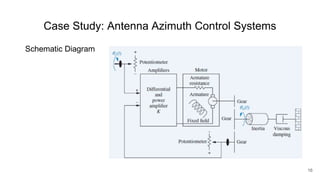
Case Study: Antenna Azimuth Control Systems
Schematic Diagram
16
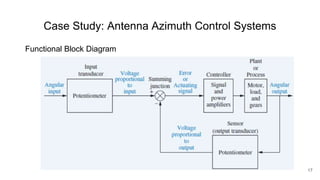
Case Study: Antenna Azimuth Control Systems
Functional Block Diagram
17
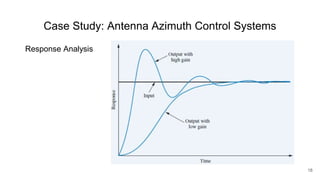
Case Study: Antenna Azimuth Control Systems
Response Analysis
18

introduction_to_linear_control_systems.pptx

  • 1.
  • 2.
    Introduction ● A controlsystem consists of systems or processes or plants assembled for the purpose of obtaining a desired output with desired performance, given a specified input. 2
  • 3.
    Example - ElevatorControl ● For example, consider an elevator.When the fourth-floor button is pressed on the first floor, the elevator rises to the fourth floor with a speed and floor leveling accuracy designed for passenger comfort. ● Two major measures of performance are apparent: the transient response and the steady-state error. ○ The push of the fourth-floor button is an input that represents our desired output. ○ The performance of the elevator can be seen from the elevator response. ○ In our example, passenger comfort and passenger patience are dependent upon the transient response. ■ If this response is too fast, passenger comfort is sacrificed; if too slow, passenger patience is sacrificed. ■ The steady-state error is another important performance specification since passenger safety and convenience would be sacrificed if the elevator did not level properly. 3
  • 4.
    Applications of ControlSystems ● Control systems are an integral part of modern society. Numerous applications are all around, some examples are: ○ Rockets fire ○ Space shuttle lifts off to earth orbit ○ Splashing cooling water, a metallic part is automatically machined ○ Self-guided vehicle delivering material to workstations in an aerospace assembly plant glides along the floor seeking its destination. 4
  • 5.
    Natural Control System ●Within our own bodies are numerous control systems, such as: ○ The pancreas, which regulates our blood sugar. ○ In time of “fight or flight,” our adrenaline increases along with our heart rate, causing more oxygen to be delivered to our cells. ○ Our eyes follow a moving object to keep it in view ○ Our hands grasp the object and place it precisely at a predetermined location. 5
  • 6.
    Examples of ControlSystems ● Drone Control: ○ https://www.youtube.com/watch?v=2BwUMk10WqI ● Elevator Control ○ https://www.youtube.com/watch?v=CvY-G2FTbGM ● Communication based train Control System ○ https://www.mobility.siemens.com/global/en/portfolio/rail/automation/automatic- train-control/communications-based-train-control-system.html ● Moving Block Train Control System ○ https://www.youtube.com/watch?v=a52ZSCIAoRk 6
  • 7.
    Objectives of ControlSystems ● Some of the reasons for control systems: ○ Remote control ○ Convenience of input form ○ Compensation for disturbances ○ Achieving stability 7
  • 8.
    Components of ControlSystem ● Input or Reference ● Input transducer ● Error or Actuating Signals ● Amplifier ● Controller ● Process/ Plant ● Disturbance ● Summing Junction ● Output Actuators/ transducer ● Feedback Amplifier ● Output or Controlled variable 8
  • 9.
    Open Loop System ●The distinguishing characteristic of an open-loop system is that it cannot compensate for any disturbances that add to the controller’s driving signal. ● Open-loop systems, then, do not correct for disturbances and are simply commanded by the input. ● The disadvantages of open-loop systems, is its inability to correct for any disturbances occurring in the system. 9
  • 10.
    Closed Loop System ●The closed-loop system compensates for disturbances by measuring the output response, feeding that measurement back through a feedback path, and comparing that response to the input at the summing junction. 10
  • 11.
    Closed Loop System ●Closed-loop systems, have the obvious advantage of greater accuracy than open-loop systems. They are less sensitive to noise, disturbances, and changes in the environment. ● On the other hand, closed-loop systems are more complex and expensive than open-loop systems. 11
  • 12.
    Objectives of ControlSystem ● Two main objectives of study of control system:- Analysis and Design ● Analysis is the process by which a system’s performance is determined. ● Design is the process by which a system’s performance is created or changed. ● To satisfy either following parameters will be studied: ○ Transient Response - Output variation when input changes ○ Steady State Response - stability of the output 12
  • 13.
    Design Process Step 1 Transform Requirements Intoa Physical System Step 2 Create a Schematic Step 3 Draw a Functional Block Diagram Step 5 Solve Mathematical Model and Analyse the Design Step 4 Develop a Mathematical Model and Block Diagram 13
  • 14.
    Case Study: AntennaAzimuth Control Systems System Concept 14
  • 15.
    Case Study: AntennaAzimuth Control Systems Detailed Layout 15
  • 16.
    Case Study: AntennaAzimuth Control Systems Schematic Diagram 16
  • 17.
    Case Study: AntennaAzimuth Control Systems Functional Block Diagram 17
  • 18.
    Case Study: AntennaAzimuth Control Systems Response Analysis 18