Principle of management
By: RAJ ARYAN BHARDWAJ
MEANING
• A principle refers to a statement which reflect the
fundamental truth about some phenomenon based
on a cause and effect relationship.
Nature of management principle
•Universal application.
•General guidelines.
•Flexibility.
•Based on cause and effect relation.
Principle of management by fayol
• Division of work.
• Authority and responsibility.
• Discipline.
• Unity of command.
• Unity of direction.
• Subordination of individual interest
to general interest.
• Remuneration.
• Centralisation
• Scalar chain.
• order.
• Equity.
• Stability .
• Initiative.
• Esprit de corps.
1. Division of work
Whole work must be divided
in to small task and assigning
the whole work to one
parson one task according to
the capability or qualification.
2. Authority
and
Responsibility
Authority means power to take
decision.
Responsibility means obligation
to complete the job assigned on
time .
3.Descipline
Descipline require good
superior at every level clear and
fair agreement between
superiors and subordinate and
judicious application of
penalties.
4.Unity of command
It means employee should receive
order from one boss only if he is
receiving orders from more than one
boss then he will get confused and
will not be able to understand
That whose order must be exeucated
first
5. Unity of direction
The purpose of unity of direction is
to direct the effort of employees of
one department in achieving the
main objective of that department.
6.Subordination of
individual interest to
general interest
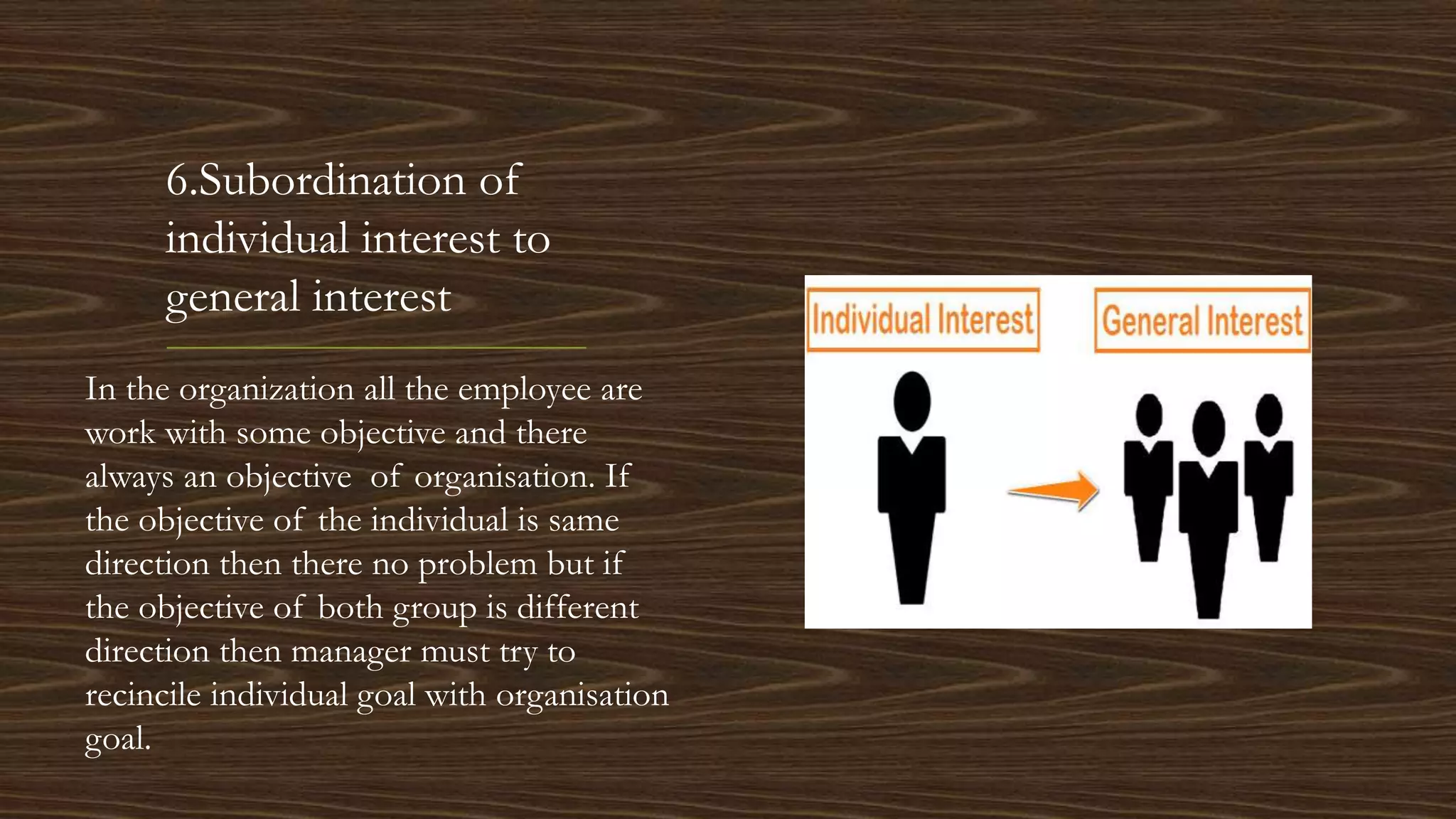
In the organization all the employee are
work with some objective and there
always an objective of organisation. If
the objective of the individual is same
direction then there no problem but if
the objective of both group is different
direction then manager must try to
recincile individual goal with organisation
goal.
7.Remuneration
Remuneration is the price for the
service received .if an
organisation want efficiant
employee and best parformance
than it should have a good
remuneration policy.
8. Centralization
•In centralization authority is concerned only
in a few hand .
9.Scalar chain.
Scalar chain means line of
authority or chain of superior
from highest to lowest rank.
10.Order
Order refers to the orderly
arrangement of man and
material that is a fixed place
for everything and everyone
in the organisation.
11.Equity.
Equity means no
discrimination on account of
sex ,religion ,cast ,language ,
belief or nationality.
12.Stability
According to this principle
the management must
provide the felling of job
security among the
employees.
13.Initiative .
Initiative refers to the first
step with self motivation. it
means managers must
welcome the suggestion and
ideas of the employee before
framing the plan
14.Esprit de corps.
It means management
must encourage and
promote team sprit
,unity , and harmony
in organisation.
Principle of management

Principle of management

  • 1.
    Principle of management By:RAJ ARYAN BHARDWAJ
  • 2.
    MEANING • A principlerefers to a statement which reflect the fundamental truth about some phenomenon based on a cause and effect relationship.
  • 3.
    Nature of managementprinciple •Universal application. •General guidelines. •Flexibility. •Based on cause and effect relation.
  • 4.
    Principle of managementby fayol • Division of work. • Authority and responsibility. • Discipline. • Unity of command. • Unity of direction. • Subordination of individual interest to general interest. • Remuneration. • Centralisation • Scalar chain. • order. • Equity. • Stability . • Initiative. • Esprit de corps.
  • 5.
    1. Division ofwork Whole work must be divided in to small task and assigning the whole work to one parson one task according to the capability or qualification.
  • 6.
    2. Authority and Responsibility Authority meanspower to take decision. Responsibility means obligation to complete the job assigned on time .
  • 7.
    3.Descipline Descipline require good superiorat every level clear and fair agreement between superiors and subordinate and judicious application of penalties.
  • 8.
    4.Unity of command Itmeans employee should receive order from one boss only if he is receiving orders from more than one boss then he will get confused and will not be able to understand That whose order must be exeucated first
  • 9.
    5. Unity ofdirection The purpose of unity of direction is to direct the effort of employees of one department in achieving the main objective of that department.
  • 10.
    6.Subordination of individual interestto general interest In the organization all the employee are work with some objective and there always an objective of organisation. If the objective of the individual is same direction then there no problem but if the objective of both group is different direction then manager must try to recincile individual goal with organisation goal.
  • 11.
    7.Remuneration Remuneration is theprice for the service received .if an organisation want efficiant employee and best parformance than it should have a good remuneration policy.
  • 12.
    8. Centralization •In centralizationauthority is concerned only in a few hand .
  • 13.
    9.Scalar chain. Scalar chainmeans line of authority or chain of superior from highest to lowest rank.
  • 14.
    10.Order Order refers tothe orderly arrangement of man and material that is a fixed place for everything and everyone in the organisation.
  • 15.
    11.Equity. Equity means no discriminationon account of sex ,religion ,cast ,language , belief or nationality.
  • 16.
    12.Stability According to thisprinciple the management must provide the felling of job security among the employees.
  • 17.
    13.Initiative . Initiative refersto the first step with self motivation. it means managers must welcome the suggestion and ideas of the employee before framing the plan
  • 18.
    14.Esprit de corps. Itmeans management must encourage and promote team sprit ,unity , and harmony in organisation.