Presented By:
 Varsha Sharma
Location and Geography
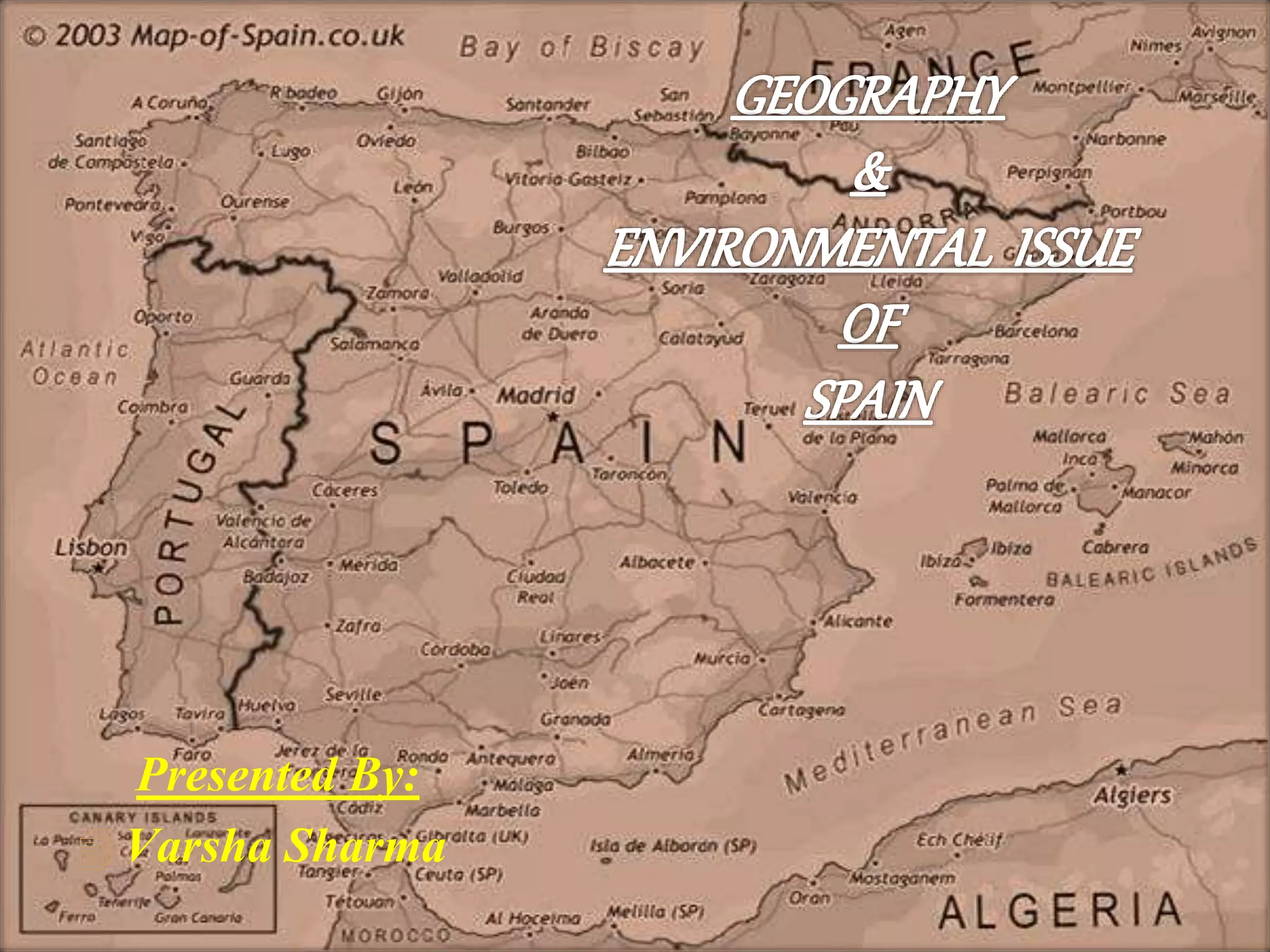
Spain is located on the Iberian
Peninsula.
Its total area is : 505,370 sq km
It is in the southwest of Europe.
It is the Second largest Country
in Western Europe.
 Gibraltar is a waterway that
separates Spain from Africa.
Geography
Spain's boundaries: 88% of the Boundaries of Spain is
connected with Water(Mediterranean Sea and
Atlantic Ocean). The Cantabrian Sea is to the north,
the Mediterranean Sea to the south-southeast,
Portugal and the Atlantic Ocean to the west, and
France and Andorra to the northeast.
Much of central Spain is covered by plateau
surrounded by mountain ranges.
Location
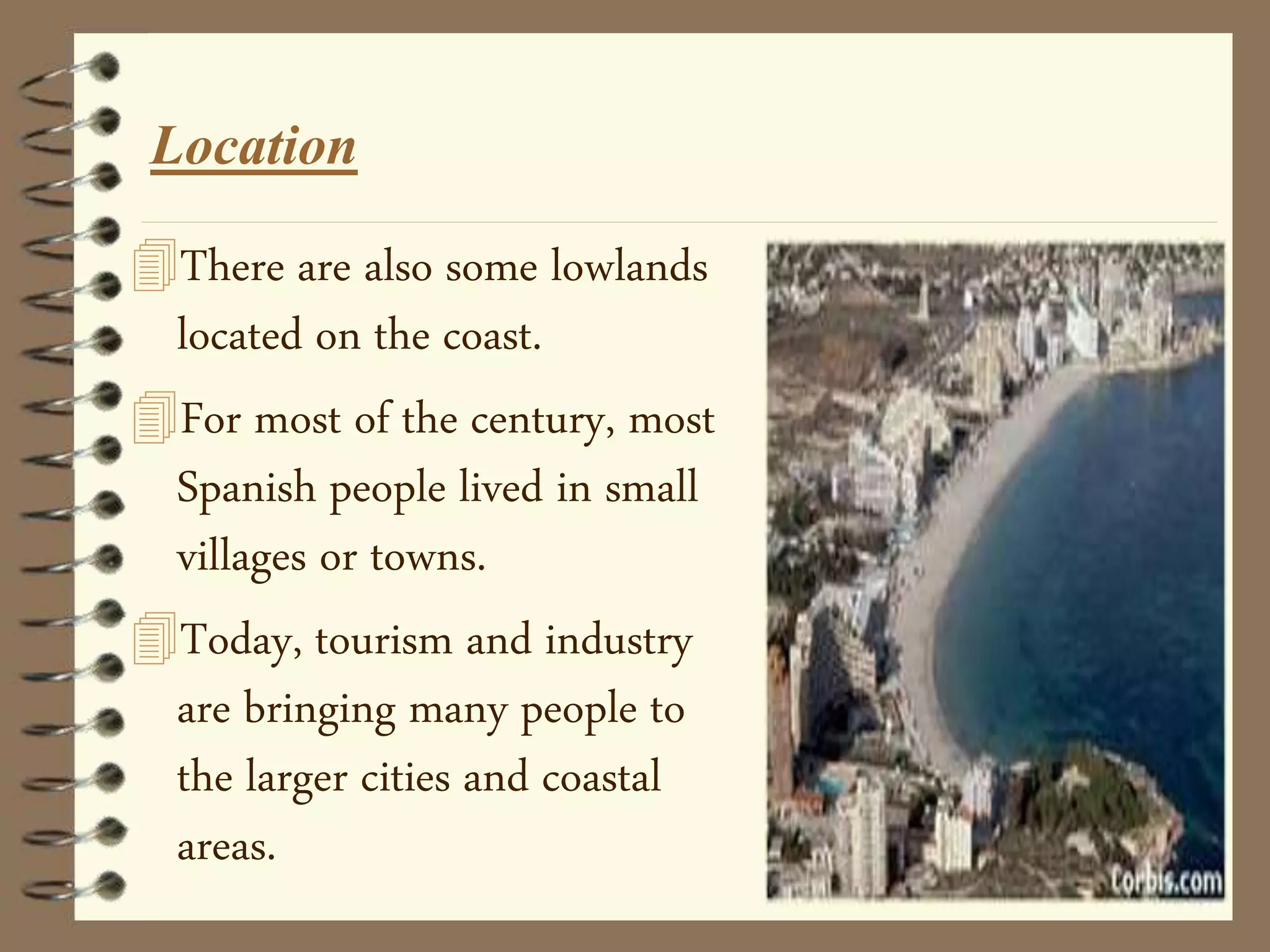
There are also some lowlands
located on the coast.
For most of the century, most
Spanish people lived in small
villages or towns.
Today, tourism and industry
are bringing many people to
the larger cities and coastal
areas.
People and Society
Nationality:
Noun: Spaniard(s)
Adjective: Spanish
Ethnic groups: Composite of Mediterranean and Nordic types.
Languages: Castilian Spanish (official) 74 percent, Catalan 17
percent, Galician 7 percent, and Basque 2 percent.
Religions: Roman Catholic 94 percent and other 6 percent.
Capital: Madrid
National day:, 12th October
Type of government: Parliamentary monarchy
Demography :
Population47,042,984 (July 2012 est.)
People and Society
Food and Daily life
 A traditional Spanish food, agriculture, animal husbandry and products
of society. Principal items of bread, rice, garden vegetables, cured pork
products, lamb and veal, made from grapes fruits, grapes and wine,
locally available wild plants, fish , and shellfish, olive oil.
 Home honey production scale used today by some of the poorest areas,
cane and beet products have been commercialized. Garden vegetables,
potatoes, peppers, tomatoes, carrots, cabbages and chard, green peas,
asparagus, artichokes and vegetables thistle, zucchini squash, and color
is the most important. The most important vine fruit, grapes and
melons, and in some areas of farming fun.
Basic Economy
 Spain is a pastoral, agricultural, and commercial nation. In the mid-
twentieth century as the country was predominantly rural. Today, more
highly developed industry, and Spain is a member of the European
Economic Community and participates in the global economy.
 Land base and agricultural mechanization, modern agriculture, farmers
in much of the United States voluntary restructuring, the development,
in rural areas lead to migration to the cities of Spain in the twentieth
century to increase significantly.
 Blue and white collar jobs offer farm families and descendants of other
industrial cities after the Second World War with the development of
the industry. Spanish countryside is largely self-sufficient.
Main Industries
 Heavy industry in Spain with investment, since the end of civil war
developed with the input of the United States is in the middle of the
twentieth century.
 Spain's weapons and ammunition manufacturing agricultural
machinery, vehicles, equipment and other types of production are still
important. North and East, Bilbao, Barcelona, Valencia, Madrid,
Zaragoza and the industry is concentrated around major cities.
 Since 1950, Spain's economy , the tourism industry is the most far-
reaching multidimensional development . The number of tourists who
visit Spain each year, Spain's resident population is almost the same.
Hotel, restaurant and tourism and regional formation of
Spain's most important industry -related services, and whose
influence is felt in every corner of the country.
 Some of the growing international demand for Spanish foods
and Spanish wines are growing introduces floodways. Spanish
leather goods, pottery and other crafts a higher and more and
more of the global market.
Main Industries
Business
 Spain, the European Economic Community (Common Market),
and there is a huge business relationships with United States &
Japan. The main export of leather and textile goods with Spain.
The first designated commercial food, ceramic, stone, and tile
commodities, metals, and various types of production equipment
 Perhaps the source of the crude oil and energy dependence at
the expense of Spain’s most important Spanish customers is
high.
Environmental
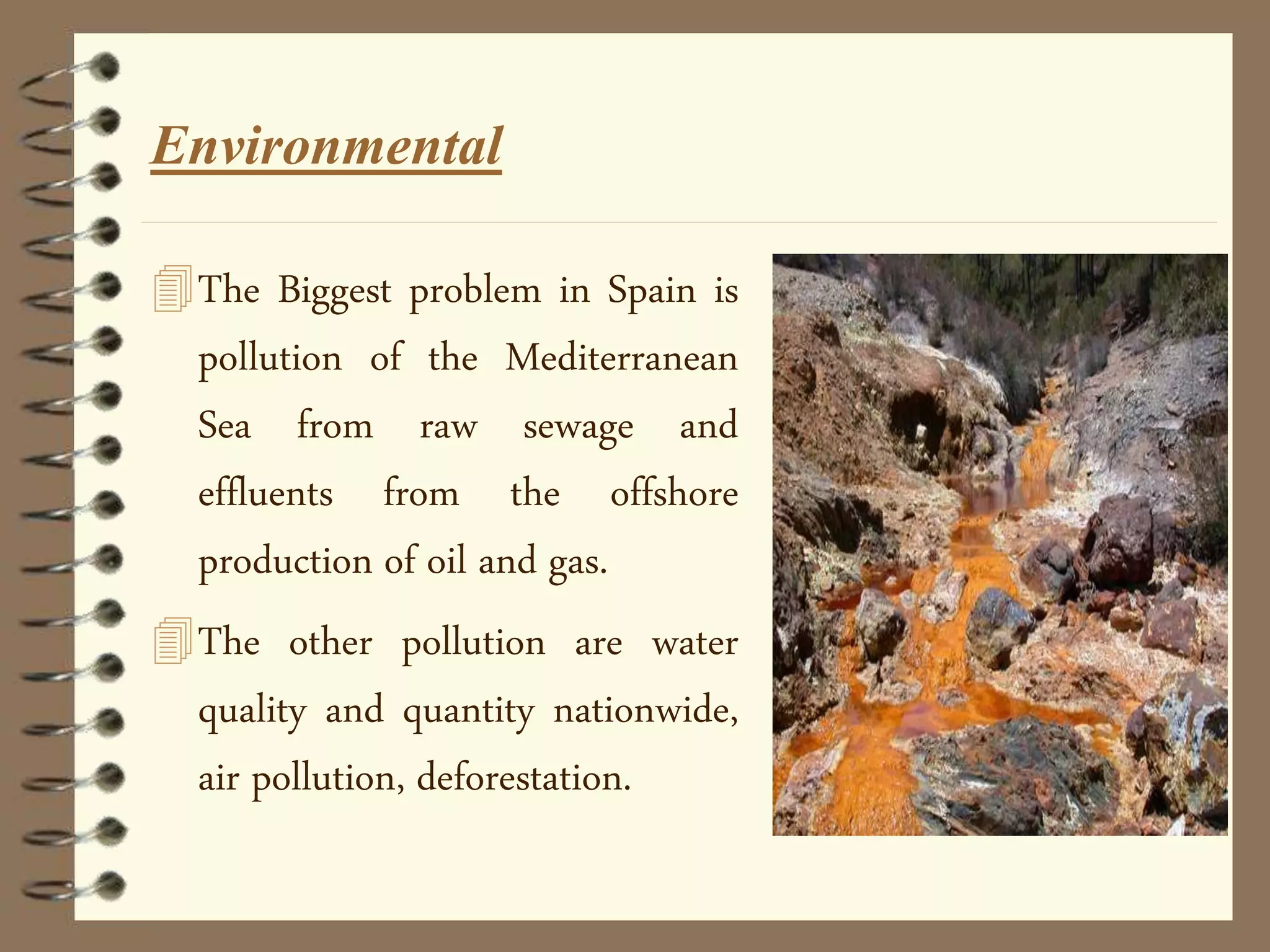
The Biggest problem in Spain is
pollution of the Mediterranean
Sea from raw sewage and
effluents from the offshore
production of oil and gas.
The other pollution are water
quality and quantity nationwide,
air pollution, deforestation.
Other environmental issues of Spain
Desertification
Forest fires in spain
Greenhouse expansion in
almeria
Drought in spain
Spain and asian Bird flu
Glaciers melting in the
Pyrenees
Activities of Spain
Spain has already ratified many agreements focused on marine
issues It has been particularly active in protecting the
Mediterranean Sea.
The Spanish coasts are in some of the world's main
hydrocarbon trade routes, but there is no surveillance system
in place to monitor and track ships that carry out illegal
dumping in Spanish waters.
The European Union (EU) Committee on Transport and
Energy has addressed the problem but no action has been put
into operation because the actions have not been approved.
A further strain has been imposed by the illegal digging of
boreholes which suck water out of the aquifers. There are
estimated to be over 500.000 boreholes in Spain, and every
effort to control them has met with fierce resistance.
Activities of Spain
India Spain
Capital city with
population
New Delhi -
294,149
Madrid -
2,947,228
Precipitation 2,168 mm 456 mm
tallest mountains Kanchenjunga Pico de Teide
GEPGRAPHY STATUS: INDIA VS SPAIN
India Spain
Total Area (Sq.
Km.)
3287260 505370
Population
Density
336.62 people per
Sq. Km.
78.43 people per
Sq. Km.
Largest City Mumbai Madrid
Forest Area (Sq.
Km.)
677598 185066
Rural Population
Density
488.84 people Sq.
Km.
73.81 people Sq.
Km.
Latitude 35’30’N 43’47’N
India Spain
Business
efficiency
59.053 59.43
Economic
importance
2.1 8.1
Income category Low income High income:
OECD
Economic
freedom
1.5 2.65
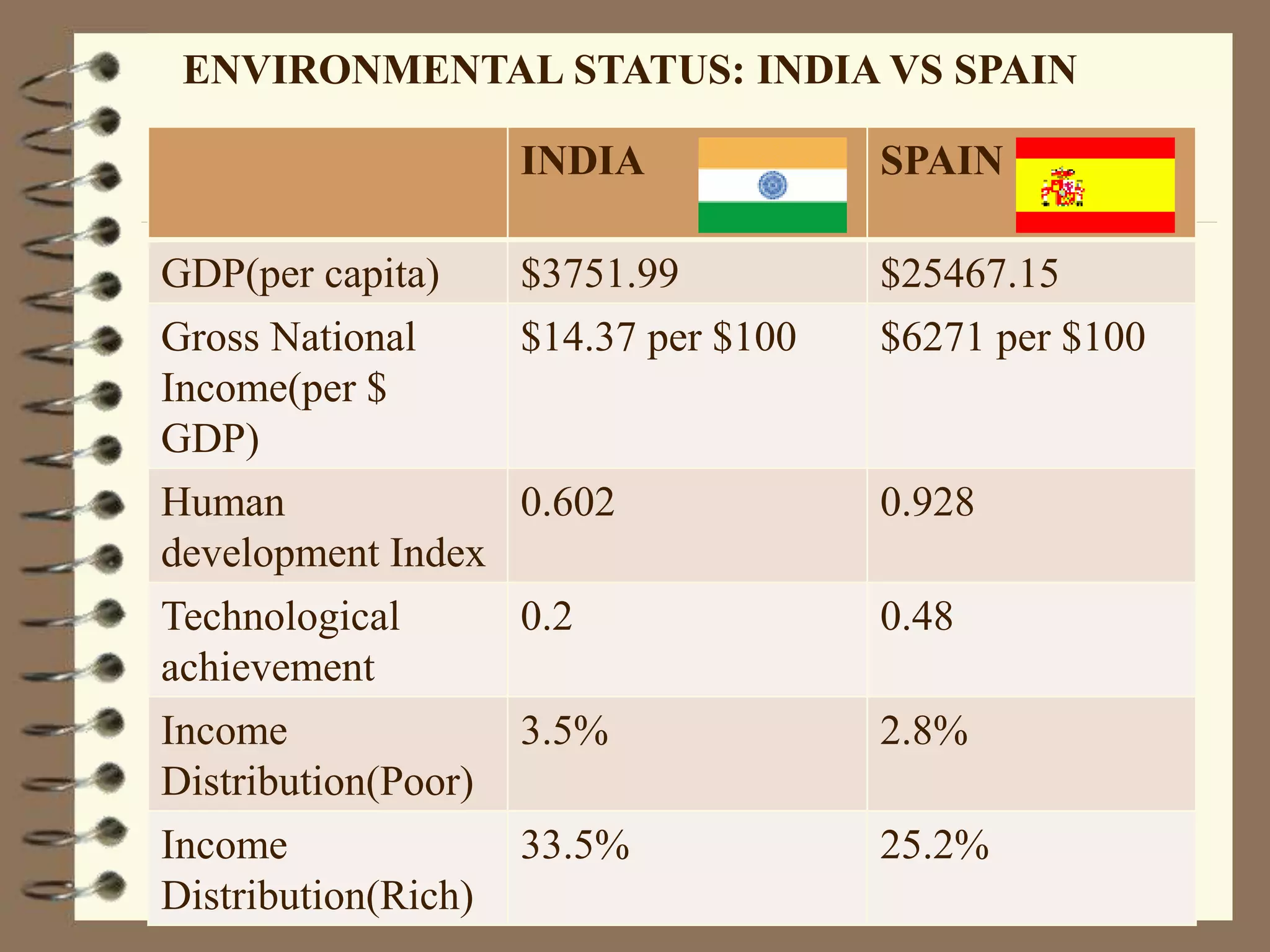
ENVIRONMENTAL STATUS: INDIA VS SPAIN
INDIA SPAIN
GDP(per capita) $3751.99 $25467.15
Gross National
Income(per $
GDP)
$14.37 per $100 $6271 per $100
Human
development Index
0.602 0.928
Technological
achievement
0.2 0.48
Income
Distribution(Poor)
3.5% 2.8%
Income
Distribution(Rich)
33.5% 25.2%
Ppt gcr

Ppt gcr

  • 1.
  • 2.
    Location and Geography Spainis located on the Iberian Peninsula. Its total area is : 505,370 sq km It is in the southwest of Europe. It is the Second largest Country in Western Europe.  Gibraltar is a waterway that separates Spain from Africa.
  • 3.
    Geography Spain's boundaries: 88%of the Boundaries of Spain is connected with Water(Mediterranean Sea and Atlantic Ocean). The Cantabrian Sea is to the north, the Mediterranean Sea to the south-southeast, Portugal and the Atlantic Ocean to the west, and France and Andorra to the northeast. Much of central Spain is covered by plateau surrounded by mountain ranges.
  • 4.
    Location There are alsosome lowlands located on the coast. For most of the century, most Spanish people lived in small villages or towns. Today, tourism and industry are bringing many people to the larger cities and coastal areas.
  • 5.
    People and Society Nationality: Noun:Spaniard(s) Adjective: Spanish Ethnic groups: Composite of Mediterranean and Nordic types. Languages: Castilian Spanish (official) 74 percent, Catalan 17 percent, Galician 7 percent, and Basque 2 percent. Religions: Roman Catholic 94 percent and other 6 percent.
  • 6.
    Capital: Madrid National day:,12th October Type of government: Parliamentary monarchy Demography : Population47,042,984 (July 2012 est.) People and Society
  • 7.
    Food and Dailylife  A traditional Spanish food, agriculture, animal husbandry and products of society. Principal items of bread, rice, garden vegetables, cured pork products, lamb and veal, made from grapes fruits, grapes and wine, locally available wild plants, fish , and shellfish, olive oil.  Home honey production scale used today by some of the poorest areas, cane and beet products have been commercialized. Garden vegetables, potatoes, peppers, tomatoes, carrots, cabbages and chard, green peas, asparagus, artichokes and vegetables thistle, zucchini squash, and color is the most important. The most important vine fruit, grapes and melons, and in some areas of farming fun.
  • 8.
    Basic Economy  Spainis a pastoral, agricultural, and commercial nation. In the mid- twentieth century as the country was predominantly rural. Today, more highly developed industry, and Spain is a member of the European Economic Community and participates in the global economy.  Land base and agricultural mechanization, modern agriculture, farmers in much of the United States voluntary restructuring, the development, in rural areas lead to migration to the cities of Spain in the twentieth century to increase significantly.  Blue and white collar jobs offer farm families and descendants of other industrial cities after the Second World War with the development of the industry. Spanish countryside is largely self-sufficient.
  • 9.
    Main Industries  Heavyindustry in Spain with investment, since the end of civil war developed with the input of the United States is in the middle of the twentieth century.  Spain's weapons and ammunition manufacturing agricultural machinery, vehicles, equipment and other types of production are still important. North and East, Bilbao, Barcelona, Valencia, Madrid, Zaragoza and the industry is concentrated around major cities.  Since 1950, Spain's economy , the tourism industry is the most far- reaching multidimensional development . The number of tourists who visit Spain each year, Spain's resident population is almost the same.
  • 10.
    Hotel, restaurant andtourism and regional formation of Spain's most important industry -related services, and whose influence is felt in every corner of the country.  Some of the growing international demand for Spanish foods and Spanish wines are growing introduces floodways. Spanish leather goods, pottery and other crafts a higher and more and more of the global market. Main Industries
  • 11.
    Business  Spain, theEuropean Economic Community (Common Market), and there is a huge business relationships with United States & Japan. The main export of leather and textile goods with Spain. The first designated commercial food, ceramic, stone, and tile commodities, metals, and various types of production equipment  Perhaps the source of the crude oil and energy dependence at the expense of Spain’s most important Spanish customers is high.
  • 12.
    Environmental The Biggest problemin Spain is pollution of the Mediterranean Sea from raw sewage and effluents from the offshore production of oil and gas. The other pollution are water quality and quantity nationwide, air pollution, deforestation.
  • 13.
    Other environmental issuesof Spain Desertification Forest fires in spain Greenhouse expansion in almeria Drought in spain Spain and asian Bird flu Glaciers melting in the Pyrenees
  • 14.
    Activities of Spain Spainhas already ratified many agreements focused on marine issues It has been particularly active in protecting the Mediterranean Sea. The Spanish coasts are in some of the world's main hydrocarbon trade routes, but there is no surveillance system in place to monitor and track ships that carry out illegal dumping in Spanish waters.
  • 15.
    The European Union(EU) Committee on Transport and Energy has addressed the problem but no action has been put into operation because the actions have not been approved. A further strain has been imposed by the illegal digging of boreholes which suck water out of the aquifers. There are estimated to be over 500.000 boreholes in Spain, and every effort to control them has met with fierce resistance. Activities of Spain
  • 16.
    India Spain Capital citywith population New Delhi - 294,149 Madrid - 2,947,228 Precipitation 2,168 mm 456 mm tallest mountains Kanchenjunga Pico de Teide GEPGRAPHY STATUS: INDIA VS SPAIN
  • 17.
    GEPGRAPHY STATUS: INDIAVS SPAIN India Spain Total Area (Sq. Km.) 3287260 505370 Population Density 336.62 people per Sq. Km. 78.43 people per Sq. Km. Largest City Mumbai Madrid Forest Area (Sq. Km.) 677598 185066 Rural Population Density 488.84 people Sq. Km. 73.81 people Sq. Km. Latitude 35’30’N 43’47’N
  • 18.
    India Spain Business efficiency 59.053 59.43 Economic importance 2.18.1 Income category Low income High income: OECD Economic freedom 1.5 2.65 ENVIRONMENTAL STATUS: INDIA VS SPAIN
  • 19.
    ENVIRONMENTAL STATUS: INDIAVS SPAIN INDIA SPAIN GDP(per capita) $3751.99 $25467.15 Gross National Income(per $ GDP) $14.37 per $100 $6271 per $100 Human development Index 0.602 0.928 Technological achievement 0.2 0.48 Income Distribution(Poor) 3.5% 2.8% Income Distribution(Rich) 33.5% 25.2%