TBILISI STATE MEDICAL
UNIVERSITY
By
Goran Baiz
Supervised by
Prof Lewan
HEALTHCARE
It is defined as multiple services rendered to
individuals, families or communities by the agentsof
health services or professionals for the purpose of
promoting, maintaining, monitoring or restoring
health.
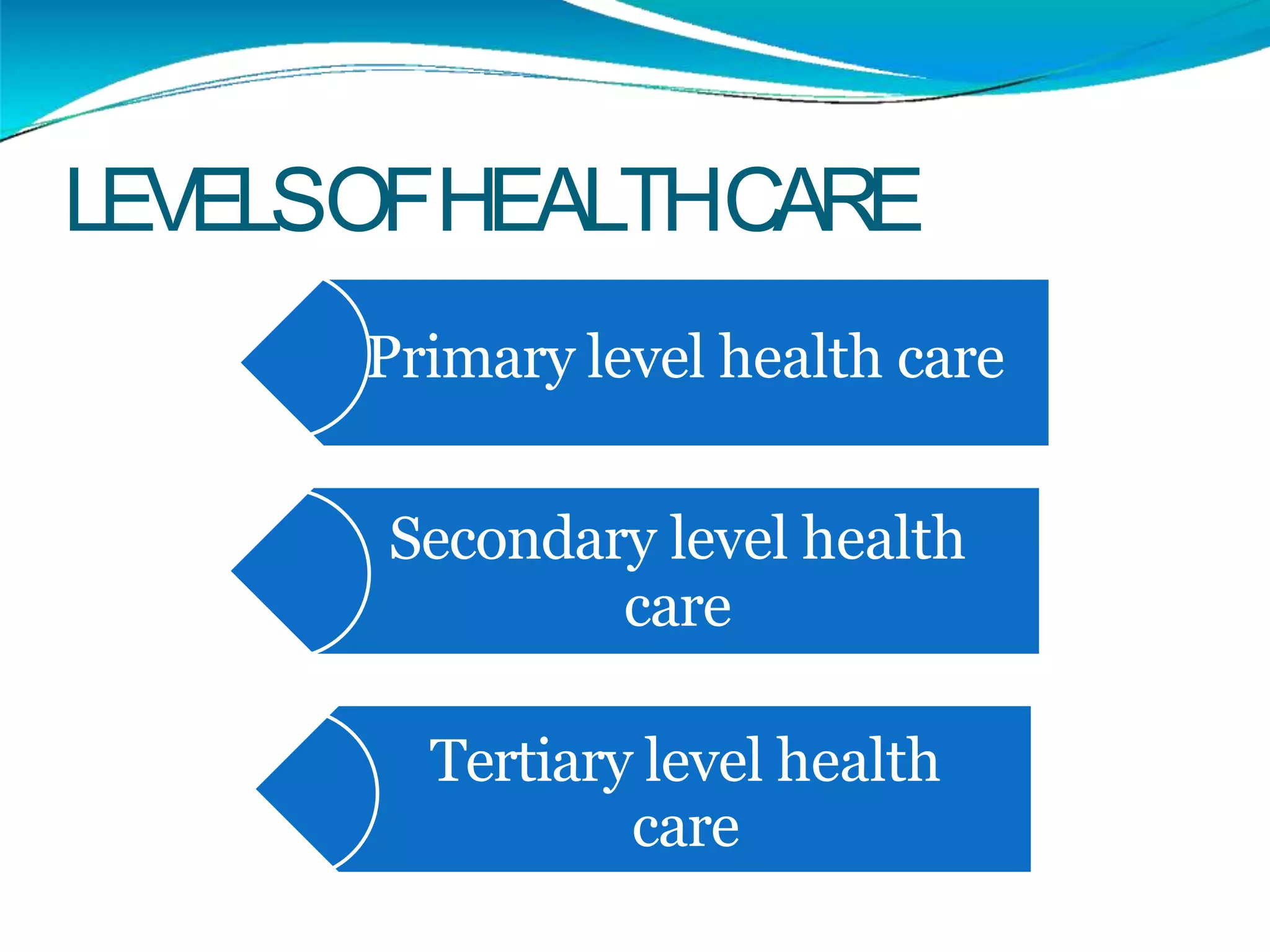
LEVELSOFHEALTHCARE
Primary level health care
Secondary level health
care
Tertiary level health
care
PRIMARYHEALTHCARE
This is the first level of contact between the recipient
of care and the health care delivery system. Majorityof
the problems at this level are solved by the people with
some assistance and guidance of healthworkers.
In rural area these services are given by the means of
sub centres, PHC and CHC.
In urban areas these services are given by maternal
child health and family welfare centres and
dispensaries.
SECONDARYLEVELHEALTHCARE
At this level more complex problems are taken care
mostly which require secondary level of preventive
services and curativeservices.
These services are provided at district health centres/
hospitals.
Those cases which cannot be handled atPHC or CHC
are referred to district health centres.
TERTIARYLEVELHEALTHCARE
This level of health care is provided at the
state/regional/central level institutions.
These institutions serve as a referral units for primary
and secondary levels.
They also serve as a teaching institution for education
and training of various categories of health care
professionals.
PRIMARYHEALTHCARE
Primary health care is essential health care and
technology based on practical scientifically sound and
social acceptable methods and technology made
universally accessible to individuals and families inthe
community by means acceptable to them, through
their full participation and at the cost that the
community and country canafford.
CONCEPT
The concept of primary health care was introduced at
international level jointly by WHO and UNICEF at the
Alma Atta conference in 1978to achieve the goal of
HFAby the year 2000A.D
PRINCIPLES
Equitable distribution
Coverage and accessibility
Community participation
Multi sectoral approach
Appropriate health technology
Contd........
Human resource
Services by community healthworker
Referral system
Logistics of supply
The physical facilities
Control and evaluation
EQUITABLE DISTRIBUTION:
it means primary health care services
must be share equally by all thepeople.
COVERAGEAND ACCESSIBILITY: Primary health
care aims to provide health care to all thepopulation
living in any geographical area.
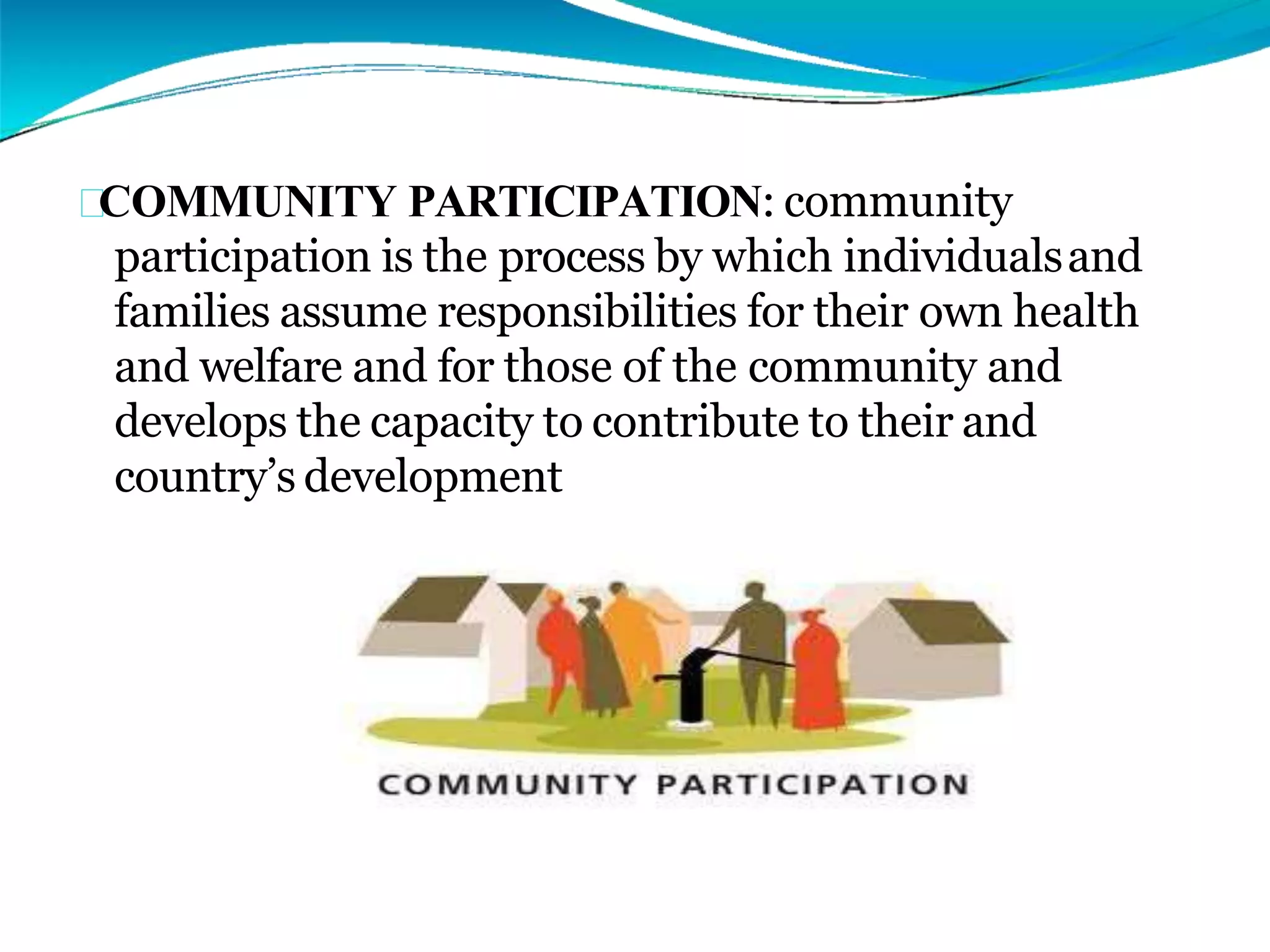
COMMUNITY PARTICIPATION: community
participation is the process by which individualsand
families assume responsibilities for their own health
and welfare and for those of the community and
develops the capacity to contribute to their and
country’s development
MULTISECTORALAPPROACH: For achieving the
goals co-ordination with the other sectors isnecessary
because no sector can achieve its goals inisolation.
APPROPRIATE HEALTHTECHNOLOGY: it implies
the use of methods, techniques and equipmentswhich
are scientifically sound but simple.
HUMAN RESOURCE: for the effective
implementation of primary health care , it is essential
to make full use of all the available resourcesincluding
the human potential of all the country.
SERVICESBYCOMMUNITY HEALTH WORKER:
community health workers form a link between the
community people and the health system. They are
given short and simple training to be able to take care
of the simple and basic health needs of the people.
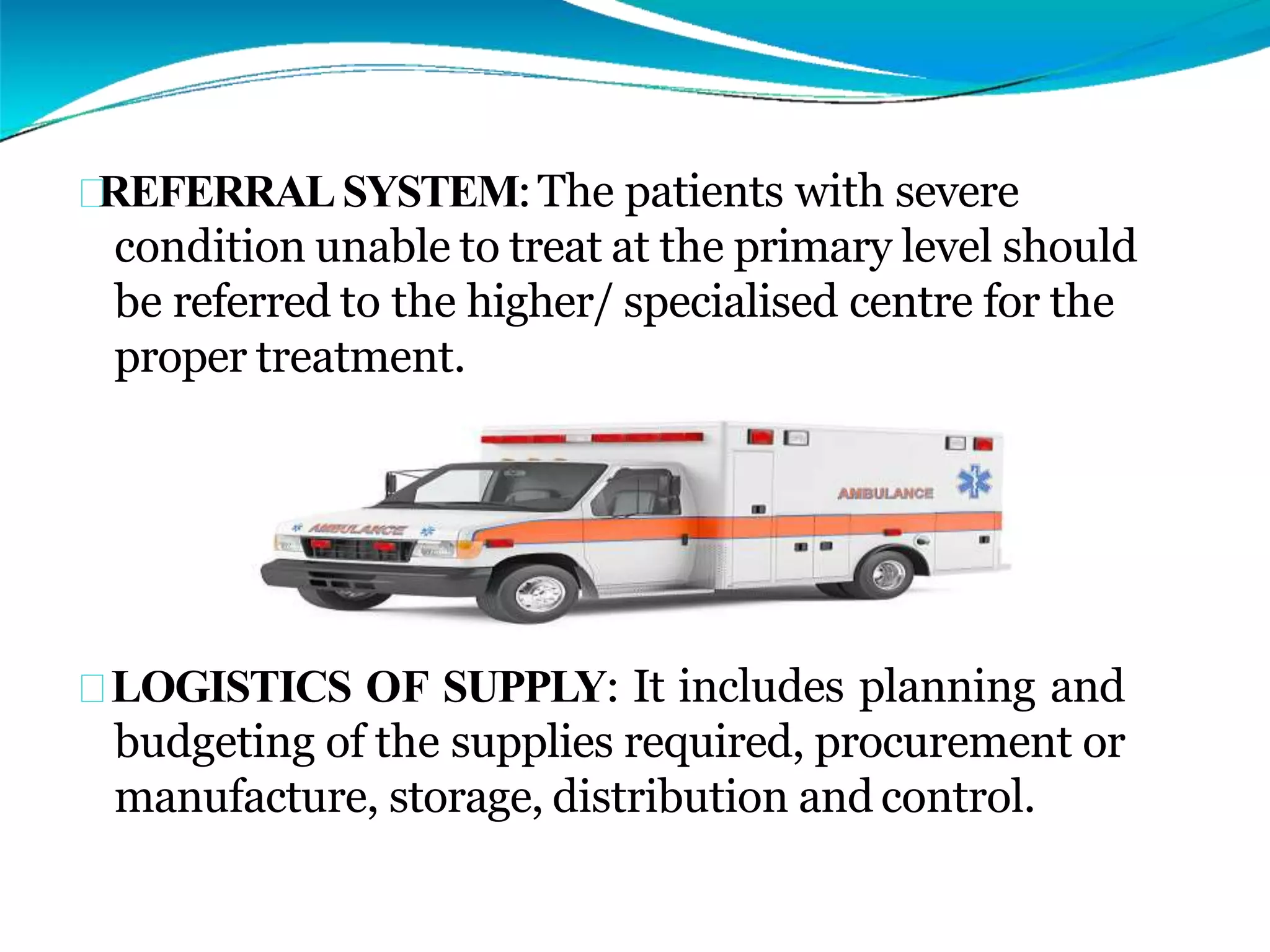
REFERRALSYSTEM:The patients with severe
condition unable to treat at the primary level should
be referred to the higher/ specialised centre for the
proper treatment.
LOGISTICS OF SUPPLY: It includes planning and
budgeting of the supplies required, procurement or
manufacture, storage, distribution and control.
ELEMENTSOFPRIMARY
HEALTHCARE
Education to the people concerning prevailing health
problems and methods of preventing and controlling
them.
Promotion of food supply and propernutrition
Adequate supply of safe water and basicsanitation
Maternal and child health care and family planning
Immunization against the major infectious diseases
Prevention and control of locally endemicdisease
Contd...
Appropriate treatment of common diseases andinjury
Provision of essential drugs
Referenses
Daviddsons prinseple of medicine
Myo clinic website
WHO infor
primary health care

primary health care

  • 1.
    TBILISI STATE MEDICAL UNIVERSITY By GoranBaiz Supervised by Prof Lewan
  • 2.
    HEALTHCARE It is definedas multiple services rendered to individuals, families or communities by the agentsof health services or professionals for the purpose of promoting, maintaining, monitoring or restoring health.
  • 3.
    LEVELSOFHEALTHCARE Primary level healthcare Secondary level health care Tertiary level health care
  • 4.
    PRIMARYHEALTHCARE This is thefirst level of contact between the recipient of care and the health care delivery system. Majorityof the problems at this level are solved by the people with some assistance and guidance of healthworkers. In rural area these services are given by the means of sub centres, PHC and CHC. In urban areas these services are given by maternal child health and family welfare centres and dispensaries.
  • 5.
    SECONDARYLEVELHEALTHCARE At this levelmore complex problems are taken care mostly which require secondary level of preventive services and curativeservices. These services are provided at district health centres/ hospitals. Those cases which cannot be handled atPHC or CHC are referred to district health centres.
  • 6.
    TERTIARYLEVELHEALTHCARE This level ofhealth care is provided at the state/regional/central level institutions. These institutions serve as a referral units for primary and secondary levels. They also serve as a teaching institution for education and training of various categories of health care professionals.
  • 7.
    PRIMARYHEALTHCARE Primary health careis essential health care and technology based on practical scientifically sound and social acceptable methods and technology made universally accessible to individuals and families inthe community by means acceptable to them, through their full participation and at the cost that the community and country canafford.
  • 8.
    CONCEPT The concept ofprimary health care was introduced at international level jointly by WHO and UNICEF at the Alma Atta conference in 1978to achieve the goal of HFAby the year 2000A.D
  • 9.
    PRINCIPLES Equitable distribution Coverage andaccessibility Community participation Multi sectoral approach Appropriate health technology
  • 10.
    Contd........ Human resource Services bycommunity healthworker Referral system Logistics of supply The physical facilities Control and evaluation
  • 11.
    EQUITABLE DISTRIBUTION: it meansprimary health care services must be share equally by all thepeople. COVERAGEAND ACCESSIBILITY: Primary health care aims to provide health care to all thepopulation living in any geographical area.
  • 12.
    COMMUNITY PARTICIPATION: community participationis the process by which individualsand families assume responsibilities for their own health and welfare and for those of the community and develops the capacity to contribute to their and country’s development
  • 13.
    MULTISECTORALAPPROACH: For achievingthe goals co-ordination with the other sectors isnecessary because no sector can achieve its goals inisolation. APPROPRIATE HEALTHTECHNOLOGY: it implies the use of methods, techniques and equipmentswhich are scientifically sound but simple.
  • 14.
    HUMAN RESOURCE: forthe effective implementation of primary health care , it is essential to make full use of all the available resourcesincluding the human potential of all the country. SERVICESBYCOMMUNITY HEALTH WORKER: community health workers form a link between the community people and the health system. They are given short and simple training to be able to take care of the simple and basic health needs of the people.
  • 15.
    REFERRALSYSTEM:The patients withsevere condition unable to treat at the primary level should be referred to the higher/ specialised centre for the proper treatment. LOGISTICS OF SUPPLY: It includes planning and budgeting of the supplies required, procurement or manufacture, storage, distribution and control.
  • 16.
    ELEMENTSOFPRIMARY HEALTHCARE Education to thepeople concerning prevailing health problems and methods of preventing and controlling them. Promotion of food supply and propernutrition Adequate supply of safe water and basicsanitation Maternal and child health care and family planning Immunization against the major infectious diseases Prevention and control of locally endemicdisease
  • 17.
    Contd... Appropriate treatment ofcommon diseases andinjury Provision of essential drugs
  • 18.
    Referenses Daviddsons prinseple ofmedicine Myo clinic website WHO infor