Compiled by:
Datta, Oindreela
Dutt, Sabyasachi
Kaur, Gagandeep
Kaur, Sandeep
Patel, Sagar
Spratt, Charles
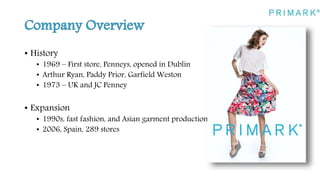
• History
• 1969 – First store, Penneys, opened in Dublin
• Arthur Ryan, Paddy Prior, Garfield Weston
• 1973 – UK and JC Penney
• Expansion
• 1990s, fast fashion, and Asian garment production
• 2006, Spain, 289 stores
STRENGTHS
Fast fashion retailer offering affordable trendy
apparel, accessories
Good supply chain policy and has started to pay
workers a living wage
Marketing plan includes extensive use of social
media
Offers products that suit lifestyles such as fitness
apparel and homeware
WEAKNESSES
Stores cluttered with lots of displays and racks
of clothing. Daunting for first time buyers
Lower price implies lower quality; no sign of
exclusivity
Lack of e-commerce website
Targets only the younger age group
THREATS
Other brands similar to Primark offer similar low
quality, low priced apparel ex: H&M, Forever 21
Lack of interactive shopping experience
Consumers are slow to accept new entrants in the
market space. Ex: Target
Challenge to find affordable retail space that
complements Primark’s low prices
OPPORTUNITIES
Launch e-commerce website
Improve layout of store and in – store experience
Develop product lines for older markets
Use celebrity endorsements to grab North American
shoppers’ attention
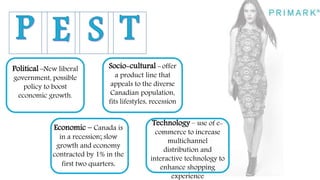
Political –New liberal
government, possible
policy to boost
economic growth.
Socio-cultural – offer
a product line that
appeals to the diverse
Canadian population,
fits lifestyles, recession
Economic – Canada is
in a recession; slow
growth and economy
contracted by 1% in the
first two quarters.
Technology – use of e-
commerce to increase
multichannel
distribution and
interactive technology to
enhance shopping
experience
• Set up costs are high for new companies
Threat of new entrant
• Supplier power is low because Primark
has good relationship with suppliers and
seeks lowest ones
Supplier Power
• Buyers have a lot to choose from due to presence of
many retailers offering low cost, trendy clothing so
their ability to switch to another competitor is high
Buyer Power
• Chances of another retailer offering the same type
of product is moderate, Primark also sells
homeware and confectionery
Threat of substitution
• Presence of other fast fashion retailers means there
is moderate rivalry based on the low cost, trendy
fashion business model
Competitive Rivalry
• Canadian Apparel and Footwear market have
growth by 14.9% in last 5 years.
• Primark’s success in international market.
• Primark’s entry in American Apparel market.
 Cost leadership and product leadership
 Major target Millennials and people
earning under $25000 annually
 Competitors target market
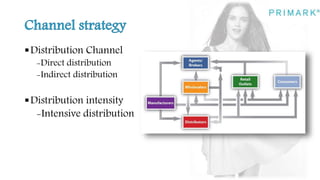
Distribution Channel
-Direct distribution
-Indirect distribution
Distribution intensity
-Intensive distribution
• Positioning- Fast fashion, rock bottom prices
• Market segments- vary widely- adolescents to parents
• Marketing strategy key- core segments- Zara, Gap, H&M
• Comparable quality, lower prices
• Avg. women’s product- £10.69 GBP, H&M- £3.87
• Competitive Advantage
• Low prices, low costs- manufacturing, advertising, personnel
• Comparable products to competitors
 Fashionable apparel- all categories- lowest prices
 More progressive mission statement
 Bangladesh, 2013
 Promoting wasteful, throw away culture
 Competitively priced apparel
 Sustainable environmental and social effects
 Highly focused and coordinated
 Marketing Strategies are practical
 Stress on collecting accurate data
 Timely implementation of all marketing
policies and strategic plans
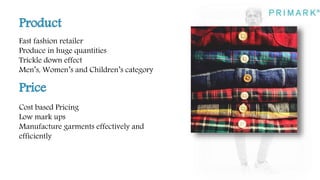
Fast fashion retailer
Produce in huge quantities
Trickle down effect
Men’s, Women’s and Children’s category
Cost based Pricing
Low mark ups
Manufacture garments effectively and
efficiently
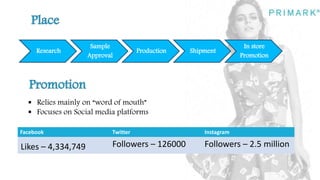
 Relies mainly on “word of mouth”
 Focuses on Social media platforms
Research
Sample
Approval
Production Shipment
In store
Promotion
Facebook Twitter Instagram
Likes – 4,334,749 Followers – 126000 Followers – 2.5 million
 Competitive and Dynamic
 Competitors Today and Tomorrow
 New brands
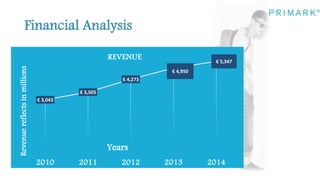
€ 3,043
€ 3,503
€ 4,273
€ 4,950
€ 5,347
2010 2011 2012 2013 2014
Revenuereflectsinmillions
Years
REVENUE
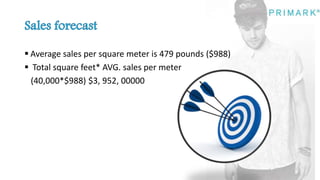
 Average sales per square meter is 479 pounds ($988)
 Total square feet* AVG. sales per meter
(40,000*$988) $3, 952, 00000
 Precise Planning
 Minimum investment
 Strategic alliance
 Research on buying and spending habits
primark ppt (1)

primark ppt (1)

  • 1.
    Compiled by: Datta, Oindreela Dutt,Sabyasachi Kaur, Gagandeep Kaur, Sandeep Patel, Sagar Spratt, Charles
  • 3.
    • History • 1969– First store, Penneys, opened in Dublin • Arthur Ryan, Paddy Prior, Garfield Weston • 1973 – UK and JC Penney • Expansion • 1990s, fast fashion, and Asian garment production • 2006, Spain, 289 stores
  • 4.
    STRENGTHS Fast fashion retaileroffering affordable trendy apparel, accessories Good supply chain policy and has started to pay workers a living wage Marketing plan includes extensive use of social media Offers products that suit lifestyles such as fitness apparel and homeware WEAKNESSES Stores cluttered with lots of displays and racks of clothing. Daunting for first time buyers Lower price implies lower quality; no sign of exclusivity Lack of e-commerce website Targets only the younger age group
  • 5.
    THREATS Other brands similarto Primark offer similar low quality, low priced apparel ex: H&M, Forever 21 Lack of interactive shopping experience Consumers are slow to accept new entrants in the market space. Ex: Target Challenge to find affordable retail space that complements Primark’s low prices OPPORTUNITIES Launch e-commerce website Improve layout of store and in – store experience Develop product lines for older markets Use celebrity endorsements to grab North American shoppers’ attention
  • 6.
    Political –New liberal government,possible policy to boost economic growth. Socio-cultural – offer a product line that appeals to the diverse Canadian population, fits lifestyles, recession Economic – Canada is in a recession; slow growth and economy contracted by 1% in the first two quarters. Technology – use of e- commerce to increase multichannel distribution and interactive technology to enhance shopping experience
  • 7.
    • Set upcosts are high for new companies Threat of new entrant • Supplier power is low because Primark has good relationship with suppliers and seeks lowest ones Supplier Power
  • 8.
    • Buyers havea lot to choose from due to presence of many retailers offering low cost, trendy clothing so their ability to switch to another competitor is high Buyer Power • Chances of another retailer offering the same type of product is moderate, Primark also sells homeware and confectionery Threat of substitution • Presence of other fast fashion retailers means there is moderate rivalry based on the low cost, trendy fashion business model Competitive Rivalry
  • 9.
    • Canadian Appareland Footwear market have growth by 14.9% in last 5 years. • Primark’s success in international market. • Primark’s entry in American Apparel market.
  • 10.
     Cost leadershipand product leadership  Major target Millennials and people earning under $25000 annually  Competitors target market
  • 13.
    Distribution Channel -Direct distribution -Indirectdistribution Distribution intensity -Intensive distribution
  • 14.
    • Positioning- Fastfashion, rock bottom prices • Market segments- vary widely- adolescents to parents • Marketing strategy key- core segments- Zara, Gap, H&M • Comparable quality, lower prices • Avg. women’s product- £10.69 GBP, H&M- £3.87 • Competitive Advantage • Low prices, low costs- manufacturing, advertising, personnel • Comparable products to competitors
  • 15.
     Fashionable apparel-all categories- lowest prices  More progressive mission statement  Bangladesh, 2013  Promoting wasteful, throw away culture  Competitively priced apparel  Sustainable environmental and social effects
  • 16.
     Highly focusedand coordinated  Marketing Strategies are practical  Stress on collecting accurate data  Timely implementation of all marketing policies and strategic plans
  • 17.
    Fast fashion retailer Producein huge quantities Trickle down effect Men’s, Women’s and Children’s category Cost based Pricing Low mark ups Manufacture garments effectively and efficiently
  • 18.
     Relies mainlyon “word of mouth”  Focuses on Social media platforms Research Sample Approval Production Shipment In store Promotion Facebook Twitter Instagram Likes – 4,334,749 Followers – 126000 Followers – 2.5 million
  • 19.
     Competitive andDynamic  Competitors Today and Tomorrow  New brands
  • 20.
    € 3,043 € 3,503 €4,273 € 4,950 € 5,347 2010 2011 2012 2013 2014 Revenuereflectsinmillions Years REVENUE
  • 21.
     Average salesper square meter is 479 pounds ($988)  Total square feet* AVG. sales per meter (40,000*$988) $3, 952, 00000
  • 22.
     Precise Planning Minimum investment  Strategic alliance  Research on buying and spending habits

Editor's Notes

  • #8 Canada is not on par with the US in terms of new foreign retailers - maybe SEARS Canada will lease space, not certain, takes time to get things organized … Supplier power – Primark owns much of its own manufring facilities, in order to compete must stay low priced in order to beat out the competition
  • #9 Lots of competitors in same category Sub threat is moderate- for clothes its is high because of the presence of Forever 21 etc, but to find a similar store that offers lifestyle, confec and homewares is low Comp rivalry – presence of other retailers offering similar product( i.e. trendy fashion) at comparative prices is high but primark offers lowest prices for its products