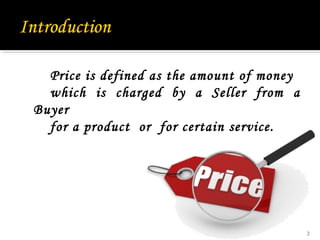


Price is defined as the amount of money
which is charged by a Seller from a
Buyer
for a product or for certain service.
2
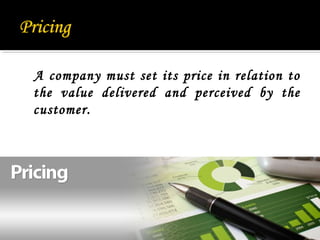
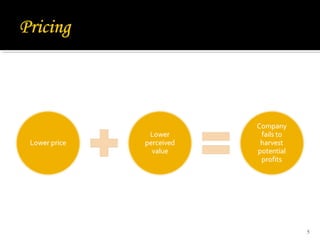
A company must set its price in relation to
the value delivered and perceived by the
customer.
3
4
5
6
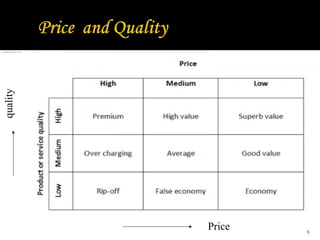
Price
quality
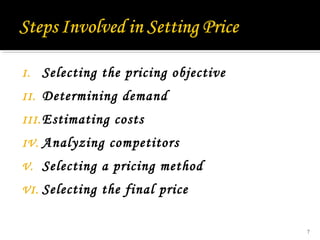
I. Selecting the pricing objective
II. Determining demand
III.Estimating costs
IV. Analyzing competitors
V. Selecting a pricing method
VI. Selecting the final price
7
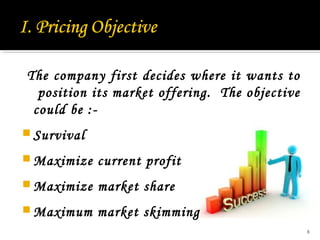
The company first decides where it wants to
position its market offering. The objective
could be :-
 Survival
 Maximize current profit
 Maximize market share
 Maximum market skimming
8
Each price will lead to a different level of
demand and have a different impact on a
company’s marketing objectives.
Demand and price are inversely related i.e.
Higher the price, lower the demand
So, Company needs to consider :-
 Price sensitivity
 Price elasticity of demand
9
The degree to which
the price of a
product affects
consumers
purchasing
behaviors.
The degree of price
sensitivity varies
from product to
product and from
consumer to 10
Buying behavior
Inventory effect ( buyers can not store the product
)
Substitute awareness by buyers
Difficult comparison by buyers
Percentage of expenditure
11
 This determines the changes in demand
with unit change in price
 If there is little or no change in demand,
when there is price change it is said to be
price inelastic.
 If there is significant change in demand,
when there is price change then it is said to
be price elastic. 12
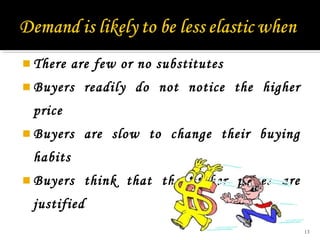
 There are few or no substitutes
 Buyers readily do not notice the higher
price
 Buyers are slow to change their buying
habits
 Buyers think that the higher prices are
justified
13
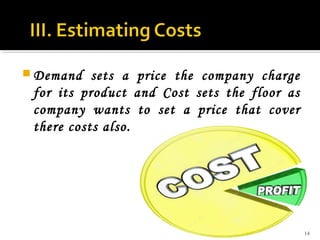
 Demand sets a price the company charge
for its product and Cost sets the floor as
company wants to set a price that cover
there costs also.
14
15
 Fixed costs-doesn’t vary with production.
 Variable costs-varies directly
 Total costs: FC+VC
 Average cost-TC/production
 Profit= Price- Total Cost
 Marketers are generally in a better position
to establish prices when they know the
competition’s prices; discovering
competitors’ prices may be a regular
function of marketing research.
 Marketers in an industry in which price
competition prevails need competitive price
information to ensure their organization’s
prices are the same, or lower than, their
competitors’ prices.
16
 An organization may set its prices slightly
above the competition to give its products
an exclusive image, or it may use price as a
competitive tool and price its products
below those of competitors.
17
 The three major dimensions on which prices
can be based are cost, demand, and
competition.
 An organization usually considers multiple
dimensions. The selection of the bases to be
used is affected by the type of product, the
market structure of the industry, the
brand’s market share position relative to
competing brands, and customer
characteristics.
18
 Markup pricing
 Target-return pricing
 Perceived-value pricing
 Going-rate pricing
 Auction-type pricing
19
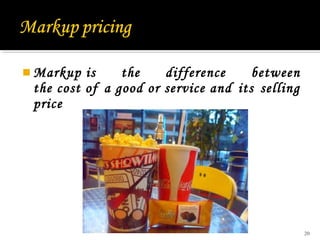
 Markup is the difference between
the cost of a good or service and its selling
price
20
 Target return is calculated as the money
invested in a venture plus the profit that
the investor wants to see in return,
adjusted for the time value of money. As a
return on investment method, target return
pricing requires an investor to work
backwards to reach a current price.
21
 The valuation of good or service according
to how much consumers are willing
to pay for it, rather than upon its
production and delivery costs.
22
 Setting a price for a product or service
using the reveling market price as a basis.
Going rate pricing is common
practice with homogeneous products with
very little variation from one producer to
another does.
23
24
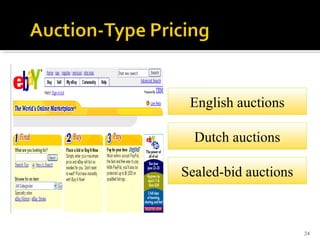
English auctions
Dutch auctions
Sealed-bid auctions
 Pricing methods narrow the range from
which the company must select its final
price. In selecting that price, the company
must consider additional factors , inclosing
the impact of the other activities , company
pricing policies, gain and risk sharing
pricing , and the impact of price in other
parties
25
26

Pricing

  • 2.
    Price is definedas the amount of money which is charged by a Seller from a Buyer for a product or for certain service. 2
  • 3.
    A company mustset its price in relation to the value delivered and perceived by the customer. 3
  • 4.
  • 5.
  • 6.
  • 7.
    I. Selecting thepricing objective II. Determining demand III.Estimating costs IV. Analyzing competitors V. Selecting a pricing method VI. Selecting the final price 7
  • 8.
    The company firstdecides where it wants to position its market offering. The objective could be :-  Survival  Maximize current profit  Maximize market share  Maximum market skimming 8
  • 9.
    Each price willlead to a different level of demand and have a different impact on a company’s marketing objectives. Demand and price are inversely related i.e. Higher the price, lower the demand So, Company needs to consider :-  Price sensitivity  Price elasticity of demand 9
  • 10.
    The degree towhich the price of a product affects consumers purchasing behaviors. The degree of price sensitivity varies from product to product and from consumer to 10
  • 11.
    Buying behavior Inventory effect( buyers can not store the product ) Substitute awareness by buyers Difficult comparison by buyers Percentage of expenditure 11
  • 12.
     This determinesthe changes in demand with unit change in price  If there is little or no change in demand, when there is price change it is said to be price inelastic.  If there is significant change in demand, when there is price change then it is said to be price elastic. 12
  • 13.
     There arefew or no substitutes  Buyers readily do not notice the higher price  Buyers are slow to change their buying habits  Buyers think that the higher prices are justified 13
  • 14.
     Demand setsa price the company charge for its product and Cost sets the floor as company wants to set a price that cover there costs also. 14
  • 15.
    15  Fixed costs-doesn’tvary with production.  Variable costs-varies directly  Total costs: FC+VC  Average cost-TC/production  Profit= Price- Total Cost
  • 16.
     Marketers aregenerally in a better position to establish prices when they know the competition’s prices; discovering competitors’ prices may be a regular function of marketing research.  Marketers in an industry in which price competition prevails need competitive price information to ensure their organization’s prices are the same, or lower than, their competitors’ prices. 16
  • 17.
     An organizationmay set its prices slightly above the competition to give its products an exclusive image, or it may use price as a competitive tool and price its products below those of competitors. 17
  • 18.
     The threemajor dimensions on which prices can be based are cost, demand, and competition.  An organization usually considers multiple dimensions. The selection of the bases to be used is affected by the type of product, the market structure of the industry, the brand’s market share position relative to competing brands, and customer characteristics. 18
  • 19.
     Markup pricing Target-return pricing  Perceived-value pricing  Going-rate pricing  Auction-type pricing 19
  • 20.
     Markup is thedifference between the cost of a good or service and its selling price 20
  • 21.
     Target returnis calculated as the money invested in a venture plus the profit that the investor wants to see in return, adjusted for the time value of money. As a return on investment method, target return pricing requires an investor to work backwards to reach a current price. 21
  • 22.
     The valuation of goodor service according to how much consumers are willing to pay for it, rather than upon its production and delivery costs. 22
  • 23.
     Setting a price fora product or service using the reveling market price as a basis. Going rate pricing is common practice with homogeneous products with very little variation from one producer to another does. 23
  • 24.
  • 25.
     Pricing methodsnarrow the range from which the company must select its final price. In selecting that price, the company must consider additional factors , inclosing the impact of the other activities , company pricing policies, gain and risk sharing pricing , and the impact of price in other parties 25
  • 26.