MONEY
HONEY
PRICING STRATEGY
    Aravind T S
    LEAD College of Management
WHAT IS MEANT BY PRICE ?


   price is the quantity of payment or
    compensation given by one party to another
    in return for goods or services.
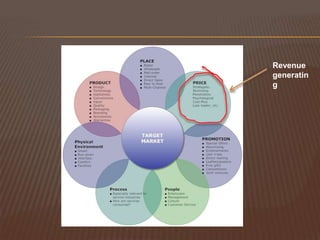
Revenue
generatin
g
PRICING

   The only part of marketing mix that is
    revenue generating all the others are cost

   Pricing is the process of determining what a
    company will receive in exchange for its
    products .
SETTING THE PRICE

1.   Selecting objective
2.   Determining demand
3.   Estimating costs
4.   Analyzing competitors cost,price and offers
5.   Selecting a pricing method
6.   Selecting final price
STEP.1 – SELECTING PRICING OBJECTIVE
   Survival :-Short term pricing objective are set in order to survive

   Profit :- The objective is to maximise profit
   Return on investment :-Price are set to attain a specified return on the
    companies investment

   Maximum market share :- Higher sales volume will lead to lower unit
    costs and higher long-run profit. They set the lowest price (IKEA)
   Maximum market skimming :- companies unveiling a new technology
    favour setting high price to maximise market skimming .price starts high
    and slowly rollback

   Product quality leadership :- Starbucks , CCD, BMW , Mercedes,Taj
    have positioned as leaders in quality , with premium pricing and very
    loyal customer base
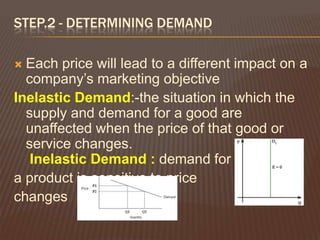
STEP.2 - DETERMINING DEMAND

 Each price will lead to a different impact on a
  company’s marketing objective
Inelastic Demand:-the situation in which the
  supply and demand for a good are
  unaffected when the price of that good or
  service changes.
   Inelastic Demand : demand for
a product is sensitive to price
changes
ESTIMATING COST

 Fixed cost : salaries, rent ,intrest
 Variable cost : vary directly with the level of
  production.
 Total cost : Fixed + Variable cost

 Average cost : Cost per unit .
ANALYZING COMPETITORS COST,PRICE AND
OFFERS
   The firm must take competitors cost , price
    , and possible price reactions .
FIXING THE PRICING
   The price of the product should be
    determined in such a way as to give a fair
    return to the producer, a good margin to the
    middlemen and a reasonable price to the
    consumer .
PREMIUM PRICING

 Use a high price where there is a
  unique brand.
 This approach is used where a substantial
  competitive advantage exists and the
  marketer is safe in the knowledge that they
  can charge a relatively higher price
SKIMMING

 A very high price is fixed by a company for a
  new product
 Earn max profit at earliest

 Deliberate to built up the image of quality and
  prestige of the product .
 Only for specialty goods

 No competition , if yes then showing
  competitive advtage
BAIT

 Two products are manufactured by a
  firm, and the price of one product is kept low
  and the price of the other product is kept high
  .
 Selling high price product by showing the low
  price
 Eg : Car, Fast food , Computers
PSYCHOLOGICAL PRICING.

 This approach is used when the marketer
  wants the consumer to respond on an
  emotional, rather than rational basis.
 For example Price Point Perspective (PPP)
  0.99 Paise not 1 rupee.
 Eg:- Bata
PRODUCT LINE PRICING.

   Different products of different prices are
    manufactured , but the price of all the
    product are determined in a line
    Say as :- 25,35, 40 etc
OPTIONAL PRODUCT PRICING

   Companies will attempt to increase the
    amount customers spend once they start to
    buy.

   For example airlines will charge for optional
    extras such as guaranteeing a window seat
    or reserving a row of seats next to each
    other.
PROMOTIONAL PRICING.

   Pricing to promote a product is a very
    common application. There are many
    examples of promotional pricing including
    approaches such as BOGOF (Buy One Get
    One Free), money off vouchers and discount
PRODUCT BUNDLE PRICING.

 Here sellers combine several products in the
  same package.
 his also serves to move old stock. Blu-ray
  and videogames are often sold using the
  bundle approach once they reach the end of
  their product life cycle.
GEOGRAPHICAL PRICING.

 Geographical pricing sees variations in price
  in different parts of the world.
 shipping costs increase price

 n some countries there is more tax on certain
  types of product which makes them more or
  less expensive
VALUE PRICING

 This approach is used where external factors
  such as recession or increased competition
  force companies to provide value products
  and services to retain sales
 e.g. value meals at McDonalds and other
  fast-food restaurants.
 http://www.youtube.com/watch?v=LX7gfhv2o
  5U
PENETRATION PRICING

 The price charged for products and services
  is set artificially low in order to gain market
  share.
 http://www.youtube.com/watch?v=EPYOlJ9t
  BHM
ECONOMIC PRICING
   This is a no frills low price. The costs of marketing and promoting a
    product are kept to a minimum.


   Budget airlines are famous for keeping their overheads as low as possible and
    then giving the consumer a relatively lower price to fill an aircraft. The first few
    seats are sold at a very cheap price (almost a promotional price) and the middle
    majority are economy seats, with the highest price being paid for the last few
    seats on a flight (which would be a premium pricing strategy).


   http://www.youtube.com/watch?v=jmNrvlQ73pU
CHANGING PRICING ENVIRONMENT

   Buyers can :
 Get instant price comparison from
  thousand of vendors (Eg:
  mysimon.com, flipcart,pricescan.com)
 Name there price and have it met
  (priceline.com)
 Get products free : Free software movement
  that started
FREEMIUM STRATEGY

 My space
 Skype

 Adobe gave away PDF reader for free in
  1994
PRICE STGY: OF GINGER

Early Booking Offer: SAVE NOW"
  Book Early and Pay Less with Ginger Hotels
 (Book today & take advantage of our Early
  Booking Offer. Upto 15% off on advance
  booking.)
1. 10% flat discount on room tariff when
   booking 7 days in advance
2. 15 % flat discount on room tariff by booking
   15 days in advance.
GINGER SPECIAL OFFERS

 Day Use Rates: Introducing special day use
  rates for travelers to freshen up or relax
  before heading for work.
 Weekend offer: 10% Off on a 1-night stay

 20% on a 2-night stay

 30% on a 3-night stay
 Length of Stay offer:The longer the stay the
  better the discount and the more enjoyable your
  stay at any Ginger Hotel.
 20% Off on stays for 2 nights or more.

 All Hotels except Jamshedpur and RYN-New
  Delhi.
 30% Off on stays for 3 nights or more –
  Applicable only at
  Pondicherry, Mangalore, Pune-
  Wakad, Goa, Indore, Guwahati, Agartala, Ludhi
  ana, East Delhi and Manesar.

Pricing

  • 1.
    MONEY HONEY PRICING STRATEGY Aravind T S LEAD College of Management
  • 2.
    WHAT IS MEANTBY PRICE ?  price is the quantity of payment or compensation given by one party to another in return for goods or services.
  • 3.
  • 4.
    PRICING  The only part of marketing mix that is revenue generating all the others are cost  Pricing is the process of determining what a company will receive in exchange for its products .
  • 5.
    SETTING THE PRICE 1. Selecting objective 2. Determining demand 3. Estimating costs 4. Analyzing competitors cost,price and offers 5. Selecting a pricing method 6. Selecting final price
  • 6.
    STEP.1 – SELECTINGPRICING OBJECTIVE  Survival :-Short term pricing objective are set in order to survive  Profit :- The objective is to maximise profit  Return on investment :-Price are set to attain a specified return on the companies investment  Maximum market share :- Higher sales volume will lead to lower unit costs and higher long-run profit. They set the lowest price (IKEA)  Maximum market skimming :- companies unveiling a new technology favour setting high price to maximise market skimming .price starts high and slowly rollback  Product quality leadership :- Starbucks , CCD, BMW , Mercedes,Taj have positioned as leaders in quality , with premium pricing and very loyal customer base
  • 7.
    STEP.2 - DETERMININGDEMAND  Each price will lead to a different impact on a company’s marketing objective Inelastic Demand:-the situation in which the supply and demand for a good are unaffected when the price of that good or service changes. Inelastic Demand : demand for a product is sensitive to price changes
  • 8.
    ESTIMATING COST  Fixedcost : salaries, rent ,intrest  Variable cost : vary directly with the level of production.  Total cost : Fixed + Variable cost  Average cost : Cost per unit .
  • 9.
    ANALYZING COMPETITORS COST,PRICEAND OFFERS  The firm must take competitors cost , price , and possible price reactions .
  • 10.
    FIXING THE PRICING  The price of the product should be determined in such a way as to give a fair return to the producer, a good margin to the middlemen and a reasonable price to the consumer .
  • 11.
    PREMIUM PRICING  Usea high price where there is a unique brand.  This approach is used where a substantial competitive advantage exists and the marketer is safe in the knowledge that they can charge a relatively higher price
  • 12.
    SKIMMING  A veryhigh price is fixed by a company for a new product  Earn max profit at earliest  Deliberate to built up the image of quality and prestige of the product .  Only for specialty goods  No competition , if yes then showing competitive advtage
  • 13.
    BAIT  Two productsare manufactured by a firm, and the price of one product is kept low and the price of the other product is kept high .  Selling high price product by showing the low price  Eg : Car, Fast food , Computers
  • 14.
    PSYCHOLOGICAL PRICING.  Thisapproach is used when the marketer wants the consumer to respond on an emotional, rather than rational basis.  For example Price Point Perspective (PPP) 0.99 Paise not 1 rupee.  Eg:- Bata
  • 15.
    PRODUCT LINE PRICING.  Different products of different prices are manufactured , but the price of all the product are determined in a line Say as :- 25,35, 40 etc
  • 16.
    OPTIONAL PRODUCT PRICING  Companies will attempt to increase the amount customers spend once they start to buy.  For example airlines will charge for optional extras such as guaranteeing a window seat or reserving a row of seats next to each other.
  • 17.
    PROMOTIONAL PRICING.  Pricing to promote a product is a very common application. There are many examples of promotional pricing including approaches such as BOGOF (Buy One Get One Free), money off vouchers and discount
  • 18.
    PRODUCT BUNDLE PRICING. Here sellers combine several products in the same package.  his also serves to move old stock. Blu-ray and videogames are often sold using the bundle approach once they reach the end of their product life cycle.
  • 19.
    GEOGRAPHICAL PRICING.  Geographicalpricing sees variations in price in different parts of the world.  shipping costs increase price  n some countries there is more tax on certain types of product which makes them more or less expensive
  • 20.
    VALUE PRICING  Thisapproach is used where external factors such as recession or increased competition force companies to provide value products and services to retain sales  e.g. value meals at McDonalds and other fast-food restaurants.  http://www.youtube.com/watch?v=LX7gfhv2o 5U
  • 21.
    PENETRATION PRICING  Theprice charged for products and services is set artificially low in order to gain market share.  http://www.youtube.com/watch?v=EPYOlJ9t BHM
  • 22.
    ECONOMIC PRICING  This is a no frills low price. The costs of marketing and promoting a product are kept to a minimum.  Budget airlines are famous for keeping their overheads as low as possible and then giving the consumer a relatively lower price to fill an aircraft. The first few seats are sold at a very cheap price (almost a promotional price) and the middle majority are economy seats, with the highest price being paid for the last few seats on a flight (which would be a premium pricing strategy).  http://www.youtube.com/watch?v=jmNrvlQ73pU
  • 23.
    CHANGING PRICING ENVIRONMENT Buyers can :  Get instant price comparison from thousand of vendors (Eg: mysimon.com, flipcart,pricescan.com)  Name there price and have it met (priceline.com)  Get products free : Free software movement that started
  • 24.
    FREEMIUM STRATEGY  Myspace  Skype  Adobe gave away PDF reader for free in 1994
  • 25.
    PRICE STGY: OFGINGER Early Booking Offer: SAVE NOW" Book Early and Pay Less with Ginger Hotels (Book today & take advantage of our Early Booking Offer. Upto 15% off on advance booking.) 1. 10% flat discount on room tariff when booking 7 days in advance 2. 15 % flat discount on room tariff by booking 15 days in advance.
  • 26.
    GINGER SPECIAL OFFERS Day Use Rates: Introducing special day use rates for travelers to freshen up or relax before heading for work.  Weekend offer: 10% Off on a 1-night stay  20% on a 2-night stay  30% on a 3-night stay
  • 27.
     Length ofStay offer:The longer the stay the better the discount and the more enjoyable your stay at any Ginger Hotel.  20% Off on stays for 2 nights or more.  All Hotels except Jamshedpur and RYN-New Delhi.  30% Off on stays for 3 nights or more – Applicable only at Pondicherry, Mangalore, Pune- Wakad, Goa, Indore, Guwahati, Agartala, Ludhi ana, East Delhi and Manesar.