Mobile Marketing: opportunities and dark-side
Matteo Scarano
LUISS Guido Carli09/11/2016Guest Lecture
Mobile Marketing: overview and opportunities
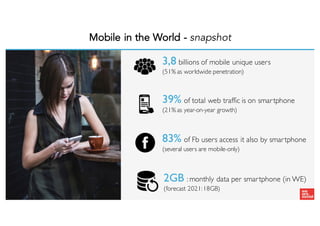
Mobile in the World - snapshot
3,8 billions of mobile unique users
(51% as worldwide penetration)
39% of total web traffic is on smartphone
(21% as year-on-year growth)
83% of Fb users access it also by smartphone
(several users are mobile-only)
2GB : monthly data per smartphone (in WE)
(forecast 2021:18GB)
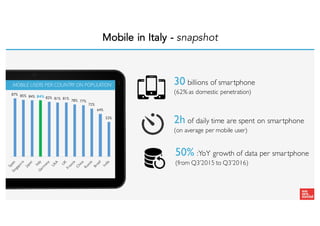
Mobile in Italy - snapshot
30 billions of smartphone
(62% as domestic penetration)
2h of daily time are spent on smartphone
(on average per mobile user)
50% :YoY growth of data per smartphone
(from Q3’2015 to Q3’2016)
87% 85% 84% 84% 82% 81% 81%
78% 77%
72%
64%
52%
MOBILE USERS PER COUNTRY ON POPULATION
Mobile in Italy – market size
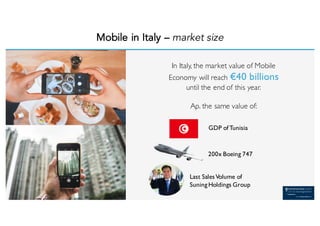
In Italy, the market value of Mobile
Economy will reach €40 billions
until the end of this year.
Ap. the same value of:
GDP of Tunisia
200x Boeing 747
Last SalesVolume of
Suning Holdings Group
Mobile in Italy - use cases
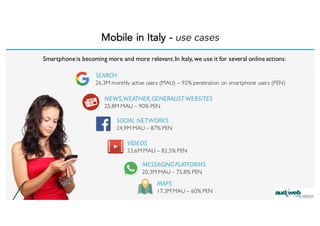
Smartphone is becoming more and more relevant.In Italy, we use it for several online actions:
SEARCH
26,3M monthly active users (MAU) – 92% penetration on smartphone users (PEN)
NEWS,WEATHER,GENERALISTWEBSITES
25,8M MAU – 90% PEN
SOCIAL NETWORKS
24,9M MAU – 87% PEN
VIDEOS
23,6M MAU – 82,5% PEN
MESSAGING PLATFORMS
20,3M MAU – 75,8% PEN
MAPS
17,3M MAU – 60% PEN
Impact of mobile on purchase funnel
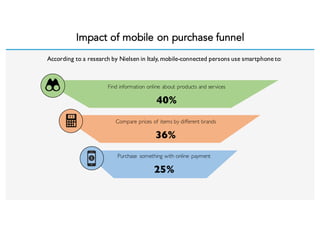
According to a research by Nielsen in Italy, mobile-connected persons use smartphone to:
Find information online about products and services
40%
Compare prices of items by different brands
36%
Purchase something with online payment
25%
Marketing implications – change for existing businesses
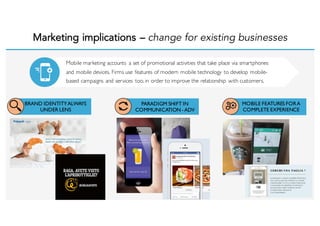
BRAND IDENTITYALWAYS
UNDER LENS
PARADIGM SHIFT IN
COMMUNICATION- ADV
MOBILE FEATURES FORA
COMPLETE EXPERIENCE
Mobile marketing accounts a set of promotional activities that take place via smartphones
and mobile devices. Firms use features of modern mobile technology to develop mobile-
based campaigns and services too, in order to improve the relationship with customers.
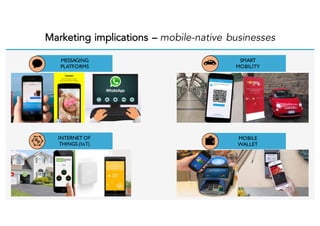
Marketing implications – mobile-native businesses
SMART
MOBILITY
MESSAGING
PLATFORMS
INTERNET OF
THINGS (IoT)
MOBILE
WALLET
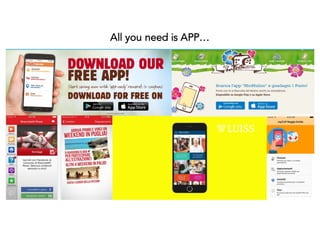
All you need is APP…
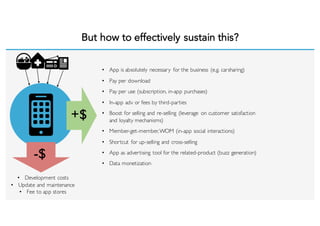
But how to effectively sustain this?
• Development costs
• Update and maintenance
• Fee to app stores
-$
+$
• App is absolutely necessary for the business (e.g. carsharing)
• Pay per download
• Pay per use (subscription, in-app purchases)
• In-app adv or fees by third-parties
• Boost for selling and re-selling (leverage on customer satisfaction
and loyalty mechanisms)
• Member-get-member,WOM (in-app social interactions)
• Shortcut for up-selling and cross-selling
• App as advertising tool for the related-product (buzz generation)
• Data monetization
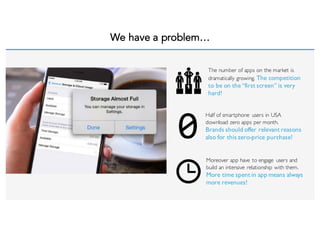
We have a problem…
The number of apps on the market is
dramatically growing. The competition
to be on the “first screen” is very
hard!
Half of smartphone users in USA
download zero apps per month.
Brands should offer relevant reasons
also for this zero-price purchase!
Moreover app have to engage users and
build an intensive relationship with them.
More time spent in app means always
more revenues!
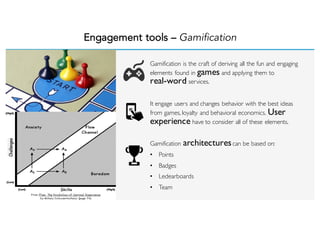
Engagement tools – Gamification
Gamification is the craft of deriving all the fun and engaging
elements found in games and applying them to
real-word services.
It engage users and changes behavior with the best ideas
from games, loyalty and behavioral economics. User
experience have to consider all of these elements.
Gamification architecturescan be based on:
• Points
• Badges
• Ledearboards
• Team
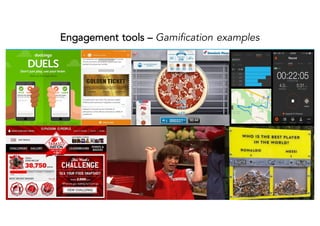
Engagement tools – Gamification examples
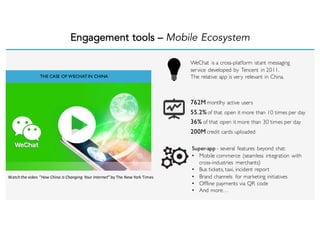
Engagement tools – Mobile Ecosystem
THE CASE OF WECHATIN CHINA
WeChat is a cross-platform istant messaging
service developed by Tencent in 2011.
The relative app is very relevant in China.
762M montlhy active users
55.2%of that open it more than 10 times per day
36% of that open it more than 30 times per day
200M credit cards uploaded
Super-app - several features beyond chat:
• Mobile commerce (seamless integration with
cross-industries merchants)
• Bus tickets, taxi, incident report
• Brand channels for marketing initiatives
• Offline payments via QR code
• And more…
Watch	
  the	
  video	
  “How	
  China	
  Is Changing Your	
  Internet”	
  by	
  The	
  New	
  York	
  Times
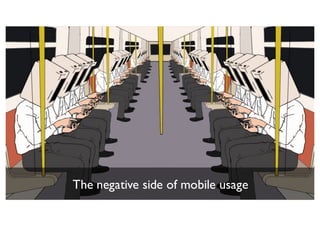
The negative side of mobile usage
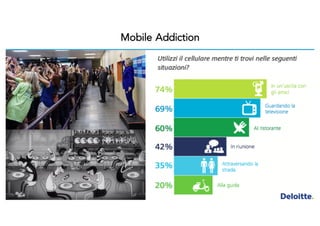
Mobile Addiction
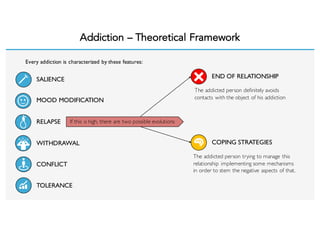
Addiction – Theoretical Framework
Every addiction is characterized by these features:
SALIENCE
MOOD MODIFICATION
RELAPSE
WITHDRAWAL
CONFLICT
TOLERANCE
If this is high, there are two possible evolutions
END OF RELATIONSHIP
COPING STRATEGIES
The addicted person definitely avoids
contacts with the object of his addiction
The addicted person trying to manage this
relationship implementing some mechanisms
in order to stem the negative aspects of that.
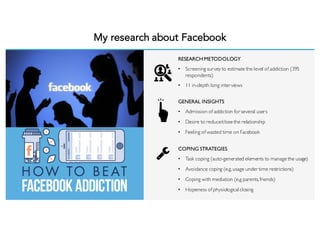
My research about Facebook
RESEARCH METODOLOGY
• Screening survey to estimate the level of addiction (395
respondents)
• 11 in-depth long interviews
GENERAL INSIGHTS
• Admission of addiction for several users
• Desire to reduce/close the relationship
• Feeling of wasted time on Facebook
COPING STRATEGIES
• Task coping (auto-generated elements to manage the usage)
• Avoidance coping (e.g.usage under time restrictions)
• Coping with mediation (e.g parents,friends)
• Hopeness of physiological closing
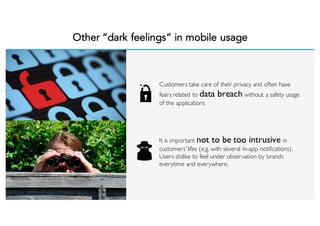
Other “dark feelings” in mobile usage
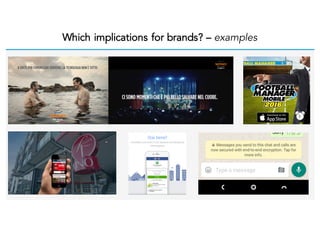
Customers take care of their privacy and often have
fears related to data breach without a safety usage
of the applications
It is important not to be too intrusive in
customers’ lifes (e.g. with several in-app notifications).
Users dislike to feel under observation by brands
everytime and everywhere.
Which implications for brands? – examples
The case of Pokemon Go
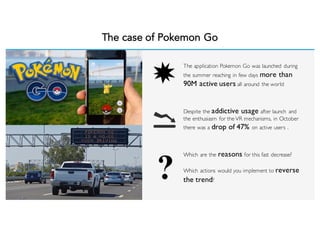
The application Pokemon Go was launched during
the summer reaching in few days more than
90M active users all around the world
Despite the addictive usage after launch and
the enthusiasm for the VR mechanisms, in October
there was a drop of 47% on active users .
Which are the reasons for this fast decrease?
Which actions would you implement to reverse
the trend?
Matteo Scarano

prez_luiss_0911

  • 1.
    Mobile Marketing: opportunitiesand dark-side Matteo Scarano LUISS Guido Carli09/11/2016Guest Lecture
  • 2.
    Mobile Marketing: overviewand opportunities
  • 3.
    Mobile in theWorld - snapshot 3,8 billions of mobile unique users (51% as worldwide penetration) 39% of total web traffic is on smartphone (21% as year-on-year growth) 83% of Fb users access it also by smartphone (several users are mobile-only) 2GB : monthly data per smartphone (in WE) (forecast 2021:18GB)
  • 4.
    Mobile in Italy- snapshot 30 billions of smartphone (62% as domestic penetration) 2h of daily time are spent on smartphone (on average per mobile user) 50% :YoY growth of data per smartphone (from Q3’2015 to Q3’2016) 87% 85% 84% 84% 82% 81% 81% 78% 77% 72% 64% 52% MOBILE USERS PER COUNTRY ON POPULATION
  • 5.
    Mobile in Italy– market size In Italy, the market value of Mobile Economy will reach €40 billions until the end of this year. Ap. the same value of: GDP of Tunisia 200x Boeing 747 Last SalesVolume of Suning Holdings Group
  • 6.
    Mobile in Italy- use cases Smartphone is becoming more and more relevant.In Italy, we use it for several online actions: SEARCH 26,3M monthly active users (MAU) – 92% penetration on smartphone users (PEN) NEWS,WEATHER,GENERALISTWEBSITES 25,8M MAU – 90% PEN SOCIAL NETWORKS 24,9M MAU – 87% PEN VIDEOS 23,6M MAU – 82,5% PEN MESSAGING PLATFORMS 20,3M MAU – 75,8% PEN MAPS 17,3M MAU – 60% PEN
  • 7.
    Impact of mobileon purchase funnel According to a research by Nielsen in Italy, mobile-connected persons use smartphone to: Find information online about products and services 40% Compare prices of items by different brands 36% Purchase something with online payment 25%
  • 8.
    Marketing implications –change for existing businesses BRAND IDENTITYALWAYS UNDER LENS PARADIGM SHIFT IN COMMUNICATION- ADV MOBILE FEATURES FORA COMPLETE EXPERIENCE Mobile marketing accounts a set of promotional activities that take place via smartphones and mobile devices. Firms use features of modern mobile technology to develop mobile- based campaigns and services too, in order to improve the relationship with customers.
  • 9.
    Marketing implications –mobile-native businesses SMART MOBILITY MESSAGING PLATFORMS INTERNET OF THINGS (IoT) MOBILE WALLET
  • 10.
    All you needis APP…
  • 11.
    But how toeffectively sustain this? • Development costs • Update and maintenance • Fee to app stores -$ +$ • App is absolutely necessary for the business (e.g. carsharing) • Pay per download • Pay per use (subscription, in-app purchases) • In-app adv or fees by third-parties • Boost for selling and re-selling (leverage on customer satisfaction and loyalty mechanisms) • Member-get-member,WOM (in-app social interactions) • Shortcut for up-selling and cross-selling • App as advertising tool for the related-product (buzz generation) • Data monetization
  • 12.
    We have aproblem… The number of apps on the market is dramatically growing. The competition to be on the “first screen” is very hard! Half of smartphone users in USA download zero apps per month. Brands should offer relevant reasons also for this zero-price purchase! Moreover app have to engage users and build an intensive relationship with them. More time spent in app means always more revenues!
  • 13.
    Engagement tools –Gamification Gamification is the craft of deriving all the fun and engaging elements found in games and applying them to real-word services. It engage users and changes behavior with the best ideas from games, loyalty and behavioral economics. User experience have to consider all of these elements. Gamification architecturescan be based on: • Points • Badges • Ledearboards • Team
  • 14.
    Engagement tools –Gamification examples
  • 15.
    Engagement tools –Mobile Ecosystem THE CASE OF WECHATIN CHINA WeChat is a cross-platform istant messaging service developed by Tencent in 2011. The relative app is very relevant in China. 762M montlhy active users 55.2%of that open it more than 10 times per day 36% of that open it more than 30 times per day 200M credit cards uploaded Super-app - several features beyond chat: • Mobile commerce (seamless integration with cross-industries merchants) • Bus tickets, taxi, incident report • Brand channels for marketing initiatives • Offline payments via QR code • And more… Watch  the  video  “How  China  Is Changing Your  Internet”  by  The  New  York  Times
  • 16.
    The negative sideof mobile usage
  • 17.
  • 18.
    Addiction – TheoreticalFramework Every addiction is characterized by these features: SALIENCE MOOD MODIFICATION RELAPSE WITHDRAWAL CONFLICT TOLERANCE If this is high, there are two possible evolutions END OF RELATIONSHIP COPING STRATEGIES The addicted person definitely avoids contacts with the object of his addiction The addicted person trying to manage this relationship implementing some mechanisms in order to stem the negative aspects of that.
  • 19.
    My research aboutFacebook RESEARCH METODOLOGY • Screening survey to estimate the level of addiction (395 respondents) • 11 in-depth long interviews GENERAL INSIGHTS • Admission of addiction for several users • Desire to reduce/close the relationship • Feeling of wasted time on Facebook COPING STRATEGIES • Task coping (auto-generated elements to manage the usage) • Avoidance coping (e.g.usage under time restrictions) • Coping with mediation (e.g parents,friends) • Hopeness of physiological closing
  • 20.
    Other “dark feelings”in mobile usage Customers take care of their privacy and often have fears related to data breach without a safety usage of the applications It is important not to be too intrusive in customers’ lifes (e.g. with several in-app notifications). Users dislike to feel under observation by brands everytime and everywhere.
  • 21.
    Which implications forbrands? – examples
  • 22.
    The case ofPokemon Go The application Pokemon Go was launched during the summer reaching in few days more than 90M active users all around the world Despite the addictive usage after launch and the enthusiasm for the VR mechanisms, in October there was a drop of 47% on active users . Which are the reasons for this fast decrease? Which actions would you implement to reverse the trend?
  • 23.