PREVENT
DEFORESTATION
Copyright by
Kella Randolph B.S., M. Ed.
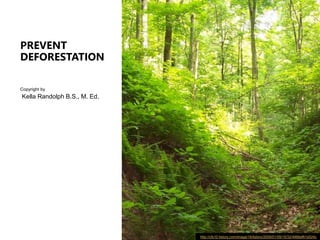
http://cfs10.tistory.com/image/16/tistory/2009/01/09/15/32/4966ef61e524c
Ourforests
OUR FORESTS
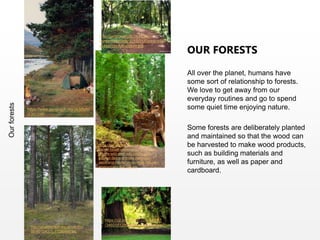
All over the planet, humans have
some sort of relationship to forests.
We love to get away from our
everyday routines and go to spend
some quiet time enjoying nature.
Some forests are deliberately planted
and maintained so that the wood can
be harvested to make wood products,
such as building materials and
furniture, as well as paper and
cardboard.
https://www.geograph.org.uk/photo
/1307243
http://jambonairobi.co.ke/wp-
content/uploads/2011/01/Forest-trail-
at-Nairobi-Arboretum.jpg
https://c2.staticflickr.com/4/3517
/3460181290_f9a9ed8601_z.jpghttp://s0.geograph.org.uk/photos/
05/90/059007_7726b6ab.jpg
https://get.pxhere.com/photo/tree-
nature-forest-wilderness-trail-animal-
wildlife-wild-deer-zoo-jungle-park-
squirrel-fauna-animals-wallpaper-
woodland-habitat-ecosystem-natural-
environment-636102.jpg
Ourforests
TREES AND THE WATER CYCLE
• The planet’s forests provide us
with many benefits. They help
mitigate climate change by
consuming the carbon dioxide we
put into the air, while breathing
out oxygen.
• Tropical rainforests, like those in
the Amazon, emit enough water
vapor to create rain for the
region. This is a valuable step in
the water cycle.
• The great Smoky Mountains look
“smoky” because of rising water
vapor from the forests.
Photo top right: https://get.pxhere.com/photo/landscape-tree-
water-nature-forest-rock-waterfall-creek
Photo bottom right: https://get.pxhere.com/photo/landscape-tree-
water-nature-forest-rock-waterfall-creek
This Photo by Unknown Author
is licensed under CC BY-SA-
NC8031193947_1ca20c1d1c_b.j
pg
This Photo by Unknown Author is
licensed under
8031193947_1ca20c1d1c_b.jpg
Amazon Rain Forest
Great Smokey Mountains, TN.
https://upload.wikimedia.org/wikipedia/common
s/thumb/e/e2/Stormwater_Management_with_tr
ees.webm/509px--
Stormwater_Management_with_trees.webm.jpg
Ourforests
WHY DEFORESTATION?
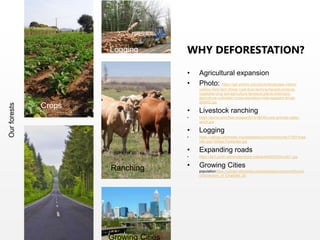
• Agricultural expansion
• Photo: https://get.pxhere.com/photo/landscape-nature-
outdoor-field-farm-flower-rural-food-farming-harvest-produce-
vegetable-crop-soil-agriculture-farmland-plants-freshness-
agricultural-cultivation-crops-plantation-india-eggplant-brinjal-
993602.jpg
• Livestock ranching
• https://pixnio.com/free-images/2016/06/09/cows-animals-cattle-
ranch.jpg
• Logging
• https://upload.wikimedia.org/wikipedia/commons/thumb/7/76/Forwa
rder.jpg/1200px-Forwarder.jpg
• Expanding roads
• https://ak3.picdn.net/shutterstock/videos/4426433/thumb/1.jpg
• Growing Cities
populationhttps://upload.wikimedia.org/wikipedia/commons/thumb/
0/0b/Skyline_of_Charlotte_20
Crops
Logging
Ranching
Road building
Growing Cities
IS THIS SUSTAINABLE?
Traditional agriculture techniques have
some advantages but can also be
damaging to ecosystems.
Commercial pesticides save crops from being ruined
by pests, but the poisons seep into groundwater and
runoff into streams.
There are some natural and harmless alternatives to
garden pesticides. https://www.peta.org/living/humane-
home/natural-harmless-alternatives-garden-pesticides/
Commercial fertilizers help plants grow bigger, but
the chemicals wash off and seep into groundwater and
runoff into streams. Look at natural fertilizers:
http://www.stream-smart.com/making-bear-creek-
better/at-home/alternatives-to-fertilizers-pesticides-
herbicides/
Monoculture, growing just one crop in an area
depletes the soil of vital nutrients. Diversifying the
crops helps keep pests down and uses less fertilizer:
https://blogs.umass.edu/natsci397a-
eross/monocultures-in-america-a-system-that-needs-
more-diversity/
Traditional irrigation usually involves spraying water
over the crops. More efficient irrigation systems:
https://theconstructor.org/water-resources/more-
efficient-alternate-irrigation-systems/254/
https://www.eoi.es/blogs/anam
ariarocha/files/2014/02/pesticid
e-featured.jpg
https://aggie-
horticulture.tamu.edu/galveston/i
mages/DSCN0844,%2015-5-
10%20lawn%20fertilizer,%20resiz
ed.GIF
https://c2.staticflickr.com/4/3565/34
58365006_9334044ed1_b.jpg
https://c1.staticflickr.co
m/7/6232/6283083426_
bb7e7d9c95_b.jpg
https://blogs.umass.edu/nats
ci397aeross/files/2017/12/dive
rsified-farming-2.jpg
FiveBags:http://hisforhomeblog.com/wp-content/uploads/reusable-shopping-bags.jpghttp://2.bp.blogspot.com/-
EarthPoster:4O6JbD_qZyw/UkqTdOsTlYI/AAAAAAAAdmA/CGe_YAg2gPY/s1600/recycling-poster-17.jpg
HOW CAN WE HELP TO
SAVE OUR FORESTS?
• Help keep mature trees healthy
• Save seeds and seedlings from
mature trees and plant them
where they will have room to
grow
• Reuse and recycle paper and
wood products
• Use reusable containers
• Choose paperless options for bills
• Look for The Forest Stewardship
Alliance seal when buying
wooden furniture or flooring.
https://c1.staticflickr.com/5/4002/454
6183151_ec24497b0c.jpg
http://www.kentcounty.com/images/g
ov/finance/onlineBillPay.png
http://www.logotypes101.com/logos/937/C9404249F27F8A127FD101D5
2B54430F/rainforestalliance0.png

Prevent Deforestation

  • 1.
    PREVENT DEFORESTATION Copyright by Kella RandolphB.S., M. Ed. http://cfs10.tistory.com/image/16/tistory/2009/01/09/15/32/4966ef61e524c
  • 2.
    Ourforests OUR FORESTS All overthe planet, humans have some sort of relationship to forests. We love to get away from our everyday routines and go to spend some quiet time enjoying nature. Some forests are deliberately planted and maintained so that the wood can be harvested to make wood products, such as building materials and furniture, as well as paper and cardboard. https://www.geograph.org.uk/photo /1307243 http://jambonairobi.co.ke/wp- content/uploads/2011/01/Forest-trail- at-Nairobi-Arboretum.jpg https://c2.staticflickr.com/4/3517 /3460181290_f9a9ed8601_z.jpghttp://s0.geograph.org.uk/photos/ 05/90/059007_7726b6ab.jpg https://get.pxhere.com/photo/tree- nature-forest-wilderness-trail-animal- wildlife-wild-deer-zoo-jungle-park- squirrel-fauna-animals-wallpaper- woodland-habitat-ecosystem-natural- environment-636102.jpg
  • 3.
    Ourforests TREES AND THEWATER CYCLE • The planet’s forests provide us with many benefits. They help mitigate climate change by consuming the carbon dioxide we put into the air, while breathing out oxygen. • Tropical rainforests, like those in the Amazon, emit enough water vapor to create rain for the region. This is a valuable step in the water cycle. • The great Smoky Mountains look “smoky” because of rising water vapor from the forests. Photo top right: https://get.pxhere.com/photo/landscape-tree- water-nature-forest-rock-waterfall-creek Photo bottom right: https://get.pxhere.com/photo/landscape-tree- water-nature-forest-rock-waterfall-creek This Photo by Unknown Author is licensed under CC BY-SA- NC8031193947_1ca20c1d1c_b.j pg This Photo by Unknown Author is licensed under 8031193947_1ca20c1d1c_b.jpg Amazon Rain Forest Great Smokey Mountains, TN. https://upload.wikimedia.org/wikipedia/common s/thumb/e/e2/Stormwater_Management_with_tr ees.webm/509px-- Stormwater_Management_with_trees.webm.jpg
  • 4.
    Ourforests WHY DEFORESTATION? • Agriculturalexpansion • Photo: https://get.pxhere.com/photo/landscape-nature- outdoor-field-farm-flower-rural-food-farming-harvest-produce- vegetable-crop-soil-agriculture-farmland-plants-freshness- agricultural-cultivation-crops-plantation-india-eggplant-brinjal- 993602.jpg • Livestock ranching • https://pixnio.com/free-images/2016/06/09/cows-animals-cattle- ranch.jpg • Logging • https://upload.wikimedia.org/wikipedia/commons/thumb/7/76/Forwa rder.jpg/1200px-Forwarder.jpg • Expanding roads • https://ak3.picdn.net/shutterstock/videos/4426433/thumb/1.jpg • Growing Cities populationhttps://upload.wikimedia.org/wikipedia/commons/thumb/ 0/0b/Skyline_of_Charlotte_20 Crops Logging Ranching Road building Growing Cities
  • 5.
    IS THIS SUSTAINABLE? Traditionalagriculture techniques have some advantages but can also be damaging to ecosystems. Commercial pesticides save crops from being ruined by pests, but the poisons seep into groundwater and runoff into streams. There are some natural and harmless alternatives to garden pesticides. https://www.peta.org/living/humane- home/natural-harmless-alternatives-garden-pesticides/ Commercial fertilizers help plants grow bigger, but the chemicals wash off and seep into groundwater and runoff into streams. Look at natural fertilizers: http://www.stream-smart.com/making-bear-creek- better/at-home/alternatives-to-fertilizers-pesticides- herbicides/ Monoculture, growing just one crop in an area depletes the soil of vital nutrients. Diversifying the crops helps keep pests down and uses less fertilizer: https://blogs.umass.edu/natsci397a- eross/monocultures-in-america-a-system-that-needs- more-diversity/ Traditional irrigation usually involves spraying water over the crops. More efficient irrigation systems: https://theconstructor.org/water-resources/more- efficient-alternate-irrigation-systems/254/ https://www.eoi.es/blogs/anam ariarocha/files/2014/02/pesticid e-featured.jpg https://aggie- horticulture.tamu.edu/galveston/i mages/DSCN0844,%2015-5- 10%20lawn%20fertilizer,%20resiz ed.GIF https://c2.staticflickr.com/4/3565/34 58365006_9334044ed1_b.jpg https://c1.staticflickr.co m/7/6232/6283083426_ bb7e7d9c95_b.jpg https://blogs.umass.edu/nats ci397aeross/files/2017/12/dive rsified-farming-2.jpg
  • 6.
    FiveBags:http://hisforhomeblog.com/wp-content/uploads/reusable-shopping-bags.jpghttp://2.bp.blogspot.com/- EarthPoster:4O6JbD_qZyw/UkqTdOsTlYI/AAAAAAAAdmA/CGe_YAg2gPY/s1600/recycling-poster-17.jpg HOW CAN WEHELP TO SAVE OUR FORESTS? • Help keep mature trees healthy • Save seeds and seedlings from mature trees and plant them where they will have room to grow • Reuse and recycle paper and wood products • Use reusable containers • Choose paperless options for bills • Look for The Forest Stewardship Alliance seal when buying wooden furniture or flooring. https://c1.staticflickr.com/5/4002/454 6183151_ec24497b0c.jpg http://www.kentcounty.com/images/g ov/finance/onlineBillPay.png http://www.logotypes101.com/logos/937/C9404249F27F8A127FD101D5 2B54430F/rainforestalliance0.png

Editor's Notes

  • #3 Pictures with reflection and blurred background (Basic) To reproduce the picture effects on this slide, do the following: On the Home tab, in the Slides group, click Layout, and then click Blank. On the Insert tab, in the Images group, click Picture. In the Insert Picture dialog box, select a picture and then click Insert. Select the picture. Under Picture Tools, on the Format tab, in the Size group, click the arrow below Crop, point to Crop to Shape, and then under Rectangles click Round Diagonal Corner Rectangle. Also under Picture Tools, on the Format tab, in the Size group, click the Size and Position dialog box launcher. In the Format Picture dialog box, resize or crop the image so that the height is set to 2” and the width is set to 2.4”. To crop the picture, click Crop in the left pane, and in the right pane, under Crop position, enter values into the Height, Width, Left, and Top boxes. To resize the picture, click Size in the left pane, and in the right pane, under Size and rotate, enter values into the Height and Width boxes. Also in the Format Picture dialog box, click Reflection in the right pane, and in the Reflection pane, in the Presets list, click Half Reflection, Touching. On the Insert tab, in the Images group, click Picture. In the Insert Picture dialog box, select a different picture and then click Insert. Repeat this process until there are three pictures on the slide. Select the second picture. Under Picture Tools, on the Format tab, in the Size group, click the Size and Position dialog box launcher. In the Format Picture dialog box, resize or crop the image so that the height is set to 2” and the width is set to 2.4”. To crop the picture, click Crop in the left pane, and in the right pane, under Crop position, enter values into the Height, Width, Left, and Top boxes. To resize the picture, click Size in the left pane, and in the right pane, under Size and rotate, enter values into the Height and Width boxes. Select the third picture. Under Picture Tools, on the Format tab, in the Size group, click the Size and Position dialog box launcher. In the Format Picture dialog box, resize or crop the image so that the height is set to 2” and the width is set to 2.4”. To crop the picture, click Crop in the left pane, and in the right pane, under Crop position, enter values into the Height, Width, Left, and Top boxes. To resize the picture, click Size in the left pane, and in the right pane, under Size and rotate, enter values into the Height and Width boxes. Select the first picture. On the Home tab, in the Clipboard group, click Format Painter. With the Format Painter cursor, on the slide, click the second picture. Select the first picture. On the Home tab, in the Clipboard group, click Format Painter. With the Format Painter cursor, on the slide, click the third picture. Press and hold CTRL, and then select all three pictures. On the Home tab, in the Drawing group, click Arrange, point to Align, and then do the following: Click Align Selected Objects. Click Align Middle. To reproduce the background effects on this slide, do the following: On the Insert tab, in the Images group, click Picture. In the Insert Picture dialog box, select a picture and then click Insert. Select the picture. Under Picture Tools, on the Format tab, in the Size group, click the Size and Position dialog box launcher. In the Format Picture dialog box, resize or crop the image so that the height is set to 7.5” and the width is set to 10”. To crop the picture, click Crop in the left pane, and in the right pane, under Crop position, enter values into the Height, Width, Left, and Top boxes. To resize the picture, click Size in the left pane, and in the right pane, under Size and rotate, enter values into the Height and Width boxes. Also in the Format Picture dialog box, click Artistic Effects in the left pane, and in the Artistic Effects pane, do the following: Click the button next to Presets and then click Blur (second row, fifth option from the left). In the Radius box, enter 30. On the Home tab, in the Drawing group, click Shapes, and under Rectangles click Rectangle (first option from the left). Drag to draw a rectangle on the slide. Select the rectangle. Under Drawing Tools, on the Format tab, in the Size group, enter 7.5” into the Height box and enter 10” into the Width box. Also under Drawing Tools, on the Format tab, in the Shape Styles group, click Shape Fill, point to Gradients, and then click More Gradients. In the Format Shape dialog box, click Fill in the left pane, select Gradient fill in the Fill pane, and then do the following: In the Type list, select Radial. In the Direction list, select From Center. Under Gradient stops, click Add gradient stops or Remove gradient stops until two stops appear in the slider. Also under Gradient stops, customize the gradient stops as follows: Select the first stop from the left in the slider, and then do the following: In the Position box, enter 0%. Click the button next to Color, and then under Theme Colors click White, Background 1 (first row, first option from the left). In the Transparency box, enter 60%. Select the second stop from the left in the slider, and then do the following: In the Position box, enter 100%. Click the button next to Color, and then under Theme Colors click White, Background 1 (first row, first option from the left). In the Transparency box, enter 0%.  Also in the Format Shape dialog box, click Line Color in the right pane, and in the Line Color pane select No Line. Select the shape. On the Home tab, in the Drawing group, click Arrange, point to Align, and then do the following: Click Align to slide. Click Align Middle. Click Align Center. On the Home tab, in the Drawing group, click Arrange, and then click Send to Back. Select the background picture. On the Home tab, in the Drawing group, click Arrange, and then click Send to Back.