Prevent [and Resolve]
   Telecom Disputes

Hank Levine                                          Justin Castillo
hlevine@lb3law.com                                        jcastillo@lb3law.com


        Organized by


                             March 7, 2012
          © 2012 Levine, Blaszak, Block & Boothby, LLP. All rights reserved.
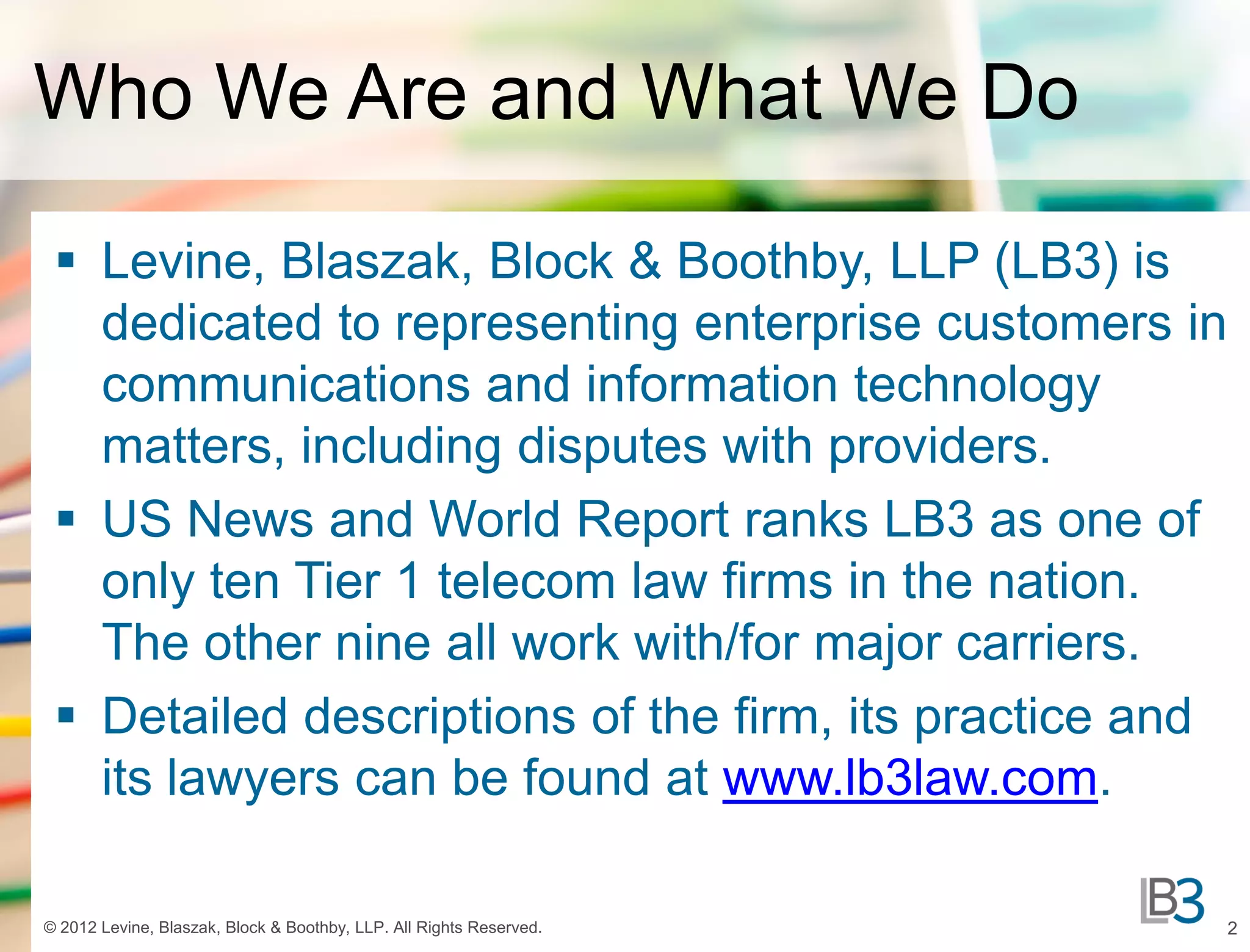
Who We Are and What We Do

  Levine, Blaszak, Block & Boothby, LLP (LB3) is
   dedicated to representing enterprise customers in
   communications and information technology
   matters, including disputes with providers.
  US News and World Report ranks LB3 as one of
   only ten Tier 1 telecom law firms in the nation.
   The other nine all work with/for major carriers.
  Detailed descriptions of the firm, its practice and
   its lawyers can be found at www.lb3law.com.

© 2012 Levine, Blaszak, Block & Boothby, LLP. All Rights Reserved.   2
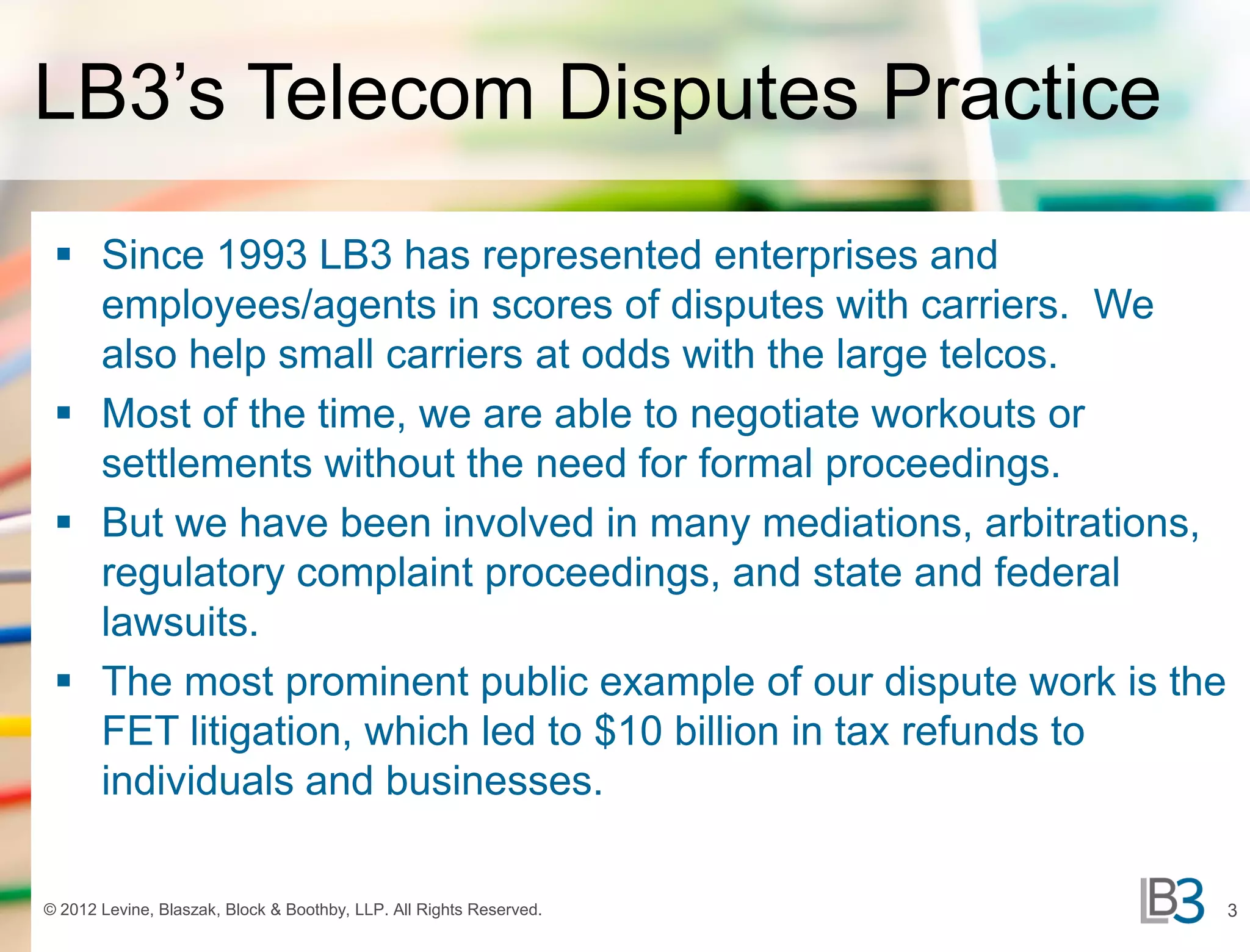
LB3’s Telecom Disputes Practice
  Since 1993 LB3 has represented enterprises and
   employees/agents in scores of disputes with carriers. We
   also help small carriers at odds with the large telcos.
  Most of the time, we are able to negotiate workouts or
   settlements without the need for formal proceedings.
  But we have been involved in many mediations, arbitrations,
   regulatory complaint proceedings, and state and federal
   lawsuits.
  The most prominent public example of our dispute work is the
   FET litigation, which led to $10 billion in tax refunds to
   individuals and businesses.

© 2012 Levine, Blaszak, Block & Boothby, LLP. All Rights Reserved.   3
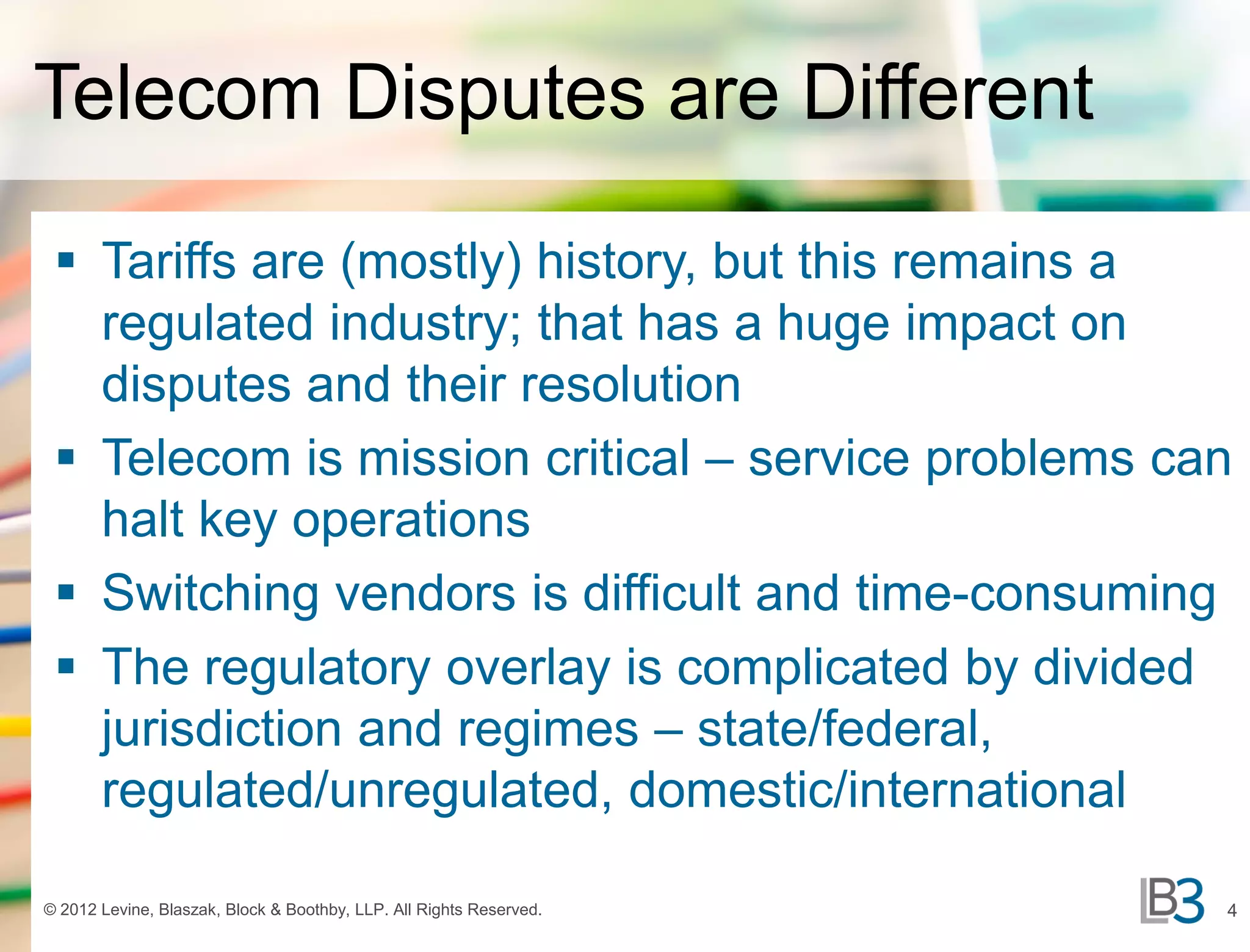
Telecom Disputes are Different

  Tariffs are (mostly) history, but this remains a
   regulated industry; that has a huge impact on
   disputes and their resolution
  Telecom is mission critical – service problems can
   halt key operations
  Switching vendors is difficult and time-consuming
  The regulatory overlay is complicated by divided
   jurisdiction and regimes – state/federal,
   regulated/unregulated, domestic/international

© 2012 Levine, Blaszak, Block & Boothby, LLP. All Rights Reserved.   4
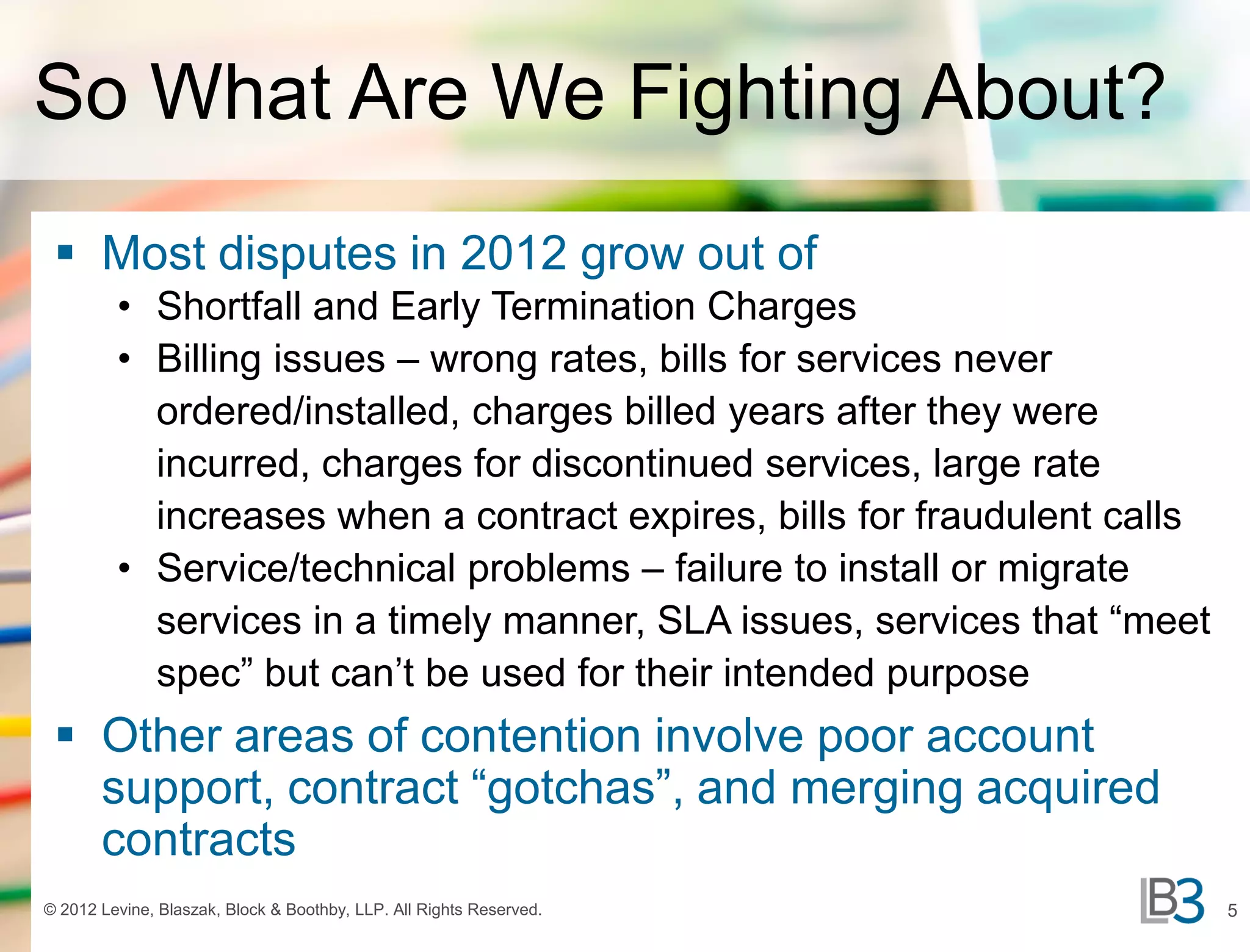
So What Are We Fighting About?
  Most disputes in 2012 grow out of
         • Shortfall and Early Termination Charges
         • Billing issues – wrong rates, bills for services never
           ordered/installed, charges billed years after they were
           incurred, charges for discontinued services, large rate
           increases when a contract expires, bills for fraudulent calls
         • Service/technical problems – failure to install or migrate
           services in a timely manner, SLA issues, services that “meet
           spec” but can’t be used for their intended purpose
  Other areas of contention involve poor account
   support, contract “gotchas”, and merging acquired
   contracts
© 2012 Levine, Blaszak, Block & Boothby, LLP. All Rights Reserved.         5
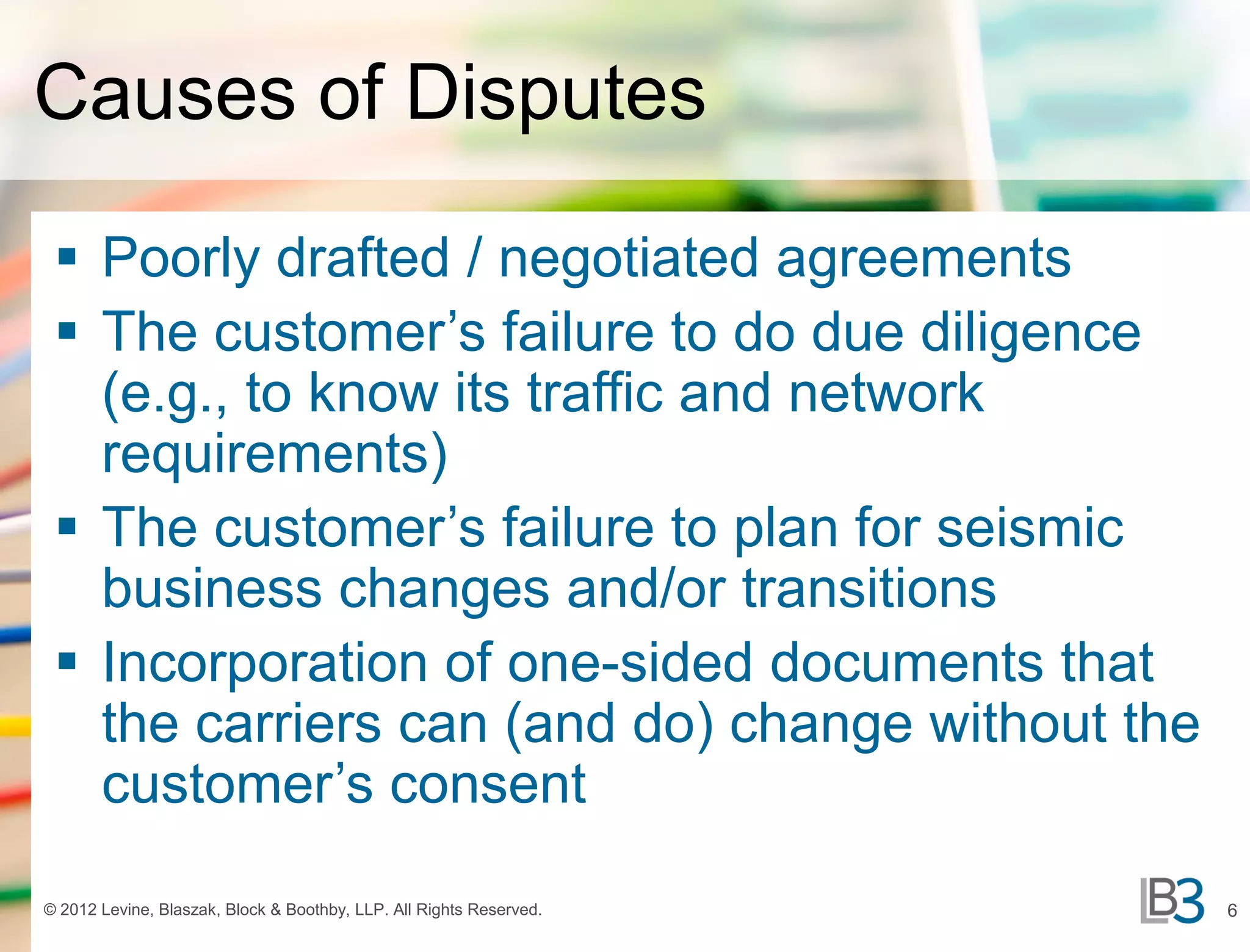
Causes of Disputes

  Poorly drafted / negotiated agreements
  The customer’s failure to do due diligence
   (e.g., to know its traffic and network
   requirements)
  The customer’s failure to plan for seismic
   business changes and/or transitions
  Incorporation of one-sided documents that
   the carriers can (and do) change without the
   customer’s consent

© 2012 Levine, Blaszak, Block & Boothby, LLP. All Rights Reserved.   6
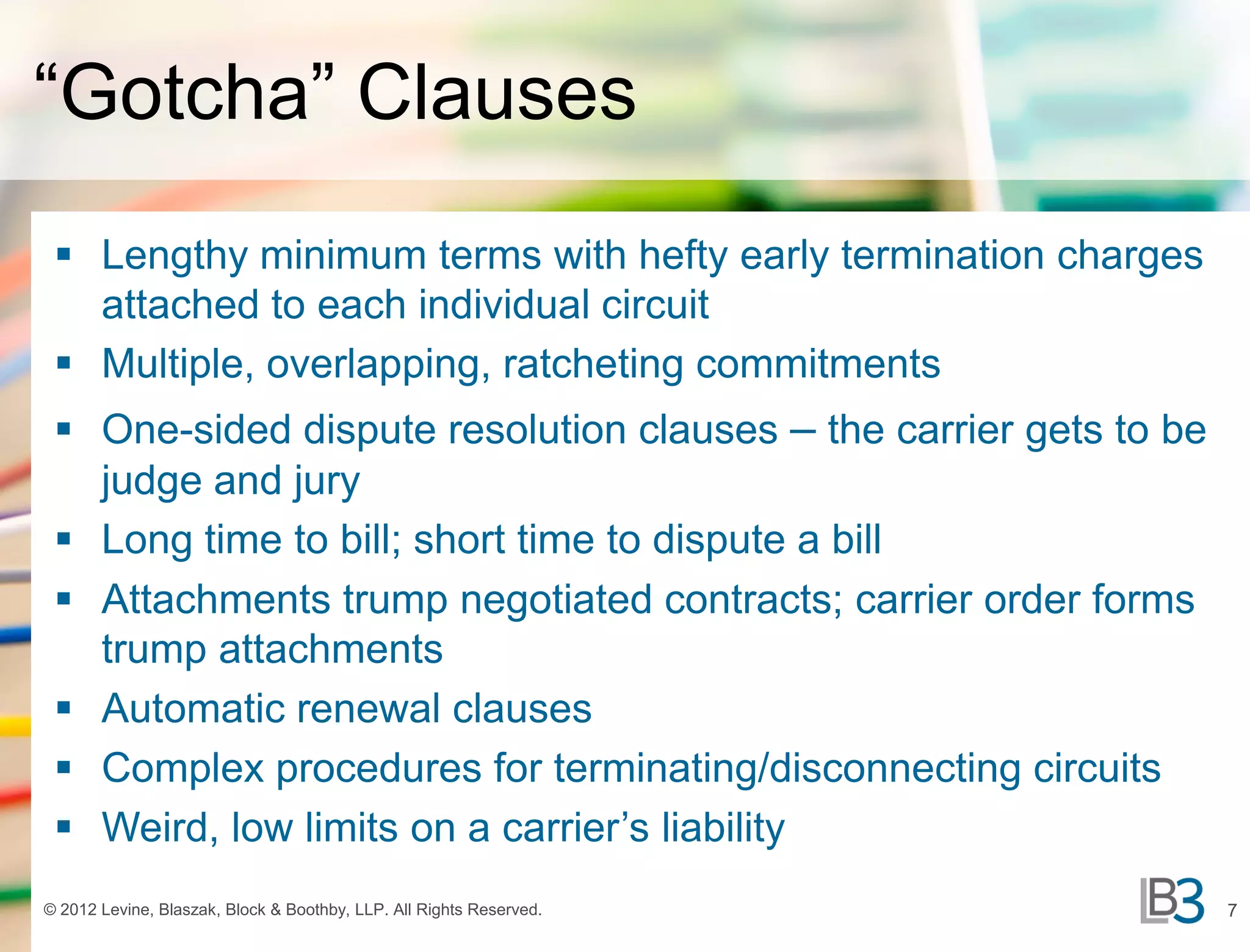
“Gotcha” Clauses
  Lengthy minimum terms with hefty early termination charges
   attached to each individual circuit
  Multiple, overlapping, ratcheting commitments
  One-sided dispute resolution clauses – the carrier gets to be
   judge and jury
  Long time to bill; short time to dispute a bill
  Attachments trump negotiated contracts; carrier order forms
   trump attachments
  Automatic renewal clauses
  Complex procedures for terminating/disconnecting circuits
  Weird, low limits on a carrier’s liability
© 2012 Levine, Blaszak, Block & Boothby, LLP. All Rights Reserved.   7
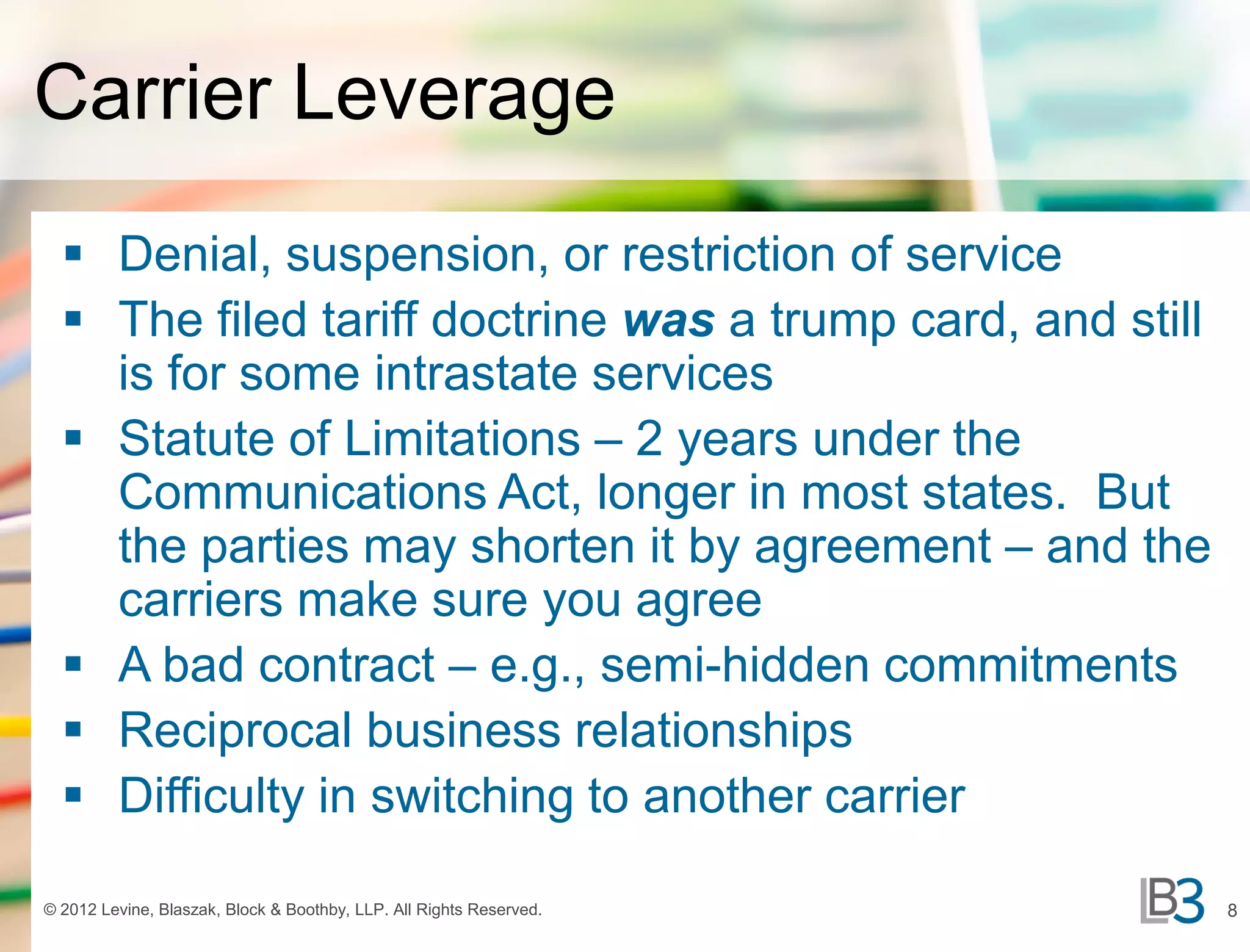
Carrier Leverage
   Denial, suspension, or restriction of service
   The filed tariff doctrine was a trump card, and still
    is for some intrastate services
   Statute of Limitations – 2 years under the
    Communications Act, longer in most states. But
    the parties may shorten it by agreement – and the
    carriers make sure you agree
   A bad contract – e.g., semi-hidden commitments
   Reciprocal business relationships
   Difficulty in switching to another carrier

© 2012 Levine, Blaszak, Block & Boothby, LLP. All Rights Reserved.   8
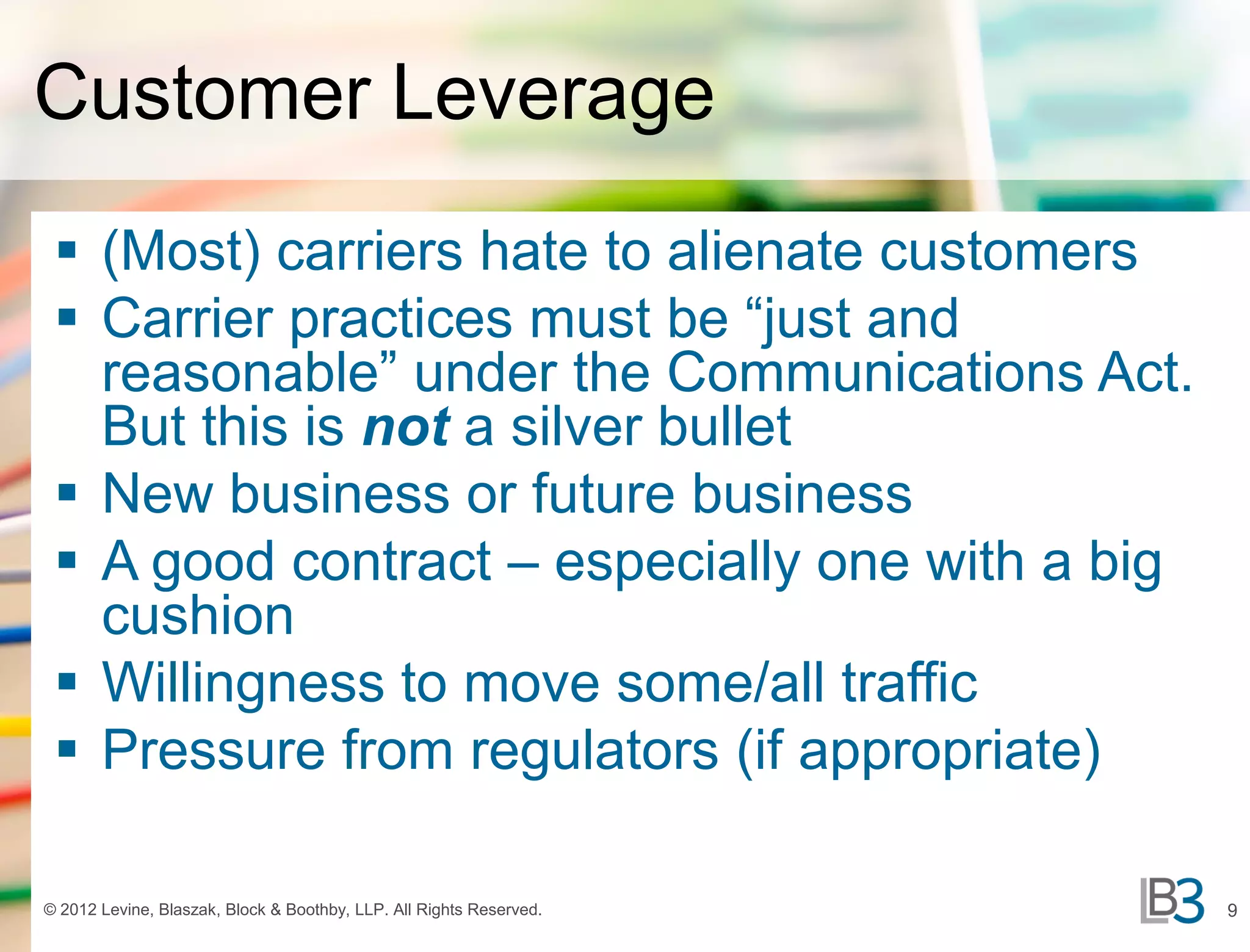
Customer Leverage
  (Most) carriers hate to alienate customers
  Carrier practices must be “just and
   reasonable” under the Communications Act.
   But this is not a silver bullet
  New business or future business
  A good contract – especially one with a big
   cushion
  Willingness to move some/all traffic
  Pressure from regulators (if appropriate)

© 2012 Levine, Blaszak, Block & Boothby, LLP. All Rights Reserved.   9
Avoiding Disputes
  Say it in writing, and keep notes
  Save reports and emails
  Pay undisputed amounts
  Escalate strategically
  Prepare for the worst (minimize the impact of
   suspension with a second-carrier relationship. If
   you are leaving, leave)
  Be willing to give and take – if you’re facing
   substantial liability to the carrier, something is
   much better than nothing
© 2012 Levine, Blaszak, Block & Boothby, LLP. All Rights Reserved.   10
Contract Clauses that Can Help
Prevent or Ameliorate Disputes
      Dispute procedures (including escalation)
      Performance pending outcome of disputes
      Reasonable billing and payment provisions
      Governance/stewardship
      Transition/migration
      Limitations on AUP and related provisions
       governing suspension/termination of
       services.
© 2012 Levine, Blaszak, Block & Boothby, LLP. All Rights Reserved.   11
Dealing with a Dispute
      Early stages – Write it down. Document everything
      The role and limitations of your account team
      Escalation – start on the business side
      When to bring in counsel – the Goldilocks rule
         • If the customer brings in counsel, the carrier has to
           reciprocate (carrier account teams often work hard to avoid
           their counsel)
         • Bringing in the lawyers too early can harden positions,
           hindering settlement
  But if the account team is useless or hostile or crazy,
   getting carrier counsel involved can help
© 2012 Levine, Blaszak, Block & Boothby, LLP. All Rights Reserved.       12
Resolving Disputes – Work Outs

  Shortfall and other penalties usually go away
  Carrier gets new revenue via a term
   extension and new business
  Contributing services are broadened.
  Customer leverage tends to be low, so rates
   and terms are usually not “at market.” But
   you’d be surprised …
  Some carriers are more amenable to “work-
   outs” than others
© 2012 Levine, Blaszak, Block & Boothby, LLP. All Rights Reserved.   13
When Negotiations Fail
  Mediation
  Arbitration – compelled by many carrier contracts
   on unfavorable terms, but often makes sense
  The regulators: FCC/State PUCs
         • Informal complaints
         • Formal complaints
         • Regulators as mediators
  Litigation
         • State or Federal Court
         • Referrals to the FCC
© 2012 Levine, Blaszak, Block & Boothby, LLP. All Rights Reserved.   14
Carrier Hot Buttons
  AT&T
    • Likes circuit-specific terms and tying up customers 12 ways
  Verizon
    • Wants to own reports and control CPNI
    • Cooperation with third-party vendors
  Second-tier carriers
    • Used to dealing with smaller customers and don’t have
      sophisticated large deal capability, so
    • Lots more “sole discretion” language
    • Lots of hair-trigger termination/suspension rights
    • Low limitations of liability/carve-outs

© 2012 Levine, Blaszak, Block & Boothby, LLP. All Rights Reserved.   15
Conclusion

  It’s not all in your head – telecom disputes
   really are weird and different
  It’s a hard but not impossible world
  Questions?


© 2012 Levine, Blaszak, Block & Boothby, LLP. All Rights Reserved.   16
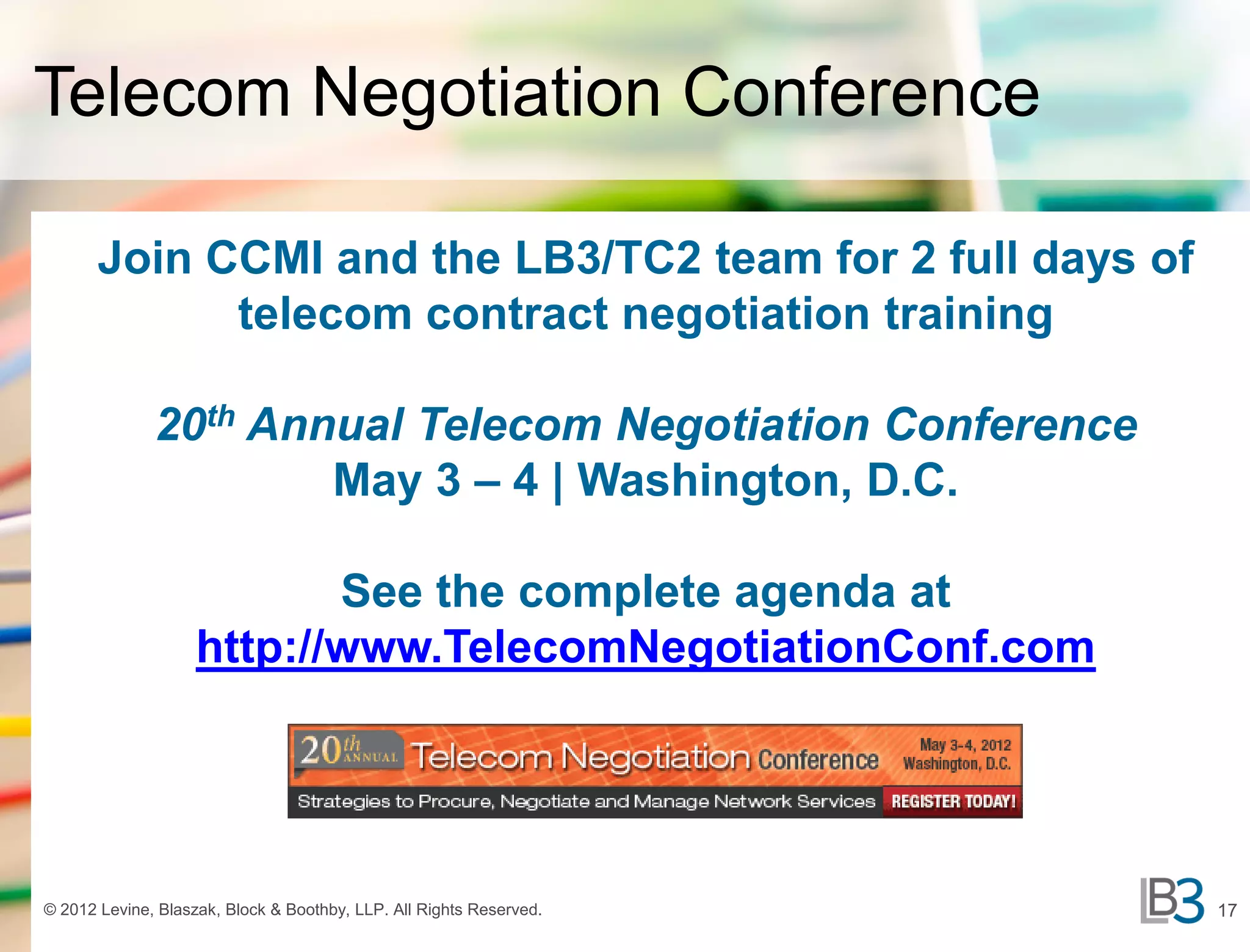
Telecom Negotiation Conference

       Join CCMI and the LB3/TC2 team for 2 full days of
             telecom contract negotiation training

              20th Annual Telecom Negotiation Conference
                      May 3 – 4 | Washington, D.C.

                           See the complete agenda at
                    http://www.TelecomNegotiationConf.com


© 2012 Levine, Blaszak, Block & Boothby, LLP. All Rights Reserved.   17

Prevent and Resolve Telecom Disputes

  • 1.
    Prevent [and Resolve] Telecom Disputes Hank Levine Justin Castillo hlevine@lb3law.com jcastillo@lb3law.com Organized by March 7, 2012 © 2012 Levine, Blaszak, Block & Boothby, LLP. All rights reserved.
  • 2.
    Who We Areand What We Do  Levine, Blaszak, Block & Boothby, LLP (LB3) is dedicated to representing enterprise customers in communications and information technology matters, including disputes with providers.  US News and World Report ranks LB3 as one of only ten Tier 1 telecom law firms in the nation. The other nine all work with/for major carriers.  Detailed descriptions of the firm, its practice and its lawyers can be found at www.lb3law.com. © 2012 Levine, Blaszak, Block & Boothby, LLP. All Rights Reserved. 2
  • 3.
    LB3’s Telecom DisputesPractice  Since 1993 LB3 has represented enterprises and employees/agents in scores of disputes with carriers. We also help small carriers at odds with the large telcos.  Most of the time, we are able to negotiate workouts or settlements without the need for formal proceedings.  But we have been involved in many mediations, arbitrations, regulatory complaint proceedings, and state and federal lawsuits.  The most prominent public example of our dispute work is the FET litigation, which led to $10 billion in tax refunds to individuals and businesses. © 2012 Levine, Blaszak, Block & Boothby, LLP. All Rights Reserved. 3
  • 4.
    Telecom Disputes areDifferent  Tariffs are (mostly) history, but this remains a regulated industry; that has a huge impact on disputes and their resolution  Telecom is mission critical – service problems can halt key operations  Switching vendors is difficult and time-consuming  The regulatory overlay is complicated by divided jurisdiction and regimes – state/federal, regulated/unregulated, domestic/international © 2012 Levine, Blaszak, Block & Boothby, LLP. All Rights Reserved. 4
  • 5.
    So What AreWe Fighting About?  Most disputes in 2012 grow out of • Shortfall and Early Termination Charges • Billing issues – wrong rates, bills for services never ordered/installed, charges billed years after they were incurred, charges for discontinued services, large rate increases when a contract expires, bills for fraudulent calls • Service/technical problems – failure to install or migrate services in a timely manner, SLA issues, services that “meet spec” but can’t be used for their intended purpose  Other areas of contention involve poor account support, contract “gotchas”, and merging acquired contracts © 2012 Levine, Blaszak, Block & Boothby, LLP. All Rights Reserved. 5
  • 6.
    Causes of Disputes  Poorly drafted / negotiated agreements  The customer’s failure to do due diligence (e.g., to know its traffic and network requirements)  The customer’s failure to plan for seismic business changes and/or transitions  Incorporation of one-sided documents that the carriers can (and do) change without the customer’s consent © 2012 Levine, Blaszak, Block & Boothby, LLP. All Rights Reserved. 6
  • 7.
    “Gotcha” Clauses Lengthy minimum terms with hefty early termination charges attached to each individual circuit  Multiple, overlapping, ratcheting commitments  One-sided dispute resolution clauses – the carrier gets to be judge and jury  Long time to bill; short time to dispute a bill  Attachments trump negotiated contracts; carrier order forms trump attachments  Automatic renewal clauses  Complex procedures for terminating/disconnecting circuits  Weird, low limits on a carrier’s liability © 2012 Levine, Blaszak, Block & Boothby, LLP. All Rights Reserved. 7
  • 8.
    Carrier Leverage  Denial, suspension, or restriction of service  The filed tariff doctrine was a trump card, and still is for some intrastate services  Statute of Limitations – 2 years under the Communications Act, longer in most states. But the parties may shorten it by agreement – and the carriers make sure you agree  A bad contract – e.g., semi-hidden commitments  Reciprocal business relationships  Difficulty in switching to another carrier © 2012 Levine, Blaszak, Block & Boothby, LLP. All Rights Reserved. 8
  • 9.
    Customer Leverage (Most) carriers hate to alienate customers  Carrier practices must be “just and reasonable” under the Communications Act. But this is not a silver bullet  New business or future business  A good contract – especially one with a big cushion  Willingness to move some/all traffic  Pressure from regulators (if appropriate) © 2012 Levine, Blaszak, Block & Boothby, LLP. All Rights Reserved. 9
  • 10.
    Avoiding Disputes Say it in writing, and keep notes  Save reports and emails  Pay undisputed amounts  Escalate strategically  Prepare for the worst (minimize the impact of suspension with a second-carrier relationship. If you are leaving, leave)  Be willing to give and take – if you’re facing substantial liability to the carrier, something is much better than nothing © 2012 Levine, Blaszak, Block & Boothby, LLP. All Rights Reserved. 10
  • 11.
    Contract Clauses thatCan Help Prevent or Ameliorate Disputes  Dispute procedures (including escalation)  Performance pending outcome of disputes  Reasonable billing and payment provisions  Governance/stewardship  Transition/migration  Limitations on AUP and related provisions governing suspension/termination of services. © 2012 Levine, Blaszak, Block & Boothby, LLP. All Rights Reserved. 11
  • 12.
    Dealing with aDispute  Early stages – Write it down. Document everything  The role and limitations of your account team  Escalation – start on the business side  When to bring in counsel – the Goldilocks rule • If the customer brings in counsel, the carrier has to reciprocate (carrier account teams often work hard to avoid their counsel) • Bringing in the lawyers too early can harden positions, hindering settlement  But if the account team is useless or hostile or crazy, getting carrier counsel involved can help © 2012 Levine, Blaszak, Block & Boothby, LLP. All Rights Reserved. 12
  • 13.
    Resolving Disputes –Work Outs  Shortfall and other penalties usually go away  Carrier gets new revenue via a term extension and new business  Contributing services are broadened.  Customer leverage tends to be low, so rates and terms are usually not “at market.” But you’d be surprised …  Some carriers are more amenable to “work- outs” than others © 2012 Levine, Blaszak, Block & Boothby, LLP. All Rights Reserved. 13
  • 14.
    When Negotiations Fail  Mediation  Arbitration – compelled by many carrier contracts on unfavorable terms, but often makes sense  The regulators: FCC/State PUCs • Informal complaints • Formal complaints • Regulators as mediators  Litigation • State or Federal Court • Referrals to the FCC © 2012 Levine, Blaszak, Block & Boothby, LLP. All Rights Reserved. 14
  • 15.
    Carrier Hot Buttons  AT&T • Likes circuit-specific terms and tying up customers 12 ways  Verizon • Wants to own reports and control CPNI • Cooperation with third-party vendors  Second-tier carriers • Used to dealing with smaller customers and don’t have sophisticated large deal capability, so • Lots more “sole discretion” language • Lots of hair-trigger termination/suspension rights • Low limitations of liability/carve-outs © 2012 Levine, Blaszak, Block & Boothby, LLP. All Rights Reserved. 15
  • 16.
    Conclusion  It’snot all in your head – telecom disputes really are weird and different  It’s a hard but not impossible world  Questions? © 2012 Levine, Blaszak, Block & Boothby, LLP. All Rights Reserved. 16
  • 17.
    Telecom Negotiation Conference Join CCMI and the LB3/TC2 team for 2 full days of telecom contract negotiation training 20th Annual Telecom Negotiation Conference May 3 – 4 | Washington, D.C. See the complete agenda at http://www.TelecomNegotiationConf.com © 2012 Levine, Blaszak, Block & Boothby, LLP. All Rights Reserved. 17