www.mwllegal.com


               NON-COMPETITION
               AND NON-SOLICITATION
               PROVISIONS


Issues in Drafting/Negotiation and Enforcement
About the Firm
2


    McMahon, Welch and Learned, PLLC represents many
    small and mid-sized federal services contractors in
    Northern Virginia, DC and Maryland, including small-
    disadvantaged firms, veteran-owned firms, women-
    owned firms and Hub Zone qualified firms. We also
    have a strong corporate and acquisitions-support practice
    which focuses on general business legal matters of
    significant interest to the broader business community.


    www.mwllegal.com
Presenters
3

    W illiam T. W elc h, Partner
    Mr. Welch has twenty years of experience providing legal
    counsel for the entire lifecycle of a government contractor from
    contract negotiation, award, and protests to contract
    administration and contract claims. Mr. Welch also has
    experience in teaming agreements, subcontractor agreements,
    and related issues. In addition, Mr. Welch advises contractors
    who qualify for small business set-aside awards, 8(a)
    competitive and non-competitive contracts, and HUBZone
    and Service-Disabled, Veteran Owned contracts.


    www.mwllegal.com
Presenters
4


    Kevin R. Learned, Partner
    Mr. Learned’s practice focuses on advising clients on general corporate
    and securities matters, including company formation and governance,
    buy-sell agreements, operating and stockholder agreements, mergers and
    acquisitions, private offerings of debt and equity securities (including
    friends and family, angel, venture capital and private equity
    investments), corporate divorces and other reorganizations, joint
    ventures, small business certifications (including 8(a), SDVO, WOSB,
    HUB Zone and MBE/DBE certifications), executive employment and
    equity matters, deferred compensation plans, franchise agreements,
    trademarks, and other commercial contracts and agreements.


    www.mwllegal.com
Moderator
5


    J. Patric k Mc Maho n, Partner
    Mr. McMahon has nearly thirty years of experience with a
    primary focus on representation of companies that offer
    information technology products and services to the federal
    government. Mr. McMahon advises corporations and other
    business entities in connection with all aspects of their federal
    procurement business including contract award and
    terminations, claims, contract disputes, bid protests, and prime
    contractor/subcontractor relationships.


    www.mwllegal.com
Non-Competition and
6
    Non-Solicitation Provisions


    www.mwllegal.com
Standard Restrictive Covenants
7


     Non-solicitation of a company’s employees
      and other service providers
     Non-solicitation of a company’s customers and
      prospective customers
     Non-competition with a company’s business


    www.mwllegal.com
Non-Solicitation of Employees and
8
    Other Service Providers
     Employees vs. Consultants vs. Vendors
     Current and Former

     Non-solicitation vs. Non-hire

     General Advertising Exception


    www.mwllegal.com
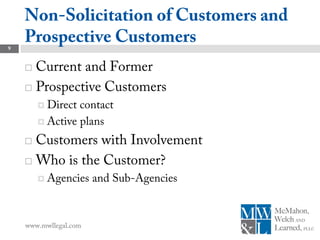
Non-Solicitation of Customers and
9
    Prospective Customers
     Current and Former
     Prospective Customers

         Direct contact
         Active plans

     Customers with Involvement
     Who is the Customer?

         Agencies     and Sub-Agencies


    www.mwllegal.com
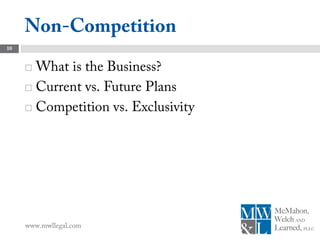
Non-Competition
10


      What is the Business?
      Current vs. Future Plans

      Competition vs. Exclusivity


     www.mwllegal.com
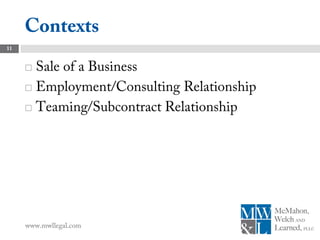
Contexts
11


      Sale of a Business
      Employment/Consulting Relationship

      Teaming/Subcontract Relationship


     www.mwllegal.com
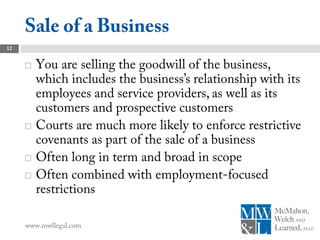
Sale of a Business
12


        You are selling the goodwill of the business,
         which includes the business’s relationship with its
         employees and service providers, as well as its
         customers and prospective customers
        Courts are much more likely to enforce restrictive
         covenants as part of the sale of a business
        Often long in term and broad in scope
        Often combined with employment-focused
         restrictions

     www.mwllegal.com
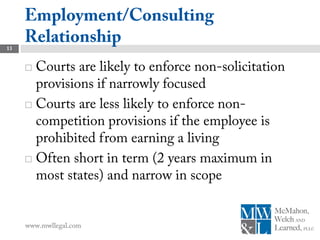
Employment/Consulting
13
     Relationship
      Courts are likely to enforce non-solicitation
       provisions if narrowly focused
      Courts are less likely to enforce non-
       competition provisions if the employee is
       prohibited from earning a living
      Often short in term (2 years maximum in
       most states) and narrow in scope


     www.mwllegal.com
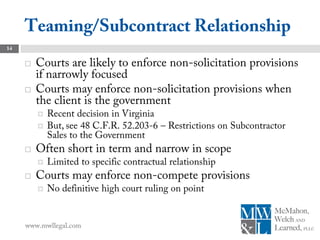
Teaming/Subcontract Relationship
14


        Courts are likely to enforce non-solicitation provisions
         if narrowly focused
        Courts may enforce non-solicitation provisions when
         the client is the government
            Recent decision in Virginia
            But, see 48 C.F.R. 52.203-6 – Restrictions on Subcontractor
             Sales to the Government
        Often short in term and narrow in scope
            Limited to specific contractual relationship
        Courts may enforce non-compete provisions
            No definitive high court ruling on point


     www.mwllegal.com
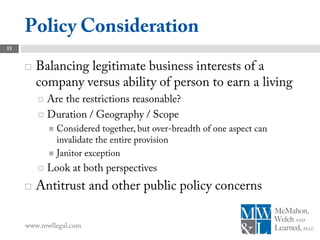
Policy Consideration
15


        Balancing legitimate business interests of a
         company versus ability of person to earn a living
          Are the restrictions reasonable?
          Duration / Geography / Scope
              Considered together, but over-breadth of one aspect can
               invalidate the entire provision
              Janitor exception

            Look at both perspectives
        Antitrust and other public policy concerns

     www.mwllegal.com
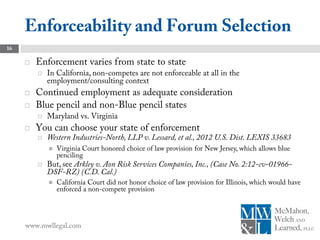
Enforceability and Forum Selection
16

        Enforcement varies from state to state
            In California, non-competes are not enforceable at all in the
             employment/consulting context
        Continued employment as adequate consideration
        Blue pencil and non-Blue pencil states
            Maryland vs. Virginia
        You can choose your state of enforcement
            Western Industries-North, LLP v. Lessard, et al., 2012 U.S. Dist. LEXIS 33683
                Virginia Court honored choice of law provision for New Jersey, which allows blue
                 penciling
            But, see Arkley v. Aon Risk Services Companies, Inc., (Case No. 2:12-cv-01966-
             DSF-RZ) (C.D. Cal.)
                California Court did not honor choice of law provision for Illinois, which would have
                 enforced a non-compete provision


     www.mwllegal.com
Drafting Notes
17


        Less is more – make provisions as narrow as possible
          Increase chance of enforceability
          Limit confusion as to scope

        Tailor provisions to specific context
          Negotiated provisions more likely to be enforced
          Ensure provisions are not punitive

          But don’t tailor too much
              Should not vary based on reason for termination
              Avoid liquidated damages


     www.mwllegal.com
Drafting Notes
18


        Severability
          Make    sure each provision is its own separate paragraph
        Extend duration during breach
        Provide for specific performance and injunctive
         relief
        Require individual to inform potential employers of
         the restrictive covenants
        Include confidentiality provisions

     www.mwllegal.com
Strategies in Enforcement
19


        Act quickly if violations suspected
          Consider     seeking a court order
      Identify and protect computers or other
       memory devices
      Review and protect all email or other means of
       stored communications


     www.mwllegal.com
Strategies in Enforcement
20
     (Go After the Third Party)
      Present evidence of the agreement to third
       party and intent to seek a court order
      Consider claim for tortious interference
       against third party and/or business conspiracy
          Could        carry punitive damages
      Consider action under the State or Federal
       Trade Secrets Act
      Consider relying on confidentiality provisions


     www.mwllegal.com
Strategies in Defense
21


        Consider not hiring the individual
          Place   the individual in a non-offensive position
        Make a business decision whether to challenge
         enforceability
        Consider filing a declaratory action to challenge
         enforceability
        Consider providing individual with separate
         counsel


     www.mwllegal.com
Strategies in Defense
22


        Negotiate a resolution
          Restrict individual’s duties
          Pay a settlement amount to the company

        Ensure individual is not holding proprietary
         information
          Make    arrangements to return immediately
        Consider dragging out the matter
          Allow    cooler heads to prevail


     www.mwllegal.com
Recent Case Studies
23


        Preferred Sys. Solutions, Inc. v. GP Consulting,
         LLC, 284 Va. 382, 2012 Va. LEXIS 160 (Sept
         14, 2012)

        Home Paramount Pest Control Cos. v. Shaffer,
         282 Va. 412, 718 S.E.2d 762 (2011)


     www.mwllegal.com
Questions?
24


       MCMAHON, WELCH AND LEARNED, PLLC
               2100 Reston Parkway
                     Suite 325
                 Reston, VA 20191
               Main: 703-483-2810
             pmcmahon@mwllegal.com
              wwelch@mwllegal.com
              klearned@mwllegal.com


     www.mwllegal.com

Non-competition and Non-solicitation Provisions

  • 1.
    www.mwllegal.com NON-COMPETITION AND NON-SOLICITATION PROVISIONS Issues in Drafting/Negotiation and Enforcement
  • 2.
    About the Firm 2 McMahon, Welch and Learned, PLLC represents many small and mid-sized federal services contractors in Northern Virginia, DC and Maryland, including small- disadvantaged firms, veteran-owned firms, women- owned firms and Hub Zone qualified firms. We also have a strong corporate and acquisitions-support practice which focuses on general business legal matters of significant interest to the broader business community. www.mwllegal.com
  • 3.
    Presenters 3 W illiam T. W elc h, Partner Mr. Welch has twenty years of experience providing legal counsel for the entire lifecycle of a government contractor from contract negotiation, award, and protests to contract administration and contract claims. Mr. Welch also has experience in teaming agreements, subcontractor agreements, and related issues. In addition, Mr. Welch advises contractors who qualify for small business set-aside awards, 8(a) competitive and non-competitive contracts, and HUBZone and Service-Disabled, Veteran Owned contracts. www.mwllegal.com
  • 4.
    Presenters 4 Kevin R. Learned, Partner Mr. Learned’s practice focuses on advising clients on general corporate and securities matters, including company formation and governance, buy-sell agreements, operating and stockholder agreements, mergers and acquisitions, private offerings of debt and equity securities (including friends and family, angel, venture capital and private equity investments), corporate divorces and other reorganizations, joint ventures, small business certifications (including 8(a), SDVO, WOSB, HUB Zone and MBE/DBE certifications), executive employment and equity matters, deferred compensation plans, franchise agreements, trademarks, and other commercial contracts and agreements. www.mwllegal.com
  • 5.
    Moderator 5 J. Patric k Mc Maho n, Partner Mr. McMahon has nearly thirty years of experience with a primary focus on representation of companies that offer information technology products and services to the federal government. Mr. McMahon advises corporations and other business entities in connection with all aspects of their federal procurement business including contract award and terminations, claims, contract disputes, bid protests, and prime contractor/subcontractor relationships. www.mwllegal.com
  • 6.
    Non-Competition and 6 Non-Solicitation Provisions www.mwllegal.com
  • 7.
    Standard Restrictive Covenants 7  Non-solicitation of a company’s employees and other service providers  Non-solicitation of a company’s customers and prospective customers  Non-competition with a company’s business www.mwllegal.com
  • 8.
    Non-Solicitation of Employeesand 8 Other Service Providers  Employees vs. Consultants vs. Vendors  Current and Former  Non-solicitation vs. Non-hire  General Advertising Exception www.mwllegal.com
  • 9.
    Non-Solicitation of Customersand 9 Prospective Customers  Current and Former  Prospective Customers  Direct contact  Active plans  Customers with Involvement  Who is the Customer?  Agencies and Sub-Agencies www.mwllegal.com
  • 10.
    Non-Competition 10  What is the Business?  Current vs. Future Plans  Competition vs. Exclusivity www.mwllegal.com
  • 11.
    Contexts 11  Sale of a Business  Employment/Consulting Relationship  Teaming/Subcontract Relationship www.mwllegal.com
  • 12.
    Sale of aBusiness 12  You are selling the goodwill of the business, which includes the business’s relationship with its employees and service providers, as well as its customers and prospective customers  Courts are much more likely to enforce restrictive covenants as part of the sale of a business  Often long in term and broad in scope  Often combined with employment-focused restrictions www.mwllegal.com
  • 13.
    Employment/Consulting 13 Relationship  Courts are likely to enforce non-solicitation provisions if narrowly focused  Courts are less likely to enforce non- competition provisions if the employee is prohibited from earning a living  Often short in term (2 years maximum in most states) and narrow in scope www.mwllegal.com
  • 14.
    Teaming/Subcontract Relationship 14  Courts are likely to enforce non-solicitation provisions if narrowly focused  Courts may enforce non-solicitation provisions when the client is the government  Recent decision in Virginia  But, see 48 C.F.R. 52.203-6 – Restrictions on Subcontractor Sales to the Government  Often short in term and narrow in scope  Limited to specific contractual relationship  Courts may enforce non-compete provisions  No definitive high court ruling on point www.mwllegal.com
  • 15.
    Policy Consideration 15  Balancing legitimate business interests of a company versus ability of person to earn a living  Are the restrictions reasonable?  Duration / Geography / Scope  Considered together, but over-breadth of one aspect can invalidate the entire provision  Janitor exception  Look at both perspectives  Antitrust and other public policy concerns www.mwllegal.com
  • 16.
    Enforceability and ForumSelection 16  Enforcement varies from state to state  In California, non-competes are not enforceable at all in the employment/consulting context  Continued employment as adequate consideration  Blue pencil and non-Blue pencil states  Maryland vs. Virginia  You can choose your state of enforcement  Western Industries-North, LLP v. Lessard, et al., 2012 U.S. Dist. LEXIS 33683  Virginia Court honored choice of law provision for New Jersey, which allows blue penciling  But, see Arkley v. Aon Risk Services Companies, Inc., (Case No. 2:12-cv-01966- DSF-RZ) (C.D. Cal.)  California Court did not honor choice of law provision for Illinois, which would have enforced a non-compete provision www.mwllegal.com
  • 17.
    Drafting Notes 17  Less is more – make provisions as narrow as possible  Increase chance of enforceability  Limit confusion as to scope  Tailor provisions to specific context  Negotiated provisions more likely to be enforced  Ensure provisions are not punitive  But don’t tailor too much  Should not vary based on reason for termination  Avoid liquidated damages www.mwllegal.com
  • 18.
    Drafting Notes 18  Severability  Make sure each provision is its own separate paragraph  Extend duration during breach  Provide for specific performance and injunctive relief  Require individual to inform potential employers of the restrictive covenants  Include confidentiality provisions www.mwllegal.com
  • 19.
    Strategies in Enforcement 19  Act quickly if violations suspected  Consider seeking a court order  Identify and protect computers or other memory devices  Review and protect all email or other means of stored communications www.mwllegal.com
  • 20.
    Strategies in Enforcement 20 (Go After the Third Party)  Present evidence of the agreement to third party and intent to seek a court order  Consider claim for tortious interference against third party and/or business conspiracy  Could carry punitive damages  Consider action under the State or Federal Trade Secrets Act  Consider relying on confidentiality provisions www.mwllegal.com
  • 21.
    Strategies in Defense 21  Consider not hiring the individual  Place the individual in a non-offensive position  Make a business decision whether to challenge enforceability  Consider filing a declaratory action to challenge enforceability  Consider providing individual with separate counsel www.mwllegal.com
  • 22.
    Strategies in Defense 22  Negotiate a resolution  Restrict individual’s duties  Pay a settlement amount to the company  Ensure individual is not holding proprietary information  Make arrangements to return immediately  Consider dragging out the matter  Allow cooler heads to prevail www.mwllegal.com
  • 23.
    Recent Case Studies 23  Preferred Sys. Solutions, Inc. v. GP Consulting, LLC, 284 Va. 382, 2012 Va. LEXIS 160 (Sept 14, 2012)  Home Paramount Pest Control Cos. v. Shaffer, 282 Va. 412, 718 S.E.2d 762 (2011) www.mwllegal.com
  • 24.
    Questions? 24 MCMAHON, WELCH AND LEARNED, PLLC 2100 Reston Parkway Suite 325 Reston, VA 20191 Main: 703-483-2810 pmcmahon@mwllegal.com wwelch@mwllegal.com klearned@mwllegal.com www.mwllegal.com