Ensuring Business Continuity with
Last-Mile Diversity and Redundancy
Michael Harris
Kinetic Strategies
INTERNET | VOICE | TELEVISION | NETWORK SERVICES | CLOUD SERVICES
Ensuring Business Continuity
with Last-Mile Diversity
and Redundancy
Michael Harris,
Principal Consultant, Kinetic Strategies
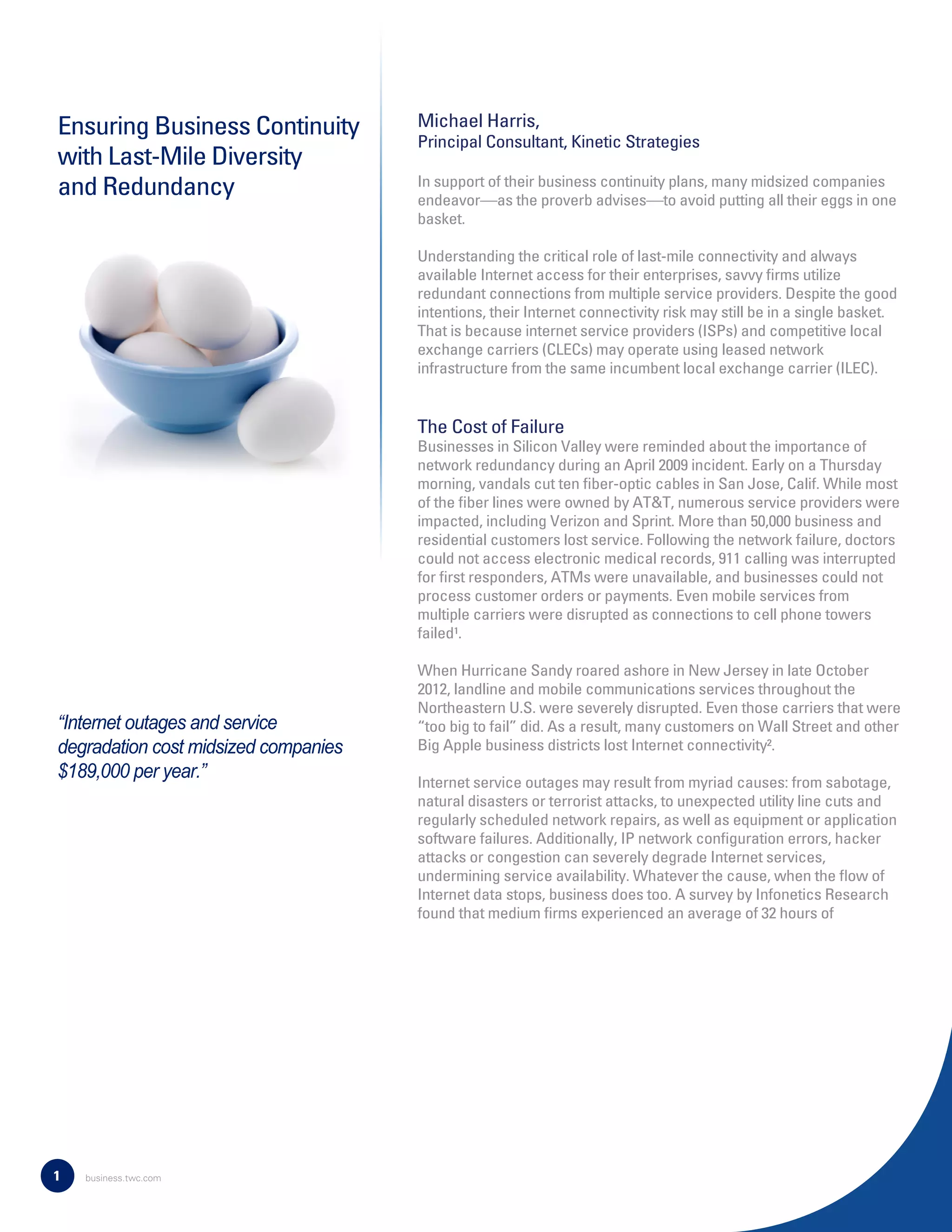
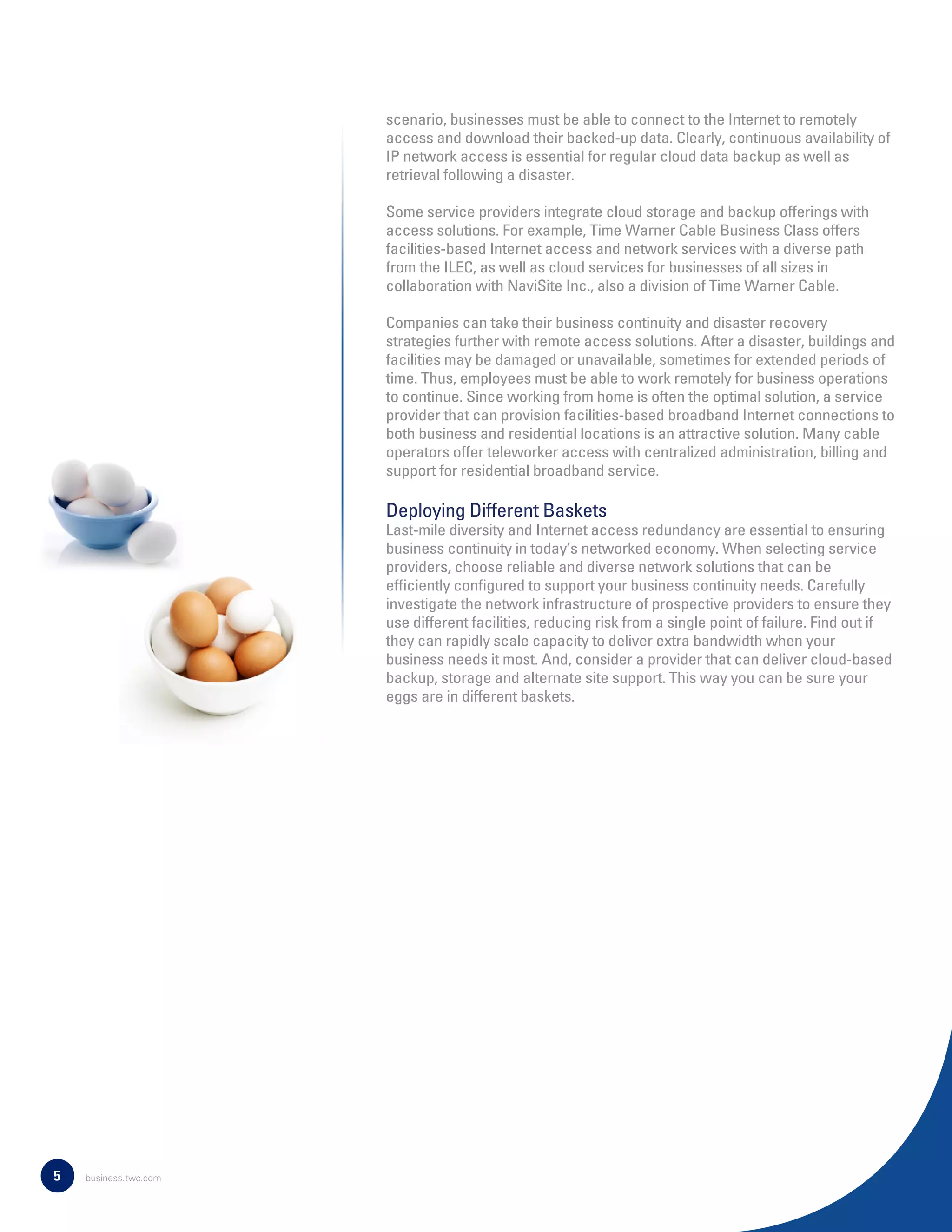
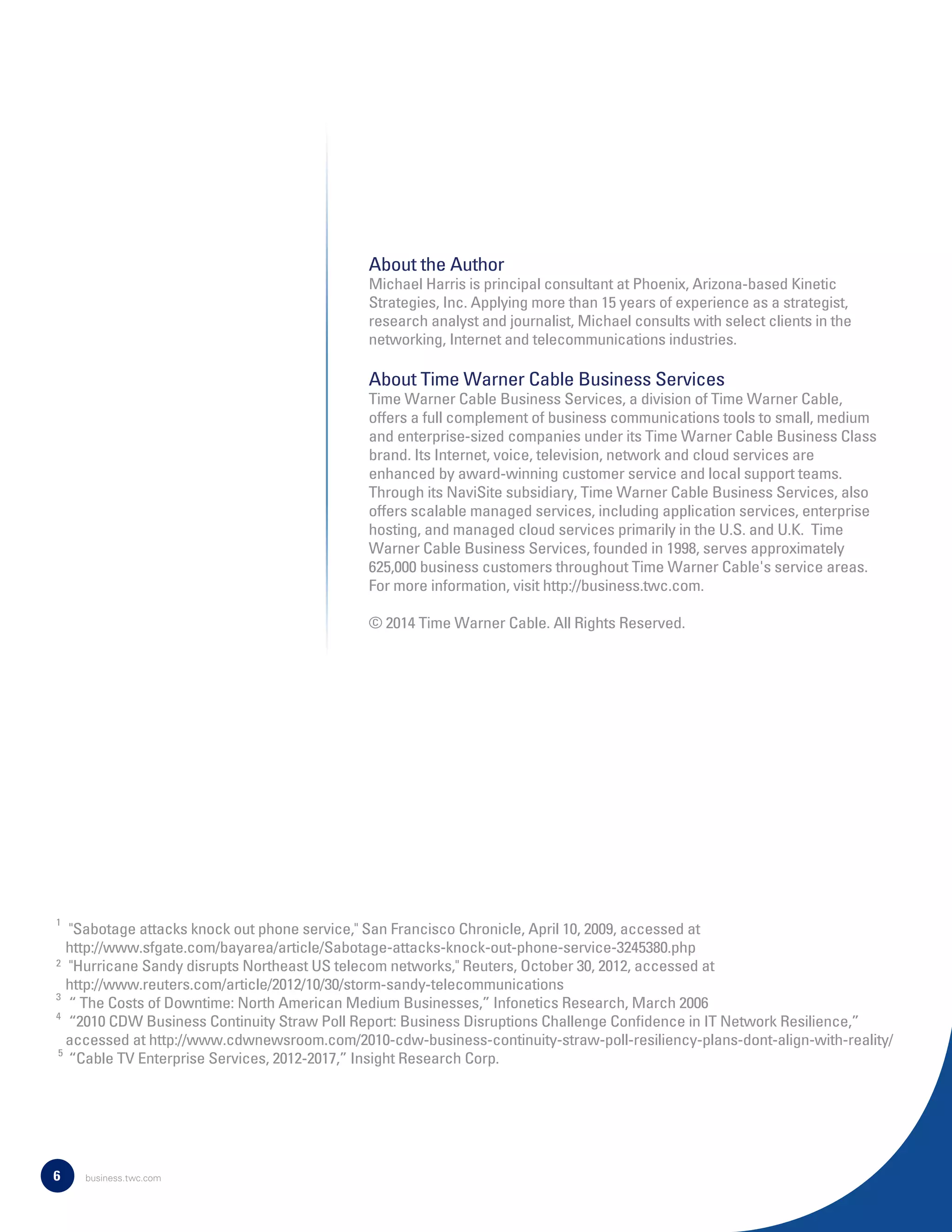
In support of their business continuity plans, many midsized companies
endeavor—as the proverb advises—to avoid putting all their eggs in one
basket.
Understanding the critical role of last-mile connectivity and always
available Internet access for their enterprises, savvy firms utilize
redundant connections from multiple service providers. Despite the good
intentions, their Internet connectivity risk may still be in a single basket.
That is because internet service providers (ISPs) and competitive local
exchange carriers (CLECs) may operate using leased network
infrastructure from the same incumbent local exchange carrier (ILEC).
The Cost of Failure
Businesses in Silicon Valley were reminded about the importance of
network redundancy during an April 2009 incident. Early on a Thursday
morning, vandals cut ten fiber-optic cables in San Jose, Calif. While most
of the fiber lines were owned by AT&T, numerous service providers were
impacted, including Verizon and Sprint. More than 50,000 business and
residential customers lost service. Following the network failure, doctors
could not access electronic medical records, 911 calling was interrupted
for first responders, ATMs were unavailable, and businesses could not
process customer orders or payments. Even mobile services from
multiple carriers were disrupted as connections to cell phone towers
failed¹.
When Hurricane Sandy roared ashore in New Jersey in late October
2012, landline and mobile communications services throughout the
Northeastern U.S. were severely disrupted. Even those carriers that were
“too big to fail” did. As a result, many customers on Wall Street and other
Big Apple business districts lost Internet connectivity².
Internet service outages may result from myriad causes: from sabotage,
natural disasters or terrorist attacks, to unexpected utility line cuts and
regularly scheduled network repairs, as well as equipment or application
software failures. Additionally, IP network configuration errors, hacker
attacks or congestion can severely degrade Internet services,
undermining service availability. Whatever the cause, when the flow of
Internet data stops, business does too. A survey by Infonetics Research
found that medium firms experienced an average of 32 hours of
1
“Internet outages and service
degradation cost midsized companies
$189,000 per year.”
business.twc.com
network downtime each year due to service provider failures. The cost to
each midsized company of lost revenue and productivity caused by outages
and service degradation averaged $189,000 per year³.
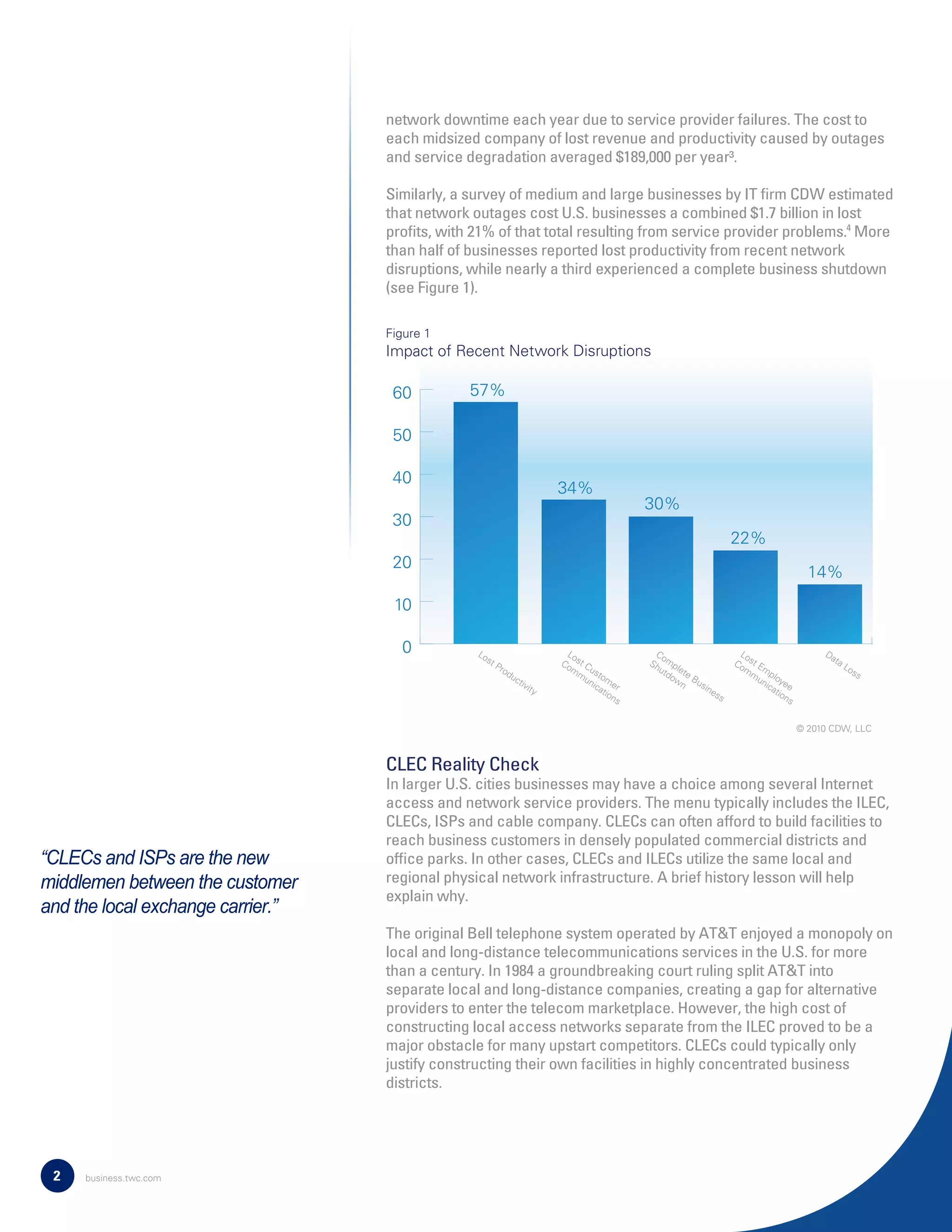
Similarly, a survey of medium and large businesses by IT firm CDW estimated
that network outages cost U.S. businesses a combined $1.7 billion in lost
profits, with 21% of that total resulting from service provider problems. More
than half of businesses reported lost productivity from recent network
disruptions, while nearly a third experienced a complete business shutdown
(see Figure 1).
CLEC Reality Check
In larger U.S. cities businesses may have a choice among several Internet
access and network service providers. The menu typically includes the ILEC,
CLECs, ISPs and cable company. CLECs can often afford to build facilities to
reach business customers in densely populated commercial districts and
office parks. In other cases, CLECs and ILECs utilize the same local and
regional physical network infrastructure. A brief history lesson will help
explain why.
The original Bell telephone system operated by AT&T enjoyed a monopoly on
local and long-distance telecommunications services in the U.S. for more
than a century. In 1984 a groundbreaking court ruling split AT&T into
separate local and long-distance companies, creating a gap for alternative
providers to enter the telecom marketplace. However, the high cost of
constructing local access networks separate from the ILEC proved to be a
major obstacle for many upstart competitors. CLECs could typically only
justify constructing their own facilities in highly concentrated business
districts.
2
“CLECs and ISPs are the new
middlemen between the customer
and the local exchange carrier.”
0
10
20
30
40
50
60
Lost Productivity
Lost Custom
er
Com
m
unications
Com
plete Business
Shutdown
Lost Em
ployee
Com
m
unications
Data Loss
Figure 1
Impact of Recent Network Disruptions
Region Average
Upload
Speeds
57%
34%
30%
22%
14%
4
© 2010 CDW, LLC
business.twc.com
Congress and the FCC worked to address the problem through the
Telecommunications Act of 1996, which required ILECs to sell unbundled
network elements (UNEs) to competitors on a wholesale basis. Competitors
could enter the market without having to construct their own facilities. The
breakthrough offered more businesses a choice for their communications
needs, applying pressure on the ILECs for better pricing and service.
The downside is that, when it comes to local network infrastructure, some
CLECs and ISPs started to serve merely as an intermediary between the
customer and the ILEC. In this situation, the competitor’s ability to innovate on
pricing is limited by the network fees charged by the ILEC. Additionally, the
ability of CLECs and ISPs to provision, monitor and repair services is dependent
on ILEC assistance. When the ILEC network fails, so do the services of
alternative providers utilizing the same physical infrastructure. Through network
unbundling and resale arrangements, not only do these CLECs and ISPs use
ILEC lines to offer service, they may also use ILEC central-office equipment to
deliver broadband Internet access over local copper loops. Where else can
businesses look for facilities-based redundancy?
Calling on Cable
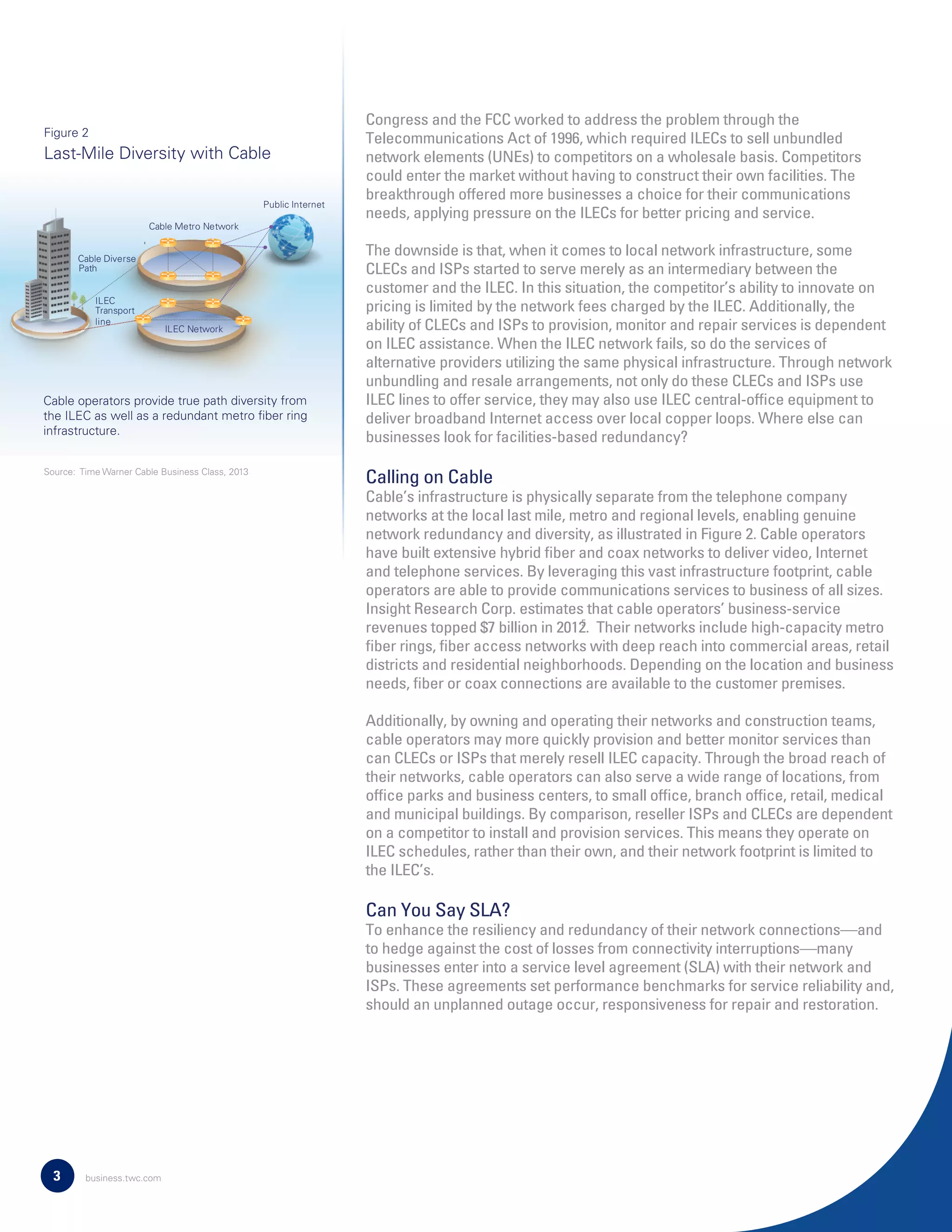
Cable’s infrastructure is physically separate from the telephone company
networks at the local last mile, metro and regional levels, enabling genuine
network redundancy and diversity, as illustrated in Figure 2. Cable operators
have built extensive hybrid fiber and coax networks to deliver video, Internet
and telephone services. By leveraging this vast infrastructure footprint, cable
operators are able to provide communications services to business of all sizes.
Insight Research Corp. estimates that cable operators’ business-service
revenues topped $7 billion in 2012. Their networks include high-capacity metro
fiber rings, fiber access networks with deep reach into commercial areas, retail
districts and residential neighborhoods. Depending on the location and business
needs, fiber or coax connections are available to the customer premises.
Additionally, by owning and operating their networks and construction teams,
cable operators may more quickly provision and better monitor services than
can CLECs or ISPs that merely resell ILEC capacity. Through the broad reach of
their networks, cable operators can also serve a wide range of locations, from
office parks and business centers, to small office, branch office, retail, medical
and municipal buildings. By comparison, reseller ISPs and CLECs are dependent
on a competitor to install and provision services. This means they operate on
ILEC schedules, rather than their own, and their network footprint is limited to
the ILEC’s.
Can You Say SLA?
To enhance the resiliency and redundancy of their network connections—and
to hedge against the cost of losses from connectivity interruptions—many
businesses enter into a service level agreement (SLA) with their network and
ISPs. These agreements set performance benchmarks for service reliability and,
should an unplanned outage occur, responsiveness for repair and restoration.
3
Last-Mile Diversity with Cable
Cable operators provide true path diversity from
the ILEC as well as a redundant metro fiber ring
infrastructure.
Figure 2
5
Source: Time Warner Cable Business Class, 2013
Public Internet
ILEC Network
ILEC
Transport
line
Cable Metro Network
Cable Diverse
Path
business.twc.com
Performance characteristics for an SLA may include total uptime for the
connection, measured bandwidth and latency between defined IP access
points. The availability of essential IP infrastructure, such as domain name
servers (DNS) and dynamic host configuration protocol (DHCP) servers may
also be specified. Should a problem arise, response and repair times are
defined in the SLA, along with penalties for noncompliance.
It is important to understand that SLAs supplement, rather than replace,
strategies for facilities-based IP access redundancy and resiliency in
business continuity plans—particularly since SLAs typically exclude
catastrophic interruptions, such as those caused by natural disasters or acts
of war.
Moving to Multihoming
After installing diverse or redundant connections for IP access, businesses
need a method to switch from one network route to the other should a
service interruption occur. Multihoming provides this automatic failover
function among Internet connections as well as other benefits.
A multihoming approach frequently employed by larger businesses is Border
Gateway Protocol (BGP). A common Internet routing protocol, BGP supports
redundant routes for traffic flows to and from a business location. The
challenge is that the effective use of BGP requires close technical
collaboration with competing ISPs, as well as internal IT staff or consultants
with the expertise to handle complex router configurations.
Fortunately, a number of vendors offer network appliances—essentially
purpose-built routers and switches—that may simplify multihoming
implementations, giving small and midsize businesses Internet access
redundancy through virtually any type of connection or service provider.
Additionally, many of these solutions offer load-balancing capabilities,
allowing traffic to be directed across multiple connections to ensure
adequate bandwidth is available for everyday operations.
Ready for Disaster
Enterprise planning for business continuity and disaster recovery are closely
linked. As the names imply, the goal of a business continuity plan is to
prevent interruptions to operations, while a disaster recovery plan is aimed at
restoring operations following an ordinary or catastrophic disruption.
Redundant facilities-based Internet connections are an essential support for
both.
Offsite data storage and backup are at the heart of most disaster recovery
plans. Historically, critical enterprise data has been backed up on drives and
discs and physically transported to alternate locations for safe storage.
Increasingly, however, businesses of all sizes are storing and backing up
data through the cloud. This way, regularly scheduled backups are
performed automatically to remote servers through a company’s secure
Internet connection. However, should a data loss occur in a disaster
4
4
“Multihoming provides automatic
failover among Internet connections
during service interruptions.”
business.twc.com
scenario, businesses must be able to connect to the Internet to remotely
access and download their backed-up data. Clearly, continuous availability of
IP network access is essential for regular cloud data backup as well as
retrieval following a disaster.
Some service providers integrate cloud storage and backup offerings with
access solutions. For example, Time Warner Cable Business Class offers
facilities-based Internet access and network services with a diverse path
from the ILEC, as well as cloud services for businesses of all sizes in
collaboration with NaviSite Inc., also a division of Time Warner Cable.
Companies can take their business continuity and disaster recovery
strategies further with remote access solutions. After a disaster, buildings and
facilities may be damaged or unavailable, sometimes for extended periods of
time. Thus, employees must be able to work remotely for business operations
to continue. Since working from home is often the optimal solution, a service
provider that can provision facilities-based broadband Internet connections to
both business and residential locations is an attractive solution. Many cable
operators offer teleworker access with centralized administration, billing and
support for residential broadband service.
Deploying Different Baskets
Last-mile diversity and Internet access redundancy are essential to ensuring
business continuity in today’s networked economy. When selecting service
providers, choose reliable and diverse network solutions that can be
efficiently configured to support your business continuity needs. Carefully
investigate the network infrastructure of prospective providers to ensure they
use different facilities, reducing risk from a single point of failure. Find out if
they can rapidly scale capacity to deliver extra bandwidth when your
business needs it most. And, consider a provider that can deliver cloud-based
backup, storage and alternate site support. This way you can be sure your
eggs are in different baskets.
5 business.twc.com
About the Author
Michael Harris is principal consultant at Phoenix, Arizona-based Kinetic
Strategies, Inc. Applying more than 15 years of experience as a strategist,
research analyst and journalist, Michael consults with select clients in the
networking, Internet and telecommunications industries.
About Time Warner Cable Business Services
Time Warner Cable Business Services, a division of Time Warner Cable,
offers a full complement of business communications tools to small, medium
and enterprise-sized companies under its Time Warner Cable Business Class
brand. Its Internet, voice, television, network and cloud services are
enhanced by award-winning customer service and local support teams.
Through its NaviSite subsidiary, Time Warner Cable Business Services, also
offers scalable managed services, including application services, enterprise
hosting, and managed cloud services primarily in the U.S. and U.K. Time
Warner Cable Business Services, founded in 1998, serves approximately
625,000 business customers throughout Time Warner Cable's service areas.
For more information, visit http://business.twc.com.
© 2014 Time Warner Cable. All Rights Reserved.
6
4
3
2
1
5
"Sabotage attacks knock out phone service," San Francisco Chronicle, April 10, 2009, accessed at
http://www.sfgate.com/bayarea/article/Sabotage-attacks-knock-out-phone-service-3245380.php
"Hurricane Sandy disrupts Northeast US telecom networks," Reuters, October 30, 2012, accessed at
http://www.reuters.com/article/2012/10/30/storm-sandy-telecommunications
“ The Costs of Downtime: North American Medium Businesses,” Infonetics Research, March 2006
“2010 CDW Business Continuity Straw Poll Report: Business Disruptions Challenge Confidence in IT Network Resilience,”
accessed at http://www.cdwnewsroom.com/2010-cdw-business-continuity-straw-poll-resiliency-plans-dont-align-with-reality/
“Cable TV Enterprise Services, 2012-2017,” Insight Research Corp.
business.twc.com

Ensuring Business Continuity with Last-Mile Diversity and Redundancy

  • 1.
    Ensuring Business Continuitywith Last-Mile Diversity and Redundancy Michael Harris Kinetic Strategies INTERNET | VOICE | TELEVISION | NETWORK SERVICES | CLOUD SERVICES
  • 2.
    Ensuring Business Continuity withLast-Mile Diversity and Redundancy Michael Harris, Principal Consultant, Kinetic Strategies In support of their business continuity plans, many midsized companies endeavor—as the proverb advises—to avoid putting all their eggs in one basket. Understanding the critical role of last-mile connectivity and always available Internet access for their enterprises, savvy firms utilize redundant connections from multiple service providers. Despite the good intentions, their Internet connectivity risk may still be in a single basket. That is because internet service providers (ISPs) and competitive local exchange carriers (CLECs) may operate using leased network infrastructure from the same incumbent local exchange carrier (ILEC). The Cost of Failure Businesses in Silicon Valley were reminded about the importance of network redundancy during an April 2009 incident. Early on a Thursday morning, vandals cut ten fiber-optic cables in San Jose, Calif. While most of the fiber lines were owned by AT&T, numerous service providers were impacted, including Verizon and Sprint. More than 50,000 business and residential customers lost service. Following the network failure, doctors could not access electronic medical records, 911 calling was interrupted for first responders, ATMs were unavailable, and businesses could not process customer orders or payments. Even mobile services from multiple carriers were disrupted as connections to cell phone towers failed¹. When Hurricane Sandy roared ashore in New Jersey in late October 2012, landline and mobile communications services throughout the Northeastern U.S. were severely disrupted. Even those carriers that were “too big to fail” did. As a result, many customers on Wall Street and other Big Apple business districts lost Internet connectivity². Internet service outages may result from myriad causes: from sabotage, natural disasters or terrorist attacks, to unexpected utility line cuts and regularly scheduled network repairs, as well as equipment or application software failures. Additionally, IP network configuration errors, hacker attacks or congestion can severely degrade Internet services, undermining service availability. Whatever the cause, when the flow of Internet data stops, business does too. A survey by Infonetics Research found that medium firms experienced an average of 32 hours of 1 “Internet outages and service degradation cost midsized companies $189,000 per year.” business.twc.com
  • 3.
    network downtime eachyear due to service provider failures. The cost to each midsized company of lost revenue and productivity caused by outages and service degradation averaged $189,000 per year³. Similarly, a survey of medium and large businesses by IT firm CDW estimated that network outages cost U.S. businesses a combined $1.7 billion in lost profits, with 21% of that total resulting from service provider problems. More than half of businesses reported lost productivity from recent network disruptions, while nearly a third experienced a complete business shutdown (see Figure 1). CLEC Reality Check In larger U.S. cities businesses may have a choice among several Internet access and network service providers. The menu typically includes the ILEC, CLECs, ISPs and cable company. CLECs can often afford to build facilities to reach business customers in densely populated commercial districts and office parks. In other cases, CLECs and ILECs utilize the same local and regional physical network infrastructure. A brief history lesson will help explain why. The original Bell telephone system operated by AT&T enjoyed a monopoly on local and long-distance telecommunications services in the U.S. for more than a century. In 1984 a groundbreaking court ruling split AT&T into separate local and long-distance companies, creating a gap for alternative providers to enter the telecom marketplace. However, the high cost of constructing local access networks separate from the ILEC proved to be a major obstacle for many upstart competitors. CLECs could typically only justify constructing their own facilities in highly concentrated business districts. 2 “CLECs and ISPs are the new middlemen between the customer and the local exchange carrier.” 0 10 20 30 40 50 60 Lost Productivity Lost Custom er Com m unications Com plete Business Shutdown Lost Em ployee Com m unications Data Loss Figure 1 Impact of Recent Network Disruptions Region Average Upload Speeds 57% 34% 30% 22% 14% 4 © 2010 CDW, LLC business.twc.com
  • 4.
    Congress and theFCC worked to address the problem through the Telecommunications Act of 1996, which required ILECs to sell unbundled network elements (UNEs) to competitors on a wholesale basis. Competitors could enter the market without having to construct their own facilities. The breakthrough offered more businesses a choice for their communications needs, applying pressure on the ILECs for better pricing and service. The downside is that, when it comes to local network infrastructure, some CLECs and ISPs started to serve merely as an intermediary between the customer and the ILEC. In this situation, the competitor’s ability to innovate on pricing is limited by the network fees charged by the ILEC. Additionally, the ability of CLECs and ISPs to provision, monitor and repair services is dependent on ILEC assistance. When the ILEC network fails, so do the services of alternative providers utilizing the same physical infrastructure. Through network unbundling and resale arrangements, not only do these CLECs and ISPs use ILEC lines to offer service, they may also use ILEC central-office equipment to deliver broadband Internet access over local copper loops. Where else can businesses look for facilities-based redundancy? Calling on Cable Cable’s infrastructure is physically separate from the telephone company networks at the local last mile, metro and regional levels, enabling genuine network redundancy and diversity, as illustrated in Figure 2. Cable operators have built extensive hybrid fiber and coax networks to deliver video, Internet and telephone services. By leveraging this vast infrastructure footprint, cable operators are able to provide communications services to business of all sizes. Insight Research Corp. estimates that cable operators’ business-service revenues topped $7 billion in 2012. Their networks include high-capacity metro fiber rings, fiber access networks with deep reach into commercial areas, retail districts and residential neighborhoods. Depending on the location and business needs, fiber or coax connections are available to the customer premises. Additionally, by owning and operating their networks and construction teams, cable operators may more quickly provision and better monitor services than can CLECs or ISPs that merely resell ILEC capacity. Through the broad reach of their networks, cable operators can also serve a wide range of locations, from office parks and business centers, to small office, branch office, retail, medical and municipal buildings. By comparison, reseller ISPs and CLECs are dependent on a competitor to install and provision services. This means they operate on ILEC schedules, rather than their own, and their network footprint is limited to the ILEC’s. Can You Say SLA? To enhance the resiliency and redundancy of their network connections—and to hedge against the cost of losses from connectivity interruptions—many businesses enter into a service level agreement (SLA) with their network and ISPs. These agreements set performance benchmarks for service reliability and, should an unplanned outage occur, responsiveness for repair and restoration. 3 Last-Mile Diversity with Cable Cable operators provide true path diversity from the ILEC as well as a redundant metro fiber ring infrastructure. Figure 2 5 Source: Time Warner Cable Business Class, 2013 Public Internet ILEC Network ILEC Transport line Cable Metro Network Cable Diverse Path business.twc.com
  • 5.
    Performance characteristics foran SLA may include total uptime for the connection, measured bandwidth and latency between defined IP access points. The availability of essential IP infrastructure, such as domain name servers (DNS) and dynamic host configuration protocol (DHCP) servers may also be specified. Should a problem arise, response and repair times are defined in the SLA, along with penalties for noncompliance. It is important to understand that SLAs supplement, rather than replace, strategies for facilities-based IP access redundancy and resiliency in business continuity plans—particularly since SLAs typically exclude catastrophic interruptions, such as those caused by natural disasters or acts of war. Moving to Multihoming After installing diverse or redundant connections for IP access, businesses need a method to switch from one network route to the other should a service interruption occur. Multihoming provides this automatic failover function among Internet connections as well as other benefits. A multihoming approach frequently employed by larger businesses is Border Gateway Protocol (BGP). A common Internet routing protocol, BGP supports redundant routes for traffic flows to and from a business location. The challenge is that the effective use of BGP requires close technical collaboration with competing ISPs, as well as internal IT staff or consultants with the expertise to handle complex router configurations. Fortunately, a number of vendors offer network appliances—essentially purpose-built routers and switches—that may simplify multihoming implementations, giving small and midsize businesses Internet access redundancy through virtually any type of connection or service provider. Additionally, many of these solutions offer load-balancing capabilities, allowing traffic to be directed across multiple connections to ensure adequate bandwidth is available for everyday operations. Ready for Disaster Enterprise planning for business continuity and disaster recovery are closely linked. As the names imply, the goal of a business continuity plan is to prevent interruptions to operations, while a disaster recovery plan is aimed at restoring operations following an ordinary or catastrophic disruption. Redundant facilities-based Internet connections are an essential support for both. Offsite data storage and backup are at the heart of most disaster recovery plans. Historically, critical enterprise data has been backed up on drives and discs and physically transported to alternate locations for safe storage. Increasingly, however, businesses of all sizes are storing and backing up data through the cloud. This way, regularly scheduled backups are performed automatically to remote servers through a company’s secure Internet connection. However, should a data loss occur in a disaster 4 4 “Multihoming provides automatic failover among Internet connections during service interruptions.” business.twc.com
  • 6.
    scenario, businesses mustbe able to connect to the Internet to remotely access and download their backed-up data. Clearly, continuous availability of IP network access is essential for regular cloud data backup as well as retrieval following a disaster. Some service providers integrate cloud storage and backup offerings with access solutions. For example, Time Warner Cable Business Class offers facilities-based Internet access and network services with a diverse path from the ILEC, as well as cloud services for businesses of all sizes in collaboration with NaviSite Inc., also a division of Time Warner Cable. Companies can take their business continuity and disaster recovery strategies further with remote access solutions. After a disaster, buildings and facilities may be damaged or unavailable, sometimes for extended periods of time. Thus, employees must be able to work remotely for business operations to continue. Since working from home is often the optimal solution, a service provider that can provision facilities-based broadband Internet connections to both business and residential locations is an attractive solution. Many cable operators offer teleworker access with centralized administration, billing and support for residential broadband service. Deploying Different Baskets Last-mile diversity and Internet access redundancy are essential to ensuring business continuity in today’s networked economy. When selecting service providers, choose reliable and diverse network solutions that can be efficiently configured to support your business continuity needs. Carefully investigate the network infrastructure of prospective providers to ensure they use different facilities, reducing risk from a single point of failure. Find out if they can rapidly scale capacity to deliver extra bandwidth when your business needs it most. And, consider a provider that can deliver cloud-based backup, storage and alternate site support. This way you can be sure your eggs are in different baskets. 5 business.twc.com
  • 7.
    About the Author MichaelHarris is principal consultant at Phoenix, Arizona-based Kinetic Strategies, Inc. Applying more than 15 years of experience as a strategist, research analyst and journalist, Michael consults with select clients in the networking, Internet and telecommunications industries. About Time Warner Cable Business Services Time Warner Cable Business Services, a division of Time Warner Cable, offers a full complement of business communications tools to small, medium and enterprise-sized companies under its Time Warner Cable Business Class brand. Its Internet, voice, television, network and cloud services are enhanced by award-winning customer service and local support teams. Through its NaviSite subsidiary, Time Warner Cable Business Services, also offers scalable managed services, including application services, enterprise hosting, and managed cloud services primarily in the U.S. and U.K. Time Warner Cable Business Services, founded in 1998, serves approximately 625,000 business customers throughout Time Warner Cable's service areas. For more information, visit http://business.twc.com. © 2014 Time Warner Cable. All Rights Reserved. 6 4 3 2 1 5 "Sabotage attacks knock out phone service," San Francisco Chronicle, April 10, 2009, accessed at http://www.sfgate.com/bayarea/article/Sabotage-attacks-knock-out-phone-service-3245380.php "Hurricane Sandy disrupts Northeast US telecom networks," Reuters, October 30, 2012, accessed at http://www.reuters.com/article/2012/10/30/storm-sandy-telecommunications “ The Costs of Downtime: North American Medium Businesses,” Infonetics Research, March 2006 “2010 CDW Business Continuity Straw Poll Report: Business Disruptions Challenge Confidence in IT Network Resilience,” accessed at http://www.cdwnewsroom.com/2010-cdw-business-continuity-straw-poll-resiliency-plans-dont-align-with-reality/ “Cable TV Enterprise Services, 2012-2017,” Insight Research Corp. business.twc.com