Aim: To provide an educative insight into the history and
progress of media education.
History of Media Studies

 ‘I think there is no question that there will be Media
 Education as an established part of schooling in 20 years
 time’.

                                          Cary Bazalgette
History of Media Studies


Media Studies has been around for a number of years......
1960s
In the UK, media studies emerged from the academic
study of English and literary criticism. It started to grow
in colleges and polytechnics, rather than through
established universities, and further challenges the
distinctions between high culture and popular culture.
1970s
Developments in Media Studies continued from the 60s.

Advent of influential journals ‘Screen’ and ‘Screen
Education’.

During the 1970s, Screen was particularly influential in
the nascent field of film studies. It published many
articles that have become standards in the field. It is still
highly regarded in academic circles.
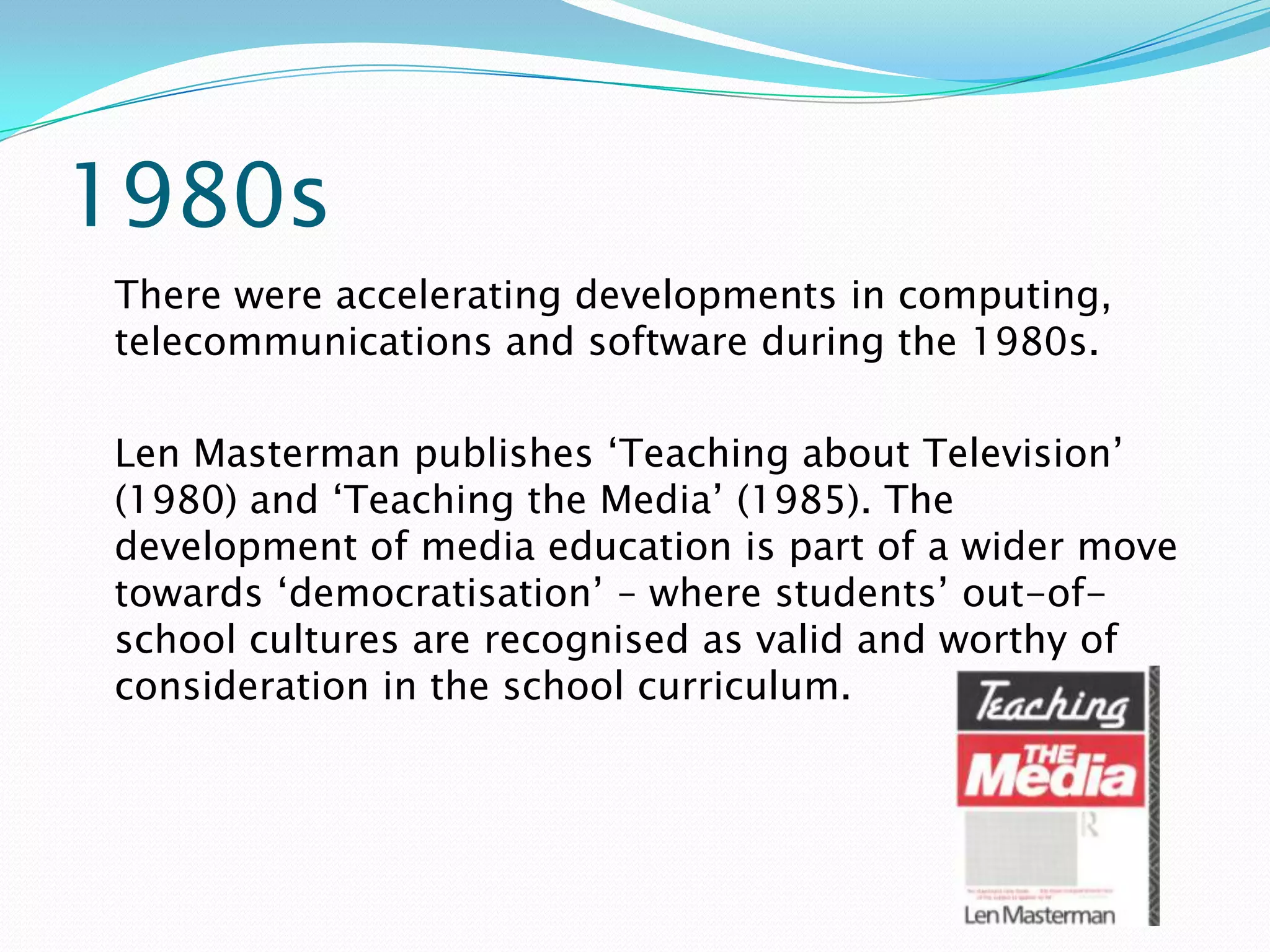
1980s
There were accelerating developments in computing,
telecommunications and software during the 1980s.

Len Masterman publishes ‘Teaching about Television’
(1980) and ‘Teaching the Media’ (1985). The
development of media education is part of a wider move
towards ‘democratisation’ – where students’ out-of-
school cultures are recognised as valid and worthy of
consideration in the school curriculum.
1980s / 90s
 ‘the big step forward over the past 3 or 4 years has been
 the development of national GCSE course in Media
 Studies now offered by five Boards and taken by
 something like 20,000 students each year’.

                                          Len Masterman
1990s
Media Studies faced a few problems.

Media Education continues to develop but much was still
required to justify it as a subject worthy of academic
study.

Most teachers of media did not have a background in the
subject; most were English or Drama.
1990s
However, the 90s could also be said to be the most
important decade in Media Studies in education.

Len Masterman played an influential part in supporting
Media Education and its teachers.
Len Masterman

 ‘Len Masterman’s work over the last decade has been
 influential... he remains the most incisive and reliable
 guide for teachers’.

                                               Andrew Hart
1990s
Media Education began to gain acknowledgement across
the world.

‘the European Minister of Education resolved that there
should be Media Education throughout compulsory
schooling in all European countries... and that the
UNESCO have taken out a five year plan to develop Media
Education throughout the world’.

                                        Cary Bazalgette
1990s
In 1998 the Film Education Working Group (FEWG) was
formed at the request of the Department of Culture,
Media and Sport to explore ways of developing a more
‘cineliterate’ audience for cinema.

It was formed of 25 members who were teachers and
lectures in Film and Media Studies and representatives
from film and television industries and institutions.
2000s
The acknowledgement and need for Media Studies grew
and the ever growing developments in technology and
children’s experience of using them, has helped to
promote this need.

Children’s existing knowledge seen as starting point for
Media Education and UK Government recognises
importance of Media Education.
2000s
‘critical understanding of film, video and television is
becoming an integral part of literacy... Children spend
more time with moving images than they do with school
work, and through this they acquire an enormous
amount of knowledge and experience which some
teachers are learning to access and develop’
                                                   BFI
2000s
There was also a range of government and commercial
initiatives offered to schools to update their equipment
and get access to training.

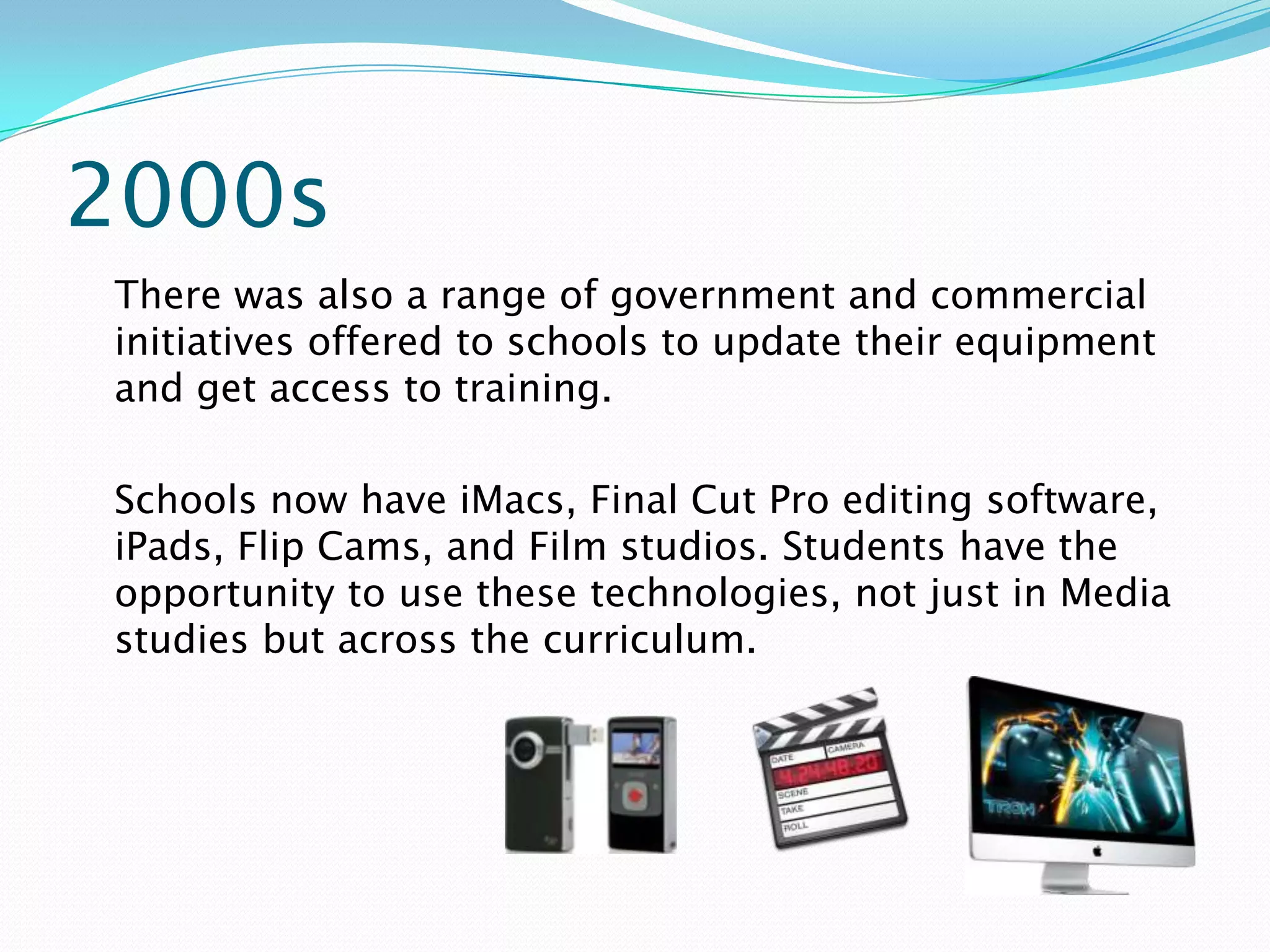
Schools now have iMacs, Final Cut Pro editing software,
iPads, Flip Cams, and Film studios. Students have the
opportunity to use these technologies, not just in Media
studies but across the curriculum.
Media Studies
 Media Studies is an important subject and needs to get
 more recognition and appreciation than it currently
 does.

 We live in a mediated world, media and technology is all
 around us and is one of the biggest industries in the
 world.

 Having Media Studies in school helps to develop young
 people’s expertise and gives them an opportunity to
 develop these skills and potentially progress into the
 film or television industry.
Bibliography:
 Marris, P and Thornham, S, Media Studies: A Reader, Second Edition,
 Edinburgh University Press, 1999

 Hart, A, Understanding the Media: A Practical Guide, Routledge, 1991

 BFI, Moving Images in the Classroom: A Secondary teachers’ guide to using
 film and television, Cromwell Press Ltd, 2000

 BFI, Making Movies Matter: Report of the Film Education Working Group,
 Norwich Colour Print Ltd, 1999

 Rayner, P, Wall, P and Kruger, S, Media Studies: The Essential Resource,
 Routledge, 2004

 Websites:
 TES – History of Media Studies
 http://www.tes.co.uk/ResourceDetail.aspx?storyCode=3003462
 (Accessed 06/09/12)

History of media studies presentation

  • 1.
    Aim: To providean educative insight into the history and progress of media education.
  • 2.
    History of MediaStudies ‘I think there is no question that there will be Media Education as an established part of schooling in 20 years time’. Cary Bazalgette
  • 3.
    History of MediaStudies Media Studies has been around for a number of years......
  • 4.
    1960s In the UK,media studies emerged from the academic study of English and literary criticism. It started to grow in colleges and polytechnics, rather than through established universities, and further challenges the distinctions between high culture and popular culture.
  • 5.
    1970s Developments in MediaStudies continued from the 60s. Advent of influential journals ‘Screen’ and ‘Screen Education’. During the 1970s, Screen was particularly influential in the nascent field of film studies. It published many articles that have become standards in the field. It is still highly regarded in academic circles.
  • 6.
    1980s There were acceleratingdevelopments in computing, telecommunications and software during the 1980s. Len Masterman publishes ‘Teaching about Television’ (1980) and ‘Teaching the Media’ (1985). The development of media education is part of a wider move towards ‘democratisation’ – where students’ out-of- school cultures are recognised as valid and worthy of consideration in the school curriculum.
  • 7.
    1980s / 90s ‘the big step forward over the past 3 or 4 years has been the development of national GCSE course in Media Studies now offered by five Boards and taken by something like 20,000 students each year’. Len Masterman
  • 8.
    1990s Media Studies faceda few problems. Media Education continues to develop but much was still required to justify it as a subject worthy of academic study. Most teachers of media did not have a background in the subject; most were English or Drama.
  • 9.
    1990s However, the 90scould also be said to be the most important decade in Media Studies in education. Len Masterman played an influential part in supporting Media Education and its teachers.
  • 10.
    Len Masterman ‘LenMasterman’s work over the last decade has been influential... he remains the most incisive and reliable guide for teachers’. Andrew Hart
  • 11.
    1990s Media Education beganto gain acknowledgement across the world. ‘the European Minister of Education resolved that there should be Media Education throughout compulsory schooling in all European countries... and that the UNESCO have taken out a five year plan to develop Media Education throughout the world’. Cary Bazalgette
  • 12.
    1990s In 1998 theFilm Education Working Group (FEWG) was formed at the request of the Department of Culture, Media and Sport to explore ways of developing a more ‘cineliterate’ audience for cinema. It was formed of 25 members who were teachers and lectures in Film and Media Studies and representatives from film and television industries and institutions.
  • 13.
    2000s The acknowledgement andneed for Media Studies grew and the ever growing developments in technology and children’s experience of using them, has helped to promote this need. Children’s existing knowledge seen as starting point for Media Education and UK Government recognises importance of Media Education.
  • 14.
    2000s ‘critical understanding offilm, video and television is becoming an integral part of literacy... Children spend more time with moving images than they do with school work, and through this they acquire an enormous amount of knowledge and experience which some teachers are learning to access and develop’ BFI
  • 15.
    2000s There was alsoa range of government and commercial initiatives offered to schools to update their equipment and get access to training. Schools now have iMacs, Final Cut Pro editing software, iPads, Flip Cams, and Film studios. Students have the opportunity to use these technologies, not just in Media studies but across the curriculum.
  • 16.
    Media Studies MediaStudies is an important subject and needs to get more recognition and appreciation than it currently does. We live in a mediated world, media and technology is all around us and is one of the biggest industries in the world. Having Media Studies in school helps to develop young people’s expertise and gives them an opportunity to develop these skills and potentially progress into the film or television industry.
  • 17.
    Bibliography: Marris, Pand Thornham, S, Media Studies: A Reader, Second Edition, Edinburgh University Press, 1999 Hart, A, Understanding the Media: A Practical Guide, Routledge, 1991 BFI, Moving Images in the Classroom: A Secondary teachers’ guide to using film and television, Cromwell Press Ltd, 2000 BFI, Making Movies Matter: Report of the Film Education Working Group, Norwich Colour Print Ltd, 1999 Rayner, P, Wall, P and Kruger, S, Media Studies: The Essential Resource, Routledge, 2004 Websites: TES – History of Media Studies http://www.tes.co.uk/ResourceDetail.aspx?storyCode=3003462 (Accessed 06/09/12)